Castlevania: Rondo of Blood aka Akumajou Dracula X: Chi no Rondo (Review)
April 17, 2025 8 Comments

Castlevania: Rondo of Blood
aka Akumajou Dracula X: Chi no Rondo
Platform: PC Engine Super CD-ROM²
Released October 29, 1993
Directed by Toru Hagihara
Developed by Konami
Included in Castlevania Requiem (PS4 Exclusive – $19.99)
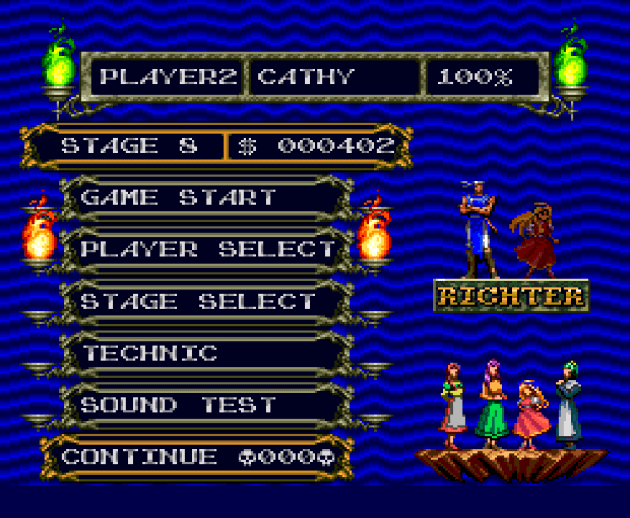
I could just skip the review and note that I spent all night getting a 100% completion. I did a complete run with both Richter and Maria, then had to go back and figure out what I was missing, which took a while, but I never got bored the entire time.
It’s been nearly six months since I reviewed Castlevania: Dracula X for the Super Nintendo, which is sometimes called the SNES remake of Rondo of Blood. Friends, I assure you that it’s just not true. In terms of level design, Dracula X is much, much closer to a remake of the original Castlevania than it is to Rondo, no matter what Wikis tell you. Hell, I’d go so far as to say Dracula X is even closer to a remake of the original game than Castlevania Chronicles, a game that’s all but advertised as a remake of Castlevania 1. The “reimagining of Rondo of Blood” is largely based on Dracula X reusing many of the same sprites from that game. Here’s a few comparison shots, and remember that Rondo is always on the left and Dracula X on the right. Here’s the giant bat:


Here’s the headless guy:


In case you didn’t know, the TurboGrafx-16, despite the name, is an 8-bit console running a slightly modified version of the same CPU the NES and even Atari 2600 have. That’s oversimplifying it, of course, as the TG-16 has a few extra things that make it much more advanced than any other 8-bit console and allows a game like Bonk’s Adventure to be more colorful and have bigger sprites than its NES counterpart. Furthermore, the Super CD-ROM² add-on gives the PC Engine/TG16 additional resources to pull from. Specifically, it quadruples the frame buffer from 64kb to 256kb. BUT, this is still an 8-bit console, so I’m not sure if this is more of an impressive win for the 8-bit Rondo of Blood or an embarrassing loss for the genuinely 16-bit Dracula X, which really doesn’t look THAT much better, if it looks better at all. Here’s the werewolf, and honestly, I think the 8-bit platform wins in a landslide in terms of atmosphere. Certainly spookier than the faded/washed-out look of the SNES game.


The SNES has more detailed backgrounds, but the character and enemy sprites themselves are usually identical. Not universally so, as Dracula has an entirely different model, but common enough it’s a little startling. It’s not just looks, either. The attack patterns of bosses and basic enemies are often similar, if not identical. That’s not a bad thing, since the bosses (except Dracula himself) were the one aspect of Dracula X I was able to praise without qualifying it. Bosses in Rondo feel climatic, helped by having a “last hurrah” final attack after being defeated. But, some of them, especially the werewolf and Dracula himself, were big improvements over the SNES game. I’ve often said that certain games, good and bad, should be shown in game design courses. I’m not kidding when I say Rondo of Blood and Dracula X should be an entire course in game design on their own. These two games together prove beyond any doubt that the difference between a historically amazing game and a game so pedestrian that it’s boring can be more subtle than you might realize.

Seriously, this one off set-piece style enemy is a cinch to get past, but it certainly wakes you up.
In fact, all the best aspects of Dracula X are here and, if they’re not identical, they’re BETTER on Rondo. In addition to the bosses and enemies, the item crash debuted here and it’s fun. The key and locked doors are in both games but mechanically, Rondo does it better. So I can get why people would call Dracula X a “reworking” or “reimagining” or even a “remake” of Rondo, even if the 16-bit game is actually a huge downgrade. But, the most important thing is that Rondo is darker and scarier than Dracula X. Some might disagree with me, but I think that Castlevania, for all its silliness, should always be played sincerely and try for spooky, not corny. Here’s one final “same boss, different game” comparison shot. You tell me, which one feels more scary looking?


It’s much more accurate to call Dracula X an “asset flip” and a lazy one at that. Having now closely examined Rondo of Blood, I think I’d be inclined to be even more harsh on Dracula X than I already was. Dracula X now feels like little more than one of those mean-spirited Super Mario ROM hacks that ramp-up the difficulty with no vision beyond being a bastard for the sake of it. It feels obvious now that the team behind Dracula X played Rondo, copied the best parts, but fundamentally didn’t understand why those bits were the good stuff. That’s the classic ROM hack problem in general. The bad ones are ones by developers who aren’t deeply interested in the why of game design.
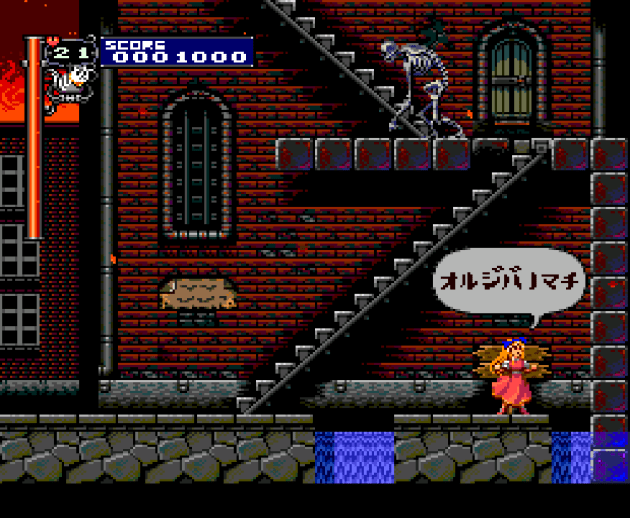
The opening stage, a tribute to Simon’s Quest, is the best thing to come out of that game. This is a memberberry done right.
If it seems like this review is more of a continuation of my Dracula X review, well, blame Rondo of Blood. It’s hard for me to do my job when a game doesn’t give me many flaws to work with. I really wish I had played Rondo first, because I think I would’ve had a better time laughing at how they completely screwed the pooch on making a worthy “Castlevania X” Nintendo release. It wouldn’t have made the game better, but it sure would have made the experience better. I was so bored playing Dracula X: a slow, uninspired game that’s obsessed with cheap shots, and certainly not worthy of reusing the sprites from Rondo of Blood, a game that lives up to its towering reputation. Hell, the only major knock I have on Rondo is the art direction of the cutscenes. Richter looks fine, but I just can’t take the threat of Dracula seriously when he looks like the world’s most douchey douchebag. Seriously, Count Chocula is more scary than this dweeb.

Look, I’m not trying to be shallow and/or superficial because that’s the type of thing that gets a person cancelled these days, but I have my limits. I can suspend my disbelief and buy that the Grim Reaper works for Dracula when logically it should be the other way around. Whatever, it’s Castlevania so sure, death incarnate lets Dracula call the shots. But what I cannot believe is that the Belmont family wouldn’t take one look at THAT guy and say “you’re adorable, Alucard, but I’m here to kill your pops. Wait, YOU’RE Dracula? No. No, you’re not scary! You look like the villain in a deodorant commercial!” I could believe a guy who looks like that is someone who would deliberately give you the wrong answers on a finals test so that he wins valedictorian. I could believe that’s a guy who would plant a bra in his best friend’s car in an attempt to break up his relationship and steal his girlfriend. I could believe that’s a guy who would start a whisper campaign about you not being a team player at work so he gets the big promotion instead of you. That is the face of someone who is clearly evil, but in a smug, underhanded, douchey kind of way and not in a “I will call on the forces of darkness to raise the dead and take over the world” type of way. Evil, but not EVIL-evil, you know?
Rondo of Blood just works better because it’s not designed around enemies trying to score one-shot kills, which Dracula X was heavily invested in. The level design is instead optimized for a faster-paced Castlevania romp. That’s surprising, because, like Dracula X, Rondo is still a back-to-basics Castlevania game for the most part. To put it in perspective, when you play as Richter, all the basic sub-weapons except the stopwatch and bible only cost one heart. This is a game that was made to be fun and not because the designer has some vendetta against humanity. Like the best Castlevanias, it’s fun to play just for sightseeing, with plenty of memorable settings and basic enemies, none of who are too spongy or too cruelly placed to make progress ever feel slow.
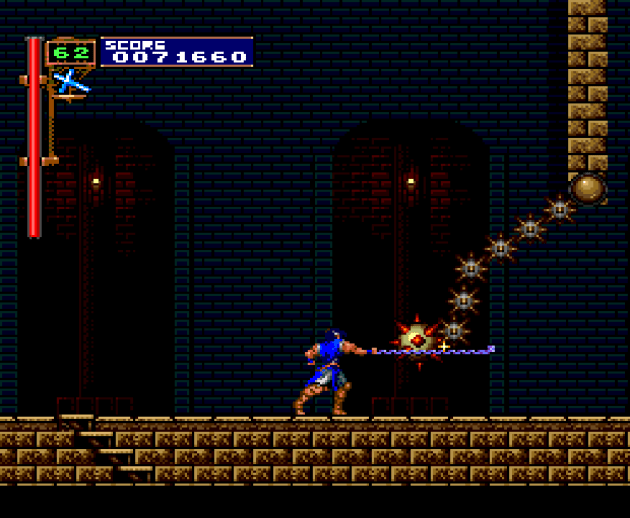
Ever wanted to whip one of the spiky ball chains? Now, you can, and it doesn’t just reverse direction. I was caught off guard when it behaved kind of realistically and was hard to get past. It’s that extra effort towards immersiveness in the level design and enemy design that makes me so frustrated with the cringey cutscenes.
Hell, I think this might even be one of the best games to introduce someone new to the Castlevania franchise. It’s not that hard a game, actually. The enemies are consistently fine-tuned to such a degree that it’s genuinely surprising when you encounter the rare spongy one. Even then, they’re usually staged in a way where they have an almost mini-boss feel. It’s actually remarkable how often Rondo takes what would normally be a flaw in a lesser game and turns it into a positive. If you’ve been intimidated by other classic-style Castlevania games solely because of their reputation for difficulty, give this one a try. In addition to some of the most balanced combat in the entire franchise, Rondo offers plenty of life refills and 1ups. If you die, while you lose your sub-weapon and your hearts are reset to 10, you’re not totally screwed, either. That’s because there’s no whip upgrades, yet every single enemy feels like it’s balanced properly to be slain by the default whip.

The only aspect that I feel isn’t well balanced is the bible sub-weapon. It has so much range and power that it’s essentially a low-cost item crash. If the cutscenes aren’t the worst problem with Rondo, the bible is because it’s too overpowered. Three hearts is just not a steep enough cost for an item this effective, and it even has a low cost (ten hearts) item crash.
While I can’t say with complete confidence that the bosses are also perfectly optimized for the whip, you will always have a chance to get at least one sub-weapon before entering a boss chamber. While you can still cheese the bosses if you have enough hearts to execute an item crash (and some cost quite a bit. One is a whopping FIFTY hearts!), it never feels like you’re cheesing it. What makes it even better is that Rondo’s defensive game is equally satisfying thanks to a variety of dodging moves. Enemies telegraph their attacks in a way where there’s always enough time to activate the backflip move. It takes practice to get the timing down, but it’s so satisfying when you successfully utilize it. I wouldn’t say this is a kinder, gentler Castlevania, but it offers the right amount of grit with almost none of dick moves Dracula X or any other Castlevania game ever has pulled. This might be the most balanced game in the franchise.
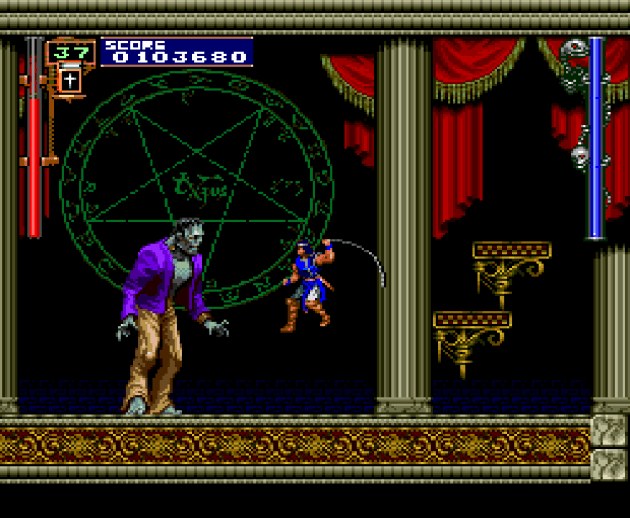
In my first playthrough, I lost three total lives from damage, two which were at the hands of the boss rush sequence that makes up the entirety of level six. It’s actually inspired, because the first four bosses are directly lifted from the original Castlevania. They don’t play the same, as Medusa has a body instead of being a gigantic head, there’s only one mummy instead of two, and The Creature doesn’t have Igor with him. I survived all of them, but I lost the final battle against the guy who resurrected Count Draculahaha. A guy named Shaft. I’m resisting the temptation to break out into song.
And this go around, the branching path system works a lot better than the half-assed effort made in Dracula X. Actually, the most damning observation of that game I have now that I’ve played through Rondo a few times is how half-assed the branching paths in the SNES “version” are. They seem to only be in Dracula X because Rondo leaned very heavily into the idea and they needed some token representation to say “see, this is totally an upgraded Rondo! It’s got an X in the title and a couple hidden paths and everything!” But whereas Dracula X’s paths feel arbitrary and out-of-nowhere, Rondo’s mostly have an elegant logic to them. Every start-to-finish game of Rondo (you open up a level-select option in the main menu after beating the first stage) will consist of playing eight levels, but each of the first five levels has secret pathways. The secret pathways aren’t that hard to find and usually contain an alternative boss which then leads to alternative levels, which, once again, have hidden paths, and so forth, and so forth. For example, in the first level, you go here:


And you get a different boss fight than if you just keep following the normal pathway and you’ll get a different second level. So, it’s not like Castlevania III where you choose a different path between levels. Now, to be clear: I prefer the way Castlevania III did it, and I’d really prefer the option of playing all the levels in a single run. If there had been a ROM hack that allowed this like the one I experienced when I reviewed Dracula’s Curse, I would have taken that option after finishing the real game. Of course, it wouldn’t work in this game without somehow rearranging the level layouts. The themes and enemies for roughly half of each of the first five levels and their alternative route counterparts change depending on which path you take. But, when the level design is THIS outstanding, I feel something is lost when you’re forced to replay it instead of them naturally unfolding. But, if a game is going to be designed with the branching paths in the levels themselves, this is probably as perfect as the concept gets.
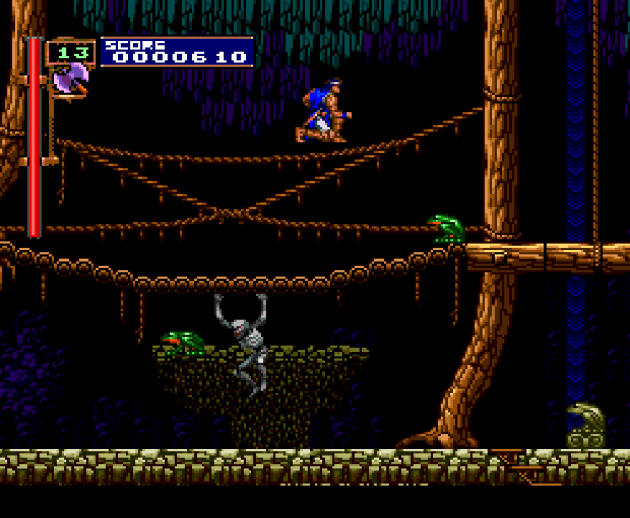
Sometimes there’s more than two paths to take. There’s a LOT of secrets in this game, including a few one-off hidden rooms. I’m fine with that. Unlike Dracula X, Rondo feels like it’s fully based on exploration and secrets instead of just shoving a couple token ones into the game because the popular game it borrowed assets from had them.
The most noticeable secrets are that four maidens are hidden in the game, the first of which is Maria Renard, who is a playable character. The method of saving the maidens is much easier than in Dracula X, where one key had to be held for multiple doors. In Rondo, there’s three total keys, each of which is used once, in the level you found it in, and not too far from where you found it. With that said, I guess that would be the biggest strike against Rondo: you never know if a pit is actually a pit or the secret path. It happens more than once, too. There’s no way to spin that as a positive if the emulator you’re playing on doesn’t have quick save/quick load or rewinding because you have to just plug your nose and jump blindly while searching. So there, Rondo isn’t perfect. Unless you have a good emulator.

Apparently, not every “hidden path” actually goes somewhere. If there’s a point to this room, I never figured it out. I got a 100% completion so I guess the game just wanted to show where all these flea men riding cannonballs were coming from.
The replay value comes from a very enjoyable alternative character. Maria is unlocked in the second level, though you have to go back to the main menu to switch to her. She’s radically different from Richter, throwing doves at enemies instead of a whip. Richter gets a defensive backflip move, while Maria gets a double jump. She also can do a sliding move, but I never found any situation where it was more effective than jumping. Even a situation that seems tailored specifically for it didn’t work. The mummy in the boss rush stage throws blocks at you and, even though it appears high enough off the ground to slide under, the slide doesn’t work for it. Whatever. Her double jump works fine enough as a defensive move. Maria’s sub-weapons are all animal-based as well, including throwing a goddamned dragon at enemies, which is the most powerful sub-weapon in the game. But even throwing a cat at an enemy is both effective and hilarious, as the cat relentlessly attacks. It’s what my cat would do, even if it wasn’t fighting the forces of evil.

The item crash with the cat is some Power of Grayskull sh*t. Well, HONOR of Grayskull in its case. By the way, Maria apparently has a Street Fighter-like special move, but I was never able to execute it.
I know that a lot of the appeal in my reviews is talking about the flaws in a game, but the truth is Rondo is close to being without flaw. The unskippable cutscenes are easily the most annoying part, regardless of whether or not you know Japanese. In case it wasn’t clear from my tirade above, I really don’t like the art style. I don’t get the direction of it at all, really. It doesn’t match-up with the in-game graphics and really only breaks my immersion. But, fast forwarding through a handful of agonizing cutscenes to play a Castlevania that doesn’t really make any critical gameplay mistakes is a very small price to pay. I guess I was disappointed that the level that’s hidden until after you beat Dracula once doesn’t have a boss fight. Seems kind of lame for a Castlevania game, but even Dracula’s Curse does that too. Sigh. Rondo of Blood really is close to being criticism proof, especially with emulation trickery used to speed-up exploration. I can’t say enough good things about it. This was such a treat to finally sit down with.

OH HEY, there’s part of a bad level! Actually, the river rafting sequence doesn’t even qualify as bad. It’s just very bland, especially when compared to the rest of the game. It needed to be trimmed by at least half.
A lot of the time, famous Japanese exclusives that never got released globally during their original life cycle are really overrated. I’ve played several of them at IGC, from Super Back to the Future Part 2 to Magical Quest 3 to Wai Wai World. Rondo is the rare Japanese holy grail that actually deserves that status and it’s an absolute travesty that it took so long to go worldwide. It got a Wii Virtual console release fifteen years ago and a PSP release a little further back than that. It was also included on the already long out-of-print TurboGrafx-16 Mini, which kind of got hosed by a limited production run and incredibly poor timing as it was delayed due to the pandemic, which is a shame because it was arguably the killer app for it.

“Hey, haven’t you ever heard of guest rights? WHAT DO YOU MEAN THAT ONLY APPLIES TO THE HOST? No, it doesn’t! Wait. Yea, you’re right. I suppose it is right in the name. It ain’t called Host Rights, after all. I guess you’ve got me there. Well, next time I resurrect, I’m going to YOUR home to kill you. See how you like it when the shoe’s on the other foot, jerk! Oh, you won’t open your door for me? Hmmmph, rude! I always open my drawbridge for you! Where would you be if I didn’t do that? Kissing your family goodbye right before I enslave humanity, that’s where!”
Hell, Rondo would be the killer app for any collection. Konami could just as well slap a $4.99 price tag on it for Xbox and Switch owners and make a killing. So, why in the hell is the only available release a PlayStation exclusive? Now granted, Castlevania Requiem: Symphony of the Night & Rondo of Blood is a contender for best retro two-pack on the market today, but come on, Konami. The cutscenes aren’t THAT embarrassing. Okay, fine, they are, but that doesn’t explain why the hell you gave us Dracula X in Castlevania Advance Collection instead of this masterpiece. I thought THAT was evil, but then you put Haunted Castle in Dominus Collection instead of Rondo, and now I know true evil.
Verdict: YES!
THE INDIE GAMER CHICK CASTLEVANIA REVIEW SERIES
Castlevania (NES) Dracula’s Curse (NES) Adventure (GB) Belmont’s Revenge (GB)
Super Castlevania IV (SNES) Dracula X (SNES) Rondo of Blood (SuperCD²)
Chronicles (PSX) Circle of the Moon (GBA) Kid Dracula (NES) Kid Dracula (GB)
ROM Hacks (NES) Konami Wai Wai World (NES) Wai Wai World 2: SOS!! Parsley Jō (NES)

“Yes, it vas I who put the sugar in your boyfriend’s gas tank, causing him to be late for school and getting him detention. Now you’re free to go to zee prom with me! Muhahaha! Truly I am the lord of evil! WAHAHAHAHA! Vas zat over the top? So vat do you say? Pick you up at 7:00? Does 7:00 mean 7:00 or are you one of those chicks where you say 7:00 but you’re still doing your hair and we leave at 8:00? I’m only asking because my hair gel starts to flake after a few hours.”

 Indie Gamer Chick
You must be logged in to post a comment.