Blade (Pinball FX Table Review)
October 11, 2024 1 Comment
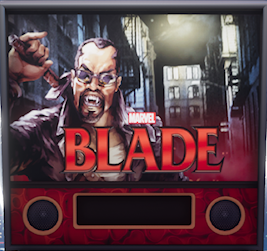
Blade
First Released December 8, 2010
Main Platform: Pinball FX
Switch Platform: Pinball FX
Designed by Imre “Emeric” Szigeti
Set: Marvel Pinball Collection 1 ($23.99)
Links: Strategy Guide – Pinball FX Wiki

Oddly enough, only a handful of the Marvel pins actually attempt to feel like they’re tied to comic books. You’d think Blade would be one of those that didn’t, but it’s really second only to Spider-Man in creating that comic-like energy using fonts and key art. We really like how this looks.
Blade does two things really well. First, it’s a pretty good tribute to early-to-mid 90s William/Bally tables. A clean, simple layout that flows really nice. Second, as stated above, this is a no doubt about it COMIC BOOK pin in the same way that Ed Kryinski’s Incredible Hulk (1979 Gottlieb) and Amazing Spider-Man (1980 Gottlieb) were. Blade isn’t anywhere near as good as Zen’s take on Spidey, but it’s a damn good table. Modes zip right on by after a couple shots, instead of the typical Zen grind. A novel monetary system allows you to buy a variety of upgrades, like kickbacks and extended ball save for the cowardly, or high-yielding scoring opportunities. Oh, and this could have easily been Castlevania II: Simon’s Quest Pinball. The table shifts from day to night and back again, with modes and bonuses exclusive to each. This could have come across as gimmicky, but it actually does work thanks to balancing what is and isn’t available during each cycle.

Signature Feature – Day/Night Cycles: All the missions (main modes) must be done during night by shooting the Lawlor Trail between the flippers, which is a shockingly tough shot. Night also has some of the best hurry-ups in Pinball FX, where you have to shoot specific lanes to slay vampires for money. The shop where you spend that money is only open during the day, along with the path to the valuable items. Our main knock with the day/night concept is that the clock for it is on the left slingshot. It would have been really great to have a separate ticking clock somewhere. Make it optional if people are afraid about ruining the purity of the visuals.
Blade’s layout looks conservative, but actually, it’s one of the more elegant and deceptively complex shooters we’ve seen from Zen. And that’s just the layout! The rules are very ambitious, with RPG-like mechanics such as stamina, money, upgrades, and collecting items. You build your Stamina (and avoid shots that drain it) so that you get more time to complete the modes. If there’s a problem with Blade, it’s that it’s the rare Zen table that doesn’t quite have enough shots. What shots are here are perfectly fine, but it can wear thin in extended play. It’s also very conservative in scoring, but without any of the balance that type of scoresheet requires. It makes Blade a table where shooting combos is just as exciting as making jackpots, which might not necessarily be a good thing because it means excitement doesn’t build. It’s incidental, and that’s before I get to an absurdly overpowered scoring device so wildly imbalanced that it broke my father and has me cracking up. It’s a whole new level of badly balanced.
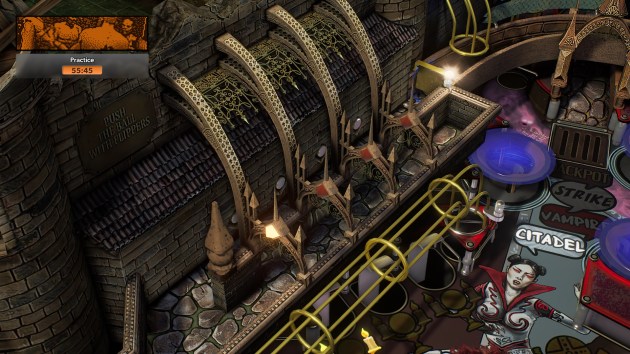
Signature Element – Citadel: This mini-table is where you collect the items. This is one of those kinds where you have to poke the ball off the correct rail. It’s the second one from the bottom that you want to light (which is done via the spinner), though it’s also that item which completely throws Blade’s scoring balance out of whack. You’ll see why..
During a day cycle, the path between the flippers will take you to the Citadel instead of the mode start. Trust me, you’ll want to go here first. There’s four total items. One adds 100 points to every score, which is basically worthless. One cuts the cost of items in half, while one cuts the amount of mode start targets you need to hit in half. Those two are good ideas. The fourth and final item, Azu’s Belt, doubles all scoring permanently. Wow. Yea, that’s insane and I have no way to spin that where it makes any sense. It badly hurts Blade’s flexibility, because the only logical strategy to start the game is work towards getting the belt as soon as possible. I don’t think it’s a deal breaker, but it does sting quite a bit. While I think this does a better job than most at ambitious RPG-like gameplay, I kinda wish they’d just stuck with the old school gameplay with new-school surroundings layout. It’s one of my favorite designs, but Blade throws a lot at you and the results are more mixed than a table that shoots this well should be.
Special Consideration – Nintendo Switch: On Switch, Blade has orbits aimed straight at the drain, which doesn’t happen in the Primary Pinball FX builds. They need to fix this, since you need to hit those shots sometimes. Until then, we consider the Switch version to be ⚠OUT OF ORDER⚠
 Cathy: GREAT (4 out of 5)
Angela: GREAT
Oscar: GOOD (3 out of 5)
Jordi: GREAT
Sasha: GOOD
Primary Scoring Average: 3.6 📜CERTIFIED EXCELLENT📜
Some review copies were provided in this review, others were paid for.

 Indie Gamer Chick
You must be logged in to post a comment.