NES Zapper & SNES Super Scope Games: The Definitive Review – Full Reviews for 22 Light Gun Games on Nintendo Consoles (Plus 1 PC Engine Bonus Review)
December 23, 2024 14 Comments
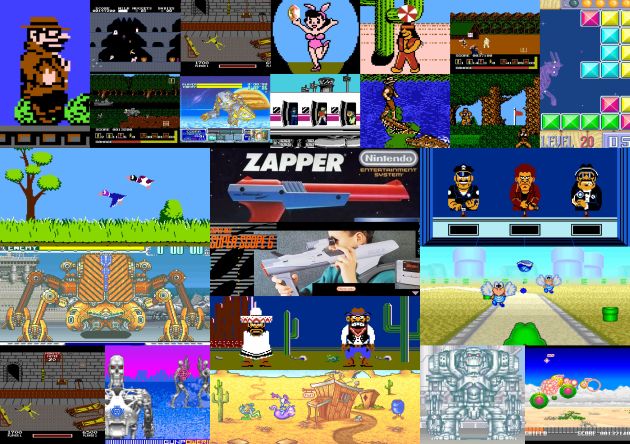
Merry Christmas, everyone! I wanted a Christmas surprise and I have a feeling that a lot of readers probably got a console packed with a light gun under the Christmas tree at some point in their lives. Now, I’ve never played authentic versions of these games with one exception: I played Duck Hunt a couple times as a kid. However, in my pre-epilepsy days, I absolutely loved House of the Dead and had a light gun for my Sega Dreamcast to play House of the Dead 2. It was the best accessory Mad Catz ever made. Also, I’m pretty sure it was the only gun made for House of the Dead 2. That was back when I was 10 years old. Now, I’m 35, and light guns are a thing of the past. Or are they? Well, kind of. In making this feature, I couldn’t play any of these games on authentic hardware even if I wanted to. Hell, even owning the consoles and accessories wouldn’t be enough. I’d have to buy an old fashioned cathode-ray-tube television, because old light guns won’t work on modern televisions. But, there are now some pretty damn good light guns that work with emulators.

THE GUN WE USED – THE SINDEN LIGHTGUN
For this Definitive Review, we used the Sinden. While this feature is really about the games, the gun for sure played a starring role, so I want to talk about it. The Sinden is a pricey accessory, especially if you buy the optional foot pedals, but nothing in this feature requires them. I’ve not been very comfortable endorsing any light gun, but hell, I’ve gotten my money’s worth with the Sinden at this point. We own the model without the recoil, which will run you a little over $100 all-in. If you want to know more, my friend Retro Ralph has a review. If you invest in one of these, be prepared to probably troubleshoot at least a little bit before getting it up and running. Sinden requires the game to add a border around the screen to make it work. There’s drivers to download (including tons of game-specific configuration files), and emulator settings to adjust. BUT, we did get everything up and running, one way or another. Well, most everything. I dropped Lethal Enforcers from the feature, but we will get back to it some day. But, if you want to know what to expect, there’s an entire Wiki dedicated just to tutorials for the Sinden for a TON of emulators. I cannot thank the hard working community that put that together enough. I dedicate this feature TO ALL OF YOU in the Sinden community! Thank you!
The big question is latency. Folks, I’ve consulted with people I trust on this, including pinball designer/my arcade guru Dave Sanders and Youtuber/dear friend of mine Retro Ralph. After talking with them, I’m confident enough to say as plainly and matter of factly as possible: all light gun games have at least some lag. “Even Operation Wolf, possibly the highest earning arcade light gun game of all-time, still had a subtle but noticeable lag” said Dave. “It’s like the controller is doing the opposite of the Atari 2600 racing the beam. Shoot the gun, get the screen flash (one frame), the gun reads the flash, the game updates based on what it saw, you see the results with no flash (another frame).” LCD screens have more lag than CRTs, which is why a satisfactory light gun took a while. LCD emulator gun solutions from about a decade ago were bad. Ralph described one model as “feeling like it dragged the cursor across the screen.” Clearly the tech has improved, because with the Sinden, most games worked fine, and the exceptions probably wouldn’t have been very good anyway. The reviews note which games had issues, but in general, the games we felt the gun didn’t work perfectly almost all had objects that moved too fast. Usually it wasn’t even the full game, either. Just situational issues.

The flash boxes for Operation Wolf on the NES, which are atypical of most NES Zapper games.
For the most part, I didn’t notice any lag in most games, and neither did my father. But I had done a lot of research on latency, and Dad knew about the past problems with LCD guns as well. That could have potentially colored our impressions or expectations. Thankfully, everyone else was totally unaware of how light gun tech works (or that the gun they were holding was really just a camera) and what problems are inherent to the format. Angela, Sasha, and the other members of my family who jumped in and out of the sessions became our control group. If they were complaining, then we made note of it. The only time complaints really happened were in some instances where the screen was moving. It was almost never a deal breaker, since YES! recipients like Gotcha! for the NES and SNES games Battle Clash and Metal Combat: Falcon’s Revenge got the most feedback. Machine guns usually did, but Yoshi’s Safari, a 100% machine-gun based game, didn’t at all. And we dropped one game, To The Earth for the NES, from this feature because none of us were able to hit anything. But, out of 22 total games in this feature, most worked without continuous incidents. After we finished our play session, we let the kids in on the latency history with light guns. They were surprised, because they didn’t really notice it except during Battle Clash and Metal Combat. That’s pretty good.
 I’ve never really reviewed hardware before, but hey, if you’re really into classic light gun games yeah, the Sinden is a pretty good solution. There are others. I am NOT an expert on these, so do your research before buying, because they’re damn expensive. If you don’t know how to set up stuff like this, maybe give it a pass. If you’re only casually into light gun games, having a nice light gun for your emulators isn’t going to blow your mind and make you completely reevaluate the genre, so don’t waste your money. Get a nice arcade controller instead, because you’ll get a LOT more play time with that in the long run. For everyone else, especially hardcore arcade fans or home light gun game fans, consider the Sinden to be Chick-Approved.
There’s some games in this feature where guns are totally optional. The reviews featured are NOT just for the light gun gameplay. These are full game reviews for titles that happen to use light guns. I really do hope everyone enjoys!
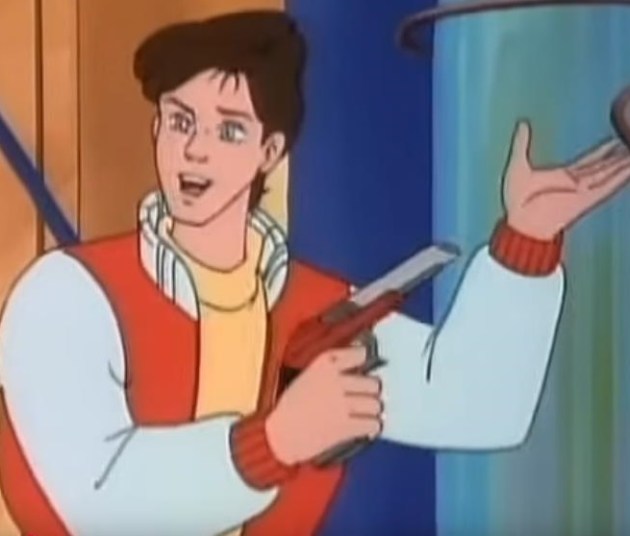
A second after this screenshot was taken, Captain N shot off his left hand.
THE EPILEPSY SITUATION
And of course, I’m photosensitive. Even though I have my epilepsy mostly in-check, I can still be triggered and suffer not only seizures but effects like dizziness, headaches, nausea, and more. Even if the guns no longer use the same technology as they used to, the flashing when the trigger is squeezed remains in the games, assuming it is THAT type of light gun. Some aren’t. The Super Scope used no flashing at all. Others, like Gumshoe or Baby Boomer, were often so flashy that my play time might have been limited to only a couple minutes, and for the NES version of Operation Wolf, they just said “you’re not playing” altogether. In the making of this review, I took as many precautions as possible, including being as distant from the screen as I could while having the gun still work, which admittedly was still too damn close. If you are photosensitive, do not do this. Just play something else. I probably shouldn’t have done this, but I’m likely going to reach the point sometime in the not too distant future where my hands will tremble too much to play light gun games well, if at all. It was now or never. If you’re reading this, obviously I made it out of this alive. If not, yea, I’m that Darwin Award winner that you saw on the news that reviewed light gun games to death. If you enjoy this feature and want to show your support, make a donation to the Epilepsy Foundation!
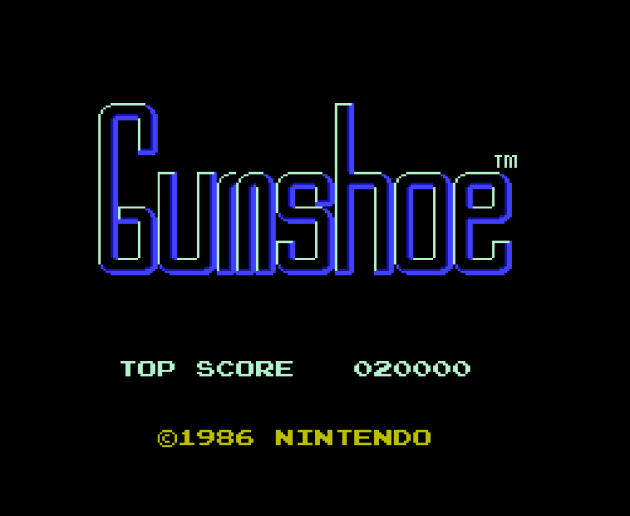
Ironically, I was going to do a Definitive Review of every black box game, but I put a pin in that because of Gumshoe. It’s a game that, as recently as a couple weeks ago, I said I would never review. Too intense with the flashing. I couldn’t even watch the gameplay of my family, but my amazing sister Angela did finish the whole thing and filled in the blanks for me that I needed for this feature. In fact, my family did that for a lot of games. I feel confident that I played each title enough to know what the gameplay was like without missing anything, with one exception: difficulty scaling. Because usually scaling in a light gun game means just adding more and more targets, which means more and more flashing. But, I think this came out pretty good given my limitations.
I’ll note in each game’s header how limited my light gun time was. And for God’s sake, if you’re photosensitive, do not use my limitations to calibrate your own. Consult with your doctor before playing any video game. I had a LOT of help from my family for this one, and I’d like to thank Angela, Sasha, and Dad. Without their help, this feature wouldn’t be as comprehensive as it is. Because they played with the Sinden so much more than me, I also let them render their own individual verdicts on most games. I love them all so much, and I’m so grateful I got to do this project with them! On with the reviews! Here’s what’s in this feature!
 The Adventures of Bayou Billy (NES) aka Mad City (Famicom)
- Baby Boomer (NES)
- Barker Bill’s Trick Shooting (NES)
- Battle Clash (SNES)
- Bazooka Blitzkrieg (SNES)
- Chiller (NES)
- Duck Hunt (NES) and Vs. Duck Hunt (Arcade)
- Freedom Force (NES)
 Gotcha! The Sport (NES)
- Gumshoe (NES)
- Hogan’s Alley (NES)
- Mechanized Attack (NES)
- Metal Combat: Falcon’s Revenge (SNES)
- Operation Thunderbolt (SNES)
- Operation Wolf (NES)
Operation Wolf (PC Engine) - Shooting Range (NES)
- Super Scope 6 (SNES)
- T2: The Arcade Game (SNES)
- Tin Star (SNES)
- Wild Gunman (NES)
- X-Zone (SNES)
- Yoshi’s Safari (SNES)
I’ve already done one NES light gun game: The Lone Ranger, where the gun is optional but very much recommended. Let’s do the rest! And by the way, THANK YOU, Angela! My sister generated most of the screenshots for the NES games in this feature, which we redid outside our gunplay sessions, with a mouse subbing for a gun.
GAME REVIEWS
For those not familiar with my way of thinking of how retro games should be reviewed, I take NO historical context into account. I don’t care how important a game was to the industry, because that doesn’t make a game worth playing today. The test of time is the cruelest test of all, but every video game must face it. I might not be here if not for Pong’s success, but I wouldn’t want to play it today. Not when there’s better options. Therefore, when I review retro games, every game gets either a YES! or a NO!
YES! means the game is still fun and has actual gameplay value when played today and is worth seeking out.
NO! means the game didn’t age gracefully and is not worth seeking out, and certainly not worth spending money on.
IN CHRONOLOGICAL ORDER
Wild Gunman
Platform: Nintendo Entertainment System
Released February 18, 1984
Designed by Makoto Kanoh
Developed by Nintendo
NO MODERN RELEASE
Cathy’s Gunplay: Mildly Limited

Honestly, if they had packed the NES with Wild Gunman instead of Duck Hunt, I think almost nothing would have changed.
Before it was a video game, Wild Gunman was a trailblazing 1974 Japanese coin-op that essentially created the Full Motion Video genre AND the light gun genre. You’ll want to watch the NES Works episode for Wild Gunman by Jeremy Parish, the most underrated person in gaming media. Ten years later, it became the original signature light gun game. And it’s really the most simple game in this entire feature. Even more simple than Duck Hunt. It’s an old timey showdown modeled after the classic spaghetti western gun duel. The more guys you defeat, the faster the five different opponents draw. That’s it, at least in the first two modes that can be played with one opponent or two. Mode B is the strongest of the standard showdown modes. There’s a chance one of the guys won’t say “FIRE!” and shooting the one who doesn’t is a foul. HOWEVER, the round instantly ends if you shoot the one who says “FIRE!” and that saved my bacon more than once because I would have shot both guys. In fact, that happened to everyone in the early games, before we got the hang of Wild Gunman. The game also tells you exactly what your opponent’s draw time will be. Okay, so it’s still just pressing the trigger twice fast enough and accurate enough, but we enjoyed it quite a bit and only wish it could have done at least one more character on the screen.
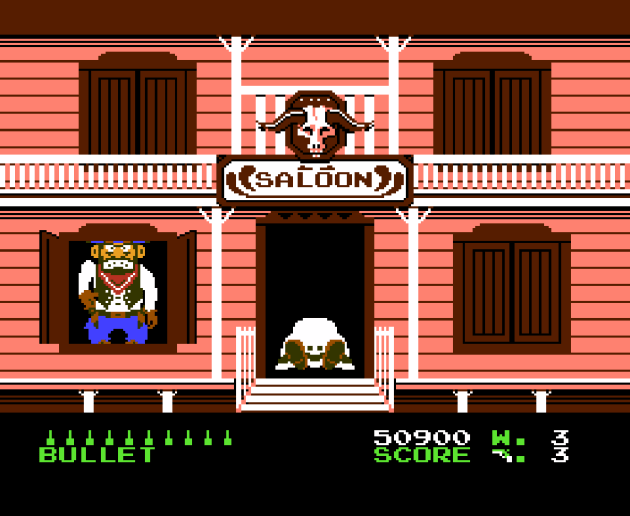
It’s funny that the one black box Zapper game that wasn’t part of the Nintendo VS. System lineup was the one chosen to be a coin-op in Back to the Future II. No, it doesn’t exist. It’s a special effect created for the movie.
The final mode is a five-position saloon where you have fifteen bullets per wave. The gunman will emerge from the windows at random. Weirdly, the scoring seems random too. If there’s any rhyme or reason to the points system, we couldn’t make sense of it. This mode takes quite a while to ramp-up in difficulty, but eventually the guys shoot almost as soon as the doors open. While GANG still retains the “quick draw” gameplay, it just isn’t as fun or immersive as the old fashioned gun fights. Like the other two games in the original Zapper Trilogy, Wild Gunman relies heavily on personality to carry the day, and it mostly does. While the gameplay is limited, so is the appeal of light guns. In Japan, the game came with a proper Colt-style gun and a holster. I suggest playing it with the gun at your side for the full, immersive effect. We all had a great time! Thanks to Wild Gunman, I knew using my family to make this feature would work. And honestly, if there was lag, we didn’t feel it. By the time we lost, it seemed like it was going so fast we would have with or without the real hardware. But, this might be a good game to test your LCD light gun with.
Verdicts – Indie Gamer Chick: YES! – Angela: YES! – Oscar: YES! – Sasha: YES!
 Duck Hunt and Vs. Duck Hunt
Platform: Nintendo Entertainment System, Arcade
NES Released April 21, 1984
Arcade Released April, 1984 or May, 1985
Designed by Shigeru Miyamoto and Hiroji Kiyotake
Uses the NES Zapper
NO MODERN RELEASE
Cathy’s Gunplay: Limited


What can I say about Duck Hunt? It’s one of the most famous video games ever made, and it didn’t age at all. Which isn’t to say it’s some kind of historically transcendent title, because there really wasn’t much to age. In the A game, one duck flies up in the air. In the B game, it’s two. In the C game, the ducks are replaced with clay pigeons. If you’re playing with a group, one player can control the duck with the port one controller, at least in the A mode. I wish I could say it was like playing dodgeball with photons, but you only have about 50% control over it, so it’s more like you’re influencing it rather than directly controlling it. Like Wild Gunman, Duck Hunt is almost entirely reliant on personality, and after two games in a row (and one more coming up) that fall into that category, it made me realize that it’s not Super Mario Bros. that established Nintendo’s identity. It’s the Zapper games that went the extra mile and distinguished themselves from all other home games that came before them. Realistically, NES owners kind of got hosed since Vs. Duck Hunt, built on modified Famicom/NES hardware has more content. It has this:

Vs. Duck Hunt, using the Nintendo VS. System.
In addition to the fact that the B mode and C mode alternate levels, after completing the two-level cycle, you enter a bonus game where many ducks fly up at once. The ducks have an entirely new sprite AND death animation, plus the dog runs interference on the whole thing. Vs. Duck Hunt is no doubt the source of the “shoot the dog” urban legend that follows the NES game around. But, you really don’t want to shoot the damn mutt. Satisfying as it might be, it ends the bonus round. The scoring of the coin-op is much more dynamic, too. Like in the skeet shooting rounds, you get more points for shooting the clay pigeons as soon as they’re pulled. On the NES, the skeets have fixed values. We all liked Vs. Duck Hunt more, to the point that the kids swapped out their YES! ratings for NO!s for the home version because the NES build is so limited, at least compared to the arcade game. Dad and I thought the bonus round went too long, but yea, the scoring is better on the coin-op. HOWEVER, only the NES game offers bonus points for perfect rounds. The coin-op also has a lives system instead of a par for each level. We adjusted to three lives to prevent games from going on forever. Assuming that the next Switch’s pointer technology is improved, Hamster might want to consider porting Vs. Duck Hunt to the Switch 2.
NES Verdicts – Indie Gamer Chick: YES! – Angela: NO! – Oscar: YES! – Sasha: NO!
Arcade Verdicts – Indie Gamer Chick: YES! – Angela: YES! – Oscar: YES! – Sasha: YES!
Hogan’s Alley
Platform: Nintendo Entertainment System
Released June 12, 1984
Designed by Shigeru Miyamoto
Developed by Nintendo
NO MODERN RELEASE
Cathy’s Gunplay: Limited (Especially GAME C)


Hogan’s Alley offers the most variety of the entire Zapper Trilogy. Each of the three modes feels different, with the C mode being totally different from the core gameplay. The A mode is a standard three-channel shooting gallery with three possible gangsters and three whammies that feels a lot like the showdown games of Wild Gunman, only with a different theme. You get a whopping TEN screw-ups before you game over. It’s too much, especially considering the fun runs out long before the lives do. Only Sasha enjoyed the A game better. B mode features the same targets, only it’s on a street. In GAME A, you know when the shooting is going to happen, but targets can appear anywhere at any time in GAME B. It just makes for a more exciting game, and a much harder one. You still get ten misses, though. Even with nice looking character models, the animation is very limited since these are supposed to be cardboard cutouts. Though having the wires that connect to the sensors, just like a real police trainer (this is based off the 1957 version of the FBI Hogan’s Alley), was a nice touch, but this IS a video game and I’d prefer animation to just spinning targets.

The walls matter, since the cans bounce off them.
The unanimous choice for best overall game for the original Zapper Trilogy was Hogan Alley’s GAME C: Trick Shot. The idea is simple: a series of cans enter the playfield from the right side of the screen and you have to shoot them, which pops them higher in the air. Using this, you have to guide them to the scoring zones. This is the only part of the original three Zapper games that has elements of risk/reward gameplay instead of just raw timing and accuracy. Oh, that stuff still matters, but there’s actual strategy at play here. You have to make your shots, but if you want to score big points, you have to allow the cans to be somewhat near the bottom of the screen since the 5,000 zone scores many multiples more than the others combined. Now, the scoring is for sure not balanced, and we all thought that only getting 100 points for landing a can on the relatively narrow platform was a bit of a rip-off. We were also disappointed that the layout never changes. It would keep you honest if the sizes of the scoring zones grew or shrank, or even if the values and location of the 100 point platform jumped around. But, we had a ton of fun playing Trick Shot. To put it in perspective, the rest of my family, IE the ones who didn’t help me with this feature, all wanted a go with Trick Shot. Even Duck Hunt didn’t get that. Again, ten misses is too much, but this concept seems like it could be built upon to create the perfect light gun mini-game.
Verdicts – Indie Gamer Chick: YES! – Angela: YES! – Oscar: YES! – Sasha: YES!
 Gumshoe
Platform: Nintendo Entertainment System, Arcade
NES – Released August, 1986
Arcade – Released May, 1986
Designed by Yoshio Sakamoto
Developed by Nintendo
NEVER BEEN RE-RELEASED
Cathy’s Gunplay: Very Limited

I didn’t get to finish the first level.
Stupid epilepsy. I figured Gumshoe was probably a bad game, but my family liked it, or rather, liked its potential. They split on whether it’s fun or not. I could barely play the damn thing, but I’m getting a kick out of their feedback. Heh, now you guys know what I go through. Gumshoe is a sort of pioneer that’s often cited as one of the first endless runners. The titular Gumshoe is always moving, and shooting him makes him jump with nearly the same height and velocity as the cans from Hogan’s Alley’s GAME C. Hell, I wouldn’t be shocked if a lot of cutting and pasting was done between the two games. Of course, Trick Shot took place on a single screen. This is a side-scroller with tons of obstacles and enemies to overcome. You know the Death Blocks from the Angry Video Game Nerd games? This is where they come from, and they’re all over. My family couldn’t agree what was worse: those, or the bottles that are thrown straight across the screen, usually at the worst times.
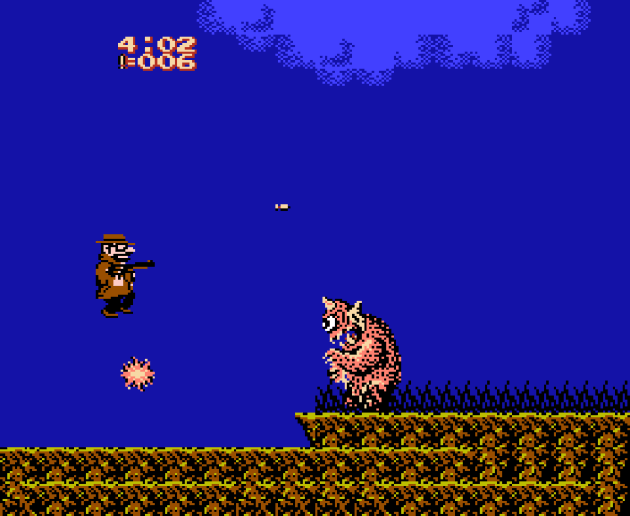
As if the normal light gun flashing wasn’t bad enough, when you defeat this boss at the end, the game does an extended, ultra-violent strobe. Angela’s advice: don’t game over. “I kept my ammo in the 150 to 200 range, but the balloons weren’t as frequent on the last level, so I ran out of ammo fighting the boss.” During this fight, Gumshoe has a machine gun that shoots automatically, so all you do is shoot him (which costs no bullets from your stock) and shoot the fire projectiles the boss spits, which come in at a steady clip. After Angela ran out of shots, her strategy was to keep Gumshoe high in the air. It still took her multiple attempts. By the way, she had to play through Gumshoe a second time with a mouse in order to get this screenshot. It means the world to me that you went through the effort.
Gumshoe requires a LOT of shooting, and every shot is a full-screen flash. So, I didn’t get to see sections of the game that my loving family called “Cathy Killers.” That would be level design that veers heavily into tight squeezes between platforms and pits that require players to turn their Zapper into a manually-clicked machine gun. And that’s just to keep the hero afloat! While you do all that, you also have boulders falling from the sky, enemies flying across the screen, and death blocks to avoid. They all agreed that Gumshoe is exhausting, and goes for cheap shots. In the water level, sharks sneak up on you quickly and require two shots to kill, but while they’re coming at you, there’s other stuff going on. “Even if you shoot flawlessly, it’s still really hard.” Angela, who took the role of main player for this review, ultimately did like Gumshoe. “I’ve seen games like this on my phone, only this time, instead of tapping the screen, you shoot a gun. Sometimes it feels unfair, but I liked this. Different from the other games we’ve played.” Sasha thought it was too unfair and that jumping sections should have kept non-jumping hazards minimum. Dad said he needed a nap.
Verdicts – Angela: YES! – Oscar: YES! – Sasha: NO! – Indie Gamer Chick: Didn’t Play Enough to Rate
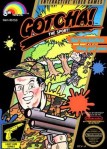 Gotcha! The Sport!
Platform: Nintendo Entertainment System
Released August, 1987
Designed by Junzo Shimada
Developed by Atlus
Published by LJN
Uses the NES Zapper
NEVER BEEN RE-RELEASED
Cathy’s Gunplay: Limited
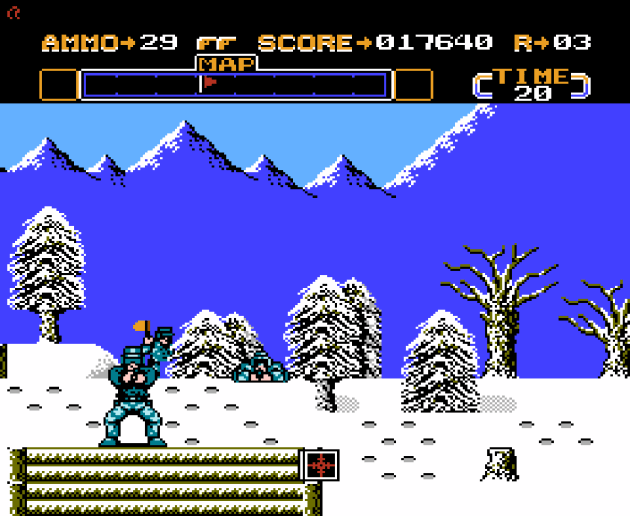
Simmons, get the warthog.
I’ve wondered why more games don’t use a combination of controller and guns? Wouldn’t it create a more immersive experience? Isn’t that the whole damn point of having a gun-shaped controller that you point at the screen in the first place? Well, Gotcha! The Sport was the first console game to do that. Here it is! Numero uno! And honestly, despite LJN’s scathing reputation, Gotcha is actually an early Atlus game. Themed around a one versus ∞ game of capture the flag paintball, you have to scroll with the controller while firing at anyone you see. You also capture the flag by shooting it, but on the return home, the other team will have no doubt gotten your flag. At some point, you’ll cross paths with their flag runner, who you must shoot and/or win the sprint to your base. Unlike the flag you’re trying to capture, you don’t have to also shoot your flag to return it to the base. Capping the flag runner will do it automatically. After three levels (there’s also three adjustable difficulty levels) the game repeats with enemies reacting faster to you every new cycle.

An annoying chime sounds when enemies are actively targeting you. It’s a couple levels below Baby Mario’s crying on the “oh god, make it stop” scale, which I guess makes it an effective alert.
The only thing I know about paintball is that they’ll eject you from a paintball arena if you shoot the attendant in the eye while he explains to you how your equipment works, and they won’t even concede that it was a good shot. But that’s fine, because there’s only the smallest hint of a sporting element to Gotcha anyway. Mostly the flag mechanics and the timer, which gives you 45 slow-counting seconds to retrieve the flag and return to the start. Otherwise, the gun action itself closely resembles any other military-themed light gun game from this era, like Operation Wolf. Enemies never run AND shoot, so when you see them moving, they’re not yet a danger to you (unless they’re taking your flag). If you’re playing on Beginner or Intermediate, you can leg it past most enemies, at least in earlier stages. Not so much Advanced, where we lost by timing-out more than once.

The guy with the flag is always as deep in the background as the game goes, and he’s also a bit sneaky, slowing down a bit before speeding up and sprinting. You can barely see him in this screenshot. He’s those black spots behind the waterfall. Thankfully, the radar shows his location.
If not for the way you move, Gotcha! wouldn’t have won me or anyone else over. Where we found most of the fun was using the mechanics as an unintended co-op game. One person took the controller, the other the gun. EVERYONE had a good time doing this, making this one of the surprise hits of this entire feature. Gotcha isn’t amazing by any means. The three different maps offer no hidden secrets, no power-ups, and no variety of enemies. Level 2’s stages look different, but they don’t behave differently. Gotcha! is as shallow as a drop of paint, but we did have some brief fun thanks to the control scheme. Worth noting: this was the most unenthusiastic clean sweep in this review. Even though everyone gave it a YES!, their reaction was “wait? 4 for 4? Hey, it’s not MY fault!” No joke, we all voted YES! thinking at least one of the others would vote NO! But, nobody wants to change their vote either, which I suppose says more about Gotcha than this review does.
Verdicts – Indie Gamer Chick: YES! – Angela: YES! – Oscar: YES! – Sasha: YES!
 Freedom Force
Platform: Nintendo Entertainment System
Released April, 1988
Designed by Richard Robbins & Michael Mendheim
Developed by Sunsoft
Uses the NES Zapper
NEVER BEEN RE-RELEASED
Cathy’s Gunplay: Limited
Freedom Force is basically yet another Hogan’s Alley-like “shoot the bad guys, not the innocents” type of game, only this one has a story. And gore. So much gore. My jaw literally dropped when I saw the first person die in Freedom Force. I think I literally gasped, because it was just so unexpected! I thought Nintendo had a “no blood” policy before Mortal Kombat II in September, 1994. Apparently not, because a HOLY SH*T is Freedom Force violent! It predates the great Nintendo cave-in to Mortal Kombat II by a full six years and five months. It really has to be seen to be believed. This isn’t just little trickles of blood, either. This is squibs, people! Blood literally bursting from characters, including the hostages that you’re not trying to shoot. On top of that, the animation is shockingly well done for an NES game, as the blood drips and characters recoil before slumping over. Some of the hostages look like you’re taking their head off if you accidentally shoot them. I assume Freedom Force must have bombed in sales, because it sure seems like this should have been a more controversial game. I even checked to make sure I didn’t unknowingly get a ROM hack that I then accidentally loaded. Nope. This is real. And awesome!

Well, it IS Christmas in two days, so I suppose it’s fitting that I’m fighting bad guys with ugly sweaters. Or possibly bull terriers in sweaters stacked on top of each-other to pose as humans. You can never trust bull terriers. Truly the most shifty of all dogs. By the way, see the “HARDER” thing in the corner? You really don’t want to shoot that. It increases the game’s difficulty on the fly. Sometimes weapons, health, or ammo briefly appear in that spot. Putting a whammy there (and it does seem to be 100% random what appears and when) was actually not the worst idea since the whole point of Freedom Force is making snap decisions.
Freedom Force consists of five levels (and two games of hangman. Yes, the letter guessing game) where you have to shoot the bad guys and not shoot the hostages. Again, think “Hogan’s Alley with gore” because enemies appear in preset channels instead of running across the screen. Freedom Force doesn’t pussyfoot around with enemies, either. When they appear, you better be ready to shoot them. They don’t give you a very big window of time before they open fire themselves, and they can drain your energy really quickly. Some also throw some of the hardest-to-hit grenades or rockets in a light gun game. Health refills appear and disappear quickly in the corner. As far as we could tell, there was no way of continuing when you die, but that’s fine. There’s no bosses and nothing that changes up the gameplay besides the appearance of the hostages.

Surely they could have come up with something more inventive instead of just repeating the same gameplay five times over with different facades.
The main complaint from everyone was the random nature of the ammo and health refills. Everyone ran out of ammo at least once. Even though we had a good time with Freedom Force, it feels a little too luck based. Plus, some of the sprites are confusing. One shows the terrorists holding a gun to a hostage, and all four of us forgot “oh right, NES light gun” which isn’t accurate enough to shoot the bad guy in the head. Shooting that sprite kills the hostage, so, when you see a terrorist holding a hostage in one of the channels, that’s a “DO NOT FIRE” foul. You get five fouls before you game over. And no, the Speed “shoot the hostage” strategy doesn’t work either. I tried that too, both intentionally and unintentionally. So, this is a pretty basic game. With the exception of the grenade launcher, all the weapons you can get feel about the same. That’s assuming I got them at all. The weapons and items needed to linger a LOT longer in the corner. Angela couldn’t beat the final level because the health refill never stuck around, or it only appeared when she had a shootout going. BUT, the excellent animation and gory, borderline realistic blood squibs make this one stand out. Another clean sweep!
Verdicts – Indie Gamer Chick: YES! – Angela: YES! – Oscar: YES! – Sasha: YES!
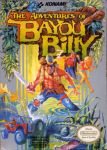 The Adventures of Bayou Billy
aka Mad City
Platform: Nintendo Entertainment System/Famicom
Released August 12, 1988 (Famicom)
Designed by Nakamoto Ichigou, Moon Nakamoto, Susumu Kusaka, & Azusa Fujimoto
Developed by Konami
Uses NES Zapper (Optional)
NEVER BEEN RE-RELEASED
Cathy’s Gunplay: Limited (2nd segment, boss fights)

Crocodile Dummy. By the way, this is the only game in this feature where I’m the sole verdict.
Light gun games make fine coin-ops because a limited shelf life doesn’t factor in. By the time the gameplay gets old, you’re out of quarters. Again, hypothetically, at least. With home games, however, you need something a little bit more meaty. More substantive. Hypothetically, Bayou Billy is the ideal use of a light gun. Same with Lone Ranger. The combination of traditional gameplay and controls that also includes the situational use of the light gun by all rights should make for a more immersive experience. And yet, very few games tried this with light guns. In fact, only Konami really went all-in on this with a few games, and to their credit, they kept trying over and over to make it work. Bayou Billy is essentially the first game in a trilogy of genre smörgåsbord, followed by Laser Invasion (which I opted to drop from this feature, but everyone else was game for) and then Lone Ranger. It’s astonishing that they attempted what they did with Bayou Billy again, because folks, this game is absolutely f*cking terrible.

This is the light-gun section, which is probably the gameplay highlight as it rises to the level of average. Now, this is very important: in the US version, Bayou Billy’s controller + zapper game is A MODE, but in Japan, Mad City’s controller + zapper is B MODE. I have no clue why they changed it.
And mind you, I’m playing the kinder, gentler Japanese ROM. You’ll want to visit Cutting Room Floor’s page that’s dedicated to the regional differences between the two versions. It’s been through even more extensive changes than Castlevania III: Dracula’s Curse. For the United States, Bayou Billy is the first game verified to have been beefed-up in order to “rental proof” it. In other words, they scaled up the difficulty to an insane degree so that children couldn’t beat the game and be done with it in a weekend rental, hypothetically forcing them to buy the game in order to put enough time into it to conquer it. I played the US build years ago and it’s so prohibitively difficult that there’s no potential left for fun. It’s weird to me that developers/publishers couldn’t comprehend that they were subtracting fun while adding cheapness. So, I’m opting instead for a modified Japanese ROM. The version I’m playing was the original intention of the designers, and what’s left is a game that both seems ambitious and too conservative. How’s that possible? Those are two contradictory development mindsets.

You can’t really see me in this picture so I put an arrow. This is the safe spot for hitting enemies. If you throw a punch from the normal, expected distance, enemies will likely counter attack immediately. Throw punches from where I’m standing in this picture and they’ll just sit and take them. It looks terrible and isn’t great for immersion, but it works.
Well, that’s because the ambition stopped with the scope itself. Every component of Bayou Billy is a lesser version of a better game. There’s a Double Dragon-like brawler, only it’s extremely limited. You get a punch, a kick, and a dropkick. That’s it. No throwing. No blocking. Even worse is that the combat lacks OOMPH. The NES Double Dragon has many flaws, but the violence feels authentic. Bayou Billy feels stiff and the actions disconnected from the consequences. Plus, even in the nicer Japanese ROM, the enemies have a fairly inelegant strategy of just matching you punch-for-punch unless you fight the way I did in the previous picture. That’s the only method that keeps them from counterattacking. Moving up and down might work but eventually they will get shots in. Or you can just throw hands and hope for health refill drops, which do happen. There’s also a tiny assortment of weapons, but the fun ones, like guns? They’re far too rare. I spent most of the time with throwing knives which have to be retrieved before you can use them again. But, when enemies drop items, they also try to retrieve them, and so they’re right there to hit you when you go for them. Collision is really bad, too. I could swear my hit box grew bigger when I picked up a whip, because a couple times I got punched by a guy halfway across the screen. I’ve played much worse brawlers, but few that are as limited and flavorless.


There’s also back-to-back driving segments that are a typical car-based shooter with the usual oil slicks or canisters of fuel just laying on the road. You get both a limitless machine gun and a limitless supply of dynamite to throw at airplanes. Hell, why would Billy even get out of the car to fight people at all? The next two levels take place on Bourbon Street. Just run people over, Billy! Don’t you want to save your girl? I have no idea what possessed them to do the driving segments as consecutive stages, unless they were as bored playing them as I was and decided to unload them all at once. They’re as bare bones as it gets and made worse by the complete lack of a sense of speed. Some games successfully create the illusion of velocity. Not Bayou Billy. I could have imagined a little old lady in a walker flipping me the bird as she passed me.


Thus, the highlight of Bayou Billy was the light gun stages. At the time of its development, Taito’s Operation Wolf (the NES version of which is coming up later) was one of the top-earning arcade games in the world. Bayou Billy does a fair job of capturing its style of gameplay while also offering absolutely nothing new. Shoot baddies before they shoot you. Shoot bullets to shore-up your ammo. Shoot health kits for life. It’s exactly what you expect, but it’s decent enough. I think the stages are too long in general. Bayou Billy would have benefited from breaking the existing stages into bite-sized chunks and shuffling them around to more evenly distribute the car, gun, and brawling parts. In case it’s not obvious, Bayou Billy is a mediocre-at-best game. But, you can mitigate that somewhat with a proper structure that cuts a good pace. Bayou Billy didn’t even get that right. It’s a very strangely ordered game.

You can practice the modes off the main menu. For this review, Sasha, Angela, and Oscar didn’t render verdicts because they didn’t play the whole game. But, they all got to use the practice round, and they all thought the gun segments were pretty good.
As decent as the gun action is, both light gun segments overstay their welcome, just like everything else in Bayou Billy. Plus, the difficulty spikes quite a bit in the second Zapper stage, to the point that I had to hand off the gun and tag back in during the boss fight. It was just too intense. There weren’t enough ammo drops, either, and running out of ammo is an instant life loss. I also replayed the game with the cursor instead of zapper, and the experience was more or less unchanged with one major exception: items. I struggled greatly to have enough time to collect item drops while also shooting the enemies. It might be the placebo effect, but I do think they slightly adjusted the enemies for the cursors. Even if they did, that second Zapper level was the toughest segment in the game, easily.

While I was playing this, I was jokingly calling it “Single Dragon” to my family. I had forgotten that the game ends fighting twins dressed in blue and red. I don’t know if Konami is invoking Double Dragon deliberately or not, but if they are, you can’t do the shots fired thing when the game you’re challenging is better than your game by several orders of magnitude. By the way, I beat them by walking around in a circle and smacking them once with a whip each full cycle. What a boring finale to end a boring game. However, I did legitimately LOL that you can get a “bad ending” by refusing to hug your lady love when she’s recused. Then I thought about it and was like “wait, you programmed that kind of thing in a game THIS bad? Wouldn’t that time have been better spent adding fun elements to the gameplay?”
It’s hard to say that I admire that Konami tried to make “the everything” action game, because Bayou Billy really does nothing right. It’s a game that feels like it settled for competence, and that’s frustrating. I can’t even say the concept is sound, because it’s really just a dollar store Crocodile Dundee knock-off crossed with a dollar store Indiana Jones knock-off. Look, action games of the era copied what was trendy and popular, and I can dig it if the gameplay is good. But, when it’s not? Well, then it’s really just a cynical cash-grab, right? I’m not sure why Konami even bothered beefing the game up to the degree they did. There was nothing all that likable about it in the first place. There were better options for all three genres featured in Bayou Billy, and claiming to be a three-in-one game is disingenuous. It’s one game that’s consistently below average except maybe a pair of light gun levels that barely qualify as “okay.” Konami has made worse games, but few are as soulless as The Adventures of Bayou Billy.
Verdict: NO!
 Baby Boomer
Platform: Nintendo Entertainment System
Released in 1989
Designed by Jim Meuer
Published by Color Dreams
Uses the NES Zapper (Optional)
NEVER BEEN RE-RELEASED
Cathy’s Gunplay: Limited

This was the first game we played in this feature, and it took about twenty seconds for me to say “well, this feature is off to a flying start.” After all the prep work that went into this project, we really thought our light gun was broken thanks to that urine rain cloud. The gun works fine, but that target is just awful. We pumped so many bullets into it, but it never actually activated via the light gun until it was too late. We shot it and shot it and shot it but it would not drop the ice that creates the bridge until the baby was under it. As the calibrating game for this feature, this showed us right away the gun was fine because of the targets that we could shoot anywhere. Only that yellow target failed. Well, eventually we did figure it out. The target isn’t the whole cloud. You want to only shoot a little right to the center. Where exactly to shoot to create the snowflake that fills-in the gaps is a consistent problem.
Baby Boomer is apparently one of the more (in)famous unlicensed NES games, as it’s one of the only two unlicensed games that uses the NES Zapper. At first, I thought it was going to be something like Gumshoe. However, unlike Gumshoe, you don’t have to shoot the character to platform around. Instead, this is basically what the Super Famicom mouse game Mario & Wario was originally going to be before they replaced the Super Scope with the SNES Mouse: protecting a helpless person by clearing their pathway. In this game’s case, it’s a hapless baby crawling along various playfields. While the targets are mostly smaller than a lot of light gun targets, we had no problem shooting most of them. The radioactive snow cloud above was one of the very limited problematic targets, and it only seems to be yellow to give you awareness that some clouds can be shot. Later in the level, the necessary clouds are now white. A bigger problem is you often have little to no warning of a target, and because the baby’s death collision with the elements isn’t sprite-accurate, you might have only a split second. Like this cat:


This would be a great target if the collision were 1 to 1. It’s not, and it’s sprung on you too quickly. This is the first level, mind you! And that’s before I get to the problem of some of the fastest moving targets in any light gun game. The first stage, I could pretty much play without any epilepsy risk once my family told me what the targets were, which were predictable enough and usually based around having to just react fast. That’s not the case in the second level, where a dog that appears to have snorted all the cocaine in the world is bouncing around. It’s so inelegant and bad, and I couldn’t do it, at least with the gun. But hell, my family who could fire the gun so much it made the screen look like a rave struggled to hit it too. Angela, while grabbing screenshots, couldn’t click it with a mouse! This is bad, folks!
And then the game goes truly nuts from the third level, which can be heaven or hell, until the credits roll. There’s so many different things coming at you all at once, and in many cases, you have a split second to react. Whether you play by yourself or with help, you have unlimited bullets, but it’s just a matter of how fast things come at you from different directions. Plus, you have to shoot the milk bottles, because you run out of energy and somehow shooting the bottles magically teleports it to the baby’s stomach. In addition to all that, there’s things you don’t want to shoot. In the Hell section (I assume it’s hell, though I don’t see any copies of Baby Boomer laying around so I couldn’t be sure) there’s torches on the screen, and shooting them causes them to start generating an endless stream of tiny little sentient sparks with smiley faces that chase you from the front and back. Accidentally shoot a torch and you have to continuously shoot the sparks until the torch scrolls off screen. This is in addition to shooting a lot of enemies on short notice.

“This would really play better with a machine gun!” was said by everyone in the group about 500 times. I honestly don’t remember any 2D light gun gaming having so much stuff to shoot all at once. You’ll want to play this co-op.
I think that Baby Boomer’s problem is it doesn’t take into account whether you’re playing solo or co-op. Yep, co-op! One player controls the cursor while the other has the Zapper. My unofficial motto at Indie Gamer Chick is “find the fun” and if there is fun to be found in Boomer, it’s probably in the co-op. Because of the volume of targets after the second world, I couldn’t play co-op on the harder stages. While it took the edge off having someone else to cover targets, it still becomes overwhelming. The general problem with Baby Boomer is the concept is solid but the sprites aren’t big enough and where exactly to shoot some targets isn’t clear. Technically you can see all targets whether the special effects are showing them or not, since all potential targets have their target frame exposed every time you pull the trigger. While the enemies are (mostly) easy enough and the “good” parts of the game, the clouds or tombstones or stalactites that you have to shoot to create bridges across the gaps are just too damn fickle. Angela and Sasha became dead eyes with the gun, but they still struggled to shoot the parts that activate the droplet that creates the bridges across the gap. And while I’m on the subject, you absolutely have to create those with plenty of room to spare. Even if the bridge is CLEARLY formed before the baby starts crawling across it, if it’s remotely close, the baby will still fall through the bridge. It’s infuriating.


For the sake of being thorough, I played solo with only the cursor, which thankfully doesn’t flash like the light gun does. If the game had multiple modes that changed depending on if you’re using the gun or not, it would be more helpful. The problem is that the game still resorts to spawning enemies next to him in a way that normally needs to be dealt with via a quick draw, which is fine if you’re aiming a gun. It’s as fast as you can move your wrist. But with the cursor, you have to keep the cursor by the baby to guard against enemies, but also shoot clouds or other bridge-building targets that might be well away from the baby. Honestly, I expected Baby Boomer to be a lot worse than it actually is, given its reputation. This was actually a closer verdict for all of us than I figured going into it. I think had they done the same game with better tech, it’d actually passed. I’m disappointed it didn’t because it was close to me being able to make an “okay Boomer” joke. I was also going to say “someone ought to remake it” but apparently a sequel did come out this year on PlayStation and PC. That’s strange because I was certain this baby was aborted in 1989.
Verdicts – Indie Gamer Chick: NO! – Angela: NO! – Oscar: NO! – Sasha – NO!
 Operation Wolf
Platform: Nintendo Entertainment System
Released March 31, 1989
Developed by Taito
Uses the NES Zapper (Optional)
NEVER BEEN RE-RELEASED
Cathy’s Gunplay: Did not use a gun at all.

This is one ugly game, too.
Operation Wolf was the only game in this feature my family said “no” to me playing. “No debate. You’re not doing this one.” All light gun games flash, but Operation Wolf’s NES flash was the most violent by far, and that was that. My family didn’t like the Zapper gameplay at all, saying that the shooting never felt accurate. “They didn’t calibrate the gun shot frames right. The boxes are too big.” And besides that, this one bothered THEIR eyes. Yikes. Playing with the cursor wasn’t much better-sounding than their experience. The movement speed was mostly fine, but there’s absolutely no POW to the shots. It’s hard to tell what’s going on because there’s so little detail, and what’s here is too blocky and ugly. I can deal with ugly graphics if the gameplay is fine, but Operation Wolf feels like it was thrown together in a month.

I died just as often from running out of bullets as I did taking damage.
Hell, it’s hard to tell when you’re being shot at all. Not that I would prefer violent strobe lights, but the sprites are too small and the effects too subtle, making it too difficult to figure out which block of sprites is the most immediate threat. There’s far too many whammies, too. The stupid idiots that run across a live battlefield, right down the center, and because collision boxes are so big, it’s too easy to hit the innocents. Now, Operation Wolf is an arcade conversion, and I was curious how bad a job they did. But, I couldn’t play the coin-op version either. I needed some help. Thankfully, I found it.
 Operation Wolf
Platform: PC Engine
Released August 31, 1990
Developed by Taito
Never Released in America
NEVER BEEN RE-RELEASED

Much better.
Okay, so this has no place in an NES/SNES Definitive Review, but this cursor-only Japanese exclusive TG16 version of Operation Wolf successfully pulls off what its NES little brother can’t. The cursor works pretty good and even has three adjustable speeds. My only problem there is that you can only adjust them at the start of the game. I mean, that’s not my only problem with the game. I was pretty annoyed with enemies who linger at the edges of the screen, where the cursor can’t reach. It’s not good for immersion that the smaller soldiers take multiple hits to kill and pose a bigger threat than the gigantic helicopters and boats. There’s also not enough health refills, especially considering that there’s situations where you just have to accept that some damage is inevitable.

I offered to let my family try playing this version with the cursor, but they all declined. We’ll be doing the coin-op in the not too distant future, and they’re waiting on that.
But, Operation Wolf PCE is nowhere near as hard as its NES counterpart. When I changed my strategy from “use the bombs on the big vehicles” to “use the bombs on the clusters of smaller soldiers” I flew right through Operation Wolf. Did I have fun? A little bit, I guess. The collision is vastly improved, and while it’s still somewhat lacking in satisfactory violence, this is basically as good as it gets when you replace the gun with a cursor. Why anyone would want to play that type of game in the first place, I’m not entirely sure. But, if you were a BIG fan of the coin-op Operation Wolf’s action and not just its gunplay, this was fine. My family saw me play this and they were bummed there was no light gun for the PC Engine. In 2025, we’ll look at arcade light gun games, but for now..
NES Verdicts – Indie Gamer Chick: NO! – Angela: NO! – Oscar – NO! – Sasha: NO!
Indie Gamer Chick’s PC Engine Verdict: YES!
 Shooting Range
Platform: Nintendo Entertainment System
Released June, 1989
Developed by Tose
Published by Bandai
Uses the NES Zapper
NEVER BEEN RE-RELEASED
Cathy’s Gunplay: Limited


It turns out, we didn’t play Shooting Range the right way the first time. Somehow, none of us thought to see if the game scrolled. So, I junked the previous review and started over, and Shooting Range was transformed from “possibly the worst game I’ve ever played” to merely a mediocre light gun game. Unlike Gotcha, where scrolling gave the game an unintended sense of cooperative progression, the controller gameplay here doesn’t really add a lot. Without a radar or any means to know or even logic-out where the targets will be, the ability to scroll doesn’t add anything. The levels are still small and still only spawn a couple targets at a time. The backgrounds don’t seem to be interactive at all, so it really is just a series of facades that have characters with pinwheels (the actual targets) scroll back and forth. There’s also a bottle-shooting “bonus stage” and a party game mode where you shoot lights to raise up targets like whack-a-mole.
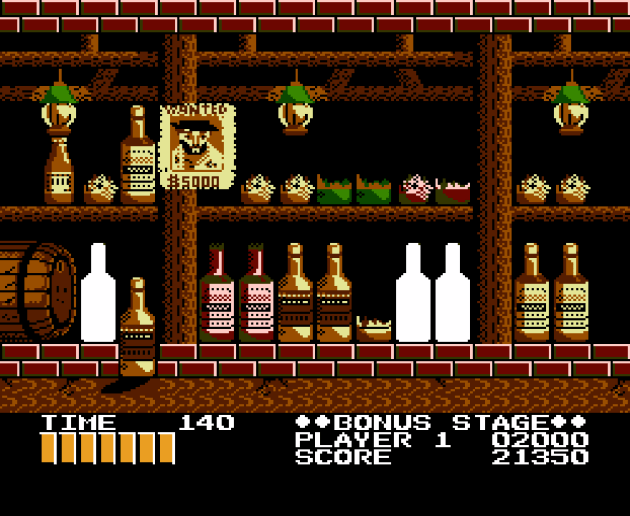
The way the bottle shooting mini-game is set up is so stupid. Some of the bottles light up white, which are when you can shoot them. Except, they don’t stay white long, sometimes only being lit for a split second. There’s also no logical pattern to them.
Apparently it is still possible to not see enough targets that generate enough points to clear a stage, which is what led to me declaring Shooting Range the “worst NES game.” I thought scrolling fixed that, but Angela again didn’t see enough total targets to have defeated the Haunted House stage. She never got the targets that generate hour glasses that increase your time. It wasn’t as consistent as our previous session (the one where we somehow never attempted to scroll), but the fact that it still happened once is damning. Plus, some of the targets are also exceptionally hard to hit, especially these little nose-creatures on the Haunted House stage that wiggle back-and-forth, where we presume the light gun’s latency factors in. Shooting Range still isn’t very good, but I’ll grant it this: it’s not the absolute worst NES game I’ve ever played. Oh, it’s up there, but not THE worst.
Verdicts – Indie Gamer Chick: NO! – Angela: NO! – Oscar: NO! – Sasha: NO!
 Chiller
Platform: Nintendo Entertainment System
Released in 1990
Designed by Christopher Erhardt and Scott Schryver
Developed by American Game Cartridges, Inc.
Uses the NES Zapper
NEVER BEEN RE-RELEASED
Cathy’s Gunplay: Mildly Limited
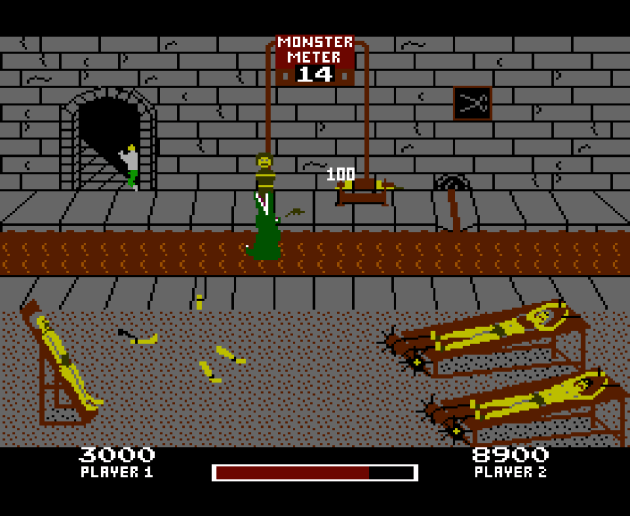
If you think this is bad, you should see the stage I can’t post here. Even though the NES version is so ugly that you can’t really see small details, we decided not to let 9 year old Sasha play this one.
The original 1986 arcade version of Chiller was one of the first gratuitously gory video games. Far more violent than the first few Mortal Kombat games. This includes scenes of systematically dismembering humans in torture devices with a gun. It’s truly horrific, especially by the standards of 1986. When Chiller came out, the violence in it would likely be considered too extreme even for an R-rated movie. So, why wasn’t it subject to the type of congressional hearings violent games of the 1990s got? Because the majority of arcade owners wouldn’t buy it. Hard to be outraged about kids playing a game that was self-censored by the industry at large. The NES port is tamer, but only by virtue of how ugly it is. So ugly that my dad said “this isn’t an Atari 5200 game?” Oh, there’s blood and torture, including squashing someone’s head in a vise. It doesn’t start out that way though. Actually, that’s what’s most strange about Chiller. It starts as a gory but otherwise mundane Haunted House type of shooter. This is the first two levels.


So, it’s quite strange how the game loses its mind in the third and fourth levels, taking the game from something which is shocking for its time but nothing too scandalous to outright torturing and murdering humans in genuinely sadistic and cruel fashion. Oh, it’s absolutely cynical. Exidy was clearly courting controversy, which to their credit, is a viable market strategy. Mortal Kombat proved that, but MK pulled it off because it gradually built the degree of violence up each installment. Chiller is jaw-dropping extreme right from the get go. But, the NES can’t do the detailed graphics of the coin-op, which removes whatever sick satisfaction that’s presumably the point of playing a game like this in the first place. Chiller is basically like an old fashioned boardwalk or carnival shooting gallery. You have about forty-five seconds to shoot X amount of targets. It’s called the “Monster Meter” but any target counts (except the dog in the second level). This was the rare game in this feature that we’re fairly certain wasn’t working correctly. Strangely, the flash point is a red light instead of a white flash. I don’t know if that’s why this barely worked, or maybe the collision boxes are too small. I strongly doubt anyone bought the Sinden to play the NES version of Chiller, but beware with this one.
Verdicts – Indie Gamer Chick: NO! – Angela: NO! – Oscar: NO! – Sasha: Didn’t Play
 Mechanized Attack
Platform: Nintendo Entertainment System
Released June, 1990
Designed by Tara Chan
Developed by SNK
Uses the NES Zapper (Optional)
NEVER BEEN RE-RELEASED
Cathy’s Gunplay: Very Limited

Mechanized Attack is Terminator in all but name. Hell, I’m stunned that Mechanized Attack wasn’t subject to a lawsuit. Look at the arcade flyer. By the way, the Arcade Flyer Archive is awesome.
“A better version of Operation Wolf” is how my family described Mechanized Attack, one of the games I got the least light gun time with. Like, a minute or two. My family, who had never heard of the game, correctly guessed that, like Operation Wolf, it was meant to be played with a machine gun. “Why the hell would you do a machine gun game on a console that can fire one bullet every second at most?” Good question. Mechanized Attack has too many people attacking from too many different spots on the screen for a gun that has to be fired one pull of the trigger at a time. In arcades, this happens because there’s two machine guns for co-op. You can’t just copy THAT gameplay to the NES. And then the bosses fire machine guns that you can’t defend against, so damage really IS inevitable. They got me to a spot with only a couple enemies to let me squeeze the trigger a couple times, and yea, the enemies take too many shots to kill from too many spots on the screen. Awful. Sasha disagreed, saying “I think if I practiced I could probably beat this. It’s tough, but it shoots well!” Fair enough.
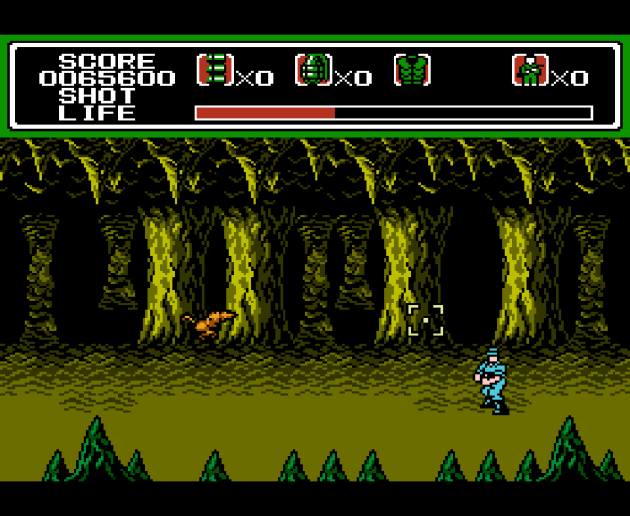
I’ve really not been impressed with any SNK NES games, but this one is especially frustrating.
My consolation prize was getting to play the game with a cursor, which wasn’t any better. NO adjustments were made, so enemies shoot you from opposite sides of the screen. Sometimes several spots at once, like a boat that has machine guns on it. Okay, that would be fine if the game had some kind of balance with items, but it’s VERY stingy with health refills. I also ran out of bullets on pretty much every level. When this happens, you still get to fire about one bullet every couple seconds, which can be used to pick up items. But hell, the odds are so stacked against you with the cursor instead of a light gun that the game would have GREATLY benefited from unlimited ammo. Especially considering that many enemies take multiple hits to kill. I have nothing positive to say about Mechanized Attack, and they really were foolhardy trying to port machine gun games to the NES. I did this review before I did Operation Wolf on the TG-16, and before that, I said “it’s not possible” but that game proved it did. So while I still think it’s a bad idea, it can be done in a playable way. This just didn’t care, and it’s one of the worst games I’ve ever reviewed. I’ve said that a lot during this feature.
Verdicts – Angela: NO! – Oscar: NO! – Sasha: YES! Indie Gamer Chick (Controller-Only): NO!
 Barker Bill’s Trick Shooting
Platform: Nintendo Entertainment System
Released August, 1990
Developed by Nintendo
Uses the NES Zapper
NEVER BEEN RE-RELEASED
Cathy’s Gunplay: Mildly Limited


Trick Shooting consists of a few mini-games that we were originally going to review game-by-game, like we did for Super Scope 6 (which we did before this, before I decided to order the games chronologically). However, the games here are too simple and limited to really justify individual reviews. In fact, they’re so simple that even the original Zapper Trilogy probably had more depth. In Balloon Saloon, you have to shoot balloons that emerge from a center platform that zig and zag randomly as they rise out of the playfield. The catch is that sometimes the Duck Hunt dog (it’s named Duck Hunt, right?) pokes his head out of the platform, so you can’t shoot too close to where they emerge. Flying Saucers is a plate shooting game where Bill and his assistant each throw a plate. You get bonus if you shoot both plates with one shot, which isn’t always possible, and you also have to avoid shooting a parrot that sometimes flies in front of the plates, and other times will grab one and fly off. In Window Pain, you have to shoot random objects as they fall down one of six channels, with each channel divided into five segments. The catch is that you can’t shoot any segment that has a covered window, with a random pattern each session. The fourth game is really a marathon of the three modes above, plus three more games, one of which might not work great with an LCD light gun.


Trixie’s Shot and the Slot Machine appear after a complete cycle of games. In Trixie’s Shot, you just shoot the diamonds she presents, again avoiding the parrot and shooting the diamonds it tries to steal (but not the parrot itself). During the second cycle, she throws the diamonds out, making this require a fast draw. The slot machine has reels slow enough that you can time them, shooting each real when you’re ready to stop. After two full cycles, you play Bill’s Thrills, where he throws an object high in the air, above the screen, and you have to shoot it before it lands on her head. This is the one we all struggled with, as the object comes down pretty fast, and none of us hit it until we started spamming shots. We believe it’s a To The Earth-like situation where it’s fast enough for the latency to affect it. Not that it would have made a difference. One thing we REALLY liked about Barker Bill is that this is the first game that tells you what your shooting accuracy was after each game. How on Earth did it take this long for any game to figure that out? Trick Shooting was the final Zapper game from Nintendo, and their “so long and farewell” to the Zapper, eh, it’s fine. The kids thought it was boring.
Verdicts – Indie Gamer Chick: YES! – Angela: – NO! – Oscar: YES! – Sasha: NO!
 Super Scope 6
aka Blastris & LazerBlazer
Platform: Super Nintendo Entertainment System
Released February, 1992
Directed by Yoshio Sakamoto
Developed by Nintendo and Intelligence Systems
NEVER BEEN RE-RELEASED
Cathy’s Gunplay: No Limitations to Very Limited (specifically Engage and Confront)

More like Super Scope 2×3.
Before starting this review, I just want to say you can’t appreciate what an enormous pain in the ass getting the Super Scope games to work was. We’re not even sure what we did that started them working right. Anyway, this is six different mini-games, three of which are part of “Blastris” and the others in “LazerBlazer.” The three LazerBlazer games are essentially the first in a trilogy of Super Scope games by Intelligence Systems, followed by Battle Clash and Metal Combat: Falcon’s Revenge. We briefly became excited when we saw a couple two player games, assuming that they would be controller/gun combos. They’re not. They’re hot seat games and not worth the time or effort of setting up the two player experience. Since the games are mostly dissimilar, we’re breaking this up into six separate reviews.
SPLIT DECISION: Blastis – Game A

Getting a Tetris is often luck, and it’s not even scored like a big deal anyway.
Despite using the standard 7-block Tetris roster, Blastris is a Tetris game in name only. You have no control over where the blocks fall. Instead, you use the gun to shape the blocks wherever they’re randomly assigned to drop, with the stack being turned on its side. As long as block segments in the stack aren’t touching any others, they’ll fall to the bottom. Oh, and you only get two bullets for every falling block, making this the only game in Super Scope 6 with any limit to your ammo. However, you bank any and all unused bullets until you die or create five lines, and can even use bullets to shoot blocks already in the stack. The only goal is always to get five lines per stage no matter how deep your run goes. Being at the mercy of random positions in a well that is only ten segments tall was a deal breaker for me. Had this same game been made with today’s wide screens, it would have been better. But, too often, the game got stuck giving me blocks on one side while I waited for something, ANYTHING to fall where I had a gap waiting on the other side. So, I didn’t really like Game A, but Nintendo really ought to consider a Blatris remake, because there’s undeniably something here. A bigger playfield and modern drop algorithm might make this work.
Verdicts – Indie Gamer Chick: NO! Angela: NO! Oscar: YES! – Sasha: NO!
SPLIT DECISION: Blastris – Game B

Before this orange block landed, I died because a second block fell on the left stack.
As with Blastris A, Blatris B’s random nature is the ruinous aspect. In this version, individual cubes that each have all three colors fall randomly on one of the seven channels, and you have to shoot the cubes to rotate them. A match three type of game with unlimited ammo in any direction, including diagonal, clears the blocks. There’s two versions of this, and in the A mode, you’re basically playing Dr. Mario with hot spots that you have to clear, while the second version is just “make matches” and is pretty boring. But, the hot spot game can be exciting and can be a lot of fun. You know, when it’s not screwing you over by dumping all the metal blocks onto one side. Like with Blatris A, there is SOMETHING here, and I’d even say that Blatris B is significantly better than the A game. Like the best falling block games, the potential for combos is here, especially with only three colors. I’ve seen some MASSIVE cascades and it’s always exhilarating to see a big stack get narrowed down. Try playing on the highest difficulty. A diagonal match might clear nearly half the playfield from the cascade that follows.
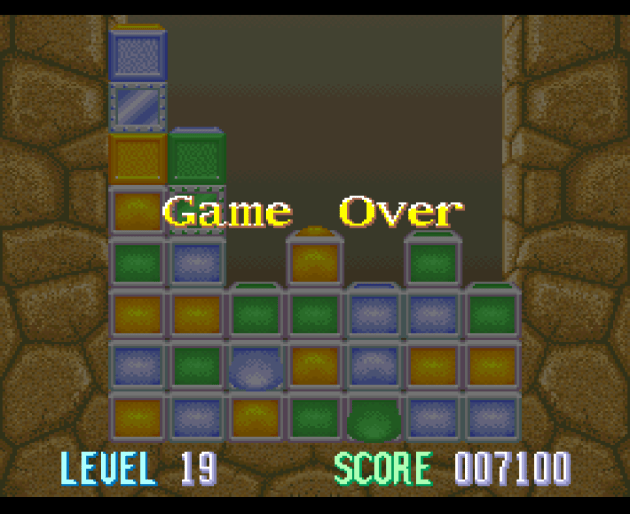
Notice that there’s not much in the way of non-hot spot blocks on this playfield. I played just about as well as one could and still lost.
With that said, once again, you have no control over WHERE the blocks drop. This is significant thanks to the metal blocks. These are only one color, and since they drop randomly, they can absolutely ruin your game. The playfield is only eight blocks tall, and if any part of the stack reaches that 8th spot, game over. I’ve had games shift on a dime because the game rained metal blocks on one side of the playfield that I had no option to defend against that blocked every possible way of clearing it. Even if you have the right strategy and your aim is true, you still can lose, and that’s just not very fun. It’s worth noting that this is one of the closest verdicts I’ve ever had at IGC, but it’s just too damn hard for me to endorse a game that you can lose by luck. Everyone else thought this was the second best game in the collection. Of course, they didn’t just review dozens of Tetris games and I did. This desperately needed a bigger playfield or some kind of help clearing the metal blocks. Again, Nintendo should REALLY consider a remake.
Verdicts – Indie Gamer Chick: NO! Angela: YES! – Oscar: YES! – Sasha: YES!
SPLIT DECISION: Mole Patrol

Why didn’t they do Duck Hunt? I mean, seriously, how many games are THE icon of their genre? How many forms of gaming even have one genre-defining icon at all? Light gun games do, and Nintendo created it. Wouldn’t the Super Scope have had a better chance at success if they had included at least one Duck Hunt game? Shouldn’t Super Scope 6 have had new versions of Duck Hunt, Hogan’s Alley, and Wild Gunman?
Mole Patrol is whack-a-mole with a gun. This is as simple as it gets: shoot the blue moles only. The pink ones are friendly and tagging one will cause the game to briefly speed up, to the point that I would be surprised if even the fastest player can use them as a strategy. Once in a while, a blue mole will fly across the sky for massive points. There’s not a lot to Mole Patrol, but it really does nothing wrong either. It’s also got a lot of personality. Shooting the moles is hella satisfying, especially since they have an evil little grin before they take their positions. They had it coming.
Verdicts: Indie Gamer Chick: YES! – Angela: YES! – Oscar: YES! – Sasha: YES!
SPLIT DECISION: LazerBlazer – Intercept
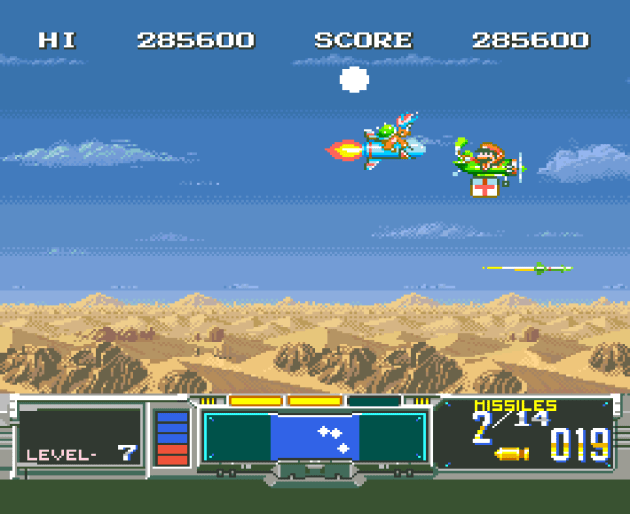
Shooting the Koopaling down recovers a miss. Shooting down Mario gives you one. The game REALLY needed to spawn these two more often. In some sessions, they didn’t appear at all.
Intercept is another game that feels like it’s more or less in the same style as classic light gun games. This is a light gun take on the classic periscope-style arcade games. You have to shoot down a surprisingly large variety of missiles that are at various distances in the background. The further in the background they are, the further ahead you have to shoot the gun. Your ammo travels somewhat slowly into the background, so you have to measure out your shots. Some of the missiles take so long for the interceptors to reach them that you have to shoot about a third of the screen ahead of your target.

If not for Sasha, this would have been the unanimous choice for “best Nintendo light gun game.”
I was really bad at Intercept. Like, embarrassingly bad, especially considering the game does give you a teeny tiny amount of grace going up and down. But, this was my choice and everyone else’s choice for the best game in Super Scope 6. Hell, the rest of the family all wanted turns, too. Intercept is both exciting and well executed, and the cameo by Mario adds just the right amount of flavor to it. We all walked away from it wishing we could have played it with the real bazooka for true immersion. Real crowd pleaser too, as we were actively cheering each other on the tougher levels. Hitting the deepest shots is so satisfying, even after you have them well clocked. As simple as the concept is, Intercept is my choice for the best overall game on the entire SNES Super Scope, and maybe Nintendo’s best light gun game ever. It has my vote.
Verdicts – Indie Gamer Chick: YES! – Angela: YES! – Oscar: YES! – Sasha: YES!
Unanimous Choice: Best Game in Super Scope 6
Cathy, Angela, and Oscar’s Choice for Best Overall Game in this Feature
SPLIT DECISION: LazerBlazer – Engage

Booooooooooooooring.
Okay, maybe I was wrong about Mole Patrol being the most simple game in Super Scope 6. My time with Engage was very limited because when a missile makes it through your defenses, it results in a fairly violent strobe effect. Thankfully, I didn’t need much time. Engage is kind of like intercept from a first person perspective, only with significantly less variety. You have a limited amount of fuel, but really that’s going to run low no matter what you do. You have to shoot enemies with the same type of shots that you get in Intercept, anticipating the position the enemy will be in by time the bullet reaches them. The object is killing X amount total enemies to clear a stage before fuel runs out. You also then have to shoot a refueling ship between levels, but to the best of our knowledge, it never gets tougher than a single shot on one large stationary target every time. We only found out you can screw that up because we were bullsh*ting between levels and then it was “whoopsie, ye dead.” I guess this was added for immersion, but all it does is increase the break between the action. The enemies don’t shoot back, and instead, the danger comes from the incoming missiles that were the cause of me not getting to play this more than five minutes on later stages. The missiles sway back and forth and, in later levels, my family had to spam the screen to have any hope of hitting them, which cost bonus points at the end of stages. Engage isn’t awful or anything, but it’s pretty damn uninspired. Maybe the single most generic thing Nintendo has ever published.
Verdicts – Indie Gamer Chick: NO! – Angela: NO! – Oscar: YES! – Sasha: YES!
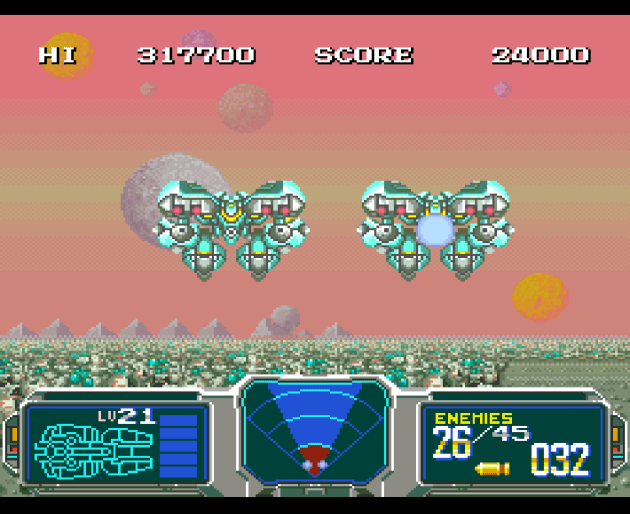
The final two games in LazerBlazer are nothing special, but this one is “nothing special” on the right side of the fence.
SPLIT DECISION: LazerBlazer – Confront
Confront isn’t all that different from Engage, only now the bullets are fast moving ballistics instead of slow-moving interceptors. Now, you can tag enemies off into the distance as soon as they appear, even if they’re up by the score. We all went several levels where the enemies were mostly nothing more than dots. Also, this time it’s the enemies themselves that shoot at you, and they have much more complex attack patterns. Unfortunately for me, when enemies land a shot on you, it features the same violent strobe effect as Engage. However, Confront just works better in every way and is my pick for the runner-up of the collection. Not only does it have a LOT more personality than Engage (so does your average piece of plywood) but the gameplay is better. Enemies have more complex attack patterns, but there’s also massive satisfaction to be had by going on an extended streak of hitting far away targets. Since this is the last game in the set, I figure I should note that none of the Super Scope 6 games have dynamic scoring. The same games done today would probably have combo effects and bonuses instead of keeping everything in the wrap-up. Not every light gun game needs that stuff, but Super Scope 6’s games probably could have.
Verdicts – Indie Gamer Chick: YES! – Angela: YES! – Oscar: YES! – Sasha: YES!
 Battle Clash
Platform: Super Nintendo Entertainment System
Released October, 1992
Directed by Makoto Kano & Masao Yamamoto
Developed by Intelligent Systems
Published by Nintendo
Uses the SNES Super Scope
NEVER BEEN RE-RELEASED
Cathy’s Gunplay: No Limitations

Hey look, Toad Man from Mega Man 4 grew up!
A couple games in Super Scope 6 had me wondering if I would have enjoyed the experience more if I had the real bazooka on my shoulder. Intercept for sure. Mole Patrol? Probably not. Well, either way, I don’t question that with Battle Clash. I imagine it would have been exhausting, and probably cause for a sore neck. This thing was made for the boilerplate arcade light gun, like the Sinden. Think of Battle Clash (and its sequel, Metal Combat) as something like Punch-Out!! or even Cuphead with light guns. A boss-only game where you have to shoot down a series of nine giant robots by finding the weak spot in their armor while also defending yourself by shooting down their attacks.
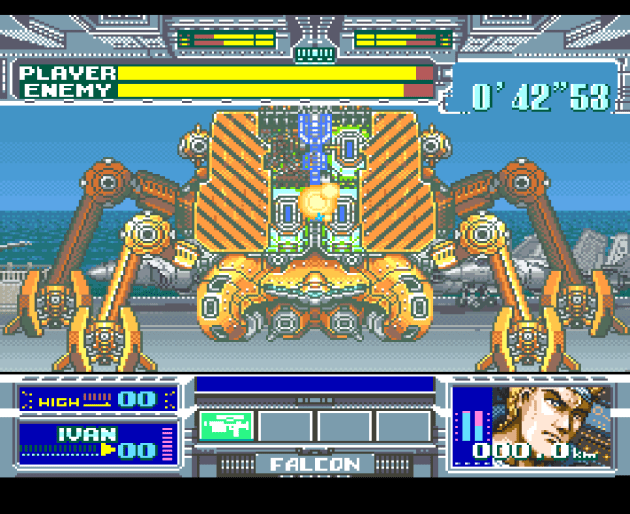
The difficulty scaling is the turd in Battle Clash’s punch bowl. It’s not even close to right. This here should have been the second to last battle, or even half of the two-part final battle. Instead it’s smack-dab in the middle of the game.
Getting to the bad part first: you will feel a tiny hint of latency in Battle Clash. Not a constant, niggling lag. A few brief but pronounced moments that are actually ALWAYS there, but you won’t notice until some kind of quick movement happens. Because the bosses are staged with attack patterns that cause the camera (which you don’t control) to swing wildly, you’ll feel latency. It’s not a deal breaker and it’s easy to course-correct thanks to the game’s machine gun. Except, the machine gun doesn’t do a ton of damage. Only the charge shots do, but we all struggled to hit those. You charge-up the gun by not shooting at all, so it’s impossible to swap directly from the machine gun to the type of blasts that inflict real damage. Frankly, the machine gun is basically useless as anything but a means of calibrating your aim. This might be a game where, if your emulator features a crosshair on the screen, you might want to consider turning it on, even if it does nerf things. We didn’t use those, but that’s because my father went on a tirade about how he didn’t spend $100 just to have a gun be aimed for him. I’m about to shower Battle Clash and Metal Combat with praise, but a faint hint of lag is there no matter what you do and this probably isn’t as good now as it was on the SNES.

And yea, the designs are a little generic and forgettable.
The good news is there’s really nothing quite like Battle Clash in the light gun genre, except its sequel. It’s not amazing or anything. I think it could have been, but the characters are all so damn generic, as are most of the boss designs. But with that said, the trial-and-error gameplay actually does work pretty good and it’s satisfying to blow apart the gigantic bosses piece by piece. The best thing I can say about Battle Clash is that it’s one of the few linear-style games in this feature that everyone wanted to play through to the end. Even Yoshi’s Safari, which was the game that everyone thought had the best raw gameplay, didn’t have everyone wanting to sit and finish it. Yoshi’s Safari is too repetitive getting to the bosses, which is the real meat of the game. Battle Clash is sort of like that, only it cuts the fat and can be finished in about a half hour, and that’s perfect. Plus, there’s time trials too, which we got some bonus enjoyment out of. The sequel is better (and that wasn’t universally agreed upon), but experiencing both games back-to-back is probably the perfect way to enjoy a console light gun.
Verdicts – Indie Gamer Chick: YES! – Angela: YES! – Oscar: YES! – Sasha: YES!
 Bazooka Blitzkrieg
Platform: Super Nintendo Entertainment System
Released November, 1992
Developed by Tose Co. Ltd
Published by Bandai
Uses the SNES Super Scope
NEVER BEEN RE-RELEASED
Cathy’s Gunplay: No Limitations

Maybe the Super Scope did so badly because so many of the early games so completely lack personality. I didn’t think Battle Clash was that memorable either.
When I sampled nearly two hundred SNES games in 2021, I put Bazooka Blitzkrieg in the bottom 13%. If you have a light gun, it’s not THAT bad, but it’s pretty awful. The problem is that BB is one of those games that gates based on difficulty. Play the easiest mode and you only get three levels before the game says “your training is complete! GAME OVER!” Oh, eat a butthole, game. Bazooka Blitzkrieg is one of the most half-assed, generic games in this feature. Weirdly, it seems like they were trying to fill the gap left by Terminator 2: The Arcade’s absence. At this point, that hadn’t gotten a home port. The best thing I can say about BB is that I think it’s probably better than T2 was, at least on the SNES. T2 was easily the most bored I was making this feature, to the point that I considered cutting it AFTER we’d finished playing it. Blitzkrieg was pretty boring too, but at least it has some really big annoyances to talk about. Like, for example, this:

Can you see the two robots? Well, the guardrails block your shots, so in order to kill the ones hiding behind the scenery (and THEIR bullets get to hit you), you have to shoot the very corner of their shoulders or arms, which barely stick out. Who was the complete f*cking moron that came up with that as a gameplay concept? Nobody wants to play a gun game that incentivizes grazing enemies. It’s just so stupid that it shouldn’t even have to be said, right? And it doesn’t even make sense logically. They’re robots, for god’s sake! They can’t take a scratch to their shoulder? Are you kidding me? Or the fact that you only get one life per run, though there are continues. Or, how about an item that costs you so much life it’s often an instant game over if you shoot it? By the way, that skull is always dropped in a way where it crosses in front of an enemy. Trollish for the sake of it.

What absolute garbage.
The verdicts on Bazooka Blitzkrieg were, to say the least, not unanimous. Actually we got into a really big argument over it. Sasha, being the wise for her age child that she is, was in agreement with me: BOOOOORING. See, that’s why she’s getting IGC when I quit. I had disinherited her after Mechanized Attack, but she got the train right back on the track. Dad and Angela thought this was fine, and actually, Dad thought this was really good. “What’s your problem? The targets are big and they don’t move so fast that it throws the gun off. The game isn’t stingy with missiles. The bosses don’t take a billion shots. This seems like something you should like!” Maybe, but I think personality matters. I think the setting and theme matters more, because all these light gun games bleed together. You all are reading this 16th, but this was the last game we did because I really thought it was going to be awful. In fairness, I was wrong, and for all my bitching, Bazooka Blitzkrieg is probably okay from a gameplay perspective. If you’re into the Operation Wolf or T2 style auto-scrolling gunners, you’ll like this a lot more than me. I admit that even its mistakes aren’t that offensive. My NO! isn’t with malice, but this feels like Bandai’s Power Ranger efforts: rushed, efficient, and dull.
Verdicts – Indie Gamer Chick: NO! – Angela: YES! – Oscar: YES! – Sasha: NO!
 X-Zone
Platform: Super Nintendo Entertainment System
Released November, 1992
Developed by Kemco
Uses the SNES Super Scope
NEVER BEEN RE-RELEASED
Cathy’s Gunplay: Very Limited
Wow, another vanilla paste sci-fi shooter.
X-Zone is yet another generic shooter with absolutely no personality. Jeez, there were a lot of those for Super Scope. This one has some mild Mode 7 effects, but the real problem is the difficulty. On Normal, the game spams the screen with so many different projectiles from so many different directions that you’re basically always playing defense. There’s no power-ups to the gun and enemies are pretty damn spongy. You can lock on for homing missiles (four at a time) but those were worthless. I only got to play the first stage and part of the second stage of X-Zone. Even though the Super Scope doesn’t use flashes to calculate the aim of the gun, developer Kemco decided the only way to represent damage from a first-person perspective was to have the screen flash white. As a result, this was more intense than most Zapper games.


The item pick-up is a health refill that gives you a whopping four bars back. You’ll be paying that many bars and more from unavoidable shots. Even on EASY, X-Zone does that thing where enemies that are spongy immediately begin firing a machine gun that you can’t defend against as soon as they appear. If you’re doing a game like this, shooting down missiles defensively is fine. At least that’s something that gives you a fighting chance to prevent. But so many things shoot guns, which you can’t even see the bullets for. The screen strobes immediately, because it’s just a damage tax. Why do so many light gun games do this? I guess it makes sense if you’re making an arcade game. A cheap, unimaginative one that doesn’t pretend to be fair. If X-Zone were based on a coin-op, that’d be one thing. But, it’s not! That tells me Kemco were just copying what other, more popular games did because the designers were creatively bankrupt. There is not a single shred of inspiration in X-Zone. The only positive thing I have to say about it is I’m happy I couldn’t play it very long.
Verdicts – Indie Gamer Chick: NO! – Angela: NO! – Oscar: NO! – Sasha: NO!
 Yoshi’s Safari
Platform: Super Nintendo Entertainment System
Released July 14, 1993
Developed by Nintendo
Uses the SNES Super Scope
NEVER BEEN RE-RELEASED
Cathy’s Gunplay: No Limitations

Certainly some of the best character models on the SNES.
Yoshi’s Safari is sort of like House of the Dead meets Mario. A Mode 7 Super Scope adventure where you go through all the expected Mario themes, shooting a handful of enemies and fighting bosses. The levels themselves are honestly mediocre at best. If you play two players, one player steers Yoshi, but they “steer” him in the same way you “drive” at the Autopia at Disneyland (I was stunned to find out they’re really gas cars, at least until 2026). Which is to say you can move about an inch or two to the left and right, apply brakes or do the jumping. Nobody wanted to sit and do it because there was no point at all to it. It was so boring. Hell, you can’t even eat enemies. With Yoshi! That’s literally the character’s defining trait! It’s so stupid! Meanwhile, the enemies are cannon-fodder and nothing more. They pose little risk, come in clusters of the same type instead of mixing it up, and at worst will knock you off the course in levels where that’s possible (like ones set above water or lava). There’s also the occasional jumping segments. “This is like Mario Kart if you had no control over the car!” said Sasha. She’s kinda right, too. Yoshi’s Safari is a bit overrated in terms of the overall game, because I thought the levels were samey and boring.
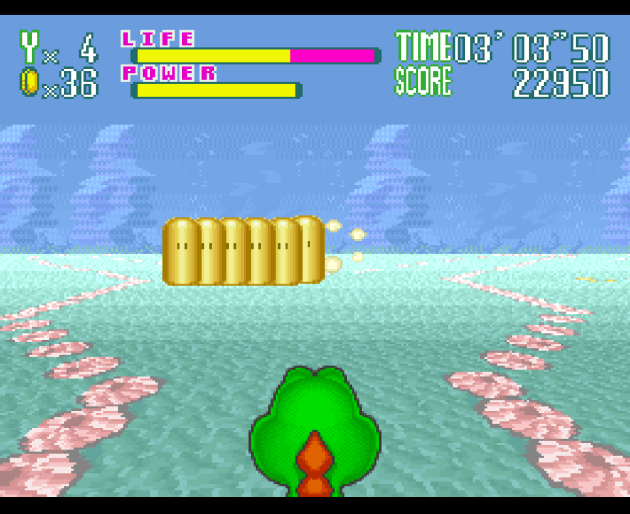
There’s several branching paths during the levels. What do they change? Who knows?! You’re not given any clue which is the “good way” and which is the “bad way.” It’s random chance, though one usually gives you a chance at an item. But, the levels are so interchangeable that it adds nothing to the experience. If anything, it feels like a relic of a more ambitious-but-deleted play mechanic that was left in because it was easier to do that than remove it from the game entirely.
But then you get to the bosses, and they’re some of the best ones ever in a Mario game. Yoshi’s Safari could have deleted all but one or two of the levels and left only the boss fights, including mini-bosses, and the game would have been so good that it’d be a contender for most underrated Mario game. Sure, it would have probably been too short as well, but I don’t really want to sit and point a gun at my TV for longer than thirty minutes at a time anyway. I can’t imagine who would, but I guess I should note that there’s no save files. This is a “beat it all at once or not at all” type of game. Twelve levels of this is too much, but if it had been a boss rush game with a pair of levels to break up the monotony, hell, this might have been the best light gun game.. well, maybe ever! There’s about twenty total bosses and mini-bosses, nearly all of which are genuinely exciting and satisfying to battle with. It’s basically just Battle Clash or Metal Combat, only without the latency and with the difficulty scaled back and a Mario theme added.
On the downside, there’s not nearly enough power-ups. You have one kind of bullet, and one only. The game requires players to turn on Super Scope’s turbo function, but then penalizes you for holding the fire button down, as it will slow your rate of shots. Thankfully, the power meter refills quickly. Yoshi’s Safari isn’t a very challenging game. Only Sasha and I played this all the way through to the end, and neither of us lost a life when we used the gun. I had to replay it with a mouse to grab screenshots, and even with an unoptimized controller, I only lost one life. There is a harder mode (hold X+Y+L+R and press START on the title screen) but all that does is add enemies and spawn them closer to you. It’s still not enough, though. I don’t think Yoshi’s Safari’s reputation as the no-questions-asked killer app for the Super Scope is accurate at all, because the levels themselves are so repetitive that they’re exhausting. But make no mistake: there is a LOT of fun to be had with the bosses. What I found most telling is that neither Dad nor Angela wanted to play Yoshi’s Safari all the way through. Oh, they wanted to fight all the bosses, so we used save states to let them replay them. As much fun as they had, they did want to beat Battle Clash and Metal Combat all the way through on their own. That says it all to me.
Verdicts – Indie Gamer Chick: YES! – Angela: YES! – Oscar: YES! – Sasha: YES!
 Metal Combat: Falcon’s Revenge
Platform: Super Nintendo Entertainment System
Released December, 1993
Directed by Toshitaka Muramatsu
Developed by Intelligent Systems
Published by Nintendo
Uses the SNES Super Scope
NEVER BEEN RE-RELEASED
Cathy’s Gunplay: Mildly Limited
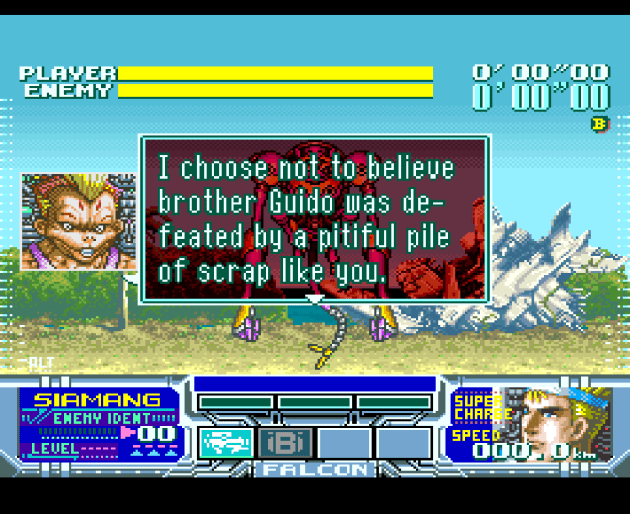
Both games have tons of dialog and a semi-elaborate story. It’s not the worst writing, but the characters are so hard to tell apart that it’s tough to get invested. Plus when the dialog is often longer than the gameplay, it almost becomes annoying.
Well, the annoying part of Metal Combat is that it has a seemingly unskippable seven-part tutorial that largely covers the same stuff you would already know from Battle Clash. The only new thing, besides new secondary weapons, is that the charge shot now has three tiers. If you’re anything like us, this will likely lead to you firing significantly less shots. “I wouldn’t have wanted to use the bazooka for Battle Clash, but this one, the big shots would probably mean more if you were shooting from the actual Super Scope,” said my father. Maybe, but what I found more annoying is how the game’s difficulty spikes suddenly during the final two bosses, both of which are basically 2 in 1 fights. Difficulty spike? It’s more like a difficulty mountain. The second-to-last boss’s second form scored multiple ten to fifteen second knockouts. I couldn’t put a dent in it. Well, it turns out, you have to bank the bombs that the game has provided you up to this point. THOSE don’t reset between matches. How embarrassing for me that 9 year old Sasha beat the game with ease while I never got past the boss below. Dammit, she learned it from me. I’m calling this the gaming version of loosening the mayonnaise jar for her.

Jeez Louise, this is tough. Even with a mouse, this was brutal.
When I ran through hundreds of SNES games in 2021, giving each a brief (hour or so) sample, I ranked these games #49 (Metal Combat) and #50 (Battle Clash) among the nearly 200 games I played. I’m not sure how much those rankings would change if given a full playthrough, but having now played these with an actual light gun, I absolutely got the Battle Clash games right. They’re top of the line.. for home light gun games. Don’t get me wrong: I’d still probably rate something like Time Crisis, Point Blank, or House of the Dead higher. But, as a unique-to-the-SNES experience, yea, these games are pretty good, but not great. I think these lacked staying power because these are some of the most uninspired giant robot designs I’ve ever seen. They’re barely a step above the exploded junkyard look of the Transformers movies. I previously gave the slight edge to Metal Combat, but for the purposes of this feature, eh, play both back-to-back. Metal Combat’s difficulty curve and boring secondary weapon design frustrated the hell out of me, but we still had a lot of fun. Feels like I’m missing something, though..

This is the two player mode.
Ah yes, Metal Combat’s got a two player game. Technically, so does the first game, but that’s just the one player game with alternating players. For Metal Combat, one player uses the controller and can pick from most of the bosses, while the other shoots them with the Super Scope. Remember that hint of lag I talked about in Battle Clash? Well, that applies to Metal Combat, and the player controlling the robot can absolutely use the latency to their advantage. THEY control the camera movement, and the obvious strategy was just to whip the camera around. Of course, to actually attack with the robot, you do have to sort of sit still. Sigh. I’m sure they had the best intentions making this, but it’s just not that fun. Nobody wanted to control the robots. EVERYONE wanted to be the gun shooter. We used a rotation system to assure everyone got a go with three robots and three gun sessions, and the robot people all got bored eventually. So, the two player mode is just not good. However, Metal Combat overall is pretty fun. Even with the difficulty spike, it’s a thirty-minute special, if that. Hell, a lot of the early bosses last well under a minute. For all of Battle Clash’s problems, the battles feel more meaty. Metal Combat feels like DLC for it, but really good DLC. What a strange pair of games.
Verdicts – Indie Gamer Chick: YES! – Angela: YES! – Oscar: YES! – Sasha: YES!
 T2: The Arcade Game
aka Terminator 2: The Arcade Game
Not to be Confused with Terminator 2: Judgment Day
Released February 24, 1994
Developed by Probe Software
Published by Acclaim
Uses the SNES Super Scope or SNES Mouse (Optional)
NO MODERN RE-RELEASE
Cathy’s Gunplay: No Limitations
Fun fact: most of the pictures of T2 in this feature were taken during a play session where I used the SNES Mouse instead of the Super Scope, though the review covers all facets of T2 for the SNES. Oh, and if you buy the Arcade1Up version of T2, the guns used to make that work are basically the same we used for this feature: the Sinden! Terminator 2’s Arcade1Up is out of print though.
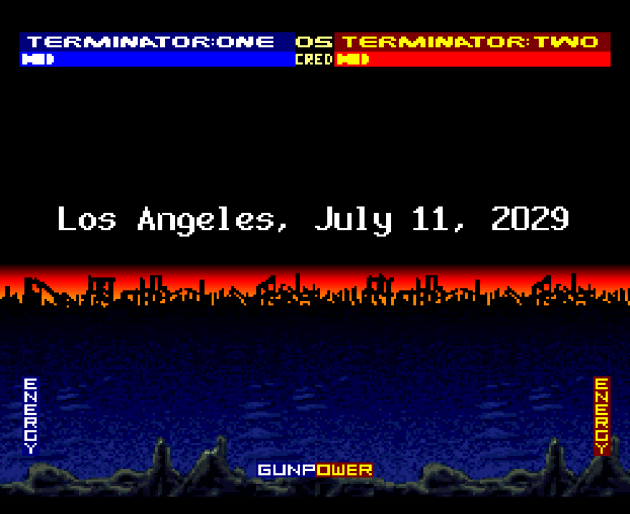
T2: The Arcade Game isn’t only based on the events of the movie, but also the lore that led to the events of both movies. Instead of fighting a single robot in the present day.. well, of 1991, the game mostly takes place during the assault on Skynet that led to the total human victory in their war against the machines. A raid that’s set to take place on July 11, 2029. Which is going to be, no joke, my 40th birthday and thus proving July 11 is indeed the coolest day of the year. Babe Ruth made his Major League debut on July 11th. The Marines were established on July 11th (or rather re-established). The Hollywood Bowl opened on July 11, and To Kill a Mockingbird was published on July 11. And this next year a Superman movie is coming out on my birthday. I thought THAT would be hard to top, but the total liberation of humanity from our machine overlords? Pretty damn sweet. I’d like to think John Connor rallied the troops by noting it was my birthday. “It’s Cathy’s birthday! Do it for her! (dead silence) Um.. alright, screw it, do it for Babe Ruth, who debuted for the Boston Red Sox on this day in 1914! (Thunderous cheering, total victory over Skynet)”
Seeing my birthday on the screen was the only entertainment I would ever get out of T2: The Arcade Game. I’m often left baffled by the popularity of some games, but my bewilderment of T2 is on another level. Seriously, THIS is beloved? REALLY? I think T2 is a miserable slog of a game that always manages to turn any situation boring. It’s like that right from the start. “Ooh, shooting the robots from the Terminator movies. That could be fun!” Then the game said “oh yea? Well, how about I put four moronic humans right in front of you that you’re penalized for killing?“

Down in front, you stupid bastards!
“Well, at least the humans won’t also block the boss fight!” Then the game said “oh yeah? Well, now they are! And also we’ll make bosses the bullet sponges to end all bullet sponges!”

First boss? Took forever.
“Well, at least the humans only take up the lower half of the.. you know, I really need to learn to shut up.” “OH YEA? TAKE THIS, BITCH!”

Yep, you can’t shoot the truck. If it dies, you have to start over. Look how big that f*cking thing is.
There’s exactly two good ideas in T2. One level has you destroying equipment at Skynet in 1991, and the other has you trying to defeat the T-1000 by freezing it to death. Of course, both of those are rendered crappy, too. The Skynet segment basically requires perfection, and everything you destroy repeats about ten trillion times. The T-1000 regains heat as the battle goes along, and it vanishes from the screen to assure that it has plenty of refill chances. So, the battle drags out and becomes one of the longest boss fights I remember playing.
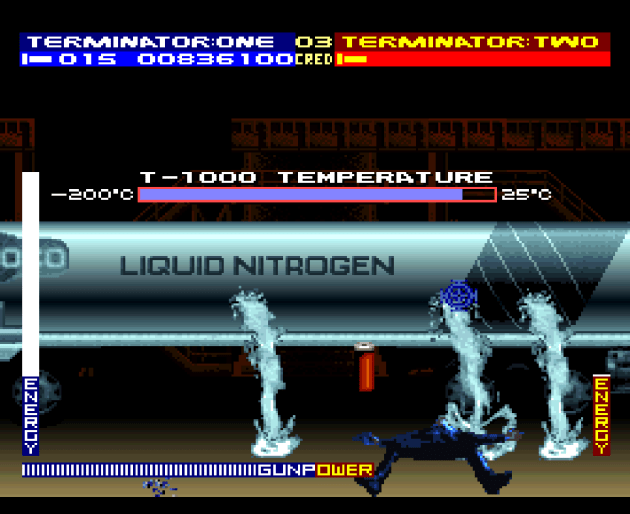
I had to do at least two different play sessions per game to make this feature work. I dreaded replaying T2. Absolutely f*cking dreaded it. I will never understand the appeal in this. Maybe the strength of the movie has made this more popular. Or maybe it was a game you put a dollar into during a simpler time and you never played it enough to realize how damn slow and boring it is. But seriously, holy crap, what a terrible game. Even playing with two players, where player one gets a cursor, is miserable. “Would you believe this is one of the most popular light gun games ever made?” I said to my family, and they really couldn’t believe it. It’s not just boring, but actively bad. The targets are not fun to shoot, and the SNES game is pretty low-res and ugly. Now, we did play the coin-op briefly, or rather THEY did, and Dad and Sasha think it’ll get a YES! from them when we do light gun coin-ops in 2025. Maybe the arcade version is better, but the SNES game has no PING to the bullets or BANG to the explosives. Everything about this is slow, grindy, and boring. A light gun doesn’t improve it. A mouse doesn’t improve it. It’s just bad. Good movie, though.
Verdicts – Indie Gamer Chick: NO! – Angela: NO! – Oscar: NO! – Sasha: NO!
 Operation Thunderbolt
Platform: Super Nintendo Entertainment System
Released October, 1994
Directed by Masayuki Suzuki and Daikoku Hisaya
Developed by Taito
Uses the SNES Super Scope or SNES Mouse
NEVER BEEN RE-RELEASED
Cathy’s Gunplay: No Limitations
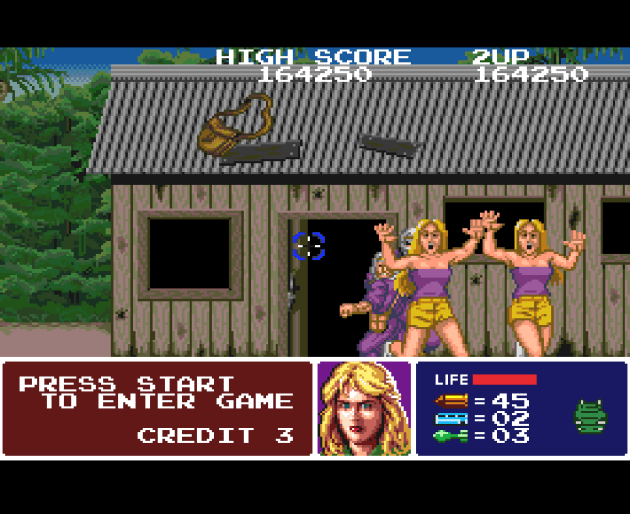
Jesus, and I thought the hostages in Operation Wolf were stupid and annoying.
This sequel to Operation Wolf is one of the roughest SNES games I’ve ever played. Rough as in completely lacking in smoothness. The scrolling is so terrible that it almost feels like stop motion animation. I’m not sure why that’s the case, either. Operation Thunderbolt isn’t exactly a launch window SNES game. This came out just weeks before Donkey Kong Country. And hell, launch window games played better and looked better than this. The graphics are pretty bad. Hell, even the PC Engine version of Operation Wolf looks nicer, animates smoother, and plays better, all without a light gun too! This is a shameful effort that nobody wanted to play. The hostages just sort of block the screen and wave while wobbling back and forth. I think you’re supposed to kill the people behind them but aiming is tough since you can’t get rid of the crosshairs. If this is the best effort they could make during the prime of the Super NES, Taito should have just cancelled this.
Verdicts – Indie Gamer Chick: NO! – Angela: NO! – Oscar: NO! – Sasha: NO!
 Tin Star
Platform: Super Nintendo Entertainment System
Released November, 1994
Designed by Marcus Lindblom, Ste & John Pickford
Developed by Software Creations
Published by Nintendo
Uses the SNES Super Scope or SNES Mouse
NEVER BEEN RE-RELEASED
Cathy’s Gunplay: Mild Limitations (only the last boss, go figure)

The Super Scope has largely been defined by games that lack personality. It’s odd this feature ends with a game that often feels like it’s trying too hard to be wacky and quirky. Especially since the gameplay is pretty good.
This is going to sound incredibly petty, but I was so annoyed by how long it takes to count up the score between stages in Tin Star. I figure I should bring that up since that’s my only major complaint about it. I was dreading doing this game, too. It’s from the same guys that made Ironsword: Wizards & Warriors II, which I just reviewed and still have nightmares about. Well, my worries were for naught, because Tin Star is a contender for the best light gun game on a Nintendo platform. Hell, it was Sasha’s favorite game in this entire feature. It’s sort of like a series of bite-sized old west tropes starring a bunch of blue robots where the objective changes from level to level. One segment, you’re in a first-person shooter where you have to stop the bad guys from blowing up a jail, and the next you might be in a showdown on the streets.
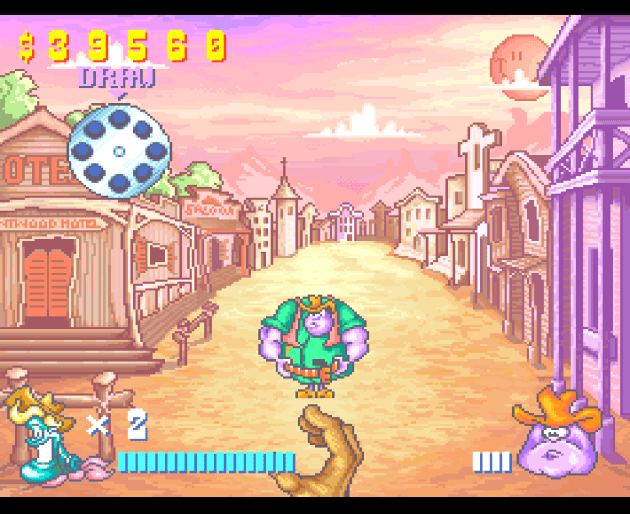
For the most part, you “draw” in the shootouts by shooting the chamber of a revolver wherever it appears on the screen, THEN you shoot the boss. It’s not a one-shot standoff, either. You have to do this a few times. To Tin Star’s credit, it does change up the formula for this as the game goes along.
Tin Star consists of seven “days” (levels) that are each broken-up into three segments. The game does run out of ideas before running out of days, but unlike many light gun games (looking at you, Yoshi’s Safari), this one does have save files and isn’t meant to be played all at once. It’ll still take you only a little over an hour to finish the whole thing. Unlike Yoshi’s Safari, everyone wanted to finish Tin Star. But, it’s certainly not perfect. Sometimes enemies don’t give you very long before they open fire. Sometimes it’s not obvious where they are. The problem with the exaggerated, cartoony graphics is it’s sometimes hard to figure out who poses a threat, and when, where they’re at. Take a look at this screenshot. Do you see the enemy damaging me right here?
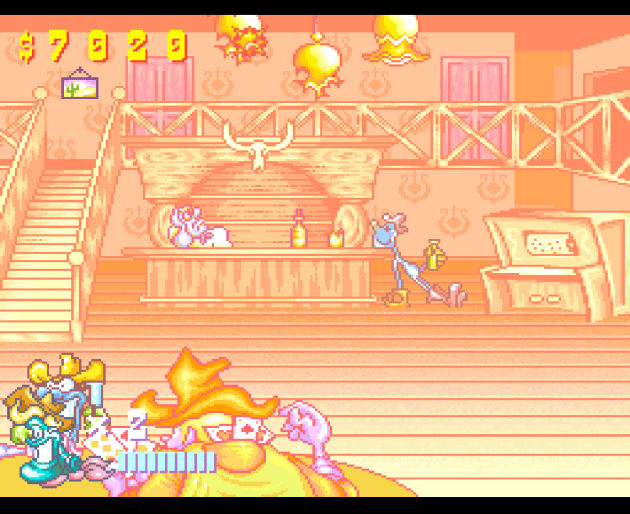
No, not the two guys at the bar. Those are just for funsies shots. The guy damaging me is in the bottom left hand corner, above just above the Tin Star icon. That’s a BIG yikes right there, but Tin Star is full of that type of design. We got into a big disagreement about whether that’s a good thing or not. I thought it was too early in the game to pull that type of dirty pool. Sasha’s big complaint was on that level too, but slightly different. At one point, guys walk into the room with hostages saying “HELP” and naturally your instinct is to shoot them.
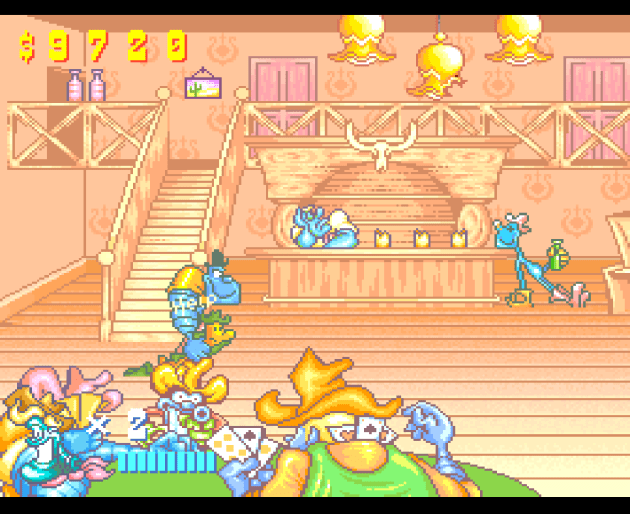
Note the guy is about to shoot me again, too.
But, doing that immediately, when you see the HELP word balloon, kills the hostage. And no, aiming for the head of the guy holding him isn’t the correct rescue method, either. Instead, you have to wait for the bully to hold the victim in front of him, THEN you shoot the bully. Sorry, but that is just awful design. Deliberately counterintuitive without any benefit except to troll players. What’s especially frustrating about the developers pulling that kind of shenanigans is that Tin Star proves again and again it doesn’t need to resort to dirty tricks. This is not a bad game, but golly, it sure does seem like it wants to toe the line on that, and to nobody’s benefit.
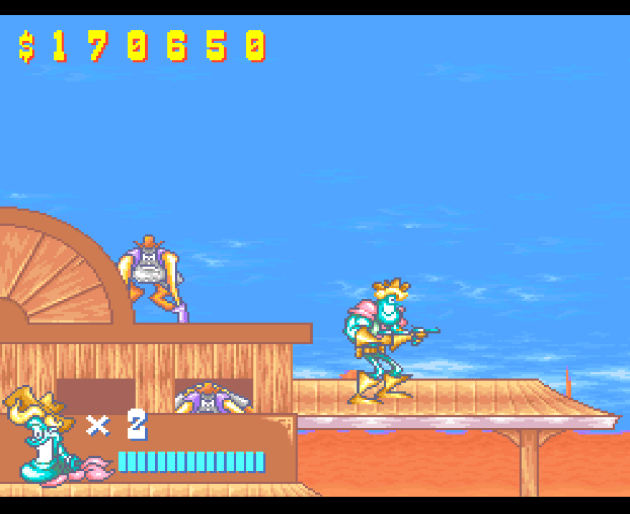
Some parts are staged like a platform game being controlled by an unseen partner. I mean, it really looks like a typical hop ‘n pop shooter, but it never is. If you’re not using the Super Scope, you use a cursor with a controller or even the SNES Mouse.
As the final game in this feature, I just wanted to be clear that I think this is probably the game that had the most potential of any of the 22 games to be viable as a modern release. Tin Star’s closest cousin isn’t any game on this list. No, actually, it’s kin to games like Dragon’s Lair or Mad Dog McCree. Really! Tin Star’s framing devices are the type of thing you’d normally expect from a LaserDisc game, only instead of using full motion video, it just uses what looks to be a boilerplate platforming engine with an NPC character as the driver. Except, Tin Star does a lot more than its gaming relatives do. The entire direction, with the fake platforming, shooting ranges, and showdowns absolutely works. There’s nothing quite like Tin Star on Nintendo platforms. I still give the slight edge to Super Scope 6’s Intercept as the best overall light gun game ever on a Nintendo platform. But if Tin Star had access to more colors, more frames of animation.. if this had been an arcade game from the same era instead of being limited by the SNES, this probably could have walked away the greatest light gun game EVER. The spirit was willing. The flesh was weak. And bazooka-shaped, but weak nonetheless.
Verdicts – Indie Gamer Chick: YES! – Angela: YES! – Oscar: YES! – Sasha: YES!
Sasha’s Choice for Best Overall Game in this Feature
To all my friends, and to my readers everywhere: Merry Christmas to all, and to all, a good LIGHT!

 Indie Gamer Chick
You must be logged in to post a comment.