Arcade Archives: King & Balloon (Review)

Back in January, I reviewed King & Balloon, which is my personal favorite Namco shooter. Sorry Galaga and Galaxian fans. Not only was King & Balloon one of the best games to emerge in the wake of Space Invaders, but it was one of THE most underrated games of the Golden Age of Arcades. Well, a couple weeks ago, Hamster gave it a solo release as part of their Arcade Archives franchise. Everything I said about the game in my original review still applies, but Arcade Archives offers a few extra features for the $7.99 price tag. It also allows players to enjoy the game on their Nintendo Switch. Which might be the best feature of all, but I’ll get to that. First, go click that link and read my original review. Especially since I’m going to ignore the gameplay mechanics here and talk about the package.

This slideshow requires JavaScript.

Like EVERY Arcade Archives release, there’s two competitive modes: “hi-score” and “caravan.” Caravan runs on a five minute timer that starts as soon as the enemies spawn for the first time. Hi-score just goes on until you die. Both have strict rules that forbid pausing the game. If you do, game over. You don’t get to upload your score, even if you were kicking ass and taking names. I’ve never understood the ordering there. Shouldn’t you take their names down BEFORE you kick their ass? Personally, I’d be a lot less inclined to give a person who just kicked me in the ass my name. I’d want THEIR name. You know.. for the lawsuit for damaging my beautiful, bony ass. Anyway, pause and you have to start over. There’s no gameplay options for these two modes (however, autofire and any adjustments to the screen you make in the standard mode will be applied here) but there’s also no cheating. You can’t say that about the standard mode. See my review of Arcade Archives: Pinball for more details on that, but needless to say, they don’t make note if you used save states or not in the high scores.

Mind you, everything I love about King & Balloon is still here, and the five minute timer in Caravan further adds to the deceptively complex strategy. You’re best served to avoid this type of swarming attack and allow the balloons to Megazordtogether. They score A LOT MORE points when they do.

You also get the option to run the game at the “original speed” but I really couldn’t notice a difference. The real reason to buy King & Balloon as part of the Arcade Archives series is if you own a Nintendo Switch and want an authentic Golden Age of Arcades release that works perfect as a portable game. King & Balloon is wonderful for short play sessions. It provides the type of thrilling, white-knuckle gallery shooting that would be jammed-up today with loud visuals and too much downtime, and it’s challenging enough that you’d be lucky to last ten minutes. That makes it ideal for handheld devices, as far as forty-three year old coin-ops go. It’s still beyond ridiculous that only three Namco Museums have ever included it, one of which never came out in America and one of which was the weird à la carte Namco Museum on Xbox back in the day. But, King & Balloon finally has a chance now to be appreciated as its own thing. Sure, I wish the game had more sophisticated scoring. Perhaps one that rewards players for consecutive made shots. But, I still adore this charming little gallery shooter. It’s one gaming tragedy that now has a legit shot a happy ending.

Arcade Archives: King & Balloon is Chick-Approved

King & Balloon was developed by Namco
Published by Hamster
Point of Sale: Nintendo Switch, PlayStation Store

$7.99 was full of hot air in the making of this review.

Arcade Archives: Vs. Balloon Fight (1984 Arcade Review)

Owwww. Ow ow ow ow ow. Owwie. My hands. My beautiful, bony hands. What the hell were they thinking with this one? Look, I’ve never been the biggest Balloon Fight fan in the world. Admittedly, I’m not a fan of Joust, either. So here’s a warning to fans: maybe take this review with a grain of salt. Balloon Fight has never been for me. But, it could be with enough twists to the formula, which is why Vs. Balloon Fight got my attention. Of all the Nintendo Vs. System coin-ops, Balloon Fight has the most profound change to the NES counterpart. Well, besides Vs. Duck Hunt, where you can shoot the dog in bonus rounds (though you’re not supposed to). It’s the same concept: flap your arms to fly, and then come crashing down on top of enemies to pop their balloons. After that, you then can hit them a second time as they parachute down, or kick them off the ledge once they land, Mario Bros.-style. So, yea, in a nutshell, Balloon Fight is really just Joust with an extra hit-point and parachutes instead of eggs. The big difference over its NES counterpart, besides having a lot more levels, is that Vs. Balloon Fight is not a single-screen game. In the coin-op, the size of the playfield is doubled vertically and you have to scroll the screen upwards. It makes for a more exciting, intense experience. Enemies might come flying out of nowhere (especially when bumpers are added after six stages) creating a chaotic atmosphere that somehow never feels cheap because you ought to know better than to leave yourself wide open from the unseen menaces above. It should be great!

Sigh.

Here comes the “but..” Like the Starks say: nothing counts before the “but.”

Vs. Balloon Fight has absolutely brutal gravity. The amount of flapping it requires is completely unreasonable by any standard. The NES version allows you to maneuver with a steady pulse of tapping the button. But, for a game that you’re expected to pay two bits per session, that won’t do at all. You have to absolutely button-mash to maintain your flight, Track ‘n Field-style. I’m not having a pity-party for myself here, but I literally physically cannot button mash to this degree anymore. Thankfully, my family, including my 12-year-old sister, also couldn’t believe how furiously you had to tap the buttons to maintain your flight. Again, I’m not a fan of the NES version, but I think I’d remember if this was one of the reasons why. Just to make sure, I threw on the home version on Switch Online, and it took me only a few seconds to verify the gravity for the arcade version isn’t like the NES version at all. The worst part of this whole issue with Vs. Balloon Fight is, if you start to come down, the gravity seems to further intensify, requiring even faster flapping to regain your momentum. Maybe that’s more “realistic” but it’s a frick’n video game about a guy in a balloon dueling to the death with birds using balloons themselves. To hell with realism! And why the heck didn’t anyone care this much about realistic gravity when it was Pinball? The gravity especially affected me in the wide-open bonus stages, which require you to chase down balloons that rise out four chimneys. I would inevitably lose my strength, and any attempt at recovery was hopeless and I’d crash pathetically to the ground with balloons still rising.

In addition to the crushing gravity, the walls and ceilings seem to have a lot more bounce to them. This can be problematic near the water. The enemies tend to do what I call “ride the current” and drift across a straight line, going through one side of the screen and coming out the other, and this will likely include one that hovers just above the water line, where the big fish will jump up to snatch you. Since there’s often platforms right above you, I tended to bounce off them and make myself hover too close to the water. I lost more lives to falling in the drink than I did to the enemies, easily. Well, partial credit for the bumpers. Those things ought to have warning signs. And yes, the fish will eat the enemies too, and it’s ALWAYS hilarious when it happens!

On the NES, you can hold the B-Button to autoflap. Thankfully, Arcade Archives games almost always have an option on the button mapping menu to turn-on autofire. Even better is that you can set the speed, and this is one of those games where that matters greatly. In fact, I took advantage of it and set a different flap speed to each face button (kinky, right?). It works great! Hey, the game’s now completely playable, and you get to appreciate what is actually a massive improvement on the Joust formula. Fun characters. Lots of charm. The combat has weight and my beloved OOMPH and it feels impactful to crash a balloon, complete with satisfying POP sound! It always brought a smile to my face seeing the sad look of an enemy as it slowly drifted to its potential doom. Of course, they can turn the tables on you if you wait too long, pumping a new balloon and upgrading to a more aggressive level of AI. There were also moments I got sadistic glee out of. Like having a stage with lots of bumpers, and I’m at the top of the level and suddenly I hear the fish jumping up and down, and then a few seconds later a bonus bubble starts to rise onto the screen, meaning an enemy just got eaten off-screen. Side note: I’d like to think that the bubbles are the enemy souls going to Heaven and bursting them sends them straight to Hell. Or maybe it stops them from being resurrected. Either way is bliss!

I did NOT die from this. When you take too much time to finish a stage, the clouds tap three mountains and cast Ball Lightning at you. It bounces around the stage and is an instakill even if you have two balloons. But, right here, more than half of it hit my body and I survived. That might be the most generous collision box I’ve seen in an arcade game.

Now, here’s why the gravity should be a deal breaker: because in the two modes designed specifically to compete for online high scores, you can’t turn on autofire. Yes, there’s online leaderboards in the main mode too, but you can cheat like you’ve been made an honorary Houston Astro in those. In addition to all scores counting no matter what adjustments you make to the game’s default settings (including giving yourself extra lives), you can use the interrupt save state feature. Until you game over, you can keep returning to the main menu and restarting from where you last saved. I used this to put myself 4th on the all-time leaderboard, because screw it, why not? Meanwhile, if you so much as pause the game in Hi-Score or the five minute Caravan mode, the game is over. You can’t just continue and must restart the game. While future releases of Arcade Archives would allow autofire in Hi-Score/Caravan, since it makes no sense to ban them when everyone has the option to turn them on and thus it’s a level playfield, they’re disabled here. So, 66% of the game requires you to mash buttons more than any game not based around the Olympics should, and those are that have protection from cheating. I figured this was an easy NO! Well, no, because it’s not 66% of the package where autofire is disabled. It’s 50% of it.

Let’s talk about co-op.

My promise to my readers in 2023: I will make a good faith effort to take the multiplayer for a test drive in games more often.

Being a Nintendo Vs. System release, a real Vs. Balloon Fight has two screens, which allows for two separate games to be played at once OR for a two-screened co-op experience. On a single Nintendo Switch, this is represented by two side-by-side mini-screens. Or, if you each own a separate copy of Arcade Archives: Vs. Balloon Fight, each player can have their own screen with one of the players hosting a game. I wasn’t willing to spend $16 on this, so Angela and me played on one screen “cooperatively” in quotation marks that feel ashamed to be associated with such an obvious lie. The only cooperation we showed was our mutual understanding that the two of us would be spending the next hour trying to assassinate each-other. Oh sure, we were bound to kill a few enemies would die along the way too. You know, in the crossfire. But really, once the game started with me immediately making a beeline for her and popping one of her balloons, sh*t was on. And guess what? It was a lot of fun, but it also further exposed some obvious weaknesses in Vs. Balloon Fight.

YOU MURDERER!

If a player runs out of lives, they can’t just re-up without issue. When either player has a game over, the action pauses and goes to the continue screen. If a player continues, the level restarts from the beginning. Since the other player was likely to be on their last life, we took to just feeding ourselves to the fish as soon as the game restarted so that we’d both have full lives to continue the fratricide. I get that it was 1984 and jump-in continues weren’t the commonplace practice yet, but it really hurts the flow of the multiplayer mode, especially when you’re having a blast killing each-other. It also sort of renders competing for points completely pointless. If you’re losing, pull a Tonya Harding and whack the other player. Your score resets to zero if you die. If you got a high score, too bad. That’s fine though. We had a jolly good time playing aggressively against each-other while also dealing with the enemies. We came to appreciate a comically well-timed betrayal when one of us was actually dealing with the baddies.

We’d actually work together best during bonus stages. I credit the cheerful music. Also, just so we’re clear: there’s no Balloon Trip mode in this. With the gravity it has, it’d basically be impossible anyway.

Even my parents got in on the action, and watching my Mom avenge me by taking out Angela about three seconds after Angela respawned from the previous murder will go down as an early highlight of 2023 for me. So, was this multiplayer mode enough to save Vs. Balloon Fight? Surprisingly.. yea! Barely, but barely counts. While I’m still pretty peeved that the modes I cared most about going into this are basically unplayable by me, fun is fun, and with autofire and a second player, Vs. Balloon Fight is a lot of fun. It could be more fun with some adjustments, like letting players reload without the level restarting. Especially since you’ll be draining each-other’s lives. Or, if you want to legitimately cooperate, that’s also fun. Of course it is! Trying to make homicide look like an accident is always fun.

Angela: “I KNEW IT!” Oh, like you weren’t doing it too!

Arcade Archives: Vs. Balloon Fight is Chick-Approved

Arcade Archives: Vs. Balloon Fight was developed by Hamster
Point of Sale: Nintendo Switch

$7.99 burst your bubble in the making of this review.

Arcade Archives: Kangaroo (Review)

This week, I’ve looked at the maze chase. I’ve looked at the gallery shooter. I looked at.. whatever the hell Journey was aiming for. But, what about the Donkey Kong-like platformer? How about Kangaroo? It was released in 2020 as part of the Arcade Archives lineup too, so no need to dip into MAME this time. Believe it or not, Kangaroo was not some kind of historical curio. Despite being made by Sun Electronics, who would go on to be Sunsoft, maker of Blaster Master and the NES Batman, Kangaroo was distributed in America by Atari. Thus, a lot of people think of this as an Atari game, and one that could have gone into my Games They Couldn’t Use feature. Indeed, you’ll be seeing Kangaroo for the Atari 2600 and 5200 in part two of that very series. It was a moderate hit for Atari, and in fact did well enough that it was even adapted into an animated short as part of the legendary Saturday Supercade cartoon block. But, as an Arcade Archives release, Kangaroo deserves its own look. While I’m grateful that Hamster released this as a solo-effort, holy smokes, this is a terrible game. Anyone who thinks I’ve gone too easy on the retro games this week, just wait. I’m going to have a Kangaroo burger here.

Literally the only stage that works without MUCH of a hitch, and it couldn’t be more bland, basic, and boring.

I’ve nicknamed Kangaroo “Sloppy Joey” because that’s how Kangaroo feels. Like a game that wanted to ride coattails, but was made by people who had no clue what they were doing. Kangaroo is made-up of three levels where the object is to climb to the top of the stage to reach your joey, and one level where you can bring the joey to you. It wants to be Donkey Kong so bad it can taste it (what does Donkey Kong taste like? The answer is “chicken” because most everything tastes like chicken, which is why you should NEVER TRUST THE CHICKEN!) but it didn’t seem to understand how to do any of the things Donkey Kong did in terms of movement or level design. I’ll start with the movement, where jumping is mapped to UP but so is climbing ladders. It makes jumping over gaps a pain in the butt. If you fall or jump down even an inch, you die.. in some parts. In other parts you still can’t fall even a single pixel length, but you can jump down to a lower ledge. There’s no consistency except anytime you step off a ledge, you die. Even if the ledge is literally the size of your foot. At that point, it isn’t a ledge, is it? It’s a step, right? But it kills you like you just fell off the Grand Canyon. In general, the movement just feels sluggish and unresponsive. The best thing I can say about it is it’s not as bad the level design, which very much incorporates that death-by-gravity inconsistency.

This slideshow requires JavaScript.

The stages of Kangaroo are some the most bizarrely constructed I’ve ever seen. They’re so weird. After a conservative first stage, the second stage begins with having to hop-up a series of uneven platforms, and this is where the game’s biggest flaw reveals itself: the rules are inconsistent. When you ring a bell, it spawns more fruit, though most of it is below you, and you will die if you even attempt to jump lower once you ring the bell in level two. The fruit DOES carry over if you lose a life, but actually going to retrieve it is apparently not possible. I tried it, and if there’s a spot where it’s safe to do it, I couldn’t find it. Normally I’d check YouTube clips to see if I’m missing something but then I was like.. why would they make it so the fruit respawns below you anyway? Wouldn’t it make sense to have the bell on the first floor, with some kind of extra risk element blocking it, and put players at a choice? See what I mean about how this makes no sense? I imagine even in 1982 or 1983 that risk/reward design was a known thing, right? Which again makes this feel like a game by people who were just sticking things on a screen and crossing their fingers that they could reach the goal, sort of like me when I make a Mario Maker level. I did make a good faith effort to try to go lower and get the fruits, but the moment I went any bit lower than the platform I was on, I went into the death animation. BUT, then you get to level four, and there’s a series of ladders and gaps, and sometimes you do have to jump to a lower platform, which is now safe to do. Just what everyone wants from a video game: one that changes the rules as you go along.

Specifically it’s the spot by the broken ladder in the right-center of the screen. You can jump down to the platform left of it. The same drop, even off a jump, will kill you in level two. Kangaroo plays Calvinball. It just makes up the rules as it goes along.

Nothing goes right in Kangaroo. I’ve had moments where I punched an enemy that wasn’t even in its throwing animation and we both died. The collision is bad, especially on the third stage. It wanted SO DESPERATELY to be the non-conventional Rivet Stage in Donkey Kong type of twist. In it, there’s a stack of monkeys holding the platform that the joey is on and you can punch the monkeys out from the stack to keep lowering the platform. You’ll be dodging apple cores dropped from above or thrown at you from the side this whole time, and other monkeys will come and try to join the stack or push back. It takes several punches to successfully dislodge a monkey, but if you’re not lined up right, you’ll punch right through them. Even though logically it should still be a punch. While alone it wouldn’t be a deal breaker, Kangaroo is a series of little annoyances that add up to one hugely crappy game. Like, you jump high enough that you’re clearly above platforms and should land on them, but you don’t. You go through them unless you jump on them from the correct platform. What was even the point of being a kangaroo then?

Also why is THIS the third stage when it has a climatic feel to it? It should have been fourth. It’s like they wanted to make a Donkey Kong-like game without taking any time or effort to figure out why Donkey Kong worked.

Sloppy Joey is ugly. It’s glitchy. It flickers like an Atari 2600 game, which is especially off-putting for an arcade game. It controls like crap. It has illogical design and scoring, especially with how the bell works. It’s also a game that defies challenging for high scores because you’re at the mercy of dumb luck. There’s a giant ape that shows up to box you and, if it scores a punch, you lose your boxing glove. But, it appears seemingly at random. I’ve had multiple instances where I’d go several games without seeing it once. Of course, it yields a high score if you punch it first. Like all Arcade Archives games, the main reason to own this would be to compete on online leaderboards. My high score was the only one in over a dozen attempts that had the great ape appear. So the one element that would make this engaging in 2023 is based on pure random chance. Most annoying: it has legitimate charm that makes you want to like it. Little touches like how, a second after you duck, the kangaroo pops its head up as if to peek and see if the coast is clear. I mean, come on! That’s adorable. And it pisses me off even more because instead of refining gameplay, they wasted their time and energy on crap like that. Of course, that little extra detail is probably what scored this a spot on Saturday Supercade. Fun fact: despite Atari’s status as the undisputed kings of video games during that show’s run, Kangaroo was the only Atari-published game to be part of Saturday Supercade’s lineup. What, they couldn’t come up with Missile Command cartoon? Which, going off how the rest of Saturday Supercade “adapted” video games (such as Q*Bert being basically Happy Days or Grease), Missile Command would probably be set during the Great Depression and be about sentient missiles running a news stand. Well.. okay, I’d totally watch that.

Kangaroo is not Chick-Approved

Kangaroo was developed by Sun Electronics
Point of Sale: Nintendo Switch, PlayStation

$7.99 got pounced in the making of this review.

Arcade Archives: Kid Niki: Radical Ninja and Arcade Archives: Elevator Action (Review)

Arcade Archives: Kid Niki: Radical Ninja was developed by Hamster ($7.99 said “tubular, dude” in the making of this review)

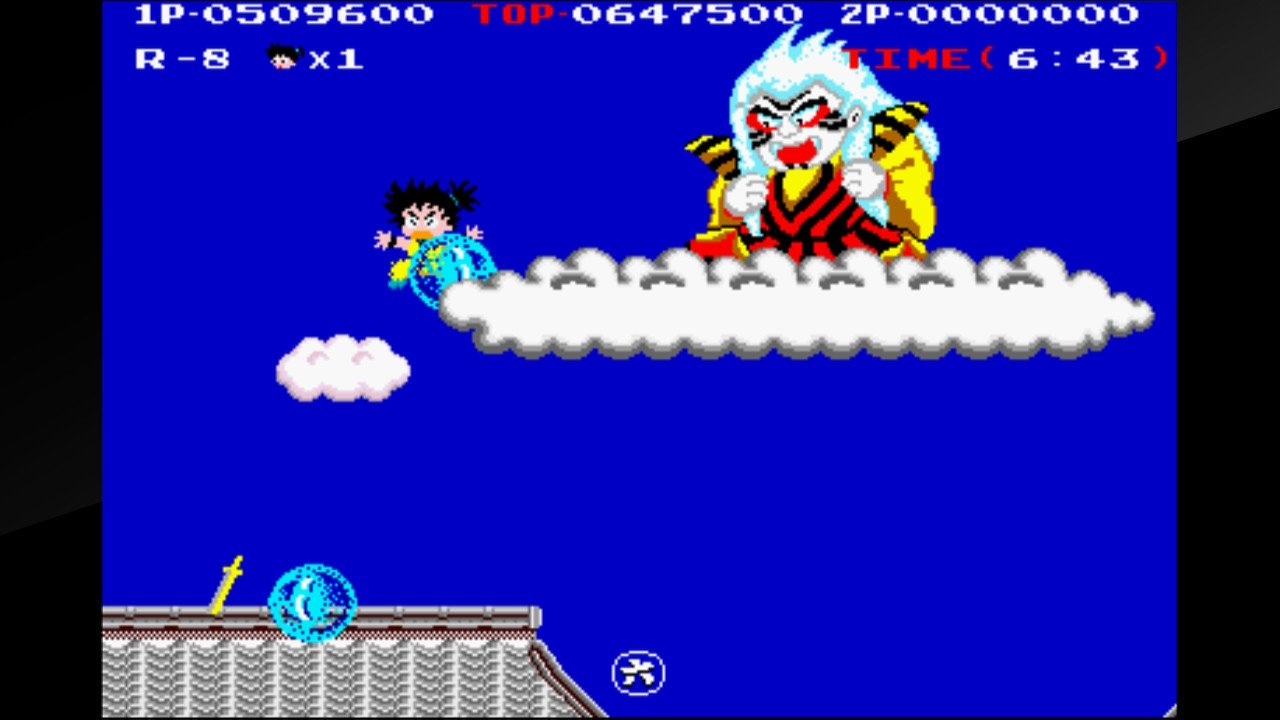
I’ve found the most generic, uninspired, bland, yet still playable game ever made. It’s called Kid Niki: Radical Ninja. I’m not sure what the story on it is, though it feels like something made to cash in on Dragonball back in the day. It’s a typical post-Mario platformer with the “twist” being you spin a sword in front of you to slay enemies. And, well, that’s pretty much it. Run right, and hit the attack button as needed. You can jump, and it’s works and doesn’t feel crappy. The controls are responsive. It’s not a badly made game. And hell, maybe for its time, it was a little more special. Probably not, since my play session with it wasn’t met with dozens of squealing retro gamers going OMG KID NIKI, HEART! In fact, hardly anyone recognized it at all. Maybe one or two people noted they rented the NES version of it back in the day. I’m used to having my older followers unleash the gushing for these titles. Not even a sniff of that here. So Kid Niki is truly lost to the ages despite being available in 2019 on Switch and PS4, and it’s not hard to see why. Every single aspect of it, from its look to its sound effects and action make it feel like you’re playing a fake video game being shown in a bad sitcom. It’s so typically 80s gaming that it’s like a joke game.

I had to abuse the interrupt save states to beat Kid Niki. The normal run-of-the-mill enemies are not a challenge at all. The same can’t be said about the bosses. Especially the last one, which is one the most unfair, impossible encounters ever. I had to save hit-to-hit because, during one phase, bubbles rise up from the floor so fast and so randomly that it’s really sheer luck to not get hit by one. If anyone gave a shit about Kid Niki, it’d be in the discussion for the worst boss in gaming history. I’d show you a clip but it has video capture disabled. Likely because the game sucks so badly.

Probably the best thing it has going for it are its boss fights. The tone, ahem, RADICALLY changes. The game does a neat thing I’ve never seen before, where hitting the boss inflicts damage upon it but causes your sword to go flying behind you, where you must retrieve it. Mind you, this doesn’t happen while making your way to a boss. It’s a neat mechanic that actually works to add tension and nuanced challenge to an otherwise bland game. I wish it did more things that changed up the formula like that. I think if Kid Niki had been remotely creative in its level design, enemy design, or play mechanics, the bosses would have gone down as some of the most memorable in classic gaming. They’re grotesque, they’re legitimately frightening, and pretty fun to battle. And that’s the travesty of Kid Niki’s mediocrity: that these quality boss encounters are lost to history.

Maybe it’s just me, but Kid Niki checks off so many gaming 80s gaming stereotypes that it almost seems like a movie prop.

If Kid Niki is the poster child for being less than the sum of its parts, Elevator Action is the poster child for being more. Unlike Kid Niki, my fans largely recognized it, which, duh. Of course they did! The franchise had legs. As I was typing this, I discovered Kid Niki actually was a franchise, at least in Japan. It had two Famicom sequels and a Game Boy spin-off. Who knew? Well, very few outside of Japan did. On the other hand, Elevator Action was at least well known enough to get a global sequel and a slew of remakes. I had one on my PlayStation 3 and it was the shits. But you have to be at least X amount recognizable to get a modern remake, so Elevator Action was remembered as a classic.

What’s really weird is Elevator Action isn’t a particularly good game if you focus on it mechanically. It’s slow, often feels unresponsive, and movement is pretty clunky. And yet, the fundamental gameplay is fun and genuinely exciting. Plus, for a 1983 game, it sure has an air of violence. What can I say? I love violence, and Elevator Action has this macabre vibe about it. When you fire a bullet at someone and it hits, it makes this incredibly satisfying popping sound that never failed to put a smile on my face. Also, I might have something wrong with me.

I actually played this in early September and deleted all my media for it. Whoops.

Don’t get me wrong: I think Elevator Action is a borderline bad game. It just does so many things wrong. You can’t duck in elevators because.. reasons. There’s too much waiting around for one of the slow-moving elevators to come to the floor you’re on. The level layouts can be so bad and nonsensical that they kill the pace of the game dead. And, frankly, I got fucked by unavoidable deaths more than once. So, why is Elevator Action fun? It really shouldn’t be. It’s a very badly made game.

It’s not exactly Mortal Kombat, but the murders in Elevator Action feel like murders, and that’s good enough for me.

I think it’s a matter of the concept is so smart and so immersive that you really only had to get the bare minimum working to create something worthwhile. Which is not to say the concept just works, period. Elevator Action Deluxe, the aforementioned PS3 game, was terrible. But what is here does feel like you’re a real spy really shooting bad guys. I’d love to see the exact same concept redone today with sharper controls and a little bit of blood. Make it feel like a real, white-knuckle espionage via elevator arcade experience. But what we got here defied all my beliefs that a retro game needs to handle well to be fun. Elevator Action plays like shit. Elevator Action feels sloppy. And Elevator Action is kinda, sorta, just a little teeny tiny bit fun. Well, fuck me.

Arcade Archives: Elevator Action was developed by Hamster
Point of Sale: Nintendo Switch, PlayStation 4

$7.99 legitimately giggled at shooting bad guys in the balls in the making of this review.

Elevator Action (and not Kid Niki) is Chick-Approved and will eventually be ranked on the IGC Arcade Retroboard.