Haunted Castle aka Akumajou Dracula Platform: Arcade First Released December 26, 1987 Designed by Masaaki Kukino Developed by Konami Sold Separately via Arcade Archives
“I’m almost certain you don’t understand how flashing works.” By the way, his actual boss sprite looks nothing like this.
Sigh. Alright, let’s get this over with. Rip the bandage off. Pop this pimple. Yank out this white hair. You see, I just realized I’m only a few games away from having reviews posted for every 80s and 90s Castlevania game (not counting threeLCDgames or the cancelled Game.Com game, even though I have the ROM for it). I want to achieve that, but that means I have to actually sit down and review Haunted Castle, and it’s not exactly bad in a way that’s all that interesting. Hell, it doesn’t even have the benefit of being the worst Castlevania game. That honor goes to Castlevania Adventure on the Game Boy (which is technically called THE Castlevania Adventure), and I’d rather be stuck with Haunted Castle than that game. Don’t mistake that as a complement, though I do genuinely have a couple small complements to make in this game that my friend Dave speculates only exists because Konami was pissy of having to cut Nintendo in on a third of Vs. Castlevania’s profits (which I intended to also review but it wasn’t so interesting I could get a whole review out of it).
“Oh, real mature, Cathy!”
First Complement: the soundtrack is really good. Second Complement: some of the settings and enemy sprites aren’t too bad. Really! There’s a convincing fog effect. The game’s version of “The Creature” is probably the closest it ever looked to being like the famous version of the Universal Studios Frankenstein.
Even if it’s a boring boss fight. Then again ALL of Haunted Castle’s bosses are boring.
There’s a genuinely spooky haunted dining room, complete with dinner and kitchen utensils attacking you. A graveyard catches fire and it looks threatening and/or menacing. While MOST of the settings are boring, it’s not all boring. And even when the settings are at their most lifeless, heck, I’ve still seen a lot worse than Haunted Castle’s tour offers. Granted, Simon’s sprite is distracting and his walking animation doesn’t feel confident or heroic. A lot of the sprite work is solid, but others are laughably pathetic. Like, look at this screenshot of blue-haired He-Man battling sawed-off Benjamin Franklin:
It’s supposed to be the fleamen/hunchbacks, but it looks EXACTLY like Ben Franklin. Then again, they did find over 1,200 pieces of human skeletons in Benjamin Franklin’s home. I suppose we can’t completely rule out that he worked for Dracula and was possibly performing a ritual to bring him back in the Americas in the 1700s. If you’re reading this Konami, there’s your plot for the next Castlevania right there!
And now I’m out of nice things to say about Haunted Castle. No shortage of bad things to say, though to be honest, my heart isn’t even into that. It’s just not a very interesting game. The thing that stinks the most is probably the collision detection. Your hit box is just a square that feels much larger than you are, and then enemy attack patterns are tailored to take advantage of the wonky collision box. When it comes to enemies, their collision is much more sprite-accurate, so bats and projectiles require direct hits to kill. They also like to have enemies such as zombies or mummies spawn right next to you, and since ducking or jumping still feature a massive hit box, evasive maneuvers are too hard to pull off and defense is NEVER intuitive.
Platforming is kept to a bare minimum, which didn’t bother me. Most of the arcade barbarian subgenre of the late 80s had roughly the same amount of jumping and moving platforms. If nothing else, Haunted Castle’s maps are boilerplate. That’s all the proof you need that it’s the action that fails this game, not the settings.
So, for example, the mummies begin firing projectiles as soon as they finish spawning. They take multiple hits to kill, AND AGAIN, your box is massive. It’s not a guaranteed life loss, but the resulting gameplay isn’t fun because you’re reacting in anticipation of what this means for your collision box, and not the enemy itself. That’s TERRIBLE for immersion, and action games that aren’t immersive are in bad, bad shape regardless of anything else the game does right. It’s like starting a footrace by immediately stepping on a rusty nail. Even turning around to scratch-out enough distance to avoid their attacks, or to counterattack something else chasing you, usually isn’t effective because of how cramped everything is. Haunted Castle is remarkable because it does NOTHING right as an action game.
These things are an example of the developers crossing the line into full-on trollish design. You kill a skeleton and it turns into these ghosts that are too fast moving and too spongy to slay. Your only option is to start backing away as soon as you strike the killing blow on the skeleton and then duck out of the way of the glorified torpedo it launches at you. This isn’t actually a bad idea in a vacuum. If Haunted Castle had a larger variety of enemies, set-pieces or even styles of layout, this might actually be a great idea for a danger element, especially if you fine tune the layout based around the fact that this will happen. But given the flat, uninteresting layouts and overall lack of satisfying combat, these instead come across as the developer trolling for the sake of it.
It’s an example of counter-optimization, as your attacks are not suitable at all for closed-quarters combat, and almost all the basic enemies are fine-tuned specifically to crowd you and be just above or just below your attack box. The developers did such a good job of crafting and polishing the trollishness that there’s really no excuse for any bad aspect of Haunted Castle. It is polished, but not in a way that’s done for the benefit of entertainment. It’s a quarter-sucker, and nothing more. This was pretty foolish too, because somewhere along the way, they forgot that games that aren’t fun don’t suck as many quarters. Haunted Castle’s fixation on near-miss combat just makes it boring to the point of exhaustion. Even challenging arcade games need to be give-and-take, but this just takes. It skews too heavily in favor of the enemies. Because of that, literally everything else about the game would have to be amazing just to make Haunted Castle rise to the level of overall mediocrity.
It’s worth noting I played two versions of Haunted Castle (out of five total) for this feature, the ones known as VERSION N, which is the initial Japanese release, and VERSION M, which is the second North American ROM and the one notorious for its hard difficulty. Regardless of which version you play, the lack of intuitive collision detection is always the worst problem. I assure you in this shot, my sprite wasn’t anywhere near those fireballs or the bat. You can feel the difference regardless of the difficulty toggles by paying attention to the bats. Version M’s bats attack in a much more cruel, hard to avoid way.
Unfortunately, the rest of the game’s design is just really dull. Now I’m not expecting complicated or even ambitious level design from a coin-op, and I can put up with a game based around mostly flat corridors. Hell, I gave YES! verdicts to Rastan Saga and Cadash in Taito Milestones 3: The Definitive Review. Haunted Castle isn’t that different from those games, with its large sprites and flat, straight-line corridors, minimum jumping, and heavy combat focus. They’re all members of the same graduating class, more or less. But Taito’s beefy action arcaders had a better sense of timing and spacing with their straight line corridors, and even at their most unfair, they never felt as unfair as Haunted Castle. Those games have problems. LOTS of problems. But they also remembered to maintain the sense of entertainment that’s part of that agreement players have with coin-ops. You’re paying to have a good time, after all. Haunted Castle forgot the good time part. I think the design team assumed the settings and connection to the popular Famicom/NES game would be enough by itself to keep players pumping cash, and obviously myself and a lot of critics over the years think they were just plain wrong.
In the opening cutscene, Dracula was white, had jet black hair, and was clean shaven. Now he has green skin, gray hair, and wears a Vincent Price mustache. Simon, you know it gives me no pleasure to say this, but you have to consider the possibility that your new wife did this to him. And he has superpowers! You don’t, so imagine what she’ll do to you! Maybe you should just let her finish him off, because the dude looks downright sickly.
If Simon’s Quest is Exhibit A in the case of Konami not having a clue what they had with Castlevania, then Haunted Castle is clearly Exhibit B. I really think I’m on to something here. It’s not hard to imagine that Konami likely mistook Castlevania’s appeal as being ONLY tied to the superficial elements like the castle or Simon or Dracula and not to the fine-tuned, satisfying combat and heavily optimized level layouts. So perhaps the most positive thing I can say about Haunted Castle is the same thing I said about Simon’s Quest: they needed these failures to point them in the right direction.
This final lead-up to the Dracula fight is so embarrassing. It’s just a typical collapsing bridge sequence, maybe the longest example of this trope ever done in a game like this. You cannot stop to fight all the bats that are spaced out along the way and eventually have to accept a few life slaps. The collapsing bridge trope ALWAYS gets my heart racing, and it’s a damning indictment of how bad Haunted Castle is that it takes one of my favorite gimmicks and runs it into the ground so badly that it becomes boring AND THEN IT STILL KEEPS GOING! By the way, this is the ENTIRE final level of the game. It screams “we have no clue how to feel climatic!”
Haunted House might not be fun, then or now, but in a morbid way, we still owe it a lot. It showed Konami that Castlevania as a theme can’t work as an empty shell. That’s a lesson a lot of franchise owners never got. Sometimes it takes learning what a franchise shouldn’t be to realize what it can be. Or to put it another way, Konami had a red hot property Castlevania, and it’s a good thing they burned themselves on it a couple times very early in its existence, but in ways that didn’t damage the brand overall. I think that’s what allowed Castlevania to become one of the most consistently good franchises in gaming. It’s something like, say, Tomb Raider never got. Then when Tomb Raider suffered its first critical and commercial failures, those failures did real, lasting damage to the Tomb Raider brand. Castlevania’s early failures, on the other hand, were pretty much inconsequential to the brand, yet valuable lessons were still learned from a purely gameplay point of view. That’s why Haunted Castle is kind of a lucky break for gamers, because it allowed the owners of Castlevania to touch the stove while nobody was looking and say “yep, don’t want to do that again!” Verdict: NO!
Konami Shoot ‘Em Ups: The Definitive Review is how I want to celebrate my site’s birthday AND my actual 36th birthday, which is on July 11. There’s seventy-six brand new reviews in this feature. Even the games I’ve already previously covered, I replayed and wrote new reviews of them just for this. Completing this feature took nearly three months and required hundreds of hours of gameplay, writing, replays, and editing. This isn’t my job, but it is work. I don’t want to ever try to make money off this stuff, so if you want to show your support, kick some cash to your closest food bank. If you’re an American, you can locate YOUR local food bank by using the resource at Feeding America. Everyone has to eat, right? I’m a big fan of the Epilepsy Foundation and Direct Relief as well. I’m also partnered with the good folks at AbleToPlay, who are creating a database for game accessibility needs. That’s all! I hope everyone enjoys my Definitive Review of Konami’s shoot ’em up library!
During the final Nintendo Direct that was dedicated to the original Switch, there was a surprise announcement from Konami: a new Gradius collection is coming this August. Gradius Origins will feature the first three Gradius games, Salamander 1 & 2, and a brand new game: Salamander 3. Not only that, but it’ll have every version of those games. Eighteen total ROMS, including some rarities. This sounds great, right? I thought so too, until I realized it’s only the coin-ops that are packed in the set. Gradius Origins is missing all the home ports, and plenty of other Konami arcade shmups closely related to Gradius are also not included. This is NOT the definitive Konami arcade collection, and frankly, it’s not even the definitive Gradius collection. Hell, even going by the ORIGINS name, it still leaves a lot to be desired. See, those home ports are often more playable than the coin-op originals due to them, you know, being designed for fun and not to swallow quarters.
(LEFT: Space Invaders by Taito. RIGHT: Space King by Konami) Like so many other companies that are prominent in gaming today, Konami got their start straight-up stealing the work of other people. For the last seven years, I’ve been advocating that gamers drop the word “clone” from their vocabulary, because the term has lost all meaning. If you want to use the word correctly, Konami’s 1979 bootleg Space King is a “clone” in the correct sense of the word, because they did not design it. They just stole it, and did a small ROM hack to it. This is what the industry was built on, by the way. A practice that started long before there were video games. Electro-mechanical games, pinball tables, and even jukeboxes were copied, component-for-component, painted to look similar or even identical, and then gained a market share by undercutting the price point of the brand names. Of course, the ones who had actual talent quickly figured out that was no way to gain a real foothold in the industry, hence why companies like Konami, Nintendo, and others eventually started making their own work.
Until Konami is willing to put out a more all-encompassing set (which is what M2 seemed to want), I’ll have to make one up. In order to future proof Konami Shoot ‘Em Ups: The Definitive Review, I’m going to do it like my McDonald’s Classic Video Games feature. For this feature, I want you to pretend that I’m reviewing a real compilation called Konami Shoot ‘Em Up Collection that’s being published to modern platforms. If such a set were real, with a lineup of seventy-six games, I think it would retail for $59.99 to $69.99, which means the goal is to create $60 to $70 in value. I’m setting the max value of any game at $15. At the end of this feature, I’ll mess around with various lineups to show how many different ways Konami could create better sets. Do I think this set, or any of the other configurations I’m going to come up with, will actually happen? Of course not. Sadly, the model Digital Eclipse and Atari have proven is highly effective isn’t contagious. Well, here’s the lineup for Konami Shoot ‘Em Up Collection.
The End (Arcade)
Scramble (Arcade)
Super Cobra (Arcade)
Pooyan (Arcade)
Time Pilot (Arcade)
Gyruss (Arcade)
Mega Zone (Arcade)
Juno First (Arcade)
Time Pilot ’84 (Arcade)
Scooter Shooter (Arcade)
TwinBee (Arcade)
Gradius (Arcade)
Finalizer (Arcade)
Jail Break (Arcade)
TwinBee (Famicom)
Knightmare (MSX)
TwinBee (MSX)
Gradius (NES)
Salamander/Life Force (Arcade)
Gradius (MSX)
Stinger (NES)
Battlantis (Arcade)
Flak Attack (Arcade)
Gradius 2 (MSX)
Life Force (NES)
Falsion (FDS)
A-Jax/Typhoon (Arcade)
Salamander (MSX)
Thunder Cross (Arcade)
Gradius II (Arcade)
Parodius (MSX)
Devastators (Arcade)
Gyruss (NES)
Gradius II (Famicom)
Nemesis 3 (MSX)
TwinBee 3 (Famicom)
Gradius III (Arcade)
Space Manbow (MSX2)
Aliens (Arcade)
Trigon/Lightning Fighters (Arcade)
Nemesis (Game Boy)
Parodius (Arcade)
TwinBee Da! (Game Boy)
Parodius (NES)
Gradius III (SNES)
Thunder Cross II (Arcade)
Bells & Whistles (Arcade)
Parodius Da! (PC Engine)
Parodius (Game Boy)
Gradius: The Interstellar Assault (Game Boy)
Crisis Force (Famicom)
Xexex aka Orius (Arcade)
Gradius (PC Engine)
Salamander (PC Engine)
Detana!! TwinBee (PC Engine)
G.I. Joe (Arcade)
Parodius (SNES)
Axelay (SNES)
Gradius II (PC Engine Super CD-ROM²)
Pop’n TwinBee (SNES)
Gokujou Parodius! (Arcade)
Gokujou Parodius (Super Famicom)
Parodius Da! (PlayStation/Saturn)
Gokujō Parodius (PlayStation/Saturn)
TwinBee Yahho! (Arcade)
Jikkyou Oshaberi Parodius (Super Famicom)
Salamander 2 (Arcade)
Sexy Parodius (Arcade, PSX)
Jikkyou Oshaberi Parodius: Forever with Me (PSX)
Solar Assault (Arcade)
Gradius Gaiden (PSX)
Gradius IV (Arcade)
Gradius Galaxies (GBA)
Parodius (PSP)
TwinBee Da! (PSP)
Gradius 2 (PSP)
GAME REVIEWS
For those not familiar with my way of thinking of how retro games should be reviewed, I take NO historical context into account, at least for the games themselves. I don’t care how important a game was to the industry, because that doesn’t make a game worth playing today. The test of time is the cruelest test of all, but every video game must face it. I might not be here if not for Pong’s success, but I wouldn’t want to play it today. Not when there’s better options. Therefore, when I review retro games, every game gets either a YES! or a NO!
YES! means the game is still fun and has actual gameplay value when played today and is worth seeking out.
NO! means the game didn’t age gracefully and is not worth seeking out, and certainly not worth spending money on.
SPECIAL NO! DISCLAIMER: If you’re a fan of bullet hells, a lot of the NO! verdicts are ones you can disregard (especially for coin-ops!). This feature is not written for fans of bullet hells, who don’t need my advice or anyone else’s on what to play. They know what they’re looking for. For everyone else, I hope you enjoy the games of Konami Shoot ‘Em Up Collection. The retro set we want but shall never get!
VALUE DISCLAIMER: The value I award any game in any collection, real or imaginary, should NOT be compared to the values I award games in other features. All values are only based on the games in the feature I’m working on. M.C. Kids NES being awarded $10 in comparison to the eight games in McDonalds Video Games: The Definitive Review is not the same as Gradius II NES being awarded $6 in comparison to the seventy-six other games in this feature. I’m not saying Gradius II is worse. I’m saying if there were a set of 76 games, it would be worth less in that collection than M.C. Kids would be in a set of 8 McDonalds games. If there were fifty McDonalds games I was comparing M.C. Kids to and it landed somewhere in the middle, I’d probably be inclined to give it less value. I also made multiple adjustments to values in my final edit of Konami Shoot ‘Em Up Collection. Around 40% of all YES! games had their value slightly changed from my initial placement. So please don’t compare the values in Konami Shoot ‘Em Up to any other feature where I assign “value” because the value is relative to the games it’s being compared to. Thank you!
IN CHRONOLOGICAL ORDER
The End Platform: Arcade Released November, 1980 Developed by Konami Reworked by Stern NEVER BEEN RE-RELEASED Listing at Konami Wiki
Unfortunately for me, in this feature there’s going to be a lot of games that have regional differences great and small. But, I’ll mostly only talk about that when playing a different ROM changes the outcome of my verdict. Out of seventy-six games, it only happened three times, the first time being right off the bat. The End’s playability changes depending on the ROM you use. It turns out Konami had a thing or two to learn from Stern.
SPLIT DECISION – KONAMI ROM
I swear, I didn’t start this feature with a game called “The End” as a joke. Well, not entirely, at least. Also, my dad, who legitimately spent another couple hours playing Konami’s The End after I got what I needed, wants to note that he really liked it a lot and thinks I was too hard on it. He felt Konami’s version, because it’s so different from all other Galaxian knock-offs, is the superior version. He’s right about it being different, but just patently wrong about it being better.
Following the success of Galaxian, EVERYONE wanted their own version. I think even Texaco looked into it. This is one of the coattail riders Konami came up with, and hoo boy, does it ever suck. An absolutely uninspired twist that seems to want to visually link Space Invaders to Galaxian, as if Konami created the ultimate hybrid. They didn’t. The Galaxian side of the equation sees colorful aliens shooting at you while constantly swooping down to grab the Space Invaders half of the game: the shields. Instead of trying to directly kill you, the aliens hold you at bay with their bullets while trying to use the bricks to spell out END at the top of the screen, which is an automatic game over. Since you can’t shoot through the shields, I found The End to be too cramped and lacking in flexibility. Aliens carrying bricks score more points, but they attack too out of sync, and besides, there’s not enough room to safely get shots off when you consider their own return fire. You basically have to shoot when you can and hope for the best. Even if you could shoot through the shields, this would be a boring, derivative game. That’s probably why Stern completely reworked it for American release. Verdict: NO! but this review is not over.
SPLIT DECISION – STERN ROM
Stern’s version is much, much better, and it even eases you into the game in a way few gallery shooters do. The enemies don’t shoot at all in the opening wave.
All credit to Stern for turning one of the worst Galaxian knock-offs into a damn decent one. In their version, you’re above the bricks, eliminating the biggest annoyance of the Konami version and opening-up the playfield entirely. The enemies can now kill you directly by crashing into you, but that’s fine. That’s sort of the genre, right? It’s not exactly a bold choice. The bold choice was how Konami did it, and it just didn’t work because the game had no tension at all. Putting the player above the shields doesn’t just add tension, but desirable risk/reward factors that further enhance the excitement. You can absolutely let the aliens take the blocks, since they’re worth a lot more points if you shoot them down before they can bank them. There’s also strategy considerations. My best run saw my stockpile of bricks be reduced to two on the right side of the screen. This forced the aliens to go for those bricks, making it much easier for me to predict their behavior.
If you make it to the seventh wave, you actually get to shoot the UFO that spawns the aliens for bonus points. I only made it that far once legitimately. What happens after you beat it is kind of strange and nonsensical. You actually get most of the END blocks cleared, but then, one final attack wave happens. That’s where my best no-cheating run ended. Had I beaten it, even though the END blocks had already been mostly cleared, you start over with a fresh playfield, minus the lives you lost of course. Oh, and the second time around, it spawns twice as many enemies each wave.
Stern also added a large buffer between stages and gave the levels something resembling personality. Okay, so Stern’s The End is still little more than a run-of-the-mill Galaxian knock-off, but it’s fine. You’re almost certainly NEVER going to lose from having END spelled out. While it’s a real risk in the Konami build, that version’s gameplay forces you to watch helplessly while the word forms. In Stern’s build, trust me, you’ll game over long before that happens, especially thanks to the erratic enemy attack patterns. The best version is probably somewhere between the two builds, maybe with the ability to move up and down added. I suppose we’ll never know, but Stern’s build is clearly superior. So, why review The End in a Konami feature if some other company had to make it fun? Because Konami modified The End’s hardware and likely a good portion of the game code to give us Scramble. So, in a sense, The End was the beginning of the shmup genre as it exists today. In a roundabout kind of way. Verdict: YES! – $1 in value added to Konami Shoot ‘Em Up Collection
Scramble Platform: Arcade Released March 17, 1981 Developed by Konami Included in Arcade Classics Anniversary Collection ($19.99) Sold Separately via Arcade Archives ($7.99) Wikis: Konami – Gradius
Golly, I hate getting that last target.
Previously, when I played Scramble back when Anniversary Collection launched in 2019, I didn’t like it at first. Oh, I certainly admired its contributions to gaming history. You know, like inventing a whole genre. Specifically, Scramble is credited as the first shooter with forced scrolling, first scrolling game with distinct levels, and also the first shooter named after a way of cooking eggs, many of which would make for good names for shooting games when you think about it. Poached. Fried. Hard Boiled. Sunny Side Up. Okay, maybe not that last one. Were these inventions inevitable? Of course they were, but Scramble is one of those rare trailblazing games that is still capable of being fun. I just needed it to grow on me. Is it fascinating that such a pioneering game still manages to rise to the level of tolerable? I think so. Is Scramble just tolerable? Again, I think so. What makes it easier is how clearly Scramble serves as the blueprints for Konami’s Gradius formula with two types of guns and targets optimized to accommodate them.
Even after several hours, I never became a good shot with the missiles. I was okay at best.
Scramble’s six unique levels aren’t really levels in the STAGE sense. Instead, they’re zones that seamlessly bleed into each-other. The only real consistent theme is “don’t crash your ship.” Seriously, even after six years of playing this on again/off again (I wanted to review Anniversary Collection but never got around to it), I still lost most of my lives, by a significant margin, to crashing. It’s actually kind of refreshing for this genre, especially since nothing is firing bullets at you. That’s what blows my mind the most about this title. Scramble, legendary founder of the modern shmup genre, has no bullets to dodge. Instead, you have to avoid surface-to-air missiles and, during the third zone, fireballs. All the while, you have to shoot enough fuel tanks to avoid running out of gas. This mechanic didn’t work for me at first, but eventually I realized that, although I never ran my tank empty, it did increase the pressure to actually hit my shots, especially with those damn missiles that I never got the hang of. You have to fire them well before you hit the target, and I never got very accurate at it.
I suppose the fireballs are bullet-like but they’re more of a prototype on the asteroid field trope.
In the first zone, you have to dodge the ground and rockets that launch upward at you. In the second zone, tiny, pesky flying saucers move up and down that should probably be worth more points but that’s neither here nor there. In the third zone, you have to dodge fireballs. The fourth zone is like the first zone, only very claustrophobic. The fifth zone is the one that I’m guessing gives most players the problems. It’s a flight through a series of tight squeezes where the scrolling is every bit as dangerous as the walls. The final zone requires you to only destroy one main target with a single shot. You can even die after shooting it as long as there’s enough of a pause between shooting the target and crashing that the victory message appears. Scramble only has one map that you replay over and over, and it gets old pretty fast. Unlike a lot of golden age games like Defender, I don’t think it holds up to all-day play in large part because of a truly dull scoring system.
The timing is pretty tricky.
The scoresheet awards 10 points per second you stay alive. Survival-based scoring doesn’t work for a shooter. Only for avoider-type games. Otherwise, isn’t survival already incentivized enough? If you’re not alive, you’re not playing or scoring. And that’s hardly the only problem with the rule sheet. The hard-to-shoot UFOs payoff only 100 points, which is potentially 200 points less than the randomly-scoring mystery targets that do not move and do not fire back. The value of the final target doesn’t increase every new wave either. It’s a flat 800 point finale, which isn’t very much even after you factor-in the survival scoring. It’s frustrating because the designers missed a golden opportunity for really dynamic scoring by incentivizing combos. The playfield certainly lends itself to it, and if it would make everything better because it would discourage mashing the attack buttons. Don’t get me wrong: I’m happy that, after six years of trying, I finally completed this review, but with that comes my realization I likely will never play Scramble again. Well, at least the coin-op. Sure, it’s still playable without the need for an asterisk, but it lacks that “one more round” quality that games of this era NEED in the 2020s. Verdict: YES! – $2 in value added to Konami Shoot ‘Em Up Collection
Super Cobra Platform: Arcade Released March, 1981 Developed by Konami Alternative Version by Stern Sold Separately via Arcade Archives ($7.99) Listing at Konami Wiki
“Gentlemen, we’ve done it. With Scramble, we’ve invented the shmup!” “Sir, we forgot to make enemies that shoot at you.” “Well fudge.” Only he didn’t say fudge.
If Super Cobra looks almost identical to Scramble, it’s because IT IS Scramble, only with things shooting back at you. For 99% of the game, the actual gameplay mechanics are identical to Scramble. You have a gun and the ability to drop two missiles at a time that you must fire well ahead of the target. The majority of targets are on the ground in most levels, and not all the structures on the ground, enemy or otherwise, will actually activate and become a threat. Besides the look of what you’re piloting, the two games even look identical. Super Cobra is often called a “spiritual sequel” to Scramble, but the window between the release of Scramble and Super Cobra is so short that it could be measured in days, at least from what I found. According to Wikipedia and GameFAQs, both games came out in March of 1981, though neither my friend Dave nor myself think that can possibly be accurate. It feels like releasing these two games so back-to-back would cause market confusion. Super Cobra is much longer and much, MUCH tougher, to the point that it makes Scramble genuinely, no joke, feel like a tutorial stage for Super Cobra.
This is literally at the start of the Stern version. The helicopter you control is much bulkier than Scramble’s spaceship, and the level design of all versions builds heavily around that with some cruelly tight squeezes.
To start, the bases that you bombed just for points in Scramble are now anti-air guns in Super Cobra. And it’s not as if their bullets are just flying around randomly for you to weave through. They take aim at you, leading to most misses being of the “near” variety. The surface-to-air missiles from Scramble no longer travel straight up and down, either. At least some of them feel like they’re heat-seeking right at you. The enemies alone make this one of the more intense games of this era, but Super Cobra is just getting started. The fuel mechanic of Scramble was copy-and-pasted here, but because there’s so much more going on, hitting them is much harder, especially with the gun. I often relied on that in Scramble, but Super Cobra forces you to rely much heavier on the missiles, and I still never got good at aiming those damn things.
Instead of bombing one final target, in Super Cobra you have to grab a cargo box to score a bonus. It’s a VERY tight squeeze at the end, made tougher by the anti-air guns. I prefer this to Scramble’s finale, though. It just feels more satisfying.
It’s not just the ground forces shooting, either. Flying enemies do as well, while others are content to try and force a collision with you. Even the fireball sequence from Scramble returns here in beefy form, as “super fireballs” for lack of a better term have to be shot down as they attempt to end your run. Finally, the terrain poses a much bigger threat in Super Cobra. The shape of the copter is awkward, and the game takes full advantage of that with some ridiculously tight squeezes. Often, those squeezes are seasoned with enemies as well. Super Cobra is a maddeningly intense, brutal game. But, in a good way. I wasn’t in love with the reliance on narrow passages, but, as a score-chasing game, this works really well. Getting points just for survival in THIS game makes a lot more sense than in Scramble.
This feature was originally going to include even more games, including Atari 2600 ports of Konami arcade games. I did briefly fool around with Parker Bros’ port of Super Cobra for the Atari 2600. Not enough for a full review, but I think it would likely have gotten a NO! Mike Brodie made an admirable effort of converting a fairly complex game to the VCS, but having only one button made it awkward to play. You have to move downward to fire a missile, and there’s a lot fewer targets than in coin-op. Again, a good effort that passes as a port of Super Cobra, but it’s just not fun. I ultimately decided to also cut Konami’s in-house developed Atari 2600 games despite their historical significance as Konami’s first home video games, but they would all get a NO! It took a while for Konami to find their footing and start producing quality home games.
It’s almost unbelievable Scramble even exists when Super Cobra released soon after it and it’s so much more exciting than the original. Given the fact that both these games exist and were released so close together, I can’t help but wonder if there was a civil war within Konami over Scramble’s style of gameplay. As groundbreaking as Scramble is, it’s also not a very exciting game, and maybe that rubbed some people at Konami the wrong way, who took the guts of it and rebuilt it. Regardless, the two games are so similar that it’s kind of absurd they’re not packaged together more often. Konami Anniversary Collection left Super Cobra out of its lineup completely. It doesn’t feel like a different game, a sequel, or a spin-off. This feels like Scramble’s hard mode. In 2025, this would be DLC. Either way, I’m fine with Scramble, but I like Super Cobra a lot more. Verdict: YES! – $4 in value added to Konami Shoot ‘Em Up Collection
Pooyan Platform: Arcade Released September, 1982 Designed by Tokuro Fujiwara Developed by Konami Sold Separately via Arcade Archives ($7.99) Wikis: Konami – Strategy
Pooyan is arguably the first game that went all-in on programming to present opportunities for high-yield combos, understanding that this makes a game especially addictive.
One of the neatest things I’ve noticed in my retro journey is that most companies that are juggernauts today started as trend-followers, until they had some kind of epiphany and began making original ideas or innovations. Hell, even the legendary Nintendo made a series of generic Space Invaders wannabes before Donkey Kong (one of these days I have to get around to doing a Nintendo before DK feature). In truth, Pooyan isn’t a “shoot ’em up” in the same way Gradius, Salamander, or Parodius are and probably doesn’t belong in this feature. But, it’s a turning point game in Konami’s existence. Along with 1981’s Frogger, it kind of feels like the “ta da” moment. Before Pooyan, they’d made plenty of games with shooting mechanics, but as much as I enjoyed Scramble and especially Super Cobra, they certainly lacked personality and charm. Pooyan is all personality and all charm, and it’s also a damn good coin-op.
I hadn’t lost a life up to this point and was pretty proud of myself. I only made it one level after this. When this sucker scales, it SCALES.
It’s such a simple idea, too: shoot the balloons. At the top of the ladder, a piece of meat appears that works like an anvil that you can lob and knock an entire string of wolves for a ton of points. That’s really it. Missing a wolf isn’t an automatic loss of life, either. Instead, what it does is mix a traditional gallery shooter with a cross-the-road element, at least in odd-numbered rounds where the wolves are jumping off the cliff and trying to reach the floor. In those rounds, any wolf you miss climbs the ladders next to your platform, filling them up one at a time. Once it has its place on a ladder, a wolf will randomly poke its head out to chomp the air, and if your pig happens to be occupying the space where that chomp happens, the wolf can’t be held responsible for its actions. It’s a brilliant twist that creates a shockingly busy playfield. The rare fixed channel shooter where you have threats in all directions. But, the game isn’t perfect.
I got down to the last one before I died here. The final wolf on every round is a “boss” that takes more shots AND missing him adds five more wolves to clear the round, the last of which will be another boss. I was about to game over, too.
In the second round and all even numbered stages that follow, the cross the road mechanic is gone, and instead the wolves float from the bottom to the top. While they do this, riderless balloons will run interference. You can survive missing five of the wolves, but if you miss six, you die from them having enough muscle to push a boulder onto you. As you make progress and the balloons take more shots, each shot causes the balloon to ascend slower. I think by time you reach the sixth round, the balloons take too many shots, and that’s before you even consider the extra-extra spongy boss AND all the balloons that will fly up in front of him. The amount of perfection required is absurd. Like this situation:
The circled one is a “boss” which has a flashing balloon.
After I ate the game over, I did rewind to see what I could have done to survive, and it practically requires clairvoyance. Or, just memorizing the patterns of each wave, I suppose, but it’s a LOT to memorize. I originally had a higher value on Pooyan, but then I hit a wall around the sixth round that tested my patience. Since building up to that level is genuinely fun, I can’t give it a NO! But, I think the odd-numbered levels are much, much more interesting than the second levels, which feel like just a run of the mill gallery shooter done from another angle. Consequently, Pooyan does become exhausting to the point that I can’t imagine this ever making its way into my regular rotation of arcade classics I fire up to kill a few minutes while waiting in a line or a car ride or a doctor’s office. It’s so close, but it doesn’t quite cross that threshold. As far as golden age games go, Pooyan is solid, but it’s a B-lister through-and-through. Verdict: YES! – $2 in value added to Konami Shoot ‘Em Up Collection
Time Pilot Platform: Arcade Released November, 1982 Designed by Yoshiki Okamoto Developed by Konami Sold Separately via Arcade Archives ($7.99) Wikis: Konami – Strategy
The first video game from the man who would go on to produce such games as Street Fighter II. I’ve reviewed several games he directed/designed. The coin-op version of Willow got a NO!, while the vastly underrated Nemo got a glowing YES! In Capcom Arcade 2nd Stadium: The Definitive Review, 1943 Kai, Hyper Dyne Side Arms, Magic Sword, Midnight Wanderer (part of Three Wonders), and Son Son got YES! votes while Black Tiger, Gun.Smoke, and Savage Bees got a NO! in votes. So, he’s got a pretty good record at IGC. Most people who reach the level of “legend” got that status for a reason.
Time Pilot is maybe the most basic game in this entire feature. Far more simplistic than even The End. There’s no power-ups. The levels all play out the same, more or less. It’s just a dog fight with a ship in the center of the screen and graphics that create the illusion that the ship is flying through the sky. The object is to shoot down various swarming enemies themed around five different time periods: 1910, 1940, 1970, 1982, and the far distant future of, ahem, 2001. Wait, did Time Pilot do 9-11? Not that the time travel theme matters at all. Enemies only take one shot to shoot down, except the bosses, which spawn after shooting down enough enemies to empty the meter at the bottom. In the last three levels, enemies begin firing missiles that get progressively tougher to avoid. And that’s really the whole game. For what it’s worth, there is a hint of elegance to Time Pilot, as you score bonus points for quickly taking an entire group of ships that are attacking in formation. That’s probably the highlight of the game, actually, and it was always satisfying when I saw the bonus points appear on screen.
I guess the way the pros play this (yes, there’s Time Pilot pros) is to farm the parachutes and deliberately avoid enemies, since there’s no cap on it.
Otherwise, there’s not a ton of depth to this. The time travel stuff is a complete airball because it just never feels like time traveling. It feels like the sprites are changing from one type of flying machine to another. The idea has legs and would certainly be much more viable in a modern 3D game, but a 2D canvas with no reference points or a cityscape cannot possibly make this work. Only the final level tries to look different, but you’re not fighting space shuttles. You’re fighting UFOs, and since it’s outer space and your ship looks the same, hell, it could be any year, right? Thankfully, the controls are solid and collision grace given to players for especially close calls makes Time Pilot fun, at least in bite-sized chunks. I wouldn’t recommend this as an $7.99 Arcade Archives title, and I wouldn’t even recommend it at 50% or 75% off that. Time Pilot feels like an Atari 2600 game with better graphics, and while I had a fun enough time with a game that’s simply about scoring as much as I could, it’s not even close to entering my regular rotation. Time Pilot is a little overrated, (well, depending on your definition of overrated, as I’ve honestly never heard anyone glow all that much about it) but it’s fine. Verdict: YES! – $1 in value added to Konami Shoot ‘Em Up Collection
Gyruss Platform: Arcade Released March, 1983 Designed by Yoshiki Okamoto Developed by Konami NO MODERN RELEASE Wikis: Konami – Strategy
Shooting the orange thing powers-up your gun. I honestly didn’t realize that in my first playthrough.
Gyruss will probably go down in Indie Gamer Chick history as being the NO! game that committed the fewest gameplay errors. I’m not even convinced any aspect that’s actually present in the game is done wrong at all. Gyruss, one of the most legendary games in Konami’s archives, is a gallery shooter done from a different camera angle. It’s sort of like Tempest in that the twist is enemies come out at you in a 360° cylinder, only without the cylinder being defined graphically. Players twist around the cylinder and shoot enemies that progressively increase in numbers. The actual shooting works just fine, with my only real knock is the lack of a nice crunch for made shots. Really, the action is solid.
Besides the one lone power-up, the only extra-mile is the typical gallery shooter bonus stage where enemies fly in formation. This is just a stripped-down Galaga played from a different angle.
So, why the hell did Gyruss bore me to death? Because it totally did. I didn’t even have a little bit of fun. I think that’s because it’s just a boring looking game. All the levels are nothing but stark, black backgrounds with only dots to represent stars, and in them, you shoot at fairly generic enemy designs. Granted, a lot of games from this era look like Gyruss, but they can make up for it with memorable enemy design (Galaga) or novel gameplay mechanics (like Time Pilot’s combos). I think the biggest factor was that there’s no risk/reward elements. While there is a fairly complicated phase/wave system, and clearing out all four waves will cause another wave to randomly attack for extra points, Gyruss is still a raw test of accuracy and movement. There’s nothing really to tempt you beyond that. No point capsules to chase. No combos. Gyruss feels like a gameplay proof of concept for a more ambitious title, and then someone in charge said “great! Ship it as-is!”
Another factor is that a lot of the time you’re firing at teeny tiny dots because the enemies are so far away from you.
Playing Gyruss reminded me of the story of Tempest’s development. Tempest originally started as a first-person Space Invaders knock-off. Atari’s designers had a habit of play-testing each other’s games, and after sampling the prototype, the consensus at Atari among his peers was that Dave Theurer’s first version of Tempest was really boring because it was just Space Invaders from a different angle. Gyruss feels like Galaga from a different angle, only without the memorable sprites, sound effects, or the risk/reward factor of the double ship. I can understand how some people could still hold Gyruss up as one of the best games of the early 80s. It controls great and has perfect collision detection. I don’t remember ever playing a game that is so well developed and all for naught because it’s just not fun. Thankfully, Gyruss’ legacy is saved by the superior NES port, which adds power-ups, bombs, and bosses. It proved my hunch that the coin-op is a glorified proof of concept. Verdict: NO!
Mega Zone Platform: Arcade Released March, 1983 Developed by Konami & Kosuka Distributed by Interlogic NEVER BEEN RE-RELEASED* Listing at Wikipedia
*I’m not counting Xbox 360’s Game Room
Look, it’s a face!!
Mega Zone is so under the radar that it doesn’t even have a listing on the Konami Wiki. It’s never been in a collection. It’s not part of the Arcade Archives lineup. It never even got home ports, to consoles or 80s personal computers. The closest it’s come to any modern recognition is being part of the Xbox 360 Game Room service that I think roughly five people used, and I wasn’t among them. In a way, I get it. Mega Zone is a fairly pedestrian vertical-scrolling shooter, only with a tank instead of a spaceship. Some sites compare it to Xevious, but I think it’s more of an attempt to ride the coattails of SNK’s Vanguard, only without changing between vertical to horizontal levels. Which isn’t to say it’s completely straight forward. I didn’t even realize until after I’d completed a full run up to the gigantic face that’s basically a boss that there’s branching paths. If my buddy Dave hadn’t mentioned it offhandedly while ranting about how boring he thought Mega Zone was, I wouldn’t have even known this is a thing you can do. It turns out, the game clues you in where the spots where the forks in the road are. This look like this:
In my first playthrough, turning left at this junction sure looked like certain death, especially since the game actually does occasionally turn to the trope of using barriers to kill you via scrolling.
The other big twist is a Super Mario-like power-up that lets you grow bigger and increases your firepower. There’s these little dots on the ground and getting a dozen turns the next one into the power-up. That’s actually not the twist, though. The twist is activating this costs you a life, Galaga-style. Yes, really. I feel like you can cue the “that’s a bold move, Cotton” meme at this point. But, this does successfully give a legitimate sense of risk-reward. The collision is so accurate that I’d even call it sensitive, because there’s no blinking. You can go from powered-up to dead instantly, which means you’ve actually lost two lives for the price of one.
Now, here’s the good news: Mega Zone features some shockingly elegant attack formations by enemies. There always seems to be enough room to dodge both baddies and their projectiles. The dirtiest pool the game plays is with instakill walls that pop up right in front of you, and even then, there’s enough time to dodge. Mega Zone is a challenging game, but one that’s pretty thoughtful for this era. Okay, not giving any grace period when you take damage as the super tank is a load of crap, especially when you consider that some of the squeezes are going to be really tight. But, the controls are really well done and the collision boxes are accurate, so those tight squeezes are on YOU. As it should be. As for the gun play, rudimentary as it is, this is a totally solid shooter. I completely understand why someone would find Mega Zone dull. Besides the gigantic face, there’s not a lot of memorable aspects. But, I thought Mega Zone was fine. Don’t get me wrong: this isn’t a lost treasure that you’ve been missing out on for forty-two years now. But, Mega Zone doesn’t deserve its banishment to gaming’s cornfield and, if Konami ever does do a larger scale compilation, it would make an excellent +1 bonus game to complement the titles people actually remember and want. Verdict: YES! – $2 in value added to Konami Shoot ‘Em Up Collection
Juno First Platform: Arcade Released July, 1983 Developed by Konami Sold Separately via Arcade Archives ($7.99) Listing at Konami Wiki
I’m surprised they didn’t just call it “Protector” or “Offender” or something equally derivative. Shame we never got the sequel, “Anchorage Afterward.”
Juno First is, without hyperbole, Defender from a third-person perspective. Sometimes descriptions like that are an exaggeration. This one is so close it comes across as desperate. Juno First is also compared to Nintendo’s Radar Scope, the shmup that had to die so Donkey Kong could live, but it only looks like it. Radar Scope is Galaxian from a third person perspective and a hollow “defend the base” facade. Juno allows you to scroll up and down, which leads to the most exciting moments in the game: flying backwards to avoid enemy fire that’s hot on your trail. You also have to rescue humans, just like Defender. This has a scoring boost to it, as every enemy you kill for about six or seven seconds after getting a human increases in value by 200 points.
I feel like these are some weak-ass graphics.
I didn’t really like Juno First at all. It’s a really ugly game with forgettable enemy design. Juno First controls like a game set on a giant air hockey table and just doesn’t do enough of the scoring frenzies to make it engaging. Probably the biggest problem is the game is really frugal about the human drops, even though that’s really the only time the shooting aspect is fun. Imagine Pac-Man if you only got one energizer per maze. Even worse is they disappear too quickly. It just doesn’t feel like a game that’s equal parts challenging and fun. It’s one of the least inspired Konami titles I’ve played. Now, I love Defender. It’s one of my favorite golden age games, but this just isn’t anywhere on that level. Of all the games in this feature, Juno First is the one I spent the least time with. I didn’t like it, and didn’t want to play it. There’s no substitute for personality, and Juno First proves that. Verdict: NO!
Time Pilot ’84 Platform: Arcade Released in 1984 Developed by Konami Sold Separately via Arcade Archives ($7.99) Listing at Konami Wiki
Despite its name and even the fact that it uses an upgraded version of Time Pilot’s engine, Time Pilot ’84 doesn’t feel all that much like Time Pilot. The time travel gimmick is completely removed, as is the variety of enemies. There’s one setting that gets color-swapped, which makes for a very dull visual experience. But, the upgraded gameplay I certainly like better than the original. You’re still trying to kill X amount of enemies to spawn a boss, but this time around, you have homing missiles that only work on silver targets. The missiles don’t hit anything if they don’t lock-on with on-screen indicators, which you have to be very close to the target to activate. Thankfully it only takes a single missile to take down the bosses, but because of the limited range, I found the only strategy that worked was to set a collision course with them and just hope I won the fast draw. Time Pilot ’84 has a higher emphasis on combo-shooting and also hides some high-yielding bonuses. Like if you see a group of eight silver targets, it’s a safe bet that taking out all eight of them will score a ton of points. I have no idea why they invoked Time Pilot when this doesn’t feel like a sequel at all, but baffled as I might be, I did have a bit of fun with this one. Verdict: YES! – $1 in value added to Konami Shoot ‘Em Up Collection
Scooter Shooter Platform: Arcade Released in 1985 Developed by Konami NEVER BEEN RE-RELEASED* Listing at Wikipedia
*I’m not counting Xbox 360’s Game Room
As long as enemies only hit the jet ski and not the human part of the sprites, you don’t die. You will slow down a little bit though. It’s almost like the hurdles crossed with a shmup in that sense.
Of all the games in this feature, it’s either The End, Mega Zone or Scooter Shooter that has fallen the deepest into the pit of obscurity. I think the edge for the title of “most forgotten game” has to be Scooter Shooter. It’s not on Arcade Archives (at least as of this writing) and has never been included in a compilation. It has never gotten a home port in any form except, like Mega Zone, it was on the Xbox 360 Game Room service. The End wasn’t, but The End was ported to the Arcadia 2001, whatever the hell that is. Some games are lost to history for a reason. But of the three ultra-obscure coin-ops in this feature, two got a YES! This is the lone game that walks away empty handed. Scooter Shooter is a very bizarre competitive shoot ’em up where two players race across a straight playfield shooting bland, basic shmup targets. When you reach the base, a fifteen second timer starts where you have to wait to enter. When each player has reached their base, you then have a showdown.
This might be the most confusing retro game I’ve reviewed.
You know, I played this several times and I’m still not entirely clear on the rules, nor did I figure out a point to not dumping players straight into the showdown. Because a showdown happens no matter what, and winning the race to the base gives you no advantage in the showdown portion of the game besides the game spitting out a ton of points (I think that’s what the “P” is). Where it gets REALLY lame is you have to wait for the other player to sit through their fifteen second countdown for their base, even if you finished and have been waiting for a while.
The second countdown is so lame. The countdown really only makes sense to give the other player a chance to finish. How stupid.
The levels before the showdowns are straight corridors with often cheap enemies. Cheap in placement, design, or both. This is really rudimentary stuff. But the showdowns actually did provide SOME fun for my family and I. They’re kind of smart in how they’re done. Despite being called “SCOOTER Shooter” the things you’re riding look more like flying jet skis, but shooting the vehicle does nothing. You have to shoot the person sticking out of it. Very smart design, because it prevents the game from degenerating into a mindless button masher won by whoever can press the button the fastest. Too bad they ruined it completely with stupid design.
Ruinous. The only way to fix it is to change it to something else by shooting it, but we tried making house rules and it wasn’t practical.
See that L circled in the picture above? It stands for LIFE and it restores the health of whoever gets to it. What an incredible coincidence that every single game we played of this was won by whoever got the L, or as my father put it “get the L for the W.” I think if we had played 100 matches there still would have never been a single exception to this. Darn shame about that, because janky and weird as Scooter Shooter is, it was heading for one of the most stunning YES! verdicts I’ve given. You would not believe how deflating that item was when my family realized how valuable it was, rendering everything that happens before it spawns entirely pointless. Even the bland shmup stuff before the showdown is elevated by the competitive side. One race was so close that my family was cheering. It was Three Stooges-like, but Three Stooges never had an element that sucked the air out of the room. We tried to implement “do not get the L” house rules but it just wasn’t viable because it drifts around the stage. Damnit, this sucks. This was a development choice so destructive it should be taught at game design schools, but for all the wrong reasons. Verdict: NO!
TwinBee Platform: Arcade Released March 5, 1985 Developed by Konami Included in Arcade Classics Anniversary Collection ($19.99) Sold Separately via Arcade Archives ($7.99) Wikis: Konami – TwinBee – Strategy
I lost count of how many times I said “wait, when did I lose an arm?”
Konami’s take on the Xevious formula that mixes vertical shooting and bombing ground targets was certainly good enough to launch a franchise. Playing this original version, it’s easy to see why Twinbee had such staying power. But, the first Twinbee was never fated to age well. Frankly, I’ve always been really bored by Xevious. While Twinbee is far more advanced, I’ve never liked the original Twinbee, either. Going more in-depth with it didn’t change my mind, though some parts of it I like now more than I ever have before. I have to admit that they clearly fine-tuned the bombing mechanic. It doesn’t require the precision aim Xevious or similar games, as Twinbee has a very ahead-of-its-time auto-targeting mechanic. The bombs scatter out and usually give you a lot of wiggle room, and that’s in addition to fairly generous collision boxes on the ground enemies. I don’t know what it says about me that my favorite part of the game is not having to aim. Probably nothing good.
The closest that Twinbee comes to a Konami-like set piece are these swinging gates.
But, and this will be considered sacrilege, I’ve never liked the iconic bells of the Twinbee franchise. Sorry, I just don’t think they’re fun, and just as often get in the way of my shots. That’s especially true in this first game in the franchise. You can tell in later games they put a lot more thought into matching the bell locations with enemy attack patterns in a way that enhances the risk/reward factors instead of interrupting the player. In this original Twinbee, I think the level design is built too much around having enemies placed where the bells will be when you’re turning them into the items. I don’t hate the bells, but I prefer normal item drops and their lack of several qualifying “buts.”
Unlike enemies, the bells don’t die after being shot once. Now, I get that blocking your shots is part of the design, but I often feel like it’s not so much risk/reward because of the enemy layout. Also I LOST AN ARM AGAIN?! For f*cks sake! I swear to God it catches me by surprise every time.
I don’t hate Twinbee (well, not exactly), but of all the early scrolling shooters by Konami, it’s easily the one that bores me the most. The enemies aren’t very memorable. The settings REALLY aren’t. I split my play session for the coin-op between two days and eventually did get good enough to reach the final boss, and yet, I don’t think I could pick half the bosses out of a lineup. They’re just not eye-catching, and neither are the basic enemies. Not that shmups need all the basic enemies to be that way, but after playing through stuff like Gradius or Salamander, I can eventually recognize enemies and know their attack patterns. Conversely, the more playful enemies of Twinbee come across as kind of samey.
I don’t like how the ambulance, which restores your missing arms, works. It just appears as soon as you lose your second arm, with a max of appearance per life. I’d much prefer some kind of pick-up that allows the restoration. Also this was during the run where I gave up on using the default settings and jacked-up my lives.
There’s just not enough power-ups to keep things interesting, and how the power-ups work isn’t very fun or balanced. If you get the green bell, which is what gives you the shadows that work like options, you cannot ever get the red bell that gives you a shield and vice-versa. In fact, the opposite item won’t spawn at all, so your decision to go for the shield or the shadow has to be made ahead of time, which is ridiculous on its face value. That’s before you even get to the realization that having the green bell is all but essential in the later levels, where you simply cannot make progress at all without the additional firepower. Eventually, I did reach the point where I could almost ace the game (my best run saw me not even lose an arm until the sixth level), but had I died even once, I don’t think I would have recovered. Look, the game even spawns you on top of strings of enemies!
Now granted, you get a small window of invincibility to move out of the way, but you’re also down to your basic gun and the lowest movement speed, while the enemies and their firepower are absolutely SPAMMING the screen. Even with the invincibility, I wasn’t long for this world. It wasn’t rare for me to go from having a no-hit run through three to five levels to dead and eating a game-over in a matter of moments. There’s no continues, either, not that it would help given the circumstances. In addition to all this, Twinbee as a franchise is always a bit of a pain in the ass with bullet visibility, and one where ground enemies you miss can shoot you in the ass even after they’ve been scrolled off the screen.
I went back and played this in early June as I was editing this feature, and it was kind of astonishing how easy it felt once I had the full catalog of games in this feature under my belt. On the EASY setting, I could cruise through most of the game by just aimlessly moving back and forth while spamming the fire button. When I bumped the setting back up to the NORMAL, the game still ate my ass.
Now, I’m sure TwinBee was brilliant when it first launched, but in 2025, it doesn’t hold-up. The closest I came to having fun was trying to chase a high score, but even that lost its luster when I realized how heavily the bells tilt the scoring. Once in a while, it was exciting trying to catch them to keep a combo going, but the consequence of this is that it takes the fun out of shooting the enemies. You know, the reason to play this genre in the first place. Sigh. I promise Twinbee as a franchise is going to score a few YES! verdicts in this feature. It’s in the same boat as the coin-op Gradius, up next: a really good proof of concept, but nothing more than that, at least in 2025. Verdict: NO!
Gradius aka Nemesis Platform: Arcade Released May, 1985 Directed by Hiroyasu Machiguchi Developed by Konami Included in Arcade Classics Anniversary Collection ($19.99) Sold Separately via Arcade Archives ($7.99) To Be Included in Gradius Origins Wikis: Konami – Gradius
I feel like this famous set-piece, which is insanely difficult in the coin-op, will be a good gauge for how accurate the home ports are.
This is the one. Yep. The one that ends with a safe dropped on my head. Because Gradius is one of the most influential and beloved video games ever. But if I’m being honest, I’ve never been the biggest fan of this specific game of Gradius. As in the original game. I know, I know. Look, I’m a HUGE fan of the franchise, but for whatever reason, the first game never “did it” for me. Maybe because they were so focused on the gameplay that the spectacular settings and unforgettable boss fights that make the franchise so delightful weren’t in place yet. Gradius has hints of that with the amazing design on the original Big Core boss fights or the volcano pictured above. But this is also Gradius at its most generic.
“What about the Moai statues? That’s pretty memorable!” It would be, if they didn’t copy it nearly identically in Gradius II and then rerun it again with small twists in damn near every Gradius that followed.
Gradius’ item system is obviously its greatest contribution to the shmup formula, as there’s something satisfying about manually turning on your loadout with a currency system instead of just getting an item with a letter in the middle. It makes the whole Gradius franchise one of the ultimate “create your own strategy” arcade experiences. Future installments would allow for players to opt out of this and have power-ups handled automatically. For me, I think the speed-ups reach a point where I can’t control the ship anymore and prefer only a single activation. Two at most, depending on the game, but in the case of the original arcade Gradius, one is enough (Update: Actually, by time I finished this feature, I usually hung out in the two-to-three speed-up range). At times, the game resembles a Toaplan-like bullet hell, well before that was a thing. There’s moments where you’re reminded that you’re playing a coin-op and Konami really, really wants you off the machine, so the next person can pay for their turn.
Ahem.
And, in the case of the arcade Gradius, I think it over does the brutality. For what it’s worth, the first Gradius will be earning some YES! verdicts in this feature. Just, not for the coin-op. The difficulty, even on the lowest dip switch setting, is overwhelming. It’s not like Gradius is never fun. I wouldn’t be here if that was the case. But, Gradius coin-op is more like a proof of concept. A promise of better times to come. And a lot of the stuff that’s here did age gracefully, especially the icon of the franchise: the Big Core. It’s not the first “boss” in a spaceship game. Xevious had its iconic big ships, but it’s the first to be structured like a modern boss fight. Okay, so it’s disappointing that Gradius only has one model that gets reused five times after its first appearance. Even the coolest boss fight gets exhausting when it happens six times in one game. But, as the original “this is a big deal” space shooting boss fight, dude, the Big Core is just so f*cking cool. How can you not love it?
This might be the weirdest compliment I’ve ever given, but I want a Big Core MK I key chain. It’s key chain cool.
Hell, it’s so iconic that they could probably do a Gradius movie if the Big Core was on the poster. It’s one of the most underrated contributors towards making boss battles a staple of gaming. But, and this might be controversial, I really do think that and the Moai are all Gradius has going for it as far as memorable design goes. I played through the coin-op two or three previous times before working on this feature, and I was startled by how many aspects of the first Gradius I didn’t even remember. The little brains? Nope. The blue wall called The Nucleus? Actually, no I didn’t. I remembered the volcanoes, the Moai, the Big Core MK I, and the gigantic brain at the end. I didn’t even remember set pieces satirized directly in Parodius, a game I had just played. The Electronic Cage for example, which shows up in several games.
It’s a neat design, I guess. Maybe if they hadn’t outclassed themselves in every sequel and spin-off that followed.
The set-pieces just weren’t spectacular yet. They would be, but like I said, it’s best to think of Gradius as a stepping stone in the evolution of gaming. I can and have enjoyed those. I can tolerate Scramble. I enjoyed Super Mario 64. But, Gradius is held back by extreme difficulty and no instant respawns. I think those would be transformative. If this had been like Salamander, the YES! would have been all but assured. But, I couldn’t make progress once I lost my first life and my max-loadout was gone. Going into some of the set pieces without both lasers and missiles is too brutal. I never thought I’d ever reach the point where I could cruise through Castlevania or Contra without a game over. But, if I saw someone do that on the coin-op of Gradius, I would still be very impressed. If I practiced enough, maybe I could do that too, but I wouldn’t want to. It might be sacrilege to say, but Gradius is kind of boring at times. It’s why I think Gradius II is one of the greatest sequels ever. It’s never boring, and one of my favorite video games. I owe the original Gradius my gratitude for that, but I don’t owe it a YES! Verdict: NO! BAM, safe dropped on my head. Don’t worry. My ghost will complete the remaining feature.
Finalizer – Super Transformation Platform: Arcade Released December, 1985 Developed by Konami Sold Separately via Arcade Archives ($7.99) Listing at Konami Wiki
Sigh. This should have been so much better than it is.
Imagine making a game where, instead of piloting just a normal spaceship, the power-ups allowed you to assemble a dual-wielding robot that could have a different kind of gun in each hand. That sounds bad ass. Like an idea you’d have to be an imbecile to screw-up. The team behind Finalizer – Super Transformation took that as a challenge and declared in one voice “AS GOD AS OUR WITNESS, WE ARE THOSE IMBECILES!” There’s no levels in the traditional sense. The only backdrop is a series of islands, and the only boss is one that some compare to the Big Core MK I but I think looks more like the first boss from Sega’s generic Master System pack-in Astro Warrior.
I guess I can see the Big Core resemblance.
As you play the game, items spawn that eventually transform you into a giant robot that can carry a shield or a gun. You can end up with two different types of weapons, such as a traditional spread gun, fireballs, or the ability to shoot fists that return to you like boomerangs. That last one is SO satisfying, by the way. The combat is really good even if the setting is dull and enemy design is forgettable. The problem comes from the fact that the game isn’t optimized for combat. The variety of enemies leaves a lot to be desired, and the ones that are here are as generic in appearance as it gets. But, at least you can shoot most of them. As if they were bound and determined to prevent fun by any means necessary, Finalizer regularly cuts to lengthy sequences where you simply have to avoid indestructible meteors or other debris. Yea, in a game where they gave you a giant robot that can shoot two different kinds of gun, they thought it would be an awesome idea to have you be able to shoot NOTHING!
None of those rocks can be destroyed by doing the fun thing. I tried different weapons and none of them worked. The only way to get them is through a horribly imbalanced mechanic.
Well, actually there is one way to destroy them. Like Twinbee, the item capsules can be changed by shooting them. In addition to the gun, one of them gives you points, one freezes all the action on screen for five seconds, and one is essentially a star from Super Mario that allows you to “crash” into enemies and rack up big points for five seconds. In theory, if you can string these together, you can cheese the game. But a lot of the time, those asteroid sequences don’t have ANY item drops at the start of them, so it’s moot point. Giving players awesome weaponry and then making sequences with nothing to shoot that feel like they last eons is so nakedly trollish that it just kind of makes me sad, because it ruins a perfectly fine game.
How I wish this would crash.
Finalizer really doesn’t want players to be the robot for very long. It plays dirty with projectiles and the meteor showers. It plays dirty with the items, which it’ll spawn in a cluster of enemies or meteors that all but encircle them. After a while, if you survive these sequences, the game will just spawn a pair of homing enemies on both sides of the screen to insure you get damaged down to the starting ship anyway. If the game had just focused on the combat and created even the most basic Twinbee or Gradius-like experience, Finalizer would have cruised to a YES! Instead, this became one of the easiest NO!s I’ve ever assigned. It’s the rare title that manages to be mechanically good, but still manages to feel like the development team resented getting the assignment and actively sabotaged it. It should be a cinch to make a decent game with this combat system. Hell, a GREAT game, because the gunplay is seriously very fun. But Finalizer isn’t a decent game. Not even close. Verdict: NO!
Jail Break Platform: Arcade Released in 1986 Directed by Oolong Sugimo Developed by Konami Sold Separately via Arcade Archives* ($7.99) Listing at the Konami Wiki
*The Arcade Archives version censors the naked women. Yes, there’s naked women.
Honestly, if I had to guess who made Jail Break, I would have probably leaned towards Sega.
Jail Break is one of many games in this feature that are, frankly, are not “shmups.” But, I mean, I’m never going to do “Run ‘n Gun Games: The Definitive Review” so I figure I should just knock all the Konami pew pew games out that I would never do as single game reviews or as part of a different review collection like this. Well, unless Konami put out a better arcade collection, but the Arcade Archives model seems to get in the way of that. Anyway, Jail Break is a 1986 game where you shoot guys escaping from jail and OH MY GOD LOOK AT THE BOOBIES!
Yes, I do have to censor nudity here or the search engine gods will banish me to the cornfield. According to my Mom “maybe you should reconsider using your mascot for censorship. It makes it look like you gave her bigger ones!” And winking ones too, Mom. What, your boobs don’t wink? Mine do. Usually after they tell me to burn things.
And it’s not just a one off thing. When you shoot bad guys out of windows or bathing in the water, sometimes a naked girl, nipples and all, is shown. This isn’t a situation where it’s ambiguous. It’s the female form in all its glory. So, that’s weird and OH MY GOD SHIRTLESS BATMAN!
What the hell is going on? Did I get the wrong ROM? Well, no. This is what the game is actually like. Hell, Batman even appears in the Arcade Archives version. Between the naked women and unauthorized appearance by the Caped Crusader, Jail Break kind of feels like a bootleg, doesn’t it? It’s especially strange, because it’s not like Konami hadn’t already reached the upper-echelon of game developers by 1986. They were established as an elite house of gaming with properties like Frogger, Gradius, and, you know, all the stuff you read above. Yet, this comes across like a game from one of those bootleg 500 in 1 consoles that replaces Mario with Goku or something. But, I think I get it, because if not for those anomalies, Jail Break wouldn’t be that interesting.
This is the gameplay in its entirety.
It’s not that Jail Break has bad action. Waves of enemies run onto the screen and you shoot them, and when bystanders run onto the playfield, don’t shoot them. All enemies take one shot to kill, and when you save an innocent, you get an extra gun. There’s three that you can swap between. The standard gun works fine enough. The rocket launcher pierces through enemies and can take out vans (and the drums that Batman hides in), and the tear gas seems to auto-aim for windows OR miss completely and feels like a prototype for Goldeneye’s Klobb. It’s all fairly generic, including the enemies who don’t feel distinct unless they’re hiding in manholes or driving in vans. There’s just not enough variety in Jail Break, and the stage themes don’t matter because the enemies and gameplay feel exactly the same level-to-level. Only the very end features a change in pace. Jail Break’s finale pits you against a handful of enemies who wheel out the warden, who is strapped to a time bomb.
If the warden let things get so out of hand that hundreds of people in jail (not prison, just jail) escape, arm themselves, and run amok causing mayhem, maybe this is nature taking its course and we should let them finish the job instead of rescuing him to allow this crap to happen all over again.
Really, the only difference between the ending and other boss waves is the timer and the pedestrian who you can’t kill. Previously, shooting innocents came with no penalty besides missing out on a new gun. During the finale, if the bomb explodes either by running out of time or shooting it, no matter how many lives you have left, it’s an automatic game over. Jeez, that’s pretty frickin harsh, especially for the way the enemies come out and move in formation around the chair. Now, I don’t love the automatic game over bit, but the way the finale is structured was the one and only time the game became exciting. They should have done more like that in Jail Break, because the rest of the game stops feeling fresh after just one stage, but there’s four to go that offer nothing new until the very end. Jail Break is proof that solid action gameplay isn’t enough if you don’t stage it in a way that keeps it fresh from start to finish. Come to think of it, I said the same thing about Gyruss. Apparently it took a while for Konami to get it. Verdict: NO!
TwinBee Platform: Famicom Released January 4, 1986 Developed by Konami Included with Switch Online Subscription (Standard) Wikis: Konami – TwinBee – Strategy
For the file size limit of the era, this doesn’t look too bad. Also, hey, first home port in this feature!
Twinbee on the Famicom is getting a NO! just like the coin-op, but for what it’s worth, it’s not the worst port. Give a little, take a little. In the “take a little” side of the column, the aspect I gave the most props to in the coin-op is nowhere near as good on the Famicom. The bombing mechanic is extremely stripped down. Instead of spraying a cluster of bombs and getting a large amount of grace, you drop one bomb at time and it has to be a hit. There’s little to no wiggle room, and thus it’s nowhere near as satisfying. In the “give a little” column, Famicom TwinBee is a lot more balanced overall. The playfield is wider, but there’s fewer enemies, so you never get a screen spammed with bullets. Speaking of which, the bullet visibility is much higher, making the Famicom port a much more effective defensive game. The bosses are significantly toned back too. Despite all that, I was just so bored playing this. The YES! verdicts are coming for Twinbee, but not yet. Verdict: NO!
Knightmare aka Majou Densetsu Platform: MSX Released March 29, 1986 Developed by Konami Never Released in North America NO MODERN RELEASE Listing at Konami Wiki
No matter what anyone thinks, I don’t stomp on beloved classics for sport. It’s not fun for me to write reviews I know will piss people off. Thankfully, most of Konami’s MSX lineup lived up to their legend.
I’m not taking these reviews in sequential order, so actually, I already had played all the Gradius MSX games before booting up Knightmare. I knew of Knightmare’s reputation as one of Konami’s most beloved MSX titles, and the change of themes from spaceships to a knight in shining armor was a welcome one. But, despite how it might look in screenshots, Knightmare is a boilerplate auto-scrolling shmup, and unfortunately, one that doesn’t hold up to the test of time. I don’t even think it came close, as this is fairly slow-paced and, for the most part, pretty bland. And it’s not like it never does anything right. The basic idea is that you auto-scroll upward, shooting waves of enemies, but your bullets also reveal hidden item blocks. Most of them just score points, but you can also activate screen-clearing bombs or freeze the action. The latter isn’t so great, actually, especially in a game that already has a sluggish pace. On the other hand, I liked that some of the bridges across rivers have to be uncovered before you suffer death by scrolling. It’s probably the only time the game gets exciting.
On the other hand, the item system is a total failure. Similar to Twinbee, items constantly spawn that you can change by shooting. Every gun is available from the item drop, and getting the same weapon back-to-back buffs its strength. This was a terrible idea all around, especially since the guns aren’t remotely balanced. In my first playthrough, I assumed the double swords were the most powerful weapon. I was wrong, because the fire arrow not only kills enemies faster but pierces through them as well. It’s the piercing part that’s especially valuable, because the hidden items and bridges take multiple shots to unlock, so enemies not being able to interfere with your shots makes the game a breeze. The difficulty further plummets from the overabundance of power-ups that are in the caption below.
There’s far too many of the power-up drops. Seriously, there’s TONS of them, even late in the game. Like the weapons, these can be changed into four different buffs. One speeds you up, one gives you a shield that can absorb a lot of damage before losing it, and the third turns you transparent, making you both invincible to attacks AND able to shoot your weapon. The fourth is less than worthless, because it takes away your weapon and allows you to destroy enemies by touching them. As far as I could tell, you cannot uncover hidden items or weapons while this is active, which means late in the game when Knightmare leans heavily on hidden bridges, you will die from it. However, there’s no drawback to the transparency. It even vanishes your shield for the duration of the buff, then brings it back as it was after the timer finishes. What were they thinking with stuff? It’s just terrible design.
The only part of the game that I kept dying on was the second boss, where I’m not entirely sure what was killing me. He wasn’t firing projectiles at all, and there was nothing on the screen, but I was just perishing anyway. Since the boss looks like the grim reaper, I assume it’s some kind of death stare thing, but I couldn’t find a single reference to it anywhere online. I admit, I used emulator tomfoolery for this section. It wasn’t playing fair, so why should I? The other seven bosses are fine, I guess. Probably the highlight of the game. They’re basic bosses with little in the way of finesse, and the order of difficulty is all wrong. If you don’t count the boss that was apparently giving me fatal heart attacks via telekinesis, the third boss was far and away the hardest. So hard, in fact, that I was stressing the next couple bosses. For no reason, it turns out, because they were pushovers.
This slideshow requires JavaScript.
Knightmare is beloved by a lot of MSX fans, and I can get how memories of it could be sweet. But today? What sealed the NO! for Knightmare wasn’t the lack of balance, but rather just how repetitive it is. When it comes to shmups, mediocre level design or lackluster settings can still be carried over the finish line by enjoyable combat and gameplay mechanics. Likewise, dull combat and subpar gameplay mechanics can be elevated by memorable settings and well-designed levels. Knightmare is lacking all around. All you have left is the facade of playing with a knight instead of a spaceship, a novelty which is fated to grow old fast. I’m sure this was a decent game in 1986, but all the problems with balance and enemy design assured that the past four decades have been less than kind. Verdict: NO!
TwinBee Platform: MSX Released May 25, 1986 Developed by Konami Never Released in North America NO MODERN RELEASE Wikis: Konami – TwinBee – Strategy
Well, (shrug) at least the Gradius games are coming.
Even though I didn’t like the coin-op or NES versions of Twinbee, I go into every review with an open mind. And in the case of Twinbee on the MSX, it has aspects I enjoy. Maybe it was lucky timing on my part, but if I died on the MSX version, I recovered my loadout with minimum fuss. On the other hand, any of the bosses that have shields made out of smaller enemies (such as the first boss) take much longer because the enemies respawn faster than you can shoot. It combines the same issues with the NES version, scaled-back power-ups and only getting to throw one bomb at a time, with the traditional issues almost all MSX games have, IE slice scrolling and sluggish speed. Okay, I probably wasn’t going to have a good time either way, but the MSX version is easily the weakest Twinbee game and a contender for worst game in this feature. Verdict: NO!
Gradius Platform: NES Released April 25, 1986 Directed by Hiroyasu Machiguchi Developed by Konami Included with a Nintendo Switch Online Subscription (Standard) Wikis: Konami – Gradius
A special edition of Gradius, known as the Archimendes Hen edition. It’s the same game, but it replaces the item boxes with ramen noodles. Ain’t that quirky?
Yep, Gradius on the NES is a lot more fun than the coin-op. I’m not just saying that because I just pulled off a no-cheating, one-death run on my second play-through during this session. It really isn’t that hard with autofire, especially since there were multiple moments where I legitimately can’t explain how I survived. Specifically in the one section of the game where the NES’ CPU can’t keep up with the on-screen action. The little brains? I for sure should have died multiple times against them and didn’t. For the life of me (heh, literally) I can’t figure out what happened, but I didn’t have any shields and it sure seemed like I got shot directly. Maybe one of my options took the bullet. Maybe it was related to slowdown, which really only happens during this part. Maybe it had to do with my own shots somehow cancelling out the bullets, which tracks with the fact that I pumped an entire screen’s worth of laser blasts into some (but not all) of the brains and they didn’t die. Either way, I know I didn’t dodge every bullet, so a single-death run wasn’t as impressive as I figured it would have been before starting this project.
I didn’t want to rewind since I was having a great run, but I sort of wish I had laid down a save state so I could go back and inspect this segment. Was I shot? I think so, but the game didn’t say so. I tried to replicate it later and nothing like what I thought I was seeing happened. Maybe it wasn’t as close. Maybe I was just “in the zone.”
Gradius had to make three major sacrifices in making the journey to the NES. The first is that a player can only carry two options instead of four. It’s just as well, because the second sacrifice is a smaller enemy count and dramatically toned-down set pieces. This has its positives and negatives. On the plus side, I don’t believe the challenge is ever unfair. Never. But, it completely undermines the excitement of major set-pieces. The iconic volcanoes aren’t so iconic here, having been reduced from holding on for dear life in the coin-op to parking in a safe spot and taking a nap on the NES. The third sacrifice is that vertical scrolling is removed from levels that feature it. I’m fine with this because it allows for a more fine-tuned, streamlined experience.
Were this a real thing, with gravity as seen in the game, imagine actually camping under this. It’d be pretty exciting, right? Am I the only one to imagine that? By the way, there’s warp zones in Gradius NES. I never successfully activated one, but I did get some of the hidden points and 1ups.
Gradius NES is probably the game that really blew up the Gradius format. I can’t prove it, except to say that Gradius sold a million copies on the Famicom alone, and while it wasn’t quite as successful as Twinbee, it assured that Konami would be sticking around. Without the burden of relying on cheap shots to keep the coins flowing, Gradius is transformed into a solid shooter. One that still has the same problems with set-pieces and memorable bosses. The Big Core MK I is awesome, but variety is the spice of life, and hell, the home port is even missing a couple segments. There’s no Electric Cage on the NES and you don’t even take out the final brain yourself. The game just sort of congratulates you after you reach it. It’s so awkward. If the coin-op Gradius is the proof of concept, the NES/Famicom Gradius is really just another evolution of it. “Yep, it works as a home game. We’re onto something!” And hey, Gradius NES was good enough to end the losing streak in this feature. Verdict: YES! – $3 in value added to Konami Shoot ‘Em Collection
Salamander Remastered as Life Force Platform: Arcade Released July 4, 1986 Developed by Konami Included in Arcade Classics Anniversary Collection ($19.99) Sold Separately via Arcade Archives ($7.99) To Be Included in Gradius Origins Wikis: Konami – Gradius (Salamander) – Gradius (Life Force) – Strategy
I really wish they’d stop doing this type of thing in these games. It’s never exciting.
Regardless of which version you play, I’m not in love with Salamander. The basic idea is “Gradius, only instead of taking place in outer space, the game takes place inside a gigantic creature.” An idea so good that Natsume stole it for Abadox. Actually, they improved it. I found Salamander to be overall a little more bland in terms of setting and theme than I was expecting, but the gameplay is clearly Gradius, especially if you play the revamped version. I ended up playing almost six full play sessions before figuring out my final verdict on both versions. Apparently Konami had second thoughts on their original build, which was released in the US as “Life Force.” So they remastered it, with the updated ROM reaching Japanese arcades in 1987 under the name “Life Force.” My apologies for how confusing this whole thing is. So, to be clear, if you play Salamander or the version of Life Force which has the following title screens:
That’s the original version, which is the most playable version if you just want to see the ending. If you tinker with the dip switch settings and then flood the game with credits, you can start rounds of Salamander with as many as 63 lives. You’re going to need them. After a few practice games where I cheated my bony little ass off and memorized the level layouts and boss patterns, I decided to see if I could finish the game with those 63 lives. Mind you, it took me a TON of rewinding to figure out how to survive the first boss simply coming to life, before the battle even really started. Well, I did figure it out and started the actual no-cheating game session pretty well. Idiot that I am, I thought “hot damn, I’m awesome at this!” when, on my third play session with this ROM, I made it to the second boss without dying. Then I started dropping like flies, including fourteen lives alone to the fourth boss. FOURTEEN! Mind you, this was on the easiest dip switch setting!
Those aren’t bullets. They’re balls that ricochet unpredictably. They’re not all bouncing at the same angle, and that means there is basically no safe spot on the board. I’ve seriously never seen the likes of this. This isn’t a “challenge” at this point. A challenge suggests a survivable situation. This is being shook by the ankles to empty your pockets.
And there’s a few other shady sections of the game where I’m convinced that they’re unsurvivable. It’s pretty obvious that, at first, Konami didn’t plan to make Salamander fully part of the Gradius franchise but rather a “faster paced” spin-off. There’s no item bar in this original build. Instead, enemies drop the pick-ups, and they’re not always useful. Missiles and options get dropped the most, and by the way, when you die, your options linger on the screen for a while and you’ll have a small window to pick them up. For this reason, you never want to linger at the edge of the screen if you can avoid it, since you won’t have a chance to regain the options.
You’ll probably have all four options within one minute into the first stage. I wasn’t kidding when I said the game is generous with them.
But even if you do lose them, it won’t take long to get them back. Options are a much more common item drop than the two gun upgrades. The valuable laser or even the slightly less valuable ripple (making its debut) are too rare in my opinion. The laser, especially, is very valuable to have. If I could hold onto it, I could usually make it pretty far. When I lost it, that’s when my life counter started to look more like a stopwatch. BUT, I did finish the game in 34 total lives. So, if you simply want to see all Salamander has to offer without the use of rewind or save states, this is the version to play. On the other hand, if the title screen looks like this:
Then you’re playing the revamped version of the original coin-op that I’ll refer to as “Japanese Life Force.” The big difference is the item bar from Gradius is back, along with the power capsules, so you can choose your loadout at your own leisure. Well, provided you get enough item drops. Oh, and you can have a max of seven lives and NO continues unless you’re playing co-op. Despite that, in some ways, Japanese Life Force is the easier game. The first boss, for example, launches easier and is much easier to defeat. The original is on the left and the revamped version is on the right.
Salamander
Japanese Life Force
This is even more noticeable with the second boss. Again, original to the left, Japanese Life Force on the right.
Salamander/Life Force (1986)
Japanese Life Force (1987)
And the boss above that took me fourteen lives I instead beat without dying in my best non-cheating play session. Even considering those changes, in the sessions where I didn’t use rewind or save states, I only made it to the final level of Japanese Life Force once, and I can’t imagine I would ever be able to finish it. It becomes maddening at times, like this sequence here:
These two styles of enemy attack formations happen back-to-back, a sequence that lasts for over over a minute, and you’re very likely to drop multiple lives during it, as there’s really no place to hide for more than a second or two. While the second part of it seems easier with co-op, the first part sure isn’t. It’s like Konami said “arcade operators are going to be so pissed at us if anyone makes it this far. GET THEM OFF THE MACHINE, by any means necessary!” Needless to say, any hope I had of finishing Japanese Life Force without cheating ended in the above segment. One final “GET OFF MY MACHINE” moment happens in the final level with this:
And mind you, those panels in the background also kill you.
But even if I had gotten to the final boss, I wouldn’t have had enough lives to make it past the escape sequence, which looks like this:
This is high speed, and those barriers weren’t there a split-second earlier.
Hell, if the bosses didn’t self-destruct after X amount of time, I wouldn’t have made it as far as I did. For all of Salamander’s problems, I was able to kill every single boss. I think, at least. Come to think of it, I probably only got past that boss that I lost fourteen lives on when it self-destructed. But, if they did die via self-destruction, it happened while I was actively shooting them. That wasn’t the case with Japanese Life Force. This right here wasn’t my proudest moment, but what’s especially annoying was I had pumped as many shots as humanly possibly into this thing with all four options AND I had the laser. It’s not like I spent the entire fight rope-a-doping it. I beat the first boss about a second after it opened its eye. This boss, I wondered if my gun wasn’t getting through. Apparently it wasn’t, because this happened:
Not exactly the most satisfying way to beat a level. And that’s ultimately how I reached a unanimous verdict on both Salamander AND Japanese Life Force. For all of Gradius’ problems, it feels like it came from a place of inspiration. Salamander largely feels like a game that exists because they NEEDED a sequel to Gradius but didn’t know exactly how to go about it. Most of the settings aren’t that exotic or enticing, regardless of which version you play. It never feels like you’re inside a giant alien, except maybe the opening stage. Speaking of which, why would the first boss be a brain and the last boss be a giant eyeball? What is the point of an eyeball without a brain? Either way, the level design never rises above “average” and the vertical levels are pretty boring in general, regardless of whether you’re playing co-op or not, which is what I assume is the reason for the relatively conservative layouts. I get how Gradius can still be popular in 2025, but Salamander/Life Force never rose above being the “other” game in the franchise for a reason. Verdict: NO!
Gradius aka Nemesis Platform: MSX Released July 25, 1986 Developed by Konami Never Released in North America NO MODERN RELEASE Wikis: Konami – Gradius
Oh hey! HEY! What’s this?
Believe it or not, this is the only release in four different Gradius/Salamander games that’s a port of the coin-ops. Salamander, Gradius 2, and Nemesis III on the MSX are all original games, and trust me, you’ll want to read about them. As for this first MSX title, like most games on the platform, Gradius scrolls by loading in slices. It’s pretty annoying and takes getting used to, but once you do, it becomes obvious really quickly why the Nemesis series on MSX is so legendary. Given the limitations, this is an excellent port that cuts fewer key elements out of the coin-op than the NES version did. You’re limited to two options and the Electric Cage is absent, but otherwise, it has everything the coin-op has. You even get to, gasp, kill the brain at the end. But, where it really gets bonkers is that MSX version has the most additions of any home port of Gradius, including a very memorable new stage that’s pictured above. It’s not entirely a smoke-and-mirrors rehash of the Moai stage, either. It feels new. There’s also hidden rooms, for example, if you bring your ship right here:
Then you enter a bonus room that’s similar in structure to levels you’ll encounter in Gradius III.
You cannot get through these without the double, so if you go into this stage with a laser, you need to give it up.
In addition to all that, the lasers and missiles come with second upgrades. Even after experimenting, I didn’t feel a difference in the laser’s second upgrade, but I think it’s supposed to fire faster. The missiles, on the other hand, do become noticeably more efficient. So, there’s a little more to Gradius MSX than you would expect, and it’s actually a genuinely good game. Probably equally as hard as the NES version, or maybe even a touch easier. While it spams the screen with more bullets at times, I was able to take down enemies like the smaller brains and the Moai statues much more quickly than I did in almost any other Gradius. It was the MSX version that made me realize what a grave mistake Gradius Origins is making in not including the home ports. The coin-op’s NO!, which likely will carry over to all the additional ROMs included in that set, means it earns $0 in value. Had they included the home ports, not only would it have put Gradius in the plus column, but they could have included some incredible special features comparing the versions. Alas. Verdict: YES! – $3 in value added to Konami Shoot ‘Em Up Collection
Moero TwinBee: Cinnamon Hakase o Sukue! aka Stinger Platform: Nintendo Entertainment System Released November 21, 1986 Directed by Kazuhiro Aoyama Developed by Konami NO MODERN RELEASE Wikis: Konami – TwinBee – Strategy
I’m actually surprised they themed the underwater enemies correctly. You’ll see why.
The game known as Stinger in America was the US debut of the TwinBee series. What a waste of time it was. If I didn’t know the story on it, I’d swear it was a rip-off of TwinBee. It feels nothing like a Konami game, and it certainly doesn’t look like one. It looks like one of those games by a second-tier AAA developer. I get that they were trying for a much more cartoonish look than they normally do, but there’s a major drawback: keeping track of enemies and bullets. Especially if you’re able to spam the screen with the Gradius-like laser gun. In the original TwinBee, I found myself saying “wait, when did I lose my arms?” a lot but it was nothing compared to how often I said it playing this game. Especially in later stages, it’s just too hard to see everything.
It kind of reminds me of the style of graphics seen in Mappy-Land, only that was a good game. By the way, the Japanese FDS build of this has a THREE PLAYER co-op. Huh. That’s a first. Sadly, I only got to play two player co-op briefly. I can’t force my family to play games with me. I mean, the judge was very specific about that. So while I can’t say I did play the three player mode, it wouldn’t have made a difference. It probably does explain the simplicity of this whole thing.
I take back every mean thing I said about the lack of memorable enemies in the original TwinBee. Hoo boy. Like, you’re flying through the Egyptian-themed stage. What do you expect the enemies to be? Sentient pyramids? Sphinxes? Mummies? Nah, clothespins, coat hangers, and clown shoes. What the actual f*ck, development team? Oh, and the boss of the Egypt stage? A goddamned giant saxophone. ARE YOU F*CKING KIDDING ME? Ancient Egypt, one of the most common tropes in video games and certainly one of the easiest to build a roster of enemies around, and the boss is a goddamn Saxophone that you fight AFTER you spent the level shooting down clown shoes and coat hangers? By the way, “Clown Shoes and Coat Hangers” would be a great name for a death metal band. Anyway, later stages do have better enemy design, but by that point, the mood had sort of been ruined.
Maybe they’re bolt cutters?
As you might have noticed, Stinger has side-scrolling levels in addition to traditional TwinBee vertical ones. In the side-scrolling levels, there’s no bomb button. Bombs are dropped on the ground automatically when you shoot your weapon. The other button is used to fire hearts that don’t hurt enemies at all and are only useful for juggling the bells, presumably through the power of love. It’s a curious thing, because your normal shots also keep the bells afloat and are more useful in general than the hearts are. However, when you switch to vertical levels, the heart button becomes the bomb button and the traditional targeting system returns. It’s a confusing decision for a confused game.
Speaking of confusing, you know how skulls are the universal no-no of gaming? Well, sometimes when you bomb a ground target, it leaves a question mark. Sometimes, touching the question mark leaves a skull. It freaked me out, but it turns out, a skull just means “nothing.” You didn’t get an item or points or anything. Seriously, a skull? In my first play session, I was trying to avoid them. I thought I’d, like, die or something.
Even stranger is that the game doesn’t alternate the two play styles, and the ordering is all wrong. Stages 1, 3, 7 are side-scrolling while 2, 4, 5, and 6 are normal vertical TwinBee stages. The vertical levels are easily the highlights of the game. TwinBee is meant to be a top-down game, and the gameplay of it, simply put, does not translate to a side view. Even with the bells, they don’t feel like TwinBee stages. Hell, they didn’t even draw the arms on the ship, which is just as well because you can’t lose arms in those stages. Wow. The side-scrolling stages are total disasters that have NO VALUE. They never have clever enemies or attack formations. They’re some of the most boring stages in this entire feature. I get that side-scrolling was the biggest thing in gaming at the time, but not every game should have it. And then there’s the bosses. There’s extreme strobing right before the fight starts, so I figure I should mention you should support my friends at AbleToPlay.
This slideshow requires JavaScript.
I had to deliberately not shoot for a while to get quality photos of them. That’s because I was able to kill the majority of the bosses before they even fully spawned. No trick to it. No secret. I started unloading my firepower on them as soon as they started to blink into existence and that usually resulted in them blowing up before I even saw what color they were. BUT, if you allow it to spawn, they take more hits. It’s so damn weird. It feels like it was meant to be a secret method of beating them, but I didn’t do anything fancy at all. I was just already firing when they started to appear. Who wouldn’t? Why would anyone design bosses that have this built into them? I swear, there’s positive reviews coming for this franchise, but the second TwinBee game is an absolute bore. Verdict: NO!
Battlantis Platform: Arcade Released July, 1987 Developed by Konami NO MODERN RELEASE Listing at Konami Wiki
“People liked Space Invaders a decade ago, and times never change! What if we took Galaga or Space Invaders and replaced the aliens with barbarians and vikings?” And that’s really what Battlantis is. It’s also a game clearly optimized for co-op. If playing by yourself, unless you shoot absolutely perfectly, you’re going to find yourself in plenty of unsurvivable situations. Battlantis is a gallery shooter where the basic concept is you’re using what looks like a minigun (I think it’s supposed to be a crossbow but it looks like a minigun) to fend off an invading hoard. If enemies reach the castle walls, they’ll begin to pull themselves up. If they get onto the castle, you have to make believe your character is incapable of turning his body 90° or even just holding his arm out, because there’s no way to kill the enemies once they’re on the same plane as you. Well, unless you have an item that shoots to the sides, which I got once in my entire solo session. Too many basic enemies take multiple shots to kill, and this is before you factor in the three shields that start every level that block YOUR shots.
The three “shields” are presumably a practical joke. You can’t shoot through them and enemies are usually (not sometimes, USUALLY) placed directly behind them to impede your ability to make progress. What a stupid game.
Naturally some enemy projectiles fly up and over the shields, because “lulz.” Unless you’re playing co-op, there’s little in the way of relief. Battlantis is stingy with power-ups to begin with, all of which run on a relatively short timer, and often the ones it does give you are only useful for taking out three or four normal baddies at most. One of the game’s main tricks is to have enemies arrive on opposite ends of the playfield, assuring one of them will kill you. The point of video games is beating overwhelming odds, but sometimes the odds cross the line from “heroic” to “actual madness.” Battlantis isn’t a total wash, as the game is MUCH more manageable with two players, which also negates the insufferable tempo of the single player experience. It also features boss fights that are enjoyable enough. Actually, the bosses are a lot more balanced than the levels that lead up to them, because the actual combat is a sluggish bore that is never, ever fun. Any lord that would leave one guy with a crossbow to single-handedly defend against these numbers is a lord that deserves to lose his f’n castle. Verdict: NO!
Flak Attack aka MX 5000 Platform: Arcade Released August, 1987 Developed by Konami Sold Separately via Arcade Archives ($7.99) Listing on Konami Wiki
It just doesn’t look exciting, does it?
Clearly trying to rub some of that glow off of Top Gun, Konami created this shooter that has the worst name AND worst alternative name. Then again, they’re generic names for a generic game. Now, don’t mistake that for a BAD game. Flak Attack is fine, or at least four out of five levels are. Oh, and like Ghosts ‘n Goblins, you have to beat the game twice to get the ending. I hate that sh*t, but it is what it is. Despite the fighter pilot motif, it’s probably best to think of Flak Attack as TwinBee if it had a personality lobotomy. You have two forms of attacking: straight ahead and bombing the ground. Unlike TwinBee, you earn power-ups by killing enemies. Quite a few enemies, actually. Both the gun and the bombs have separate meters that slowly fill up as you take out targets. It’s actually an effective incentive to not miss any baddies, but I think it takes too long for the meters to fill up, especially for the bombs. I didn’t get my first upgrade for them until the second level. Mind you, the meters are emptied between levels, too.
These lightning bolts are complete and total bullsh*t, happening during lulls in the combat and increasing in frequency during the final three levels of the second loop. There’s no warning for them. There’s no methodology to anticipate or dodge them. Even calling this a “GOTCHA!” feels wrong. While I’m sure if you play this enough you can memorize the safe zones, I don’t really care. Who would play THIS GAME that much? So, this is straight-up cheating and the one thing I cannot forgive Flak Attack for. So, if there’s no ability to rewind in the emulator Flak Attack is with, the verdict changes to NO! just for lightning bolts.
The big twist with the traditional scrolling formula is that, when you reach the boss, the scrolling stops, the ship’s sprite shrinks and you enter a Star Fox-like all-range mode. The bosses all require you to bomb them instead of shooting them. Take my word for it: you’ll want to avoid the speed-up icons, which are the only items dropped that aren’t tied to the meter. I never felt like I was moving too loosely in the main game, but when I entered the all-range mode, yeah, I felt the speed ups. Your bombs have a relatively short range and so you have to be a little too close for comfort to attack the bosses. But, they are pretty dang fun battles.
“ALL RANGE MODE!!”
The BS lightning bolts aside, Flak Attack is a perfectly decent vanilla game. At least until you get to the fifth level, where bullet visibility becomes a MAJOR issue. I blew up several times without realizing what was getting me because they decided the background should be a series of silver pipes. I’m fine with visually busy backgrounds as long as the bullets stand out. When they don’t, I have a problem with it.
Between the lightning bolts, other random explosions (that’s what the pink circle is in the above picture), the low visibility, and the slowness of upgrading your weapons, you’d swear this was a game that was sabotaged by the development team. It’s kind of a miracle that Flak Attack rises to the level of decent, but it does so despite itself. Even though it has the personality of a cotton ball, Flak Attack isn’t a bad little game at all. The enemies explode with a nice pop that makes the combat satisfying enough to never bore. Okay, so the game needed a bigger variety of enemies, and it probably needed more upgrades than it gives you or maybe a lower penalty for dying. It’s not worth the $7.99 Arcade Archives price. In fact, I wouldn’t say this is a game anyone should seek out just to own it. But, if something like my fictional Konami Shoot ‘Em Up Collection existed, Flak Attack is the ideal game to pad the game count by one. Players DO NOT need games like Flak Attack, but prestige retro collections do. Verdict: YES! – $2 in value added to Konami Shoot ‘Em Collection
Gradius 2 aka Nemesis II Platform: MSX Released August 22, 1987 Developed by Konami Never Released in North America NO MODERN RELEASE Wikis: Konami – Gradius
Oh baby! I knew this feature would be worth doing!
Don’t let the name fool you. Besides being a part of the Gradius series, this is NOT the Gradius II most people are familiar with. In fact, not only does Gradius 2 (note the use of a number instead of Roman Numerals) predate the coin-op game that would go on to be known as Vulcan Venture, but the more commonly known Gradius II isn’t based on this, either. Gradius 2 on the MSX is an entirely original member of the Gradius franchise, and it’s excellent. Seriously, it took me a while but I finally get to review an MSX game that solidified that console’s reputation for quality curios. See, Gradius 2 isn’t just a series of new Gradius levels and settings. That’s part of it, and what levels are here are fantastic and worthy of the franchise. Some of them work as sort of prototypes for future Gradius II/III levels, but even those play radically different. Does this look familiar?
Yea, I’ve got a lot of firepower.
Well, it might look like levels from Salamander/Life Force or Gradius II, but it’s totally different. You’re not dodging massive blasts of fire. It’s actually more like a cross between that stage and the volcanoes from the first game, but it absolute works, and it even stands out on its own with these:
There’s also several unique, original twists on the main design of the Big Core MK ship, but the biggest twist of all is what happens when you finish them. In my first playthrough, I was like “why do they take so long to explode after you beat them? Gosh, it really hurts the pacing.” But, it turns out that after you defeat a boss, before it explodes, you can fly into it to acquire new weapons that you can spend your item points on. You do need to defeat the bosses quickly in order to earn one. 30 seconds or less for one upgrade, 15 seconds or less for two.
This slideshow requires JavaScript.
There’s also some risk/reward factors to consider. As you acquire more upgrades, the item bar becomes longer. Of course, this means that it can take longer for you to get enough item points to regain a full load-out if you die. Or, you don’t even need to die. The shield is always the last item on the bar, so every new addition to the bar is a +1 for how many item points you need to light it again. The new weapons, including wide-angled lasers, are likely overpowered. I became an unstoppable tank for large sections of the game. But, it’s fun, and that’s all I’ve ever cared about. In addition to all of that, there’s new capsules that act as temporary boosts that do things like make your options spin around you or turn your ship into a drill. This really is a fantastic game.
You’ll want to make sure that the version you’re playing, if you use the flamethrower-like weapon, fixes a bug that stops you from being able to shoot these barriers. Otherwise, you will die. Hell, I died here several times anyway.
There’s only one major knock on Gradius 2. The true final level can only be reached after completing two cycles of levels, and how it’s handled is a bummer. After you beat one cycle, you have to replay the stages in reverse order, meaning the start of the back-half forces you to re-beat stages you literally just finished. If that doesn’t sound fun, well, it’s not. The only virtue to this is that the levels are shorter the second time, but it still sucks the way they set it up and I wish they hadn’t done it like that. Otherwise, Gradius 2 is like the ultimate expansion pack of the first MSX Gradius. It uses the same engine and has a similar appearance, but it feels grander than you would think its hardware limitations would allow. And now I’m really annoyed that Gradius Origins doesn’t include these. If they aren’t hidden in the collection somewhere, I’m going to shake my fist so much. Verdict: YES! – $6 in value added to Konami Shoot ‘Em Up Collection
Life Force aka Salamander Platform: Nintendo Entertainment System Released September 25, 1987 Directed by Shigeharu Umezaki Developed by Konami NO MODERN RELEASE Wikis: Konami – Gradius – Strategy
There’s moments of brilliance and high tension in Life Force. I wish the game could maintain it. Also, please note that only the Famicom version allows for three options. Two is the limit in the US port.
Life Force has a very serious pacing problem. While the NES version doesn’t necessarily utilize the dirty tactics of the coin-op, it still has most of the problems of the original. The setting is boring. The enemies are (mostly) uninspired. If this were released in 2025, it’s a safe bet Life Force would be DLC for Gradius, and not even amazing DLC. Also, the US version has the thirty lives code from Contra (apparently the LEFT RIGHT LEFT RIGHT part doesn’t matter) so after familiarizing myself with the Japanese version, I decided to see if I could finish the game in a single pack of 30 lives. The counter started at 29 and finished with 16, but that doesn’t count all the extra lives I found or earned along the way. And, I felt the experience was a little underwhelming.
The NES version surely doesn’t scale right. Easily the hardest part in the entire game was this right here. It didn’t help that I died right before it and lost my loadout, so I had to go into it with my peashooter. And in the home version, the bosses don’t feel sorry for you and die on their own.
Easily the highlight of the game is the bosses. They’re a big improvement over the coin-op and the only reason why my verdict wasn’t as simple as it should have been. They’re all pretty fun to fight, and despite the game being only six levels, there’s a whopping three new bosses to battle in the home version. There’s also some set pieces I enjoyed that are exclusive to the NES game. A speed zone in the fourth level. An Egyptian theme that starts halfway through the fifth level. Which obviously means the game abandoned the whole “flying inside a giant creature” theme it’s supposed to have. I mean, seriously, you just suddenly enter a structure that looks like this:
“Now entering the Testicle Temple.”
And it’s like……. okie-dokie?! I guess the people previously eaten by the giant space creature you’re blowing-up from the inside decided to make the best of a bad situation and built a temple to thank the gods before they became poop. “Or maybe the giant space creature ate the temple whole!” my father proposed, but I dunno. Seems like a good way to get kidney stones to me. Also, the boss of that stage is King Tut, who shows up constantly in games despite the fact that Tutankhamen was, to put it mildly, physically and developmentally disabled. Okay, fine, that’s actually not Tut himself. You’re right, because it’s really his death mask. You know, the thing he needed because he f*cking died at the age of 18 from, well, everything. This includes goddamned bone necrosis. Do you know what that means? It means his skeleton died before the rest of him did! Holy crap! He certainly lived in constant, inescapable pain and suffering until dying at the age of 18, presumably after speaking his final words, which records show were “oh thank the gods.”
Good boss fight, don’t get me wrong. And yes, the mask isn’t actually supposed to have the likeness of Tut, but rather a mix of Tut and Osiris. Well, maybe not. They almost certainly, no joke, repurposed a mask that was made for previous pharaohs and gave it to Tut instead. So, the most famous object of Ancient Egypt was probably regifted. Who knew?
But the Tut battle is also indicative of a bigger problem. As you enter the boss chamber, it takes nearly a full minute for the actual battle to start, and all but a single second of that is spent waiting around. The ceiling starts to collapse one brick at a time, but you only have to dodge one brick during that entire sequence, then wait out the rest. It’s boring. There’s several extended sequences with no enemies and no bosses. It’s not like the setting or scenery is interesting, either. It’s just a lull in the action. That’s why I really struggled with this verdict quite a bit, just like I did with the coin-op.
The original bits are pretty memorable, and Life Force absolutely needed them.
Not even the co-op helped because it just made the game even easier. Originally, I had Life Force NES down as a NO! In a genre defined by white knuckle action, Life Force on the NES just doesn’t offer enough of it. But, NO! didn’t feel right, either. Ultimately, I think there’s just enough highlights to push Life Force over the finish line for what might be my least enthusiastic YES! in a long time. That’s almost entirely based on the bosses, the NES-exclusive parts and the fact that it should take under a half hour to finish. Before writing this feature, I was certain I’d like this more than the NES Gradius. I was wrong. Life Force is a massive step backwards from Gradius and is, at best, barely okay. Verdict: YES! – $1 in value added to Konami Shoot ‘Em Up Collection
Falsion Platform: Famicom Disk System Released October 21, 1987 Developed by Konami Utilizes the Famicom 3D System Never Released Outside of Japan NEVER BEEN RELEASED Wikis: Konami – Strategy
Thank you to my friend David Medina, who has experience with the Famicom 3D System, for helping out with this one.
What you’re seeing above is a paused single moment of Falsion, only the sprites themselves are slightly out of alignment. It’s the shutter effect of the Famicom 3D System, which is such a non-entity in gaming history that I completely forgot it exists. “It is very similar to the Sega Master System 3D glasses except it has a rubber strap that will fit on anyone’s head. Like the Sega glasses it has LCD shutter technology. Each side flashes rapidly so the blurred images on the TV creates the illusion of depth” says David Medina. Only seven games were made for it, and only two of those were converted for the global audience: The 3-D Battles of WorldRunner and a game known as Highway Star in Japan that has a more famous NES name: Rad Racer (which I’ve kind of covered as part of Nintendo World Championships 1990 in Tetris Forever: The Definitive Review). That’s the game that the dweeb plays with the Power Glove in the feature-length Nintendo advertisement The Wizard.
Am I fighting the Phoenix Suns over here?
Falsion never made the jump over, and it’s easy to understand why. I didn’t get to play this with the 3D effects, which, if the above screenshot doesn’t make plainly obvious, is literally the only thing the game has going for it. Even if I had the means to do the 3D, I couldn’t. I have epilepsy, and 3D media is a strict no-no. For that reason, I originally had a wishy-washy non-review here. While editing this feature, I felt icky about my Falsion non-review. “Come on, Cathy. You know the difference between a good game and a bad one, even without imaginary depth perception.” So, yeah, Falsion is a terribly boring game, and I’m going to guess that’s true no matter how you play it. It’s just a bland After Burner/Space Harrier wannabe where, if you have an expensive and underutilized accessory, you can see layers. Ooooh, layers. Well, that totally makes up for having graphics that look like this:
That’s embarrassing.
Okay, so even though it offers the option of 2D gameplay, reviewing only the 2D version isn’t TOTALLY fair to the game, which heavily relies on the 3D illusion for the gameplay to make logical sense. You can’t trust your senses or your instincts playing Falsion without the glasses. Like, take a look at this screenshot:
I can pass directly through those sprites and not die, because they’re actually closer to the camera than I am. The problem is you can’t really tell where any enemies are in relation to your position if they come from any angle but the horizon, where you can see their approach. So, playing Falsion in 2D mode requires brute-force memorization of the enemies and their patterns. Now, some people like that style of shmup, but I don’t. I like instinctive, reactive gameplay. Granted, it’s not hard to memorize the enemies or anything, because Falsion helpfully repeats attack patterns, usually via mirroring their position on the screen, to the point of exhaustion. When I actually played the game from start to finish, it became really clear really fast that Falsion has very limited appeal as a video game. It’s a novelty, and nothing more. The enemies aren’t memorable in design or clever in their attack patterns. It’s really basic, and that was almost certainly to accommodate the 3D gimmick. Even the boss fights are pretty damn boring (and you can’t pause the game during them for some reason).
David (not to be confused with regular IGC consultant Dave Sanders, designer of legendary pinball table Alien and my go-to arcade guru) actually has played this with the Famicom 3D System. “If you played Space Harrier 3D for SMS with the glasses before you get the idea how the 3D effects work. Unfortunately you will need an older CRT monitor to be able to see the effects. The 3D System goggles will not work with any flat screen. While it’s a cool little gimmick these days it’s nothing worthwhile that would make one without a CRT shell out big aftermarket prices for one just to stare at the game like you’re hallucinating with sunglasses on. The game is easily playable without them.” He would have given it a YES! Safe to say we’re not in agreement, but I thank him for helping out! You know, I have some pretty damn cool friends.
While I agree with David that Falsion is “playable” without the glasses, I certainly wouldn’t give it a YES! and I’m fairly confident that would be true even with the 3D effects. I don’t think the game is cynical or anything. The development team’s heart was in the right place, but the technology just wasn’t there for the amount of depth and layers they wanted to achieve. I think with 3D glasses, this would probably have a slight touch of the uncanny valley to it. There would be no shadows, shading, and the limited colors mean the sprites aren’t detailed enough to truly pull off the illusion of depth. It would be like having popsicle stick puppets in a shoot ’em up. None of the backgrounds are particularly interesting, and as noted above, some of them are downright embarrassing. I think most people would get over the 3D effect quickly, because Falsion is just not a fun video game, with or without depth perception. Verdict: NO! But, if a collection changed it to red-cyan 3D and included glasses, I’d probably award some kind of bonus value for going the extra mile.
A-Jax aka Typhoon Platform: Arcade Released December, 1987 Developed by Konami Included in Arcade Classics Anniversary Collection ($19.99) Sold Separately via Arcade Archives ($7.99) Listing at Konami Wiki
Golly, it looks fun, doesn’t it?
Everything you need to know about how much A-Jax/Typhoon wants you to enjoy it can be summed up by how weapon drops behave. A red helicopter flies onto the screen that you shoot to create the power-up. You then have to shoot that to change what it is. So far, so commonplace. The problem is the power-up drifts towards the side of the screen, and it doesn’t take long to become out of reach. Just to prove that, yes, the designers were deliberately being pricks, later levels usually spawn enemies firing missiles that occupy the space right in front of the helicopter. It’s basically telling you “no, you’re really not getting one of the later power-ups. At the very most, you can get one of the early ones in the sequence. Maybe!” It’s such trollish design, but that’s the A-Jax experience. A possibly amazing game that comes across as a giant middle finger to players.
The crappiest thing about the sheer amount of self-sabotage on display here? There’s a damn good game in here! Awesome level design. Very enjoyable boss fights.
I’m not naive. I get that we’re now firmly in the era of “coin-ops don’t make money if a player can last a long time on a single quarter.” Fine. But there’s situations in A-Jax that sure seem unsurvivable unless you preemptively move into the right spots. Unless you want to put time into memorizing the entire layout and how to manipulate things like the enemy spawns or the item drops (which change locations depending on where you’re at on screen), you’re not going to last. Hell, there’s even situations where I think you can only survive if you go against your shmup instinct and not shoot the formation of enemies swooping in to kill you. When you kill them, they launch their missiles immediately, giving you no room to dodge. I guess that’s a novel approach to risk/reward, but there doesn’t seem to be much of the “reward” side of the equation. And by the way, all that criticism is only against the 2D sections. Because three times in the game, this happens:
It looks like a cutscene in that screenshot, but actually these are the “3D” levels, and they’re really good, especially the bosses. I’ve seen plenty of examples of the “gigantic boss is actually the background” trick that classic games had to rely on, so when I say the trio of 3D bosses in A-Jax are some of the best examples of that method done in a way that’s totally convincing, I hope it means something. The 3D stages in general are very short, but memorable and exciting. The difficulty drastically scales back for them, too. It’s almost like they remembered that the whole point of video games is for the players to have fun, not for the sh*thead developers to treat players the same way sadistic kids armed with firecrackers treat bullfrogs.
I was genuinely surprised that a game like this gives you unlimited heat-seeking missiles. That almost never happens in these types of games, but I’ll be damned if the combat isn’t SO satisfying.
So why are there only three of the “3D” stages, and more importantly, why are the stages ordered differently depending on which region’s ROM you’re playing? Dave shot down my original theory that it was a budget thing. He thinks this was meant to be a showcase for Konami’s new high performance, low cost 8-bit arcade system without over-saturating the technology or gameplay style for a hypothetical future game. As proof, he cites the fact that the international version starts with a 3D stage, while the original Japanese version opens with a 2D stage. But then a new theory came into being: Sega launched After Burner in July of 1987, five months before A-Jax released. With all due respect to A-Jax, despite the fact that it had a five month head start, After Burner looks a lot more futuristic and cutting edge. Mind you, I really liked the look of A-Jax’s 3D stuff, but it’s much slower and far less intense than After Burner. My gut instinct says the dev team was, at least in part, following the trend and the three stages are what they could whip out in four or five months. Either way, they’re the highlight of the game.
The 2D bosses are good, too. Unlike the stages themselves, there’s predictable rhythms that make them enjoyable. Still very difficult, but not to the point of being demoralizing.
Part of me wishes that Konami had recognized how entertaining those 3D stages were and just sh*tcanned the 2D aspects. I’d rather have five or six sublime levels that last a minute or two each than the mean-spirited 2D levels. The other part of me wishes they just hadn’t gone into this with such a mean-spirited attitude to begin with. The 2D levels could be sick if they toned them back dramatically. What really sucks is A-Jax never got a console home port during the era, which would have certainly toned back the difficulty like every other Konami home port. This is not a NO! verdict that I want to give out. There’s moments of brilliance in A-Jax. There’s also moments where I literally couldn’t see what was killing me due to the screen being so spammed with bullets. There’s no instant respawning when you die. A-Jax is like building an amazing water slide and replacing the water with honey: it takes all the fun out of the experience and just makes a mess of things. Verdict: NO!
Salamander Platform: MSX Released December 26, 1987 Developed by Konami Never Released in North America NO MODERN RELEASE Wikis: Konami – Gradius
This is only loosely based on the coin-op.
Darn it. After Gradius 2 on the MSX, I really thought these MSX versions would run the table on YES! verdicts. Especially since this version of Life Force has permanent upgrades, just like Gradius 2. They’re acquired differently here, as you gain upgrades every fifteen “E” items you collect. These are found by destroying key enemies along the walls, and they turn you into a death machine. Seriously, the corkscrew lasers had my jaw literally drop when I first saw them. Look at this:
You’ll also note that there’s a max of four options in this game, a first for MSX.
And there’s whole new bosses and levels, and some unexpected twists. Like, levels will scroll horizontal AND vertical, without your ship changing directions. You fly sideways when it happens, and it’s unexpected and kind of cool. This seems to check all the boxes that Gradius and Gradius 2 did, but those games kept up the pace as best as the MSX could handle. I don’t feel Salamander did at all. You move forward too slowly, but the challenge isn’t adjusted for it. I’m not even sure they used a modified version of the engine built for Gradius, as Salamander feels smaller, slower, and a lot less intense. It’s kind of silly at times, too. Like you can’t get the full experience without plugging a copy of Gradius 2 into the second cart slot. This would no doubt get corrected for a modern release, but there’s also a nonsensical bit where you can play the three middle levels in any order, but you have to play all three anyway. That’s not a positive, because they had to halt scaling to make it work. There’s no sense of increasing stakes.
The final boss is HUGE and fun to fight, but getting to it isn’t exactly thrilling.
Unlike a lot of NO! games, Salamander MSX isn’t a total stinker. The bosses are fun, as Gradius/Salamander bosses usually are. But, the game crawls along at such a sluggish pace that I did the unthinkable for this franchise: I was hitting the fast forward button on my emulator. I wasn’t dying from it, either, which is an especially damning indictment on its design. I could push the game forward, which is 3x to 4x the normal speed, for a second or two and not catch a stray bullet in the process. It’s not like I was doing this once or twice in early stages. I found myself still doing it on the last stage. The settings and themes weren’t that interesting and the level and enemy design is very dull, but even if they were better designed, inching forward as slowly as this version does would render them boring anyway. That should not be possible, ever. I’m heartbroken because I really thought I was in for a treat, but the MSX Salamander is simply too poorly paced to be all that fun. Verdict: NO!
Thunder Cross Platform: Arcade Released in 1988 Developed by Konami Included in Arcade Classics Anniversary Collection ($19.99) Sold Separately via Arcade Archives ($7.99) Wikis: Konami – Gradius
Oh baby! Now this is what I’m talking about!
This is the most obvious split decision I’ve ever made. No game has regional variations quite as far apart in quality as Thunder Cross. Well, and Xexex too, which I’ll get to later. For Thunder Cross, the Japanese build is one of the most inspired, enjoyable games I’ve played in the last year. A game that fundamentally wants to be an elite, popular game. And then it was sent overseas, where it apparently caught scurvy along the way. So, I have another split decision. Traditionally, I do the NO! version first, then follow it with the YES! variation. For Thunder Cross, I have to flip it around because it’s so unfathomable that a sublime game was DELIBERATELY transformed into a mediocre one. I want to spell out to my readers what a needlessly destructive design decision was made with Thunder Cross.
SPLIT DECISION – JAPANESE VERSION (aka ROM SET 1)
“I’ve got the joy joy joy joy down in my heart!”
With Thunder Cross, Konami seemed to realize that the little options that players acquire are damn fun to have, so why not base an entire game around them? They’re frequently dropped until players get the max of four. Okay, so what’s the big deal there? Two amazing twists turn Thunder Cross into the best game in this feature yet (which will last until the start of the next review). The first twist is that, when you don’t have an option-specific power-up, the button for the options adjusts how spread-out they are. You can stretch them the length of the screen, or have them fly close by the main ship. It works wonderfully, too! Feels naturally intuitive and takes a minimum amount of gameplay to adjust to. Of course, you won’t get to use it that much because of twist #2: option-specific power-ups. Those flame throwers in the above picture? That’s one of them. There’s two more: some very generous bombs (they’re called napalm but they’re not) and lasers.
Weirdly, the lasers are the least satisfying of the three, by quite a margin too. They cut through everything but not in a way that offers a nice “POW” to it, for lack of a better term. I wasn’t a fan. The napalm and flamethrowers? The smile never vanished from my face. Now, they’re limited usage based on ammo and not a set time limit, and the catch is you lose the ability to space out the options until you run out of ammo. Presumably the game would be too easy if you could still do that. But, the good news keeps coming from Thunder Cross: it’s not stingy with drops at all. Even better is that the basic guns are just as fun as the option’s gun, and picking up the same gun twice in a row gives you an even more effective version of it. The vulcans are gigantic bullets that you can fire at a fairly high rate. There’s a laser, which isn’t to be confused with the gigantic lasers the options can equip. And then there’s my new favorite gun ever: the boomerang gun. It literally shoots boomerangs. That sounds delightful, but it gets better: THEY RICOCHET! OFF EVERYTHING! Enemies! Walls! It’s f*cking awesome!
Now, if there is a problem with Thunder Cross, it’s that the enemies and bosses are nowhere near as inspired or memorable in their design as the Gradius franchise. If they had looked or sounded half as interesting as what Gradius II is about to have (and it’s up next), this would be the new favorite to finish #1 in this feature. While I won’t argue anything looks bad in any way, Thunder Cross’ sprites are very generic. I just beat the game a few times and I still don’t think I could pick a single basic enemy out of a lineup, and the bosses aren’t much better. Here’s the first boss.
I mean, it’s not the worst by any means. But it feels like something that could be cut and pasted into any space shmup, doesn’t it? And other bosses are kind of in the same boat, as are the settings and enemy sprites. If not for the stellar gameplay, Thunder Cross would be so generic that it could practically be called Spaceship Video Games: The Video Game. All the personality is limited to the gameplay, and it speaks to how well done the gameplay is that Thunder Cross is oozing personality. It’s this strange juxtaposition of bland settings and bland character design that pops to a degree it shouldn’t because it’s impossible to be bored playing this version of Thunder Cross.
This is the final boss. I’m actually kind of embarrassed for Konami on this one.
Some games are all-in on themes. Thunder Cross is all-in on a shoot ’em up experience. It’s such a generous game that it’s almost hard to believe it’s a coin-op. You respawn instantly when you die. Items are plentiful. Hell, the reason I kept dying is because the options are so visually distracting that I lost track of my ship. That’s not a joke, either. There was the occasional moment where the special weapons of the options were so big and covered the screen to such a degree that it caught me off guard when my ship suddenly blew up. There’s a BIG learning curve to anticipating when you’re being fired upon. Otherwise, this is probably one of the best of its breed I’ve played. I didn’t play these games in the order they’re listed here. At this point, it’s been a couple weeks since I played Gradius II, which has been the front-runner for best game in Konami Shoot ‘Em Up Collection ever since. If Thunder Cross had even a single memorable set-piece, this could have overtaken it. It’s probably one of the most forgettable good games ever made, but I suspect I won’t remember it within a year. Sure is fun while it lasts, though. Verdict: YES! – $12 in value added to Konami Shoot ‘Em Up Collection but this review is not over.
SPLIT DECISION – US VERSION (aka ROM SET 2)
Seen in this pic: a fully powered ship in the OTHER version of Thunder Cross.
Take the previous review that already hurt badly for personality. Remove all the power-ups but the vulcan bullets. And I do mean ALL the other power-ups, including all three special guns used exclusively by the options. Hell, they even removed the ability to space-out the options. The only kindness offered is starting with two options right off the bat, plus players have the ability to drop three bombs (which are just the napalm bombs from the Japanese version) every stage. You can’t even add to that. The end result is a version of Thunder Cross that has no pulse at all. No personality. No thrilling gunplay. This thing is dead. I poked at it with a stick and everything and it’s not even twitching. Call the coroner because Thunder Cross has been murdered!
The “giant ship as a level” trope is utilized here, and it was a lot of fun in the Japanese version. It’s an unfair slog in the US version because of the lack of useful bullets.
Why on Earth would they do this? Apparently Konami had an institutional policy of beefing-up the difficulty for American releases. I guess this wasn’t just done for NES rental proofing like seen with Bayou Billy (which I reviewed in this feature). My father pointed out that arcade games are just a smaller scale form of rental so technically we could still call this a form of rental-proofing. The Japanese game is probably the easiest Konami shmup to grace arcades up to this point thanks to the wrecking ball strength of the guns. I don’t know if the only way to juice the difficulty was to strip out all the fun items, but it was probably the way that required the least amount of effort. They also added some cheap ass enemies, like ones that fire what sure seems to be unavoidable homing bullets that resulted in an automatic death every time, at least for me. Thunder Cross in Japan is one of the best shmups Konami has done. This version is one of the worst, and it feels like it was done with malice. I’ll never understand it. There’s no way to spin this in a logical way. For that reason, I declare this to be Konami’s dumbest move of the 1980s. Verdict: NO!
Gradius II: Gofer no Yabou aka Vulcan Venture Platform: Arcade Released March, 1988 Directed by Hiroyasu Machiguchi Developed by Konami Included in Arcade Classics Anniversary Collection ($19.99) Sold Separately via Arcade Archives ($7.99) To Be Included in Gradius Origins Wikis: Konami – Gradius – Strategy
What an opening stage! Wow!
I’m so mad at Gradius II. I mean, I love it, but it’s to blame for this definitive review. I only wanted to get some screenshots of the Crab encounter and a few other comparison shots for use in a review of Parodius Da!, the satire of Konami shoot ’em ups that’s still to come in this review. But, the Crab comes at the end of the game, which means playing through the whole game, which made me want to review every Konami shmup. I don’t know if the first Gradius or Gradius III would have done that to me. It’s not simply “more of the same” because the pacing and scale is historically good. That screenshot above of the first stage? It’s so grand in scale that it feels jarring for an opening level. Flying around suns while shooting fire dragons? That feels like a mid-to-late game trope. Putting it right at the start would come across as desperate in a lesser game. What a ballsy call starting Gradius II with this was. It’s putting your cards on the table and saying “imagine what the rest of the game will be like!”
I’ll whine about close-quarters encounters in a lot of these reviews, but this one works because it doesn’t trap you in one tight spot too long. Remember: tempo, not timing. It doesn’t matter when you do this kind of thing in a game, or how long it lasts, as long as the game maintains a consistent sense of urgency. Gigantic spaceships that carve out a tiny little space for you to hide in while the ship slowly lingers on the screen is not the way to do it. THIS IS, because it feels more open, even if it’s just an illusion, thus maintaining the sense of tense urgency.
Gradius II is a sequel that knows it’s a sequel. It’s the same base game, only with more loadouts (thus more player flexibility) and different set pieces. BIGGER set pieces. It also takes it for granted that people playing Gradius #2 probably are fans of Gradius #1 and don’t need to see the same kind of introductory stage or set pieces from the first game. It’s a space shmup. Really, set pieces, settings, and bosses are all you have, so go big or go home. The only aspect of Gradius II that feels like a close approximation of an already existing Gradius stage is the Moai level, which was also the lowest point of the game for me because it felt kind of like a rerun. A little bigger in scale, maybe, but I would think you really have to do more than that to stand out, especially in THIS game. Compare the picture on the left (Gradius I) to the one on the right (Mario is Missing. No wait, it’s Gradius II).
Gradius
Gradius II
The Moai stages aren’t going to evolve all that much past that initial version in future installments of Gradius, either. Thankfully, the rest of the game is overflowing with memorable levels and some damn good boss fights. You can tell that everyone had ideas for the bosses, because the game ends on a massive boss rush, but not a boring “rematch the ones you already beat” boss rush. You fight not one, not two, but SIX bosses different from the ones you’ve already encountered in a row. Some are original designs while others are callbacks from the original Gradius and Salamander, but you didn’t already fight them in this game so it doesn’t count. I have no objection to bringing back old bosses from previous games in a segment like this, especially since this isn’t the actual finale of the game. Hell, the way they do it, it feels exactly like the final desperate act of a villainous enemy force staring down defeat. This was so successful the boss rush became a beloved staple of the franchise. This is also why I hate boss rushes that just repeat the same bosses you already did. Be like Gradius, developers!
What I especially love is after fighting the iconic Big Core from the first Gradius (this after beating the Big Core MK II in the previous level), the game surprises you with one last new Big Core encounter, the boringly named Covered Core, to close one the best boss rushes in gaming history.
I didn’t even mind the debut of one of the most pesky little bastards in the history of the medium: the Option Hunter. It’s an indestructible nuisance that shows up behind you and, after giving you a couple seconds to take evasive maneuvers, it lunges forward and snatches your options, potentially taking all of them if it hits the one closest to you. While touching it doesn’t kill YOU, once it has your options, they’re gone. You have to get new ones. This is the textbook definition of “keeping you honest” since you have to be hyper-aware of their lingering threat. If I had any one knock on Gradius II, it’s that the timing of when it appears isn’t elegant. If you’re going to create something like this, don’t tie it to when the player activates four options. Base it around the level design. They should have watched play testers, selected three or four segments throughout the game where players are more likely to go into cruise control, and stuck the option hunters there in order to keep players on their toes.
The option hunter is behind me here. These will eventually become annoying in the franchise, but for now, they’re fine and work as intended to add tension and stakes.
It goes without saying that Gradius II is one of the best shoot ’em ups ever, and in that regard, it’s almost boring to talk about it. It just doesn’t do anything wrong. Unlike some later Konami games, it never even feels like a bullet hell, at least on the default settings. The challenge is spot-on if you have experience and skill, but an average player can probably also get good at the genre just through practicing at Gradius II. It’s the right kind of challenge to be an excellent trainer game, even more than the original. What fascinates me most about Gradius II is that it’s the perfect game to educate game designers on how to do fan-pleasing sequels. Why? Because it’s such an uncomplicated game that it doesn’t require a close examination, yet the lessons you can glean from it are universal to gaming as a whole.
Well, I never said it was ALL original. Original in the “it wasn’t in the first game or Salamander” sense but not in the “yeah, we all liked Alien and Aliens” sense. It could also be said to be kinda like R-Type, but I stand by my “we all saw Aliens” comment.
Anyone working in the industry who is developing a video game sequel, regardless of the genre, should play Gradius and Gradius II back-to-back in order to get an idea of how a sequel should scale. Or how to start a sequel. Or how to feel more extravagant without betraying the settings and theme. Or how to feel fresh while actually changing very little that made the first game successful enough to warrant a sequel in the first place. The only question I had was “does Gradius II make my short list of perfect games?” Pac-Man, Portal, the modern Tetris formula, the tiny but flawless NES indie Böbl, and the pinball table Attack From Mars? It’s certainly close. At first, I thought the Moai stage should be disqualifying. But, the more I thought about it, the more I realized that, besides repeating the previous game, that stage doesn’t do anything wrong. While I continue to think about it, there’s one question I don’t need to ask: whether or not Gradius II is the perfect sequel. It is. Verdict: YES! – $15 in value added to Konami Shoot ‘Em Up Collection
Parodius aka Parodius: The Octopus Saves the Earth Platform: MSX Developed by Konami First Released April 28, 1988 Never Released in North America NO MODERN RE-RELEASE Read the Original Indie Gamer Chick Review Wikis: Konami – Gradius
This slideshow requires JavaScript.
Now that I’ve closely examined the Gradius/Salamander franchise, I appreciate the original MSX Parodius more. Oh, I still don’t think it’s a very good game. It could be, even without changing things like some of the level design or basic enemy design. Parodius is a fun, quirky game rendered a total snoozer by how damn spongy bosses are and how long some of the set-pieces are. Take the above segment. You fly into a small corridor and the ceiling caves in on you. That should be exciting, but after a minute the thing is still raining blocks on you, and it’s not exciting anymore. The sh*tty thing is, they should have already known the “stop scrolling and dodge the falling blocks” concept doesn’t really work as a thrilling set-piece because they tried it in Life Force for the NES and murdered the pace right before a wonderful boss fight. Well, this segment is like if you had to repeat THAT prelude to the King Tut fight twenty times in a row. Octopus Saves the Earth needed someone in charge to say “lose the falling blocks” or “cut that boss’ health by 75%.”
Disappointing final boss, too. This looks like the design of a mid-tier boss.
Appreciate was the wrong word. I admire that Parodius is a satire that also tries to stand on its own as a fully-realized original shoot ’em up. That’s in contrast to the first “major” Parodius game, Parodius Da!, which largely just reskinned set-pieces from other games. I’m sure there’s an argument as to which way is a parody and which is a satire. I’m pretty sure a true parody is actually more like what Parodius Da! does. Either way, this MSX original really isn’t cynical. There’s heart and soul to Parodius, and it just isn’t as fun because of pacing problems that go beyond normal MSX technical limitations. Sadly, one of the last reviews of this feature is a PSP remake of it, only it just eliminates the slice-scrolling without actually touching the gameplay issues. I’d love to see this remade entirely, with re-balanced bosses and maybe removal of the white bell segments in the final level, which I don’t really think work all that well. I’m happy I replayed Parodius to make sure I got it right the first time, and I did: really close to being a YES!, but not quite good enough. Verdict: NO!
Devastators aka Garuka Platform: Arcade Released September, 1988 Developed by Konami NEVER BEEN RE-RELEASED Listing at Konami Wiki
See that little firecracker going off in front of me? Yea, that’s how far your standard bullets travel. It’s like playing an action game that replaces guns with a Roman candle that’s halfway to being a dud.
For all the nasty things I’m about to say, keep in mind that Devastators is getting a YES! It’s fine. It’s also got more problems than a math test. Now, I’m writing this review about a week after completing the re-review of Konami’s coin-op G.I. Joe (which I’ve already reviewed at IGC) which I played co-op with the kids for this feature. When I showed them this, sans the title screen, all three said some variation of “you didn’t tell me G.I. Joe had a sequel/was a sequel!” Devastators and G.I. Joe clearly shares a connection, though oddly enough, the original 1988 game offers a far more nuanced offensive game and a much, much stronger defensive game. It’s also a perfect example of how sometimes a game’s audio/visuals can override your senses and make the experience feel different than the actual gameplay suggests it should.
Co-op is for sure the way to play this as the enemies attack formations are clearly oriented for two players on opposite sides of the screen.
You have to manually scroll forward and the sense of speed or progress is, well, let’s say “less than energetic.” For that reason, Devastators feels like one of the slower run & gun games I’ve played, but is it really? The actual tempo of the action is on par with any other run & gun game, with tons of small enemies to gun down broken-up by more dangerous vehicles or lookout towers. Even though that tempo is constantly upbeat, it still feels like you’re barely crawling forward. Perception is reality, and so a game that’s basically non-stop running, dodging, and shooting still feels like it’s drag racing tectonic plates. It’s also extremely repetitive. The closest it comes to a set-piece is a level where you’re navel-high in water, but it doesn’t change the feel of the game. Plus, the immersion doesn’t quite click when rockets take out most helicopters with one shot, but not the bosses that are often not much bigger or as armored as the choppers are.
See the gigantic explosion in the water? That’s not a rarity, nor is it limited to the water stage. These massive blast sprites are arguably the biggest flaw in the game. Needless to say, it screws with visibility and makes deaths come out of nowhere because a not-insignificant portion of the playfield is being blocked by the BOOMs.
Now, if you can tell yourself that the slowness is an optical illusion (and I cannot stress enough: IT IS an illusion) and Devastators is paced correctly, you’re in for a solid but unspectacular twenty to thirty minutes of action. You have a default gun and most enemies function as little more than cannon fodder. Basic baddies die from a single shot, Contra-style. Ones in yellow uniforms drop either a form of grenades that are used for the normal enemies or a rocket launcher that targets only vehicles (including bosses) or other structures. Item drops are above average in terms of generosity, but special weapons are mapped to a single button. This causes problems.
Okay, fine, not ALL the designs are bland.
Which type of weapon you use depends on whether the game locks onto a target or not, but the locking on is too fickle. This is especially noticeable in co-op, where it seems to always take longer for the system to decide which player is targeting which thing. It’s all done automatically. Konami was very wise with basing boss fights largely around them. Some games have bosses so spongy it’s tolerable. Devastators hits the sweet spot. Just right. It’s a damn shame it’s so unmemorable in design, but the gameplay is solid. Okay, so suspension of disbelief is out the window. Like, it’s a boat. Shouldn’t a rocket that obliterates a helicopter with a single shot do the same to a hovercraft?
The second-to-last boss is just guys in cars. Womp womp.
Maybe the greatest challenge is the timer. You can only really stop a few times to take out the enemies, and if you’re playing single-player, you really do have to keep moving forward. If time runs out, it’s game over regardless of how many lives you have. This probably further contributes to the sensation of slowness. So does the act of firing the rockets since the sprite fully animates pulling out the launcher, aiming, and firing. You can die in the space between pressing the button to fire and the rocket actually launching. Thankfully, the explosions are VERY satisfactory. When the lock-on for the rockets happens, I always smirked just a little.
The smoke bombs/dynamite/whatever the fudge they are (pictured above) work a LOT better on the enemy clusters than the grenades. Really, as overzealous kaboom sprites as they have, the grenades really aren’t that effective, at least before boss fights.
Okay, so Devastators isn’t going to change your life. You won’t sit around thinking “golly, I wish I had heard of this game sooner.” It’s fine. Nothing special, but also a damn cathartic use of twenty to thirty minutes. I thought it was pretty decent. The kids were nowhere close to me on that and thought it was barely okay because of that perception of slowness. Worth a look? Yep. Should it be in Arcade Archives? Absolutely. Is it a game you should buy on day one when it happens? Nope. Wait for a discount, but then get it. It’s one of those games that’s as basic as an undressed salad, but it has a sense of moxie that elevates it. Now if only it had a sense of pep in its step, it might have been one of the all-time underrated coin-ops. Verdict: YES! – $4 in value added to Konami Shoot ‘Em Up Collection
Gyruss Platform: Nintendo Entertainment System First Released November 18, 1988 Developed by Konami NEVER BEEN RE-RELEASED Wikis: Konami – Strategy
I feel like standing up and cheering. Wow, what a difference a few years makes.
I approached the NES Gyruss with a sense of cautious optimism, which is a wishy-washy way of saying I thought it might be one of the most boring games in this entire feature. I knew that Konami reworked the coin-op by adding bombs and bosses, which was the source of the wary hope. I also knew it retained the 360° playfield that takes place on stark black background and the same core gameplay, which is why I thought I was in for a world of suck. Thankfully, it became pretty clear pretty quickly that Gyruss on the NES is a vast improvement over the arcade version. The game cuts a much better tempo, with mini-bosses and genuinely challenging big bosses. The enemies have a nicer snap to them when you blow them up, and their designs look so much bigger and more detailed, which makes the whole premise that much more exciting. It’s, dare I say, kind of immersive.
Excellent sprites, too. These are enemies that you want to fight. They’re memorable.
Now remember, the coin-op has basically perfect game mechanics, and it just didn’t add-up to a fun game. Those perfect mechanics made the trip home. Gyruss plays great, with excellent shooting action and accurate controls. The worst part of the coin-op also carries over: the setting is still boring, and there’s no getting around it. A plain black background with dots to simulate forward movement is exhausting after so many stages. There is something resembling a set-piece right before you fight the last boss: you have to avoid a series of fireballs. This sequence is fairly easy and goes on too long, especially since it’s the prelude to the big finale. Maybe the final boss was playing 4D chess and trying to put me to sleep.
Bombs are more like power-shots that obliterate everything in their path, including the modules on the bosses.
That one fireball sequence is the only part where the pace dies. The rest of Gyruss NES has a peppy tempo, though if you play the Famicom Disk System version like I did, you will have to suffer through a few load times in exchange for getting a proper ending that’s exclusive to the Japanese build. The remarkable thing is the pace is kept-up despite adding more levels, bringing the total to forty. Each planet is divided into three waves, with the first wave being third-person cylindrical Galaga, just like the coin-op. But then, the second wave introduces a mini-boss like arrangement of pods that continuously release enemies until they’re defeated. At first, the third and final wave of each planet feels like it’s going to be a slightly more intense rehash of the first wave, but after slaying the last enemy, a boss appears.
A couple of the bosses feel like they’re straight out of Gradius, including the final boss.
The boss battles serve as legitimate highlights and actually do put up a fight. Most of them have a similar structure: blow up all the modules, with each level adding another module to the core structure. They’re almost all fun to fight and certainly good enough that you want to keep playing just to see what the next one will be. There’s one single dull boss: a trio of ordinary looking spaceships that you fight at the same time that just kind of didn’t do anything for me, but thankfully, it’s a one-off whiff. In addition to all the excellent bosses, levels have unique enemies, though they’re not totally successful in making the stages feel unique. The black void setting prevents that, of course. While the potential of the coin-op’s mechanics is finally realized thanks to this NES port, I think we’re still waiting on the best version of Gyruss. Apparently the Xbox 360 had better backgrounds, but that doesn’t help me much today.
Does that not look like a Life Force boss? Or maybe like the brains from the first Gradius?
I’m really grateful for the NES Gyruss because it proves how valuable unique settings for each-level are. Even if they’re not interactive, it’s still important because those facades create a unique experience. There are so many games that let you take the role of an intergalactic fighter pilot. There has to be thousands of them. Some of them play badly. Gyruss is fortunate enough to play splendidly, especially on the NES, but that alone doesn’t help you stand out in a crowded field. Having awesome gameplay is great and obviously should be the most important thing, but it’s not everything. As good a time as I had playing the NES Gyruss, I’m not entirely sure I’ll remember it a year from now. It’s a game where the setting feels like it’s still using a placeholder. Imagine Gradius if every stage was a stark black void. That’s what Gyruss actually is, and it’s not better for it. With that said, I really enjoyed playing this port because of its excellent space combat punctuated by enjoyable boss battles. It’s just a better game than the coin-op. The only thing that’s frustrating is this could still be an all-timer if someone could craft an inspired backdrop for it. Verdict: YES! – $5 in value added to Konami Shoot ‘Em Up Collection
Gradius II Platform: Famicom Released December 16, 1988 Directed by Shigeharu Umezaki and Setsu Muraki Developed by Konami Never Released Outside of Japan NO MODERN RELEASE Wikis: Konami – Gradius – Strategy
Screenshots for NES games are going to look a bit janky going forward due to how Konami got around hardware limitations. In motion, it’s flickery but in a way you can adjust to.
Gradius II is one of the most technologically advanced games on the Famicom. This is likely the reason it never came out in the United States, as it utilized the special VRC4 mapper chip. For the unwashed masses, the Famicom/NES was designed to play a nearly arcade-perfect version of Donkey Kong, and to a lesser extent Donkey Kong Jr and Popeye. That’s it, and hell, by time the original Mario Bros. came out, the Famicom was already incapable of making it look like the coin op, causing a massive downgrade in graphics and animation. But, Nintendo kind of knew that the Famicom would also be future proofed, only it wouldn’t be by the inhouse hardware itself. It would be expanded via the in-development Famicom Disk System and by the ability of Famicom cartridges to house more advanced chips and sub-processors. This is GROSSLY over-simplifying things, but in a nutshell, it’s the guts they put in the carts themselves that beefed-up the native capability of the NES. Thus a platform designed specifically to play games that looked like this, and ONLY this:
Could instead, with additional chips housed within the cartridge, look like this:
Wow!
By the way, the left and right games in that second set of pictures never came out in America. Crisis Force and TwinBee 3 (coming up in the feature) and Gradius II both used the complicated VRC4. So did Konami all-star stink bombs Wai Wai World and Wai Wai World 2. Neither of those came out stateside either. Now, the cost and complexity isn’t the only reason why these games never came out in America. Life Force used the VRC3, and IGC favorite Castlevania III: Dracula’s Curse used an even more complex special chip, the VRC6. Why did they come out in America but all those others didn’t? The general consensus seems to be that Konami determined a sequel to Castlevania was worth the time and effort to convert to the NES because it would sell well in America, but the other games would not, and that was that.
Gradius II’s character design, even for the exclusive bosses, is striking. By the way, nothing like this boss really shows up at any point in the franchise ever again. Allegedly, it’s the same boss as the giant face in the NES version of Life Force, but it doesn’t feel like it at all. There’s twelve total bosses. Thirteen if you count the finale, which (per tradition) doesn’t fight back.
Whatever their reasons were, I think they made a BIG mistake passing on Gradius II. Unlike the first game, this one could have been marketed towards cutting edge NES graphics. Let’s say it didn’t release until March of 1990, a month after Super Mario 3 released in the states. I think western audiences would have rewarded Konami by making Gradius II, arguably the best looking 8-bit Konami game on a Nintendo platform, a million-seller. You can’t go off of JUST the sales of the first Gradius. Not when the sequel looks THIS good and would have been so easy to market from a visual standpoint. Especially the bosses, which would have looked great on the back of a box, or even in TV ads. We’ll never know if Konami made the right call, and the devil’s advocate in me is shouting that this would have been a relatively expensive gamble and some key aspects might have needed to be removed entirely. Notably, the voice call-outs when you activate power-ups? Those would have likely been cut. But, one way to look at it: what was a better prospect? Gradius II or an action game based on a short-lived roller derby show?
This is the slowest version of this sequence so far.
Gradius II on the Famicom is a fantastic game, but it’s a fantastic game with two major problems.
MAJOR PROBLEM #1: Constant Slowdown. And it’s not a nothingburger. In a game that constantly pushes the limits of NES sprites, along with allowing players to use four options at once (my jaw literally dropped), slowdown is constant throughout the game. Unlike sections of Gradius 1, Life Force, or Contra on the NES, it doesn’t always lend it an unintentional “bullet time” quality. That only works if you’re dealing with tight squeezes, regardless of whether they’re environmental or enemy projectiles, but in Gradius II for Famicom, it happens because of massive sprites that fill the screen. Remember the memorable crystal asteroid segment in the coin-op game? Even though it’s VASTLY scaled-back on the Famicom to the point that the threat is minimal (especially if you have a full load-out), the game chugs along to the point that excitement is sapped out of it.
The Famicom is basically saying “I think I can! I think I can! I think I can!”
MAJOR PROBLEM #2: Imperfect Collision Detection. The collision detection isn’t sprite-perfect. While the box isn’t so inaccurate that it completely ruins the game, it’s hard to intuitively know how close you can get to some of the obstacles. “Inconsistent” is the word I’d use to describe the collision. You’ll feel it right from the start. On the left, I’m alive, and on the right, I’m already dead and exploding. Spot the difference, if you can. Did you figure it out?
The game couldn’t draw the solar flare as fat as it was meant to be, so it killed me because the NEXT frame, the one that would be lethal, would be the true representation of the danger element. When you straddle the cutting edge, you’re bound to get nicked once or twice. Take a look at this screenshot, where the tiny solar flare that killed me isn’t drawn at all, until it suddenly is.
I’m really not convinced either of the shields are accurate, especially the forcefield that surrounds you. There were a couple times where I escaped a barrage of bullets and my shield was still depleted despite nothing hitting it. I suppose it was close enough that I’ll concede the possibility there was a grazing shot. And yet, in some sections, it seems to be pretty close to perfect. Enemies bullets? I never remember a single one that felt like it was shady. How about solid walls? Nope. If anything, Gradius II is extremely generous about them. Take a look at these two screens. On the left, I’m barely dodging relatively large bombs, and on the right, most of my sprite is enveloped by the floor, but I’m dying from neither.
This tells me that most of the things that feel like “collision” issues aren’t so much the ship or bullets, but the large-scale objects. The fires in the opening level. Boss sprites. Large energy blasts. It’s not nothing, as there were plenty of times I said “hold on, that shouldn’t have killed me” and games like this sort of need to be perfect. Gradius II, like Gradius I, doesn’t instantly respawn you, and besides that, you lose your loadout. The good news is you don’t have to be a God at Nintendo to finish this. It even uses the exact same thirty lives code that Contra does at the title screen. And Gradius II is certainly a game worth playing on the Famicom. It changes a lot from the coin-op, including new bosses. Well, “new” being relative, as they’re copy-and-pasted from Life Force. But, it feels fresh, even if you played the sublime coin-op. It even has double-upgradable lasers/ripples and, after getting your fourth option, you can activate it a fifth time to get ten or so seconds of the options circling around you.
Hell, you can even blow up the walking robot in this one. I’m pretty sure the NES version is the only one that allows this. Oh, it’s tough to do it. It takes a while to get in front of it. If you have four options and you’re feeling bold, you can try to drape them behind you, giving you enough reach to zap the core when it walks towards you.
While its technical hang-ups are frustrating, Famicom Gradius II is also such a dang fun game. Like so many home ports on this list, Konami can’t argue that it’s redundant to include the Famicom game when the coin-op is in Gradius Origins. As someone playing these games often back-to-back with the arcade counterparts, trust me, they don’t clash. They complement each other. It’s impossible to argue that the Famicom version isn’t historically significant. New technology had to be invented to make Gradius II on the Famicom possible. That seems like a big deal to me. Depending on how you feel about the first Mother game (Earthbound Origins or whatever they call it these days) it’s probably the biggest Famicom-exclusive game, and for my money, it’s the best one too. Verdict: YES! – $6 in value added to Konami Shoot ‘Em Up Collection
Gofer no Yabou: Episode II aka Nemesis 3: The Eve of Destruction Platform: MSX Released January 27, 1989 Developed by Konami Never Released in North America NO MODERN RELEASE Wikis: Konami – Gradius
You really might think during the first level that this is a direct lift of Gradius II, but it’s really not.
The final game of Gradius trilogy on the MSX not only assures that the franchise gets a clean three-for-three sweep, but I walked away thinking “they really should remake these as if they were arcade games.” Getting the negative out of the way first: there’s occasional moments of slowness, though never to the degree Salamander on MSX featured. I only found myself fast forwarding cut scenes. Don’t get me wrong: Nemesis 3 isn’t as perfectly fine-tuned for MSX as Gradius 2 was (obviously not counting the “now do it again, only backwards” part), but it does a solid job. It also drops the “flying into the boss core to gain a new weapon” feature from Gradius 2 in favor of hiding upgrades in the game. Nemesis 3 is a space easter egg hunt, and this time, it’s not optional. Oh, some of the weapons are, and they’re pretty well hidden. I only found three in my play-session. Unlike Gradius 2, there’s no guides online for this one. So when this happened:
I wasn’t looking for it, didn’t expect it, and never figured out exactly what it did until after the game was finished. It turns out, it unlocked the good ending. Yea me! I did get two new guns, but there were SO MANY I didn’t get, and I wouldn’t have even thought to look except after beating nine levels, I was told I needed to find three maps that were hidden. I’d found none of them and had to replay them. Thankfully it’s not a full restart and you only have to replay the levels with the map pieces. The verdict might have turned out differently, otherwise. BUT, you do have to keep redoing them until you find the maps. By this point, I’d played enough home versions of Gradius that I sort of knew the logic of how they would be hidden, so once I knew I was looking for stuff, it wasn’t that hard to find them. If you don’t have the patience to search, spoilers for their locations, and the location of the Extra Shield System (which unlocks the good ending) are located after the first picture in the slideshow below.
This slideshow requires JavaScript.
The other big difference is this is the only game in the Gradius MSX trilogy where you choose your starting load-out. You get four configurations to choose from, and after picking them, you even get to choose how you want your options to behave. I don’t recommend doing what I did in my first run and having them circle around you. What was fun and novel as a temporary power-up in previous games became an annoyance when it came to lining up shots. Thankfully, all this added content isn’t going to waste like it would have with Salamander. This is going to be a game you want to replay, with so much hidden stuff that isn’t THAT hard to find once you get a feel for the logic of it, along with excellent level design and memorable boss encounters. Maybe it’s just the placebo effect, but I think this even controlled the best, with the speed boosts scaling better than ANY version of the Gradius item bar I’ve seen. This is a really outstanding game.
Nemesis 3 finished as my favorite MSX game in this feature. Hell, I think it has to be a serious contender for the best MSX game of all-time, and maybe the best game in the genre to never get an official American release. It’s easily one of the best shoot ’em ups of the 1980s. Seriously, we’ve reached the point where not including the MSX games in Gradius Origins is an actual gaming tragedy. This game is a little over six months older than I am, but in thirty-six years, it’s never gotten a US release in any form. None of the MSX Gradius games have, and it’s long overdue. It’s tragic that Konami is throwing its hat in the ring for a big prestige collection like Gradius Origins but leaving the home games out, especially the MSX games that most people have never even seen, let alone played.
The bosses stand out in a big way. This isn’t just a series of reworked Big Cores you’re battling (not that there’s anything wrong with that). These are bosses that are also set-pieces.
Maybe they’ve got plans for another collection that includes all the home games, or maybe they’ll do them as DLC. I’m not fine with that anymore. These MSX games are good enough to be more than just bonus features. They deserve better. I didn’t know about them before this feature, but they’re downright legendary among MSX fans and hardcore Gradius fans. It didn’t take long for me to understand why. That might be the most profound thing I can say about the MSX Gradius trilogy. None of these are optimized for MSX2 or MSX2+, mind you. Well, there’s an MSX2 reworking of Gradius 2 that was bundled with a Salamander collection. In fact, it’s the final review of this feature. Not that it matters, because none of these games are celebrated by Konami today. That’s a horrible miscarriage of justice. These three titles should stand shoulder-to-shoulder with the rest of the games in the franchise, and if they did, they would still manage to stand very, very tall. Verdict: YES! – $10 in value added to Konami Shoot ‘Em Up Collection
TwinBee 3: Poko Poko Daimaō Platform: Famicom Released September 29, 1989 Developed by Konami Never Released Outside of Japan NO MODERN RELEASE Wikis: Konami – TwinBee – Strategy
Who would have guessed the final game of the NES Twinbee trilogy would be one of the more complicated verdicts in this entire seventy-six game feature?
After the first couple stages of TwinBee 3, I really thought this would waltz to a NO! and I would be glad to be done with the Famicom run of this franchise. For all its strengths, the Famicom hardware just couldn’t do TwinBee as a series justice. The first level exemplified that. That opening stage in TwinBee 3 is an epic disaster. Somehow it’s both too conservative in terms of appearance, enemy attack patterns and level pacing while also trying way too hard to be quirky and aloof with its enemy design. It’s one of the most awkward failures I’ve seen on the NES. I want to especially single-out the use of colors, because the greens and sky blues make for such a boring shooter. Truly boring, to the point that it’s kind of exhausting right from the start.
And it’s not like TwinBee 3 had done nothing right. From the very start, I recognized that the bombing mechanic was as generous with the aiming and collision boxes as the original coin-op had been. This is also the first of the Famicom games that does damage to each arm instead of one shot costing you the ability to drop bombs. So it’s an upgrade in the sense that you’re getting a more arcade-like experience. But it didn’t help because the opening stage is a slog, and the second stage is only barely better. Good sprite work. No excitement. I was so grateful the game only has five levels. At this point, with the exception of the boss fights, TwinBee 3 felt like a game saturated in flop sweat.
This is actually the fifth and final level, and once again, we’re back to a boring green/blue backdrop, only with even less details to the terrain. What were they thinking? That’s exactly one extra color than just having a blank screen behind you. If that’s what it takes to be able to have detailed enemy sprites, maybe you should rethink your priorities. Honestly, as dull as an all-black background can be, at least it’s not an eyesore. A green-blue checkerboard crosses the line into obnoxiousness.
But then, something weird happened. Well, actually, let me go back just a little bit, because the first and second bosses were very memorable. These could have been Parodius bosses for how wacky they are. BUT, unlike the levels themselves, it doesn’t feel like a lampshade-wearing class clown trying too hard. Okay, maybe the first boss a little bit. I mean, look at it:
Ohhhhhkay. But regardless, the bosses were legitimate highlights. In fact, I’d go as far as calling them elite-level Konami shmup bosses. Well, at least for home consoles of this era. Now, here’s the weird part. After the second boss, the level design started to work for me. Enemies and attack patterns found their teeth, while the personality also started to feel less forced and more inspired. Strangely, the third level feels more like an opening stage to a TwinBee game, right down to the setting.
I remember liking this a lot more than the picture would suggest. Maybe I was just happy to be away from the blue. Sometimes blue makes for a terrible backdrop in 8-bit shmups. Oh, and see how my ship is on fire? If you find the right item under a bomb target, the next bell will be on fire, and catching it gives you a free pass to the boss. In my second play session, I deliberately avoided them. If you’re going to have an item like that, just have it spawn the f*cking boss.
The fourth level was good too before the game cratered with yet another bore of a final level and the weakest of the five bosses. Okay, so maybe the verdict wasn’t that close because TwinBee 3 bores more often than not. But, its highest highs are far more impactful than its lowest lows. I can’t stress enough: the first four bosses are very fun to fight, and they’re cleverly staged, too. The second one is themed like a concert. The third one is a dragon, but instead of fighting it, you’re fighting the plaque on its teeth. No kidding, but it totally works and should make any “top 100 bosses of all-time” list. TwinBee 3, when it hits its stride, is just so oozing with originality and personality that you can’t help but be charmed.
The fourth boss isn’t quite as unique as the second and third bosses, but it’s also a delight to fight. These muddied the waters of my verdict somewhat. So, I focused on the core gameplay to make the decision. TwinBee 3 doesn’t offer a radical upgrade over previous games. It’s so short at only five levels that it feels like an all-vertical expansion pack for Stinger. The boss graphics look fantastic, and some of the enemies sprites are pretty good, but the backgrounds are mostly uninspired. The combat hasn’t advanced at all, either. Besides the generous bomb blast radius, the best thing I can say about TwinBee 3 is it seems to have put more thought into making the three-way valuable instead of a gun to avoid. But it’s just not enough. I also disagree with Dave that the sacrifices made for TwinBee 3’s co-op mode are what wrecked the core gameplay. No, I think this game is so clearly a victim of the limited Famicom technology, even with the legendary VRC4 (the same memory mapper that made Gradius II Famicom possible) that it kind of hurts my heart. TwinBee 3 is far and away the best of the Famicom TwinBees, but I’m very happy to be done with this phase of the series. Verdict: NO!
Gradius III Platform: Arcade Released December, 1989 Directed by Hiroyasu Machiguchi Developed by Konami Sold Separately via Arcade Archives ($7.99) To Be Included in Gradius Origins Wikis: Konami – Gradius – StrategyWiki
Gradius III’s fun pretty much ends right after this boss, with the exception of a couple stellar boss fights.
Well, we’ll always have the arcade Gradius II. The coin-op version of Gradius III gets off to a scorching hot start, but when it wants your game to be over, it really wants it. The arcade game has a variety of ROMs from different regions, but across all ROMs, even on the lowest setting, Gradius III is just punishing to the point that it’s boring. It’s also a game that’s so uniformly affected by slowdown that it’s kind of jaw dropping. In rare instances where I had to not shoot anything and reposition myself on the screen, I would also be startled by the movement speed of all the stuff on screen suddenly moving like any normal game. Now granted, there’s so much slowdown in the seventy-six games in this feature that it’s like I was reviewing games inside the event horizon of a black hole. But Gradius III is certainly among the worst.
At least the Moai level feels fresh, which is more than I can say about this level in Gradius II.
In theory, the slowdown should make the game easier, but Gradius III’s problems aren’t JUST the amount of bullets or enemy attack patterns. I felt that the collision detection wasn’t always predictable or intuitive. When you have sections of the game that look like this:
Notice that my nose is touching it but I’m not dead. The trickier thing to judge is the sides.
Your collision better be absolutely perfect, and Gradius III’s isn’t. The box is certainly not pixel-perfect, and at this point in the existence of the franchise, with large-scale danger elements like the malicious soap bubbles above, you want to be able to intuitively know what’s safe and what isn’t. Some segments are worse than others. During the boss battle of the Moai level, the heads spit out inflatable Moai bullets. In addition, even getting near the statues seemed to cause my ship to explode even when my sprite wasn’t touching them.
You’ll notice I’m dead in this picture.
I’m not going to go too in-depth with Gradius III’s coin-op because it’s universally agreed that the Super NES version is superior. Here’s the thing though: I’m having fun and hopefully you are too with this imaginary 76 game collection of Konami pew-pew-a-thons. But in reality, a Gradius collection that’s literally being marketed as “the definitive” Gradius collection will NOT include that famous and acclaimed SNES port. I have a problem with that. So far in this feature, coin-ops have taken a beating compared to their home console little siblings. I don’t dare to presume that I should speak for every gamer, but I think fans of this genre should be outraged by the illusion of value Konami is presenting. You’re getting “all” the arcade ROMs, but those ROMs are less fun versions of the games.
This might be the most maddening, tedious, frustrating boss I’ve ever fought in a shmup. When it opens itself up to being vulnerable, it also has a very strong vacuum that sucks you into it. You cannot resist the pull and might not be able to get any bullets at all into it. I only won this fight when time ran out and the boss self-destructed. It was NEVER fun either, despite the impressive visuals and memorable theme and design. What a disaster Gradius III turns into.
Eighteen ROMs for seven games. That’s Gradius Origins. But the ROMs that have the highest appeal? Those are missing. Gradius III has a lot of fans, but most of those fans are fans of the Super NES game, even though it cuts a lot of content. But even the deleted content is mostly a plus. The biggest loss, in opinion, is the memorable battle with the dragon on the fire level. Awesome fight, but only the second half of that battle, where it becomes the typical dragon MADE of fire is present in the SNES game. On the other hand, the Moai boss, which was as cheap as cheap gets in the coin-op, is rendered into a typical enjoyable Gradius boss on the SNES. Easily the biggest win in the deleted scenes department is a tedious sequence where you avoid blocks that dart at you unpredictably that might genuinely be the most boring moment of any Gradius game.
This is the dodging section in question. Those giant ice cubes will suddenly change course directly at you, and even after reloading the save state and trying to figure out a pattern, I couldn’t predict every one. I’m sure there’s a method to the madness, but my problem is more about how long this sequence goes. It’s one of those things where it continued so long I started laughing. Not because it was funny, but because someone thought it was a good idea. Then I stopped laughing because it was STILL GOING! It refused to end, to the point that I honestly questioned whether I was playing it wrong and I was supposed to be doing something else. Nope. Just dodge these until the cabinet you’re playing on suffers catastrophic CPU failure.
When the best part of a port is that it deletes sequences from the original, maybe that’s a sign the original is in dire shape. Gradius III has fans, but very few are fans of the coin-op. When I reviewed Teenage Mutant Ninja Turtles IV: Turtles in Time for the SNES, I wasn’t as experienced then as I am now with retro games and was certain it had to be one of the first home ports that was superior to the coin-op, and I got several “what about Gradius III?” replies. And they were all correct!
This is the best aspect of the coin-op that was deleted. It’s really everything you want in a boss fight: a visually striking, challenging, incredibly intense encounter that gives you a sense of accomplishment when it’s over. That last part is especially impressive given the fact that the fight continues with another form. This isn’t in the SNES game, but that doesn’t mean they shouldn’t include that version, which now that I’ve played it, I can confirm is superior in every way that matters most.
It’s baffling to me that anyone would make a game like coin-op Gradius III even for arcades. If you think of the arcade game as an advertisement for the home game, at first it seems to make a little sense. Players can’t sit and plug quarter after quarter into a machine and expect to beat a game this difficult, but the promise of a home version played on your couch, with unlimited credits and more generous gameplay can be quite enticing. Does it really make, though? In the case of Gradius III, if I had played the coin-op before the SNES game existed, I would’ve had no interest in the home game. I think Gradius III’s packaging in Gradius Origins might be the most damning indictment that Konami doesn’t understand their own catalog anymore. Verdict: NO!
Space Manbow Platform: MSX2 Released December 21, 1989 Developed by Konami Never Released Outside of Japan NO MODERN RELEASE Wikis: Konami – Gradius
My first ever MSX2 review brought the goods in a big way.
Space Manbow is often considered to be either a spin-off or the second game in the Thunder Cross series because it was actually intended to be a port of that coin-op before Konami got cold feet and made an original game. It’s actually got a mechanical fish theme to it, as both your ship and the bosses all resemble various aquatic life. Thankfully, as an MSX2 game, it’s far more advanced, as you can see from the very impressive sprite work. Mechanically, while the scrolling still feels a bit on the jerky side, it’s much improved over all the previous MSX games in this feature in the sense that it feels like you’re moving forward and not loading an entire new screen every split second. It even has a convincing parallax scrolling effect. But, gameplay is king, and Space Manbow is a solid space shooter with mammoth bosses and some damn inspired level design.
Manbow is very impressive looking. Seriously, now I wish the Gradius games had gotten full MSX2 ports.
The gameplay is more of a traditional shmup without the Gradius item bar. Besides speed-ups, missiles, and options, the game only gives you two types of guns via item pick-up. The twist is that you can power-up those guns by collecting energy points. Energy gradually fades out if you don’t keep collecting it, but if you can keep it above eight points, whatever weapon you’re using becomes stronger. I was pretty annoyed by the fact that the energy doesn’t stop draining in the pause in action between the end of a level and the start of a boss fight. The bosses are well staged as they emerge and they’re certainly worthy of an over-the-top introduction, but from a gameplay perspective, it’s dead air that’s actively costing you. Manbow also goes through extended stretches where it doesn’t provide any enemies with the potential to drop the power points. In fairness, once I maxed out, I never dipped under it.
One of the more exciting set pieces has these little machines that draw boxes on the screen, and you have to get out of the box before they finish, or you will die. It’s like reverse Qix! I’m normally not a fan of tight crowding, like you see in mega-ship type levels. But this idea was well thought-out and worked really well. Genuinely exciting.
Okay, so I wish there were more guns, but I’m always going to want that with this genre. Besides, Manbow has a few more twists, my favorite of which is related to the options. In Manbow, you can change which way they’re aiming with the press of a button. What’s really impressive is despite the fact that these are items that you have to pick up, they weren’t afraid to lean heavily into level design optimized for this. Manbow isn’t limited just to left-to-right scrolling, but with the options being able to shoot in four directions, there’s no time to catch your breath during the actual stages. Manbow is easily the most up-tempo of the Konami MSX shmups. There’s also a handful of scrolling-based traps, some of which penalize you for moving too soon, while others penalize you for waiting too long. Like with these spinning blades:
If you enter them too soon, you will die because you can’t see that it’s actually a pair of them, synced in a way where there’s no room to dodge until the screen has scrolled enough. Again, that’s fine, because the important thing is this type of design isn’t overdone. I really can’t say enough good things about Space Manbow. Yea, I wish it gave players more guns, or maybe just more tiers of upgrades for your weapons. But, there’s more than enough great game here to make up for the limited arsenal. The setting and graphics are original enough. The bosses aren’t too spongy. Most important of all is that, for the most part, it has pitch-perfect timing of when to introduce a set-piece.
This is it for MSX games in this feature. I wanted to use this opportunity to thank all the MSX fans out there who have found IGC over the last year. You’ve all been great, and I’m really happy to have found the MSX. I’m not done with it yet. Not by a long shot. I might not have a very big platform here, but I’m going to continue to use my platform to call for a modern GLOBAL celebration of MSX. Come on, Atari! Call Konami! An MSX collection with all the bells & whistles of Atari 50 has “award-winning Gold Master Series release” written all over it. Imagine the behind the scenes stories!
Space Manbow is apparently one of the most sought-after games among MSX fans, with copies regularly fetching hundreds of dollars. I was skeptical, but the more I played it, the more I kept redoing my initial value estimate and eventually coming to the conclusion that Konami could slap on a $9.99 price tag as a solo release, $2 more than any of the Arcade Archives releases in this feature cost, and it’d be worth it. I still favor including Space Manbow in a collection, but Konami, you’re sitting on a goldmine with this one. Believe the hype, folks. This is outstanding! Verdict: YES! – $10 in value added to Konami Shoot ‘Em Up Collection And if you care about these things, I still give the slight-slight-slight edge to Gradius 3 for “Best MSX game.”
Well, this was an unexpected result, especially considering that I literally just reviewed this. By the way, this was the last review written for this feature. Or second-to-last since I re-wrote Falsion almost completely.
How to make this Aliens review different from the one I just posted? Well, that was strictly based on a single co-op session with my nephew. This time, I played solo, though I did decide to stick to the same ROM from the previous session since the other ones require you to press a button every time you fire. In this game? That’s asking for your hand to grow sentience and strangle you. Now, what’s especially strange is that I called the co-op experience “empty calories gaming.” I stand by that, but I can’t help but wonder if my nephew and I went into this with the wrong mindset. Neither of us could stay alive during our session and had to constantly press the start button to load another credit. In the review, I estimated it would take $5 in quarters per player on the default setting. Playing solo, I just legitimately beat the game without cheating in under $1. Okay, I bumped the life count up and set it to “EASY” but I still did it.
It really annoyed the hell out of TJ that there were so many non-canon aspects of Aliens, even though he understood that they had to pad this thing out. An action arcade game based on the best parts of the 1986 film that actually lend themselves to a game like this would be about a minute long.
Playing this solo didn’t exactly feel like a totally different experience. If the co-op was mindless fun, the solo game is a more deliberate, slower, less chaotic fun. I was wrong about the enemies having no attack patterns. I think that happened in co-op because enemies got confused targeting us, as if they were so excited to have double the meal that they didn’t know what to do with themselves. And who among us hasn’t been there? Well, when playing single-player, there’s very basic attack formations and patterns that are pretty easy to clock. The same goes for the bosses, only two of which I found to be “problematic.” In addition to the spongy and cheap last boss, there was this thing:
And my problems with it were situational. It turns out the homing missiles are a lousy gun to bring into the fight, because they’re so slow and its vulnerability window so small that I couldn’t get more than a single hit at a time on it. As soon as I lost a life and was left with the default machine gun, the fight ended about thirty seconds later. Honestly, I ended up admiring the level and enemy design a whole lot more this time around. It helps that I was actually able to play around with the weapon drops. I let TJ have the majority of them when we played, and I never really got to use the robot suit. This time, I did, and the game did revert back to “mindless fun” for a couple minutes.
Weirdly, it’s not fun to use the suit at all during the final boss. It just gives it a bigger target to swing for. I recommend just using your machine gun until the airlock opens. You HAVE to get in the suit to beat the game because it follows the movie.
Aliens is one strange cat. This might be the first time that a 90s Konami arcade game is better in solo than in co-op. Which isn’t to say Aliens is bad in co-op. My YES! verdict remains intact. But, it’s just pure mayhem. As a solo game, where it’s you and you alone against the hordes of aliens, this is actually a pretty dang decent white knuckle action game. It’s still not the deepest game by any stretch. But putting forth a good faith effort to beat the game on a single credit was actually quite exhilarating. When I made it past the first level without taking a single hit, I literally paused the game to tell my friends that this feels like the ideal way to play this game. So if you’re playing this in an arcade and someone tries to join you, tell them “get away from here you bitch!” I did a thing there. It’s from Aliens. You get it. Verdict: YES! – $6 in value added to Konami Shoot ‘Em Up Collection
Trigon aka Lightning Fighters Platform: Arcade Released February, 1990 Developed by Konami Sold Separately via Arcade Archives ($7.99) Listing at Konami Wiki
I was told “don’t play this one single player” but what if I don’t have a second player who can stay alive long enough to test the cool stuff? Then what?
There’s a lot of games in this feature that benefit from co-op. Mostly because you can respawn instantly, which turns a lot of games from likely unbeatable to, you know, beatable. Trigon though, is tailored specifically for co-op, and not because there’s a really cool mechanic that requires a second player to work. It’s because a lot of enemies and bosses take so many bullets that I’m not even sure a single person can shoot them enough to authentically defeat them. Trigon is one of those games where, if you take too long fighting a boss, the fight just ends. In this game, they don’t self-destruct like in Gradius, but rather they just sort of drift to the bottom of the screen and you eventually scroll past them. It’s as if you put up such a pitiful fight that it made the act of trying to kill you just too awkward. For my one and only full single player run, I’m pretty sure I only beat four out of the nine big bosses. I’m not counting rematches, either. During the boss rush in stage eight where you replay several previous bosses, I didn’t knock out a single one until the end of the level, when it gave me a new boss to fight.
I don’t even know if it’s possible to time-out against the 8th boss. This time I saved up the max six bombs. I unloaded all six of the f*cking things into it and still had to shoot a few more times to win the battle. I even tried to conserve the bombs, but there were a few situations I’m not sure how it’s even possible to survive. I tried cheating and couldn’t find a way of dodging this boss’s attack.
But it’s not just bosses. There’s big enemies you encounter during the levels that have similar sponginess. For the mid-level big bads, I had to rewind so that I was shooting them the moment they spawned onto the screen. Any deviation from shooting them as soon as they appeared likely meant they wouldn’t die, and this is with full power-ups and a drone that only appears in single player. Against the big bosses? Even with heavy use of rewind and save states, I couldn’t pump enough bullets into them to OUTRIGHT win. Maybe the game knew I had epilepsy and was sparing me since the screen flashes red when you win? Considerate of it, I guess. But really, does anyone want to play a game where you can sit and shoot a thing that much and still not win? The bosses would be exciting if the fights didn’t last as long as they do. Even the bosses I did manage to defeat were boring because the fights keep going long after the excitement wears off. But, this is even true of co-op. Look at this boss:
IT’S SO COOL! A bunch of smaller ships form a bigger robot. It’s an evil Megazord! Neat! But like so many other bosses, there’s no elegant attack pattern to it. Trigon, even on the easy toggles, is sort of a bullet hell, especially in stages that follow this one. The big hook with co-op, the titular “Trigon” itself, is a drone that stays between the players, who have to cooperate to aim it. You can see it in the pictures above, shooting the big blue bullets. It’s actually really fun to use, depending on which of the four guns you get. Well, except one problem: if one player dies, the Trigon is lost. What would have been interesting is to make it a permanent perk of co-op. Instead, it’s an item you pick-up, and they were pretty stingy with distributing it. I’ve been playing tons of shoot ’em ups, but nobody around me has. They couldn’t stay alive unless I cheated.
The bombs are fun. The Trigon item is fun. Nothing else is fun.
That’s the catch-22 with teamwork-based co-ops: if both players aren’t equally as good, you probably won’t be able to have all that much fun with the co-op mechanics. I didn’t even get to finish Trigon co-op because neither my father nor TJ wanted to sit and play a game where they had to continuously mash the fire button. There’s only two basic gun upgrades. Only one of them has autofire and neither of them are fun, novel, or imaginative. I offered to turn autofire on by the emulator, but they declined, and I know why: because they wanted to be done with Trigon. That’s because Trigon is very, very boring without that drone, which again, they don’t give you nearly enough AND IT’S LITERALLY THE NAME OF THE GAME! I didn’t even get to try all the Trigon weapons. There’s four. They were like “peace out” before I even found out what the third was. That meant I had to gut it out in single player.
There’s no way my father or TJ could have survived this stuff anyway. This is with the dip switches set to the easiest setting, mind you. By the way, in the US version called Lightning Fighters, there’s no Trigon in single player. In Japan, you can get one that auto-targets and effectively clears out weak enemies. But me and the Trigon giving bosses everything we had still wasn’t enough five out of nine battles.
Of all the games in this feature, Trigon is the game I had to cheat the most to see what the ending looked like. No other game is close, in fact. For most other games, I’ve reached the point where, if I jack-up the life count, I can actually do pretty good when I try to win legitimately. I could never do that in Trigon. In single player, when you die, you’re reset back to a checkpoint. YEESH! It’s not even worth the effort, either. Trigon is so difficult and enemies are so spongy that it’s just exhausting more than it’s actually entertaining. Sure, it’s awesome that one of the bombs is a dragon that curls around the enemies, but the game is kind of stingy with bombs, too. Plus, the settings, basic enemies, and guns are uninspired and dull. I think the reason the evil Megazord stood out was because it felt like the first imaginative thing that happened. Well, besides the Trigon itself, which should have just been automatic when two players were on. I think I would have given this a YES! had that been the case. It’s not like it was so powerful that we just shredded everything, either. It wasn’t THAT powerful. When you have it, the co-op is genuinely original enough to be fun. But Trigon: The Game really doesn’t want you to have Trigon: The Item. Or fun, it would seem. Verdict: NO!
Nemesis aka Gradius Platform: Game Boy*, Game Boy Color† Released February 23, 1990 Designed by Naoki Matsui Developed by Konami NO MODERN RELEASE Wikis: Konami – Gradius
*Super Game Boy version included in Konami GB Collection Vol. 1 (Exclusive to Japan) †Game Boy Color version included in Konami GB Collection Vol. 1 (Exclusive to Europe)
Man, Konami got every possible early Game Boy title right. Well, except Castlevania. Read my two-in-one review of Castlevania Adventure and Operation C.
Don’t mistake Nemesis as a Game Boy port of Gradius. Only the first level feels like a close adaptation of previous games. Even then, it’s a fairly tame version that only replicates the Volcano set piece and the typically expected Moai stage. The other levels are completely fresh, in feel if not in intent. Nemesis offers everything you would expect from Gradius in terms of items, basic enemy designs, and level design. But right from the start, Nemesis offers big changes. You can turn on auto-fire before beginning the game and you can skip to any level you want. I’m not sure why anyone would bother skipping levels, since the whole game takes maybe twenty minutes to beat. Maybe. You certainly won’t need to skip for the challenge. Nemesis may be the easiest Konami shmup ever.
All credit where it’s due to Konami, because Nemesis looks fantastic and I smiled joyously whenever I saw the new boss designs. They’re HUGE, but the graphics are so rich and detailed, especially on the Game Boy. There’s Super Game Boy and Game Boy Color variants. For God’s sake, don’t play them. The graphics were clearly made for the black & white screen and, much like Operation C, the choice of colors for the Konami GB Collection re-release distract from the experience instead of adding to it. It’s always gaudy looking, especially the eye sore backgrounds. Take a look below. One of them looks like a genuinely intimidating boss encounter that’s actually pretty frightening to behold. One looks kind of close to it but not as cool. The other looks like a lesser NES game. (The Japanese versions of Konami GB Collection Vol. 1 – 4 are not GBC, but rather Super Game Boy-enhanced.)
Game Boy
Super Game Boy
Game Boy Color
But do yourself a BIG favor and play the standard version. In black & white, it earns the title “Nemesis” with its graphics. That specific version, ultimately a tiny little slice of portable Gradius, is actually pretty dang good. Even with spotty collision detection, which is probably the biggest knock on the game. I died a couple times and had to rewind to see what got me, but it’s never a deal breaker because you should have plenty of dodging room. Plus, once I had the shields, I cruised through the game like I have with no other Gradius game before it. The only part that came close to being “hard” was a few timing-based traps in the final level that involve gigantic moving barriers.
Look at those graphics. What a truly gorgeous game.
Actually, I liked Nemesis even more than Operation C, making this the best Game Boy title I’ve played so far. I suspected it would lose that title before this feature was done, and I was wrong, though the sequel does tie it. To be clear, Nemesis is NOT going to provide thrills at all to those who seek a challenge. Even with the difficulty buffed up, which you have the option to do, this game is a cinch. The shields, especially, are some of the most effective in the franchise. I don’t actually seek a challenge from these games. I want epic sci-fi settings, the occasional set piece, and enjoyable boss fights. For twenty minutes, Nemesis mostly delivers the goods, and also provides one of the best looking Game Boy titles. Seriously, the graphics are so good, in a way you don’t expect from this platform. Konami was better at this than Nintendo, at least when the Game Boy first came out. I still wish it was longer, but if a game leaves you wanting more, that’s usually a very good sign. Verdict: YES! – $5 in value added to Konami Shoot ‘Em Up Collection
Parodius Da! Shinwa kara Owarai e aka Parodius: From Myth to Laughter Platform: Arcade Released April 25, 1990 Developed by Konami NO MODERN RELEASE Wikis: Konami – Gradius
This thing is basically the meme culture before memes were a thing.
Let’s get this part out of the way first: the whole “parody of Gradius” thing isn’t that difficult to pull off. The spaceships and bosses in Gradius or Life Force could be drawn as literally anything and the game would be the same, and they just so happened to draw them as spaceships. If Konami had wanted it to be a biplane or a submarine, they could have done that. Taking that premise a step further, a different developer might have very well just made this as a boilerplate Gradius-style space shooter AND THEN put a code in the game that unlocks “silly mode” that is, more or less, the game being reviewed here.
One of the tropes of shmups I never loved is the gigantic ship/tight squeeze segment, and I think Parodius has an especially weak one. It’s not that tense, developers! There’s no choice for the player. There’s one safe zone, and it’s so tight that there’s no action in it.
Is it that hard to imagine? Parodius, in many ways, feels like it’s just an excuse to squeeze more out of the Konami formula without flooding the market with games called “Gradius” or “Salamander.” All I really care about is that there’s extra games with that engine. I love the engine of Gradius and Life Force. I love how the items work. I love the load-out options. I like that they do exciting, tense set-pieces. With so much to love, it’s a safe bet I’ll still love them even if they replace the typical walking robot with a showgirl. Even the music is basically the same. Look at the Crab from Gradius II and Chichibinta Rika, aka the showgirl from Parodius. The only difference really is when it happens. The showgirl shows up very early, while the Crab is the final set piece before the last boss.
The Crab (Gradius II)
Chichibinta Rika (Parodius Da!)
And if that’s setting alarm bells that some of the humor won’t land if you’re not a Gradius megafan, well, you’re right. In fact, a lot of Parodius relies heavily on a player knowing not just Gradius but the Konami brand as a whole. But, don’t let the parody aspect cloud your expectations. Parodius is a really fun shmup. It’s certainly not perfect, as the fun of the solo experience doesn’t last the full length of the game. Parodius shows its arcade nature with BRUTAL difficulty, at least on the NORMAL tab. It’s safe to say that Parodius eventually becomes a bit of a bullet hell in the late stages, and that’s fine. I tried swapping to the EASY dip switch to see if I could feel the difference, and I think it was marginally noticeable in the early stages with the amount of bullets and the bosses. But, if I’m not mistaken, that still vanishes by the last third of the game, which was the part that I needed toggled relief from anyway.
Like this part? Maybe it’s because I picked the octopus and it’s more optimized for this section (it’s basically the Life Force/Salamander load-out) but this was much easier on the EASY toggle than on NORMAL.
Although the level themes are delightful and having every major Konami load-out (Gradius/Salamander/Gradius II/TwinBee) adds a lot of replay value, I still don’t recommend playing the arcade version solo. If you’re by yourself, stick to the home ports, which tone back the bullet count significantly. I did attempt a few solo games of Parodius for this feature, and as far as the arcade game goes, the fun as both a shmup and a novelty game doesn’t last. The problem is that, when playing by yourself, you don’t respawn immediately when you die. You’re taken backward to whatever was the last checkpoint you reached. In later stages, especially one specific segment, this is a brutal punishment.
This is the part in question, which is a direct parody of an equally maddening segment from the original Gradius. Those umbrellas (which are based on the Kasa-obake ghost of Japanese legend) flood the screen. This screen doesn’t give you a good idea of how brutal it gets.
As a co-op experience, Parodius really is just another Gradius/Salamander game, which is fine. Those are awesome, and Parodius is more of the same. However, I think it’s a little too close at times, with several bosses and set-pieces being direct reskins of Konami shmup staples with no surprises. Even the last boss is just the brain from Gradius reskinned as an octopus that plays identically, more or less, to the Gradius original. As fun as Parodius is, it doesn’t quite stand on its own. Parodius Da! is an all-star game. A highlight reel. A clip show. The best thing I can say about it is that they really did seem to take the best parts from previous games for reskinning. I’m guessing that’s why a port of Da! will score the highest value of any Parodius game later on in this feature, even after the technology gets better. If you’ve never played Parodius, expect a lot of awesome action and fun sprites. Don’t expect much in the way of new gameplay. And if it seems like I’ve left anything out, hey, I have five more versions of this to play, some of which are better than the coin-op, and I need to have stuff to discuss for them, too. Verdict: YES! – $5 in Value added to Konami Shoot ‘Em Up Collection
TwinBee Da! aka Pop’n TwinBee Platform: Game Boy*, Game Boy Color† Released October 12, 1990 Developed by Konami Never Released in North America NO MODERN RELEASE Wikis: Konami – TwinBee
*Super Game Boy version included in Konami GB Collection Vol. 2 (Exclusive to Japan) †Game Boy Color version included in Konami GB Collection Vol. 3 (Exclusive to Europe) That’s not a typo. Konami GB Collection Vol. 2 – 4 are ordered differently in Europe.
Game Boy
Super Game Boy
Game Boy Color
Well, congratulations are in order because TwinBee’s losing streak in this feature is over. TwinBee Da! isn’t amazing or anything. It’s a perfectly fine bland shmup that’s elevated by incredible graphics and smooth shooting. It’s certainly a lot harder than the Game Boy version of Gradius was. There’s a lot more bullets flying at you, and because of the smaller playfield, the bells are a lot harder to juggle and transform into power-ups. But, “harder than Nemesis” leaves a lot of room for interpretation, because like most other Konami Game Boy games, TwinBee is still pretty easy compared to other versions. The odds are never overwhelming thanks to the limitations of the Game Boy. Hell, you wouldn’t know there are limitations just going off these graphics. I really think this is the best looking TwinBee game yet. Black & White looks great on it, doesn’t it?
It might be harder than Nemesis, but it’s certainly not as good. This might be the most memorable boss in the game, but all the bosses feel kind of samey.
Not only do most of the bosses feel mundane and predictable, but the game ends on an extended boss rush that didn’t do anything for me at all, which is unusual for Konami shoot ’em ups. In Gradius, the boss rush sequence is usually the highlight of the game, but TwinBee Da’s designs are too limited to effectively pull it off. Hell, even the last boss doesn’t feel THAT different, only bigger. Thus, this becomes the rarest of Konami shoot ’em ups: a shoot ’em up where the levels outshine the bosses. This can be owed largely to the effective balance of gun and bomb targets. The bomb auto-targeting system is really well done, giving you a lot of wiggle room that you absolutely need with the compact screen. Again, is it amazing? No, but it’s not boring for most of the twenty-five minutes it lasts. I just wish it had stuck the landing a little better. If only this were remade. For, say, the PSP. One can only dream. Verdict: YES! – $2 in value added to Konami Shoot ‘Em Up Collection
Parodius Da! aka Parodius: From Myth to Laughter Platform: Nintendo Entertainment System Released November 30, 1990 Developed by Konami Never Released in North America NEVER BEEN RE-RELEASED Wikis: Konami – Gradius
This is actually the entrance to a hidden level, but at first, I couldn’t get through it. Finding the door is the easy part. I remember blowing this hole open in my initial playthrough. But when I actually went for the hidden stages, I tried and failed to get through it probably around twenty times. It turns out, you have to shoot it open well before the scrolling reaches it, which is tough with characters like TwinBee. Not in love with that design.
Parodius is a bit glitchy. There were a few “WTF” moments during my initial playthrough, but I didn’t think much of them until I did one last check during my final edit of this feature. I replayed most of the games during one final “sweep” and for Parodius NES, I did something that caused enemies who entered a certain part of the screen to spontaneously combust, and it even kept bouncing a bell. It lasted pretty deep into the start of the stage before going away. It also vanished if I died. (Shrug) It’s certainly not commonplace, as I only know for certain it happened twice when I did five or six full play-throughs, with a couple other parts I wish I had rewound to examine further. Still, nothing like this happened in any other game, so these moments stood out. While making my final check of Parodius, I also realized that it’s still damn good looking for an NES game. That’s even considering how much they had to scale back for the Famicom.
Arcade
Famicom/NES
But, those amazing graphics come with a hefty cost. In addition to constant flicker, Parodius suffers from slowdown on a scale I’ve not previously experienced in this feature. I thought Gradius II on the Famicom was hard-up, but it was nothing compared to this. When you get a full fleet of options, Parodius genuinely feels like the game could crash at any moment. It’s absolutely not to the game’s benefit, either. The famous showgirl sequence? On the Famicom/NES, it lasts a whopping THREE-AND-A-HALF MINUTES! If that was three-and-a-half minutes of non-stop action, that would be one thing. But it only makes three roundtrip passes the entire time, meaning six total times you have to time your movement to dodge the limbs. Even if you trimmed a pass, this would have lasted over two minutes. That’s insane for a shoot ’em up set-piece! WHAT WERE THEY THINKING?!
No hesitation that this is the worst part of Parodius on the NES was, and maybe the single most boring section of any game in this entire feature. This version of the indestructible avoider has no excitement because it drags on forever. It went so long that I wondered if they had changed it up from the coin-op and there was something I was supposed to be shooting. The crab in the Famicom Gradius II was like that. Only, this isn’t like the crab. This was mind-numbingly intolerable and an all-time low point for the entire genre. A genuinely braindead moment that should be scaled-back by 75% at least.
The good news is, I overall liked the NES build of Parodius, which dumps the worst level of the coin-op (the graveyard, sorry fans) and adds a carnival-themed stage. It’s certainly not a perfect build. In addition to the self-inflicted visual problems that I must do for my photosensitivity (I have to play in a well-lit room, which causes some visibility issues), the game is just generally very flickery, especially if you’re playing well. I had to remind myself constantly as I played this that this is one of the most remarkable technical achievements on the entire Nintendo Entertainment System. It uses the legendary Konami VRC4, the same memory mapper used in the Famicom port of Gradius II, though it seems somehow less obvious in this game. If there isn’t some graphical anomaly happening on screen, you must be having a bad game.
The Moai ship is equally slow and tedious. Unlike the iconic showgirl, I really think this level should have been deleted entirely for the Famicom. I get that it’s one of the famous highlights of the coin-op (I disagree but whatever) but common sense says the Famicom can’t do it justice. Well, maybe not. The only good part of Wai Wai World 2 was a version of the gigantic ship trope, and that was done really well. Apparently it CAN be done, which is actually a damning indictment on this specific build. Maybe a ROM hacker should cut that sequence out of Wai Wai 2 and paste it over the Moai ship.
For all the problems with flicker and speed, Parodius on the NES is pretty dang decent. It’s certainly not as difficult as the coin-op, even on HARD. I think there’s a small chance if I really focused enough, I could ace the game, or at the very least, finish it without a game over. If you lose a life, you’re reset to a checkpoint, BUT, you’ll quickly get your loadout back because the game drops a ton of roulette power-ups. If your timing is true, you should be able to quickly get back to the level of speed, firepower, and options you had when you died in under a minute. It helps a ton that there’s a lot less bullets flying around than in the coin-op. Sometimes hardware limitations work for the player, and Parodius NES is the proof.
There’s some exclusive bosses to the NES version, too. Like this duck that looks like one of Scrooge McDuck’s nephews trying to cosplay as Mega Man. His name is Woon Botton, which made me giggle.
The game is shorter than the coin-op, but the stages that are omitted really are no major loss. To make up for the smaller experience, they’ve added a whole new level, the amusement park, which is a very strong level with many memorable segments. Oh, and it also include a hidden path that takes you into a very, very short version of the deleted graveyard scene.
Sadly, the hidden graveyard is the only one of the four hidden stages that contains its own unique boss fight, which is a small twist on the original female ghost. It’s barely even a real twist, since it starts as a smoke cloud and then plays kind of the same, only the model is different. Still, it’s a nice little bonus. So are the other three hidden stages, for that matter. Even cooler is, completing them allows you to switch to one of the other three characters, something I wish other games in the series would have utilized in order to beef-up the strategy.
Entrance to the hidden graveyard.
The rest of the game is every bit as solid as the NES ports of Gradius and Life Force, except for the sheer amount of slowdown. Remarkably, if you play on one of the higher difficulties, Parodius still manages to be a fairly up-tempo game. Well, besides that one low-stakes segment with showgirl and the ever present problem with the gigantic Moai ship, which really only has one good version of it to speak of (it’s the PlayStation version). I wouldn’t mind seeing the reworked Famicom levels and exclusive bosses included in a modern remake. With no slowdown, they’d probably turn out pretty amazing.
Here’s the last NES-exclusive boss: a Moai viking ship. It’s actually a sub-boss that takes place before the robo-duck I showed you above. Like the showgirl, it’s an indestructible avoider, only it actually fits the amusement park theme. Its attack pattern is directly modeled after the famous pirate ship flat ride, in that it just sways back and forth several times. On HARD difficulty, it’s a genuinely intense encounter because the basic enemies that fly onto the screen shoot at you. I thought this worked pretty dang good as a set-piece, and my only knock is putting it right before the stage’s boss. This should have been a mid-stage segment.
The bosses are, of course, the highlights of the game. Despite being smaller, they’re almost as fun to do battle with as their arcade counterparts. So, while this is nowhere near as good as Gradius II on the NES, Parodius is a solid 8-bit shoot ’em up. I guess I sort of get why they didn’t bring this out in America (which doesn’t explain why it got an EU release) but it’s a damn shame it didn’t get a full global release. While I don’t think it’s amazing or anything thanks to the inevitable ravages of age and that heartbreaking slowdown, I think it’s a safe bet that Parodius would still be fondly remembered as one of the all-time greats on the NES. Verdict: YES! – $4 in value added to Ultimate Konami Shoot ‘Em Up Collection
Gradius III Platform: Super Nintendo Entertainment System Released December 21, 1990 Directed by Hiroyasu Machiguchi Developed by Konami NO MODERN RELEASE Wikis: Konami – Gradius – Strategy
The SNES version of Gradius III has a lot of hidden bonus stage-type rooms. But, if you find them, you don’t fight the bosses and skip directly to the next stage. That’s like winning a trip to Disneyland only to find out you’re not allowed to get on any rides.
Jeez, I thought the coin-op Gradius III had a lot of slowdown, but Gradius III on the SNES takes the cake. I mean, it takes it very slowly. If you have all four options and a full loadout, I’d conservatively guesstimate 90% of the game suffers from slowdown. It led to multiple frustrating deaths, too. I’d be fighting a boss and blow them up while dodging an active bullet only to have the CPU wake from its coma. This caused me to steer straight into the bullet because my movement, which I was basing around the practically omnipresent slowdown, suddenly wasn’t affected by slowdown. This kept happening, too. I figured I should get that out of the way first because, other than those moments of hair-pulling bullsh*t, I had a lot of fun with Gradius III on the SNES.
Both the coin-op and the SNES game offer you to customize your loadout, like so. I had a lot of fun experimenting with different arrangements. Good stuff. No notes. Wish more games in the franchise allowed it.
Despite the leap to 16-bit platforms, the same type of changes made to the 8-bit home versions of Gradius coin-ops still apply to Gradius III on the SNES. The enemy count and bullet count have been dramatically shrunk, which in turn dramatically shrinks the difficulty. Segments and boss battles that couldn’t be done within the limits of launch-window Super Famicom have also been removed or altered. So a fight that looked like this in arcades:
Now looks like this on the Super Nintendo:
For all intents and purposes, it’s a totally different boss, with a different strategy and cadence. It’s addition by subtraction, for sure, including the stages that were cut. Oddly enough, the third person sequence from the coin-op that you would swear was made for the SNES’ Mode 7 effect is missing entirely. Missing, but not missed, along with every other sluggish part of the arcade game. However, the new content is not entirely welcome either. The cube dodging sequence is gone. Awesome. There’s a terrible speed zone sequence. Not awesome. The Shadow Gear boss (left in the below screens) that I hated in the coin-op is gone. Awesome. The replacement (on the right) is a poor substitute AND you have to fight two of them back-to-back. Not awesome.
Shadow Gear (Arcade)
Shadow Gear MK II (SNES)
Every step forward Gradius III’s home port makes over the coin-op is also typically accompanied by a smaller step backwards. Thankfully, that means Gradius III on the SNES still ends up well ahead of the coin-op. It even has plenty of replay value. While the bonus rooms do nothing for me, mostly because my favorite part of these games is fighting bosses, people who want replay value will have those to look for. The collision seems better. Gradius III on the SNES is a typical solid home version of a Gradius game. I don’t think I loved it quite as much as others did. I certainly don’t think this is a “legendary” game. It’s fine. There’s a sense of “been there, done that” that I assume is there because Konami’s goal was simply to buff the audio-visual experience, and mission accomplished. A better looking version of one of the NES Gradius games is hardly a bad thing, but this wasn’t the creative leap I was hoping for. Either way, the exclusion of this version of Gradius III from Gradius Origins is a crime against gaming. Verdict: YES! – $6 in value added to Konami Shoot ‘Em Up Collection
Thunder Cross II Platform: Arcade Released in 1991 Developed by Konami Sold Separately via Arcade Archives ($7.99) Wikis: Konami – Gradius
I’m about to say a LOT of mean things about this game, so here’s something cheerful and positive: this is the best version of the famous Gradius set piece known as the Electric Cage I’ve played so far. Of course, like all bosses in Thunder Cross II, the battle goes on too long because they increased the hit points for bosses across the board.
The sequel to Thunder Cross is little more than a seven stage expansion pack to the good version of the original game. One that was made mostly of ideas deleted on the drawing board because they weren’t good enough for the original game. No split decision needed this time. There’s no American ROM that removes all the best parts in favor of flavorless space warfare. The gameplay centered around the four options returns. You still have the ability to spread the options out or close them in, exactly as before. The badass guns, including the boomerang, return, along with the special guns used by the options. Also returning are the ultra-generic settings and bosses, only this time, the bosses are way more spongy AND they’re seemingly designed around trying to keep the fight going until the time runs out and you win by default.
This is the first boss, which died of boredom before I could kill it. See, it has a small hit box and arms that constantly shield it. Who the hell wants to actually WIN boss fights anyway? Players want tedious, sluggish-paced fights that are won by forfeit, right?
Even the mini-bosses are a complete f*cking slog. A lot of Thunder Cross II’s problems are tied to co-op, but the sponginess of the bosses isn’t really all that affected by it since only X amount of shots can actually land thanks to the bosses blinking. I tested this theory and determined that co-op maybe shaved a second or two at most off the bosses, though granted, my partners kept dying during them because, you know, they haven’t spent the last two months playing shoot ’em ups as much as me. But like, look at this boss:
This is NOT a big boss. It’s the second level’s mid-stage boss.
This thing just sits there and sucks up your bullets like they’re nothing. Well, it’s a two-piece boss, since each individual half is its own sprite that needs to be destroyed, but come on. It’s a MID-STAGE BOSS, and without hyperbole it can absorb more bullets from a full load-out than the overwhelming majority of final bosses from other games in this feature. Consequently, I wouldn’t really describe most of the bosses or even mid-bosses as being truly “fun” to battle against. Many of them become reduced to repetitive, mindless grinds.
This thing doesn’t actually move all that much. Once you blow up the gun, it awkwardly floats forward a little bit, then remains stationary while its tail pokes at you. It’s laughable.
There is one thing that didn’t make the journey to the sequel. Go figure it would be my favorite super weapon, the flamethrower. Oh, there’s still an “F” weapon, only now, instead of streams of fire being shot by each option like in the original Thunder Cross, you just shoot big fireball-like bullets that aren’t anywhere near as satisfying as the cutting flames of the first game. In fact, they don’t really feel that different from the gigantic laser beams now. They kind of behave the same way, and with that, the sense of uniqueness is gone. Goddamnit, Konami. I swear your developers could f*ck up an order for a glass of room temperature water.
So that sucks, and then Thunder Cross II further goes out of its way to make the special guns less desirable to pick up. I died more than once from barriers because the special guns simply couldn’t shoot fast enough to punch through them before I crashed. These are the “co-op or die” parts that Thunder Cross II leans heavily into. If you’re playing co-op, you should get through them easily. If you’re flying solo though? There’s no way of knowing if you’re coming up on a barrier that you can only make it through if you’re able to spam the normal weapons. Like this part:
These pipes are an example of everything wrong with Thunder Cross II, because if you power-up the drones, unless you make literally the perfect choices with perfect timing, you won’t get through them.
A lot of this seems to be another byproduct of Thunder Force II being optimized for co-op. Now, to the game’s credit, there’s a few boss designs that are SLIGHTLY more memorable this time around. This even includes fighting a giant robot gecko at one point. And by the way, for all my whining, we’re still talking about a sequel to one of the best arcade shmups I’ve played. Thunder Cross II is still capable of being a lot of fun between the boss battles. Most everything that had me dazzled about the first game returns, even if it feels like they nerfed the weapons. I still don’t think Thunder Cross II is anywhere near as good as the original. Again, today this would be a low-rated DLC pack, which is why I’m awarding it less than half the value of the first game. But, you don’t have to be a shmup superfan to have fun. That’s all I really care about. Bad DLC to a great game is usually still okay, right? Verdict: YES! – $5 in value added to Konami Shoot ‘Em Up Collection
Detana!! TwinBee Bells & Whistles Platform: Arcade Released February, 1991 Directed by Masato Ohsawa Developed by Konami Sold Separately on Arcade Archives ($7.99) Read the Original Indie Gamer Chick Review Wikis: Konami – TwinBee
Before I get to the review, I have to pass along the most heartbreaking trivia of this entire feature. The director of Detana!! TwinBee, Masato Ohsawa, passed away on January 2, 1991, just a month before the release of his game. According to MobyGames, this was his only directing credit. The only other game he’s verified to have worked on is the coin-op version of Jackal/Top Gunner. Detana!! TwinBee is an excellent game and should have been a breakthrough for him that led to a legendary career. What a tragic loss for gaming. So, everyone please take a moment and lift your most handy beverage in a toast! 🍺 To Masato Ohsawa: a gifted creator of games taken far too soon. Thank you for a truly fun video game that I’ve enjoyed thoroughly for five years now! You have not been forgotten! Cheers to you, Masato! 🍻
Hey, I promised you that TwinBee reviews would become glowing, didn’t I? The above shots are an example of Detana!! Twinbee at its most clever. A boss that you have to shoot the paddles to rotate its base around to expose its vulnerable spot. Okay, so that boss is probably the high point of the game, but I was so charmed that my socks landed two counties over. I don’t know if my opinion has changed all that much from my original 2020 review of Bells & Whistles. My #1 issue five years ago was bullet visibility. Now that I’m much, much more familiar with the genre thanks to working on a feature devoted almost entirely to shmups for the last couple months, yeah, the problem is actually worse than I realized before. It’s not even just enemy bullets, either. The enemies themselves, especially ground targets, get lost in the fog of war.
Detana!! TwinBee
Bells & Whistles
By the way, the left screen is Detana!! TwinBee and the right from Bells & Whistles. It matters, because Bells & Whistles is a one-button game that maps bullets and bombs to a single button. At first, I thought I preferred that, until I realized that constantly dropping bombs whether there are bomb targets actively on the screen or not made the visibility problem even worse. I even tried playing with a CRT filter over the screen, which does help for some games but it did nothing for this one.
When playing in co-op, if one player bumps the other from behind, it shoots these five HUGE projectiles. If anyone else in my house was even average at shmups, I think this would have been so powerful as to nearly entirely cheese the game. Except, nobody in my family wanted to do this because it totally looks like the ships are, well, humping each other. I assume this was deliberate.
The visual loudness is not a nothingburger issue and it significantly muffles the potential of Detana!! TwinBee. This could have been a Gradius II-like contender and instead I had to play it multiple times just to figure out what the value would be. How do I quantify the value of a game where the biggest problem, by far, is that it’s often hard to tell what’s going on? Oh, and if you think THIS is bad, try playing in co-op, especially in Bells & Whistles. Holy smokes. The targeting system of the bombs isn’t perfect, either. Despite scattering several of them, sometimes they felt like they hit everything BUT the one thing I needed to kill.
In this battle against the final boss, I assure you that I’m being shot at right now. I know, it’s hard to tell.
Detana!! TwinBee is still a YES! without question. The enemy attack patterns and boss fights are, simply put, awesome. The settings, despite the massive drawback that comes with them, are among the best facades created for a shmup of this era. The quirky personality never feels forced, either, something the NES games struggled to pull off. But the niggling little annoyances keep its potential constantly in check. Like the uncanny timing of the clouds that contain the bells, almost always synced with enemy attack waves that the bells will inevitably interfere with. The giant ship boss is a little on the tedious side, and I couldn’t see what was going on at all with the final boss pictured above.
Oddly enough, I never found myself saying “I wish this had more guns” like I had with previous TwinBee games, even though this doesn’t really add much in the way of new guns. It has a second ship and a big charge shot. I guess that’s good enough.
Don’t mistake my whining about visibility as a deal breaker. I just played three full games of Detana!! TwinBee, a game I’ve already reviewed once at IGC. I never got bored, and I’ll be playing a couple more rounds when I begin reviewing the PC Engine port, which was the only console port this entry in the TwinBee series ever got before the compilation era. I’m not dreading it at all, either! I’m looking forward to it! That’s because the base arcade game is fantastic. I don’t know what the solution to the loud visuals could be. Visibility problems seem like the price you have to pay for having backgrounds that feel both cartoonish but also vibrant and alive. My TwinBee running gag of “wait, when did I lose an arm?” has never been more in effect as it was playing this, the second arcade TwinBee. But, I still had a ton of fun, and that’s all I’ve ever cared about. Verdict: YES! – $8 in value added to Konami Shoot ‘Em Up Collection
Parodius Da! Shinwa kara Owarai e Platform: PC Engine Released February 21, 1991 Developed by Konami Never Released Outside of Japan NEVER BEEN RE-RELEASED Wikis: Konami – Gradius
I think I was making a face like that when I experienced the slowdown when the music switched over.
Oh dear. I played Parodius on the PC Engine after playing Gradius, Salamander, and Gradius II. When I say that PC Engine fans will be very happy with the final results of Konami Shoot ‘Em Up Collection, trust me, I mean it. But Parodius is a terrible start for one big reason: the game skips when new music gets loaded. Now, if they had timed that right, no problem. Gradius II does the same thing when you switch stages. But Parodius does it while the bullets are flying. This caused me to die a few times, especially late in the game when the pre-stage enemies really become prevalent. It just throws your timing completely off. Who wants to play a shmup that does that, especially when there’s better options for the same game?
This is the bonus stage that can be selected off the main menu. The SNES version has the same thing, only its version is much more fun.
And it’s not like the occasional lock-up in the middle of the action is the only problem. This is the only PC Engine-based game in this entire feature that had levels deleted from the coin-op. Two whole levels, in fact, including the famous Moai Battleship. Sometimes removing stages is a positive, if you make up for it. I’m not even a fan of the stage or the gigantic ship trope in general, but I’m also deeply in the minority on that. Besides, even the NES and Game Boy versions had it! As if to rub it in, miniature versions of the Moai ship appear in the “bonus game” that was added. A high score challenge that apparently has three hidden bosses if you can score high enough. Even cheating I couldn’t get a single one of these hidden bosses to appear. I even tried again once I finished this feature and the best I could do was the graveyard’s boss. I hate that this is the first PC Engine game in this feature, because Parodius on it just isn’t a good effort, especially compared to the other four games that are coming up. Verdict: NO! And by the way, this is the only version of Parodius Da! to get a NO! Ouch.
Parodius aka Parodius Da! Platform: Game Boy*, Game Boy Color† Released April 5, 1991 Developed by Konami Never Released in North America NO MODERN RELEASE Wikis: Konami – Gradius
*Super Game Boy version included in Konami GB Collection Vol. 4 (Exclusive to Japan) †Game Boy Color version included in Konami GB Collection Vol. 2 (Exclusive to Europe)
Game Boy
Super Game Boy
Game Boy Color
Unlike the TwinBee Da! and the two Gradius/Nemesis games on Game Boy, Parodius is a direct port of the coin-op. I’m not sure what to think about that decision, either. On one hand, holy smokes, what a remarkable achievement that the final product is indeed a close approximation of the arcade game. At eight levels long, Parodius is the longest of the four Game Boy titles in this feature, and by quite a bit. If you go by the average total play time, it’s double the length of the others. The two deleted levels are not missed, and the third stage is heavily altered in the Game Boy version, functionally making it a new stage that can make a case for being the best in the entire game. They also censored this version less than the NES game. The sumo wrestlers’ butts show. The showgirl isn’t dressed more conservatively. This is a PORT in all caps, and if I had to venture a guess, I’d guess this is probably the most true-to-the-arcades port in the entire library of the black & white Game Boy. It’s absolutely mind-blowing what they accomplished here.
The new third level feels like it was meant for Nemesis. It doesn’t feel satirical in nature, and even the boss is a direct remake of the famous Golem boss from Salamander that isn’t tongue-in-cheek. I’m not complaining, mind you. This stage was excellent.
On the other hand, this is the rare high quality game that was still destined to age poorly. Well, actually hold on, because that isn’t putting it right. Game Boy Parodius plays splendidly and I’m giving it a YES! without even needing to think twice about it. If you go off the raw gameplay, this should comfortably be the #1-ranked Game Boy title in this feature. It’s certainly more fair than the coin-op as well. Like the other four Game Boy titles, it’s borderline too easy on the default settings. But I also concede that, if Konami Shoot ‘Em Up Collection were to really happen, there’s not a lot of reasons to play this over the other games. “Aged poorly” is a bad way of saying it. What I meant is “rendered almost entirely obsolete.” If not for the new version of level three, literally everything in Parodius would be a downgrade over other versions of Parodius offered in Konami Shoot ‘Em Up.
Despite amazing graphics, remarkably true-to-arcades level design, bosses, and gameplay, much of the charm is unquestionably lost in Parodius. Parodius should be a colorful game, but obviously that wasn’t going to happen. Unlike the two Nemesis games, Parodius doesn’t benefit from the black & white graphics because it’s not trying to feel foreboding. It’s trying to be funny, so while it still has a lot of personality, everything comes back to “there’s better options.” If they had used the formula to make a Young Frankenstein-like black & white satire, it might have aged better.
This wall mini-boss in the Pachinko level is exclusive to the GB build. I feel like such a sh*theel for not enjoying this more. There’s a part of me that’s so happy for Game Boy owners of the early 90s that such a genuinely quality coin-op port. And heartbroken for American Game Boy owners, who were, yet again, hosed by the lack of Parodius releases in our part of the woods.
At the time this came out, Parodius certainly had to be a contender for best overall Game Boy title. It’s that well made, but it’s not 1991 anymore and you’re likely not stuck with only a Game Boy. Now, had this been 1991, I’d give victory to the Game Boy version of Parodius over its NES counterpart. It loses less, has a better tempo, and a LOT less slowdown. But in 2025? As fun as Parodius on the Game Boy is, its only real value is as a companion piece for better ports. It’s a shame that such a well-made game is now reduced to only a historic curio, but sometimes, that’s just how these things work out. Verdict: YES! – $4 in value added to Konami Shoot ‘Em Up Collection
Gradius: The Interstellar Assault Nemesis II: The Return of the Hero Platform: Game Boy*, Game Boy Color† Released August 9, 1991 Developed by Konami Included with Switch Online Subscription (Basic) Wikis: Konami – Gradius
*Super Game Boy version included in Konami GB Collection Vol. 3 (Exclusive to Japan) †Game Boy Color version included in Konami GB Collection Vol. 4 (Exclusive to Europe) I didn’t play the Game Boy Color version. It was so ugly it hurt my eyes.
Game Boy
Super Game Boy
Game Boy Color
Huh. I just realized this will be the final 8-bit Gradius game I do for this feature. Oh, not the last you’ll read, but I didn’t play games in order. I’m having an emotional moment over here. What a fantastic experience this whole thing has been for me. And the second Game Boy Gradius is actually a worthy follow-up to the first game. Okay, so the level design isn’t quite as uniformly solid and there’s a few slow going moments. But the best levels in Interstellar Assault easily surpass the best levels in the original. The above screenshots are all taken from the coolest opening segment in the entire series up to this point: a high speed chase with a Big Core on your tail. That’s not a boss. THAT’S THE ACTUAL START OF THE GAME! There’s a lot of boldness squeezed into these five levels.
Somehow the graphics are even better this time around, too.
The gameplay is, more or less, the same as the previous GB Gradius. There’s loadout options at the start this time around to choose how you want your missiles to work, and sometimes the stages are bigger than the screen itself. It also doesn’t try to copy as much from previous games. There’s not even a Moai stage, which is pretty unusual by itself. The most important thing is the bosses are genuine highlights and some of the best in the entire franchise. Thank goodness for it too, because a couple of the levels gave me the vibe that they had run out of ideas. The last level especially, before an excellent final boss sequence, is kind of lame for the grand finale.
The f’n Big Core in this one has f’n volcanoes growing out of it! That’s objectively badass!
With the final stage, I’m going to assume the designers put all their chips on the table into the final boss. That’s because there’s a memorable chase sequence that takes place after that battle that sort of serves as the real final boss. So, the game begins with you being chased and ends with you being the chaser. Love it. Smart. It certainly makes this game stand out more than it would given its small stature. Interstellar Assault feels like the first game that leans deeply into immersion via telling a story. A story NOT limited to just text or the opening and closing credits. But it does it so well I kind of wish they’d done more that type of thing up to this point. So, Gradius II GB isn’t as consistent as the previous game, but it’s still fantastic for what it is. I can’t really pick one of the two Game Boy Gradius games over the other. They’re short, at about twenty minutes a pop, and they’re much tamer than most Gradius games. Interstellar Assault has adjustable difficulty, and veterans might want to beef it up, but all fans ought to check them both out. Verdict: YES! $5 in value added to Konami Shoot ‘Em Collection
Crisis Force Platform: Famicom Released August 27, 1991 Developed by Konami Never Released Outside of Japan NO MODERN RELEASE Listing on Konami Wiki
This is the good stuff.
One of the more legendary Famicom exclusives, though it wasn’t supposed to have that status. Konami planned a global release of Crisis Force, but by time it finished production, the SNES had been globally released and “high tech” for the NES wasn’t “high tech” anymore. The shame is, this would have made a fantastic swan song for the Nintendo Entertainment System. A sprite-pushing, intense, and often clever shoot ’em up with a ship that can transform into three (really four) different forms. Okay, so the basic enemies and a few of the bosses are slightly generic, but the action never lets up.
When the enemies aren’t generic, they POP on the screen. One of the best looking 8-bit home console games.
Unique to Konami shmups, you don’t have one-hit deaths in Crisis Force. Well, as long as you’ve upgraded your gun. Gun gems alternate between blue and red. The blue gems are more traditional shmup guns that fire bullets and I’m not sure why it’s even an option. In my first play-through, I honestly thought the blue gems were a challenge element to be avoided, because the gun capsules with a red gem in the center give you these huge lasers. From there, you can change the shape of your ship on the fly to shoot three different ways, and you’ll need it. They tailored many enemies and bosses to linger near the bottom of the screen, requiring you to swap over to a gun that shoots sideways or behind you.
Even though there were options to shoot behind me, I usually opted to shoot sideways because it was easier to line-up and I could get more rounds off without having to dodge out of the way. I even used this strategy for the last boss too.
The other big twist is that if you collect five red items, you transform into a mega ship that is essentially invincible and has massive firepower. This ship works on a fast-moving 99 second countdown and taking damage while using it subtracts the time you have. I actually reached the point where I didn’t like using this. It was exciting the first time I got it, but it became less fun as the game went along, especially since it’s harder to dodge things and you can’t change shape or use bombs while in the form. They could have removed this entirely and lost nothing.
The bullets you fire with this thing are huge, but so is your sprite, and there’s a lot of tight squeezes in Crisis Force.
Crisis Force isn’t perfect. There’s a LOT of flicker and slowdown and some of the stages feel samey. Some of the bosses don’t feel like epic encounters, which I wouldn’t complain about if not for the fact that there’s some jaw-dropping boss fights with imaginative sprite work, like seen here:
So when the boss is simply three volcanoes to cap off a stage where you’ve already flown over several identical volcanoes followed by a relatively small Aztec-like rock, it kind of takes the joy out of it, you know? Or even having the final level feature a whopping six mini-bosses before you fight the final boss (seen on the right in the above pair of pics)? That’s the seventh level in the game. Wouldn’t it have been wiser to distribute those mini-bosses across the entire game? I’m guessing they were going for a Gradius-like boss rush, only one that has small buffers between each mini-boss. Except the designs for those mini-bosses are largely weak, as is the theme for the level. It makes Crisis Force’s finale come close to being a bit of a slog.
Oh, it’s not a deal breaker by any means. Up to this point, Crisis Force had near-perfect pacing and enjoyable level design. I really think Konami made an error in judgment by choosing to release something like Contra Force or Monster in my Pocket over this. The excuse of “well, the SNES was out” holds no water unless they felt Crisis Force only had value as a technological showpiece. What a terrible decision, because Crisis Force is a very good video game. I get that it would have been riskier due to requiring specialized chips, but Konami was still supporting the NES and it feels like they left a lot on the table by not rolling the dice on this or Gradius II. I don’t get the choices they made at all. Do you think NES owners in 1994 would really have more fun with Ninja Turtles Tournament Fighter than they would with Crisis Force? It doesn’t even make sense from a business standpoint. US gamers get hosed yet again. Verdict: YES! – $6 in value added to Konami Shoot ‘Em Up Collection
Xexex aka Orius Platform: Arcade Released October, 1991 Directed by Toshiaki Takatori Developed by Konami Sold Separately via Arcade Archives ($7.99) Listing at Konami Wiki
This gun, like many guns, is not in the international versions. Japan only.
Another split decision coming your way, because there’s massive regional differences. Like with Thunder Cross, the international versions strip out so much content that I feel I have to do the Japanese version first. Both games have identical level themes and some of the most imaginative enemy designs and bosses in shmups. Xexex/Orius is clearly meant to be Konami’s answer to R-Type. Both versions give players “The Flint” which is like a shield that you can separate from your ship, similar to R-Type. It’s ALWAYS there in some form. If you scroll off the screen, it’ll return to you even if it has to pass through walls to do it. It can absorb every single form of an enemy bullet and even be used as a battering ram. It’s a lot of fun. But how it behaves when you launch it, along with Xexex/Orius’ variety of guns and boss attack patterns changes depending on which ROM you’re using, and the difference is a lot more complicated than Thunder Cross to say the least.
SPLIT DECISION – JAPANESE VERSION
Downright criminal this was never ported to the SNES or Genesis.
Before I drool all over the Japanese version of Xexex, let me get the one maddening negative out of the way first: a relatively small segment in the final stage that made me have to think a lot harder about whether or not this was among the top games in this feature. It’s the typical compactor section, only taken to an extreme I’ve not seen before. A VERY tight squeeze and small safe zones, the final one of which even resorts to using a bit of trickery to fool you because the screen is scrolling one way while the contraption is moving another. Unlike the international builds of Xexex/Orius, you do not instantly respawn in the Japanese build. If you have a lot of speed-ups, this is practically impossible because you can’t hope to move accurately enough, even feathering the D-pad/control stick. I died twice without any boosts at all. This is literally the last thing you do before the final boss, and it’s just dirty pool. If the final boss hadn’t been relatively easy, I might have penalized it a lot more.
Now, with that said, holy mother of God, why does nobody talk about this as one of the greatest shmups of all time? It’s WONDERFUL! Actually, I get why. Like Thunder Cross, the best version of Xexex took a long, long time to get an ideal American release. The Japanese version includes a massive variety of guns, including one of the coolest weapons I’ve ever seen in a game like this. It’s called the Shadow Gun, and if you sit still while you shoot it, it kind of seems like an ordinary Gradius-style laser. Whoopee doo. BUT, if you move around while you shoot it? Well, you might want to watch this because I don’t think I can do it justice. Oh, and the video shows what a fully-powered charge shot looks like no matter what gun you use.
The first time I saw that gun, I started giggling because it was so awesome. It’s VERY satisfying to use and easily my favorite gun in the game. But, unlike a lot of shmups, some bosses are clearly tailored to work better with some guns than others. Against a boss that also features a giant hologram that blocks your shots, I struggled when I used the Shadow Laser but later did much better when I used a weapon called the Search Laser. In fact, I found so many situational uses for the guns that I wish you had an inventory instead of only getting to have one gun at a time. There’s too many good weapons to be limited to whatever your latest pick-up is.
Nobody can accuse Xexex of being too generic. (“I can’t believe you didn’t make a Zordon joke, Cathy.” Me neither.)
No matter which gun you use, the Flint (the shield attached to your ship) can be detached for major damage depending on how many tentacles it has. It can have three at a time. Now, in the Japanese version, the Flint can be detached two ways. Just pressing the detach button will release it right in front of you. Or, you can hold the attack button down to charge up your power blast, then press the detach button to launch it across the screen. It’s an effective option for some bosses, and for others, I honestly can’t imagine any other way to beat them except via the Flint. Like these things:
You can actually see the one on the left has the Flint stuck in its vulnerable part (aim for the brains!). I could not possibly shoot these things enough to kill them any other way. They’re clearly designed specifically to be defeated by the flint. Thankfully, it’s so satisfying. Every element about Xexex is, frankly. There’s never a dull moment. Every boss is an event. There’s a section that feels like baby’s first bullet hell that I enjoyed a lot even if the enemies are shaped.. ahem.. suggestively. It’s also not as difficult as you would think for a game that has NO dip switch settings. I couldn’t stay alive at all in the US version thanks to the lack of guns and lack of flexibility with the flint. In the Japanese version, I didn’t even need to cheat to warm-up to it and eventually beat the game without cheating at all.
Golly, that three-tentacle charge shot never got old.
When I started this feature, this was NOT one of the games on my radar. Hell, it wasn’t even on the initial list of 40 to 50 games that I started with even after I added the first wave of non-Gradius/Parodius/Salamander games. Needless to say, I’m very happy that I decided to just go for broke and do every Konami shmup from before the Xbox/Game/PS2 era I could find, because Xexex stands very tall. I strongly doubt I’ve played any game that was screwed historically to the degree this one was. I really struggled to figure out what’s missing. I guess set-pieces, but that can so quickly devolve into gimmickiness that I’m happy they “played it safe” with straightforward level design seasoned with large and detailed enemy sprites and some genuinely imaginative facades. I don’t know if Xexex is the best shmup ever. I really liked Gradius Gaiden, coming up later. But this is the best arcade shmup I’ve reviewed so far and maybe the most underrated game ever made. Verdict: YES! – $15 in value added to Konami Shoot ‘Em Up Collection but this review is not over.
And then there’s the US version. Oof.
SPLIT DECISION – US/EU/WORLD VERSIONS
Very subtle, fellas. By the way, in the international versions, the “baby’s first bullet hell” section is just a straight-up bullet hell. Enemies can spawn behind you or above you and begin spreading bullets in a way you can’t really defend against. In Japan, there’s ways to deal with them regardless. There’s no heat seeking bullets in the international versions and the flint is ALWAYS shot across the screen.
In the international versions, you don’t have lives. You have a lifebar that drains very, very quickly. On the plus side, checkpoints are replaced by instant respawns and no limit to how many times you can continue. I’d say “you’re hosed when you lose your gun” but gun drops are generous. The problem is there’s only one gun, a spreader, that is gradually upgraded to include more bullets and a wider range. There’s also Gradius-like missiles that mostly did nothing. In Japan, even the crappiest gun pick-ups do more damage than any non-Japanese version’s fully-upgraded standard gun, forcing you to hold the fire button down and rely solely on the charge shot. Why not use the Flint, you ask? You can, especially against bosses. I took down over half of them by detaching the Flint in a way that caused it to ping the boss to death. But, in the middle of a level, with bullets and enemies all around you? It’s not that simple.
The bosses mostly play differently too. Like in Japan, you fight one satellite here. It’s two in all other versions, one of which can basically only be hit with the charge shot since its vulnerable spot never faces you. Bosses also had their sponginess increased for the non-Japanese games. Battles I could win in 30 to 45 seconds in Japan could take me several minutes in the US. It’s a total slog.
You can’t do a charge shot without having the Flint attached to your ship. This matters a great deal. In the international versions, the standard gun is so useless that I was caught by surprise when it actually caused a killing shot. I stopped using it after a certain point. In Japan, I could take down basically everything from basic enemies to bosses with the guns. Since the Flint has to be shot across the screen in the international versions, you can’t use it as a shield while you attack enemies with your gun. A gun that, as a reminder, is next to worthless even when fully-juiced. That means the risk/reward factors associated with how you use the Flint in Japan are gone ENTIRELY from the US version. On top of all this, they beefed up the sponge and heavily altered attack patterns. I couldn’t even cheat to survive several situations.
There’s multiple instances that feel like they’re built specifically to knock a player’s health out come hell or high water to force them to drop another quarter in. The Flint can ram enemies from the front, but unlike the Japanese ROM, there’s not a lot of options for what’s behind you.
So here we are, with yet another Japanese masterpiece ruined for no good reason. Like with Thunder Cross, all these changes were likely implemented to appease arcade operators by making a much more difficult game. In a sense, I get that. I can legitimately beat the Japanese game without emulator-based shenanigans. I can’t say that about a lot of coin-ops. But, if someone of MY skill level can do that, without all that much practice at this specific game? That means a player without a lot of money can spend a lot of time on it. It might make for an amazing game in 2025, but it doesn’t make a ton of business sense in 1991 for a machine trying to earn a quarter per play. But surely there’s a better way than stripping most of the fun out of it. What hurts the most is, unlike Thunder Cross, this completely wrecked Xexex, now known as Orius, is still pretty close to being okay. It’s not boring, that’s for sure. It’s just too brutal to be fun. A reminder that Konami’s business motto for the world outside of Japan seems to have been “fun, but never before profit.” Verdict: NO!
Gradius Platform: PC Engine Released November 15, 1991 Developed by Konami NO MODERN RELEASE* Wikis: Konami – Gradius – Strategy
*Included in TurboGrafx-16 Mini. In the TG16/PCE Minis, hold SELECT while GRADIUS is highlighted on the main menu to unlock the “arcade” version. This review covers only the standard retail build.
This is much closer in feel to Gradius III’s desert than MSX’s boneyard.
Gradius for the PC Engine is the final version of the original game in this feature. It’s late to the party, but at least it has some added value to make it worth it. Ignore what the Gradius Wiki says about this being the skeleton level from the MSX game. The theme might be similar, but it looks and plays completely different and is yet another welcome addition. Another thing the Gradius Wiki got wrong is saying this is an otherwise identical game to the coin-op. I disagree. I feel the difficulty is slightly toned down, leaving it within the acceptable parameters.
It’s a REALLY cool stage.
For example, I had a much easier time surviving the volcanoes in the TG-16 build than the coin-op. They’re noticeably easier, but not as completely nerfed as the NES versions. Also, because of issues related to scaling of the coin-op graphics and sprites, the stages are wider. Like, you literally need to vertically scroll. Is that what’s happening here? I just double checked the coin-op directly against the PC Engine version. Here’s what it looks like. The screen in the middle is from the coin-op, while the screens on the left and right are taken in the same position on the first level, only higher and lower on the playfield.
Gradius (PC Engine) High
Gradius (Arcade)
Gradius (PC Engine) Low
Oh! I see it! It’s the score! It’s actually down under the item bar instead of being laid over the top of the playfield. Except, the scrolling temporarily stops during the volcano/Big Core fight. So, let’s compare those!
Arcade
PC Engine
What a strange development decision. Well, the good news is, it actually makes this version feel different, and perception is reality. It’s not as good as it could be. The biggest problem in the game, by far, is that there’s NO option menu. By this point in gaming, not having options to increase or decrease the difficulty is obviously not a good thing. I thought this was a well-balanced game, but I’m not good at these games. I imagine someone who is might be annoyed that they have to do a full game cycle to bump the difficulty up. This is probably too easy for seasoned veterans.
Since this is the final version of the original Gradius, I figure I’ll take this space to say how lame I think the whole “the final boss doesn’t fight back” trope of Gradius/Parodius is. I get it! I get it! Everything you’ve fought through leading up to it is the line of defense by the enemy forces, who are protecting the brain, so it DID fight back, which is what the whole game has been. F*ck that noise. It’s the last boss of a video game. Besides, you really don’t think they’d have a ton of guns aimed at the door of it, instead of just in front of it?
Otherwise, *I* think this is a better version of the coin-op with a really fun new level that makes for an excellent way to say goodbye to the original Gradius. The home ports in general made me feel better about that NO! I assigned to the coin-op. Konami, if you’re reading this, you have to right this wrong with Gradius Origins, before it’s too late. The people are going to want these ports. They’re good ports worthy of both playtime and study. The most tragic thing of all is what an unfathomable longshot including the PC Engine ports in a modern console collection is. It shouldn’t be. This was the console that went toe-to-toe with Sega in their prime and won, and even held industry leadership over Nintendo, albeit very briefly. The TurboGrafx-16 is a historic footnote, but its Japanese counterpart is not. From my experience, PC Engine fans are right up there with any of the best gaming fanbases. Non-toxic, loyal, and dedicated. Let’s do the right thing here, Konami. Verdict: YES! – $5 in value added to Konami Shoot ‘Em Up Collection
Salamander Platform: PC Engine Released December 6, 1991 Developed by Konami NO MODERN RELEASE* Wikis: Konami – Gradius – Strategy
*Included in TurboGrafx-16 Mini. In the TG16/PCE Minis, hold SELECT while SALAMANDER is highlighted on the main menu to unlock the “arcade” version. This review covers only the standard retail build.
Warning to people with photosensitivity: you might want to avoid the PC Engine build of Salamander.
Look, that dragon is also a question mark!
Keep in mind that this is a port of SALAMANDER and not Life Force, and boy, does it scoot along fast. The speed of movement for enemies and the background was increased, possibly to make up for having fewer enemies and targets flying around. It’s not smoke and mirrors, either. You feel it. I have to admit, after playing the coin-op and finding out the PC Engine build used the same item system and included no new stages, I didn’t think I’d be giving this a YES! There were changes, though. The guns and missiles can now be upgraded twice for a higher fire rate. A couple of the bosses play differently, including the final boss gaining the ability to huff, puff, and blow your options away or even disintegrate them completely. Finally, you no longer instantly respawn upon dying in single player. If you need a reminder why that’s a big deal:
Yep. Die during this segment and you get to start it all over. Thankfully, the start-over point is the start of the escape sequence instead of having to fight the final boss all over again. I also think the game gives you a little more cushion in terms of the movement speed of the barriers. I only needed two attempts to escape.
I have no clue what possessed this change. What makes it especially frustrating is there’s adjustable difficulty. Why not have the instant respawn taken away for the hard mode but leave it as it’s supposed to be for easy difficulty? I don’t get it. By the way, in the coin-op, if you die, there’s a window where you can catch your options before they scroll off screen. In the PC Engine port, they kept the animation for the options beginning to drift away, but not the “respawn with a chance to catch them” part. You dicks. I’m pretty mad about it because Salamander was cruising to an easy YES!, but these changes muddied the waters pretty badly and turned my final verdict into a closer call than it needed to be.
Unlike the coin op, these balls don’t linger on screen. Now it’s an enjoyable boss fight.
When in doubt, I always ask myself “did I have more fun than not?” In those terms, recommending Salamander for the PC Engine is a no-brainer. It’s a big improvement over the less fair coin-op, and with none of the technical problems that plagued the NES game to boot. I will never love the item system of Salamander. Even after multiple sessions, I can’t really tell the items apart. I don’t think the theme was a rousing success at all. I also think they must have buffed the boss hit points because it took me forever to kill the dragon during the fire level. I’m also not sure why it took them so long to bring these games to the PC Engine. The PC Engine came out in October, 1987, and by time it did, Gradius and Life Force had already been released for the Famicom in Japan. What took over four years? In the case of Salamander, it doesn’t even add any new content. It’s fine, but worth the wait? Probably not, especially for a game that was always overrated to begin with. Verdict: YES! – $2 in value added to Konami Shoot ‘Em Up Collection
Detana!! TwinBee Platform: PC Engine Released February 28, 1992 Directed by Masato Osawa Developed by Konami NO MODERN RELEASE Wikis: Konami – TwinBee
You know, in screenshots this doesn’t look like it solves the visibility problem, but trust me, it did in a big way.
Getting the negative out of the way first, the PC Engine port of Detana!! TwinBee is missing the entire sixth level. That’s a big downer and there’s no getting around it, especially since the sixth level was pretty strong in the coin-op. Maybe I’m spoiled because both Gradius and Gradius II on the PC Engine, which I played before I played this, added levels. Really good levels, at that. The pace is certainly slower, as well. Maybe it’s an illusion because the screen is stretched out, but levels feel longer than in the coin-op. The visuals also take a slight hit, though that might not be a bad thing. Now for the good news: in many ways, the PC Engine version of Detana!! TwinBee is superior to the coin op.
This boss didn’t open himself up to attack as quickly as he did in the coin-op. I had to wait quite a while before I had an open shot for his final form.
The most obvious difference is visibility problems that plagued the coin-op are mostly improved. I only struggled to see enemies and bullets in the fifth level and the battle against the final boss. That’s a big upgrade. As expected, the enemy counter is lowered, along with the projectiles. For what it’s worth, I think when you pump up the difficulty (or play the second cycle after beating the game), Datana!! TwinBee on PC Engine is harder than its Gradius or Parodius counterparts, and right from the start, too. I’m also happy to report they didn’t simplify the more ambitious bosses. The giant ship that you have to fly around twice in the coin op plays the same here, as does the boss that you have to rotate the paddles on its head to open up.
While you still have one PC Engine review to go (the best one, in fact), Datana!! TwinBee was the fifth and final PC Engine game I played for this feature. I think that Konami’s shmup presence on the platform was nothing short of phenomenal. It’s a punch in the gut that it’s unlikely for Konami to ever do the right thing and put these games in collections. Especially a collection like the one I’ve imagined in this feature. In the 80s and early 90s, home versions of coin-ops, even with all the sacrifices they had to make to the audio/visual experience, were often better. I ultimately can’t go THAT far with Datana!! TwinBee because it’s missing a pretty good level. Had that been there, I might have given the slight edge to the PCE build over the coin-op. I penalized Parodius Da! for missing a stage and fair is fair. But this is obviously a much stronger game than Parodius, even with the lost content. It’s not QUITE as good as the arcade version, but it’s pretty close and worthy of inclusion in a set that celebrates what Konami accomplished in this genre. Verdict: YES! – $5 in value added to Konami Shoot ‘Em Up Collection
I’m still cautiously optimistic that G.I. Joe will get some form of a home release.
I’ve already reviewed G.I. Joe, but I wanted to briefly revisit it. Partially because I was curious if this started development as a sequel to Devastators, but that game has a lot more going for it than G.I. Joe and I abandoned those thoughts quickly. I still stand by everything I said in my February, 2023 review, so this time, I want to talk about the co-op AND what kids of the 2020s would say about it. Playing G.I. Joe with two players can be a frustrating experience. Items often land too close together, and since there’s only three (health, rapid fire, and missiles), having one player scoop up both rapid fires is annoying. This is compounded by the fact that one single shot from any enemy causes you to lose the rapid fire. G.I. Joe is an unrepentant button masher that has one gun, and one only. The need to constantly mash the fire button was so physically painful, even for the kids, that I had to activate autofire, even if it negated the point of rapid fire. Once I did that, yea, the game is better co-op than solo. Like, no duh, right?
The game is so visually loud that it almost always caught me by surprise when I died.
While the kids, ages 9 to 14, all kinda enjoyed it (none of them loved it), they were baffled that a game that looks as good as this does has NO variety to it. None at all. No mini-guns. No laser guns. Nothing but the basic weapon and the ability to stop mashing buttons for maybe as short as a single second. No jumping. No diving out of the way of big enemy attacks. There really isn’t even much in the way of a defensive game because the bullets are so poorly drawn that you can’t really see what’s killing you. G.I. Joe’s claim to fame is the gameplay degrades into unbridled chaos with no finesse and no variety, and it’s actually a miracle that what’s here is still an okay game. It is fun, but even the kids understood why this was never ported to the SNES or Genesis. It’s too shallow. I don’t even think the normal $7.99 Arcade Archives price would be worth it. G.I. Joe is video game junk food, and like junk food, you’ll regret it afterwards, especially when your hands cramp like they’ve never cramped before. Verdict: YES! – $4 in value added to Konami Shoot ‘Em Up Collection.
Parodius Da! Shinwa kara Owarai he aka Parodius: Non-Sense Fantasy Platform: Super Nintendo Entertainment System Released July 3, 1992 Developed by Konami Never Released in North America NEVER BEEN RE-RELEASED* Wikis: Konami – Gradius
*Technically re-released in 1997 in Japan via the Nintendo Power flash cartridge system.
For the SNES version, the screens with the Octopus were played on a “2” out of 7 in difficulty. The screens with Twinbee ship are 4 out of 7 and the screenshots with Gradius ship are the max 7 out of 7 difficulty.
Had Parodius for the SNES gotten a US release, I have no doubt it would be remembered today as one of the greatest games ever made. But it wasn’t. Imagine that it’s 1994 and someone at Konami says “we need one more game for our release schedule and we still haven’t released that ultra fun, ultra quirky Parodius game in North American. But.. nah, let’s license Biker Mice From Mars instead!” Yeah, yeah, there would have been some controversy over the showgirl. I wonder if Nintendo told Konami “not in the United States, because Sega might cite it against us in congressional hearings.” Of course, they repainted her for the Famicom version, so why couldn’t they for the US version? Change it from a showgirl to a gorilla. I mean, why not?
Anything can be a dil(censored) if you’re brave enough! “Cathy NOOOOOOOOO!”
Parodius on the SNES has a whopping seven adjustable difficulty settings. I played full sessions of three of them, and I’ll say that you can feel the difference, at least between “2” “4” and “7” levels. Mind you, “7” isn’t an automatic trip to the second loop. It’s hard, but not so hard I couldn’t beat it without cheating. Curiosity got the better of me, so I decided to really put the difficulty settings through the wringer by playing the bonus “Omake/Lollipop” stage. By the way, while it has the same scoring-rush rules, it’s a very different stage from the PC Engine version and I ultimately think the SNES Omake is better. I played it seven times with 9 lives, each round with the penguin, upping the difficulty each time. It was a fun exercise because the incremental difficulty was very noticeable from higher enemy counts or enemies firing more bullets. I’d say they nailed the balance perfectly. Of course, for the bonus stage you’ll want to play on level 7 because it gives you more scoring opportunities.
My best game of Lollipop, at least with the penguin.
Because of the flexible difficulty, the SNES port is clearly superior to the otherwise nearly identical coin-op version. Whether or not it’s the best version depends on how you feel about the PlayStation build. On the SNES, no levels are deleted, and actually, one stage unique to the SNES was added. Sadly, unlike a lot of previous examples of new stages, the “public bath” level is a major disappointment. I think part of that is the placement in the level order. Despite feeling like a very early stage in terms of layout and challenges, the public bath is placed as the second-to-last level in the game. I think if it had been the second or third overall level, it would have felt a lot better. But putting such a low-frills stage as the penultimate stage was a structural misfire. Plus, it ends on a spongy, boring boss fight that feels too similar to the “Pig Tide” boss (the sumo guy) from the fourth level.
And I wasn’t totally sold on the collision detection being perfect, especially for the large scale bosses. Never a deal breaker or even close, but there were multiple moments that made me go “hmmm.” The showgirl and the giant puffer fish especially. For the PlayStation build, only the quills of the puffer fish I felt were a bit sketchy on the collision. The SNES also doesn’t quite nail the pacing that the PlayStation does. The speed doesn’t pick-up in the Pachinko level, for example, and it’s missing some minor and ultimately insignificant animation sprites and theme special effects.
From here out, the many, many versions of Parodius still left to review pretty much all offer the option to disable the ultra-annoying roulette. It’s sort of a monkey’s paw thing, because if you turn it off, you can’t recover quickly from death. The roulette really sucks if you have a full load-out that includes the shield, since your only options are a speed-up, the double gun (a downgrade) and the whammy that takes away everything. This is a game with so many tight squeezes that I didn’t want more than two speed-ups.
So, while Parodius on the SNES is excellent and it’s a crying shame it didn’t come out in America, there is one slightly better version of it. If you could only choose between the PSX and SNES versions, it would really come down to how much do you want that score rush mode. PSX doesn’t have it. For me, it’s a fun extra, but the main course is why I’m here. Make no mistake, however: you’ll have a great time playing Parodius on the SNES. Verdict: YES! – $8 in value added to Konami Shoot ‘Em Up Collection
Axelay Platform: Super Nintendo Entertainment System Released September 11, 1992 Designed by Noritoshi Kodama Developed by Konami NO MODERN RELEASE Wikis: Konami – Strategy
Holy cow. I don’t know what I expected, but I wasn’t expecting my mouth to hurt from smiling so much.
Like most games in this feature, I’d never played Axelay before. I’m not sure why that’s the case with Axelay, either. I’ve had it recommended to me a bunch of times from gamers of all stripes, who always note that the team who made it all left shortly after finishing it to found legendary development house Treasure. Despite all those requests, it never was really on my radar until I did this feature. I think that’s probably because I only recently realized that shmups are one of the genres I most consistently enjoy. That’s why I’m doing this feature, where I was told that a YES! verdict for Axelay was guaranteed. Oh really? Guaranteed, huh? Fourteen years of doing this and nobody has ever guaranteed me I would like a game. And guess what? They were totally wrong.
Nah, I’m just kidding. This game is pretty good. Mostly.
The vertical scrolling stages feature the best use of the famous Mode 7 effect I’ve seen. It’s got an almost holographic quality that makes it feel like you’re really hallucinating a game. I think this is what they were hoping Super Castlevania IV‘s special effects would be like. By the way, a lot of the CV4 crew worked on this. You can tell, for better and for worse.
From a technical point of view, three levels of Axelay are jaw-dropping visually. It’s astonishing to me that anyone thinks a game like Star Fox on the SNES was some kind of masterpiece visually. I wasn’t around for the debut of Star Fox, but by the time I was playing retro games, I thought it was ugly. Most games that feel like they’re based around cutting edge graphics don’t seem to age well. Of course there’s exceptions to that, but I would never bet on such a game. Well, if I had bet against Axelay, I would have lost. It uses Mode 7 for levels 1, 3, and 5 to hypnotic effect. I literally can’t imagine ever wanting to play a game that looks like this:
When I can instead play a game that looks like this:
The Mode 7 stuff is certainly not perfect. The distorted perspective makes tight turns especially tough to judge safe distance. As a result, I died as much from crashing into walls as I did from enemies. Especially at the end of level one right before you fight the first boss. This is the point when the game felt less like a shmup and more like Super Mario Kart, only with much tighter turns. It wasn’t until my second playthrough that I understood what they were going for. In that one, I wasn’t braining myself to death on the walls, but I was gnashing my teeth the entire time because it felt close. As exciting as it was as it was happening, I’m also not entirely sure how I survived it when it looked and felt like I was as close to the walls as I was the first time I played.
That’s not to say the enemies aren’t affected by the strange Mode 7 stuff, either, because the curvature and way they enter the playfield makes judging the most immediate threat unintuitive. But, going against a player’s intuition is sort of Axelay’s thing even in side-scrolling levels. There’s a lot of instances where it’s not instinctively clear that you can safely pass through something. This became REALLY apparent during the first boss fight of the first “2D” level. It’s an ED-209 clone that likes to pin you up against the wall, to the point there’s no wiggle room.
Except, even though it’s not colored differently and there’s no real indication this is even possible, there’s parts of the robot’s leg that you can safely fly past.
What parts? I dunno. Sometimes when I tried it, it worked, and sometimes I blew up. Safe:
Not safe:
Also not safe:
Safe:
It seems to have to do with both whether the foot is moving or not, but also whether the other foot gets you, even though the other foot is darkly shaded, which implies it’s in the background. But I’m flying IN FRONT of the left foot, so why is that other foot even able to get me? Shouldn’t it be well away from me? Also, the circular joint seems to not be safe. You know what? I’m sure there’s a logic to this that made complete sense to the developers. But, they didn’t really prepare the players to know this stuff intuitively, and I don’t think the graphics do a good job of letting players know that depth is part of this fight. There’s no real point where you pass through a similarly-colored thing or a structure in the level. I know this game has fans, and actually I did overall enjoy it. But, this part here was REALLY badly done. “Or you could fly above it.” I suppose.
It often feels like Super Metroid if Super Metroid were a shmup.
The weird thing is, nothing like that happens again, and overall that ED-209 fight was awesome. I don’t know what happened. Given that nearly everyone who made Axelay bolted Konami shortly after this, maybe they were distracted? Or maybe Konami didn’t have a lot of faith in Axelay? It’s a short game at only six levels. Besides the trio of Mode 7 stages, the big hook is there’s no item pick-ups at all. Instead, you swap between three different “arms” that each have a different style of gun or missile. You swap between them with the shoulder buttons and acquire one new potential weapon after each stage. That sounds great, except after a few playthroughs, I came to the conclusion that the most enjoyable three weapons were the ones you start the game with.
What a joy this is, and a heartbreaker as well.
The gun that I really liked was actually a pair of guns that, when you first activate them, shoot behind you. But as you hold the button down, the guns pan to your sides before ultimately shooting in front of you. When you let go of the button, the guns travel back behind you before ceasing fire. They specifically tailored several attack formations for this gun, and it’s awesome. The upgraded guns have nothing that satisfying. I was consistently disappointed whenever I tried a new gun. Every single one of them lacks a nice BANG, which is so damn baffling because the starting three have that punchiness to them in spades. There are few games I’ve played that I like as much as Axelay where it’s also obvious that something clearly went horribly wrong along the way. It’s a game that pretty much consistently is very fun, and also one that never feels like it reaches its fullest potential.
Like this. This is the last upgrade you get, and it’s so boring.
I might be in the minority of this, but I wish the whole game had been the “3D” vertical scrolling stages. I’d rather have had five of those and no 2D levels than the three of one type and three of the other that we got. Even with the double-sprinkler-head gun, I’ve played a lot of stuff like the 2D levels. The 3D levels felt fresh, original, and never failed to be exciting. There’s just not enough of them. I have faith that the team that came up with those three levels, then immediately created one of the greatest studios in gaming, could have done at least two more stages like that. Axelay just never quite feels like a finished product. It feels like a very highly polished proof of concept for a more ambitious game that never happened. If you beat the game twice on hard, it teases a sequel that never came. But really, the whole game is a tease. Verdict: YES! – $6 in value added to Konami Shoot ‘Em Up Collection
Gradius II: Gofer no Yabou Platform: PC Engine Super CD-ROM² Released December 18, 1992 Developed by Konami NO MODERN RELEASE* Wikis: Konami – Gradius – Strategy
*Included in the TurboGrafx-16 Mini.
For what it’s worth, even though I think the Moai stage feels too much like the original Gradius, something about the Super CD-ROM² version of it worked better for me.
Man, I’m happy we got the Super CD-ROM² emulation working right. Gradius II on the PC Engine Super CD-ROM² was probably the #1 game on the absolutely stacked TurboGrafx-16/PC Engine Mini. Yes, even ahead of Castlevania: Rondo of Blood. One of these days, I’ll go through my collection of Minis and rank the games in them, and when I do, I’m starting with the TG-16 Mini, even though I’m pretty sure the winner is a lock. This build of Gradius II is the best home version of the best arcade Gradius and one of the greatest video games ever made. Yep, I’ll go that far. It plays faster than the coin-op but comes with none of the technical issues of the NES game, at least on the default settings. If you boot up right away, the difficulty is far more balanced. If the default setting doesn’t offer enough bite, there’s also adjustable difficulty that I’ll get to shortly. Oh, and it throws in an extra level, and like most extra levels in these home ports, it’s one of the best levels.
It looks familiar, as it should, but in terms of gameplay, it feels original enough.
The new level is like a cross between the NES Life Force’s temple stage and the opening level of Gradius III. But it has whole new enemies, environmental challenges, and a one-off version of the Big Core that never appears in any other version of any other Gradius or Salamander game. It’s not a long level, but it might be the best in the entire game, and that’s saying something. It doesn’t go as far as it could have. There’s no double-upgrades to the guns or missiles, and I think the Option Hunters are spawned a little too often. The damn thing was spawned after I’d already beaten the final boss! No kidding!
It’d be funny if this thing, which doesn’t even kill your ship, somehow ended up destroying you and winning the war for the bad guys. It gets an evil ticker tape parade and the evil key to the city. I’m telling you, there’s a spin off here. “Option Hunter: Hero of the Bacterian Empire” could be good. Can’t be worse than Gyruss!
But overall, I think Gradius II on the PCE-CD is one of the best games I’ve played in this feature so far. I really had to stretch to come up with anything it does that could truly be considered “wrong” and I’m still struggling. I think it even looks better at times than the coin-op, despite sacraficing backgrounds. I guess offering Gradius III-like flexibility in choosing your loadout would have been nicer, but the way it is now is directly lifted from the coin-op. Nah, Gradius II on PCE is probably as perfect as shoot ’em up gets. I’d probably even place it on my short list of genuinely perfect video games, alongside Pac-Man, Portal, the modern base concept of Tetris, the tiny NES indie adventure Böbl, and the pinball table Attack From Mars.
This screenshot was taken on PROFESSIONAL difficulty. You feel the difference immediately as the dragons have a different attack, acting as almost wranglers that try to force you to move in a way that’ll block you from making progress. There’s no continues and the max starting lives is capped at three.
I played through this build once with every loadout and never got bored and even tried the hidden arcade mode (hold UP + both face buttons when you boot it up) but all it seems to do is remove the extra stage. Why would anyone want to do this? The only change a person might want to make is to buff-up the difficulty. There’s four settings: EASY, NORMAL, HARD, and PROFESSIONAL. If you want much more aggressive enemies that spit out a lot more bullets, Gradius II on Super CD-ROM² can do that, but at a steep cost. PROFESSIONAL offers a meaty challenge, but warned: performance takes a big hit on this mode, slowing down as much as the coin-op does. Even with only two options, the slow motion kicked-in fairly quickly on this. I barely noticed it on NORMAL, though it did happen. But, it’s certainly not worse than the coin-op’s slowdown either. And thus, I can comfortably say that NEC fans in Japan had the best option for Gradius II. The fact that this version isn’t in Gradius Origins should be the nail in the coffin for anyone’s enthusiasm for that set. Verdict: YES! – $15 in value added to Konami Shoot ‘Em Up Collection
Pop’n TwinBee Platform: Super Nintendo Entertainment System Released March 26, 1993 Developed by Konami Included with a Nintendo Switch Online Subscription (Standard) Wikis: Konami – TwinBee
Those little robot chickens (man, that’d make a great name for a claymation TV show aimed at Gen-Xers) were some of the most annoying basic enemies in the entire genre.
I’ve gotten pretty good at these shmups over the course of writing this feature. I’m not a pro or anything, but I can eventually either beat a game or come close to it without cheating. I mention that because, on the standard 4 out of 7 difficulty, Pop’n TwinBee ate my ass for lunch. Badly. What makes that weird is this is one of the few games in this feature that doesn’t contain one-hit deaths. Instead, you have a life bar this time and a limited number of credits to beat the game, and every X amount of ground-based enemies you kill will drop life refills. Also, you can’t have your arms blown-off this time. I was really happy about that. No more “hey, wait, when did I lose an arm?” Instead I was looking up at my life bar and saying “when did I take that much damage?” Or “when did I lose all my drones?”
This is easily the coolest boss design of Pop’n, and it’s still very far behind the coolness factor of Detana!! TwinBee/Bells & Whistles.
Once I toned back the difficulty to a “2” out of 7 and then a “3” out of 7, ehhh, Pop’n TwinBee is fine, I guess. It’s just such a letdown after Detana!! TwinBee. It doesn’t feel like it takes the franchise forward. That’s probably because it seems optimized for co-op. Hell, there’s even an option for someone playing with a shmup novice that will cause the enemies to target Player One while leaving Player Two alone for the most part. So that’s neat, and co-op has a, well, let’s call it “slightly overpowered” feature that I’ll get to later. But, as a single player experience, there’s also no adjustment in the amount of enemies. This is a big deal, especially with the ground-based threats. In previous TwinBee games, at least in the coin-op versions, you throw a whole cluster of bombs and the auto-aiming is very generous. In Pop’n TwinBee, you throw one bomb at a time, and you throw them very, very slowly. That wouldn’t be a bad thing, unless, say, the whole screen is full of them.
You’ll have to take my word for it that every one of those holes had a cannon and one point. Apparently I was so focused on the chaos on screen I wasn’t grabbing as many screenshots as I thought. Oh, and see those big bullets? Those are mine, but they don’t do more damage than just plain normal bullets. They’re just bigger. That’s so lame.
You’ll also notice that the enemies are shooting pink bullets, and a large part of the playfield there is pink. So, Pop’n TwinBee has tons of visibility issues and it’s slow and frustrating to fight ground-based targets. Plus, the bosses are a big step backwards from Detana!! TwinBee. Normally, I’d hate the game that screws up that much. But, Pop’n does have genuinely good basic combat mechanics. In this version of TwinBee, you have to collect up to four drones individually. Taking damage costs you a drone, though you can stockpile more than the four by catching green bells even after you have all four drones flanking you. and what you can do with them takes a page out of Thunder Cross if you pick one of the three possible formations. Specifically, this one:
The first one is just the traditional “drones follow slightly behind you” TwinBee options. The second one is where they spin around you. But with the third one, you can spread out the options by holding the attack button. What makes it interesting is that, in this formation, when a drone reaches the side of the screen, it climbs up the screen and starts shooting to the side. So, when I played my first round of Pop’n TwinBee, I got annihilated by this screen.
This is with the difficulty set to a “2” out of “7.” That seems to cause less enemies to appear.
Oh no! The whole screen is full! What can I do to stop all these fish? Well, I can just hold the fire button down and look what happens:
The center circle isn’t mine, obviously. By the way, there’s a “punch move” that allegedly defends against baddies at close range, but I found it very flimsy and unreliable. I wasn’t even sure it was working until my third or fourth play session. It’s not well animated and they didn’t design it in a visually satisfying way. It’s one of those ideas that the tech wasn’t ready for.
That’s pretty nifty. And it begs the question: why isn’t this just the way the game is? The designers of TwinBee came up with so many enemies and attack formations that are seemingly built specifically around the ability of your drones to ride the walls and shoot to the sides that it’s really weird that they gave you two other formations to choose from that don’t have this ability. A LOT of enemies will linger towards the bottom of the screen, hug a wall themselves, or even have their only vulnerable spot be something that you need that wall riding ability to kill. Like these things:
These centipedes must be shot in the head, but there is no possible basic attack that can actually hit them in the head. You just don’t have the ability to shoot at that angle. If you choose any other formation for the drones but the Thunder Cross-like spreadable formation, your only option with these is to either avoid them or use a valuable screen-clearing “super bomb” on them. Now refills for the super bombs are plentiful, but you’ll still want to save them for ground-based stuff because when the game floods the screen with them, I can’t stress enough, you can’t take them out as fast as you need to. There’s no power-ups for the normal bombs you throw at the ground, and even the incredibly overpowered co-op double team move doesn’t do anything about them. So, Pop’n TwinBee is just sort of okay. It feels like it never gets out of first gear.
Oh, and about that co-op move.
With a single press of the right shoulder button, you can grab your partner, swing them around, and throw them. They will ricochet around the screen, destroying almost every non-ground-based enemy they come in contact with. It lasts several seconds and seems to even heat-seek for combos when you successfully hit the first enemy. There’s no cost to doing this move. You don’t take damage from it. It doesn’t use up one of your super bombs. It’s effectively a free, unlimited-use mini-super-bomb. That sounds cool, except it had an unintended consequence when I attempted to play this with both my father, my niece Sasha, and my nephew TJ. No matter who my partner was, the game would inevitably devolve into us spending the entire time trying to throw each-other. We didn’t CO-OP-erate. It was silly. It was chaotic. It got old quickly. It hastened a state of boredom along faster. BUT, there was nothing to stop us from doing it. I can’t tell if this is bad design on the development team’s part for this mechanic or bad design on God’s part for me and my family. Verdict: YES! – $2 in value added to Konami Shoot ‘Em Up Collection
Gokujou Parodius! aka Fantastic Journey Platform: Arcade Released in 1994 Developed by Konami NO MODERN RELEASE Wikis: Konami – Gradius
LULZ at the bonus level that happens when you finish the game. “Thanks for playing our game. We appreciate it. You’re a gentleman and a scholar. Kindly get the f*ck off our machine now so we can make money. Thank you, and God bless.”
Don’t expect a major leap forward with the second real Parodius game (assuming the MSX original was a proof of concept). This feels more like a more-of-the-same expansion pack with eight new levels and a couple new characters. Whether that’s a good thing or not really depends on how much you enjoyed Parodius Da!, because the main game being satirized in Gokujou Parodius is the previous game. A lot of the gags and setpieces are fully dependent on you already being a fan of Parodius. Which isn’t to say there are no improvements. Far from it. The timing of set-pieces are really well done. The cat ship? It shows up early in the second stage instead of right before a boss. I’ve never understood the logic of putting a mini-boss directly in front of a big boss. Well, while you finish the cat right before the boss, you encounter it throughout the level. There’s an excellent speed-zone bit, and a couple of the settings really stand out, like the opening claw-game stage. So why didn’t I like this more?
How they stage it is perfectly done, too. You see glimpses of it before diving under the water to deal with it directly, but I’m pretty sure you can’t win before the end of the stage.
Here’s a great example of “the step forward is really a step backwards.” The showgirl is back, only this time she’s twice as big. That sounds great, except this time around, each pass she makes only has half the available safe zones to navigate. On paper, that sounds more intense. But really stop and think about it: because the choice of how to navigate to safety is already made for you, logically it’s less exciting because there’s only one option to escape. You don’t have to struggle with the tension that comes with having choices. That’s just how it works, and if a dummy like me can grasp that, surely Konami, who have been making one banger after another (seriously, there’s only three NO! votes left in this entire feature) should have fundamentally got this. What they should have done was turned this from the traditionally “can’t kill” walker into a King Kong-like “knock it off the building” trope.
You can’t see my sprite because the score is blocking it. I cannot stress enough to developers: DO NOT DO THIS!
But, other tropes I’ve never cared for have been improved. I’ve never been a fan of the “crumble wall” segments from Gradius/Parodius. Shooting the walls to clear a path is too limiting and thus there’s no excitement. Remember: the most flexibility a player has, the more they have to think about what to do, which means the choices are more exciting, which carries over to the gameplay. I think Gokujou Parodius’ development team must have agreed with me, because this is the best implementation of the crumble wall in any Konami shmup yet. They managed to open it up in a way that causes white knuckle near-misses without feeling cheap. Having an emphasis on falling blocks hidden within the walls, which causes wider gaps to navigate, which makes the whole thing much more open, and thus more exciting.
Obviously a satire on falling-block puzzlers.
Probably my biggest knock, and this will probably be controversial, is the reason why I don’t think this is on the level as Parodius Da: the boss fights. They’re fine from a gameplay perspective. It’s safe to say that Konami had this part of shoot ’em ups down to a science. In terms of their personality or memorability? I don’t really think they’re that amazing. A few of them feel like they’re trying too hard. There’s genuine quirk and there’s forced quirk. Gokujou Parodius’ bosses feel artificially wacky, and frankly, the franchise isn’t going to get much better from here.
This slideshow requires JavaScript.
Of course, being a coin-op, Gokujou Parodius features extreme difficulty. Well, unless you pick the fish. In my final run through the games in this feature, I played as the fish, which certainly nerfs some of the levels, especially the final one, but that’s the only character who really saps the challenge. For all other characters, the difficulty situation will be almost entirely fixed in the upcoming home ports. But, for the coin-op, it’s certainly a thing that would turn off a lot of players. There’s also a few minor differences between Fantastic Journey the coin-op and the SNES/PlayStation Parodius. The biggest one is the bunny girl that I did my first play session with in the coin-op. She has a totally different gun in the SNES/Super Famicom game. What gun? Oh, just the boomerang gun from Thunder Cross. Yeah, I’m ready to play that version, please. Gokujou Parodius in arcades is fine, but nothing special. Verdict: YES! – $5 in value added to Konami Shoot ‘Em Up Collection
Gokujou Parodius! Platform: Super Famicom Released November 25, 1994 Directed by Nobuniro Matsuoka Developed by Konami Never Released Outside of Japan NO MODERN RELEASE Wikis: Konami – Gradius
Oh hey, it’s Kid Dracula! Wait, so they shoehorned him into Parodius but they never made a 16-bit Kid Dracula game? Boooooo! Bad form! Boooooo! Boooo, says I! Booooo!
The Super Famicom version of Gokujou Parodius adds Kid Dracula (an NES and Game Boy parody series that went away for no reason), Goemon (aka the Mystical Ninja), and Upa from the Famicom classic Bio Miracle Bokutte Upa. Also, some of the guns were changed around. The most notable, as mentioned in the coin-op review, is that Hikaru and Akane now have the boomerang gun that I fell in love with from Thunder Cross 1 & 2. Does it work as well as in those games?
Yep. By the way, instant revival from death instead of checkpoints is a toggle in this. Very cool.
There’s three other big notable differences. One is that the adjustable difficulty works wonderfully, which leads into the second big change: the after-game bonus level isn’t f*cking impossible. Unfortunately, it’s just not a very strong stage. It has a few unique enemies, like satires of the tentacles from the original Gradius. There’s also another boss, but again, it’s just not that fun to fight. As far as bonuses go, this whole thing was weak. But, almost everything that led to it was pretty good. Well, except the third addition over the arcade game: lots and lots of slowdown.
Not all the characters get options. Some just get their gun upgraded over and over. Upa gets more bullets for his gun. Additionally, Upa doesn’t get a shield. Instead, he gets a bomb that’s functionally like the blue bell.
The amount of slowdown you’ll experience will be dependent on who you use and what your loadout is. For example, with Kid Dracula, it was constant. With the bunny girl, it became constant once I had all four options and the boomerang. It’s not a deal breaker, but after playing through a coin-op where it almost never factors in, it stands out. There’s also heavy balance issues with the characters, but at least that feels in service to the entertainment value. Like, Kid Dracula’s gun is so incredibly overpowered that it almost feels like a satire on its own. The Super Famicom port is fine. An imperfect port of an imperfect sequel, but since the PlayStation version has INSANE amounts of slowdown, the extra characters might make this the best version of it. Verdict: YES! – $5 in value added to Konami Shoot ‘Em Up Collection
Parodius Da! Part of Gokujō Parodius Da! Deluxe Pack Platform: PlayStation* Released December 3, 1994 Developed by Konami Never Released in North America NO MODERN RELEASE Wikis: Konami – Gradius
*I did NOT play the Sega Saturn version. It doesn’t have the hidden level the PSX version does.
Finally finished with Parodius Da! Six different versions. Yeesh.
The final version of Parodius Da! in this feature is the one found in the PlayStation 2-in-1 pack, and it’s far and away the best version of the game. Sorry Saturn fans. You got hosed, because there’s an extra level hidden in this game that ranks among the best levels in any Gradius-engine based game. For whatever reason, that’s only in the PSX build. I’ll get to that stage in a few moments, but first, I’ll note what this package does not offer: the Omake/Lollipop score rush mode found in the PC Engine and SNES builds. While I really enjoyed that mode, it is just a nice bonus on top of an already solid game. It’s missed, but not to the point that I would have considered its exclusion a deal breaker unless the gap between the SNES and PSX was close. It wasn’t. However, you shouldn’t expect profound changes in the PlayStation version of Parodius Da!, but rather a series of subtle ones that add up to a greater whole.
The second loop I could never hope to beat legitimately if I lived to be a thousand. Well and presumably was a vampire. If I lived to be a thousand without being a vampire, I imagine I would be pretty decrepit from 60ish onward.
Besides the bonus level, the most notable feature Parodius Da! on the PSX doesn’t offer is any attempt at an audio/visual upgrade. While it retains every frame of animation from the coin-op, any visual changes are barely noticeable. It’s a little disappointing. I know this sounds weird coming from me, but I was really hoping for an updated soundtrack that replaced the memorable, cheerful classical music chiptunes with full orchestral renditions. That would have been insanely cool, but alas. During the ball maze level, I weirded out my sister by singing Homer Simpson’s version of the Nutcracker, which she had never heard before. “I need a present for my wife, or I’ll have no sex for life! A diamond ring! A vase by Ming! Some kind of useful kitchen thing!” and she stared at me afterward like 😶. As for the graphics, again, subtle changes over the SNES version. On the left is the SNES build, and on the right, the PlayStation. The water effect is much more rich in it, but otherwise, it’s pretty much the same, right?
Super Nintendo Entertainment System
PlayStation
If you’re curious how close it looks compared to the arcade, here’s some comparison shots that I chose because you can see the difference, or lack thereof. It’s really a matter of dimensions and stretching. Super Nintendo is always left. Arcade is always in the center. Right is always PlayStation. Here’s the clowns in the second level.
Super Nintendo Entertainment System
Arcade
PlayStation
Here’s the trees in the Japan level. The PlayStation build DOES have a richer, fuller falling-leaf effect and is probably the most stand-out “special effect” added to the build. It’s not much, but it’s there.
Super Nintendo Entertainment System
Arcade
PlayStation
And here’s the ball maze.
Super Nintendo Entertainment System
Arcade
PlayStation
So it’s really close visually, and I guess that’s disappointing, right? On one hand, it perfectly replicates a 1990 coin-op. On the other hand, 24 of the PlayStation’s 32-bits are going to complete waste (the original coin-op is, shockingly, an 8-bit game). Well, except in one sense: there’s no slowdown this time. Or at least, there isn’t on the default settings or under, and you feel it. I really didn’t care for the gigantic Moai ship in the coin-op. It just plays too slowly and, once you’ve destroyed all the targets, you have to spend too much time waiting around for the action to scroll back so you can take out the bottom targets. It’s pretty boring, actually. On the PlayStation, the tempo is vastly increased thanks to the horsepower. The result is one of the most tedious stages is instead reborn as the mid-game highlight it was meant to be all along. But the whole game is like that. The same game you already loved, only without any of the technical hangups. It was that aspect, and not the extra level, that really hammered home to me that this was the best version of Parodius, hands down.
It kind of looks like Dwayne “The Rock” Johnson, doesn’t it?
So, what about that extra level that I declared “one of the best?” Well, it’s not actually part of the natural progression. It’s an alternative Stage 2 that you must unlock after beating the first boss. Here’s how you do it. As soon as the buffer zone between the first and second levels starts, shoot every one of the enemies in the first row that comes out at the bottom of the screen. Then, when the second row of enemies comes out the top, you have to only shoot the one in the front. This is the part that annoyed me about this, because depending on your loadout, it might not even be possible to only kill the front one. And you’re not even done yet! After shooting that front enemy in the second row, you have to not kill anything else. If you do this correctly and avoid dying, after about ten seconds, there will be a fairly long load time, then every enemy on screen will explode and you’ll enter yet another buffer zone before the train station begins.
STEP ONE: Kill all these guys.
STEP TWO: Kill only this guy.
STEP THREE: Avoid dying until this happens.
It is worth the effort because the stage is fantastic. It’s a little on the short side, but I like that aspect. It has a lot of unique enemies, one-off sprites, an excellent use of the tight squeeze trope, and one of the best bosses in Parodius Da! But, I hate that you have to unlock it, and I especially hate that the method for unlocking it is so arbitrary. What a waste of a masterpiece of a stage. None of the other games with extra levels make you jump through hoops like this. At some point in those other games, it’s just like “here’s an extra level. Thanks for buying our product!” I’m also not sure why they didn’t bother putting this in the Sega Saturn version, because it’s seriously THE highlight of the game and one of the best levels in a shoot ’em up EVER! It’s fantastic, and most people who owned this collection probably never even played it. What an absolute travesty!
In my hypothetical Konami Shoot ‘Em Up Collection, they can right this wrong and add the extra stages from both the SNES and PlayStation games into the order of the levels, placing the bathhouse early and the train station late in the game, creating a definitive version that would be in the upper-echelon of Konami’s shoot ’em up library. I guess that’s the thing that frustrates me most of all. Over the last couple months, I’ve played six versions of Parodius Da. I did it the “right way” and spread out playing the different versions so that I wouldn’t get burned out on it. When I thought I was done, I had to go back and check things to see how close the versions were. And I’ve come to a sad realization: the best version of this game really doesn’t exist. Not yet. It’s somewhere between all the different ports that have existed. The best of those versions is the one included in Gokujō Parodius Da! Deluxe for the PlayStation, but now I kind of hope Konami does one final Parodius Da! and gives us the game they should have included here. Verdict: YES! – $8 in value added to Konami Shoot ‘Em Up Collection
Gokujō Parodius! ~Kako no Eikō o Motomete~ Part of Gokujō Parodius Da! Deluxe Pack Platform: PlayStation Released December 3, 1994 Developed by Konami Never Released in North America NO MODERN RELEASE Wikis: Konami – Gradius
If the shape of the fish looks familiar, it should. It’s got the same outline as the player sprite from the MSX legend Space Manbow. These weapons are hell of fun to use, despite being grossly overpowered. However, they come at a very steep cost to the game’s performance.
Gokujō Parodius on the PSX has so much slowdown that I went back and replayed Parodius Da on PSX again to see if I somehow hallucinated the lack of slowdown I experienced playing it. I didn’t. Now, Gokujō Parodius is much more technically advanced than Da!, but still, this is pretty damn bad slowdown. While it’s always sort of there if you have a full loadout, it’s especially noticeable when you choose the fish. I wish this build had a hidden extra level, a bonus boss fight, or some new player characters to make up for it, but it doesn’t. This was SO disappointing after the best version of Parodius Da, from literally the same disc mind you. Gokujō Parodius on PSX is still a quality game, but really, there’s no reason to play this specific build over the superior SNES version that offers more characters and probably a little less slowdown. So, this is a historic first: I’m awarding both a YES! and nothing in value. Verdict: YES! – No value added to Konami Shoot ‘Em Up Collection
TwinBee Yahho!: Fushigi no Kuni de Ōabare!! Platform: Arcade Released April 19, 1995 Developed by Konami Never Released Outside of Japan NO MODERN RELEASE Wikis: Konami – TwinBee
Woo hoo! Wacky fun! That’s what I want from a TwinBee game!
The final original TwinBee shmup goes out with a decent-sized bang. This is basically “what if a shmup took place in Alice in Wonderland?” I mean, it’s not called Alice in Wonderland. In fact, the giant robotic doll you fight that looks exactly like Alice is actually called “Emily” but, trust me, this is Alice in Wonderland: The Shmup. There’s Cheshire Cats. There’s evil playing cards. The only thing it’s missing is growing and shrinking. How can you make an Alice-inspired shmup and not have growing and shrinking? I’m as mad as a hatter over that.
You even fight Tweedledum and Tweedledee, though again, they’re not called that. Instead, they’re called “the Balloon Brothers.” Really? There’s no way this is a copyright concern issue, either.
My biggest concern with Yahho is the lack of fairness. There’s several attack patterns I’m almost not entirely sure are survivable. Thankfully you come back to life where you died and have as many credits as you need to win. With that said, over the last sixty-five games in this feature, I’ve gotten pretty damn decent at shmups, and I want to genuinely win without needing to reload quarters. I want the glory of victory, dammit! But when the screen looks like this:
This laser beam eventually reaches the corner and I died when I flew as high as I could get and tried to cross over the head, where I thought I would be safe. Nope. Died as soon as I reached the midpoint.
(shrug) I’m sure there is a way to survive, but it feels like blind luck. That’s fine. I’ve played enough brawlers and run & gun games that I can appreciate a shameless quarter shakedown as long as the game is fun, and there’s no doubt that TwinBee Yahho! is a ton of fun. While I think Bells & Whistles is certainly the cleaner game, I appreciate the heavy emphasis on setpieces in this follow-up. It’s probably the most cinematic classic-style shmup ever made up to this point. It almost feels like they were trying to steal a bit of that Star Fox magic with all the character dialog, talking head windows, and shifting camera perspectives. This is a shmup that really wants to tell a story. Now, if you can’t read Japanese, that story might be lost on you. It’s basically an expansion of the TwinBee radio dramas that ran for 96 episodes in Japan. That’s not what’s important, though. This is:
The camera movement is limited strictly to the backgrounds. The gameplay stays entirely 2D, but the backdrop creates the illusion of doing loopty loops or flying on your side. It can be very disorienting, which I suppose means the illusion is successful. Actually, it’s one of the most successful background tricks I’ve experienced in any game. It works. Now, whether it’s welcome will be up to you. I thought the camera tricks were neat. On the other hand, I thought the giant talking head windows were hugely distracting in those rare times where they show up in the middle of stages. Thankfully, such moments are few and far between. The other big knock is the “lose an arm” bit returns from previous TwinBee coin-ops. After the last SNES game, I was kind of hoping that mechanic would be retired, but to their credit, they really came up with a way to make it work. How? Well, first let me note that Yahho has the heaviest emphasis on ground-based targets in the franchise. Thankfully, they didn’t leave you hopelessly overmatched this time. For the first time, there’s an item that helps with the ground targets. This:
Yea, it’s a big ass bomb that has a big ass blast radius. Awesome, right? Well, yes and no. Yes, it’s great that they finally addressed the problem with the ground based targets and the speed at which you can hit them by creating an item that’s tailored to them. It only took them until the very last goddamned shmup game (the last TwinBee game was an RPG) in the franchise to do it, but better late than never. Hell, if I’m being honest, the item they created is even more powerful than one I or anyone else would have reasonably expected. It’s so unbelievably useful that the first time I saw it, I thought it must be a one time item. Nope. You get it until you lose the arm throwing it.
One big difference between this and other TwinBee games is that the game isn’t stingy with repairing your arms. In addition to the ambulance no longer being limited to once per life, you can also grab a pink bell to repair a broken arm. You’ll need these too, because the collision doesn’t feel completely accurate. The game is so visually loud that I never was able to tell for certain, even when I used rewind to examine lost arms, whether or not the collision was truly sprite-accurate. It sure doesn’t feel like it, especially when you have to make tight squeezes like seen above. Hey, I really enjoyed TwinBee Yahho, but make no mistake: this is a messy, messy game.
OR, until you pick up another item. Remember how you got the triple shot from ground-based targets in previous games? Well in TwinBee Yahho, there’s four weapons that rotate from a single pick-up, and one of those four items is the bomb in question. In my opinion, this doesn’t quite work out as well as they probably hoped it would. In theory, one arm gets the gun, the other gets the bomb, right? Well, you can do that, provided you get the items in the correct order. Or you can dual-wield triple shot guns, or you can have the big bombs in one hand and the triple shot in the other. In practice, I couldn’t keep BOTH arms alive long enough to get a good feel for it, even when I tried to cheat. I should also note that when you have only one arm, the bomb is so useful, especially in later stages, that you’d be foolish to take anything else. Sure, it’s not very useful against bosses, but you’ll want to use charge shots against them anyway.
The bosses are mostly a lot of fun to battle against. This really is quite the hidden gem, as far as Konami shmups go.
And speaking of the charge shots, there’s four styles of charge shots as well that you have to select at the start of each credit. One is the traditional wave of fire. One is the boxing glove you can see in the first pic of this game’s review. One is a really weak spread weapon that I don’t recommend. The third option is the strangest: it allows you to give birth to up to three drones, like you’d get with the green bell. Then, charging them unleashes a bomb similar to the one in Pop’n TwinBee for the SNES.
TwinBee Yahho has one of the worst final levels of any shmup. It’s not hard or anything. It’s just not that good.
TwinBee Yahho does all the stuff I love about a good Konami shmup. The locations are genuinely fun, high-energy facades. The enemies are memorable. The bosses feel like events. It doesn’t take forever to build up a formidable loadout. Really, the most disappointing aspect of Yahho is that it’s a very short game. Five full stages and then a remarkably strange finale themed around a chase against Dr. Warumon. Some games stick the landing with their climax. TwinBee Yahho not only didn’t stick the landing, but the plane exploded midair and it bailed out at the last second only to discover that someone had swapped its parachute with a tombstone. There’s no satisfying final boss. The whole thing just kind of ends anticlimactically after a certain point. I guess, in a sense, the giant Alice is the final boss and the last level is a glorified epilogue. I’m not taking away anything from TwinBee Yahho because the game had been damn fun up to that last sequence, but it does kind of break my heart. Especially since that was it. The last memories of the last coin-op TwinBee. Talk about going out with a whimper instead of a bang. Verdict: YES! – $8 in value added to Konami Shoot ‘Em Up Collection And now let me talk briefly about Detana TwinBee Yahho! DELUXE PACK
As you can plainly see, the PSX port is an easier version of the coin-op.
Originally, I planned on doing full reviews of both games featured in Detana TwinBee Yahho! DELUXE PACK for the original PlayStation, but unlike the Parodius PS1 collection, no additional levels were added. The two games included are the same games, only both now come with an options menu. The most important inclusion to both Detana!! TwinBee and TwinBee Yahho is adjustable difficulty. Especially with Yahho, you can feel it, though even on 2 out of 7 (pictured above) Yahho can get quite fierce. Yahho also includes extra voice-overs and, I think at least, a very slightly improved collision box. Maybe. Or maybe it was the placebo effect. I enjoyed replaying both games very much but I think I’m all out of words for them. If you wish, consider both an easy YES! Because the gameplay is, more or less, identical to the coin-ops, and, because the options are more extensive than the coin-ops, I would not be angry if the coin-ops were not included in my hypothetical Konami Shoot ‘Em Up Collection. Hell, these versions might even be preferred. For that reason, I’d award $2 in bonus value to each game for the options menus.
Jikkyou Oshaberi Parodius Platform: Super Famicom Released December 15, 1995 Directed by Nobuhiro Matsuoka Developed by Konami Never Released Outside of Japan NO MODERN RELEASE Wikis: Konami – Gradius
Except for the cat, this could have been any of the SNES Parodius games.
It’s safe to say that, after dozens of Gradius and Gradius-like games, the formula is starting to become predictable. Except, like, shouldn’t Parodius be where the formula is played around with? Where a surprise or a twist should happen? Sadly, there’s no such moments like that in the third and final 16-bit Parodius game. I take back what I said about Gokujou Parodius, because THIS is the one that feels like little more than DLC. Which might not be a bad thing, depending on how much you enjoy Parodius. If you’ve liked the previous games, Jikkyou Oshaberi Parodius is more of the same. If not, well, Jikkyou Oshaberi Parodius is more of the same.
The bosses are the most spongy of any Parodius game so far. This is not a good thing.
The big original hook of Jikkyou Oshaberi Parodius is the “Oshaberi” part. Oshaberi means “chattering” or “chatterbox.” Usually the context for it refers to idle, frivolous talk, so a more accurate English translation for the purposes of this game would be “bullsh*tting.” At the time of its release, Jikkyou Oshaberi Parodius probably set some kind of record for a cart-based title’s voice samples. The entire game has running commentary that describes themes, enemies, setpieces, and bosses. Unfortunately, if you’re not fluent in Japanese, this won’t do anything for you. For a hypothetical future compilation, if they recorded an English dub of it, I’d award bonus value.
The other baby (the one in the pink clothes, not Upa) is insanely overpowered.
I can’t argue that Jikkyou Oshaberi Parodius is a bad game. But even with direct parodies of familiar Konami games, I just didn’t think this was as good as previous titles in the series. Hell, there’s a level that’s a direct parody of Xexex, from the art style to the enemy patterns, but it’s just not well done. It’s not terrible either. It just feels like this is the Parodius made out of ideas that were cut from previous games that they then decided to doll-up with the commentary. There’s nothing particularly clever about it. Like, the showgirl returns, only this time, she’s faster. Oooh.
And she looks different too.
Everything right about Parodius on the Super Famicom returns as well. The pitch-perfect adjustable difficulty. The optional ability to immediately respawn after dying. The fact that there’s not separate buttons for normal shots and missiles. Seriously, that might be the most underrated aspect of the SNES games. I hate having to press two different buttons. But, overall I felt the humor didn’t land nearly as much, the levels were much more bland than the previous two games, and the bosses dragged thanks to their increased hit points. It’s still a pretty fun game because the Gradius formula is hard to screw up, but it’s also not hard to see why games like this weren’t long for this world. Verdict: YES! – $3 in value added to Konami Shoot ‘Em Up Collection
Salamander 2 Platform: Arcade Released January, 1996 Programmed by Takeaki Hasegawa Developed by Konami To Be Included in Gradius Origins Wikis: Konami – Gradius
I just finished this game and I honestly don’t remember fighting this thing. It wasn’t even half-an-hour ago. Yeesh.
Salamander 2 is the sequel that honestly feels like it doesn’t want to exist. Like they felt like they had to do a sequel to a Gradius game because the technology was getting better, but they had no inspiration at all for it. The weird thing is the first Salamander felt the same way, but that game feels especially inspired compared to its sequel. The biggest change this time is to the options. Now, there’s two tiers of them. You could get a large one, or you could get a small one. The small ones are especially under-powered and kind of useless. Now, two small options will combine to form a large one, but it begs the question: why bother if the game will occasionally drop big ones and small ones? Shouldn’t they all be small to start? Also, you can sacrifice options for power shots. The small ones will make a tiny little shield around you for a second or two. Sacrificing a big one is basically a bomb. It looks like this:
Functionally, it’s more like a high-powered homing missile that never seems to aim for what you’re hoping it will aim for unless you save these exclusively for bosses. But even after activating this, you can still pick-up the now reduced-in-size smaller option. So, I guess that’s kind of neat. Less neat is the fact that you can double-up the power of the guns, but a max-power gun only lasts for ten seconds before it goes back to the previous tier. This system MIGHT have worked if they had done the Gradius item bar system, but Salamander 2 uses the same system as the original Salamander, so the super-powered guns never seem to appear when you want them the most. Thankfully, there’s only six pretty boring levels to slog through, along with some of the least inspired bosses in the franchise. The first boss is pretty cool. Here it is:
Either this is the first boss or I said “Beetlejuice” three times.
Very cool. But, after that, there were bosses that didn’t feel like bosses at all, and this sensation is punctuated by one of the most ridiculously spongy final bosses in any game in this entire feature. It’s terrible.
You’ll notice there’s a lot of bullets there. Salamander 2 often feels like it’s an attempt by Konami to do a Toaplan-style bullet hell. It didn’t do that bad a job, except for the fact that the whole game is boring. I didn’t actually struggle all that much even when enemies were spraying waves of bullets not far from me. At most, I only needed to wiggle a little bit to make my way through a swarm of bullets. For most enemies who launch tons and tons of shots, the opening is just right there in the center of the cluster they create. It feels like a bullet hell that doesn’t understand bullet hells. It also doesn’t feel like it understands why the bosses are considered highlights of other games. Salamander 2 is competent blandness run amok. Well produced, and a total bore. Verdict: NO!
At this point, I planned on reviewing Gradius and Gradius II from the 1996 Japanese-exclusive Gradius Deluxe Pack. I was operating under the assumption that it might be an upgraded version of the coin-ops, or feature no slowdown. The only real upgrade is adjustable difficulty. It’s pretty disappointing, given Konami’s track record. BUT, those option menus would be nice to have for the coin-ops. You can especially feel it in the first Gradius game. Like with the TwinBee two pack, I’d award $2 in bonus value for those option menus alone.
Sexy Parodius Platform: Arcade, PlayStation Released March, 1996 (Arcade), November 1, 1996 (PSX) Developed by Konami Never Released Outside of Japan* NO MODERN RELEASE Wikis: Konami – Gradius
*Apparently the coin-op was available in other Asian countries.
There’s no octopus ship this time, meaning no ring weapons. However, a sentient option is a ship, and it has the boomerangs from Thunder Cross.
The good news is that the PSX and Arcade versions of Sexy Parodius are identical, except the PSX version has adjustable difficulty. The bad news is they’re identical. Sexy Parodius is the one Parodius shmup I had never previously played coming into this feature (probably a poor choice of words). I felt some degree of sadness as the title screen loaded, knowing this was it. The only Parodius that followed this is a Japanese-exclusive turn-based game. Hell, this could very well be the last time I play a Parodius game for the first time (I played the next game in this feature before playing this). Well, after playing Sexy Parodius, yeah, it was time to end this franchise. They were clearly out of ideas for levels and especially bosses. Besides Salamander 2, I’d even say that this has the weakest lineup of bosses of any Gradius game of the 90s. A couple stand-outs, like Medusa or a penguin wearing a toilet seat on its head, but for the most part, the designs and attack patterns are uninspired.
To really nail (probably a poor choice of words) how lazy and uninspired the design is, the boss rush features three bosses from Parodius Da! and one from Gokujō Parodius instead of new bosses. Okay, so the evil mouths eventually combine to form a bigger mouth and that’s new, but then the final boss of the rush, which looks original, only uses attack patterns from the previous four bosses in the rush. Whoa, careful there, fellas. I almost sat up in my chair for a moment. Actually, I became genuinely listless playing this, which hasn’t happened much in this feature so far. Sexy Parodius is so phoned-in that it feels like an assignment that nobody wanted. Like the CEO of Konami said “gentlemen, we need another Parodius to fill a gap in our arcade release schedule” and everyone who might have had an original thought said “not it!” in unison, leaving only Uncreative Joe who was late to the meeting because his zipper got stuck.
For whatever reason, they decided the bosses needed a visual lifebar in this version. Also the white bell spawns that Pac-Man like thing that has to be fed bells but preemptively eats many enemies.
The big twist with Sexy Parodius is that each level now has an objective to it, mostly collecting or destroying things. Well, the first level’s goal is just “beat the boss” which isn’t exactly optional, but after that, the objectives take priority and mostly succeed at giving players more to do than just shoot with reckless abandon. It’s actually not the worst idea for a Gradius-style shmup. I REALLY liked the fairy collecting in the next Parodius game in this feature, which is a remake of Jikkyou Oshaberi Parodius. For Sexy Parodius, the first actual objective is collecting 300 coins. My first time playing the coin-op, I actually failed it with 298, and I thought I was doing pretty good. So, it’s not a token gameplay mechanic. That’s a good thing, right?
The “sexy” part is related to finding girls in a few levels. Oh and a woman who squashes an octopus with her bare ass. This could be called “Parodius: Rule 34 Edition.”
But, I don’t think the objectives are a win at all, and here’s why: branching paths. Normally I’d totally go down on them. I MEAN I’m down with them. Ahem. I mean, I’d prefer an option that allows you to play every single stage if you want. I think one of the best quality of life ROM hacks I’ve ever played is a Castlevania III ROM hack that removes the branching paths and gives you a complete level tour, but I’m down for having a variety of levels. Except, Sexy Parodius has levels that can only be accessed by failing objectives, and if you want to experience the whole game, you’ll need multiple play-throughs and have to avoid shooting things in some stages. The latter part of that could have easily been fixed by letting players choose which level they want if they succeed while taking the option away when they fail. The real kick in the ass is that the better levels are the ones you play when you miss the objectives. This could very well be the worst version of branching paths I’ve experienced in a retro game so far.
Your reward for completing every objective is a quite unimaginative but ultra-difficult “bonus stage” that plays almost exactly like the after-game bonus stage of Gokujō Parodius. I only was able to finish it by grabbing about a dozen green bells along the way, and the boss fight at the end is nothing to write home about.
Before I wrap this review up, I have to tell you about one of the worst closing sequences to a game I’ve seen. Here’s how Sexy Parodius climaxes (probably a poor choice of words).
“You’ve already had to fight several identical walls like this one in this level, except this wall has three targets. Blow up this wall!”
“Okay, I did it!”
“Cool. Now here’s another wall, but this one has five targets and even more crap spamming the screen. Blow up this wall too.”
“Okay, this is getting tiring but I got one more in me. I’ve made it this far, afterall!”
“You’re tired of not fighting walls? Well how about yet another wall, this time with TWELVE targets!”
“……… Nah, actually I’m good, thanks.” (turns off game)
What a boring way to end a game. Yes, I get what they were trying to do, but as a gag it’s not funny because the gameplay is too repetitive. And even if it wasn’t meant to be a joke, it doesn’t work as climatic sequence anyway, because, I mean, it’s f*cking walls! Like most other Gradius games, there’s no boss after these final walls. THEY ARE the last boss, unless you count the bonus level. I’m not even mad about the shameless blanketing of bullets coupled with low visibility, even on the easier settings mind you. By this point, I already realized why Sexy Parodius was the last original Parodius shmup. They were creatively bankrupt at this point, and in retrospect, the franchise was on a downward trajectory after Da! and was going to crater eventually. Well, it happened, because Sexy Parodius just isn’t fun. The set pieces, bosses, and new characters are lame as f*ck and the jokes don’t really land. The gameplay is still Gradius and if you are incapable of being bored by Gradius, you’ll enjoy a handful of new levels, but otherwise, it was clearly time to put this franchise to bed. Probably a poor choice of words. Verdict: NO!
Jikkyou Oshaberi Parodius: Forever with Me Platform: PlayStation Released December 20, 1996 Directed by Kazutomo Terada Developed by Stone Heads Published by Konami Never Released Outside of Japan NO MODERN RELEASE Wikis: Konami – Gradius
Much, much better.
Forever With Me is a remastering of Jikkyou Oshaberi Parodius that rights a lot of wrongs. Some of the more boring boss fights are replaced with better ones in this build. Like, the Big Core MK I just shows up in JOP. Not a satire of it, but the real thing, and apparently the subversion of the expectation of a joke is the joke. Well, that’s not funny, so here’s a dog instead. You’ll notice in the picture its attack pattern is still the Big Core’s, more or less, but it just works better. That’s not to say they only repainted bosses, either. After three previous games spent as a mini-boss, the Cat thing is now a full-fledged boss in Forever With Me and a highlight of the game. There’s also several small changes to the level layouts and new set-pieces.
In the Lethal Enforcers level, a new addition is two virtual players taking aim at you for a good chunk of the level. You simply have to avoid their crosshairs. This was not in the SNES version.
There’s also new graphical effects, background gags, and even replay value. Hidden in the game are seventy fairies that must be located by shooting the area they’re hidden in, then collecting them. After you find these seventy, a fresh batch of seventy more are hidden in different locations. Now, I think they kind of skimped on the unlockables, as the only character you can get is Kid Dracula, and only if you get all 140 fairies. But, it’s a great idea that I had a lot of fun with. So much fun, actually, that I’m kind of heartbroken it took all the way to the 70th game in this feature for Konami to come up with something like this. By the way, it is different from Sexy Parodius’ objectives, because the fairies aren’t just on the screen. You have to reveal them AND collect them. They’re genuinely hidden. Now, it could have been better by having the fairies be numbered to let you know how much progress you’ve made. I feel a modern game would know to do that, but this sort of “collect-a-thon outside of adventure games” thing wasn’t super common back then.
I didn’t manage to unlock Kid Dracula, who is probably the only character that would be considered “overpowered.” Unlike Gokujō Parodius, the developers put a heavy premium on balanced characters.
Another neat addition that’s exclusive to the Sony versions are ACCIDENT levels. You have to turn them on in the options menu. These are like bite-size bonus mini-stages with a series of repetitive challenges. Oh, and they’re polygonal enemies, and there’s always something 3D-ish about their vulnerabilities or attack pattern design. There’s no bosses for these segments, and as far as I can tell, no fairies are hidden in them either. So, these are just for funsies optional stages, hence being a toggle. But, they’re certainly fun if you want to pad-out the game.
And Jikkyou Oshaberi Parodius: Forever with Me is STILL not done with the new content, providing not one but two local leaderboard-driven bonus modes. First, remember the scoring-driven Omake/Lollipop levels? Yep, there’s a brand new one that’s called Omake 1 in the menu. Sadly, I felt this was probably the weakest of the Omake levels in any version of Parodius, including the PC Engine version. No awesome surprises at all. It’s solid and fun, but a bit of a letdown.
HOWEVER, I thought the way the boss worked was a nice twist, since it tosses coins out alongside its attacks. Never been a big fan of the “wall boss” in Gradius/Parodius games, so go figure the most interesting one is in a throwaway bonus mode in a remake of a Parodius nobody remembers.
Omake 2 is a totally different experience. Instead of being themed like a score rush, this level takes place on a race track and highly incentivizes using the SPEED UP boosts. Instead of competing for a high score, you’re trying to post the fastest time. The course is always the same and you really have to work to memorize it because some of the turns are, simply put, ridiculous. Dare I say seemingly impossible if you use too many speed-ups. But, as a completely out of left field change of pace to the shmup formula, I really liked this. Real crowd pleaser too, as everyone wanted to take turns trying to post a high score.
So Jikkyou Oshaberi Parodius: Forever with Me is superior in every way to the Super Famicom game. But I also must stress that, like the SFC original, fluency in spoken Japanese is absolutely required to be able to fully appreciate the game. The “chattering” part is back, and apparently some of the dialog has been updated, but it’s entirely in Japanese. Also, like the original, some of the set-pieces just aren’t very good. The Xexex level was a total flop for me, and that’s coming from someone who thinks Xexex is the bees’ knees. I would have loved a deluxe version of Parodius Da, which I still think is the best game in the franchise. I guess improving a weaker game is a good thing, but I still prefer Da! Oh well, we’ll always have the flasher Moai, I guess. Verdict: YES! – $5 in value added to Konami Shoot ‘Em Up Collection
Wait, what?
Almost made it to 36 years old without being flashed by a Moai. Alas. At least they blurred it out.
Solar Assault: Gradius aka Solar Assault: Revised* Platform: Arcade Released July, 1997 (Original) Released December, 1997 (Revised) NEVER BEEN RE-RELEASED Wikis: Konami – Gradius
*The version released in the United States titled “Solar Assault” is the Japanese “Solar Assault: Revised.” Since the original Solar Assault was basically a glorified prototype that should never have been released, I only played Revised for this feature.
Do you get it?
Well, at least they finally figured out a way to freshen-up the Moai stage: make it 3D! The best way to explain Solar Assault is take Star Fox 64, add a version of the Gradius item bar that’s completely missing the speed-up slot, and then remove the NPC aspect, all-range mode, the barrel roll, and the somersault. That’s actually a very accurate way of looking at Solar Assault. It’s so well done that Nintendo could have modified this and released it as Star Fox 64-II with minimal fuss. You know how I talk about shared DNA? Solar Assault isn’t a cousin to Star Fox 64. It’s a fraternal twin. Does the item bar, including options and the classic shield design, make it feel like a Gradius game? Nope. Not even a little bit. It’s Star Fox 64, period. Easily the most Nintendo-like Konami game I’ve ever played in my life. That’s not a bad thing, by the way.
Not bad looking for an early 3D game, either.
Actually, in many ways, I like this better than Star Fox 64. I was never a big fan of the all-range segments in that. The on-the-rails stages and bosses felt more “pure” somehow and there was always a hint of jank to the truly 3D elements. Well, there’s no truly 3D gameplay here. All the 3D elements like turns through corridors or buildings are on-the-rails. Thankfully, the illusion of 3D is very well-crafted, leading to heart-stopping near-miss moments. Angela owes me $5 for doing a sentence with three hyphens. There’s a lot of smart design choices, too. The classic Gradius item capsules return, and they linger on the screen when you would logically scroll past them, giving you time to collect them. That’s probably one of the reasons why it’s not a hard game, which is stunning for a Konami arcade game. The developers apparently decided “speed-up” wouldn’t work for this format, and that’s fine. The game controls like a dream, with smooth and accurate analog controls. Why mess with that for the sake of tradition?
This is the forest primeval, only with evil robot centipedes and spaceships instead of murmuring pines and hemlock.
Sadly, I couldn’t recreate the arcade experience, which featured an open cockpit deluxe cabinet along with a gigantic flight stick equipped with a fire and/or missile button. But, the game still manages to be pretty immersive. The levels have a “theme park dark ride” quality I was hoping for. I didn’t really expect this to have exciting settings, and I was wrong. The levels are very well-themed, with even boilerplate settings going the extra mile to make them stand out. The opening level is an asteroid belt, only set directly above a planet, with the outline of a black hole off in the distance. It might offer nothing new in terms of gameplay, but the Moai stage, a scary forest, and a pair of spooky space stations feel fresh in both look and gameplay. My breath was constantly taken away by some of the sights.
This is a VERY visually-loud game.
Solar Assault is not perfect. There are two major flaws in it. The first big problem is that it’s very easy to lose where you are on the screen. Even though I’m nearly 36 and nearing my third decade of gaming, Solar Assault’s action got so crazy that I still managed to lose track of my exact position on the screen multiple times, especially at the end of the game. This didn’t happen with every ship. I strongly recommend playing as Lord British (no, not that one), who fires the classic Salamander ripple rings. The ship is reddish-pink, and it just stands out more, plus the weapon was much more effective anyway. A bigger problem is the bosses are too spongy. Hell, in my first playthrough, I beat the first three bosses by running the clock out even though I’m pretty sure I was hitting most of my shots on them. It’s telling that, once I switched off Vic Viper to Lord British, I was beating bosses with time to spare.
When you defeat third boss King Tut, his goddamned eyes roll into the back of his head and it’s so creepy and scary. That’s nightmare fuel.
The strangest thing of all about Solar Assault is that the basic enemies are much more fun to fight than the bosses. Even the traditional Big Cores show up, and they’re just not fun to do battle with because they’re too damn spongy. They don’t look great either, and I only barely recognized them as Big Cores. Oh, and the finale does the typical Gradius “the last boss doesn’t fight back” gag, and even that is spongy to the point that it loses all its entertainment value. There’s really nothing wrong with Solar Assault that some light rebalancing couldn’t fix. Even Konami seems to have recognized this, hence this being the rare game that was released, then immediately redone with new segments, an entire new level, and rebalanced difficulty and basic enemy attack patterns.
If you play the original version, you won’t be playing the lava stage. It’s not included. While this wasn’t exactly a highlight, all six levels in the revised build are damn solid 3D shooting action and worth playing. Losing even one stage hurts.
I did fiddle around with the original build, which wasn’t as good as Revised and I don’t recommend even trying it. It’s so clearly an unfinished prototype, and one that feels like it was released simply to gauge the reaction. Hell, they later did the same thing with Castlevania 64 in a way. But even the Revised version of Solar Assault is a short game at six levels. Still, it’s just awful that this has never seen a home release. Of all the games in this feature that’s true of, Solar Assault hurts the most. Sometimes early 3D games have a gimmickness to them. Not this one. It’s one of the very best games I’ve reviewed in recent years. I loved it.
Imagine what a modern remake of this could look like!
I really don’t give a sh*t if it’s little more than Konami’s take on Star Fox 64. Solar Assault really feels like the type of game that could have stoked new interest in the Gradius franchise. That was NEVER going to happen if they kept this in arcades, and especially never going to happen if the US build only got a limited release. Solar Assault might be one of the best coin-ops ever to slip into obscurity. It’s a non-entity in modern gaming, and nobody is better off for that. I’d never even heard of it, and it’s just a fantastic game. What a tragedy this whole thing is. It just hurts my heart that it’s slipped so far under the radar. This was actually the final original game I played for this feature (though not the last sequentially), and I’m wiping tears because it feels so good to have found one last hidden gem/killer app for a potential future collection. Do the right thing, Konami, because you didn’t in the late 90s. Verdict: YES! – $15 in value added to Konami Shoot ‘Em Up Collection
Gradius Gaiden Platform: PlayStation Released August 28, 1997 Directed by Teisaku Seki Developed by Konami Never Released Outside of Japan* NO MODERN RELEASE* Wikis: Konami – Gradius
*Ported to Gradius Collection for PSP and the Japanese version of the PlayStation Classic
There’ve been a lot of games in this feature that didn’t get released in North America that make me heartsick. Gradius II on the Famicom? The Japanese versions of Thunder Cross and Xexex? The entire MSX Gradius franchise? But, Gradius Gaiden hurts more than all the others, mostly because we’re now in my gaming lifetime, which basically starts during Christmas of 1996. Now, the odds are actually slim that I would have ever had this game. I was not into shmups at all. BUT, I could see a scenario where my father looks at a well made spaceship on a cover and buys it for me so I can try something new. Or, maybe my parents would have grabbed it as a rental from Blockbuster Video. Now, Gradius Gaiden would have had to beat out some pretty crazy odds for all that to happen and realistically, I think my parents would have more likely rolled the dice on licensed properties. But, just those slim chances have legitimately had me staring at walls thinking “what if?” Especially after 1998 when I really got into gaming at the age of 9, I think I would have fallen in love with the genre at a much younger age than I did.
Gradius Gaiden IS Gradius #4 or #5 depending on how you feel about Salamander/Life Force. Yes, there’s an actual Gradius IV coming up, but only because they chose a name instead of a number. There’s no twist in the formula that fundamentally changes the Gradius format. This is the sequential heir to Gradius III’s legacy, period, end of story. So, why is this so much better than the others except maybe Gradius II? Because this is all the good stuff with none of the bad. Because the levels are often not just facades. Like the above stage? The crystals can reflect your lasers! Well, provided your ship shoots lasers. If it doesn’t, it’s just another pretty stage. Gradius Gaiden has a lot of those.
Here’s a very neat weapon. It’s actually the first upgraded gun of a new ship called the “Jade Knight.” Its second gun is just twin lasers. Very ho-hum, really. This is much, much more interesting. These rings are ideal for levels like the Moai stage, where you don’t always have a straight shooting angle. This is one of the best non-high-level guns in any Konami shmup. It checks all four boxes: visually striking, incredibly useful, balanced risk/reward factors, AND cathartically satisfying. I loved it.
So why isn’t it just outright the best Gradius? Well, you kind of have to be a big fan of Gradius for a lot of Gradius Gaiden’s level themes and design to work. Like, the second level is a scrapyard full of failed Big Core variants. It’s like Parodius without the humor, played entirely sincerely in a way that works. In addition to tons and tons of callbacks and hidden details, this is a game that largely sets up expectations with level themes that seem familiar, but then some incredible twist happens. Take those Moai heads. It’s been done in nearly every Gradius game, but this time, the statues break apart after being destroyed, creating secondary hazards that keep you from going into cruise control. That’s a nice subtle change. There’s also the not-so-subtle, like the sixth level. It starts with a very familiar setting: the first level of the original Gradius, which has returned multiple times at this point. Seems kind of late in the game for this particular memberberry but I guess that’s fine and HOLY F*CKING SH*T! THE LEVEL IS BEING SUCKED INTO A BLACK HOLE!
I can’t really get a good screenshot of it. You’ll just have to take my word that it’s awesome.
Now, the black hole bit works even if you don’t recognize the level. But it WORKS BETTER if you are a Gradius superfan. So do the twists with the Big Core variants you fight. And the final boss and really the entire climax relies heavily on callbacks to make any sense and I imagine will be very disappointing if you lack that context. Like, it literally morphs into three seemingly random Salamander bosses, for no reason. The gag of the last Gradius bosses being weak and essentially defenseless has long overstayed its welcome by this point, and this one doesn’t even have a memorable design to make up for it. It’s not a satisfying climax at all, so I want you to imagine dropping a new player in with THIS finale. Shooting a giant head that runs the whole thing is memorable. Shooting a thing that morphs into three bosses from an old spin-off of the actual game you’re playing is not.
This is the boilerplate Gradius game, only everything is different enough that it feels like an entirely fresh experience for veterans. This is a SEQUEL in all capital letters. That’s fine with me, and I imagine it’s fine with anyone who has read this far into Konami Shoot ‘Em Ups: The Definitive Review. I’m not entirely sure it’ll be fine for someone playing their first Gradius game. That’s why now I think I kind of understand why this never came out in America. This is not the kind of sequel that makes new fans. Not every amazing game is also an amazing jumping-in point for its franchise. While I genuinely think any fan of action games should be able to appreciate Gradius Gaiden for its amazing level design and enemies, realistically, it’s a tougher sell in a country that never really embraced the franchise to begin with. It’s a great game, but to genuinely be amazed by it probably requires preexisting knowledge.
I’m also a little disappointed that more wasn’t done for the after-game experience. After the hidden fairies in Jikkyou Oshaberi Parodius: Forever with Me, I was really hoping that something like that would be in Gradius Gaiden, and there isn’t. The junkyard level has two paths, each with a unique boss, and there’s a secret true final boss at the end of the boss rush that can only be fought during the game’s second cycle. But, after seeing those things, you’ve experienced everything Gradius Gaiden has to offer. Even though this is very deep into my marathon, I would have been game to find all the hidden content for Gaiden, something I didn’t want to do for Jikkyou Oshaberi Parodius. A shoot ’em up that leaves me hungry even after my fourth run through it is a true rarity in this feature. That’s why I consider Gradius Gaiden the best of the franchise, at least for me. Gradius II might be a literally perfect game and Gradius Gaiden isn’t, but Gradius Gaiden is the game I enjoyed the most in this entire feature. Verdict: YES! – $15 in value added to Konami Shoot ‘Em Up Collection
Gradius IV: Fukkatsu Platform: Arcade Released February 4, 1999 Directed by Hiroyuki Ashida Developed by Konami Never Released Outside of Japan* NO MODERN RELEASE Wikis: Konami – Gradius
*Coin-op only. Included in various collections.
Oof. Those graphics didn’t age well.
My resident arcade expert Dave really doesn’t like Gradius IV and talked about it like it was programmed to be the entrance exam into Hell itself. That’s basically how I felt about the coin-op version of Gradius III, so I was prepared for the worst. Well, Dave and I are very, very far apart on our assessment of the fourth sequential Gradius game. I thought it was fine, and the biggest problems were ones typical of the era. Much like with Super Castlevania IV, I have a bonkers conspiracy theory related to this game and Gradius Gaiden, though I think this one is probably even more likely than my SCV4 “the eight way whipping was a last second addition” theory. Strap on your tinfoil hats for this one.
Actually, that doesn’t look too bad in screenshots. I didn’t say it ALL aged badly.
It’s not really a conspiracy so much as a weird suspicion about Gradius Gaiden. I think it was meant to be a very late-era Super NES game, which is why it barely got a bump in the audio/visual department when the project was moved to the 32-bit PlayStation. Oh, it’s almost certainly not true. Gradius Gaiden’s development cycle was well documented, but it’s fun to wonder, isn’t it? What makes it believable is Gaiden certainly isn’t trying to look “modern” by the standards of the late 90s, which is very strange for a home-exclusive 1997 PSX game. Gradius IV the first real Gradius of the polygon era, IE one designed entirely with graphics that were typical of the era. It shows, because it’s so clumsy with its handling of polygons and “advanced” visual effects that it ends up pretty damn cheesy. I’ve never thought of Gradius as a “cheesy” series, so the tonal shift is jarring. Like, there’s actual goddamn explosions during the game. As in live footage spliced into the game, and it doesn’t match the look of the game at all and it’s so distracting and wrong.
To the explosions’ credit, my family was cracking up so badly that I had tears pouring down my cheeks as I squeaked out “why would anyone do this?” Perhaps they’re playing 4D chess and this was a ploy to induce fits of laughter that would cause loss of lives, forcing faster game overs and thus earning the game more money. I’M ONTO YOU, KONAMI! But, they only have a handful of explosion effects too and it’s kind of funny that Konami thinks a giant space triops would explode in the same way that a space station does. Where it gets weirder is the first boss doesn’t have the live footage explosion when it dies. They made a different effect for it. It’s like someone on the development team was caught screwing around with a Video Toaster at their work station after the first level was complete and they said “that’s pretty cool! Let’s put it in the rest of the game!”
Dave had me thinking I was in for pure pain, but honestly, I thought this was a lot easier than some of the earlier versions of Gradius I played. The Moai stage was easily the hardest stage in the game, at least for me.
At the start of Gradius IV, I was worried that, because “cutting edge” graphics were the hook, the game would be full of repeated set-pieces and bosses, only now they’re polygons instead of sprites. I was right, to a certain extent. Like, the Moai stage’s new twists aren’t new at all. They break apart, just like the ones in Gradius Gaiden did, and the boss is the same two-headed giant Moai as before with a new attack pattern. The only fresh part of the whole thing is that it’s a 2D game with 3D graphics. Yippie. But, there are some really memorable segments. The lava level waves up and down and it’s so hypnotic when it happens that you wish you had more time to sit and admire just how breathtaking it is.
One of the best uses of the tried and true “tight squeeze” trope as well.
Actually, my biggest knock with Gradius IV is the lack of a nice BANG to the gunplay. There’s a feathery lightness to the whole thing that becomes especially pronounced during boss fights. They’re all a bit spongier than I care for to begin with, but they ALL lack a nice, satisfying snap to them when you land your shots. The worst by far was the new “armor-piercing” gun that’s the sixth and final loadout’s laser weapon. I do NOT recommend using it, but the other guns don’t do much better in the satisfaction department. Even something as simple as the “Konami Bing” or whatever that noise is that signals a landed shot in dozens of Konami games would have made all the difference in the world. It’s rare that I comment on sound design and music because I spent the majority of my play sessions with the game muted, but I thought Gradius IV had some of the worst sound design in the franchise.
At times, this can still be a damn beautiful game.
Okay, so the first polygonal Gradius that’s meant to be Gradius (that assuming we don’t count Solar Assault) was never fated to age as gracefully as other games in the series. But, let it be said that I’ll stand by Gradius IV as being not that bad, actually. Hell, I gave both the odd-numbered games in the series a NO! for their coin-ops so it’s only fitting that both even-numbered ones scored a YES! I really liked a lot of the boss designs and attack patterns. There were still plenty of twists to keep me interested from start to finish. A bizarre but absolutely true final note to end this review on: Gradius IV is easily the most generous in terms of the collision box. There were so many times I caught myself saying “how did I survive that?” Of course, a counter to that is I’m sure at least some of the sponginess was related to small collision boxes for the bosses, especially the Big Cores. I don’t want a re-release of Gradius IV. I want a full remake of it that fixes the crappy soundtrack and offers toggles for difficulty and collision. But, this is an underrated game. I’ll die on THAT hill, Dave. Verdict: YES! – $6 in value added to Konami Shoot ‘Em Up Collection
Gradius Galaxies aka Gradius Advance (EU) Gradius Generation (JP) Released November 9, 2001 Designed by Hideaki Fukutome Developed by Mobile21 NEVER BEEN RE-RELEASED Wikis: Konami – Gradius
OH MY GOD! LOOK AT THE LITTLE BABY LEGS ON THE ROBO-MOAI! HAHAHAHAHA!
Seriously, I laughed more at the GBA version of Gradius than I did at any Parodius game. I honestly couldn’t tell if it was serious or not. As the last original Gradius game in this feature, I mean, it’s fine. I guess. There’s no real stand-out set-piece, though not for a lack of effort. The problem is the “twists” are just kind of the same things they’ve already done, only framed differently. For the Moai stage, after a third of the stage being the normal, extremely tired Moai stage, they start to emerge from the ground like zombies. I mean, they’re just the same old Moai statues with the same evil ring bullets, but they, you know, come out of the ground. Or for the expected remake of the original level one Gradius stage, instead of the whole level being sucked into a black hole, a mountain falls off the ceiling.
We call this “fracking” on Earth. I have a funny story about that. “No, don’t tell them about that!” Angela pleads. Oh, I’m telling them. We were watching the Presidential debate in 2020 and the topic of fracking came up. “Fracking” does sound dirty, and there was no context for what it actually was in the debate. After a couple minutes of arguing about it, Angela, then 10 years old, asked with complete earnestness “is fracking a sex thing?” Our mother did the most Hollywood-perfect spit take. It was so cinematic. Of all the happy memories I have of my family, that’s the one that’ll be stuck in my head on my deathbed.
So there’s a large “been there, done that” vibe to Gradius Galaxies. It’s certainly not a bad game. I’m giving it a YES! and everything. But there’s also nothing really notable about it. Well, unless you play the Japanese version. Exclusive to Gradius Generation, when you beat the game, you unlock a challenge mode that made me sit up in my seat. For about twenty seconds, until I realized what it was.
This could have been so cool. Alas.
It’s exactly the same game you just already played, broken into forty-seven bite-sized chunks. As in, thirty or less seconds per challenge. Challenge A is roughly equal to the game on NORMAL, and after finishing every single stage, Challenge B is unlocked which contains the same challenges set on HARD. It’s sort of like Gradius meets WarioWare, and it is challenging, because you start each segment from scratch with no speed or gun boosts. The problem is that they created a “challenge” for seemingly every square-inch of the game, when not every square-inch of the game is suitable for such a challenge. Like, there’s a challenge for each buffer-zone between levels that ends at exactly the point the stage would be starting proper. If they had limited this concept to just the bosses and the big set-pieces, and maybe put a worthwhile reward for completing it, like a new ship or even a new level, hell, this could have been the best feature in Gradius history. Instead, it’s almost entirely busy work, and you need to beat all forty-seven of them to unlock the much meatier Challenge B.
When the challenges work, they’re pretty dang good. But less than half are any fun.
Make no mistake: there’s some damn good gameplay in this challenge section. I’d reached the point where I wasn’t dying a ton in Gradius games and nearly aced the game. When playing the main mode, I only really died in the speed zone (which got me several times). These challenges reminded me how hard the game is when you don’t have a full loadout. It just doesn’t work because they overdid it. Well, their hearts were in the right place, I suppose. It’s rare enough to complain about bonus content missing the mark, because this is bonus content. But this would have been a lot more welcome in one of the better Gradius games. I don’t even know if I would have complained about the oversaturation of challenge stages if this had been a feature in Gradius Gaiden. For Galaxies, hell, not a single boss is among the elite of the Gradius franchise. It’s just north of the middle of the road. Not a disaster, but nothing special. If nothing else, it’s proof that Gradius is pretty hard to screw-up. Verdict: YES! – $3 in value added to Konami Shoot ‘Em Up Collection
PLAYSTATION PORTABLE COLLECTIONS
This slideshow requires JavaScript.
There’s four collections of Konami shoot ’em ups for the PSP, and at first, I was going to play through every game in them, but honestly, it’s overkill. TwinBee Portable offers a Tate Mode for its games, which is nice, I suppose. The more interesting builds are Gradius Collection and Parodius Portable, which reworked the games to be wide-screen. That’s not the blessing you think. Maybe some day I’ll talk about them, but I don’t think they’re likely to get a re-release. At the time these were released, they didn’t get the best reception because the PSP was not suitable for shmups with its crappy D-pad and crappier little analog nub. Thankfully, I got to play these with the comfort of a PS5 controller. Anyway, there’s two MSX remakes and one Game Boy remake spread among the four collections, which felt like a great way to cap off this feature. Enjoy!
Parodius Remake of Parodius for MSX Part of Parodius Portable Platform: PlayStation Portable Released January 25, 2007 Developed by Konami Never Released Outside of Japan NEVER BEEN RE-RELEASED Wikis: Konami – Gradius
The game design of the MSX original is fully intact, for better and for worse.
The first of three PSP remakes contained within collections I played, and I had the highest hopes for this one. The other two remakes that I’ll be giving the full review treatment for already got a YES! but Parodius for MSX I’ve already given NO! to twice before. I was hoping the gameplay would be improved, and to a degree, it is. The slice-scrolling of the MSX original is gone, replaced with the expected smooth scrolling. Plus, the game runs in widescreen. REAL wide-screen. No stretching here. So, the remake of the original Parodius is a rousing success then? Well, no.
This slideshow requires JavaScript.
The problem with the Parodius remake is it’s still the same game, with the same rules, as the MSX version. What was spongy then is spongy now. What takes forever then takes forever now. While the boss attached to the rope was easier to defeat because the hit box seems more accurate (and the hit boxes can apparently be adjusted in the options menu), other bosses were every bit as miserable to fight as they were on the previous build. The giant Moai took forever. The twin maids took forever. The giant eyeball took forever. The part of the game where the ceiling collapses took forever. Plus, they stuck to the original game’s format, so all five characters are just skins that all have the same potential weapons and upgrades. I’m SO disappointed because they had an opportunity to vastly clean up a game that wasn’t very fun to begin with and they didn’t take it. The gameplay is better because the scrolling is better, but the original Parodius is still a badly designed game, and I’m glad to be done with it for good now. Verdict: NO!
TwinBee Da! Remake of Pop’n TwinBee for Game Boy Part of TwinBee Portable Platform: PlayStation Portable Released January 25, 2007 Developed by Konami Never Released Outside of Japan NEVER BEEN RE-RELEASED Wikis: Konami – TwinBee
Well, this is much better than the Parodius remake.
Following Parodius Portable’s remake of the original MSX game, my expectations for the remake of the Game Boy version of Pop’n TwinBee were pretty low. I expected, more or less, the same game with sharper sprites and color. While that’s technically what I got, TwinBee Da! on PSP is so damn good that it makes Parodius retroactively worse. It’s so good that we suspect they might have used the original development notes and figured out where mechanics and enemy attack formations had to be cut due to the limitations of the Game Boy. You could even call this Pop’n TwinBee: Arcade Edition. Remember how you threw whole clusters of bombs in the early TwinBee coin-ops? That’s back! Actually, I don’t think the bombing mechanic has ever felt better.
The boss rush sequence of the Game Boy original puts up a MAJOR fight in this one. This was not a cakewalk.
It’s also much, much harder than the Game Boy original was, because there’s just so much flying around the screen. Yet, the graphics are so damn crisp and vibrant that it never becomes too busy to follow the action. It’s still a short game at only five levels plus a grand finale boss fight. Except, the weakness of the Game Boy game is now a major strength in the remake. The boss rush that caps off what is now the fourth level was fairly weak in the original build. In this one, not only do the colors and reworked sprites make the bosses feel less generic, but they actually put up quite the fight. I even ate a GAME OVER during this sequence. And the final boss was a major pain in the ass too. But, the strength of the well-designed levels carries over to the boss rush. There’s no downtime in this TwinBee. It’s short but potently fun from start to finish.
What had been a let-down of a finale on the Game Boy is now the chef’s kiss in the remake.
I can’t stress enough how impressed I am with the entire direction of the Pop’n TwinBee remake. It’s one of the best looking games in the series, easily. You would never guess this started life as a Game Boy title. But it has perfect, even generous collision detection while maintaining a fast pace and a lot of action. Nobody would have possibly expected this in a collection like this, and the fact that it’s part of a collection really makes this a kick in the pants. Of all the “lost” gems in this feature, this one might shine the brightest, yet it’s treated like a throwaway +1 for a collection. If Konami ever does another collection, HOPEFULLY they don’t forget this one. Verdict: YES! – $7 in value added to Konami Shoot ‘Em Up Collection
Gradius 2 Remake of Gradius 2 for MSX Part of Salamander Portable Platform: PlayStation Portable Released January 25, 2007 Developed by Konami Never Released Outside of Japan NEVER BEEN RE-RELEASED Wikis: Konami – Gradius
Hmmph. Total letdown after TwinBee.
Hmmph. Total letdown after TwinBee.
Welp, this is it. The final-final-final game of Konami Shoot ‘Em Ups: The Definitive Review. You’ve reached the end. Hope you enjoyed it. I wish I had ended on TwinBee, because this remake of Gradius 2 for the MSX is not a major step-up over the original. Actually, I’m pretty sure this is what the game would have been if it had been made for the MSX2+. If the MSX2+ was, you know, wide-screen. The graphics are marginally improved and scrolling is marginally smoother. However, there’s still a TON of slowdown. It’s certainly preferable to play this build over the MSX one because smoother scrolling helps with immersion. BUT, if this isn’t an option, you’re not missing out on anything, really. Kind of a letdown for a final review after everything above, really. Verdict: YES! – $6 in value added to Konami Shoot ‘Em Up Collection BUT only if the MSX build isn’t in it. If it is, then this is $2 in bonus value.
FINAL TOTAL
YES!:52 NO!:24 Target Value: $60 – $70 Total Value: $292
And that final total is before factoring in any bonus value, including the automatic $10 in bonus value for a nearly fully-loaded Infinity Gauntlet of Emulation. Now, of course my hypothetical Konami Shoot ‘Em Up Collection is never going to happen. So, let’s play around with some combinations, shall we?
The obvious one is Gradius Origins, which will retail for $39.99. Now, I haven’t played it yet, but I’m projecting a value of, drum roll: $15. Actually, that goes up to $25 with its fully-loaded Infinity Gauntlet and it might even get another $5 to $10 from its galleries and bonus features, and Salamander 3 is eligible for up to $15 in value. Keep in mind that, in previous features like Making of Karateka or Tetris Forever, I always noted that if you’re not into old advertisements or box art, you can ignore the bonus value I add for that. And even if you don’t ignore it, the total value still comes short of $40. It’ll need a big YES! from Salamander 3 or it’ll need to earn bonus value from the prototypes, which can earn a little value even if they get a NO! Still, only a single game in it got a YES!, and that’s Gradius II. Gradius I, Gradius III, and both Salamander games got a NO!, so having multiple versions of them ain’t going to help all that much. Having used rewind and save states, the NO! games are not saved by those features. They’re just not aged well enough. Now, the collection will get discounted if Konami’s other collections are any indication (Arcade Anniversary is priced at $7.99 as I type this, but scored an actual retail value of $29). Gradius II *is* worth owning, and hell, if it’s cheap enough, you might as well get the other games.
But what if Gradius Origins had more? Let’s go back to just the $15 we know I’m giving Gradius II and the likely $10 for the emulation, so $25 in value. Let’s add JUST the NES Gradius games and Life Force. That’s +$10 in value just by those three additions for $35, but with the bonus value of the special features, it likely makes it to $40 in value. Doesn’t that by itself make Gradius Origins look pretty silly? Or, forget the NES games. Let’s add JUST the MSX trilogy and MSX Salamander. Salamander got a NO!, but the three Gradius games earned a YES! and a whopping $19 in value, bringing the total to $44 and a victory for Gradius Origins. Hell, let’s really go nuts! What if the collection had all the Gradius and Salamander ports I covered up to Gradius III? $15 for Gradius 2, $10 for the emulation, $10 for the NES games, $19 for the MSX games, $10 for the Game Boy titles, $22 for the PC Engine games, and $6 for Gradius III SNES. Total: $92.
Now, here’s where it gets REALLY damning. Let’s ignore every single home port and pretend that Gradius Origins went to IV instead of III. That’s $31 in value. Okay, still not quite enough, but what if it had Gaiden instead of IV? That’s $40 and a victory. The same goes for putting Solar Assault instead of Gaiden. Now, what if it had all three of those games? That’s probably the most believable alternative package I could come up with. Gradius Origins + Gaiden + IV + Solar Assault = $61 and a win. Remove Gaiden because it’s a home exclusive? Fine, it’s still a winner at $46. Do you see why I’m so frustrated? They had paths to make this happen.
Just for fun, what if Gradius Origins had included zero arcade games? What if it had been focused on 8-bit consoles, including the MSX? Well, it wouldn’t be called “Gradius Origins” then. Let’s call this set Konami Home Origins, and we’ll say it has the NES, MSX, and Game Boy games from this feature. That set would contain twenty-two games valued at $70, before any bonuses are added. Wowie!
Imagine if they could get the Salamander anime as a special feature.
All Gradius & Salamander games earned a total of $93. The total value of TwinBee games in this feature was $32. Parodius earned $47 as a franchise ($29 of that from versions of Parodius Da! by itself), while Thunder Cross, which apparently includes Space Manbow, earned $27.
Five games earned the max $15 value: Gradius II Arcade, Gradius II for Super CD-ROM², Xexex, Gradius Gaiden, and Solar Assault. Three other games earned $10 or more: Thunder Cross, the third MSX Gradius game, and Space Manbow. And this really means nothing in the grand scheme of things, but the two games based on licensed IPs, Aliens and G.I. Joe, earned $10 in value.
Having the Super Game Boy/Game Boy Color options for the GB games would probably get $1 in bonus value. These things are so hard to predict. It really depends on how many essential features are missing, because if they add the GBC filters but not things like quick save? I’m not going to be in a generous mood.
The total value of all thirty-four coin-ops in this feature was $125. The NES/Famicom/Famicom Disk games are worth $25. The MSX games + Super Manbow for MSX2+ scored $29 in value. The PC Engine games along with Gradius II for the Super CD-ROM² earned $27. The original black & white Game Boy titles earned $16, which is $19 if you throw-in the GBA Gradius. The Super NES games are $22, while the PlayStation titles scored $28.
Gradius II for the Super CD-ROM² is the big winner among classic platforms and one of only two home console games in this feature to score the max $15, along with Gradius Gaiden. My congratulations to PC Engine fans. Shame on you Konami for not doing more with this platform.
Twenty-one of the games I reviewed have been released on Arcade Archives. Those cost $7.99 each, so the total value should be $167.79. The actual value? I swear, I didn’t plan this out but it’s perfect: $67. Wow. I mean, come on, that IS funny. And in fairness, those would get a lot more consideration than this review gave them due to special features. Titles like Time Pilot certainly benefit from Arcade Archives’ high score and 5 minute modes. Games on Nintendo Switch Online scored $10.
Meanwhile, twenty of the games have never been re-released, and they earned $82 in value. That’s sad. Thirty games were filed under NO MODERN RELEASE, and those games earned $133. Lots of money left on the table. In short: DO BETTER, KONAMI!
THE END
To my amazing family, to all my friends, and to every single reader I’ve had over the last fourteen years: thank you so much for putting up with me. I know I’m often annoying and I’ve given you many sleepless nights. But, please don’t ever forget that I love you all! I mean that, from the bottom of my heart, which is apparently where all the love must be located since everyone who especially loves people cites their love comes from their heart’s bottom. I would think coming from the top would be better because it means your love traveled less distance, as if you wanted them to feel it faster, but whatever. I’ve tried to think of what I could possibly say that would express the heartfelt love I feel for you all, and this is the best I came up with: you all make me want to find the best version of myself.
You’re still here? Huh.
Okay, well, fine. Here’s my thoughts on the wide-screen versions of PSP’s games.
Arcade
PSP
When I saw that Gradius Collection and Parodius Portable had true, reworked wide-screen, I became really excited. But, the problem with wide-screen gameplay is that the games weren’t built for it. They might have adjusted the size of the playfield, but they didn’t make any adjustments to the enemies for it. Every single attack pattern that was presumably fine-tuned for the original dimensions of the arcade or television monitors at the time is cut and pasted. Consequently, some tight squeezes or sections built around claustrophobia are actually less exciting. Sometimes significantly so.
This was probably my least favorite level of Gradius II, and it’s still one of the better crumble-wall levels. But, the sense of tightness is gone. It’s just not as good. By the way, there’s STILL slowdown in this version, only it doesn’t feel the same as previous versions of slowdown. If I didn’t know better, I’d say they added it artificially because it was originally there. Parodius Da! doesn’t have it.
Weirdly, they did make SOME adjustments to the bosses, but it’s never to the benefit of the fight. The giant female Moai statue that spits out Moai missiles? The gag with her (poor choice of words) is that her missiles reach the full length of the screen. Hold on, wait a second. The whole point of that fight was it’s built around REALLY close calls. So what happens when the screen is much bigger? Well, this happens:
Now a boss that was built specifically around narrow safe spaces to dodge the attacks has a great big gap between the edge of the screen and the launching point of the projectiles. Well, that boss is ruined. It turns out, you can’t just keep the same attacks on a wide-screen. I actually laughed when I saw that the solution Gradius II had for this was to just position some of the bosses more in the center of the screen, like so:
But, some bosses are still ruined because the logic of the fights no longer makes any sense. I can’t stress enough that Gradius bosses are almost entirely built around limiting your available space to dodge attacks. On the left is the Super CD-ROM² version of Gradius II’s second boss. On the right is the PSP. Does this look like there’s still limited room to dodge its attacks?
Super CD-ROM²
PSP
That’s just too much playfield for a boss that still has the same attack pattern. It doesn’t work at all. It’s not all a disaster. The Parodius games have little to no slowdown, but who cares when many of the set-pieces and bosses are completely destroyed by the wide-screen format? There’s segments of some stages that do work slightly better in both Gradius and for Parodius. But for the most part, this was actually a pretty epic disaster. The famous electric cage? Dead. Like, dead-dead. Here’s the Parodius version of it:
Look at all the extra space to move around.
This is the equivalent of when an old television series with a 4:3 aspect is “enhanced” for modern TVs and that ruins the experience because now you can see ceiling lights and boom mics. There’s a reason why this type of thing isn’t commonplace with retro re-releases: it just doesn’t make a whole lot of sense. This doesn’t count for the reviews above, but I would actually give every game in Gradius Collection and Parodius Portable a NO! They’re some of the best games ever made, only formatted in a ruinous way. If they ever do something like this again, they can’t simply copy and paste the old games. They have to be entirely remastered, with new logic, or they won’t work.
And now you’ve reached the end. Thank you for fourteen amazing years, and here’s to the next fourteen! I hope you enjoyed Konami Shoot ‘Em Ups: The Definitive Review!
From what I’ve seen, this is one of the most hyped releases of 2024 for my readers, and there are two main reasons: Bubble Bobble and Rastan. Over half the games in Taito Milestones 3 belong to those franchises (assuming you count Cadash as a Rastan spin-off, and I do). So, let’s get to this review. Taito Milestones 3 retails for $39.99 (digital pre-order price of $35.99) and contains ten games, and so it has to create $40 in value to get my seal of approval. Since all ten games are all sold separately for $7.99 via Arcade Archives, each YES! verdict has a fixed value of $8, meaning Taito Milestones 3 must score five YES! votes out of ten games to break-even and earn my seal. Following the ten games, I’ll tally-up the numbers and render my final verdict. Originally, I had plans for bonus reviews following the ten included games. I’m going to post those separately over the course of this week, including my review of ININ and Ratalaika Games’ re-release of Parasol Stars.
Update: At the time of Taito Milestone 3’s release, Dead Connection, Thunder Fox, and Warrior Blade were exclusive to this collection, but each game has since been released separately for $7.99 with all the bells & whistles of a solo Arcade Archives release. This development does NOT affect my ultimate verdict or the YES!/NO! status of any game in this feature.
You can remap the buttons if you wish. For all my bitching about Arcade Archives, they do handle controls pretty well.
EMULATION & FEATURES
Taito Milestones 3 is the latest collection of somewhat stripped-down versions of Arcade Archives releases from ININ and developer Hamster. The games themselves aren’t the stripped-down part, only the Arcade Archives side of things. If you buy these piece-by-piece, you get two extra modes with each game, at least with most of their releases. This is kind of a big deal, since Hi-Score Mode and Caravan Mode are cheating-proof. In those modes, if you so much as pause the game, the entire run is scrubbed. Taito Milestones 1 – 3 only includes the basic, normal mode for each game. While the games have the full assortment of dip-switches and difficulty settings, and also allow for gaming’s most roundabout save states, Taito 3’s online leaderboards don’t factor any of that stuff in. In my opinion, since the leaderboards never take into account how those scores came about, that makes them completely worthless.
I did create a ton of save states using the interrupt feature, and I did use them to refight a couple bosses I’d already beaten. But otherwise, my 20th is a pretty legit score. I did game over multiple times leading to it, so I was really spared from NEEDING save states, even though I kept generating new save points, I never needed them. I just didn’t die. Actually, come to think of it, all my scores except Bubble Bobble are legit.
I have already reviewed both Taito Milestones 1 and Taito Milestones 2, but this one feels different in terms of star power. Without exaggeration, I heard from some readers they were more excited for Taito 3 than they were Tetris Forever. Whoa. That speaks to how fondly these games are remembered. But, it’s 2024 and we’re still using the same outdated Arcade Archives emulator. There is NO rewind. There is NO quick save or quick load. The effort just isn’t here. I’m a big fan of the Taito Milestones franchise because of the convenience of having ten games in one package, most of which are under-the-radar stuff that you wouldn’t expect to be part of relatively small retro collections. For all my whining for the lack of features, I want to make it clear: I admire ININ’s lineups a hell of a lot more than I do Namco Museum with its endless recycling of Pac-Man and Galaxian. Seemingly no consideration is given for a game’s level of fame, and I admire that. It paid off, too. Volume 2’s most famous game was either Darius II or NewZealand Story, neither of which are exactly globally famous releases. The best game in that set, Liquid Kids, I’d never even heard of before, but it succeeded in being an anchor game good enough to be the star of a ten game coin-op collection. That’s how these things should work, right? Hidden gems become hidden no more if given the chance to shine in a collection. Taito Milestones excels at that idea, and Taito 3 is no different. The best game in THIS collection has never been in a globally-released retro set before. Neato.
Dead Connection allows players to toggle a secondary display for their ammo. I didn’t find it useful.
But, given the fact that these are mostly under-the-radar games, you really want the publisher to put forth their best potential package. Games are NOT made to be timeless. They’re meant to commercially appeal to gamers at the time of release, and if they end up holding up to the test of time, that’s a bonus. But, things can be done to enhance their chances. Coin-ops are often brutally difficult, so giving options like save states or rewind take the edge off. Bubble Bobble doesn’t offer unlimited continues.. or ANY continues, in single player. There’s nothing inherently sacred about the decisions made regarding Bubble Bobble. It’s the way it is because it’s trying to earn $0.25 per play and it needs players to lose in five to ten minutes or less, in order to be profitable by the standards of 1986. But save states would fix that. Rewind would fix it better. But that’s not here. Hamster’s save state methodology is the worst I’ve ever seen, requiring you to exit the game entirely and return to the main Taito Milestones menu. It takes forever.
There are some screen filters, such as scan lines, but there’s no artwork from the original cabinets for wallpaper, with one exception that I’ll get to. For 9 out of the 10 games, the only wallpaper is functionally useless. It’s on right now, in this screenshot. A bland ass gray ribbon. Did you even notice it? I mean come on, Hamster. Once more with feeling, please.
And the weird thing is, they’re NOT lazy! Some of the games have tons of features. I don’t always like using the dip-switch options in MAME, but the menus for what each option does are clear in Hamster’s emulators, so checking the options and applying them is super easy. But, because of the individual release nature of Arcade Archives, not every build in Taito Milestones 3 is given equal consideration. Even something like autofire isn’t consistently an option in every game. Most have it, but Bubble Bobble doesn’t, and I would have liked to have had it. Thankfully, most games do have all the options you absolutely need. Every game supports full button mapping and plenty of display options. This is especially important for a game many consider to be the true crown jewel of Taito Milestones 3, including myself. I’m talking about Warrior Blade: Rastan Saga III, a double-screened release.
This slideshow requires JavaScript.
While not as impressive as the triple-screened Darius II from Volume 2, they included a ton of options unique to this title. Do you want arcade-like jankiness to the two-screen effect, which was done using mirrors? Or maybe you want one screen to have more color than the other? If that’s something you’re nostalgic for, you’re weird, but you can do that. It’s also the only game in Taito Milestones 3 that includes the original bezel. For $40, you’d really hope for more bezels than 1 out of 10 games. The wallpaper the other 9 games use is pathetic. Why is it barely better than no wallpaper at all? These games had art assets, flyers, and logos. Couldn’t you cobble something, ANYTHING together? In general, the quality of the options depends on how far back the original Arcade Archives title was released. Bubble Bobble was released way back in 2016, so it doesn’t get a very inspired set of options. However, Rainbow Islands just came out this year, and it’s loaded, and so are the three exclusives to Taito Milestones 3. This is why I’ve decided to note the original Arcade Archives release date of each game. It does matter.
There’s also instruction screens, and like with the options for each game, the more recent the release, the more clear and thorough the instructions are. Bubble Bobble gets six pages that glosses over lots of stuff. Like, it literally doesn’t tell you a single thing about any item. Hamster has gotten MUCH better at their instruction manuals over the years. Rainbow Islands has more pages devoted to the items than Bubble Bobble has pages altogether. Seven pages just for the items, including the conditions you need to meet to spawn them. I give Hamster a lot of crap for what I feel is an outdated emulator, but in recent years, I honestly think they’re better at instruction screens than Digital Eclipse. I don’t take statements like that lightly. They’re currently the cream of the crop for detailed instructions, and that makes the inconsistent quality from game to game that much more frustrating. Well, except for the three exclusive games, all three of which get really tiny and not so helpful instruction books. I had a LOT of Warrior Blade questions and the instruction book answered almost none of them.
For the price you’re paying and the fact that you’re getting significantly less content (a full two modes missing per release), would it have really killed Hamster to update the options for every game included for ININ’s compilations? Treat every game included like it’s a 2024 release! Either way, Taito Milestones continues to leave a LOT to be desired, but there are some quality of life options, so I’m awarding at least $5 in bonus value for all the options included, the most important of which is button mapping and the nearly full range of dip switches. That’s $0.50 per game, times ten games. That seems fair to me for what this offers. If any of these games offered quick save/quick load, I’d probably go $7.50 to the max $10. Taito Milestones 3 has a chance to earn a couple more bucks in bonus value via Rainbow Islands, which has a pretty impressive quality of life menu, including buffing up the game’s responsiveness over the arcade build. If the game gets a YES!, I will add more bonus value.
Having tried Rainbow Islands with the “Improve Game Operation” toggle off (which is the default), honestly, I couldn’t tell the difference. The second line is very cool. Both Bubble Bobble and Rainbow Island are the rare coin-ops that have console-like cheat codes that you can input in the title screen. In Taito Milestones 3, you have to manually put in Bubble Bobble’s cheat codes, but they do work. In Rainbow Islands, the “Preference Settings” menu allows you to auto-input the cheat codes. Very, very cool. I opted to play with the unlimited continues and turning food into money bags.
GAME REVIEWS
For those not familiar with my way of thinking of how retro games should be reviewed, I take NO historical context into account. I don’t care how important a game was to the industry, because that doesn’t make a game worth playing today. The test of time is the cruelest test of all, but every video game must face it. I might not be here if not for Pong’s success, but I wouldn’t want to play it today. Not when there’s better options. Therefore, when I review retro games, every game gets either a YES! or a NO!
YES! means the game is still fun and has actual gameplay value when played today and is worth seeking out.
NO! means the game didn’t age gracefully and is not worth seeking out, and certainly not worth spending money on.
IN ALPHABETICAL ORDER
Bubble Bobble Platform: Arcade Released June 16, 1986
Arcade Archives Debut: January 29, 2016 Designed by Fukio Mitsuji Developed by Taito
Also Included in Bubble Bobble 4 Friends: The Baron is Back!
This is one of my most requested reviews EVER, and I’m so happy to finally do it.
What is the second most famous Taito game? Obviously Space Invaders is first, but what’s #2? It’s probably either Arkanoid or Bubble Bobble, with Jungle Hunt, Darius, Rastan, or Elevator Action FAR behind them. Between Arkanoid and Bubble Bobble, I think the edge goes to Bubble Bobble, a game I’m declaring to be “King of the B-Listers.” It’s a game everyone knows in the same way everyone knows who Billy Zane or Kato Kaelin are. Were it a person, it’d be the biggest name on any given season of Dancing with the Stars, but it’s still only that famous. Center square on Hollywood Squares level of famous. The very definition of a gaming B-Lister. Games like that thrive on retro collections like Taito Milestone 3, because the unstated part of the classic gaming B-list is that their best days are behind them. Every Bubble Bobble game released in my gaming lifetime, IE 1998 onward? “Eh, it’s okay. I guess.” Yet, when Taito Milestones 3 was announced with Bubble Bobble being the anchor game? People got excited. Maybe Bubble Bobble is washed-up, but there’s still love for it out there. And yet, it didn’t take long for me to realize why Bubble Bobble never lasted as an elite gaming franchise.
I want to say that Bubble Bobble would have made a better home game than an arcade game. Removed from the pressure of having to earn $0.25 every five minutes or so, this might have been one of the all time greats. When Bubble Bobble cooks, it REALLY cooks. But when it’s trying too hard to kick players off the cabinet or make them drop another quarter? It becomes one of the most unlikable games out there.
I thought Bubble Bobble was held in high esteem in the same way Battletoads is: an impossibly difficult game built specifically for two players that’s legitimately fun when it’s still warming-up. But, once it gets warmed up, it actually becomes an actively bad game. At least when you’re playing by yourself. It turns out that, unlike Battletoads, co-op will save the day here, but I’m getting ahead of myself. The core gameplay is positively inspired. Spitting bubbles at enemies, then bursting them for the kill (presumably via decompression) is one of the most satisfying combat methods of the era. Moreover, Bubble Bobble does a fantastic job of incentivizing bursting enemies in clusters with the E-X-T-DIFFERENT E-N-D letters. When you actually spell EXTEND, the over-the-top animation that follows is nothing short of breathtaking.
And it’s an automatic warp to the next level, a fact that bailed me out at least twice in my full solo 100 level run.
Then you take into account how far ahead of its time Bubble Bobble is. Each room has its own “physics” for lack of a better term. There’s an invisible air current in every level that affects the drift of the bubbles. Being invisible, it’s something you have to discover and ultimately use. Your bubbles can act as platforms if you hold down the jump button, and about one-third of the way through Bubble Bobble, the game completely shifts in its tone and turns into a jumping puzzle/escape room game where the challenge isn’t generally the enemies, but rather how you reach them at all. The first stage indicative of tonal shift being level 35. It looks like this:
The stage only has a few of the most basic enemies, but they’re not the problem. Getting to them without accidentally jumping into them is. From this point onward, Bubble Bobble will regularly drop you off in stages that are genuine puzzles when it comes to how to make progress at all. And in those rare stages that are still entirely combat focused, the combat isn’t anything like how things were when the game started. In early stages, when you trapped enemies in bubbles, you had time to burst them before the enemies “hatched” and reemerged in ultra-fast “pissed-off mode.” But, that doesn’t last long.
I get why the coin-op is stingy with fun items like the “spit fire” cross, but once or twice in 100 levels just isn’t enough.
For the midway point of the game to 99th and final “normal” level, most stages see the enemies almost immediately hatch from trapped bubbles. Most of my deaths were from attempting to burst an enemy I just caught, only the physics don’t cooperate. Instead of the bubbles reliably popping, they might recoil ever so slightly, which gives the baddie trapped within enough time to hatch, meaning I’m dead since I’m still mid-jump and right next to the bubble. That would be annoying enough, but combined with level design that feels optimized to kill you by either timing-out or funneling you directly into the bad guys, it sure seems like Bubble Bobble is done with the fun and is now doing everything in its power to get you off the machine so the next person drops a quarter in it. There are NO continues if you’re playing solo, meaning if you lose all your lives, it’s game over no matter how far you’ve made it.
It was Thanksgiving Day when I played this level, and after an hour trying to beat it and god knows how many times quitting to the title screen and reloading the “Interrupt Save” that I’d generated, I slapped a $20 bill on the table and said if anyone could get this, the money was theirs. But, nobody did because nobody had played Bubble Bobble yet. I did eventually climb up.. and overshot the landing, ending up in the letters where I couldn’t get down. Twice. After about four or five rage quits, I finally wiggled up and out of the starting box. The secret is to just spam the bubbles while changing directions as fast as you can. It’s also easier to do it without the shoes. I’m pretty sure they just doubled the movement values for your character instead of making elegant, logical speed-up. Oh, and the shoes make jumping weirdly heavy. I hated them.
Again, this would make for a great home game, but this Bubble Bobble isn’t a home game. In fact, the home games tried to copy the arcade design, so even most home versions aren’t much better. Eventually, Bubble Bobble’s level design and cheap tactics had almost completely drained the fun out of the experience. I think when people say they adore Bubble Bobble, they’re either talking about the first thirty stages or they played co-op. Famously, you can only get the “happy ending” in co-op, but I got it playing 100% solo just by hitting Player 2 start when I knew the death of the final boss was imminent. It worked, but the ending I got wasn’t even the legitimate real good ending. It turns out that Bubble Bobble shares a lot of DNA with Tower of Druaga and features tons of hidden secrets. Like, if you don’t die once for the first 20, 30, and finally 40 levels, the special items in those stages are replaced by doors that take you to hidden rooms. I didn’t get any in my first play-through, but I did during a second run.
But, I didn’t actually beat the game twice, at least by myself. Actually, I was pretty miserable by the time I finished the game for the first time. If Bubble Bobble had kept the same core gameplay from the first couple dozen levels but just upped the movement speed of the enemies, I probably would have liked the game a whole lot more. I probably rage quit a dozen times when I played with the attitude that Bubble Bobble ought to be a cutesy game about dinosaurs blowing spit bubbles at enemies. But, when I looked at the levels like 8-bit miniature escape rooms, well.. I won’t say I had more fun, because I wasn’t having any fun at all. Instead, I was less annoyed, mostly because I was too preoccupied with the escape room mentality to be annoyed. Even then, when I see levels like this one:
I think the line is crossed from “genuinely trying to be fun” to “trying to trigger a game over by any and all means necessary, including outright underhanded tactics.” By the time you reach the last ten levels, Bubble Bobble is one the most shamelessly money grubbing in terms of its level design and punishing anyone not playing with a second player. It’s actually not a surprise that the franchise didn’t have staying power given the shift from quirky, novel fun to wanton cruelty. The concept of Bubble Bobble works, but the game is so mean-spirited by the end. When the difficulty started ramping-up, I was cheering every time I beat a tough stage, but after a while, cheers were replaced with sighs of relief. 100 levels is too much, too, especially since the back half of them are so brutal that they feel like a sadistic ROM hack of the game you had been playing. Imagine Super Mario Bros. if the Lost Levels were just the back half of the game. Yea, you’re doubling the level content, but it’s not fun, so who cares? The most annoying thing of all is it didn’t have to be this way. EVERYTHING I’ve written about would have been fixed by modern emulation options. Quick save/quick load and/or rewind would have been transformative of Bubble Bobble while not in any way hurting it. Some games don’t need crutches, but Bubble Bobble does. Or, at least it does if you’re flying solo.
SPLIT DECISION – SINGLE PLAYER BUBBLE BOBBLE
Since I beat this ten days before Taito Milestones 3 released, I assume this leaderboard must be the standard Arcade Archives leaderboard. That or they sent out TONS of review copies. Either way, I wasn’t exactly collecting every item and I still finished 59th all-time, on a leaderboard that you can absolutely cheat on and still make it.
Sadly, Taito 3’s inconvenient save state method means Bubble Bobble has to stand on its own, with no help. As a single player game, it doesn’t do it. And honestly, I think I’m the easiest game critic out there, because I have the lowest threshold to earn a positive review. The rule to getting a YES! is “I have to have more fun than not.” 50.01% fun to 49.99% awful? That’s a YES! Bubble Bobble wasn’t even close to the line. In my single-player run, it was about 30% lots of fun and 70% pain and suffering. Really, the only good thing I can say about Bubble Bobble’s endgame is the final boss is pretty dang good. It makes me wonder why they didn’t have more bosses? But, that was the lone shining highlight for the back half of the game. So, at this point, I’m going to do something unusual. I’m going to render two separate verdicts for one game. If you have NOBODY to play with.. Verdict: NO! But this review is not over.
SPLIT DECISION: CO-OP BUBBLE BOBBLE
The “MTJ” here is the initials of Bubble Bobble designer Fukio Mitsuji, who tragically died at only 48 years of age in 2008. For all my whining about the solo-mode, there’s no question that Mitsuji made a sublime multiplayer game. So, I’d like everyone to lift a glass. 🍺 To Fukio Mitsuji, a real one, taken too soon, who left an indelible mark in gaming. Thank you for the creation of Bubble Bobble & Rainbow Islands. Cheers to you! 🍻
Let’s talk about co-op. Bubble Bobble’s two player game is clearly its strongest aspect. How strong? I played three multiplayer sessions. In the first session, my playing partner was Sasha, my 9 year old niece who is not versed in classic gaming beyond what she’s seen me play. She’d never even heard of Bubble Bobble when I told her a few months ago I’d need someone to play this with. After giving me the runaround for a couple days, probably due to my annoyance at the single player experience, she finally sat down to play this with me and.. she loved it. Not only did she enjoy the game, but she became really excited when she found out there’s a bunch of Bubble Bobble games out there. “Are you doing those too? Can I play too?” And, even though I was “grouchy” while playing in single player, yeah, I had a great time too. My unofficial motto at IGC is “find the fun” and Bubble Bobble is one of those games where I absolutely NEEDED a second person to help me with that.
Even with 100 levels, it’s not a long game with a second player. Angela and I did a complete 100% playthrough, and even with a couple breaks, we didn’t make it through two episodes of Angela’s new favorite show, Boardwalk Empire. Good show, by the way. No clue why I kept starting it and stopping it. Finally watched it all the way through. For sure worth a look. (Happy, Sis?)
Even funnier is that once the rest of my family saw how much fun we were having, we started over and played a second time, where players who ate a game over passed the controller to the next in line in a way where everyone got paired with everyone else at least once. The last time we did that with a game in our house, it was Three Stooges on December 6 of last year, and it was one of the most memorable and joyous days of my gaming life. Almost exactly a year later, Bubble Bobble did that for us. Tis the season, I guess?! But, to be clear, everything I wrote above in the single player section is still true, with two exceptions. The first, and most important, is that you get unlimited continues in co-op, provided both players are on-the-ball and immediately come back to life upon dying. If you both game over at the same time, I’m pretty sure there’s no grace period and the game truly is over, so don’t mess around. If you want to be extra certain, just lay down save states once in a while between stages.
I actively wondered if we broke the game here. The HURRY UP!! warning never came, and neither did the lightning bolts that I figured you needed. We never made it this far when the whole family was playing because the difficulty spike led to levels designed for pain and not pleasure. We made it into level 72 as a family, aka HI-TECH with the jails in the corner pictured above. I made it roughly the same distance with Sasha, and the fun stopped when we got stuck on some of the more, ahem, ridiculous designs. But, when it was just me and Angela, without the chaos of family yelping and hollering, we could better coordinate. I recommend that, when possible, you designate one player the bubble blower and one the jumper. I was the jumper since my sister couldn’t seem to grasp the concept of holding down on the jump button to ride the bubbles. It didn’t help for HI-TECH, but wouldn’t you know it? I got out in like five seconds that time. Weird. It’s also worth noting that level 99 is so ridiculous that I had to use my controller and hers and beat the stage all by myself since it’s not tailored to novice gamers.
Like the single player game, the fun still has a chance of eventually trickling away, but there’s also a lot more moments that shine very bright thanks completely to co-op. Levels that I was breathing out a sigh of relief in single player saw us cheering and slapping high-fives in co-op. More often than not, it’s based on climbing. It’s hard to both spit a bubble, then turn around and climb it. It’s so much easier when one player is designated the jumper and the other is the bubble maker. There’s so much more flexibility you have, depending on the stage and the current. There’s also a LOT more stage-clearing items. It’s very noticeable and it absolutely made a difference for the first, oh, 90 levels in my run with Angela. But, the home stretch started giving us shoes or candy instead of the valuable bombs. We still got very frustrated on a few of the levels. The stage pictured above? #97? That took us about ten minutes by itself to get those last two enemies. We really thought we broke the game.
The “race to get the most items” bottles REALLY appeared more frequently. Which was fine with us since you automatically win the stage whether you collect all the items or not.
Bubble Bobble’s endgame isn’t cheerful or friendly at all, and that doesn’t change in co-op. BUT, without exaggeration, this feels completely different with a second player. Remember the family session I talked about above? That speaks to the greatest strength of the game: anyone can learn it really quick. Some players weren’t getting turns until we were dozens of levels into the game, but when it was their turn, they were up to speed and contributing REALLY fast. And that says it all. Usually, the only co-op games where someone can jump in with no experience and not be a drag are brawlers. Bubble Bobble is in a unique class. For all the sloppiness, and all the jank, its reputation as one of the greatest co-op games of all time is completely legit. So yea, if you’re playing by yourself and there’s little to no chance of finding a playing partner, I don’t recommend Bubble Bobble. It’s pure gaming agony solo. But in co-op? It’s easy now for me to understand why it’s considered one of the greats that came at the end of the Golden Age of Arcades. I don’t think it’s “great” and hell, I’d still call Bubble Bobble “overrated.” But, it’s still a solid co-op game nearly forty years later, and yes, still worth a look in 2024 and beyond. Verdict: YES! – $8 in value added to Taito Milestones 3
Cadash Platform: Arcade Released September 4, 1989
Arcade Archives Debut: August 31, 2023 Directed by Hiroshi Tsujino Developed by Taito
There’s a lot to like about Cadash, including some damn good combat. It’s a good looking game, too.
I was very skeptical of Cadash. Of all the coin-ops I’ve reviewed, or even console ports of coin-ops, it’s easily the one that goes the deepest into full-fledged RPG mechanics. Forget Tower of Druaga, which really isn’t an RPG anyway. THIS is the most RPG-like so far. Experience points? Check. Currency and shops? Check. Lots of NPCs to talk to, most of which have nothing of substance to say? Check. Having to purchase weapon upgrades? Check. Magic? Check. This isn’t something vaguely resembling an RPG. This is the real deal. Cadash’s closest kin is probably Zelda II or the Wonder Boy in Monster Land games that I’ve never played (except the third one, a home exclusive). So, how much fun did I have with Cadash? I had such a good time that I bought the Wonder Boy Anniversary Collection with the intention that it’ll get the full IGC Definitive Review treatment in 2025. I’d skipped it because I had no interest in arcade RPGs. I think the greatest possible compliment someone like me can give any game is that it stokes more than a passing interest in its genre. So yea, Cadash is pretty good. Sometimes. Other times, Cadash seems to be trying really hard to be unlikable.
Hell, even the bosses aren’t too spongy. That’s a place anyone would expect a game to be a butthole, but Cadash isn’t at all. Depending on if you do just a little bit of grinding, most can be defeated in just a few seconds.
Cadash is one of the more up and down games I’ve played. When it works the way you want it too, it’s undeniably fun. I’m playing this directly after finishing Rastan Saga II, aka the worst game in this set. THIS should have been Rastan Saga II. There’s four characters you can choose from, and if you play as the fighter, Cadash’s gameplay will feel VERY familiar if you play Rastan first. From the ropes to the stiff movement to the jumping physics and platforming, Cadash is basically Rastan, only with better combat and a better variety of enemies. Oh, it can be frustrating for sure. A lot of the enemies seem like some damage is unavoidable when dealing with them. This applies to indestructible background stuff, like giant hands that smash out of the floor. The safety zone for them is very small, but you simply don’t move fast enough to avoid them without a lot of luck. Later on in the graveyard, lightning strikes with almost no warning. When I fell into fire pits, I found the only way I could climb out was to turn the opposite direction and allow myself to keep getting knocked back from damage in the direction I wanted to go. I had to remind myself constantly that Cadash is trying to suck quarters, and more than a few times, it’s pretty shameless about it.
If you only play as one character, I easily had the most fun with the Priestess, who has a whip-like chain mace that has reach and can attack diagonally. Oh and don’t ask what that little version of me running around is. One of the most silly power-ups I’ve ever seen.
Thankfully, there’s unlimited continues. Plus, the downtime when you need to start a new life is as minimal as I’ve ever seen in a game like this. Almost instantaneous, though that comes at a big cost: no swapping characters between credits. A bigger problem is there’s no map, and I think you need one. There’s some backtracking, especially at the end of the game. I almost feel like I lucked into picking the correct directions more than once. I’m guessing NPCs were supposed to be more clear than they are about where to go. While I never came THAT close to timing-out (a timer is running the whole time, but it resets when you die and come back to life), the backtracking was the closest I came to being bored. Hell, I’m not embarrassed to admit that, even after beating the game with the “Fighter” (I kept calling it the Warrior), I still found myself going around in circles in some areas. Of course, that wasn’t entirely my fault. See, Cadash has a bit of a problem handling talking-based events, and it nearly ruins the entire game.
Fighting the kraken took me FOREVER with the fighter, since I’m pretty sure the down thrust attack won’t reach its body. You have to instead target the tentacles. I beat it in about ten seconds with the Priestess.
The timer never stops when you talk to NPCs, and near the end of my first playthrough, a couple different talking moments were supposed to trigger an event, but it didn’t happen the first time. At one point, I was stuck in a house for several minutes because I didn’t talk to the NPC the “correct way” I guess. I genuinely thought there was a chance I’d soft-locked the game, because I talked to the woman a few times, but it wouldn’t let me leave the house. After listening to her full dialog repeat multiple times, I finally was lined up with her in a way where I got an item that let me out of the house, but over two minutes had been eaten up. Later, it was a headstone that I had to talk to a couple times to activate. In my fourth and final playthrough, it was the gate after beating the first boss that wouldn’t activate, then later the gravestone glitch happened even worse than before. It played the “you got the item” music indicating I’d gotten the item that turns you into Dr. Doolittle. But, when I went to talk to the dog, it didn’t work. I thought I missed something and spent quite a long time going around in circles, talking and re-talking to every single person until I determined that the gravestone “moment” which had already f*cked up once on me had f*cked up again. And I was right. Had I not found a guide that told me I had to strike the grave a few times to force getting the pendant, I’d have never finished my final run.
What’s really infuriating about this is I believe these specific issues were deliberately left in the game in order to squeeze more quarters out of players. This feels like the type of thing that any amount of play testing would eliminate. They’re just too easy to trigger and happen constantly! There’s no way this was a simple oversight. But, it’s always the house that benefits from these “incidents” and I genuinely feel like someone in charge said “leave ’em in! Operators will love us for them!” They eat up time, cause people to run around trying to figure out what they missed, and ultimately shake the player down for more quarters. “You have to listen to ALL the dialog” isn’t good enough. I did listen to all the dialog! But maybe I wasn’t standing in the right spot or maybe I pressed the wrong button. I’ve been playing video games since I was 7 and I’ve never seen a game that f*cks up such a simple mechanic as handing you the key items when you talk to the right people like Cadash does.
Ignore the timer. You’ll die from combat damage long before it runs out.
Given the circumstances and Taito’s track record, yea, I think it’s deliberate. Just having unlimited quarters is the ultimate quality of life improvement. Had I been reviewing a game that cost $0.25 per life, I’d give Cadash the biggest NO! I’ve ever given. This is an arcade game that actively grifts players. But, removed from the arcade environment and given unlimited time and continues, these problems just become massive annoyances. It’s certainly not “charming” or homespun or anything like that. These aspects straight-up suck and there’s nothing redeeming about them. Cadash as a game in Taito Milestones 3 is a good game despite those things, and not because of it. Of all the games in this collection, this is the one I’d love to see a modern remake of the most. Everything that’s fun about Cadash would be more fun with modern gaming conveniences. Take casting spells, for example. In order to activate them with the wizard or priestess, you have to hold down the same button that’s a melee attack. A little word bubble pops up and begins cycling through the spells you’ve learned, and when you see one you want, you let go of the button. I’m sure in 1989 this was a pretty good solution, and I especially like that, the next time you cast a spell, it’s already on the same spell you last used. But, these days you’d have shoulder buttons to scroll with and more face buttons to activate.
I didn’t mind that it scrolled a little too fast when casting a spell. At least that felt like a proper timing-based challenge. I should also note that I died so often that I never ran out of magic points until the end of the game either time I played.
And while I’m on the subject of magic, if you’re going to have a spell-casting character, making too many enemies immune to magic is just a prickish thing to do. I really enjoyed the combat of Cadash, but that’s entirely situational. I didn’t enjoy using the ninja or his throwing stars at all, and the wizard just isn’t fun to play as. If you’re going to try Cadash, and I’m giving it a YES! so obviously I think you should, I recommend you play as the fighter or priestess. With either of those characters, Cadash is a haphazard, deliberately sloppy action-RPG carried by some damn satisfying combat. It’s short. A full run through will take about an hour, even if you stop to grind-up a few levels. Since the combat is enjoyable enough, grinding never feels like a grind. The RPG notes it HAD to do right, IE the weapon upgrades and sense of progress, are well done. It doesn’t always play fair, but since you’re not ponying up a quarter a play, technically you aren’t either. So, Cadash is the rare game that’s better today than it was upon release. It doesn’t happen a lot, but it’s nice to see. Verdict: YES! – $8 in value added to Taito Milestones 3 And no, you can’t do the linked-cabinet thing. Two players only. Sorry.
Champion Wrestler Platform: Arcade Released August, 1989
Arcade Archives Debut: September 8, 2022 Designed by Atsushi Iwaoka Directed by Takeshi Murata Developed by Taito
I think most wrestling fans my age or older will agree that games that used the AKI Engine, which started in America with WCW vs. nWo: World Tour in 1997 and ended with WWF No Mercy in 2000, was the height of video wrestling. I’ve met the occasional outlier who says Fire Pro Wrestling, but I never really liked those all that much, or really, any wrestling games except AKI developed ones. They felt like they best replicated the give-and-take nature of pro wrestling that makes you build up to the big, strong moves with striking and weaker grapple attacks, leading to matches that looked more like what you saw on TV than any other wrestling game. I bring this up because I suspect the team behind Champion Wrestler was trying really hard to get the little details right without consideration for the big picture. I was immediately amused by seeing wrestlers stomp the mat as they threw punches. I mean, come on! I’ve never seen a wrestling game do that before, and it has the right sound effect and everything! I think it’s safe to say that Taito deliberately leaned into the simulated violence aspect of pro wrestling, as you don’t have to make contact on punches and kicks at all, but in a good “yea, that’s wrestling!” type of way. Not only does it not feel like “bad collision” in the traditional sense, but it also never feels like it’s mocking the source material. To Champion Wrestler’s credit, it’s completely sincere. And it should be, because that’s what makes wrestling fun, right?
Occasionally, managers will throw weapons into the ring, and the referee starts counting against you (or the CPU) when a weapon is used. I tried to deliberately get disqualified, but you automatically drop the weapon on the count of four. There’s also illegal choke holds and even biting that, again, the referee gives you a four count before the move is automatically broken. So, there’s no disqualifications, but there is a 20 count rule outside the ring. Champion Wrestler is really fickle about other rules, like rope breaks. They do happen, but I won a lot of matches when my opponent was practically under the bottom rope. Weirdly, rope breaks happened more during cage matches, where logically there should be no rules.
The in-ring action of Champion Wrestler probably does a better job of feeling like wrestling than any game had up to this point, but there’s still a big limit to that. You can run the ropes by tapping a direction twice, but you can only hit the ropes moving left and right. You can’t hit the ropes up and down, even though you can run up and down. Weird. You can climb the ropes, but in the entire time I was playing, I never hit a move off the top rope on a down opponent, and when I hit one on a standing opponent, it didn’t do enough damage to make it worth the risk. Actually, consistency was a big issue in general. Even with one of the best instruction manuals in Taito Milestones 3, I couldn’t really pull off any specific move with any consistency, including pinning. Sometimes I would just stutter-step around an opponent. Sometimes I instead attacked. Other times, I would perform a diving pinning attack only when the opponent got up. The same goes for grappling, or even just initiating the act of grappling. I ran through the game with each character, plus all the multiplayer we did, and I still never could do anything with any consistency except basic striking moves. The CPU was constantly able to switch from a front grapple to a rear grapple, but I don’t recall me or the kids ever doing that once. I was startled when I saw it was even possible.
When *I* was a kid, unless it was a Hell in a Cell match or a War Games match, cage matches were won by whoever escaped the cage first. If a gigantic wrestler cut a hole in the ring, crawled through it, and threw you into the cage so hard the cage broke and you landed lifelessly outside the ring, you still won the match. Here, it’s functionally a normal match where you just can’t run the ropes. Try to do that, and you’ll brain yourself on the cage. But otherwise, it’s still pins and submission to win. There are a couple little touches to make cage matches stand out, especially if you do a move in a way that the wrestler hits the cage. A few of the wrestlers do the “giant swing” where you grab someone by the feet and spin around, which is apparently a submission hold in this game since you can tap out to it. But, if they’re next to the cage, the same move just bangs you into the cage once. It looks kind of silly when it happens, but again, I mean silly in an authentic pro wrestling way.
So, what I’m saying is that my success or failure in Champion Wrestler came down to good ole’ fashioned button mashing. To my credit, Taito makes it clear this is the object. In addition to a normal health meter, you have a power meter that charges via movement of the stick (or d-pad) and button mashing that increases the damage done by all moves AND increases the likelihood of a pin or submission being successful. The submissions are the game’s weakness. You would think that if someone grabs a submission hold and it doesn’t work, the other person would at least get to stand up. That’s how the AKI games I was raised on work, and it makes sense because that’s proper risk/reward gameplay, right? It discourages spamming those moves, because if you don’t get a submission, your opponent gets a virtual reset and a chance to come back. Unfortunately, Champion Wrestler has no such buffer in place. You can put someone in the same hold three, four, or even more times in a row without giving them a chance to defend themselves. And it has nothing to do with how much life they have, either. It makes sense you can’t scrape yourself off the canvas if you’re completely drained of energy, but what if you still have most of it when this sequence of consecutive submission holds begins? In fact, this is how the CPU often beat me, not just when I had the game on the default difficulty setting, but even on the easy setting in later matches.
There’s also not enough penalty for missing running strikes or diving strikes on downed opponents.
If all that sounds discouraging, don’t let it be, because honestly I had more fun with Champion Wrestler than I have in my limited experience with other 80s/90s arcade wrestling games. I did something a little different with Champion Wrestler than my normal review process. My nieces and nephew, ages 9 to 13, are all big wrestling fans and, the day I played this for review, their friends were coming over for a viewing party for the latest WWE event on Peacock. I thought “getting them to play Bubble Bobble might be like pulling teeth, but I bet they’re all primed for an old school wrestling game!” The kids agreed to give it a shot, and I just watched, curious to see how quickly they all wanted to quit, but that never happened. Instead, Champion Wrestler’s pick-up-and-play action meant that everyone could immediately have fun and not have to ease into the game. The learning curve is nearly non-existent, and at first, they only complained about the time limit after the first couple matches ended with time running out. Thankfully, not only can match time be increased via the dip switches, but the actual speed the clock counts down can be adjusted too. I highly recommend that players do not use the default settings with Champion Wrestler.
I asked the kids if they could guess who each wrestler was supposed to be based on. I was surprised that the kids correctly guessed two of the eight wrestlers, though they had heard of Ricky “The Dragon” Steamboat as well. I’m giving them credit for Road Warrior Animal, even though the kids got into an argument over whether it was Hawk or Animal. It’s Animal. Hawk had a reverse mohawk. The one they unambiguously got right? Andre the Giant, of course!
How did it go after I made the adjustments? Well, I asked the kids for “just a few minutes” and they kept playing it right up until the show started. Hell, their parents wanted to play too. And everyone had so much fun that they asked me to pencil-in doing reviews for other retro arcade wrestling games for Wrestlemania week this next year, even though I couldn’t promise they’d like them as much. “You know, if they’re bad, we still have to play them! That’s how reviews work!” They were down! So, yea, apparently they liked Champion Wrestler a lot, with my nephew saying he thought it was almost as fun as WWE 2K24. I wasn’t sure if that was a good thing for Champion Wrestler or a bad thing for WWE 2K24, and he told me that’s his favorite PS5 game. Mind you, none of these kids had EVER played a 2D wrestling game, but they really liked this one, and when I asked what was their favorite thing, they said they thought it was “like wrestling.” Apparently I wasn’t the only one who thought stomping while punching was a nice touch. “It’s funny” was another common complement, and indeed when any two players got into an extended sequence of missing pin attempts, everyone laughed. It looked exactly like a comedy wrestling match. We also were ALL freaked out by the twisted static screens between rounds, one of which has the words KILL YOU written in blood behind the wrestler, whose manager is handing him a gun. What the hell? Seriously, IS IT IMPLYING WHAT I THINK IT IS?
This feels like the start of an episode of Dark Side of the Ring. Or the ending of one.
The complaints were also pretty universal, and besides the lack of tag team matches, the most common one was there was no finishing move meter. Each wrestler has unique moves, but they’re not necessarily devastating finishers. One of the wrestlers’ big moves is just a small package, which for the unwashed is a fancy type of pin that isn’t supposed to hurt at all. Another complaint was nobody could figure out how to throw a wrestler into the ropes. Not that it mattered, because the wrestler being whipped can still do their flying attack on the rebound. It also became clear really quick that Champion Wrestler doesn’t have the type of balance you want from a fighting game. The running attacks are the easiest to perform, and for one character in particular, the Samurai, the flying attack is a Liu Kang-like flying dropkick. It not only covers the full length of the ring if your power meter is fully charged but it’s also probably the fastest move in the game. It was so annoying that we agreed to ban the character because there’s really no way to block, and it was too easy for someone to spam that move. In general, the kids would have preferred a bigger roster and more ease of grappling, and I agree with all of that. But, we had so much fun that my nieces and nephew wanted to play it again the next day.
Good move. Too bad I couldn’t pull it off with regularity. To Champion Wrestler’s credit, all the wrestlers feel different from each-other. They have varying levels of speed and strength, and different moves. Even their strikes and diving attacks are different. This is impressive for the time period, even with the short roster.
We didn’t have as much fun on the second day. To be clear, we still had fun, but we also were unable to get any better than we were the day before. After we all got sick of button mashing, we tried to actually be able to pull off moves with consistency, and none of us were able to. The two-button gameplay is just too limited and too inconsistent. Even when we played by ourselves against a standing-still second player, it still felt like pure luck when we pulled off a good move twice in a row. As fun as Champion Wrestler can be, you never forget that this was made to be just good enough to keep kids pumping quarters into it for fifteen minutes at an arcade in 1989/1990. It plays the way it does because it needs players to be able to walk up to the machine and play well enough to see moves right away, in your first match. It’s nothing short of remarkable that it holds up as much as it does in 2024. It aged well enough that kids who watch the modern wrestling product and play modern wrestling games couldn’t put it down. But, the lack of refined controls, inconsistent grappling system, and exploitable submission holds will eventually cause the fun to wear off. Champion Wrestler is the rare game where we didn’t have as much fun when we tried to play it “right.” But, in small doses with the right audience? You don’t need to know how to play it right to have a good time. If that’s not the mark of a solid arcade fighter, I don’t know what is. Verdict: YES! – $8 in Value added to Taito Milestones 3
Dead Connection Platform: Arcade Released July/August, 1992 Arcade Archives Debut: February 27, 2025 Directed by Masaki Ogata, Ichiro Fujisue, and Hidehiro Fujiwara Developed by Taito
I can’t remember playing a game that I had an easier time losing my place on the screen, and that was in single player! When I tried playing this in co-op, I suddenly felt comfortable declaring Dead Connection to be the worst “lose your place” game I’ve ever played.
I’ll give this to Dead Connection: at least it’s totally different from any other Taito coin-op I’ve reviewed so far, and I think that’s probably a good thing. It’s a single-screen at a time action game where you’re dropped off in the middle of the action and have to take out wave after wave of baddies. You really want this to be Taito’s answer to Robotron: 2084, Berzerk, or similar arena blasters. But, even if the core gameplay is like those games, it never feels like it belongs to the same genre. Hell, Dead Connection feels more like a light gun game without the light guns. Five years earlier, Taito had seen great success with Operation Wolf, and it’s a safe bet they always had their eye on further arcade shooters along those lines. I wouldn’t be surprised if Dead Connection started development with that intention, possibly as a hybrid game where you provided cover to the on-screen hero instead of having enemies attack you directly, only Taito abandoned the light guns to turn this into a 360° wave shooter. I hope so, at least. It would explain why this is so bland.
Even with only eight levels, there are some set pieces. Like in this stage, you can set off a bomb by shooting the switch up against the wall. At least, I think it was me doing it. It’s hard to tell. There’s a chance it was just something that happened in regular intervals. Also, it was this game and not Growl/Runark that was the most intense for my epilepsy.
Dead Connection’s biggest problem is the action just isn’t very fun. It is incredibly busy, and while it’s satisfying to pick up a shotgun and blast a huge cluster of enemies, the fun doesn’t last. The presence of bosses who don’t look like gaming “big bosses” takes a tommy gun to immersion. Most enemies are dead in one shot. You know, like how guns are supposed to work, but then guys who look almost indistinguishable from normal baddies will take a shotgun blast to the body. Then they get up and take another, and another, and another, and MAKE IT STOP! It’s ridiculous looking when it happens, too. It looks like the boss is doing the worm, but eventually they’ll get shots off too. In over half of the eight levels during my first playthrough, I died at the same time as the boss did and pressed start just in time to see the LEVEL CLEAR graphic. There wasn’t a single decent boss fight in this whole game. They’re all lame as hell, and all of them feel like spongy normal enemies.
Honestly, besides the immersion-busting bosses, Dead Connection doesn’t exactly do anything wrong. It even has some aspects I enjoy. The environments are interactive, so if there’s doors somewhere on the screen, you can walk into a building and open fire on any enemies hiding within. It doesn’t change the screen or anything like that when it happens. Actually, you can’t really see what you’re doing, but it’s still a neat idea. My father thinks that I’m wrong about the light gun thing and that the real inspiration was “that game show game.” He’s talking about Smash TV, and perhaps he’s right. But, that’s the thing, you see. That game is a twin stick shooter, and Dead Connection isn’t. If you want to aim, you have to move the way you’re aiming. It’s such an outdated way of handling this type of wave shooter.
This.. totally normal looking person is the final boss. And I’m almost certain he got stuck on the scenery. This was probably the easiest battle in the entire game. The dude couldn’t move! It was fish in a barrel!
I loves me some good twin stick shooting action. Who doesn’t? I think that if Dead Connection had gone that route but changed nothing else, it would have been just good enough to squeak by with a tiny YES! Without twin stick gameplay, Dead Connection is actually a stunningly bland game that relies too heavily on set pieces to make up for some of the most boring enemies I’ve ever seen. Pretty ho-hum weapons too, actually. The best part of its offensive game is a satisfying dodge maneuver, but even that was only really effective against bosses. Weirdly, Dead Connection is the simplest game in Taito Milestones 3, and that’s stunning because it’s the newest game on here, releasing a few months after Warrior Blade. I suspect that it’s a game Taito gave up on, but one that made it too far along in development to outright cancel. Whatever the reasons why this didn’t work, Dead Connection is just not that fun. Verdict: NO!
Growl aka Runark (its name in Taito Milestones 3) Platform: Arcade Released in 1990
Arcade Archives Debut: July 27, 2023 Directed by Hidehiro Fujiwara Developed by Taito
Indiana Jones and the Quest for Intellectual Property Protection.
Oh, thank God. Finally, a relatively uncomplicated review. Growl is a mostly boilerplate beat ’em up with the amount of moves and OOMPH you would expect from this era. The big twist is this one has an environmental theme about the evils of poaching attached to it. It’s also a game that I got a ton of potential epilepsy warnings about. Thankfully, the flashes are brief and usually predictable. In fact, the heroes of this game will literally duck and cover when an explosive is thrown. In terms of presentation, Growl/Runark has more personality than almost any brawler had up to this point. It’s genuinely laugh-out-loud funny at times, to the point that it feels like a deadpan satire. You know the trope of scrolling along while playing a brawler and someone breaks through a door to join the fray? When that happens in Growl, the baddie falls through the broken door. How can you not laugh? And then, right before I fought the final boss, get this, the game began to glitch out before freezing entirely. As far as comedic timing goes, it was perfect. For a second, I really thought I broke the.. game.. hey wait, that’s not a joke, is it?
What you’re not seeing after that clip is the game really was frozen solid, and my run was over literally right before the last boss. Couldn’t move. Couldn’t do anything except insert quarters. Actually, it caps you at nine credits, but when I froze the game, I could put in more. So yea, that part wasn’t so funny. Okay, it was a little funny. And, it only happened that one time (I beat it three times total), though that was my only session that would have cracked the leaderboard so I’m slightly annoyed. Otherwise, Runark is fine as a two button brawler that goes just a little beyond the extra mile. As you go along, you get a chance to directly save animals from poachers. If you do so, the animals will help you later on, and it’s genuinely thrilling when it happens. Runark has more enemies on screen than almost any brawler I’ve ever seen, but typically when the game goes nuts with enemies, it pays it off by sending in your animal friends to help. And it’s always exciting when it happens!
This slideshow requires JavaScript.
Now, with all that said, the combat is really limited and basic, with all attacks mapped to one button, though this game does the “hit both buttons at the same time for a special move” thing. Is there a name for that? It doesn’t even cost you life to do it, either (apparently the Genesis version added that), but the catch is you have to be close. As long as there’s an ample supply of weapons, Growl’s combat doesn’t get boring, but it’s not amazing, either. The violence isn’t lightweight, but it’s also not always as impactful as it should be. There’s four characters to choose from, but really it feels like two characters who each have their own variant. However, each character has different jumping, strength, and health. You can swap between them each life, but in the case of one of the characters, I ate a game over in about ten seconds or less after using them. Health should not be something that has variables in a brawler. No matter who I was using, I found the jumping attacks to be ineffective and dull to use. The best thing I can say about the jumping is there’s a brief platforming level that comes out of nowhere near the end of Growl, and it’s better than the platforming bits in Double Dragon. Faint praise, perhaps, but it makes for a welcome break even if it just sort of ends unceremoniously.
Let me get this straight: in a game based around fighting poachers, the last boss is an alien worm? So, is it REALLY still poaching if it’s an alien species? If their normal behavior is to journey from planet to planet eating whatever life is on it, that’s not poaching. That’s just, you know, their nature. It’s like accusing a lion of poaching a gazelle. Not only is it a pointless twist just for the sake of a twist, but the last boss isn’t any fun to fight at all. Then again, neither is the evil clown that it’s disguised as.
Whether you call it Runark or Growl, full sessions take maybe thirty minutes, if that. So it doesn’t exactly have enough time to be boring. But, the game also doesn’t stick the landing. The difficulty suddenly spikes during the final level. Growls offers no buffer in the time between getting knocked down to getting back up. In multiple play sessions, this never factored-in until the final stretch, where every game except the one I crashed saw enemies counter every move I made and catch me in a cycle of knocking me down before I could even move. The second-to-last boss, the evil clown form of the alien worm you’re fighting, is one of the cheapest (and most boring) final bosses I’ve seen in a brawler. It’s a slow, tedious grind to get any damage at all on it. The entire final level cost Runark in my rankings, though I think what’s here is still barely good enough to get a YES! It’s not a spectacular game, but there’s just enough here to make it worth playing a couple times and enjoy the gags and some perfectly fine bland brawling. Verdict: YES! – $8 in value added to Taito Milestones 3
Rainbow Islands: The Story of Bubble Bobble 2 Platform: Arcade Released in 1987
Arcade Archives Debut: January 25, 2024 Designed by Fukio Mitsuji Developed by Taito
It’s all fun and games until someone turns on autofire. By the way, I was so disappointed when I found out Rainbow Islands isn’t a co-op game. How the hell do you make a sequel to Bubble Bobble and not have it be co-op?
In my first run on Rainbow Islands, I made it to the first boss and got a game over quickly. I lasted just a few seconds each life. In my second run I, um, beat the entire game without losing a single life, or using save states. I mean, I was laying down save states because I thought I could turn into a pumpkin any second, but it never happened. I couldn’t believe it. If you’re thinking there has to be a catch, well, define “catch.” I turned the setting down to EASY, but hell, I did that for games like Bubble Bobble and I couldn’t play the games perfectly. Maybe because Rainbow Islands offers to let you input cheat codes automatically. You just pick what you want from a menu, and there are some item-based ones. But, I used a code that allowed me to continue after the 5th level (or 8th, I’m hearing conflicting stuff on where is the normal point of no return) instead of permanently giving me a double or triple rainbow. I also toggled on “IMPROVE GAME OPERATION” which is basically “remove input lag” or at least I think it’s supposed to be. At first, I thought it worked, but when I replayed Rainbow Islands with it turned off, I honestly couldn’t tell the difference.
Here’s a neat optional feature that you can toggle on and off in real time. The REAL object of Rainbow Islands is to get the full assortment of seven different colored diamonds in every world. There’s another hidden layer to this, as the real REAL object of Rainbow Islands is getting the diamonds in sequential order. I didn’t even catch-on until nearly the end of the game that what diamonds are dropped isn’t random. It depends on where the dead enemies land when they’re defeated, and it’s a little trickier than it seems. Many levels go extended stretches without platforms in certain positions on the screen, and if there’s nothing for the enemy’s corpse to land on, it means you don’t have opportunities for diamonds.
I don’t know if any of those things factored-in, but there was something in Taito Milestones 3 the original arcade version didn’t offer that was unquestionably responsible for my ability to cheese the game like I did: autofire. Well, autofire combined with a couple in-game items. For the Taito Milestones/Arcade Archives build, you can map jumping and rainbows to one button, then crank up the autofire to the max and basically fly straight up the center to the goal. Well, provided you pick up the wings, which are a permanent upgrade (as long as you don’t game over) that allow you to jump in mid-air. I also got a fairy that spins around you that was so effective. The collision isn’t pixel-perfect, but in a way that benefits you, and as I scrolled the screen up, my first sighting of enemies was often their now dead bodies flying from being hit by the fairy. Enemies were literally dying as soon as the stage turned-on. Who needs save states? This was a cinch!
See the top-center of the screen? That enemy was instakilled the very microsecond the level loaded. By the way, that’s the 8th world, which is based on Fairyland Story, making Rainbow Islands the best thing to come out of that game.
I was curious if it was autofire or all the other options that Hamster/ININ included, so I took a scientific approach and started turning them off and restoring default settings. I *FINALLY* died on easy mode for the first time in the fourth world, and to my astonishment, I basically suffered no penalty at all. When I came back to life, I still had the wings and the fairy. The only penalty was my triple rainbow was downgraded to a double rainbow. After that slap on the wrist, I decided to abandon that run and restore all the default settings except the 10 figure cheat code (hell, if I’m going to keep playing this, I want to try for the leaderboard). Now on the default NORMAL setting with only three starting lives, surely the game will penalize me for dying. Nope. I only had one death going into world 6-4, when I dropped three consecutive lives. And there was no penalty beyond losing my triple rainbow the first time. I still had my shoes, double rainbow, fairy, and wings. Of course, I’d built up a stockpile of lives by this point (you get one every time you get a full set of diamonds, plus a couple scoring-based ones).
There might have been more enemies on NORMAL, or enemies moved faster, or they were more aggressive with their attack patterns, or all of the above. My strategy of “let the fairy take care of what was above me” was clearly less effective this time. It was usually a projectile that got me instead of the enemies directly. Either way, as long as I came back to life with the wings and the fairy, the odds were always in my favor.
In my very first game, the one where Rainbow Islands annihilated me, what killed me more often than not was accidentally walking up a rainbow I just made that took me directly into an enemy. In my unexpected no-death run on EASY, my strategy was initially to keep my distance. Once I had the triple rainbow, I had enough reach to take out almost everything without getting close. Once I got a feel for how the fairy works, my strategy changed to stay low and let the fairy take care of the stuff above me, which changed to “stay high” on the bosses. I figured they would put up a fight, but I beat ALL of them in a few seconds, a feat I repeated once I switched over to the default settings, though in my NORMAL run I did die once. It was the 8th boss, fittingly a devil that spawned basically on top of me. I suppose they were fun while they lasted.
This slideshow requires JavaScript.
Actually, that could be said about Rainbow Islands in general. For as breathtakingly overrated as Rainbow Islands difficulty is, I was never bored. There’s a lot of really fun set pieces, including four worlds themed after other Taito games. You know what’s weird? The only stage that didn’t “do it” for me was the one themed around Bubble Bobble that acts as the finale (provided you get the big diamonds in each of the first seven game worlds). The level design was a little too repetitive and boring in that one. Everything else flew by so fast I didn’t really have time to be bored by it. The combat is satisfying. The graphics are really nice and colorful. Collecting the diamonds added just the right amount of nuance, especially once I realized the screen was divided into seven columns. There’s obviously a lot of flexibility for different ways to tackle each stage. Rainbow Islands might be a little too easy with autofire, but it’s never really dull. My biggest complaint is that it feels like it gives you the bum’s rush. Too many stages give you the “hurry up” warning too quickly, which further compounds how difficult getting the diamonds in the correct order can be. Part of that is waiting for the right moment. Or maybe you have to wait for the wrong diamond to vanish, since if you come near it with a rainbow, even a broken and falling one, you collect it. Rainbow Islands might have taken the hidden content a little too far, but eh, I had fun. That’s all I’ve ever cared about. Verdict: YES! – $8 in value added to Taito Milestones 3
And I’m awarding $2.50 in bonus value for all the extra options that go beyond common emulator options. More of this type of thing, please.
Rastan Saga aka Rastan Platform: Arcade Released March, 1988
Arcade Archives Debut: May 2, 2024 Directed by Yoshinori Kobayashi Developed by Taito
Do you know what Rastan’s biggest problem is? It’s not the endless cheap shots, because in fact, there IS an end to them. This is a coin-op. It’d be weird if it didn’t have those. I’ll get into what I mean by that, but for me, far and away the #1 problem Rastan has is that the bosses don’t scale right. I died plenty on bosses 1 – 3, but then I started wasting bosses in a few seconds. The last boss took me all of six seconds to defeat. I beat a couple other bosses that quickly.
My friends and I determined that Conan the Barbarian was the property that has had its serial numbers filed off for purposes of gaming the most in the 80s and 90s. The shirtless, beefy barbarian was such a recognizable gaming staple that Ironsword: Wizards & Warriors II, a game based entirely around a fully-armored knight, put a shirtless barbarian beef boy on the cover. Someone at Acclaim’s marketing had to see the gameplay of Ironsword and say “yea, armor is great and all, but do you know what boys really want to see in their gaming heroes? Pecs and glam rock hair!” When I showed my family Ironsword’s cover, they were baffled, but while I played Rastan Saga today, they weren’t anymore. “Was this popular?” they asked. “It’s not NOT popular! Also, Rastan was never on the NES. It was exclusive to Sega’s platforms” was my reply. “That explains (Ironsword).” Hell though, Rastan isn’t even the first of its kind. Namco’s Dragon Buster came out over three years before it, and Rastan feels like it’s an attempt to improve upon that game specifically. Taito made the most of that three years, because Rastan is superior to Dragon Buster in every imaginable way.
After Volume 3, the biggest Taito game that’s part of Arcade Archives that isn’t in one of the Milestone collections yet is probably Jungle Hunt (the Atari 2600 and 5200 versions of which I reviewed in Atari 50: The Games They Couldn’t Include Part Two). It would have fit in perfectly here, because Rastan genuinely feels like someone said “Jungle Hunt was a big hit for us. What if we did that, only as a combative game?”
I think that a lot of people expected Rastan to receive an easy NO! I think the reason so many people were eager for me to play it is because they expected it to be a prime example of games that were fine at the time but aged badly, probably due to cheap shots. After all the things I heard about it, I expected something much harder than this. But really, Bubble Bobble is far worse in terms of dirty pool from a coin-op. I went as far as to call Bubble Bobble “underhanded” and I stand by that, but Rastan is just good old fashioned cheap. Like with Bubble Bobble, after an initial run where I played on the default settings, I upped the lives to six per quarter and set the difficulty to the lowest setting. With that, Rastan was still cheap, BUT, it was cheap within the acceptable parameters.
I’m almost certain enemies are chosen at random and it’s only the amount that’s consistent.
It helps that Rastan only has a handful of tricks up its sleeve that it repeats constantly. For example, when there’s a slope, you’re almost certain to have either rocks falling down on you or instakill gaps with fireballs on the slope. Once I got the timing down (and once my muscle memory got used to holding UP when I jumped for added lift) I never died on another slope. The challenges based around the slopes were really predictable after a certain point, and it was just a matter of where the enemies would be when I got to the bottom. That’s the Rastan experience in a nutshell.
Rastan suffers the same problem SO MANY action games do: it has these terrifying, imaginative enemies that you would drop dead of a massive heart attack if you encountered in real life. So, what is far and away the most dangerous enemy in the game? Why, it’s the smallest, most insignificant creature that’s an actual real life animal, because OF COURSE IT IS! In Rastan’s case, it’s bats. I never clenched my butthole while fighting manticores or skeletons or medusas, but when I saw bats, I was terrified. It’s because they swarm you and end up binding to your sprite, quickly draining your health. They’re hard to shake off, too. The swarms seem to only happen when you wait around too long, but that wasn’t consistent. Either way, with all the fantastical creatures in the game, it wasn’t exactly good for the immersion that a non-imaginary fruit-eating mammal poses the biggest threat. For the love of God, can’t anyone at least make them look like they’re made of fire or something?
Needless to say, Rastan’s difficulty didn’t live up to expectations, but that’s a good thing. The ropes all behave with the same speed, so it’s just a matter of waiting and not rushing through them. The same goes for the fireballs that bounce up and down the fire pits. It’s the same pattern every time, and once you know it, you know when you can move or not. Hell, even the instakill spikes that pop out of the ground have consistent speeds and become predictable. You never feel like the rug is pulled out from underneath you in Rastan. If you pace yourself and don’t just stomp through the levels with reckless abandon, there’s really no GOTCHA! type of stuff. There’s no last-pixel jumps, not even with the ropes. There’s a couple nearly blind jumps, but none that I remember that were legitimately blind luck.
The closest thing to a “GOTCHA” is water seen here. Between where the rocks are? Yea, that’s an instakill. While the collision detection is fine, it’s not perfect, so you do need to make sure you give yourself as much room as possible when jumping. Believe me, it will become second nature before the credits roll.
And the combat isn’t so tough either. Most enemies die in only a hit or two, and your jumping strike does three times the damage. There’s a decent variety of enemies that come out in seemingly random pairings, but they’re not too tough. A few have projectiles, while others are able to initially block you, but jumping attacks work on most the first time. Hell, one time there were so many enemies when I climbed a rope that I climbed down the way I came, then back up and they were gone. Scrolling is practically your secondary weapon in Rastan. Everyone warned me how hard the final level was, especially since the unlimited continues vanish on it. Die on level six, and it’s game over. But, Rastan had run out of ideas before the finale and, since it keeps going back to the same handful of predictable enemy patterns and obstacles, I ran through the final stage making save states I never needed. This isn’t THAT hard. Even better is that, while it does run out of ideas, it doesn’t overstay its welcome. The whole thing should only take you, even if you die a lot, under an hour.
Here’s one quality of life enhancement that Taito Milestones 3 does have: all the games but Bubble Bobble have autofire. At first, I figured “why’d they even bother with Rastan?” Nothing in the game seemed to require it, and I want to actually press the buttons for the repeated sword strikes anyway. But then I came across this puddle of quicksand. I think this might be the only one in the entire game, too, unless there were others I jumped over. Without autofire, I’d certainly have been stuck in it. Even cranking the autofire up to the max, it took me a while to work my way out of it. I think it’s safe to say I would have lost a life without it here, so hey, good inclusion.
Ultimately, Rastan was always going to live and die based on how well the combat was. I’d heard words like “rigid” or “stiff” and even “awkward” used to describe it. I’ll use a different word: ActRaiser. You know, the SNES game. That’s what Rastan reminded me of. If I asked you “what’s the first game you think of with a beefy dude using two-handed broadsword combat while making his way through basic set pieces that were cutting-edge for their time using stiff movement and heavy jumping while fighting a hodge-podge of assorted beasts taken from various mythologies from all around the globe?” what game would YOU think of? You know how I talk about some games sharing DNA? Well, this doesn’t just share. In the case of Rastan, it feels like ActRasier’s long lost gaming sibling. Not even a prototype, but rather a legit prequel. It’s that close, and if you’re a fan of ActRaiser’s 2D segments, I think there’s a chance you’ll really dig Rastan. I really thought I’d get annoyed that enemies chime when defeated (I think it’s supposed to sound like the clink of a sword), but the combat does have a weight to it. I wish it did more than it does. The best thing I can say about Rastan’s combat is they tailored the game to assure plenty of usage out of the vertical attacks, be it above or below you.
I was lucky enough to carry the axe, which does triple damage, into the final boss fight. For a coin-op where you lose weapons after a certain amount of time, Rastan was surprisingly generous with the weapon drops. The three weapons are placed in the levels in strategic locations and often come with some form of risk/reward to get them, like hovering over a pit. Everything else is dropped by enemies. The ring I have in this shot increases my attack speed, while the armor allegedly prevents damage, though I could swear I saw it decrease anyway a couple times. Also, remember not to drink the red potions. I finished 20th on the Rastan leaderboard I think because I was too stupid to realize the red potions were taking away my health. But you get a big scoring bonus for them. Presumably Rastan was the kid in the school yard who would eat bugs if you paid him enough.
Okay, so Rastan is repetitive, lacks dazzling set pieces that I figured a game like this would absolutely need, and the gameplay is basic. But, it doesn’t matter, because I still have fun. Yea, it feels more antiquated than some games. Side scrolling sword & sorcery games have come a long way in the last thirty-five years. But, what makes Rastan work is it has the perfect tempo for a game like this. There’s no down time at all, but never in an overwhelming “this is TOO intense” type of way. Rastan’s greatest triumph isn’t anything it built, but rather the fine tuned balance. It’s equal parts platforming and combat, and the transition from one to the other is seamless. To steal a pinball term, it has good flow. And here’s why that matters: graphics can age badly and advancements in game design theory can turn a once elite game into something too basic to be enjoyable compared to modern games. But, flow is immune to any aging factors. Good flow in 1988 is good flow in 2024 and beyond. I thought Rastan would be lucky to squeak by with a YES! And I was wrong, because this verdict wasn’t even close. Verdict: YES! – $8 in value added to Taito Milestones 3
Rastan Saga II aka Nastar or Nastar Warrior Platform: Arcade
Arcade Archives Debut: June 20, 2024 Released March, 1989 Designed by Hisaya Yabusaki Developed by Taito
A walking steroid advertisement foiled yet again by a tiny little turtle monster with a spiked shell on its back. That sword should be able to cleave Everest in half, but it can’t kill these things? Then logically shouldn’t the forces of evil have duct-taped these to themselves?
Holy moly, wow. Rastan Saga II is one of the worst sequels in gaming history. Despite having a similar control scheme, limited weapon upgrades, and nearly equal parts combat and platforming segments, it never feels like it’s tied to the first game. So bad is this that, if I didn’t know the story behind it, or its name, I’d think this was a rip-off of Rastan that mandated bigger character models. Instead of sharing DNA with the original, Rastan Saga II’s closest gaming cousin is Haunted Castle. You know, the Konami arcade version of Castlevania that overdid the character sprites, opting for big, detailed models at the cost of everything enjoyable about playing Castlevania. Rastan II is that for Rastan I.
The shame is, these ARE great character models, and the sound design is pretty good too. You hear the elephant’s trumpet, and then a goddamned skeleton riding a war elephant rides in. This should be awesome, and it’s annoying that it’s not.
The first game wasn’t exactly high art, even for its genre. But the combat and platforming bits were just good enough to let the sublime pacing carry it over the finish line with plenty of room to spare. Rastan II is “what if you did that again, only it’s shorter now. And the combat is flimsy and lightweight while being even more stiff than the original. And what if we made the platforming bits unworkable?” People think the first Rastan is stiff? Try this one. THIS is stiff! I think King Rastan lifted one too many weights, because the guy moves like he’s barefoot on a frozen kitchen floor. That doesn’t matter so much for the action bits, but the platforming wants to do things like ducking while jumping. The designers included plenty of tight squeezes to justify adding that mechanic, but they didn’t polish it at all and it’s awful.
The ropes only work if you grab the base this time. I died five times before I beat this by just walking off the ledge at the right time. Oh, and the only ropes are swinging ones. There’s no climbing ropes. The levels are only as big as the screen, and you just scroll right until you reach a boss.
But, it’s the combat that’s the deal breaker for me. While the character sprites are massive, they have limited movement and there’s no sense of weight or impact to anything done by heroes or enemies. Well, with one possible exception. Inexplicably, Rastan II replaced the axe and the mace weapons with Wolverine-like claws. As silly as that is, it’s the only attack that feels like it has OOMPH to it, but not much more. Since there’s limited animation, it doesn’t matter how imaginative things like war elephant-riding skeletons are. They all feel like cardboard cutouts. Even Haunted Castle didn’t have that problem. It’s so bad that all the sprites feel like they exist in their own dimension. I’ve never seen anything like that in a video game before. It’s so weird! Unlike Rastan Saga, the sequel feels stingy with the power-ups. In the entire play session, I got a flaming sword one time and lost it seconds later, while the worthless gigantic sword I got multiple times.
I beat this guy and then went to the bathroom. I returned to the game, satisfied that I staved off peeing on the couch and ready to continue, only for the end credits to roll. I’d been playing maybe twenty minutes and change of total game time. It doesn’t feel climatic. It just feels spongy.
The only improvement over the first game is that Rastan Saga II has unlimited continues. There’s also a quality-of-life toggle that allows you to turn on the ability for enemies to continue to drop items in the fifth world, so hey, the effort was there. Not that it matters. There’s NOTHING fun about Rastan Saga II. Okay, so the first game didn’t exactly have amazing bosses, but I’d prefer flaying them in four seconds and cheering to myself over slashing mindlessly at one for a minute with no end in sight. Suddenly, I realize why Rastan died a miserable death as a franchise. The only value I see in Rastan II is to game design students. I’m not even joking when I say I think there’s value in having them play both games. Because the sequel really does hit most of the same beats as the original, and I’d even argue the pacing is spot-on. The problem is that, this go around, the individual components are terribly done. We need a destroyer for this barbarian. Verdict: NO!
Thunder Fox Platform: Arcade Released June, 1990 Designed by Hiroyuki Maekawa Arcade Archives Debut: January 30, 2025 Developed by Taito
Oof. This was so close to getting a YES! that it was right there, and the bosses threw it away. Thunder Fox is so generic that it feels like a joke. I kind of admire that they wanted to cram as many action tropes as possible into a relatively short game. There’s side-scrolling levels where you can hijack cars. There’s a brief side-shmup segment, and once it’s over, you can continue to ride your hovercraft into the normal part of the level until it’s too damaged to go on. There’s a Metroid-like “escape the base” segment in the middle of the game, and that’s followed by a jet skiing section that ends on a submarine and, Christ, this is starting to sound like a Fast & Furious movie. Thunder Fox is Generic Action Man’s Action Game, and it’s trying so damn hard, but it’s just not good. Like, come on, Taito! You went to all this effort and you couldn’t even include an upward attack?
This lasts maybe a minute and only has one type of enemy. This kind of genre mash-up used to impress me, but the more that I think about it, the more I hate it when games do this. If you’re going to shoehorn a shmup into your non-shmup game, at least have some variety to it! Because here’s the thing, developers: WE ALL PLAY THIS GENRE TOO! If someone has put money up to play Thunder Fox, you can bet that money that we play every other action game. You’re not blowing our minds because one second, we were slashing guys with knives and now we’re flying in the sky. This sh*t is old hat for everyone, so you might as well go all-out for the minute your game is a shmup. Why bother doing this if you’re going to be conservative about it? You’re not impressing us with a single enemy type and one background. Not that I think Thunder Fox needs more bosses, because they were the bad parts of the game, but hell, do a shmup boss! Otherwise, we’re going to walk away from the segment thinking “well, that was boring. I hope it doesn’t do that again.”
If Thunder Fox had controlled more like Contra, it probably could have overcome the ruinous bosses and still squeaked by with a tepid YES! But, the combat is downright bizarre. This is the rare Taito Milestones release with three buttons. One is jump, naturally, while one is the knife/melee attack and the other is firing the guns you pick up. If you pick up a gun but want to save your ammo, you can beat people with the butt of the gun. However, this isn’t as fast as the default weapon: a Rambo-like knife that’s easily more effective than any gun except the flamethrower. I didn’t like using any of the bullet-based guns. Why? Because in Thunder Fox, firing a gun is a slower way of mowing down enemies than swiping with the knife, which allows you to cut through swarms of enemies. Whose bright idea was that?
I got a bit of a chuckle out of the jet ski section, where a helicopter rains enemies down on you who don’t seem to care whether or not they miss. I wonder how that meeting went? “Phil, you’re flying the helicopter. Carl, you’re on a jet ski. Brad, we’re giving you a knife and pushing you out of the chopper. Try to hit the guy before the impact shatters your body. If you do manage to connect, our experts estimate it’ll decrease his life by three full bars!” “And I’ll die?” “Yes, you’ll die.” “On impact?” “I mean, hopefully!” “Well, if it was only two bars of health, I’d probably have more questions, but if it’s three bars, what the hell, I’m in!”
And guns are spectacularly worthless against bosses, assuming you even have one when you enter the battles. A few of the bosses are armed themselves, and they literally hold their weapons as shields to block EVERY shot you fire. Not just some shots. ALL OF THEM. I never hit a single one with a bullet. Not even once. I had to use the knife and accept a ton of damage. That’s where the game falls apart. I’m pretty sure I spent more time fighting bosses than I did playing the game. One in particular was where I drew the line. It’s a wrecking ball where you have to hit a tiny gun that pokes out once in a while for about a second. While this is happening, two lasers shoot you from the ceiling. In previous stages, the same lasers could be destroyed with a few knife whacks, but these two are indestructible and move around, with the left one parking right under the thing you have to hit. And while this is happening, the wrecking ball drops, causing bits of the ceiling to cave in. You can’t get on the structure, then duck and hit it. Your knife goes right over the target, which is where immersion dies. I mean come on, the guy can’t aim a little lower? This is the worst boss I’ve ever seen in a game like this. Even with the game set to give me five lives per credit, I still had to reload five or six times playing this thing. The window to actually cause damage is so small and so covered by crap from all angles. This is a legit quarter shakedown at this point, and it’s beyond shameful.
Not that Generic Action Man was a great game up to this point, but it was okay. The enemies are a little too repetitive, and the guns weren’t worth using with the exception of the flamethrower, mostly because it had coverage and didn’t wear out too fast. I also liked that one boss and one mini-boss required you to use grenades dropped by enemies in order to damage them. There’s some legit good stuff here, but everything that comes after the jet ski section is a slog, especially the bosses. A few of them barely move. They just wait for you to attack so they can counter attack. And hell, if you don’t beat the last boss fast enough, you have to start the fight over from the beginning. When I finally beat him, I did it by dropping any effort at elegance and finesse and just spamming the attack button, hoping to do more damage than he did, and it worked. A lot of times, I get frustrated with bosses but I can look the other way if getting to them is good, but in the case of Thunder Fox, they just took the shameless money grubbing too far. If Taito hadn’t been so f*cking greedy, maybe they would have had their own version of Contra and Thunder Fox would be remembered as one of the more decent games in this oversaturated genre. But, they just had to make the bosses so cheap and boring that it ruins the whole game. Verdict: NO!
Warrior Blade: Rastan Saga Episode III Platform: Arcade Released May, 1992 Arcade Archives Debut: December 19, 2024 Directed by Kenji Kaido Developed by Taito NEVER RELEASED OUTSIDE OF JAPAN
Whoever did this sequence is obviously a big fan of Jason and the Argonauts. I was so impressed. This is a 1992 game, yet these skeletons are animated with a sort of stop-motion-like movement to make it look just like the famous skeleton fight from the movie. It’s wonderful!
Note: I wrote this review before the Arcade Archives release, which happened ten days after the publication of this review.
If I were ININ, I’d fight tooth and nail to keep Warrior Blade from getting an Arcade Archives release. Not only is it the killer app of Taito Milestones 3, but it’s the best game in the entire Taito Milestones franchise. I assume at some point they’re going to do a Taito box set, and this right here is your anchor game. As much fun as I had with Liquid Kids in Volume 2, that had several moments of brutal difficulty spikes. I’m not quite sure that Warrior Blade ever reaches the peaks of Liquid Kids, but I give it the trophy for “best game ever in Taito Milestones” by a pretty big margin because there’s no down time at all. Warrior Blade is always fun, from start to finish. It’s seriously one of the best arcade brawlers I’ve played, and I’ve done quite a few. For a while, Indie Gamer Chick was practically a brawler review-centric website. What can I say? I love a good ole fashioned brawler that puts the focus on wacky fun. Warrior Blade does exactly that. Best of all, the difficulty settings in the dip switches are, you know, accurate! Often, “EASY” in coin-ops means “still so brutal that it’s practically hateful” but not Warrior Blade. In fact, I recommend that beat ’em up veterans leave it on NORMAL, only adjusting to EASY when you play with newcomers to the genre. Even on NORMAL, this is never unfair. No cheap shots. No GOTCHAs. No sponge. I literally can’t believe this is a Taito arcade game.
If Warrior Blade had twelve characters to choose from, I’d have beaten it twelve times and never got bored. Sadly, it only has three. Also, this is two player only, which I made a mistake during my co-op sessions and conscripted Sasha and Angela, only to find out that I only needed one. So awkward.
On the plus side, each character feels COMPLETELY different from the others. It’s not simply a few sliders being adjusted, like with Growl/Runark. I’d go so far as to say they all three characters radically change the feel of the game. Sophia, who uses a whip, was my least favorite of the three. Whips are a brawler stalwart, but they’re usually temporary weapons that you pick up and eventually lose. That’s fine, by the way, because it becomes a big deal when you get one. Sophia’s whip is permanent, and it’s oddly not very satisfying. Either Rastan or the ridiculously named Dewey are much more fun to use. But, even the worst character in Warrior Blade has value. I played with Sasha, who is still getting used to brawlers. Sasha tried playing as both Rastan and Dewey, but she was much more effective with Sophia. That character is excellent for beginners because she has range, making it much easier for a novice to contribute without having to directly enter the mob. And by the way, my biggest knock is that this is a two player game. There’s three characters and a HUGE playfield, but only two players? Lame.
“What’s up with the screen?” Yea, this is one of those wacky Taito widescreen games. Not nearly as big as Darius II’s triple screen. This is only double. ININ and Hamster included a ton of options, including allowing users to add all the true-to-arcades misalignment of the screens or having the colors not match jank that they want. I got asked a few times if there’s a two monitor option. There is not, though hopefully the next Nintendo device uses this.
Rastan himself is the typical side-scrolling beat ’em up character. Cut and paste from any game, really, but obviously the closest comparison is Golden Axe’s main character. Dewey, meanwhile, is like a cross between a Ninja Turtle and a tweaker. He moves super fast and does flippy moves and feels so completely out of place in this sword & sorcery setting, and I love it. I thought I’d hate playing as a ninja in this game and instead I ran through Warrior Blade twice with him, once solo and once in co-op. You can also swap characters between lives. There’s one unique setting I should note: Warrior Blade is normally a branching-paths game. When a game is this good, I hate that. I want to experience EVERYTHING in a single playthrough. When I reviewed Castlevania III: Dracula’s Curse, I used a ROM hack that had every level. I suspect I would get along just fine with the original developers of Warrior Blade, because they actually have a toggle that lets players go through all 14 stages in every session. Turn it on! As soon as you boot it up, go to the options and set “Total Stage No.” to “14.” You’re only adding a couple minutes to the overall runtime, but every single minute of Warrior Blade is sublime, and you don’t want to miss it.
You want set pieces? Here’s your set pieces! I officially want the team who made this to reunite for a Game of Thrones brawler.
I was stunned by how much action they squeezed out of two buttons. The attacks feel nice and OOMPHful, though not quite Capcom-levels of impact. But, there’s lots of little details to make up the difference and some of the best animation I’ve seen for a game from this era. The character models are especially impressive, and even normally generic baddies have attention to detail. During the horseback set piece, I was pretty impressed that they even took the care to have the horses collapse the right way. It’s a violent game, but that’s what I want from this genre anyway. If I’m disappointed about anything, it’s that almost every basic enemy has the same tiny, subtle blood-swipe effect when they blink out of existence. I’d prefer if they collapsed first, then vanished. It’s nit-picky, but it stood out to me. Hey, don’t look at me like that! The game calls attention to it! When most enemies die and vanish, they let out a scream that sounds exactly like Cobra Commander if he stepped on a tack. You think I’m joking, but listen to it!
I seriously looked up to see if it really was Chris Latta‘s voice! I don’t care what anyone says: that is definitely Starscream, and it gets a little distracting that one specific “YAAAHHHH” is heard pretty much continuously throughout the entire game. Well, provided you actually fight the enemies. Yea, that’s Warrior Blade’s big twist: combat is optional. I mean, you have to fight the bosses of course, but before them? If you want to lay waste to their minions, have at it! If not, run! Unlike most brawlers, there’s no invisible crosswalk light that activates as soon as you beat the latest wave of enemies. If you want to just ignore the baddies, you can. And you won’t even have to run that far to get to the boss. Levels are very short. The first stage is maybe thirty seconds long. Forty seconds. Somewhere in that ballpark. In my first couple sessions, I was always caught off guard by how soon bosses appeared in levels. This is one of the fastest-paced brawlers I’ve ever played, easily.
One of my biggest pet-peeves is characters in brawlers lingering to the edge of the screen. Warrior Blade’s ahead-of-its-time widescreen mostly prevents that. Instead, the playfield is a little squashed, and so sometimes you miss seeing stuff because of the status bar. This is especially true of a couple bosses. Kinda annoying but I prefer this to most brawlers, especially since the action flocks to the center of the screen instead of the fringes.
So, why even engage at all? Well, because enemies drop items and currency that you automatically cash in after every stage for a health boost. I’ve never seen a brawler structured like Warrior Blade, but it speaks volumes to how solid the combat is that I never wanted to skip it. It’s fun, plain and simple. Nothing too spongy. Nothing overwhelmingly dangerous. But, if you’re going for a high score (and points don’t carry over between credits), the fight or flight option adds strategic flexibility, which means this is the rare brawler where you can develop your own game plan. Hell, after the quick intro stage, you can even take the four main three-part levels in any order, and each offers a pair of unique permanent buffs for completing. My longtime readers know that, when it comes to coin-ops, I put a LOT of stock in being able to come up with your own strategies. This is the rare brawler that leans heavily into that. It’s refreshing!
Whereas the first two games were equal parts platforming and combat, Warrior Blade is very clearly a brawler. The platforming stuff is kept to a minimum, but when it shows up, I was pretty impressed at how well-timed it was implemented. The segments that are “traditionally Rastan” for lack of a better term, IE hopping over gaps or climbing on ropes, are spaced out when you need something, anything, to break-up gameplay that could devolve into mindless button mashing. It might only be two or three jumps, but I’ll be damned if it doesn’t always happen at the right moment. And, you can incorporate the environment into the combat. Throwing is easy, and I had a lot of fun throwing guys into gaps or timing-based traps. This game slaps.
The weakest link in the game is easily the magic. It’s also the strangest way of handling it I’ve ever experienced. You don’t cast spells yourself. An NPC wizard waddles behind you, sometimes. Actually, it’s even weirder because this is a dip switch setting, where you can make the wizard an item that’s found via a crystal or just have him automatically show up at the beginning of stages. I played most games with him as a crystal because the thought of having him around full-time was nuts to me. When you want to cast a spell you, ahem, hit the wizard. I’m not joking.
“Hey old timer, what are you standing around for? Kill these guys for me!”
It’s so weird, and it gets weirder. For the most part, Warrior Blade isn’t one of those brawlers where the main challenge is getting yourself on the same plane as the enemies. One boss is like that, but otherwise, lining-up with your foes isn’t an issue. But, it is for the wizard. Half the time, when I really needed a spell to bail me out, I swung and missed for my first several attempts at smacking the guy. Even though the same strikes would have hit an enemy with the same alignment, I totally whiffed the wizard. Maybe it’s for the best. His spells are so far beyond over-indulgent. There’s a couple that don’t pause the game, and I only saw him actually hit one of those once. Usually when he shot those, he was facing the wrong direction. But, if you have plenty of magic, he casts spells that come complete with a lingering title card and a dramatic special effect. It’s going to be several seconds before you get to resume playing the game. It’s awful.
Six times. I played this game six times, and this was the only time I cast this spell. If there’s a way to control what he casts, I haven’t figured it out. I know there’s an item that causes the “valuable” meteor show, but I don’t see what’s so valuable about it. The bombs that freeze enemies or put them to sleep are still functionally “clear all” spells, only you have to manually resolve them.
I’d be fine with these spells if they ate up the entire magic bar. That’s how it should be, because they’re basically bombs, right? That’s another brawling staple that’s time-tested, and the reason they work is they’re used sparingly. But, these big spells might only take a quarter of your magic bar, and refills are all over the place. So, when the wizard is around, the game is constantly pausing for the same two or three spells cast over and over. That’s fine, though, right? Just don’t cast spe….. oh wait, that’s right. It’s not a button. It’s a dude in the middle of a battlefield that does this. While I was constantly struggling to hit the guy on purpose in two or fewer swings, the wizard was constantly getting hit by accident, especially in co-op. It’s the worst, and I wish they’d done anything else because it absolutely murders the pace of the game. What were they thinking? Tone back the casting phase, which takes quite a while, to a second or so and this wouldn’t be so bad. Hell, if it was nearly instantaneous, I’d probably have done a paragraph on how much I loved the wizard and what a great idea it was. Instead, it’s the one blemish on an otherwise genuine beat ’em up masterpiece.
This boss wasn’t exactly epilepsy friendly. Looks cool, though.
Again, I think Liquid Kids’ highest highs were greater than Warrior Blade’s. But, few games are as consistently good as it. Remove the wizard and I think we’d be talking “greatest arcade brawler of its time” here. It’s a damn shame this never came out in America. Do you know what’s really funny? The Taito collections of MY childhood were Taito Legends. There were two of them plus another for the PSP, over seventy total Taito games, and Warrior Blade wasn’t one of them. Wild! People are going to be buying Taito Milestones 3 for Bubble Bobble and Rastan, but I really think this is the one that they’ll keep coming back to. I think this is the one they’ll show friends. It’s fantastic. Yea, it’s probably just a more souped-up version of Golden Axe and now I have to review all those in 2025 now to keep the cosmic scales balanced. But, this was the last game I played in Taito Milestones 3, and I couldn’t put it down for a full day. Great controls. Awesome combat. Varied combat, which really surprised me. Tons of personality. It’s a damn good looking game too. Warrior Blade should not be a lost treasure. It should not be a hidden gem. Maybe now, it’ll finally get its due, because folks, this was a truly great video game. Verdict: YES! – $8 in value added to Taito Milestones 3
Winner: Best game in Taito Milestones 3 And I’ll throw in a $1 bonus for all the video options.
FINAL TALLY
YES! – 7 games totaling $56 in value. NO! – 3 games Bonus Value: $8.50 Goal: $40 in value Actual value of Taito Milestones 3 – $64.50
$39.99 smacked a wizard in the making of this review.
A review copy was supplied by ININ for this feature so it could be up before the release date. I’ve purchased a full physical copy which I’m giving to my niece.
COMPLETE TAITO MILESTONES RANKINGS
Warrior Blade (Taito Milestones 3)
Liquid Kids (Taito Milestones 2)
Metal Black (Taito Milestones 2)
Darius II (Taito Milestones 2)
Elevator Action (Taito Milestones 1)
Rastan (Taito Milestones 3)
Bubble Bobble* (Taito Milestones 3)
Qix (Taito Milestones 1)
Rainbow Island (Taito Milestones 3)
Cadash (Taito Milestones 3)
Kiki KaiKai (Taito Milestones 2)
Champion Wrestler (Taito Milestones 3)
Legend of Kage (Taito Milestones 2)
Runark/Growl (Taito Milestones 3)
Halley’s Comet (Taito Milestones 1)
Alpine Ski (Taito Milestones 1) TERMINATORLINE
Thunder Fox (Taito Milestones 3)
The NewZealand Story (Taito Milestones 2) *Single Player Bubble Bobble goes here.
Dead Connection (Taito Milestones 3)
Gun & Frontier (Taito Milestones 2)
The Fairyland Story (Taito Milestones 1)
Chack’n Pop (Taito Milestones 1)
Space Seeker (Taito Milestones 1)
Front Line (Taito Milestones 1)
Rastan Saga II (Taito Milestones 3)
Ben Bero Beh (Taito Milestones 2)
Wild Western (Taito Milestones 1)
Dino Rex (Taito Milestones 2)
The Ninja Warriors (Taito Milestones 1)
Solitary Fighter (Taito Milestones 2)
What is the best Taito Milestones set?
Here are the average rankings for each set! Taito Milestones 1: 19.0 Taito Milestones 2: 15.5 Taito Milestones 3: 12.0
I was a little startled when I saw the lineup for Taito Milestones. Taito was the company behind Space Invaders, Bubble Bobble, and Arkanoid. What’s their first collection have? Two barely memorable “oh yea, I played that one! It was fun!” all-stars and eight other games that nobody could possibly get excited over. Compared to the Taito compilation of my childhood, Taito Legends, which had a whopping 29 games. The follow-up, Taito Legends 2, had an insane 39 games (43 if you bought every version!). This feels like the junior varsity team of classic collections.
I picked up the physical version of Taito Milestones last Christmas when it was on sale for $20. As of this writing, it’s only $11.80 on Amazon. The Milestones series uses the Arcade Archives builds of ten Taito coin-ops. Good deal, right? And, while I’ve not had great luck selecting Arcade Archives games, there’s no doubt they mostly have great emulation. The only time I can think of where I didn’t enjoy the actual technicalities of one of their releases was their port of the arcade Punch-Out!! Otherwise, Hamster knows what they’re doing.. even though they stubbornly refuse to add rewind. Logically, a set of ten games at $39.99 that uses their emulators is like getting ten Arcade Archives titles for the price of five, right? BUT, you’re not getting the full Arcade Archives packages here. The cheating-proof Hi-Score and 5 minute Caravan Modes that seem to be in every Arcade Archives release are not included with this set. So, what IS included?
EMULATION EXTRAS
This slideshow requires JavaScript.
To repeat: there’s no rewind or quick save/load, so that’s annoying. There is a form of save states called “interrupt save state” that, when used, creates a save state that you have to quit the game and restart to activate. And that save state disappears when you game over. Why not just give us the option for normal, run-of-the-mill save states? What annoys me about Arcade Archives is that it has progressed very little over the last few years. Also, the save state feature they included can be used to cheat on the online leaderboards (check my review of Arcade Archives: Pinball for that) rendering those leaderboards functionally useless. Hi-Score mode and Caravan Mode in standard Arcade Archives releases end if you so much as pause the game, rendering cheating impossible. And frankly, the games included in this set could have used as much extra value as humanly possible.
The options would normally be controlled by dip switches. Here, what they are (and what’s the default setting) are clearly labeled. I appreciate that.
What you DO get is clear, detailed instructions for each game. I always appreciated that Arcade Archives has some of the most well-written instructions in the retro gaming scene. They always include photos of the items and what they do. They also include all the dip switch options for each game, and again, they’re clearly labeled. Also, this is now the only way to get Hamster’s Arcade Archives build of Elevator Action on Switch, which was delisted on the eShop (still available on PSN). Finally, there’s a variety of screen options, including being able to turn the Switch into “tate mode” and turn it on its side for a more accurate arcade experience, at least when the games used vertical monitors. For all the emulation features, I’m awarding no bonus in value and I’m not issuing any fines for the set. Call it a wash!
THE ULTIMATE VERDICT ON THE COLLECTION
For those not familiar with my way of thinking of how retro games should be reviewed, I take NO historical context into account. I don’t care how important a game was to the industry, because that doesn’t make a game worth playing today. The test of time is the cruelest test of all, but every video game must face it. I might not be here if not for Pong’s success, but I wouldn’t want to play it today. Not when there’s better options. Therefore, when I review retro games, every game gets either a YES! or a NO!
YES! means the game is still fun and has actual gameplay value when played today and is worth seeking out.
NO! means the game didn’t age gracefully and is not worth seeking out, and certainly not worth spending money on.
I’m going off the standard set by Capcom Arcade Stadium 2: if the games are sold separately, the sales price for each individual game is the value for a quality game. Since all ten of these games are sold separately for $7.99, I’m rounding it up and setting a value of $8 per quality game. Taito Milestones has a standard suggested retail price of $39.99, which I’ll round-up and call $40. That makes the break even requirement 5 YES! votes. Though, keep in mind: nobody sells it for that, which is why I no longer award my Seal of Approval to classic collections. I set a value.
YES!: 4 GAMES NO!: 6 GAMES Standard Price: $39.99 Final Value: $32
How I determined the rankings is simple: I took the full list of games, then I said “I’m forced to play one game. Pick the one I could play the most and not get bored with.” That goes on top of the list. Then I repeat the question again with the remaining games over and over until the list is complete. Based on that simple criteria, here are the final rankings. Games above the Terminator Line received a YES! Games below it received a NO!
Elevator Action
Qix
Halley’s Comet
Alpine Ski **TERMINATORLINE**
The FairyLand Story
Chack’n Pop
Space Seeker
Front Line
Wild Western
The Ninja Warriors
GAME REVIEWS
Alpine Ski Arcade Release: 1981 Unknown Designer
The collision detection seems accurate, which helps.
Ah, for the days of simple reflex-based coin-ops. In Alpine Ski, ski down a hill, pressing or alternately holding down the buttons to pick up speed while avoiding other skiers, trees, and rocks while scooping up points. Every time you crash, you lose ten seconds, and you keep playing until you run out of time. The game is divided into three segments, but really, the “ski slope course” and the “slalom course” are the same gameplay, with the only difference being you lose 100 points if you touch a flag in the slalom. The third segment, the ski jump, is the bonus stage. Here, you just have to time jumping at the end of the ramp, then not hit any trees using a radar. There is a novel twist: instead of reaching physical checkpoints on the levels, your time is reloaded when you reach scoring benchmarks. I’ve never seen a game like that, where the timer doesn’t just reload in intervals, but rather runs all the way out THEN reloads if you’ve earned it. So that’s something different!
Unless I missed it, there’s no “big points” like the 1,000/1,500 scores in the slalom course. You also don’t get a time penalty for hitting flags or just skipping the course.
Here’s my issue: nobody in their right mind expects a forty-year-old skiing game to hold up today, in the 2020s. The inclusion of Alpine Skiing in a Taito collection only really works if the set is aiming to be comprehensive. But, this Milestones series isn’t attempting that at all. Each release is staying firm at the ten games per set. Including a forty-year-old skiing game seems like it would just be bad for business. This is the type of game that probably should have been thrown in as a bonus +1 instead of being one of THE ten games. But, all I care about is whether or not I had fun. I found Alpine Skier to be somewhat cathartic in its simplicity. Wiggling back and forth, scooping up points wasn’t the worst use of time. I couldn’t get the hang of the bonus jump. Stuff like this is where going that extra mile and adding a rewind feature would have helped a lot, which would have allowed me to practice at it. I think it’s silly to have included this over more iconic games, but I had a mildly better time than I expected. Verdict: YES! $8 in value added to Taito Milestones
Chack’n Pop Arcade Release: April, 1984 Designed by Hiroshi Sakai and Hiroyuki Sakô
It’s really rare for these classic arcaders to have not one but TWO deal breakers that all but assure I vote NO! on the game. Chack’n Pop is one of those rare games that has two complete deal breakers. If it controlled fine, the enemies would be too annoying, and vice versa. The whole concept needs a complete overhaul.
The best thing I can say about Chack’n Pop is that it apparently led to the creation of Bubble Bobble. Of course, it’s one of those situations where it feels like they recognized one game wasn’t fun and set out to make a better game. Despite a couple enemies sharing nearly identical character sprites, this has nothing to do with Bubble Bobble. This is more like a side-scrolling Bomberman where you don’t have to eliminate ALL the enemies. Instead, the object is to cling to surfaces and eventually bomb all the cages that contain hearts that unlock each stage’s exit. The bombs sort of bounce a bit like baseballs during the Dead Ball Era. Planting one where you want it to go is a pain in the ass and never intuitive.
It took me forever to figure out you could swim in the water. I appreciate that it tried to change up the formula, but the problem with Chack’n Pop is it’s almost impossible to manipulate the enemies into the path of the explosion. It’s agonizing to see them float away from the bombs.
What kills Chack’n Pop for me is how badly done the movement is. There are times where I’ll hold UP to transfer to the ceiling, in a spot I’ve done it before, and it doesn’t work. I read the manual multiple times trying to figure out what I was doing wrong. It has something to do with whether your foot is hanging off a platform or not, I guess. But the issue was there regardless of where my feet were. I think the collision detection for the movement was just haphazardly done. I also can’t stand the combat. The enemies are the little floating whale head thingies from Bubble Bobble, but their behavior makes no sense. You have to try to bomb them, but because their behavior is apparently randomized (or possibly programmed to retreat from the bombs), they’re too hard to kill. Because your bombs take so long to explode, chances are by time they have their sights set on you, it’s too late to fight back. I hate Chack’n Pop. I’ve played it a variety of times, on a variety of platforms, and I’ve always found it to be one of Taito’s worst games. Astonishingly, it only fell to 6th place. Really tells you how terrible the bad games in this set are. Verdict: NO!
Elevator Action Arcade Release: May 23, 1983 Designed by Toshio Kono Arcade Archives release on Switch Delisted
I don’t think any classic side-view coin-op has such a satisfying ability to dodge projectiles as Elevator Action. It’s exhilarating to leap over enemy gunfire. It’s always a thrill!
I’ve already reviewed the Arcade Archives port of Elevator Action. It got a YES! before, and it’s still getting one here. I have this game design theory: the best ideas for video games only need to accomplish the bare minimum playability to work. Elevator Action is my poster child for that. While its sequels eventually improved the core gameplay, Elevator Action Returns was really bad, but it also didn’t hit that “bare minimum playability” benchmark. Meanwhile, the original still gets the job done. A forty-year old, ultra-repetitive, sluggish-controlling action game is still damn fun after celebrating its fourth decade of existence. If that doesn’t prove my theory to be correct, I don’t know what would. Now, I find myself asking if Elevator Action really only does the bare minimum? Is it possible I got that part wrong? Yea, it is.
Dropkicks work in a pinch, but few things are as fun as dropping the lights on someone. Actually, crushing them with the elevator is the best, but that’s a rarity.
Hey, I’m not too big to admit when I’m wrong. Rolling Thunder? Now THERE’S a game that does the bare minimum. That’s probably why it sucks, while a game like Elevator Action overcomes some glaring issues with controls. It’s all about the little idiosyncrasies you barely even notice. Being able to dropkick enemies isn’t as satisfying as shooting them, but if the option wasn’t there, close quarter combat would be too unpredictable and chaotic. When you shoot out the lights on the upper floors, enemies react slower to you. Moreover, Toshio Kono proved he understood the value of good gameplay by the fact that a major gameplay mechanic was cut from the game. Originally, there would be barrels that enemies would hide in. I couldn’t find a reason why it was deleted, but I suspect it might have been too cheap. I once called Elevator Action a borderline bad game. I was just plain wrong. It’s a solid action game that does one bad thing, and many more good things. Verdict: YES! $8 in Value added to Taito Milestones WINNER: Best in Set
The Fairyland Story Arcade Release: July, 1985 Directed by Masaki Ogata and Mikio Hatano Designed by Hiroshi Tsujino
I figured Taito knew how to make a novel, exciting single-screened action game. And they do, but that doesn’t mean every recipe is a winner.
If you were hoping for a signature Bubble Bobble-like “jump around and exterminate the baddies” experience, keep hoping. The FairyLand Story actually predates Bubble Bobble by nearly a full year. That explains why it feels like a proof of concept that hasn’t figured out how to make the whole extermination aspect fun. Here, you play as a witch who transforms enemies into.. uh.. cake? Why cake? You don’t even eat it, either! You can then destroy the cake by continuously shooting it with your magic, pushing it off a high enough ledge, or having an enemy land on it. Is it fun? Not at all.
Some of the level design is so cheap that you could die a second after a stage begins. It’s not uncommon, actually.
I get the distinct impression that Taito understood they were onto something with the idea, but that they created some of the dullest combat mechanics in gaming history. It’s just not a fun way to defeat enemies. Occasionally, a worm pops out that might eat you, but it might also eat the enemies too. I think that is what the game should have been. Turning baddies into food that other baddies eat. Maybe a little macabre, but hey, so am I. However, the combat isn’t the only problem. Level design ranges from dull to annoying, with some levels having too high of barriers to cross over, forcing levels to end when the game declares a stalemate and moves you automatically to the next round. I’ve never been impressed with a game that’s so sloppy it has to give you a pity advancement. The FairyLand Story is an action-free action game, and it’s a total snoozer. Verdict: NO!
Front Line Arcade Release: November 10, 1982 Designed by Tetsuya Sasaki
CONTROLS ALTERED FROM ARCADE ORIGINAL
I will never complain about Commando being hard again.
If Front Line wasn’t impossible, it might be a decent little game. This beat titles like Ikari Warriors or Commando to the market by several years, and the arcade version even had a dial to aim your gun, something many SNK games would later copy. Unfortunately, Front Line is so prohibitively difficult that I couldn’t make any progress. That’s not an exaggeration: I COULD NOT MAKE PROGRESS! Front Line isn’t my first rodeo. While I’m nowhere near a professional caliber gamer, I’m not too shabby, either. But I couldn’t even get past the first stage of Front Line, and I spent a whole day trying.
This was the sole time I lasted more than a second in the “big tank.” Which looks more like a Dalek with a case of the blues.
Like so many crap games, fans will say you need to “get to the good stuff.” In this case, the good stuff is being able to hop into tanks. Tanks where it’s still one shot and you’re dead. The thing is, when you die at the point where you reach the tanks, you respawn without a tank you can climb into near you, surrounded by enemy tanks. You might be able to take out one of them with a grenade, but the others move faster than you and dodge your grandees easily. So, once you that first life in the area with the tanks, you’re toast. For what it’s worth, I thought the dual-stick controls Hamster implemented worked better than the arcade dial. However, Front Line wasn’t even trying to be fun. One of those games so impossible it’s practically a quarter-shakedown scam. Sadly, this won’t be the last such game in this set. Verdict: NO!
Halley’s Comet Arcade Release: January, 1986 Designed by Fukio Mitsuji
I got the power! Until I didn’t. Then, not so much power as I had a pile of broken ships.
In my first round of playing Halley’s Comet, I almost instantly became an unstoppable tank that was shredding through enemies with ease. It was quite empowering, but kind of awesome too. “Hey! This ain’t too shabby. Why isn’t this a more popular game? I’d literally never even heard of it before I started this set!” And then a wayward bullet blew me up, and my tank days were over. A few seconds later, so was my game. Yea, Halley’s Comet is one of those shmups where, when you lose your power-ups, the game doesn’t really feed you a chance at recovery and you’re pretty well screwed. Also, I now totally understand why other, better shmups give you a SPEED-UP item almost immediately.
And of course there’s no continues. Taito hadn’t yet figured out that players are more likely to keep plugging quarters into a game they suck if they’re allowed to keep sucking on their own terms. I imagine a big reason why it had no staying power is because when a game turns on a dime, like Halley’s Comet does, players are inside an arcade full of other titles that don’t feel like they just pull the rug out from underneath you.
The main problem is just don’t move fast enough to dodge all the crap Halley’s Comet throws at you. Since enemies (1) move faster than you (2) will hook right into you (3) completely fill the screen and (4) have some of the least visible bullets in the genre, when you lose that first, presumably most powerful life, the rest of the lives are certain to not be long for this world. When my GAME OVERS happened, they happened very quickly. While it lasts, Halley’s Comet is a fine generic shmup, I suppose. Even getting my ass kicked, I kept coming back, and enjoyed those early lives where my firepower could fill the screen. It’s not a total wash. But, again, I can’t help but feel this would have been a nicer game to have as part of a more comprehensive collection, like the Taito Legends games had been back in the day. Verdict: YES! $8 in Value added to Taito Milestones
The Ninja Warriors Arcade Release: “Late” 1987 Directed by Masaki Ogata Designed by Hiroshi Tsujino and Yukiwo Ishikawa
What was even the point of having a triple-wide screen?
I have never seen the likes of Ninja Warriors. I mean, I have seen games with this play style. It’s a shallow rip-off of Kung Fu Master or Shinobi, only with the gimmick of having a triple-wide screen. The original arcade cabinet used mirrors so you couldn’t see it was really using three monitors instead of a single long one. Cool idea, but the gameplay is as lifeless and shallow as any I can remember. You walk right at a pace where you can practically feel yourself being lapped by snails and slice any enemy that walks by you, or throw your progressive less effective throwing stars at them. After you walk far enough, a boss shows up. The OOMPH is non-existent and the combat is terrible. Even if what happened to me in the second stage hadn’t happened, the Ninja Warriors would have been one of the most boring games I’ve done so far. Then, IT HAPPENED! What happened? The thing that compelled me to say “I have never seen the likes of Ninja Warriors.”
“You want to keep playing this game? Well, you haven’t fed me quarters in almost a minute, since the first boss spam attacked you. Give me more quarters. Oh, you still have health. BOOM, now you don’t. More quarters, please!”
That is not hyperbole, because I’ve never seen anything like this: at the start of the second level, after you kill a small handful of baddies, you just blow you up from a tank that’s off-screen. Mind you, the screen is TRIPLE WIDE and you still can’t see the tank, and you can’t even see its projectiles it fires at you. Just BOOM, dead, pony-up more quarters, bitch! I legitimately laughed. It was just shameless about it. So flagrant. It then pulls the same crap again at the end of the stage. This sat in arcades and cost real quarters. Given the fact that an off-screen enemy shoots invisible projectiles that lead to a GAME OVER, I have to say that Ninja Warriors, as an arcade experience, is a scam. Just dying like that, from an off-screen enemy, with invisible projectiles? That’s a shakedown for quarters. Look, it’s not like Ninja Warriors was getting a YES! anyway. At its very, very best, it’s boring. But hell, I’ve dealt with boring games before. If I can’t deal with boredom, I might as well quit. What astonishes me is the game bored me to death AND THEN went that extra mile towards becoming one of the worst video games I’ve ever played. The determination to excel at being crappy is remarkable. Verdict: NO!
And it wasn’t just the Taito Milestones build where I couldn’t see the projectiles.
Qix Arcade Release: October, 1981 Designed by Randy Pfeiffer and Sandy Pfeiffer
Even Nintendo wanted in on the action. The Game Boy port had a cameo from Mario in it!
Ah, Qix. Good ‘ole, reliable, dependable, durable Qix. Somehow both relaxing and tranquil while also lending itself to white-knuckle, edge-of-your-seat excitement. If you’re unfamiliar with the concept: you have a blank canvas with an evil screensaver bouncing around. The object is to leave the border and draw a line through the playfield. When you reach another border, the game fills in the area that doesn’t contain the “Qix” which is that aforementioned evil screensaver. You can either use a blue line, which is much faster and much lower scoring, or you can go for broke with the slower orange line and try to pile up points. The bigger the boxes you draw, the more points you score. When 75% of the playfield is covered, you move onto the next stage and score a bonus for every percentage point you go over. The Qix has no attack pattern and should not be mistaken for a chaser. It is just totally random in its movement. Less random are the fuses that crawl around the border, preventing you from lingering too long. It’s a simple premise, and it’s been copied for four decades now for a reason: it’s crazy fun.
Once you reach level three, the dynamic changes. There’s two QIX sticks, and if you can manage to complete ANY line between them, you win. It’s not as easy as it sounds. I only managed to do it once.
The funny thing is, few games have been ripped-off as much as Qix, and yet, the original might be the hardest version to this day. Like so many other Taito arcade experiences from the 1980s, the biggest issue with Qix is it’s too damn difficult. Even on the EASY settings, the Qix Stick becomes too fast on the second level. Boldness? Hah. I feel like every big box I completed from level two onward happened because the Qix didn’t bounce my way. Sheer dumb luck. However, I’m still grateful that Qix exists. If anyone thinks I’m some kind of soft ass who can’t take a beating and whines too much about difficult games, look no further than Qix. I suck at it. I played this for hours and rarely even made it to the double Qix levels. And yet, I couldn’t put it down. Maybe the reason why this version.. specifically THIS version.. holds up to the test of time is that tough-as-nails gameplay, which makes those moments where you cut the screen in half SO satisfying. I love this one, folks. Verdict: YES! $8 in Value added to Taito Milestones
Space Seeker Arcade Release: October, 1981 Unknown Designer
You can only shoot so high and so low in the first person mode. Naturally, the enemies will almost immediately drift below your range. This really is awful.
Combining a flagrant-yet-bad rip-off of Konami’s Scramble (which released seven months before this) with a flagrant-yet-bad rip-off of Atari’s Star Raiders, Space Seeker is a game that has no identity of its own. You’re given a world map and have to slowly crawl the cursor to one of three bases, trying to avoid the red dots. If you make contact with one of those dots, you enter the Star Raiders-like first person shooting sequence. The enemies don’t shoot at you and instead just try to suicide-bomb your guns. It makes literally no sense that it’s your guns you have to stop them from flying into. IT’S FIRST PERSON! Wouldn’t flying into literally any part of the ship do the trick? Either way, there’s no crosshairs, which makes aiming tough enough, but the upward and downward movement feels unresponsive and sluggish. Some rounds I only lasted literally a second or two before the first batch of enemies dived into my guns.
The missiles come in massive clusters, and to the game’s credit, if your timing is accurate and your aiming is true, you can wipe out all of them. Or fly into a mountain trying. I usually flew into a mountain. Unfortunately, Jimi Hendrix wasn’t there to chop it down with the edge of his hand.
Assuming you don’t die on the map itself and reach a base, Space Seeker becomes a side-scrolling shmup where clusters of missiles attack in curvy or circular patterns. Fly into the various jaggy mountains? You die. Fair enough. Fly into the clouds? Also death. Well, obviously. After all, being a ship capable of interstellar travel, condensed moisture would be lethal to you. On the plus side, the stages only have X amount of missiles, so if you keep returning to the same base, eventually you’ll get what’s essentially a free pass to that base’s goal, which ends in a speed tunnel that you can fly through for bonus points. So, there’s three play styles in one game, which yes, was ambitious for 1981, and I always admire ambition. But, forty-year-old ambition isn’t worth much today. Hell, judging by the fact that people who were around for arcades during the time haven’t heard of Space Seeker either, it doesn’t seem to have had contemporary value, either. Verdict: NO!
Wild Western Arcade Release: May, 1982 Unknown Designer
CONTROLS ALTERED FROM ARCADE ORIGINAL
The Meh Train Robbery doesn’t have the same ring to it.
Wild Western takes the rotary controls from Front Line and applies them to a game where you bobble back and forth on horseback shooting train robbers. The train is part of the playfield and bullets ricochet off it. That I was able to pull off, successfully angling bullets off the train and onto the baddies. It wasn’t remotely satisfying, but hey, it’s something. What I couldn’t do regularly was hop onto the train when the bandits boarded it. I kept.. well.. dying when my horse brained itself on it. When you clear the enemies out, you do the worst bonus stage I’ve ever played then start another stage. Unlike Front Line, I didn’t think the controls carried over well to the home port, and frankly, I don’t think Wild Western ever had potential as even a decent game. It’s actually stunning how little game is here, though at least the coin-op had the attraction of a novelty controller. That wasn’t part of the home version. Many of my lives in Wild Western lasted as long as it took for the enemy to fire their first bullet. As the final game in this set, Wild Western hammers home that Taito Milestones 1 is the collection of games not good enough to buy alone. Verdict: NO!
Back in January, I reviewed King & Balloon, which is my personal favorite Namco shooter. Sorry Galaga and Galaxian fans. Not only was King & Balloon one of the best games to emerge in the wake of Space Invaders, but it was one of THE most underrated games of the Golden Age of Arcades. Well, a couple weeks ago, Hamster gave it a solo release as part of their Arcade Archives franchise. Everything I said about the game in my original review still applies, but Arcade Archives offers a few extra features for the $7.99 price tag. It also allows players to enjoy the game on their Nintendo Switch. Which might be the best feature of all, but I’ll get to that. First, go click that link and read my original review. Especially since I’m going to ignore the gameplay mechanics here and talk about the package.
This slideshow requires JavaScript.
Like EVERY Arcade Archives release, there’s two competitive modes: “hi-score” and “caravan.” Caravan runs on a five minute timer that starts as soon as the enemies spawn for the first time. Hi-score just goes on until you die. Both have strict rules that forbid pausing the game. If you do, game over. You don’t get to upload your score, even if you were kicking ass and taking names. I’ve never understood the ordering there. Shouldn’t you take their names down BEFORE you kick their ass? Personally, I’d be a lot less inclined to give a person who just kicked me in the ass my name. I’d want THEIR name. You know.. for the lawsuit for damaging my beautiful, bony ass. Anyway, pause and you have to start over. There’s no gameplay options for these two modes (however, autofire and any adjustments to the screen you make in the standard mode will be applied here) but there’s also no cheating. You can’t say that about the standard mode. See my review of Arcade Archives: Pinball for more details on that, but needless to say, they don’t make note if you used save states or not in the high scores.
Mind you, everything I love about King & Balloon is still here, and the five minute timer in Caravan further adds to the deceptively complex strategy. You’re best served to avoid this type of swarming attack and allow the balloons to Megazord–together. They score A LOT MORE points when they do.
You also get the option to run the game at the “original speed” but I really couldn’t notice a difference. The real reason to buy King & Balloon as part of the Arcade Archives series is if you own a Nintendo Switch and want an authentic Golden Age of Arcades release that works perfect as a portable game. King & Balloon is wonderful for short play sessions. It provides the type of thrilling, white-knuckle gallery shooting that would be jammed-up today with loud visuals and too much downtime, and it’s challenging enough that you’d be lucky to last ten minutes. That makes it ideal for handheld devices, as far as forty-three year old coin-ops go. It’s still beyond ridiculous that only three Namco Museums have ever included it, one of which never came out in America and one of which was the weird à la carte Namco Museum on Xbox back in the day. But, King & Balloon finally has a chance now to be appreciated as its own thing. Sure, I wish the game had more sophisticated scoring. Perhaps one that rewards players for consecutive made shots. But, I still adore this charming little gallery shooter. It’s one gaming tragedy that now has a legit shot a happy ending.
Owwww. Ow ow ow ow ow. Owwie. My hands. My beautiful, bony hands. What the hell were they thinking with this one? Look, I’ve never been the biggest Balloon Fight fan in the world. Admittedly, I’m not a fan of Joust, either. So here’s a warning to fans: maybe take this review with a grain of salt. Balloon Fight has never been for me. But, it could be with enough twists to the formula, which is why Vs. Balloon Fight got my attention. Of all the Nintendo Vs. System coin-ops, Balloon Fight has the most profound change to the NES counterpart. Well, besides Vs. Duck Hunt, where you can shoot the dog in bonus rounds (though you’re not supposed to). It’s the same concept: flap your arms to fly, and then come crashing down on top of enemies to pop their balloons. After that, you then can hit them a second time as they parachute down, or kick them off the ledge once they land, Mario Bros.-style. So, yea, in a nutshell, Balloon Fight is really just Joust with an extra hit-point and parachutes instead of eggs. The big difference over its NES counterpart, besides having a lot more levels, is that Vs. Balloon Fight is not a single-screen game. In the coin-op, the size of the playfield is doubled vertically and you have to scroll the screen upwards. It makes for a more exciting, intense experience. Enemies might come flying out of nowhere (especially when bumpers are added after six stages) creating a chaotic atmosphere that somehow never feels cheap because you ought to know better than to leave yourself wide open from the unseen menaces above. It should be great!
Sigh.
Here comes the “but..” Like the Starks say: nothing counts before the “but.”
Vs. Balloon Fight has absolutely brutal gravity. The amount of flapping it requires is completely unreasonable by any standard. The NES version allows you to maneuver with a steady pulse of tapping the button. But, for a game that you’re expected to pay two bits per session, that won’t do at all. You have to absolutely button-mash to maintain your flight, Track ‘n Field-style. I’m not having a pity-party for myself here, but I literally physically cannot button mash to this degree anymore. Thankfully, my family, including my 12-year-old sister, also couldn’t believe how furiously you had to tap the buttons to maintain your flight. Again, I’m not a fan of the NES version, but I think I’d remember if this was one of the reasons why. Just to make sure, I threw on the home version on Switch Online, and it took me only a few seconds to verify the gravity for the arcade version isn’t like the NES version at all. The worst part of this whole issue with Vs. Balloon Fight is, if you start to come down, the gravity seems to further intensify, requiring even faster flapping to regain your momentum. Maybe that’s more “realistic” but it’s a frick’n video game about a guy in a balloon dueling to the death with birds using balloons themselves. To hell with realism! And why the heck didn’t anyone care this much about realistic gravity when it was Pinball? The gravity especially affected me in the wide-open bonus stages, which require you to chase down balloons that rise out four chimneys. I would inevitably lose my strength, and any attempt at recovery was hopeless and I’d crash pathetically to the ground with balloons still rising.
In addition to the crushing gravity, the walls and ceilings seem to have a lot more bounce to them. This can be problematic near the water. The enemies tend to do what I call “ride the current” and drift across a straight line, going through one side of the screen and coming out the other, and this will likely include one that hovers just above the water line, where the big fish will jump up to snatch you. Since there’s often platforms right above you, I tended to bounce off them and make myself hover too close to the water. I lost more lives to falling in the drink than I did to the enemies, easily. Well, partial credit for the bumpers. Those things ought to have warning signs. And yes, the fish will eat the enemies too, and it’s ALWAYS hilarious when it happens!
On the NES, you can hold the B-Button to autoflap. Thankfully, Arcade Archives games almost always have an option on the button mapping menu to turn-on autofire. Even better is that you can set the speed, and this is one of those games where that matters greatly. In fact, I took advantage of it and set a different flap speed to each face button (kinky, right?). It works great! Hey, the game’s now completely playable, and you get to appreciate what is actually a massive improvement on the Joust formula. Fun characters. Lots of charm. The combat has weight and my beloved OOMPH and it feels impactful to crash a balloon, complete with satisfying POP sound! It always brought a smile to my face seeing the sad look of an enemy as it slowly drifted to its potential doom. Of course, they can turn the tables on you if you wait too long, pumping a new balloon and upgrading to a more aggressive level of AI. There were also moments I got sadistic glee out of. Like having a stage with lots of bumpers, and I’m at the top of the level and suddenly I hear the fish jumping up and down, and then a few seconds later a bonus bubble starts to rise onto the screen, meaning an enemy just got eaten off-screen. Side note: I’d like to think that the bubbles are the enemy souls going to Heaven and bursting them sends them straight to Hell. Or maybe it stops them from being resurrected. Either way is bliss!
I did NOT die from this. When you take too much time to finish a stage, the clouds tap three mountains and cast Ball Lightning at you. It bounces around the stage and is an instakill even if you have two balloons. But, right here, more than half of it hit my body and I survived. That might be the most generous collision box I’ve seen in an arcade game.
Now, here’s why the gravity should be a deal breaker: because in the two modes designed specifically to compete for online high scores, you can’t turn on autofire. Yes, there’s online leaderboards in the main mode too, but you can cheat like you’ve been made an honorary Houston Astro in those. In addition to all scores counting no matter what adjustments you make to the game’s default settings (including giving yourself extra lives), you can use the interrupt save state feature. Until you game over, you can keep returning to the main menu and restarting from where you last saved. I used this to put myself 4th on the all-time leaderboard, because screw it, why not? Meanwhile, if you so much as pause the game in Hi-Score or the five minute Caravan mode, the game is over. You can’t just continue and must restart the game. While future releases of Arcade Archives would allow autofire in Hi-Score/Caravan, since it makes no sense to ban them when everyone has the option to turn them on and thus it’s a level playfield, they’re disabled here. So, 66% of the game requires you to mash buttons more than any game not based around the Olympics should, and those are that have protection from cheating. I figured this was an easy NO! Well, no, because it’s not 66% of the package where autofire is disabled. It’s 50% of it.
Let’s talk about co-op.
My promise to my readers in 2023: I will make a good faith effort to take the multiplayer for a test drive in games more often.
Being a Nintendo Vs. System release, a real Vs. Balloon Fight has two screens, which allows for two separate games to be played at once OR for a two-screened co-op experience. On a single Nintendo Switch, this is represented by two side-by-side mini-screens. Or, if you each own a separate copy of Arcade Archives: Vs. Balloon Fight, each player can have their own screen with one of the players hosting a game. I wasn’t willing to spend $16 on this, so Angela and me played on one screen “cooperatively” in quotation marks that feel ashamed to be associated with such an obvious lie. The only cooperation we showed was our mutual understanding that the two of us would be spending the next hour trying to assassinate each-other. Oh sure, we were bound to kill a few enemies would die along the way too. You know, in the crossfire. But really, once the game started with me immediately making a beeline for her and popping one of her balloons, sh*t was on. And guess what? It was a lot of fun, but it also further exposed some obvious weaknesses in Vs. Balloon Fight.
YOU MURDERER!
If a player runs out of lives, they can’t just re-up without issue. When either player has a game over, the action pauses and goes to the continue screen. If a player continues, the level restarts from the beginning. Since the other player was likely to be on their last life, we took to just feeding ourselves to the fish as soon as the game restarted so that we’d both have full lives to continue the fratricide. I get that it was 1984 and jump-in continues weren’t the commonplace practice yet, but it really hurts the flow of the multiplayer mode, especially when you’re having a blast killing each-other. It also sort of renders competing for points completely pointless. If you’re losing, pull a Tonya Harding and whack the other player. Your score resets to zero if you die. If you got a high score, too bad. That’s fine though. We had a jolly good time playing aggressively against each-other while also dealing with the enemies. We came to appreciate a comically well-timed betrayal when one of us was actually dealing with the baddies.
We’d actually work together best during bonus stages. I credit the cheerful music. Also, just so we’re clear: there’s no Balloon Trip mode in this. With the gravity it has, it’d basically be impossible anyway.
Even my parents got in on the action, and watching my Mom avenge me by taking out Angela about three seconds after Angela respawned from the previous murder will go down as an early highlight of 2023 for me. So, was this multiplayer mode enough to save Vs. Balloon Fight? Surprisingly.. yea! Barely, but barely counts. While I’m still pretty peeved that the modes I cared most about going into this are basically unplayable by me, fun is fun, and with autofire and a second player, Vs. Balloon Fight is a lot of fun. It could be more fun with some adjustments, like letting players reload without the level restarting. Especially since you’ll be draining each-other’s lives. Or, if you want to legitimately cooperate, that’s also fun. Of course it is! Trying to make homicide look like an accident is always fun.
Angela: “I KNEW IT!” Oh, like you weren’t doing it too!
Arcade Archives: Vs. Balloon Fight is Chick-Approved
Arcade Archives: Vs. Balloon Fight was developed by Hamster Point of Sale: Nintendo Switch
$7.99 burst your bubble in the making of this review.
I used to golf quite a lot. I grew up literally right next to a country club that we were members of, but we never went next door to do anything but eat. Then my father had a mild heart attack and the doctor suggested he needed to take better care of himself and take-up a nice, relaxing physical hobby. Guess what he chose? Heh. Yea, because golf has NEVER been known to cause stress, right? I was 11-years old and, content that my father was on the mend and not, you know.. dead.. I went back to my normal routine of staring blankly at the screen while playing video games. I was on my brand-spanking-new PlayStation 2 when my Dad said I was coming with him to take-up golfing too. I refused, and he threatened to repurpose all my disc-based games as drink coasters. I said “you wouldn’t do that” and turned around to find my copy of Eternal Ring sitting under his mug. So, bitching and complaining the entire walk over to the clubhouse, I took-up the sport with my old man. Like most middle aged men suffering a midlife crisis, Dad overdid it with all the best equipment money could buy and lessons from the club pro, and whatever he bought for himself, he bought for me too out of guilt. It didn’t help him at all. His swing is such a disaster that I wanted to learn to play the violin and strum out Nearer, My God, to Thee after every tee-off. “It’s been a pleasure playing with you, Pops.”
Like Satan himself, this goes under many names. It could be called just Golf. It could be Vs. Golf. It could be Stroke & Match Golf. Hell, there’s even a re-sprited version with women called Vs. Ladies Golf that has different holes. Why wasn’t that included in this set? Because it’ll be an extra $7.99 when it inevitably lands on Nintendo Switch. Duh!
Meanwhile, given my size, strength, and complete lack of coordination and athletic ability, I wasn’t too bad a golfer. At my best, I was a 14 handicap. Which, for you non-duffers out there, that means if I were to play a full eighteen hole round of golf with a score of -14 to start, you would expect that I’d finish the round at 0, or even par. In essence, I got good enough where you wouldn’t expect me to bogey every hole. Dad was a 29 handicap. He couldn’t even get halfway to me, and if you don’t think I didn’t take a moment to rub that in his face every single time we hit the links, you don’t know me. None of that has anything to do with golf video games, but what do you want? They’re usually games about stopping a meter on time. YOU try to make it interesting! Really, the only reason to put all this here is to make it clear: I know my golf, and even though I consider myself a mediocre-at-best video game player, I usually annihilate golf games. I played Mario Golf on Switch Online a few months ago, a game I played a lot as a kid, and it was like putting on a comfy pair of old shoes. After a brief warm-up period, I was draining eagles and holes in one like there was no tomorrow. I even had an elusive albatross! It was like no time had passed at all. Mario Golf for the Nintendo 64 shockingly holds up very well to the test of time. I wish the same could be said about the one that started it all.
If some of these holes seem eerily familiar, they should. If you played golf on Wii Sports, you played these holes too. They just took the NES/Arcade Golf course and made it 3D. Yep, really.
Golf was one of the most successful of Nintendo’s Vs. System arcade games, so much so that they had one in the country club before I was born. I’ve heard from people who bought an NES just to have it. So, this is a little more historically big than I thought. And man, talk about a pedigree! Golf was designed by Shigeru Miyamoto, directed by Kenji Miki (who also directed NES Open Golf and Wario Woods before going on to be a very prolific producer at Nintendo), and programmed solely by Satoru Iwata. Apparently, Miki got deeply into golf during the Japanese golf boom of the 80s. You wouldn’t know it from this. I know a lot of my readers get annoyed when I talk about the dribblty-ball or other assorted sportsballs, but this is where I have to let the sports nerd in me come out. Because this is a golf game that basically does one thing right, and everything else horribly wrong. And, by the way, if you don’t know anything about golf, you’re going to need time to read the manual and memorize the max shot length. There’s no computer assistance with choosing your club, nor anything on-screen that tells you how much yardage you get out of each. If you don’t know the difference between a 3 Wood and a 6 Iron, you’re on your own to figure it out. There IS a chart in the instruction manual but you have to pause the game for it (which will automatically end your game if you’re playing Caravan or Hi-Score mode), but still, it’s not the most user-friendly golf game. You also always default to the driver at the start of every new hole, even if it’s not a hole where you’d want to bring the thunder. This is golf played exactly like everyone who steps onto the links for the first time: hammer always in hand.
One of the golden rules of golf is it’s better to undershoot than overshoot. A wise man once said you’re not likely to hit a parked car by undershooting.
So, here’s the thing about golf that matters most: any idiot can do a tee shot with a solid 80% accuracy if they practice it enough. It’s not even that much practice you need to learn to drive well enough to not embarrass yourself. In golf, real or video, it’s the short game that makes or breaks you, and Match & Stroke Golf has a pretty abysmal short game. Especially troublesome is chipping. In real life, if you ask any professional golfer what’s the most important club in their bag besides the putter, they’ll almost all agree it’s the pitching wedge. In Vs. Golf, the club is just not calculated right and it makes it unsuitable for chipping and other assorted short-distance shots. In fact, they seem to have designed it to play like a lob wedge, which is not the same thing. A lob wedge is designed to make high-arcing drop-shots that have less bounce and roll. They also allow for more control over the spin if you want to angle it. In Vs. Golf, the wedgie launches the ball high into the air with a tall arc, even if you chip. In a game where there’s no topography outside of the green and you can’t put English on the ball, that kind of shot is totally unnecessary.
The bunkers might as well be repainted fairways for all the challenge they pose in this game.
Yet, if you’re right by the green, you don’t want to use the wedgie. Even with a very light powered chipping stroke, the ball gets too much distance. I found myself using the sand wedge, which I suppose was a satisfactory enough chipper for the purposes of this game. Yes, many people, including pros (famously Phil Mickelson) use the sand wedge on the fairway because of its large-angled face which is great for a variety of different spins. You know what? I honestly found it was a lot safer and accurate to just putt from the fairway if I was 30 yards away. The game at least tells you how far you are from the hole, and anything less than 30, screw it, I putted. Sometimes it would even go in the hole, though this felt entirely like it was luck-based. This doesn’t seem like that big a deal, right? But, it sort of is.
Putting is annoying at first, but you can get SOMEWHAT used to it. The arrows on the green clue you into the slope, and it’s just a matter of figuring out the power to use. But, it’s not a good system. There’s no adjustable power and judging the speed and roll and distance is completely guesswork. Also, sometimes you’ll get a lie that I’m almost entirely certain isn’t possible to make in a single stroke. That happens in situations where you’re putting directly against the slope from a long distance. I had full-powered strokes come to a stop before they reached the hole. Golf doesn’t do any of the short game in a way that feels good, but putting is the worst. It never feels comfortable. Annoying you can learn to deal with it just enough to not be a deal breaker, but you’ll NEVER like it. Okay, maybe this really IS accurate to the sport.
See, you’re not going to be shooting holes-in-one or ironing-out eagles from 150 yards out as anything but dumb luck in Vs. Golf. It’s just not a precise enough game. BUT, you also can’t just chip-in either, and that’s where it crosses the line for me. Putting from a pixel or two off the green isn’t the same as knocking-in a forty-yard chip, and you can’t do that here. 99% of the best moments in golf, real or digital, are not shots off the tee. The most exciting and satisfying shots almost always come after that, and that can’t happen here. Not with these mechanics. Thus, you’re left with a game of video golf that lacks the potential for the most exciting shots. It’d be like a basketball game without dunking or a three point line. That’s the fun stuff! Remember, Golf is the one sport where “close enough” can be exhilarating. One of the single most incredible moments of my life was the first time I shot a ball from a bad lie in the rough and put it about five feet from the hole. Mind you, the putt was for a double-bogey, but I didn’t care. I was 12 years old and it was the first time I’d ever done anything that resembled good golf.
I had to rewrite a few parts of this review because I didn’t even think to pause the game to check and see if there was a shot chart to help newbies. I hate that I keep picking games I ultimately don’t like. I can see why Hamster wouldn’t want me to get review copies. They have a bad winning percentage with me. BUT, I will always give them props for their instruction manuals. They’re never half-assed and I really do appreciate the effort for clear instructions.
Well, the Nintendo Golf doesn’t really capture that spirit well because the short game just isn’t exact enough, and while “close enough” is a staple of golf, it’s also a game of precision. The strongest aspect about Vs. Golf is easily the shots off the tee. This was a pioneer of the standard triple-click swing mechanic that’s so ingrained into the video golf genre that the recent EA PGA game brought it back. It works here, and thank god for that. You can only shoot in sixteen exact directions and have to learn to utilize the slice (curving the ball right) and the hook (curving it left), which is simple to remember: left is right, and right is left. On the final click, if your meter is left of the white target, the ball will slice right mid-flight. If you’re right of the target, the ball will hook left in the air. You have to learn to use this, because sometimes you absolutely just can’t aim at the green the way you want to and have to sort of guestimate the hook or slice. There’s no flight trajectory or any method of helping you. I suppose, once again, it’s true to real life golf: you have to practice to get a feel for it.
Stupid as it is, I did enjoy the standard Arcade Archives five minute Caravan Mode. Yes, it’s even part of Golf. My best was shooting -4 after five minutes. I only barely finished the 6th hole when time expired. My best in the standard mode was shooting -10 for 18 holes. Not too shabby. In my recent Mario Golf session, I shot a 51, or -21 under par for the second-to-last course. My best as a kid wasn’t far off that. I think I did -25 under once. In real golf, one time at a par-3, nine-hole pitch & putt, I shot +1. At the course I played most on, my best ever for a day was +7 scratch. Sounds not too bad, but I was only +1 after nine holes. I gagged away the best nine holes I ever shot in my life, and Dad was calling me “Shark” after famous choker Greg Norman.
Another problem with Vs. Golf is every single shot is essentially a clean lie on the fairway. If the ball lands on a tree, it’s out of bounds and a penalty. Otherwise, even if you’re facing a tree, you don’t have to do anything different. It’s as if the trees aren’t there. There’s not even a rough in this golf game. Rough, aka the tall annoying stuff which is the thing that you’re desperately trying not to hit in real golf. No worries about that here. Instead, you’re playing all-or-nothing golf. It’s feast or famine: you’re either on the fairway, bunker, or green, or you’re out of bounds (or in the water, but at least there you get to take a drop). There’s wind, which barely manipulates the ball at all unless it’s over 10mph. Even sand traps don’t really factor in all that much. I never once hit one that wasn’t right by the green, which would be the only time that would actually hurt. The ball doesn’t get buried in sand, and you don’t have to do anything special besides switching to the sand wedge, which makes them kind of toothless, which defeats the point of having them in the first place. If anything, they’re just a brown-colored fairway that’s easier to chip off of. They’re the one element where it IS safe to chip and not worry about overshooting.
The little fist-pump Mario does when you sink a birdie managed to bring a smile to my face. Sadly, I never shot an eagle this entire review process. Not one. Came close only once, and yea, that was cool. It’s golf! Those moments would be cool no matter how antiquated the actual game is.
So, what do I make of this? Because golf should be frustrating, right? It’s golf, named as such because all the other four letter words were taken (yes, I stole that from Leslie Nielsen). It’d be weird if there wasn’t a steep learning curve. But, I think that this does little more than serve as a good first step towards making video golf a legitimately fun and viable genre. I’m totally certain this was groundbreaking and probably very fun in the mid-80s, like Golden Tee was in the 90s. Nintendo’s Golf is ultimately a very stripped-down game of golf, and while it isn’t totally crap by today’s standards, it’s just not that fun anymore. Vs. Golf is hurt badly by what it doesn’t do. Despite the lack of complex terrain, it lacks for assisted club selection, thus making it not so newbie friendly. But, veterans of video golf will find it too basic. What is Match & Stroke Golf? It’s a really good proof of concept for where video golf would go over the coming decade, and that’s awesome and admirable. But, now it really only has value as a historical curio. Then again, there’s people buying this because this version has music and the NES version doesn’t. Do I recommend it? Well.. no. But, with handicap, it could be a yes.
Golf is not Chick-Approved.
Golf was developed by Hamster Corp. Point of Sale: Nintendo Switch
$7.99 triple-bogeyed in the making of this review.
Yep, I spent $7.99 on this. And this time, the game wasn’t purchased by a fan. It was all me. I also ordered 18lbs of my beloved Mega Fruit gum at the same time. Fuck it, if I’m going to burn money, I want to (eventually, it won’t be here until between May 11 – 18) chew synthetic rubber chased with plastic filler coated in artificial fruit-flavored sugar while I play my over-priced arcade versions of games that I already get free by being a Switch Online subscriber. I’m fucking stupid!
Not entirely stupid. Hey Daddy, if you’re reading this, I used your Visa card for the gum.
I’ll enjoy chewing the lemon, grape, and orange flavors.. once I flatten them with a plate and break them into smaller pieces, at least.. and enjoy using the watermelon flavors on my putting green. Because they are disgusting. Apple is nasty too. Strawberry is what I save when I have nothing else to chew on.
So, Clu Clu Land. Or, in this case, “Vs. Clu Clu Land” even though the title doesn’t include the “Vs.” part. Previously, it had been one of my least favorite Nintendo-produced games. But, I go into these reviews with an open mind. After a few play-throughs of the various modes offered in the Arcade Archives release of it, I’ll admit that Clu Clu Land is simply a bad game and not an all-time toilet clogger. Hey, that’s progress! Also, I’m going to come to the defense of this stinkeroo by saying it’s not Nintendo’s attempt at Pac-Man. That would be Shigeru Miyamoto’s Japanese-and-Europe only release Devil World. Clu Clu Land doesn’t feel like Pac-Man at all, and as bad as it is (and it’s pretty bad), it at least deserves to be recognized as an original idea. Here, you only use the left and right arms to swing yourself around a grid of poles to reveal a pattern of hidden gems. Until the Donkey Kong: King of Swing games (for the record, I didn’t like those either), nothing controlled like Clu Clu Land.
That’s for the best.
Exclusive to the Arcade and Famicom Disk System versions of Clu Clu Land are these Super Urchins that look like that boss you have to blow the whistle to destroy in the NES Legend of Zelda. They don’t appear until you’ve squashed several of the smaller urchins in a stage, and only one spawns per level. They still only require one shot and a shove into the wall to kill, but doing so gives you credit for killing ten enemies. It’s essential if you’re chasing scores.
Really, Clu Clu Land’s controls frustrate beyond reason. Don’t get me wrong, I’d be insanely impressed watching someone who practiced long enough to wire their brain to adjust to the peg-swinging mechanics. I’m sure I could do it with enough practice. But, keeping it real, I could probably also train myself to juggle while riding a unicycle if I practiced long enough, and at least I can make tips at the piers doing that. Honestly, the best thing Clu Clu Land, Vs. or Clu Clu Land D have going for them is the combat formula. You get infinite shots with a sound wave, which stun-locks the enemy urchins that you then push into the walls to defeat. It’s a genuinely satisfying way to kill enemies, especially when they make that wonderful sound that’s a mixture of a crunch and a pop. That part’s fun. Uncovering the hidden patterns.. which is the actual point of the game.. isn’t so much. The bad controls actually take a back seat to the fact that Clu Clu Land is just sort of boring, and there’s no worse sin a game can commit.
This is as close as I came to getting all the gems in the bonus round. I tried so much I have a small sore on my thumb. That’s not a joke. I became obsessed for a couple hours with acing this bonus round and only managed 63.
BUT, before I wrap this up, there’s an interesting idea I didn’t make it far enough in the game to find out about until right before hitting publish. Later in the game, Vs. Clu Clu Land becomes a logic-reflex puzzler when suddenly the gems that form the puzzles have two sides. In order to beat levels, you have to put all the gems on the shiny side (if each turn of the gem is odd and even, it’s the odd side, or first side, that you need). If you have the Switch Online Famicom lineup, the version of Clu Clu Land in it is essentially Vs. Clu Clu Land, only you can start the game on these harder levels, with a fresh and genuinely good idea. This by itself would have saved Clu Clu Land because I was very interested in this concept. However, there’s a relatively quick time limit to each stage. The time limit and the control issues are going to be an insurmountable tag-team when you reach this point in the game. So, Clu Clu Land still sucks, but at least I see a light where a potential remake of this could build a fun and worthwhile play mechanic. You’d be dumb to spend $7.99 on Arcade Archives Clu Clu Land (unless you want to compete on a barren leaderboard where some absolutely horrible play by myself still put me in the top 40 global scores ever). But, the format isn’t as dead on arrival as I figured going into this review. That’s an upgrade in the same way being sick with flesh eating bacteria is upgraded to being healthy and missing a foot.
Arcade Archives: Clu Clu Land was developed by Hamster Point of Sale: Nintendo Switch
$7.99 still had her Dad’s Visa card committed to memory in the making of this review.
I’ve somehow managed to play multiple versions of TwinBee over the last year. The arcade version was included in the putrid Konami’s Arcade Classics Anniversary Collection, while the NES version is free with Switch Online. I wrote off the formula as being unworkable and dumb. The concept of a shump where items come in the form of bells that must be juggled via shooting until they become useful is, frankly, kinda not good. That doesn’t change here. While playing Bells & Whistles, you’ll want to shoot a lot. But if the bell changes to a useful item, a second shot changes it back to gold, which is only worth points. And you’ll make that mistake a lot because, you know, you’re supposed to shoot a lot. That’s by design, too. The screen is often spammed with enemies at the very moment the clouds that contain the bells arrive. That’s useful in the typical Arcade Archives Hi-Score or 5-minute Caravan modes, but not so much when you’re trying to go as far as you can in the game without losing a life. It’s a bizarre mechanic for sure, and while it has fans, I’ll point out that TwinBee as a franchise is comfortably on the fringes of gaming and never rose above it. Maybe that’s why?
I’m happy to report that bosses are a LITTLE more than “spam with bullets until dead”. I mean, they really are still that, because Bells & Whistles is a shump, but the bosses are each different and open themselves to attack in ways that require a bit of finesse. I’m a finesse type of chick, so I appreciate the effort. Also, they’re some of the coolest looking bosses in a shmup.
Having said that, I’ve played two very decent entries in the series this last week. Bells & Whistles was chosen by a fan to be included in this Arcade Archives marathon, while a previously Japanese/Europe-only SNES release, Pop’n TwinBee, is now included globally on the Switch Online SNES lineup. Surprisingly, they’re both pretty decent. It’s not entirely a “realized potential” situation because I don’t think these represent the maximum “as good as TwinBee CAN get” situation. You still have to juggle those fucking bells, but at least the enemy formations are more rational (at least early on) and the speed, pacing, and reliability of projectiles feels more modern and slick. I wish the power-up system was handled differently, since getting the desirable guns was a pain in the ass, but otherwise these were both pretty decent shmups. Focusing on Bells & Whistles, it has some clever enemy & boss design, a charge shot that is bad ass, and a decent variety of power-ups. The cutesy setting is also a welcome break from your typical bleak space setting.
Don’t let the adorable facade fool you, though, because Belly & Whistler dips its toes in bullet hellfire late in the game. And that can be problematic, because the visually loud background and relatively small, under-developed bullets are often very hard to see. Some fans of the genre disagree with me, and I’ll fully admit I’m not a hardcore bullet hell fan, but I think the key to a really good bullet hell is to make the bullets visible. In a screen full of projectiles, the challenge should be dodging them, not trying to locate them and dodge them. In a fast-paced, auto-scrolling shump, having to do both isn’t a reasonable challenge. It’s just not. Granted, this game was made to earn money 25¢ at a time, and if the person is deep into the game, that means they’ve been sitting there for a while. If they’re there by virtue of being good, that machine wasn’t making money. Spamming the screen with low-visibility bullets against backgrounds that bleed into the bullet colors is a cheap, borderline dishonest way of getting the person occupying the cabinet to put more money in it, but it works.
For its time, this probably was visually impressive, but it needed to make bullets stand out more.
Still, this is the first TwinBee game that’s fun enough on its own merit to warrant a recommendation. I’ll be talking about Hamster’s misguided $7.99 price tag when this marathon is over with, but needless to say, eight bucks might be a bit too much for a one dimensional (albeit finesseful.. yes, finesseful, it’s a word as of now) shump. This should have been in the Konami Anniversary set, which had a miserable lineup outside of Life Force. In fact, I’d go so far as to say Bells & Whistles is comfortably better than everything in that set but Life Force. I’ve played a lot worse, and I’ve played a lot better, but if you’ve got an itch for a decent shmup, you won’t hate Bells & Whistles, even if it’s lacking, um.. something that indicates extra effort.
Arcade Achives: Bells & Whistles was developed by Hamster Point of Sale: Switch, PlayStation 4
$7.99 never learned how to whistle in the making of this review. Hey, I only learned how to snap my fingers within the last year.
A fan purchased this game for this review.
Bells & Whistles is Chick-Approved and will be ranked on the IGC Arcade Retroboard when it debuts July 1, 2020.
I’ve found the most generic, uninspired, bland, yet still playable game ever made. It’s called Kid Niki: Radical Ninja. I’m not sure what the story on it is, though it feels like something made to cash in on Dragonball back in the day. It’s a typical post-Mario platformer with the “twist” being you spin a sword in front of you to slay enemies. And, well, that’s pretty much it. Run right, and hit the attack button as needed. You can jump, and it’s works and doesn’t feel crappy. The controls are responsive. It’s not a badly made game. And hell, maybe for its time, it was a little more special. Probably not, since my play session with it wasn’t met with dozens of squealing retro gamers going OMG KID NIKI, HEART! In fact, hardly anyone recognized it at all. Maybe one or two people noted they rented the NES version of it back in the day. I’m used to having my older followers unleash the gushing for these titles. Not even a sniff of that here. So Kid Niki is truly lost to the ages despite being available in 2019 on Switch and PS4, and it’s not hard to see why. Every single aspect of it, from its look to its sound effects and action make it feel like you’re playing a fake video game being shown in a bad sitcom. It’s so typically 80s gaming that it’s like a joke game.
I had to abuse the interrupt save states to beat Kid Niki. The normal run-of-the-mill enemies are not a challenge at all. The same can’t be said about the bosses. Especially the last one, which is one the most unfair, impossible encounters ever. I had to save hit-to-hit because, during one phase, bubbles rise up from the floor so fast and so randomly that it’s really sheer luck to not get hit by one. If anyone gave a shit about Kid Niki, it’d be in the discussion for the worst boss in gaming history. I’d show you a clip but it has video capture disabled. Likely because the game sucks so badly.
Probably the best thing it has going for it are its boss fights. The tone, ahem, RADICALLY changes. The game does a neat thing I’ve never seen before, where hitting the boss inflicts damage upon it but causes your sword to go flying behind you, where you must retrieve it. Mind you, this doesn’t happen while making your way to a boss. It’s a neat mechanic that actually works to add tension and nuanced challenge to an otherwise bland game. I wish it did more things that changed up the formula like that. I think if Kid Niki had been remotely creative in its level design, enemy design, or play mechanics, the bosses would have gone down as some of the most memorable in classic gaming. They’re grotesque, they’re legitimately frightening, and pretty fun to battle. And that’s the travesty of Kid Niki’s mediocrity: that these quality boss encounters are lost to history.
Maybe it’s just me, but Kid Niki checks off so many gaming 80s gaming stereotypes that it almost seems like a movie prop.
If Kid Niki is the poster child for being less than the sum of its parts, Elevator Action is the poster child for being more. Unlike Kid Niki, my fans largely recognized it, which, duh. Of course they did! The franchise had legs. As I was typing this, I discovered Kid Niki actually was a franchise, at least in Japan. It had two Famicom sequels and a Game Boy spin-off. Who knew? Well, very few outside of Japan did. On the other hand, Elevator Action was at least well known enough to get a global sequel and a slew of remakes. I had one on my PlayStation 3 and it was the shits. But you have to be at least X amount recognizable to get a modern remake, so Elevator Action was remembered as a classic.
What’s really weird is Elevator Action isn’t a particularly good game if you focus on it mechanically. It’s slow, often feels unresponsive, and movement is pretty clunky. And yet, the fundamental gameplay is fun and genuinely exciting. Plus, for a 1983 game, it sure has an air of violence. What can I say? I love violence, and Elevator Action has this macabre vibe about it. When you fire a bullet at someone and it hits, it makes this incredibly satisfying popping sound that never failed to put a smile on my face. Also, I might have something wrong with me.
I actually played this in early September and deleted all my media for it. Whoops.
Don’t get me wrong: I think Elevator Action is a borderline bad game. It just does so many things wrong. You can’t duck in elevators because.. reasons. There’s too much waiting around for one of the slow-moving elevators to come to the floor you’re on. The level layouts can be so bad and nonsensical that they kill the pace of the game dead. And, frankly, I got fucked by unavoidable deaths more than once. So, why is Elevator Action fun? It really shouldn’t be. It’s a very badly made game.
It’s not exactly Mortal Kombat, but the murders in Elevator Action feel like murders, and that’s good enough for me.
I think it’s a matter of the concept is so smart and so immersive that you really only had to get the bare minimum working to create something worthwhile. Which is not to say the concept just works, period. Elevator Action Deluxe, the aforementioned PS3 game, was terrible. But what is here does feel like you’re a real spy really shooting bad guys. I’d love to see the exact same concept redone today with sharper controls and a little bit of blood. Make it feel like a real, white-knuckle espionage via elevator arcade experience. But what we got here defied all my beliefs that a retro game needs to handle well to be fun. Elevator Action plays like shit. Elevator Action feels sloppy. And Elevator Action is kinda, sorta, just a little teeny tiny bit fun. Well, fuck me.
 Haunted Castle


 Knightmare (MSX)
 A-Jax/Typhoon (Arcade)
 Gradius III (Arcade)
 Crisis Force (Famicom)
 Jikkyou Oshaberi Parodius (Super Famicom)
 The End


 Scramble


 Super Cobra


 Pooyan


 Time Pilot

 Gyruss


 Mega Zone


 Juno First

 Time Pilot ’84

 Scooter Shooter


 TwinBee


 Gradius


 Finalizer – Super Transformation


 Jail Break


 TwinBee
 Knightmare


 TwinBee
 Gradius


 Salamander


 Gradius


 Moero TwinBee: Cinnamon Hakase o Sukue!


 Battlantis


 Flak Attack


 Gradius 2


 Life Force


 Falsion


 A-Jax
A-Jax


 Salamander


 Thunder Cross


 Gradius II: Gofer no Yabou


 Parodius
 Devastators


 Gyruss


 Gradius II


 Gofer no Yabou: Episode II


 TwinBee 3: Poko Poko Daimaō


 Gradius III


 Space Manbow


 Aliens


 Trigon


 Nemesis


 Parodius Da! Shinwa kara Owarai e


 TwinBee Da!


 Parodius Da!


 Gradius III


 Thunder Cross II


 Detana!! TwinBee


 Parodius Da! Shinwa kara Owarai e

 Parodius


 Gradius: The Interstellar Assault


 Crisis Force


 Xexex
Xexex


 Gradius


 Salamander


 Detana!! TwinBee


 G.I. Joe: A Real American Hero

 Parodius Da! Shinwa kara Owarai he


 Axelay


 Gradius II: Gofer no Yabou


 Pop’n TwinBee


 Gokujou Parodius!


 Gokujou Parodius!


 Parodius Da!


 Gokujō Parodius! ~Kako no Eikō o Motomete~
 TwinBee Yahho!: Fushigi no Kuni de Ōabare!!


 Originally, I planned on doing full reviews of
  Jikkyou Oshaberi Parodius


 Salamander 2


 Sexy Parodius


 Jikkyou Oshaberi Parodius: Forever with Me


 Solar Assault: Gradius


 Gradius Gaiden


 Gradius IV: Fukkatsu


 Gradius Galaxies


 Parodius
 TwinBee Da!


 Gradius 2

 YES
YES
 Now, here’s where it gets REALLY damning. Let’s ignore every single home port and pretend that Gradius Origins went to IV instead of III. That’s $


 Bubble Bobble


 Cadash


 Champion Wrestler


 Dead Connection


 Growl
Growl

 Rainbow Islands: The Story of Bubble Bobble 2


 Rastan Saga


 Rastan Saga II


 Thunder Fox


 Warrior Blade: Rastan Saga Episode III


 YES
YES Warrior Blade (Taito Milestones 3)
 Qix (Taito Milestones 1)
 Alpine Ski (Taito Milestones 1)
 Front Line (Taito Milestones 1)

 Alpine Ski

 Chack’n Pop

 Elevator Action

 The Fairyland Story

 Front Line

 Halley’s Comet

 The Ninja Warriors

 Qix
Qix

 Space Seeker

 Wild Western


 King & Balloon was developed by Namco


 Arcade Archives: Vs. Balloon Fight is
  Arcade Archives: Vs. Balloon Fight was developed by Hamster


 Golf was developed by Hamster Corp.


 Arcade Archives: Clu Clu Land was developed by Hamster

 Arcade Achives: Bells & Whistles was developed by Hamster
 $7.99 never learned how to whistle in the making of this review. Hey, I only learned how to snap my fingers within the last year.


 Arcade Archives: Elevator Action was developed by Hamster
 $7.99 legitimately giggled at shooting bad guys in the balls in the making of this review.
 RSS - Posts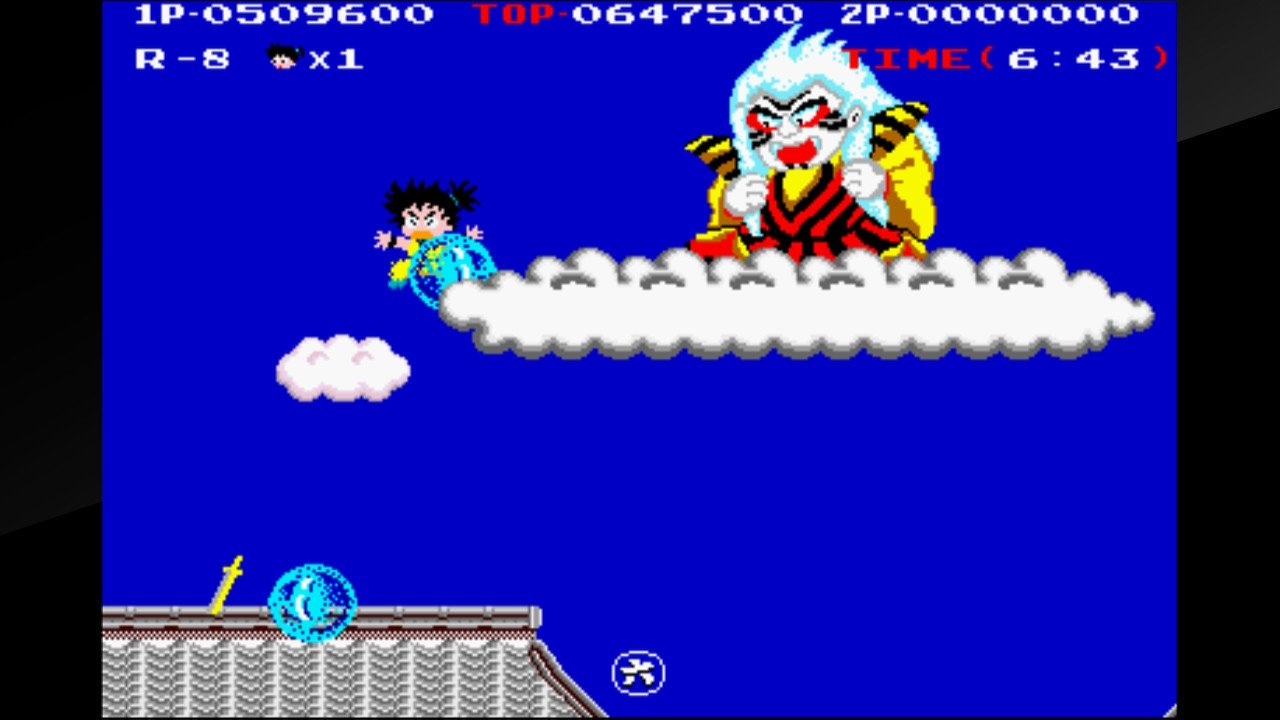

You must be logged in to post a comment.