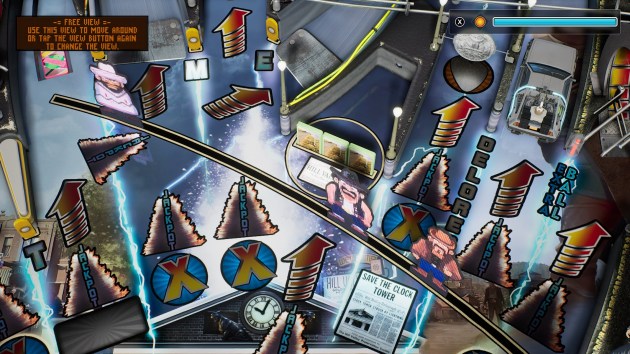
Star Wars: Calrissian Chronicles (Pinball FX Table Review)

Calrissian Chronicles
aka Lando
First Released September 12, 2018
Main Platform: Pinball FX
Switch Platform: Star Wars Pinball
Designed by Thomas Crofts
Set: Star Wars Pinball Collection 2 ($23.99)
Links: Strategy GuidePinball FX Wiki

It looks like it’s going to be so fun, but it’s one of the most frustrating, annoying, and polarizing pins in the Star Wars lineup.

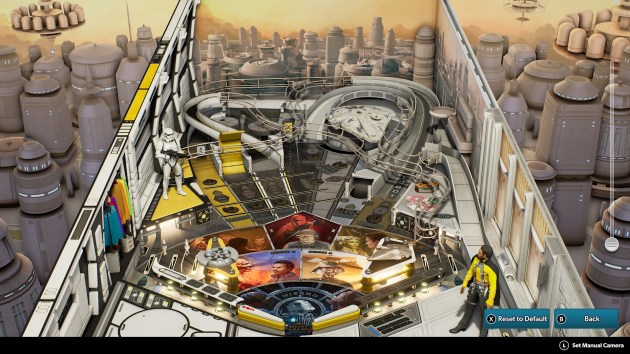
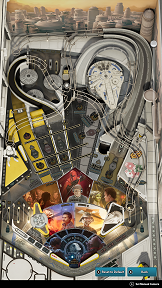
Lando is the proud owner of some of the most lethal rails in the sport. Rails so lethal that even made shots could be killed by them if the ball drops uncleanly out of the habitrail. It turns a lot of people off the table, while others adore that it’s among the most lifelike tables Zen has ever done. At times, it almost feels like it was made by an entirely different company. No Star Wars pin has a ball that feels so heavy, and with that comes huge satisfaction watching a successful shot glide gracefully around an orbit. Of course, that doesn’t cancel-out watching the ball fall lifelessly into the drain after hitting the dead-center capture ball at the top of the screen, or the agony of seeing a successful lit-shot wobble out of the chute, dance off the rails and then drain down the left outlane. I couldn’t forgive it for that last one. It just happened too many times for me.

Persistent Problem – Rejections: Even the fans of Lando will concede that it’s frustrating to shoot a ball in a way where, by all logic and reason, it should easily clear the orbit and it doesn’t. I’m a lot more frustrated with my family than I am with the table itself, because I don’t see how they can admit it does this and still defend it. But they do. Angela especially is a big Lando fan, plays it recreationally outside of our Pinball FX review stuff, and has held records on it (and she’s still the Distance Challenge Undisputed World Champion as of this writing).

Lando is probably the most polarizing of all Zen tables. Usually, when we split our votes as a group, it’s done so in tiny degrees. For Lando, there was a big gap between us, at least until Sasha came along. I told her “you’re going to be a diplomat when you grow up.” She asked what a diplomat does, and I said “honestly I don’t have a clue but people respect them!” You either love Calrissian Chronicles or you hate it. I hated it. Jordi did. Elias really did. Too brutal. Too unfair. Too many rejections. And on top of everything wrong with how it shoots, some of the modes have the Millennium Falcon and even TIE Fighters flying all over the screen like an antsy kid waving their hands in front of the screen. It’s so distracting and just plain annoying. I think you can add characters and story to a table without distracting from the shots. All of Zen’s best pins do exactly that. Meanwhile, Dad and Angela love Lando. They love the layout. They love the elegant combo-shooting (something my love of is purely hypothetical and based on the shots actually working right), and the unique physics. It seems to have a slope angle that no other Star Wars pin has, or they have an entire different gravity setting just for it. Meanwhile, Sasha is just kicking up her feet and laughing at us for making such a to-do over such a middling pin. Say what you will about Lando, but it sure sparks interesting debate, doesn’t it?
Cathy: BAD (2 out of 5)
Angela: GREAT (4 out of 5)
Oscar: GREAT
Jordi: BAD
Sasha: GOOD (3 out of 5)
Elias: THE PITS (1 out of 5, Star Wars Pinball)
Overall Scoring Average: 2.6* – OKAY
Primary Pinball FX Scoring Average: 3.0GOOD
*Nintendo Switch version is, more or less, identical to all other platforms.
Some review copies were provided in this review, others were paid for.

Brothers in Arms: Win the War (Pinball FX Table Review)

Brothers in Arms: Win the War
Pinball FX Debuting Pin

First Released February 16, 2023
Main Platform: Pinball FX
Switch Platform: Pinball FX
Designed by Thomas Crofts
Set: Gearbox Pinball ($14.99)

The first time I heard about this table, I remember thinking “Brothers in Arms? Why the hell would they go to gaming’s graveyard and dig this license up?” Now that I’ve played it, I.. feel exactly the same way. Brothers in Arms? REALLY? Why even bother with the license? Just make a generic war-themed table that you don’t have to pay the royalty for! I get that Gearbox doesn’t have a ton of options to choose from in order to pad the set’s table count, but is anyone really nostalgic for the further two-fisted adventures of Matt Baker, only this time, it’s pinball?! What they should have done is two completely different Borderlands pins. The one we reviewed already, and one that’s actually fun.

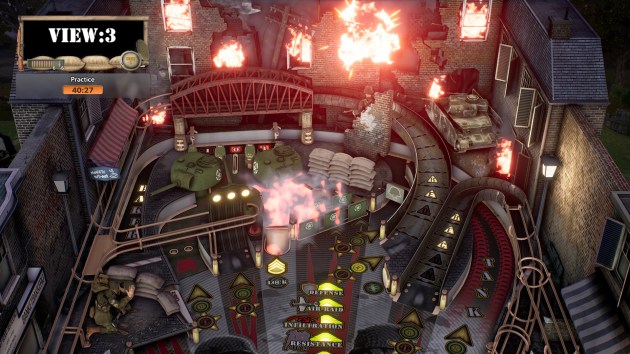
Do you know what Brothers in Arms’ problem is? Well, besides the fact that everyone at Zen Studios should be charged with desecration of a corpse for taking THIS license? Brothers in Arms is a pinball version of a gritty war first person shooter. So, why’s there no grit to it? Look at the best war pinball game ever: Battle of Mimban. It looks ramshackle, like a rickety barracks thrown together in fifteen minutes that’s expected to collapse from the elements not long after they pack their bags and leave. It’s just a facade: that table has elegant target placement and a nice zip to the ramps, but it feels gritty. Then you have Brothers in Arms, and it looks like.. well, any other generic pinball table. Could be any theme, really! War is ugly, and cold, and raw. Brothers in Arms doesn’t capture that at all. It looks like a propaganda poster, and that’s certainly one way of going about it. But even when the table adds things like explosion effects or rainfall or fires, it just looks too clean cut. Everyone says I don’t focus enough on theme integration. Here, the failures of using the theme stand out. I’m just too spoiled by Mimban.

Signature Shot(s) – Mode Start: The old school layout of Brothers in Arms is punctuated with a cluster of drop targets protecting the mode start hole. These targets also become stationary for some of the modes. Sometimes the target cluster concept works. I don’t think this quite pulls it off. Like every other element on Brothers in Arms, it’s efficient. It gets the job done. And there’s nothing exciting about it.

Otherwise, Brothers in Arms is a genuinely solid table with a nice layout and variety of solid but unremarkable shots. The biggest problem is there’s no truly memorable elements to Brothers in Arms. The modes in Win the War are “mid” as the kids say. The ones that use multiball all feel samey, but at least they don’t have a timer. By far the best mode is infiltration, where you have to hit an orbit to sneak into a base, and if you miss, it alerts the Germans, AND THEN the timer starts, but you can turn off by hitting the mode start. I liked that one a lot more than the spam-multiball stuff. I suppose those technically fit the theme, but it happens too much and becomes mundane. Besides, this is NOT a table situated for multiball. The outlanes are too bloodthirsty, and the slingshots are their Renfield (I was saving that line for Bram Stoker’s Dracula but I’m not holding my breath for that one coming anytime soon). The kickbacks are often completely worthless. I lost count of how many times the left outlane threw the ball directly at the right outlane. When you devalue kickbacks, Zen designers, you’re only turning table features into busy work for no reason. The table has nothing to gain from this. That’s not a challenge. That’s not difficulty. It’s just a coin flip, over and done so fast that it’s not exciting for the player. It just ruins the fun of the table. YOUR table. Knock it off.

Signature Mode – Air Raid: Air Raid mode is terrible. How about adding time to the clock when you make a shot? Some of those shots you have to make take the ball to the bumpers, where they bounce around as the clock is ticking. And the mode isn’t even over when you DO make the three shots. You have to do it again because of the tried and true mentality of “why be three shots when it can be six? Why six when it can be eighteen?” Yes, EIGHTEEN shots in a single mode: six with a single ball, twelve multiball, all while the table shakes in regular intervals. By the way, the answer to those questions is and always has been “because it becomes boring.”

I initially had Brothers in Arms rated GREAT, but I think that was just excitement for a new table that wasn’t a trash fire. Now, eh, I think it’s just barely okay. This is a table with shot selection that feels like it would be a shoe-in for a Certificate of Excellence, and instead it’s struggling to keep its head above the water. Dad REALLY likes it. He loves the bat flippers and the loot drops, though even he concedes that Zen’s kickbacks throwing the balls down the drain is so tiring at this point. The best thing I can say about Brothers in Arms is, despite the flaws, you don’t need to be a fan of the franchise to enjoy the pinball table. That’s normally an underrated achievement, but it means nothing here because this is a generic World War II-themed pin based on a generic World War II-themed game franchise. Actually, I was wrong when I said A Samurai’s Vengeance was Zen’s version of a Zaccaria pin. No, THIS is that table, right down to snatching the license to the washed-up gaming franchise. And by the way, there’s nothing wrong with that. It’s pinball! If you can’t cement your tongue firmly in your cheek with this, I don’t want a part of it. The problem is, you can’t try to make THIS style of shooter’s pinball table when your only goal as a designer is apparently making it hard to control the ball above all else. It just becomes a lot less fun than it should be. If Goat Simulator is any indication, Mr. Crofts finally figured that out, but a little too late for Brothers in Arms.
Cathy: GOOD (3 out of 5)
Angela: GOOD
Oscar: GREAT (4 out of 5)
Jordi: GOOD
Sasha: GOOD
Overall Scoring Average:
3.2 🧹CLEAN SCORECARD🧹
Some review copies were provided in this review, others were paid for.

Borderlands: Vault Hunter (Pinball FX Table Review)

Borderlands: Vault Hunter
Pinball FX Debuting Pin

First Released February 16, 2023
Main Platform: Pinball FX
Switch Platform: Pinball FX
Designed by Zoltan Vari
Set: Gearbox Pinball ($14.99)
Links: Pinball FX Wiki

When I first saw the layout, I was like “okay, okay, this looks kind of sick.” This is why any first impressions that aren’t gameplay first impressions are worthless, kids. It didn’t take me long to realize Borderlands ain’t any fun at all.

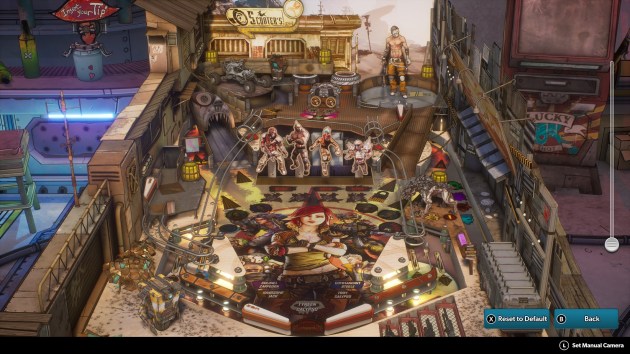
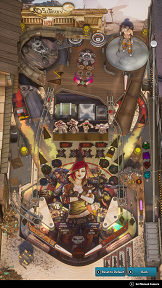
What a shame about some of the decisions made here, because there’s a lot to like about Borderlands’ jump to silverball. I mean, hypothetically of course. I couldn’t really enjoy any of it because something else always got in the way of the good parts. Usually it was the extra ball hole, which is located directly above the right slingshot. This thing is far too easy for the ball to go into accidentally, and it MURDERS the pace of Borderlands. Combined with the ultra violent slingshots that are pretty much unavoidable thanks to the table’s angles and all remaining potential is obliterated. Take the shooting gallery. It’s perhaps the best central target(s) of any table Zen has done that debuted in Pinball FX (my father is a HUGE fan of it). It’s fun to blast the targets. Except they usually take two hits each and regain their health quickly, on a table with tons of sinkholes that eat up time by returning the ball well away from the flippers. In fact, the targets themselves are surrounded by a sinkhole, and when the ball goes into it, which isn’t that hard, it takes a couple seconds before you can shoot again since it returns on the habitrail well above the left flipper. It’s such obviously trollish design. There was no consideration at all for whether it was fun or balanced. This is a game that wants shots that generate a constant sense of urgency while having a layout with a constant sense of downtime. That doesn’t sound fun at all to me. That sounds miserable, and it is.

Elias on Faithfulness: In the games, you play as Vault Hunters: badasses who shoot, loot, and level-up to improve their abilities and their stats. In this pinball table, the Vault Hunters play such a minuscule role in the table that they are only used for skillshot and super skillshot. There’s no powers or skill trees whatsoever. The spinner on the farthest left lane is used for getting XP. Leveling-up allows you to get more points when you kill enemies. It doesn’t really affect the combat. When the inlane and outlane lamps are lit, you gain access to a second wind. So just like the games you get a chance to shoot and kill an enemy before you die and respawn, and if you get it within the time limit, you don’t die. Shooting and looting, the entire point and the core gameplay mechanics that makes up the franchise are both a tad bit lacking. Zoltan Vari tried staying faithful to Borderlands 3 (I prefer Borderlands 2 myself) by making it take forever to actually get good loot. The video games revolve around constantly getting weapons, which doesn’t happen much on this table. It just hurts my soul being a fan of the franchise. The table allows you to choose between 4 different guns that all shoot the same and only make the shooting gallery targets take one less shot. They’re cardboard targets, while the Psycho who jumps onto the table only takes one hit. Why? Shouldn’t a gigantic person on the table take more hits than a cardboard target? Claptrap becomes annoying since his lines repeat so much, the Catch-A-Ride spin disc is sketchy, and there’s too many shots that take grinding to build-up. A 1:1 Borderlands pinball adaptation? Sounds great! But this ain’t it. I still found the table fine enough to award a GOOD rating, but it’s not worthy of the Borderlands name.

Elias is right. There’s no legit sense of combat. None of the danger elements of Borderlands feel like a gun fight. It’s a shooting range. The looting is bad too. The idea is clever, placing three different-sized boxes behind the cardboard targets. Unfortunately, they aren’t something you can really aim at. They’re not designed specifically like VUKs. The ball barely fits them and is constantly going over them, back again, and not going down into the holes. To convert the loot box shots, you need not just accuracy but the right speed, and that’s hard to control. Also remember that there’s a gigantic sinkhole between the playfield and boxes. That’s where the cardboard targets come from. That gap makes this feel like a spiritual sequel to Rogue One and causes all the same stop-and-go problems that pin has. This table has absolutely no flow. Combine that gap, the extra ball saucer, the violent slingshots, and the orbits designed to prevent ball control and I honestly can’t believe this was good enough to not go into THE PITS. I hated this table, and that sucks when there’s so much to like about it. But, let it be said, Angela and especially Oscar adored the shooting gallery and the strange angles, feeling the uniqueness alone elevates the table. Of all the new tables, Borderlands was one of the most divisive among The Pinball Chick Team.
Cathy: BAD (2 out of 5)
Angela: GOOD (3 out of 5)
Oscar: GREAT (4 out of 5)
Jordi: BAD
Sasha: GOOD
Elias: GOOD (Nintendo Switch)
Overall Scoring Average: 2.83GOOD
Primary Pinball FX Scoring Average: 2.8GOOD
Switch Scoring Average: 3.0GOOD
Some review copies were provided in this review, others were paid for.

Boba Fett (Pinball FX Table Review)

Boba Fett
First Released February 27, 2013
Main Platform: Pinball FX
Switch Platform: Star Wars Pinball
Designed by Zoltan Vari
Set: Star Wars Pinball Collection 1 ($23.99)
Links: Strategy GuidesPinball FX Wiki

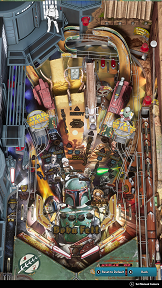
I have no idea how anyone has fun with this thing. Right now, my best theory is it just looks like it’s going to be fun, and maybe even historically fun. Even though I already know Boba Fett is one of the worst tables in Pinball FX, every single time I see a screenshot, for just a brief second, my brain says “damn, that looks really fun.” It’s an actual succubi that lures you in and then eats you alive. There’s never been a table that looks as good as Boba Fett that plays as bad as Boba Fett.

Boba Fett is one of two Pinball FX tables that plays so incredibly, unfathomably poorly that you’d swear it was a different company besides Zen Studios that produced it. It always leaves me dumbfounded when this table shows up on anyone’s “best of” list. It’s like we’re playing completely different tables. First off, the slope feels too steep, and so the table runs very fast. The around-the-world orbits dive-bomb into the drain like they’ve lost their will to live. It doesn’t help that the table is a total brick-layer. The ball feels like it has a wobble, making already tough shots that much tougher since the ball can’t complete them. The ramps are the most incredibly rejection-heavy of any older pin, especially the two corner ramps. I’ve had flush, full-power shots still eat a rejection. For a table with a ball speed permanently stuck on HOLY SH*T, it sure takes forever for a ball to return off one of those rejections, too. It’s like space time itself folds around the top of the table to add three times the visible length. It’s Star Wars so I suppose you can’t rule this out.

Signature Shot – Ball Lock: In order to start Mandalorian Multiball, you have to turn off Boba Fett and boot-up the much better table Mandalorian. No wait, actually you have to get his ship, Slave I, to land on the board then lock one ball at a time three times. This and the teeter-totter shot that’s a fixture on the playfield are Boba Fett’s only good shots. See, I’m not a total hater. Of course, the multiball that happens when you lock all three balls sucks, because this table isn’t made to play multiball. Hell, I’m not sure it was made to play one ball.

Honestly, I think there’s something wrong with the physics of Boba Fett, because these are easily the worst ramps among legacy tables in Pinball FX. There’s just no consistency to them, and the ball speed just feels incorrect in general. Passes I can easily make on other tables I can’t here. As for the central orbits, they might as well be ramps since a giant chasm cuts through the top of the table that your ball can easily fall into. The slings are violent, tilted to an absurd angle, and feature hair triggers. There’s some neat ideas here, like the “choose your difficulty” Bounty system. I just wish it were on a better table. What’s here was enough newest Vice Family member Sasha and honorary Vice Jordi to keep Boba Fett out of the cellar (and actually both are in agreement that Boba Fett isn’t THAT bad and if the slingshots were fixed, this layout might earn from them a mild GOOD). As for the rest of the Vices, it was between this, Classic Collectables, and Han Solo for worst Star Wars table. It took me a long time to get here (I used to have this table rated BAD), but I actually now think this has emerged as the Star Wars table I want to play the least. Not the worst, mind you. That’s undoubtedly, undeniably, unequivocally Han Solo. But at least with Han Solo I’ll have fun laughing with my family at how crap it is. Boba Fett is all brutality and no charm. Just a terrible, no good, very bad table. And now that I’ve finished this review and never have to play it again, I can finally close the book on Boba Fett. See, I did a thing there. I’m sure you got it.
Cathy: THE PITS (1 out of 5)
Angela: THE PITS
Oscar: THE PITS
Jordi: BAD (2 out of 5)
Sasha: BAD
Elias: THE PITS (Star Wars Pinball)
Overall Scoring Average: 1.3* 💩CERTIFIED TURD💩
Primary Scoring Average: 1.4 💩CERTIFIED TURD💩
Star Wars Pinball Scoring Average: 1.4 💩CERTIFIED TURD💩
*Nintendo Switch version is, more or less, identical to all other platforms.
Some review copies were provided in this review, others were paid for.

Blade (Pinball FX Table Review)

Blade
First Released December 8, 2010
Main Platform: Pinball FX
Switch Platform: Pinball FX
Designed by Imre “Emeric” Szigeti
Set: Marvel Pinball Collection 1 ($23.99)
Links: Strategy GuidePinball FX Wiki

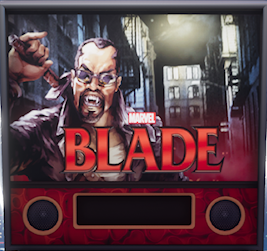
Oddly enough, only a handful of the Marvel pins actually attempt to feel like they’re tied to comic books. You’d think Blade would be one of those that didn’t, but it’s really second only to Spider-Man in creating that comic-like energy using fonts and key art. We really like how this looks.

Blade does two things really well. First, it’s a pretty good tribute to early-to-mid 90s William/Bally tables. A clean, simple layout that flows really nice. Second, as stated above, this is a no doubt about it COMIC BOOK pin in the same way that Ed Kryinski’s Incredible Hulk (1979 Gottlieb) and Amazing Spider-Man (1980 Gottlieb) were. Blade isn’t anywhere near as good as Zen’s take on Spidey, but it’s a damn good table. Modes zip right on by after a couple shots, instead of the typical Zen grind. A novel monetary system allows you to buy a variety of upgrades, like kickbacks and extended ball save for the cowardly, or high-yielding scoring opportunities. Oh, and this could have easily been Castlevania II: Simon’s Quest Pinball. The table shifts from day to night and back again, with modes and bonuses exclusive to each. This could have come across as gimmicky, but it actually does work thanks to balancing what is and isn’t available during each cycle.

Signature Feature – Day/Night Cycles: All the missions (main modes) must be done during night by shooting the Lawlor Trail between the flippers, which is a shockingly tough shot. Night also has some of the best hurry-ups in Pinball FX, where you have to shoot specific lanes to slay vampires for money. The shop where you spend that money is only open during the day, along with the path to the valuable items. Our main knock with the day/night concept is that the clock for it is on the left slingshot. It would have been really great to have a separate ticking clock somewhere. Make it optional if people are afraid about ruining the purity of the visuals.

Blade’s layout looks conservative, but actually, it’s one of the more elegant and deceptively complex shooters we’ve seen from Zen. And that’s just the layout! The rules are very ambitious, with RPG-like mechanics such as stamina, money, upgrades, and collecting items. You build your Stamina (and avoid shots that drain it) so that you get more time to complete the modes. If there’s a problem with Blade, it’s that it’s the rare Zen table that doesn’t quite have enough shots. What shots are here are perfectly fine, but it can wear thin in extended play. It’s also very conservative in scoring, but without any of the balance that type of scoresheet requires. It makes Blade a table where shooting combos is just as exciting as making jackpots, which might not necessarily be a good thing because it means excitement doesn’t build. It’s incidental, and that’s before I get to an absurdly overpowered scoring device so wildly imbalanced that it broke my father and has me cracking up. It’s a whole new level of badly balanced.

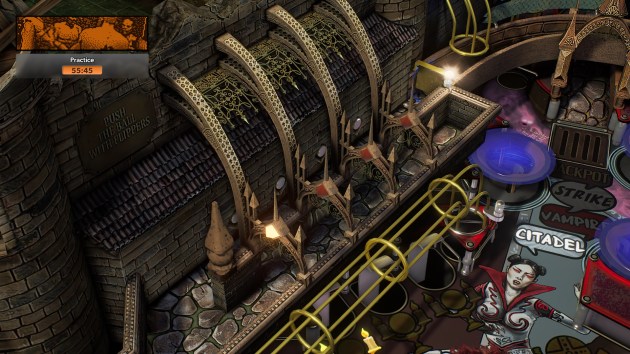
Signature Element – Citadel: This mini-table is where you collect the items. This is one of those kinds where you have to poke the ball off the correct rail. It’s the second one from the bottom that you want to light (which is done via the spinner), though it’s also that item which completely throws Blade’s scoring balance out of whack. You’ll see why..

During a day cycle, the path between the flippers will take you to the Citadel instead of the mode start. Trust me, you’ll want to go here first. There’s four total items. One adds 100 points to every score, which is basically worthless. One cuts the cost of items in half, while one cuts the amount of mode start targets you need to hit in half. Those two are good ideas. The fourth and final item, Azu’s Belt, doubles all scoring permanently. Wow. Yea, that’s insane and I have no way to spin that where it makes any sense. It badly hurts Blade’s flexibility, because the only logical strategy to start the game is work towards getting the belt as soon as possible. I don’t think it’s a deal breaker, but it does sting quite a bit. While I think this does a better job than most at ambitious RPG-like gameplay, I kinda wish they’d just stuck with the old school gameplay with new-school surroundings layout. It’s one of my favorite designs, but Blade throws a lot at you and the results are more mixed than a table that shoots this well should be.
Special Consideration – Nintendo Switch: On Switch, Blade has orbits aimed straight at the drain, which doesn’t happen in the Primary Pinball FX builds. They need to fix this, since you need to hit those shots sometimes. Until then, we consider the Switch version to be OUT OF ORDER
Cathy: GREAT (4 out of 5)
Angela: GREAT
Oscar: GOOD (3 out of 5)
Jordi: GREAT
Sasha: GOOD
Primary Scoring Average: 3.6 📜CERTIFIED EXCELLENT📜
Some review copies were provided in this review, others were paid for.

Black Rose (Pinball FX Table Review)

Black Rose
First Released July, 1992
Zen Build Released December 4, 2018
Main Platform: Pinball FX
Switch Platform: Pinball FX 3
Designed by John Trudeau and Brian Eddy
Conversion by Peter Horvath
Set: Williams Pinball Collection 1 ($23.99)
Links: Internet Pinball Database ListingStrategy GuidePinball FX Wiki

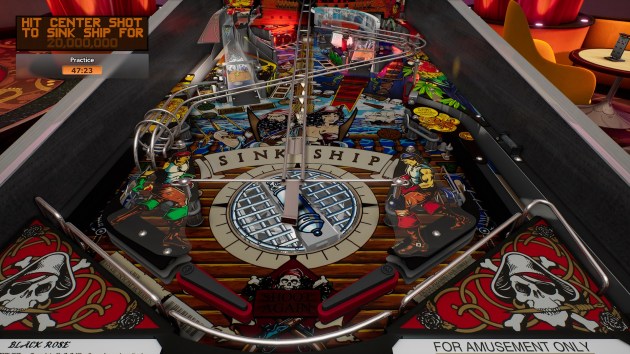
Black Rose is the owner of what is, for my money, the second strangest layout among Williams pins in Pinball FX’s lineup. Space Station’s lack of an Italian Bottom sets it apart as #1, but the race for weirdness is a lot closer than you’d think. At least the rest of Space Station feels like traditional 80s style shot selection, ramps, and objectives. Black Rose is just flat-out bonkers with its sharp-angled ramps and tight squeezes, all packed into a very claustrophobic playfield. If I had never played Black Rose before Pinball FX, I’d have sworn this was a Zen original. It feels more like their modern design than any of the 90s pins in their library.

It was the Pinball Chick staff that was given the task of introducing Black Rose to the lineup to the new Pinball FX. We had a pretty decent pool to choose from, but Black Rose stood out. We enjoyed the task of hyping a table we weren’t necessarily in love with, but found admiration in nonetheless. Hell, Angela had it ranked BAD for Pinball FX3 and Pinball Arcade. At the time, she was still essentially a rookie to pinball. She fully admits now that, with a few years of pinball experience, she’d be more inclined to enjoy Black Rose, but she thinks the outlanes are too punishing for their own good. However, the new Pinball FX build is a little more manageable in that regard, leading to her revising her score. “It’s alright” was her new, unenthused opinion that she insisted not a single word be added to. That’s fair. Let’s face it, Black Rose is a very problematic pin. Horrible scoring balance (the Double Broadside mode is absurd). Little incentive to tour the table. Brutal multiballs that can end in the blink of an eye thanks to the lack of ball save. This isn’t a table for the faint of heart.

Signature Element – The Cannon: Do you know what I love most about the cannon? It’s the rare gimmicky element of the 1990s that doesn’t cause any interference during normal gameplay. You don’t have to shoot around it. You don’t have to factor it in at all when trying to make your shots. It’s wonderful.

On the other hand, I’m finally prepared to raise the GOOD score I awarded it to GREAT, because Black Rose looks and plays great on Pinball FX. The cannon is one of the great key shots of the early 90s, while the whirlpool ramp has grown on me over the years. I didn’t love it before. Now, I’ve come to appreciate how satisfying it is to fully charge its value. Also, in this new build, multiballs don’t feel like they clear each-other out to such an absurd degree as they did in Pinball FX3. Having now put more time into real life Black Rose tables, yea, that doesn’t really happen on a corporeal version. Multiball is much cleaner in real life, and while it’s not 100% there on Pinball FX, this build is more true to how a physical Black Rose shoots. Even with the improvements, Black Rose is still a bizarre and punishing table with unconventional angles and hungry outlanes. Oh and that Walk the Plank video mode can choke on a sea biscuit and die. As much fun as Black Rose is, it will always feel like a prototype for the type of Brian Eddy layout that would dominate the end of the arcade era of pinball. As far as proof of concepts go, it’s a good one, but it’s mostly just a taste of better pins that would happen thanks to it.
Cathy: GREAT (4 out of 5) GOOD on Pinball FX3
Angela: GOOD (3 out of 5) – BAD (2 out of 5) on Pinball FX3
Oscar: GOOD
Jordi: GREAT
Dash: GREAT
Sasha: GREAT
Elias: GREAT (Pinball FX3)
Dave: GREAT (Pinball FX3)
Overall Scoring Average: 3.75 📜CERTIFIED EXCELLENT📜
Primary Scoring Average: 3.66 📜CERTIFIED EXCELLENT📜
Pinball FX3 Scoring Average: 3.16GOOD
Some review copies were provided in this review, others were paid for.

Biolab (Pinball FX Table Review)

Biolab
First Released October 27, 2010
Main Platform: Pinball FX
Switch Platform: Pinball FX 3
Designed by Imre “Emeric” Szigeti
Set: Zen Originals Collection 1 ($15.99)
Strategy GuidePinball FX Wiki

One of those tables where the art is both fantastic and the art direction was taken too far because it’s so tough to know what you’re supposed to do.

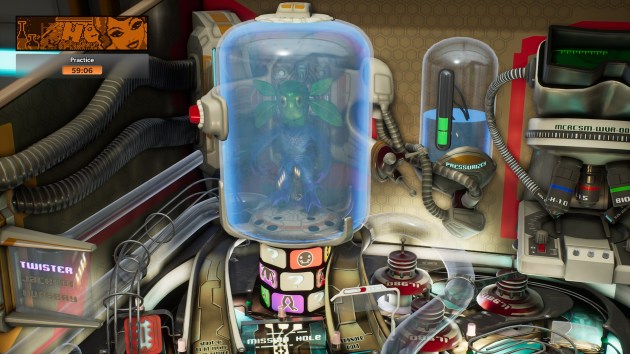
Do you know what Biolab’s #1 problem is? It’s too visually loud, to the point that, if you’re not playing with true table dimensions in vertical mode, it’s too hard to see what shots are lit and which aren’t. Shame, because Biolab feels like a child-friendly training wheels-type table, but I couldn’t possibly recommend it to newcomers. It’s just too confusing. The central feature, a big tube with roto-targets, is one of Zen’s most smackable drivers. That shot would be their Attack From Mars saucer, or Medieval Madness castle, if they had painted this more elegantly. This is one of those rare pins where the art is so gaudy that it’s hard to figure out what exactly you’re shooting, because NOTHING stands out. If you rely on light-chasing, this might be one of the toughest pins to figure out, even with a guide. Of all the Zen Originals, this is the one that took me the longest to figure out. Then came the vertical camera angles, and suddenly Biolab was a highly playable table that went from “difficult to follow” to “difficult to shoot.” I actually mean that to be a good thing, by the way.

Signature Target – Roto-Target on Steroids: Most roto-targets have to be shot to move. Biolab’s triple-stacked roto-target is the mode start for Biolab and works like the reels of a slot machine. Hitting all three segments will begin a mode. This makes for a VERY fun target.

I think a bigger problem is that the modes aren’t all equally difficult. “Brains” is a rotating maze video mode that’s basically a lay-up. “Wisdom” requires you to make three skillshots (use the nudge), but it’s easy to clock the plunger since there’s a power meter (more of that please, Zen). Muscles and Reflexes are the only two shooting modes, and they’re pretty tough, actually. Muscles requires you to hit enough targets before your stamina falls to 0, while reflexes is a two-ball multiball on a table that really isn’t made for multiball. Then you get to the final wizard mode, which features what I believe is Zen’s first magnetic playfield element. Hoo boy, yea.. I totally get why even the most staunch Zen fans were a little nervous about their adaptation of Addams Family’s magnetic playfield. The magnets are too chaotic and unfair, giving you a wizard mode that really comes down to dumb luck. Even worse: if you ball out during it, you have to keep playing until you win. It came THIS CLOSE to dropping Biolab into the BAD column for me. I like the table’s shot selection enough to keep its head barely above water.
Cathy: GOOD
Angela: GREAT
Oscar: GOOD
Jordi: GOOD
Dash: GREAT
Sasha: GOOD
Overall Scoring Average: 3.3 🧹CLEAN SCORECARD🧹
Some review copies were provided in this review, others were paid for.

Battlestar Galactica (Pinball FX Table Review)

Battlestar Galactica
Pinball FX Debuting Pin

First Released May 16, 2024
Main Platform: Pinball FX
Switch Platform: Pinball FX
Designed by Andras “Babar” Klujber
Set: Universal TV Classics ($14.99)

Okay, okay, I admit it. When the Universal TV Classics pack was announced, I rolled my eyes so much that I could see the wrinkles in my brain. But, they ended up with three pins that felt like they came from a place of inspiration. Statistically speaking, this is the lowest ranked of the three, and it just won a Clean Scorecard (excluding Switch). That really tells you how good that set is, even if I didn’t care for Knight Rider at all.

In terms of layout, Battlestar is in an elite class. It flows really well and any one shot can transition seamlessly to any other. Even better is the table’s toughest shot, the ramp leading to the Cylon, is tough enough and risky enough that it becomes satisfying to hit, and it does this without resorting to cheapshots. I just wish the rules were a lot less confusing. There’s too many non-essential lights going at once. While this might lend itself better to making your own strategy, it also makes it more difficult for newcomers to use lights to complete modes. The decision to have so many mini-modes that stack with main modes, in a table this visually loud, might not have been the wisest. Otherwise, the atmosphere is spot-on with the various color-coded room lights that change the tone and feel of the pin. That should have been enough without piling on the added distractions of too many mini-modes.

Signature Element – Mood Lighting: One of the unique aspects of Battlestar is that the colors change depending on the mode you’re playing. It works pretty good, too. It gives Battlestar that cheesy space opera quality you’d hope for if you’re going to develop this kind of licensed pin.

While the layout is solid, we all struggled to become more enthused about Battlestar. Even Oscar, who was a big fan of the show, struggled to put into words why the table just feels kind of middle-of-the-pack, ultimately settling on the pin feels kind of directionless. Which is ironic because the most memorable mode is shooting orbits to aim a ship at the right coordinates and then hit the FTL hole to make it travel. It’s solid. The whole table is solid. Of course, “solid” is usually the word I use to describe something that’s certainly good, but nothing special. It feels like everything here is technically well developed to the point that it’s hard to find too much to complain about, even if I’m not having as much fun as it seems like I should be having. Solid. Oh, and there’s also some minor scoring imbalances tied to some high-yielding bumper scoring bursts that pay-off more than most modes. Battlestar is decent. It’s not there yet. It’s GOOD, so say we all. They told me I had to use that line so I assume Battlestar fans get it. I’ve never seen the show, but judging from the older people here (Dash and Oscar) who have, I’m guessing it wouldn’t help.
Cathy: GOOD
Angela: GOOD
Oscar: GOOD
Jordi: GOOD

Dash: GOOD
Sasha: GOOD
Elias: BAD (Nintendo Switch)

Primary Scoring Average: 3.0 🧹CLEAN SCORECARD🧹
Nintendo Switch Scorecard: 2.8GOOD
Overall Scoring Average: 2.85GOOD
Some review copies were provided in this review, others were paid for.

Star Wars: Battle of Mimban (Pinball FX Table Review)

Battle of Mimban
aka Star Wars: Battle of Mimban
First Released September 12, 2018

Main Platform: Pinball FX
Switch Platform: Star Wars Pinball
Designed by Peter Horvath
Set: Star Wars Pinball Collection 2 ($23.99)
Links: Strategy GuidePinball FX Wiki

You certainly don’t have to be a fan of the Han Solo movie to love what Mimban has to offer. I’m not at all, but the difficult production of that film feels worth it just for this pin. I don’t want to say this table single-handedly justified our purchase of Arcade1Up’s Star Wars pinball table, but it’s DAMN close.

Battle of Mimban is Peter Horvath’s finest table and almost certainly the best original design to come out of Zen Studios. The ultimate marriage of all-encompassing environments that can only exist in video games with the sport of pinball. Mimban is, for my money, the greatest war-themed pinball table ever made. It’s gritty, and dirty, and raw, and visceral. The layout has that feeling too, like a freshly dug foxhole. A ramshackle network of orbits and targets that are so simply placed and accessible that it feels like a table thrown together in five minutes, and I mean that in a good way. Like a base camp set up by a front line battalion that could be broken down and moved on a moment’s notice. But, wash away the grime and the dirt and you’ll discover an elegantly-crafted, smoothly flowing table. Getting the bad stuff out of the way, the slingshots are a little aggressive and the left outlane is brutal. You’ll want to light the kickbacks, which is simple: shoot the spinner. That’s it. No complicated multi-step process. Even better is that these aren’t violent kickbacks. They catch the ball and drop it in the outlane. AWESOME!

Signature Element – Split Level: Zen has done many multi-story tables, but only Mimban has successfully pulled off the degree of realism that makes you believe the layout is the offspring of real world split-level tables. Specifically, this shares a lot of DNA with Black Knight 2000. Hey, that’s one of my all-time favs so I ain’t complaining.

Zen has a love for cardboard targets, and no table by them has better usage of them. It shifts Battle of Mimban from combo-centric finesse gameplay to white-knuckle sharpshooting on the fly, and it WORKS. It doesn’t feel jarring or gimmicky at all. Instead of clashing, the play-styles complement each-other. It helps that, despite the complex idea of an actual battlefield with attack waves, the gameplay couldn’t be more simple or intuitive. The clean layout leaves little in the way of distraction, making it easy to know which shots are lit and how to get to them. It also really helps that this probably has the best written rules of any of the more complicated Zen original creations. Thanks to the clever concept of alternating between attack formation and defense, modes that would be dangerously close to samey and repetitive instead feel high in stakes. There’s also enough options to allow players to come up with their own strategies in order to tackle them, including high risk side-missions that usually pay off with extra balls.

Signature Mode – Infiltration: In this short but sweet shooting gallery video mode, you use the flippers to aim a close-range cannon to shoot cardboard targets. Just remember: red guys bad, Stormtroopers good. Don’t shoot the Stormtroopers.

In a way, Mimban kind of reminded me of my first game of Risk. The rules felt overwhelming and complicated at first, but it took only like fifteen minutes for me to learn what I was doing. Battle of Mimban does exactly that for pinball, and it can be overwhelming. But actually the flow is really simple to learn and the targets are clear enough that it makes for an awesome shooting pin. One that has none of the typical problems with modern Zen. Just getting the ball isn’t the hard part. You have to make your shots in a way where you don’t kill yourself.  Retheme this as any other property, or any other setting, and Mimban wouldn’t work. You’d ask yourself “why is this layout so.. so.. rudimentary?” Simplicity works in a tactical war setting, especially with spot-on scoring balance. Hell, this pin feels more like it’s based on a board game than any of the tables in their three-table pack themed around board games! The end result is a table that has to enter the discussion of the greatest digital-only pinball table ever. It has my vote.
Cathy: MASTERPIECE
Angela: MASTERPIECE
Oscar: MASTERPIECE
Jordi: MASTERPIECE
Elias: MASTERPIECE (Star Wars Pinball on Nintendo Switch)
Sasha: MASTERPIECE
Overall Scoring Average: 5.0* 🏛️PANTHEON INDUCTEE🏛️
*Nintendo Switch version is, more or less, identical to all other platforms.
Some review copies were provided in this review, others were paid for.

Back to the Future (Pinball FX Table Review)

Back to the Future
First Released September 26, 2017

Main Platform: Pinball FX
Switch Platform: Pinball FX 3
Designed by Peter “Deep” Grafl
Pinball FX Set: Universal Classics Pinball ($9.99)
Links: Strategy GuidePinball FX Wiki

Getting the obvious confusion out of the way, this has no relationship to the 1990 Data East coin-op designed by Ed Cebula and Joe Kaminkow. I personally believe that’s one of history’s most overrated pins, but it does have some big fans. This is MUCH better.

Back to the Future is probably the owner of Zen’s best original layout. If not for the bloodthirsty slingshots and outlines, I think we’d be talking about whether or not this is Zen’s greatest achievement in pinball design. Back to the Future is overflowing with satisfying shots and the best stackable multiballs they’ve ever done. I normally hate any multiball that passes three-balls, but the “one new ball every time” Outta Time Multiball won me over, and I especially like that I can use it to clear the modes. Speaking of the modes, the way they did them is pretty damn genius. You can start the game in any of the six time settings from the trilogy at the start of the game. Each setting has three modes that are live the moment you begin. They’re essentially checklists, so every shot matters. Instead of feeling like a grind, it actually feels rewarding to see how many shots are left, and seeing the lights go out as you check off the last shot. I wouldn’t mind at all if they did more pins like this. While the modes might feel a bit samey, they’re dressed differently thanks to a huge variety of cardboard targets and toys that change depending on the time period. Far out. And, there’s even risk/reward built into the modes. If you do them in movie order and succeed, the final wizard gives you a seven ball multiball instead of a four ball. That’s big, since basically everything pays-out in the wizard even if you seal-clap.

Signature Shot – Cardboard Targets: Each of the six different time periods has different cardboard targets that run along a track, including characters that look very close to the characters from Wild Gunman. This might be the closest we ever come to seeing Nintendo characters on Sony and Microsoft consoles.

As fun as Back to the Future is, it also feels like this was the start of Zen’s hostility towards all things like ball control. Somewhere along the line, their designers got it in their heads that the worst possible thing they could do is make gaining control of the ball easy. Instead of just trusting the players to put the challenge onto themselves, they resort to the same handful of tired, predictable tricks. Like aiming the slingshots right at the outlanes, then trollishly giving them hair triggers and explosive punching power. And while I’m sure they’ll say “that’s what kickbacks are for” I’ve had multiple games of Back to the Future where one kickback launches the ball the full length of the table right into the other outlane, which then immediately launches it back towards the original outlane. That’s why I had to drop my MASTERPIECE rating down to GREAT. It’s SO close. If they went back and toned down the slingshots.. not change the angles but just tone back the hair trigger and the punching strength, I actually think this might have a shot at beating some of the top-tier Williams tables. It’s really amazing, and tragic because there was literally no benefit in making this as unfair as it is. Addams Family might get away with it, but Addams Family doesn’t have anywhere near the shot requirement Back to the Future has, or the frequency of multiballs. One of these days, Zen’s designers will stop shooting themselves in the foot like this.
Cathy: GREAT (4 out of 5)
Angela: GREAT
Oscar: GREAT
Jordi: GREAT

Dash: GREAT
Sasha: GREAT
Overall Scoring Average: 4.0 📜CERTIFIED EXCELLENT📜
Some review copies were provided in this review, others were paid for.