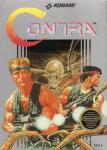
Contra (NES Review)

Contra
aka Probotector
Platform: Nintendo Entertainment System
Released February 9, 1988
Directed by Shigeharu Umezaki & Shinji Kitamoto
Developed by Konami
Included in Contra Anniversary Collection

I imagine the Konami NES NO! streak is about to end.

Ever shut down an account with 18,600 followers? It doesn’t feel great. I need something to cheer me up. I think it speaks volumes that, when I was asking myself “what classic game can I play that I know is guaranteed to be a good time no matter how many times I play it?” Contra sprang to mind. Come on, it’s Contra! What can I possibly say that hasn’t been said by everyone who loves games? “It’s a very fun game, but when do we get to the part where we trade arms to Iran?” Thanks, Dad. I’m sure nobody has ever made THAT joke before. So, I did something a little different with this review. In addition to playing through it, I watched my father and niece Sasha play a round. I just wanted to see if they had fun. No help from me, except I told them the Konami Code, which Dad had heard of but Sasha, all of age 9, hadn’t. Took them a couple tries but they got it right. Dad had played this a little bit before with me, but we’d never really finished it. And, they had a great time! They really liked Contra a lot, both declaring it one of the best games they’ve ever played, and that made me feel awesome. That could be the whole review there, but WHY is Contra fun? Why is it so beloved? Has any game that’s so small and unassuming left a bigger footprint? Arguably, it’s more famous for the Konami Code than the game itself. Plenty of people can’t recite their own driver’s license number by heart, but they can recite how to get 30 lives in Contra, even if they haven’t played it in decades. I HAVE to know: what makes Contra.. well, Contra?

This is arguably the game that introduced the concept of “epic” to gaming.

The obvious answer is “everything.” The music. The sound effects. The guns. The bosses. The two gameplay styles, side scrolling stages and third-person stages, being completely compatible in a way that changes the pace in a fun and inventive way? Something a different Contra game proved matters a great deal, by the way. Super C’s top-down sections are nowhere near as fun as Contra’s third-person stages. Top down? Pssh, what is this? Ikari Warriors? Commando? Top-down is far too common-place on the NES, unlike the third-person stuff. Even the mythology around Contra elevates it above other games. I’m not just talking about the most famous cheat code in gaming history. It certainly played a big role, but it’s not even really Contra’s code. It’s Konami’s code, and it started in the game Gradius because play testers weren’t able to finish the game and needed help. It was a series of inputs nobody could do by accident. Then, they just forgot to delete it before publication, and the code became an icon of gaming. Hell, it’s in the Tengen version of Tetris. Sort of. The “UP UP” part isn’t, but if you pause that game and press “DOWN DOWN LEFT RIGHT LEFT RIGHT B A” it changes any block into the Tetris-making long block.

This slideshow requires JavaScript.

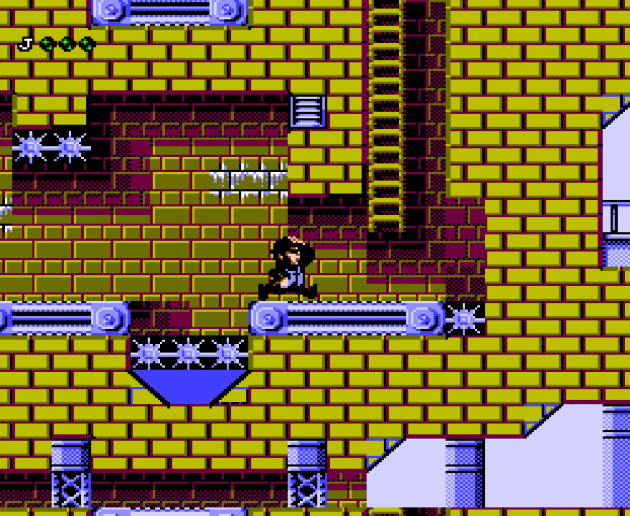
And that’s just the start of Contra’s mythology. How about the fact that, in Europe, they replaced humans with robots? That’s one of those things that’s just so weird, but in a charming way. There’s no doubt about it: Contra for the NES is in the discussion for the greatest video game of all-time, but I suspect the secret to its success goes deeper. I think Contra is one of the most interesting games ever made. On the surface, it doesn’t really seem like it would make for an interesting review, either. Well, at least my style of review, because Contra doesn’t do very much wrong. What can I possibly complain about? There’s no cheap shots. There’s no gotchas. The jumping is damn near perfect. The levels are flawlessly paced. There’s not one placement of platforms I would consider to be an unfair or bad jump. There’s no trollish enemy placement. If anything, Contra handles all those elements so precisely and thoughtfully that you’d swear a super computer chose their locations based on some kind of scientific formula. The one sort of “dirty pool” part are these hooks, which don’t use a timed interval like previous ones had:

And.. you can just jump over them. There’s enough clearance. Took me a while to figure that one out. Even the weapons are equally fun. While I know what gun *I* like (the spread gun), there’s practical arguments that the flamethrower, laser, and even the machine gun are equally balanced. Hell, did Contra even make a mistake at all, or is this that rare game that’s absolutely perfect?
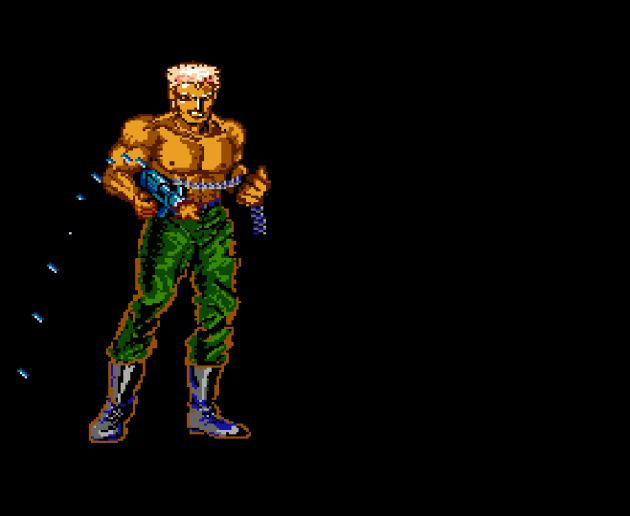
In Japan, there’s some special effects that don’t happen in the US. There’s also a Ghosts ‘n Goblins-like Map Screen and “cut scenes” like the one above.

It might actually be perfect. Except the co-op, which has scrolling that can double-kill you or worse if you die and then respawn right over a pit without your partner moving the screen far enough over. You can also scroll-kill on the Waterfall stage too. Except, that sort of feels like the type of communication-based challenge that co-op SHOULD have, doesn’t it? So, great, back to “is it perfect?” And the answer to that is “no.” There’s one flaw that I would come down on like a ton of bricks if it were any other game, and fair is fair. So, here is the one and only genuine problem with Contra: visibility issues. And it’s not nothing. Assuming you have a non-standard gun, your bullets are big and highly visible. But, basic grunt enemies and the turrets shoot white dots at you, and sometimes they vanish in the fog of war. Depending on your screen, it can be very easy to lose track of the enemy shots. As a precaution I have to take with my photosensitivity, I have to play my games in a room that’s brightly lit. It sucks, but it beats having a seizure, a headache, or whatever else might happen. Some games it’s not even a big deal, but it absolutely is with Contra. I’m good enough now that, when I die, it’s usually a total surprise because of a stray bullet that blended a little too perfectly with the rest of the screen. Once I was absolutely certain that there was nothing about the graphics or effects of Contra that was dangerous for my photosensitivity, I turned the lighting down a little bit. Visibility was still an issue. So, it’s a thing.

The visibility thing is especially annoying in the third-person levels. The little electric beam that keeps you from running forward is white and bounces up and down. It’s visually noisy and white, while the bullets are visually small, subtle, and white. There’s also white lines to create the illusion of depth, and enemies have white shoes. Hell, the seams of your pants are white. It’s not a coincidence most of my deaths in this feature came during these base stages.

That one flaw is certainly not enough to take Contra out of the contention for the title of best NES game. I obviously don’t think it is (that honor goes to another Konami game: Castlevania III: Dracula’s Curse), but it’s no-doubt-about-it in the discussion. Even people not inclined to enjoy pew-pew beefy dudes shooting guns type of games love Contra. I think a big part of that is it’s one of the most clockable games of this type out there. In recent years, one of my proudest gaming achievements was successfully beating the original Castlevania without dying. But, a no-hit run seems so far out of my league that it’s practically off the table. When I had that no-death run, a few people mentioned trying a no-death run on Contra. HAH. That feels well out of reach. Then I played it for this review. Actually, I played it multiple times, but that wasn’t my intention. I was going to play it once single, and once co-op. In the first game, I put the 30 lives code in as a precaution, but I didn’t need it. I ended up making it over half-way through the game on my first attempt before I lost my first life. WTF? Really? In fact, yea, I made it to the “energy zone” before I died right here:

This prickish fire beam that behaves differently than other fire beams is where my no-death streak ended in my first game in this review.

Am I just fantastic at games? Nah. If you want to completely trivialize Contra’s difficulty, all you need is a controller with autofire, the spread gun, and enough experience playing Contra that you know what to expect. It’s not even that much experience, either. I hadn’t played Contra in a long time when I made that first run during this review, and I finished the entire game with only two deaths thanks to cautious gameplay and the autofire. On its own, with a regular controller, Contra is genuinely pretty tough, right? Maybe the first time, but if you know what to expect, it’s really not that hard. I know this because I just created a challenge for myself: Contra, with no thirty lives code and no autofire. Can I beat the game without needing a continue?

That was a warm-up, everyone. Warm-up.

Let’s try that again.
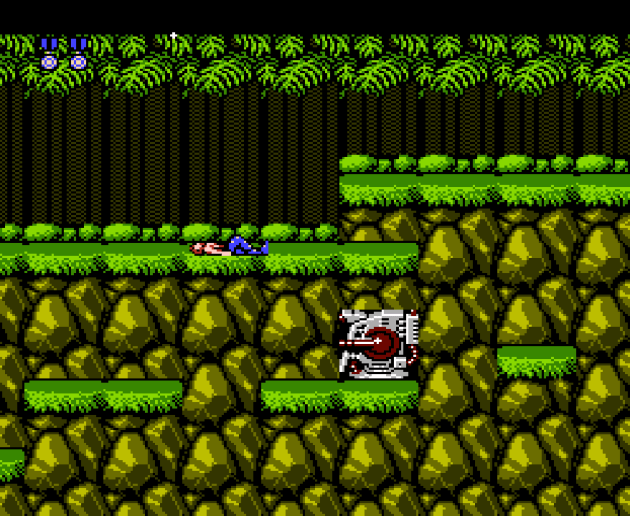
Oh for f*ck’s sake, Cathy.

Alright, seriously, starting over, and this time I’m going to remind my brain there’s no autofire and I can’t just barge through the game like I want to talk to the game’s manager. No BS, how far can I make it in Contra with zero extra help? No thirty lives code. No autofire, no rewinding, no save states. Go!

Death #1 happened during the last room before the boss of the second level. I tried to get too many shots off at the primary target before smartening-up and taking out at least one of the turrets. The worst part was losing my spread gun. I basically traded it and one of my lives for the flamethrower, which is my least favorite of the four non-basic weapons. I didn’t get the spread gun back until over halfway through level three, which is where I also scored my first free life (CORRECTION – IT WAS MY SECOND FREE LIFE).

This slideshow requires JavaScript.

Death #2 happened during the third boss, which is one of the few bosses that shoots large projectiles you can’t blow-up with your own bullets. I think I just died from a bullet that spawned in the same space I was occupying. Death #3 happened in the first room of level four. Yep, I’m in trouble. I got a flamethrower (sigh, why do the third-person things give me that POS first?), then ended up with the laser, and soon after, another free life. Made it to the final room which has three turrets, tons of barrels that come at you, and enemies that never stop shooting. Death #4, but I got a machine gun for the first time since the start of the game and got out of the boss fight with two lives left. Without any third-person levels left, for a moment, I thought I had a shot at it. I got ANOTHER free life soon into the next stage, and I got my spread gun back. And then I remembered the big f’n tanks in the next level.. which I defeated easily. In fact, I had my first level since level one where I didn’t die! I also didn’t die in the 6th level and got ANOTHER free life.

This slideshow requires JavaScript.

This was my Homer Simpson moment. “I’M GONNA MAKE IT! I’M GONNA MAKE IT! THIS IS THE GREATEST THRILL OF MY LIFE! I’M QUEEN OF THE WORLD AND..”
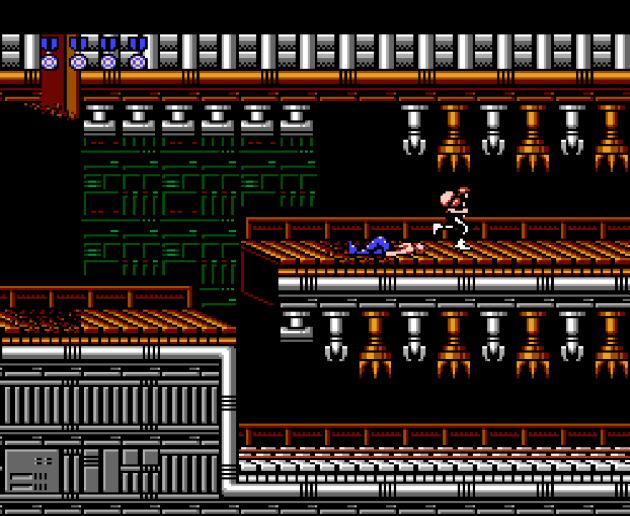
Death #5

Are you kidding me? A pack of three guys had been running to the edge of the platform below me and then turning around. I shot two of them, but one jumped and got me. Goddammit so much. Except.. uh.. that was my last death. Holy crap, I just beat Contra without gaming-over, without the 30 lives code, without cheating, AND without autofire!

This slideshow requires JavaScript.

Granted, I had a two-death game with autofire already in the making of this review, but I literally squealed with joy. It just feels like it matters for some reason. So, now that I’m really warmed up, how far can I make it with autofire? How much does that completely neutralize the difficulty of Contra?
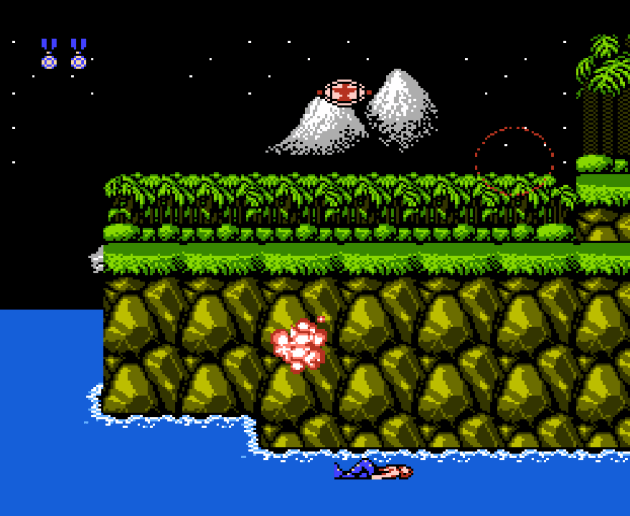
Warm up. WHAT? WARM UP! (I didn’t make my jumps across the exploding bridges).

After that false start, I did it. No death run on Contra. With autofire, but no cheating. The game continues afterwards with another cycle. I couldn’t find anything on if the second cycle is supposed to be harder. I didn’t think it was, but I wanted to see how far I could make it without dying. I wasn’t as cautious this time. The first cycle, I paced myself, especially with the turrets. I made sure to take them out as soon as I could to lessen the chances of a stray bullet. I didn’t the second time around and I made it..

This slideshow requires JavaScript.

Contra, like Castlevania, has a overstated difficulty. It’s tough, but not unclockable. Random elements are kept to a minimum, and enemies are predictable. Your bullets travel the full length of the screen, and it’s not like enemy fire is blanketing the playfield. This isn’t a bullet hell, or even remotely close to that. On top of all that, if you die, there’s never too much distance between you and the next opportunity to upgrade your gun. How many video games with a reputation for being difficult are there where the difficulty is based on the fact that you’re absolutely f*cked the very first time you lose your current loadout? That’s not the case at all with Contra. In my no autofire run, I only finished one boss without the default gun. Enemies are never too spongy. Bosses aren’t, even with your basic gun, but the odds are you won’t have your basic gun for long anyway. That was my revelation about Contra: as far as this type of game goes, it’s almost unprecedented in how generous it is with power-ups and extra lives. Mind you, there’s no extra life pick-up. Extra lives come from points only, yet, I was constantly hearing the pleasant chime of a +1 to my stockpile. I’ve played a lot of NES run & gun games way more intense than this. Compare Contra to something like Capcom titles Gun.Smoke or Commando. Contra is downright kind.
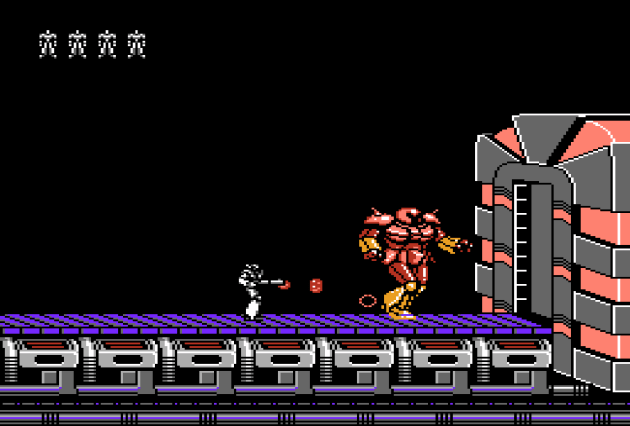
In Europe, the franchise is called Probotector. It sounds like a satire of a game name, doesn’t it? But, it’s the same game. Oddly enough, I didn’t find the difficulty better or worse on any of the three versions (including the Famicom). That’s rare. If there was any difference, it was so subtle that I didn’t feel it.

And I think I know now why Contra is so universally loved: challenge isn’t the point. Fun is. It’s generous with the special guns because they’re more fun than the basic gun. It’s not spongy with the bosses because that would make the novelty of fighting them wear off quickly. The developers have nothing to prove or gain by demoralizing players. Contra is tough to start, but it’s easy to memorize where enemies are going to be. It doesn’t even slow gameplay down that much to play conservatively. It’s the most doable of any “hard” game on the NES. It was A LOT harder for me to beat Castlevania without dying than it was to beat Contra without continuing or, with autofire, without losing a life.

It helps that not one single level qualifies as “the bad one” or even the “not as good one.” Contra is a masterpiece of level design. They’re all a lot of fun.

When people talk about “Nintendo Hard” it’s usually about games like Battletoads which are so prohibitively difficult that they just become boring after the first couple stages. Then there’s Contra, which thanks to the 30 lives code, anyone can finish with a continue or two. It’s a cinch. But, without that code, it’s a game hard enough that beating it without continuing is an accomplishment I’m proud of. At the same time, it wasn’t that hard. It just took a lot of replays over the years. And that’s where Contra’s credentials as a bonafide gaming legend are revealed. Hell, I could probably brute-force memorize any game and get myself to the point where I can beat it in a way that feels like a big deal. Some would just take longer than others. But, for 99.9% of all games, the process for getting to that point would be so boring. Not Contra. No matter how many replays, it’s as fun the last time as it was the first time. It might not be anyone’s #1 game of all-time, but it’s up there for EVERYONE, and there’s not a lot of games you can say that about. And THAT’S why Contra is one of the all-time greats. But, certainly not THE greatest.. right? RIGHT?! I don’t even know.
Verdict: YES
“What about the coin-op? What about Super C? What about..”

Contra SplashPART OF THE CONTRA REVIEW SERIES!
IGC Review of Contra (Arcade)
IGC Review of Contra (MSX)
IGC Review of Super Contra (Arcade)
IGC Review of Super C (NES)

Ghost Manor (TurboGrafx-16 Review)

Ghost Manor
Platform: TurboGrafx-16
Released in 1992
Designed by Art Huff
Developed by ICOM Simulations
Published by Turbo Technologies, Inc.
NEVER BEEN RE-RELEASED (?)

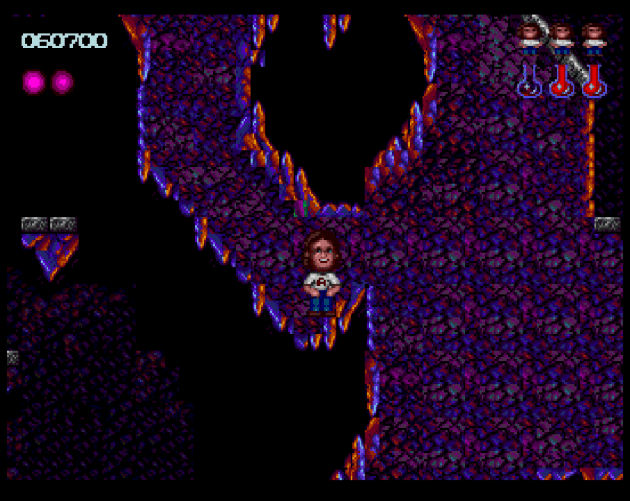
What the hell kind of hero is that? Why does he have an “A” on his shirt? Did Alvin from the Chipmunks make a wish to be a real boy and that’s what he became? And by the way, you can’t see it but the A is on both sides. He’s an A both coming and going.

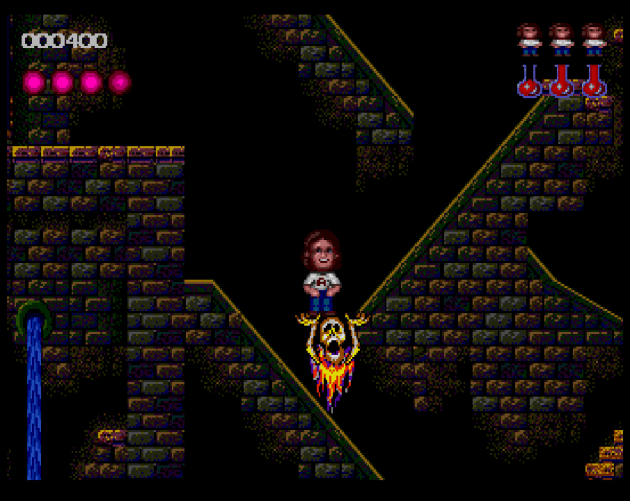
What horror themed game starring a character named Arthur did YOU think I was going to review? Well the thing is, next year is Ghosts ‘n Goblins 40th anniversary, and I think it’s a safe bet that the franchise will be getting a retro collection in 2025. Besides, what stuck out to me about this is I’ve already reviewed a game called Ghost Manor. It was for the Atari 2600 and the review is part of Atari 50: The Games They Couldn’t Include – Part Two. THAT Ghost Manor was an ambitious genre hodgepodge. While I didn’t ultimately give it a YES!, I admired that the company behind the Veg-O-Matic didn’t phone-in their attempt at carving-out a niche in the game industry. I wish I could say the same about this version of Ghost Manor. This take on the theme is a labyrinthine platformer that shares more DNA with Wizards & Warriors than Castlevania or Ghosts ‘n Goblins. Not good DNA, either. It’s one of those passed-on traits that’s not desirable, like asthma or, in this game’s case, slanted platforms that you slide down in a semi-controllable fashion. It’s not that Ghost Manor is a god awful game by any means. It’s just a basic, boring game that relies too heavily on GOTCHAs to ping your health away. One of this game’s main strategies for challenge is moments like this:

This slideshow requires JavaScript.

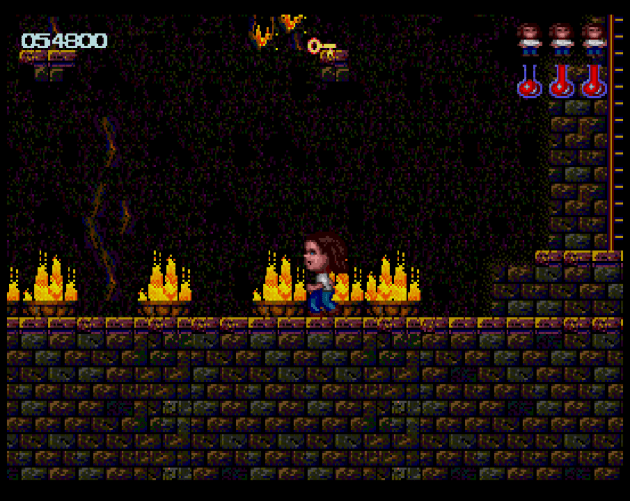
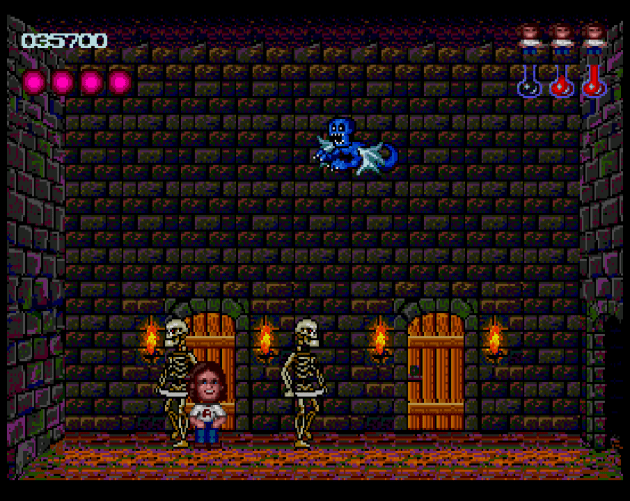
Placing enemies on the other side of the door so that taking damage is a certainty is a trick Ghost Manor pulls all the time. Or entering a door only to have a monster on the other side on top of where you sprite will first come into existence. If this game had instakills, it’d be impossible. It’s a health tax, and nothing more. Why even do the enemies thing? Just take away some health to pass to the next screen. Weirdly, I still never died from taking damage. The only deaths were, like so many games, instakills from pits, environmental hazards, or direct contact with the game’s only boss. How it handles environmental hazards is so weird. Like, look at this screenshot.

I’m walking safely past the fire. BUT, had I jumped onto the same spot I’m on, I would have been killed instantly by the fire. The background suddenly, inexplicably counts as the foreground when it’s a danger element. This happens with spikes too (though they don’t kill you instantly). I don’t recall ever seeing anything like this before. It already doesn’t help that your character looks like a Cabbage Patch Kid that grew up, but once the scariest aspect of the game is bright lights in the background instead of actual monsters and skeletons, it’s probably time to rethink your game. Everything else about Ghost Manor is as generic as it gets. Hearts refill your life. Red orbs act as your projectiles and kill things. I was constantly running out of ammo and having to take damage.

See, I walked through this door and poof, damaged. By the way, some of the enemies that you kill split into two smaller versions that circle around you until you kill them or leave the room, but they don’t kill you. What are they doing? Taunting you?

On the other hand, there’s treasure chests or boxes all over that have life refills, ammo, points, and occasionally whammies (though nowhere near as many whammies as Ghosts n’ Goblins have). Even with this, there still wasn’t enough ammo. I reached the point where if an enemy wasn’t directly blocking the path I was on or I could easily avoid it, I didn’t kill it. Where’s the fun in that? A bigger problem is the way momentum works. Ghost Manor reminded me of the 3D version of Dragon’s Lair, because if you walked into any wall at any speed, Dirk the Daring recoiled. Well, this game does that too. It doesn’t damage you, but it absolutely grinds movement to a halt. There’s no consistency to it, either. Sometimes I was running full speed and no recoil happened. Other times I was attempting to get close to a wall with a platform so I could jump and my character was like “BOING.” It was just something I had to deal with. It’s such a weirdly sloppy thing to add to a game based around jumping and exploring because it has no benefit. It’s neither immersive nor does it add to the challenge, because I don’t even think it caused me to take damage even once. It’s just a bad idea in a game that feels like it’s grasping at straws.

I’m actually stuck here. I had to rewind the game to unstick myself. I couldn’t find any benefit to clipping through the wall like this so I assume it’s a glitch. There’s no guides anywhere for this game so if I’m missing something, I couldn’t find it.

The best thing I can say about Ghost Manor is that it’s pretty short. I finished it in under 90 minutes even though I’d never played it before. The level design isn’t half bad and the exploration is moderately okay. Weirdly, there’s no graphics to indicate whether something is locked or not, so it’s never quite clear what the key goes to when you find it. At one point, I was in a room that looked like the right wall opened up into another room. I’d seen over a dozen walls that looked exactly like it already. The door appeared open, but instead, I brained myself on it. Well, that’s because the key went to it. They couldn’t draw a door? Really? It’s a stunningly lazy game, and what’s even weirder is there is a logical way to help with that problem built into the game. When you face the final boss in a free-roaming room while riding a ghost, an arrow points you towards where the boss is in the arena. Why didn’t they just use that arrow to tell you where to take the key? It would have cut down on the busy work. And ultimately, that’s the problem with Ghost Manor: there’s no extra effort at all. The combat is boring, the movement sucks, and it doesn’t even really work as a “scary” game, especially with the perpetually smiling hero. I’d like to think Ghost Manor is a game starring a hero who is tripping balls on acid. If it’s true, it begs the question: what were those skeletons I killed, really?
Verdict: NO!

Fox’s Peter Pan & The Pirates: The Revenge of Captain Hook (NES Review)

Fox’s Peter Pan & The Pirates: The Revenge of Captain Hook
Platform: Nintendo Entertainment System
Released January, 1991
Developed by Equilibrium
Published by THQ
NEVER BEEN RE-RELEASED

Peter Pan v. Rambo? Nah. That’d actually be fun.

Based on the Fox Kids cartoon Fox’s Peter Pan & The Pirates, Fox Kids Presents Fox’s Peter Pan & The Fox Network Approved Pirates: The Revenge of Captain Hook (sponsored by Fox) is a legit contender for the worst game on the NES. A game with absolutely no grace, no finesse, and especially no polish. It’s one of those rare titles that I have nothing positive to say about it. One of the most lazy and soulless games I’ve ever played in my entire life. It’s actually kind of astonishing how out of f*cks it is. A sloppy-ass platformer where the object is to kill X amount of pirates before exiting the stage. I didn’t even realize that was the object at first. I beat stage one in about ten seconds when I jumped on a mushroom near the start of the level that flung me all the way to the end of the stage. It was quite a distance too. Mind you, it only took me those first ten to twenty seconds to realize how unresponsive and awful the controls were. So when I saw the points of my surprise victory start to be tallied-up, my jaw literally dropped. “Maybe this won’t be so bad!” I thought. Then I did it again in the second level, only I hadn’t killed enough pirates. “Maybe not.” When I went to replay the game, I’m honestly not sure how it happened since I couldn’t have possibly killed enough pirates to beat the stage. I went back and looked at my screenshots, and it says there were 7 left. This never happened again, and in fact, the second time I played it, the mushroom did not throw me the full length of the stage. What happened? I still don’t know.

This is one of those games where the weapon barely extends past your body. I can’t think of any game like that I actually enjoyed. At least Wizards & Warriors added the throwing weapons.

By 1991, I don’t think there was any excuse for a game that can’t even do jumping or platforms right, but Peter Pan & The Pirates screwed up both. Jumping is super sluggish and quite worthless. There’s a handful of environmental hazards, and most of the time, your jump isn’t good enough to clear them. It’s also often unclear what is or isn’t a platform. My family, because they like to dabble in trash TV, recently binge-watched a Netflix game show called “Is It Cake?” where you have to guess which thing among a handful of objects is actually a cake decorated to look real. Yes, I watched it too. I’m doing MY part to inch us closer to full-blown Idiocracy. ARE YOU? Anyway, I’d like to propose a spin-off show called “Is It a Platform?” Can you tell me..

IS IT A PLATFORM?

THAT’S A BIG JUMP! SURELY IT MUST BE..

WRONG! NOT A PLATFORM!

TRY AGAIN! IS IT A PLATFORM?

I MEAN, THERE’S NO LITERALLY REASON FOR ONE TO BE THERE SO..

WRONG AGAIN! IT’S A PLATFORM!

Yikes, right? But that’s okay, because this is Peter Pan, and Peter Pan can fly. To do it, you just hold up when you jump, which transitions you to flying mode. There’s no actual flying animation or anything. That would have been a LOT of work. Like, at least an afternoon. Maybe two. MAYBE EVEN THREE! So you just lock into your jump sprite.. a single gosh-darned sprite.. and move around with the most sluggish, unresponsive air hockey puck movement imaginable. It feels like they just turned the debugging tool into the flying mode, but it’s even worse than that sounds. You collect fairy dust as you go along, which always tops you off at 250 points, but it drains really quick while you fly. You’d think letting go of a button or something is what would turn the flying off, but it doesn’t. You have to push yourself down onto a platform to end the flying. And it gets even worse than that, because you can be knocked out of the air if you clip into any solid surface like, say, a platform. And the platforms are often smooshed together, so when you NEED to fly with the cement hockey puck physics, if you hit anything, you could very well fall into a pit. It doesn’t even need to be that way. Even graze a platform you’re trying to fly up onto and you’ll fall. This is one of the worst controlling platform games I’ve encountered.

And of course there’s instakill gotchas in the form of these cages.

You’d probably think Peter Pan & The Pirates must be impossibly hard, but actually, you get so much life that I never came close to dying from enemies. Each treasure chest you collect gives you two points. I finished my non-cheating round game with 65 health, with a high of over 110. Oh and it turns out the pirate that I was killing with one or two hits at the end levels WAS Captain Hook, but in the finale, the rules change and you have to knock him off the plank. They couldn’t even be bothered to do a unique Captain Hook sprite for the finale to signal the change in rules. But in that entire cleanly-played session, I never died once via enemies. All my lost lives were falling deaths. Thanks to the magic of rewind, I also discovered a lot of weird things, like how sometimes enemies spawn and sometimes they don’t. Remember how I beat the first stage from what must have been some kind of glitch? Well, the game got its revenge in later stages. More than once, even though I killed every enemy I passed, I’d reach the end of a level and still have not filled my dead pirate quota. I’d have to walk back until another one finally spawned. But it wasn’t just the pirates. The booby-trapped cages didn’t always fire, or sometimes a gotcha-placed spider wouldn’t show up.

Weirdly, this is the second awful licensed game I’ve reviewed this year with a final “boss” defeated by knocking them off a cliff. Wolverine for the NES did the same thing.

What else can I say? The level design is basic, uninspired, and bland. The combat is inconsistent, unsatisfying, and somewhat glitchy. It’s one ugly sucker, too, with little in the way of convincing sprite work or even thoughtfulness about what colors to use so as not to totally confuse everyone. After playing through it twice (which didn’t take long at probably an hour combined) I honestly wonder why Fox’s Peter Pan & The Pirates isn’t up for “worst NES game.” It has to be close, and I really think if this had been released a year or two earlier or gotten a wider release, it might be universally regarded as one of the worst video games ever made. Absolutely miserable to play from start to finish with no redeeming qualities at all. A game that actually made me really angry. Peter Pan & the Pirates was before my time, but they showed reruns on Fox Family when I was a kid. It actually had something resembling a soul. It didn’t FEEL cynical. It had Tim f’n Curry as the voice of Captain Hook. Enough said. I’m sure it doesn’t hold-up today because it’s basically a typical 80s/90s animated cartoon designed to sell merch, but it’s also not hard to imagine that the cartoon had a lot of fans who might have been excited to play a video game based on it. And this is what they were given. A game so terrible that it practically holds the kids who would be inclined to want a Peter Pan & The Pirates game in contempt, as if they’re idiots for being fans in the first place. Not every bad licensed game feels like it comes from bad faith. This one does. It’s so obviously rotten that it feels hateful towards potential buyers, and if that isn’t grounds for being a contender for the worst game ever made, I don’t know what is.
Verdict: NO!

I wouldn’t know. BTW, this is not doctored. It really looks like that.

The Lone Ranger (NES Review)

The Lone Ranger
Platform: Nintendo Entertainment System
Released August, 1991
Developed by Konami
Utilizes the NES Zapper (Optional)
NEVER BEEN RE-RELEASED

The Lone Ranger is a top-down action adventure that shares DNA with Metal Gear and the original Konami Ninja Turtles game. Well, sometimes.

The Lone Ranger is also an action-platformer that shares DNA with Contra and Castlevania. Well, sometimes.

The Lone Ranger is ALSO a first-person exploration game that shares DNA with the Goonies II an Operation Wolf.

Oh and it uses the Nintendo Zapper if you so wish. And sometimes it’s an auto-scrolling shmup. There’s even shooting galleries and video poker games too.

Yea, Lone Ranger on the NES is a directionless mess. If I didn’t know better, I’d swear it’s Konami’s answer to Nintendo’s StarTropics. Like StarTropics, Lone Ranger was designed specifically for an American audience. The game was never released outside of the United States, and it feels like it throws everything at the wall hoping something, anything, will stick. The StarTropics comparison also applies to the sheer amount of busy work you have to do to open up the game. Like in the sixth level, there’s two towns you have to visit. The first one requires you to find an empty building where, upon leaving it, you see a note that the woman who lives there has been kidnapped. Then you have to make your way to the second town and find a room full of people sitting at tables. One of the people will tell you that the office in the previous town will tell you how to get to the mine. You then have to return to that town and find the office, which opens up the actual level for you. BUSY WORK! Even worse is that it’s not immersive at all. The dialog just plain isn’t good enough for immersion. It didn’t even matter that the side-scrolling segments that followed were by far the strongest the game had seen up to that point. I was already annoyed at all the hoops it made me jump through leading up to it.

The levels aren’t equally as engaging, either. The fifth level features the mass extermination of Native Americans followed by retrieving a magic egg as a “my bad” token of affection towards them. I’m only half-kidding, by the way, but regardless of the theme of the level, it’s just not that exciting of level design.

In fact, level six mentioned above, for all of its frustrating busy work, was the turning point in the game. Up to that point, I thought Lone Ranger was very “mid” as the kids these days say. The problem with being a “jack of all trades” is the less often said rest of that title. “Jack of all trades, master of none.” No one aspect of Lone Ranger stood out as particularly strong. Adding genres doesn’t add gameplay value if every example is average-at-best. Average is average no matter how many twists you take along the way. Easily the worst parts were the first-person segments. I found all of them to be pretty boring, even if you use a light gun. But, if you go that route, having a light gun takes the edge off the difficulty and I regret that I didn’t choose it for my full play-through.

The problem with the shootouts is that there’s only two types of them; indoors and horseback, and they repeat constantly. The enemies for the indoors shootouts attack in roughly the same positions and attack formations. The horseback ones are the same way, and after you’ve done each version once, with the exception of a lone boss battle that’s boring as hell, you’ve seen everything that gameplay style has to offer. But, each is going to repeat several times over the rest of the game.

First person segments involve the type of single-screen scrolling that games were limited to back then. As you explore, you’ll occasionally be interrupted by shoot outs. What makes it neat is even with a gun, you still need a controller since attacks happen from all sides. You get a warning light when enemies enter from one side. If you only use a controller, it’s all done by cross-hairs. While I always had enough time to pick off the enemies with the cursor, sometimes I had to switch screens before being able to pick up the loot they dropped. With the light gun, I never had that problem, and the shootouts also went quicker which is a good thing because they’re all samey. The only exception is the lone boss fight done from the first-person perspective. In that boss’s case, having a light gun makes it almost trivial.

For light gun games, I use the Sinden, which I also used in my Safari Hunt review. It’s compatible with most emulators. They’re pretty spendy and the optional foot pedals for games like Time Crisis cost a LOT extra, so I’d only recommend getting one if you’re REALLY into light gun games. There’s tutorials for most popular emulators to get them up and running, but for this review I couldn’t get it to work on RetroArch and ended up using a solo-build of Mesen for it. I used a passcode to skip to the more “exciting” first person sections. 0810 7830 3251 2 is the level select code. You have to leave the last few spots blank.

Up until the last three (of eight) worlds in the game, I would have insisted the top-down segments were the best parts in the game. The side-scrolling level design was too short and too basic up to this point, with little to no environmental hazards. Really, the problem with Lone Ranger is that it just takes too long to get going. While the game isn’t ever really bad per se, it’s often very bland. There’s not enough variety in the action. You only get one type of gun that fires two identical-looking bullets. The only thing that changes is the range: short barreled, medium barreled, or long barreled. You don’t feel a difference, even if you’re shooting longer bullets. The silver bullets do more damage and pierce through enemies, but they cost more. I’m not sure why silver bullets would be more powerful than lead bullets. Ever hear of someone dying from silver poisoning? Either way, there’s never a sense of empowerment. Also, you have to manually reload your gun, something my brain just would not remember to do. You can also buy sticks of dynamite which blow up enemies, but I can count on one hand the amount of times I actually found them more useful than just shooting my gun. There’s also no hidden walls to blast through or, as far as I could tell, any secrets at all. Despite all the mixed-up genres, Lone Ranger is a surprisingly shallow game.

The “overworld” segments don’t get beyond basic until right near the end of the game.

For the first five (of eight) levels I’d been quite annoyed by the top-down stuff leaning a little too heavily on empty “red herring” type of buildings that have nothing but enemies in them. It reminded me a lot of Konami’s Teenage Mutant Ninja Turtles NES game, but Lone Ranger’s red herrings are even worse than that game’s. At least in TMNT the non-essential buildings had things like valuable items or health refills in them. For Lone Ranger, they’re just fake-outs that pad the game time, and nothing more. In a game where players are often forced to talk to everyone in a village to open up progress, all these red herring buildings are especially tiresome. It got to the point where I began using save states and would just exit the structures by reloading my state to save time instead of walking back out. And ultimately, none of them ever had anything valuable in them. Not a single one. At least it was kind of predictable which ones were the decoys, since they usually have the same appearance on the inside. Eventually, I cracked open the guide at GameFAQs to shave off all the busy work. Much like with the light gun, I wish I used this from the start, since I didn’t really start having fun until I cut out all of Lone Ranger’s gristle.

Look familiar?

Even while skipping all the BS, Lone Ranger was a game I couldn’t wait to be over with. But then something happened that complicated my review. The level design got good. Really good. The side-scrolling segments went from basic hoppy-shooty-climby type of action to the type of well thought-out layouts and set pieces you would expect from Konami at their 8-bit height. And the top down stuff added things like landmines, turrets, and spikes, and the layouts became more maze-like in a way that reminded me of Sunsoft’s Blaster Master or Gremlins 2. The enemies became more than cannon fodder. The platforming was on par with the type of layouts you’d expect from Castlevania (and that franchise’s staircases are even along for the ride). This was suddenly a really fun game. The question is, did it take too long to get there?

None of the bosses are really memorable. Appearance wise, they usually don’t look that much more distinguishable from basic enemies.

Actually, yea. Taken as a whole, Lone Ranger is pretty boring. Those early levels are just such a slog to get through, and all the RPG-like “talk to the townspeople” stuff whiffed completely for me. I wasn’t invested at all. Had this come out five years later, the writing might have been better or there might have been more character-driven stuff that would justify it. All those bits did was create too big of a pause between the action, but the action that followed was very basic and very bland for over half the game. Having baddies in some of the towns helps a little, but they’re the same basic enemies with the same attack patterns. After a while, they feel like they’re working with the talking bits to do nothing more than pad out the game.

There’s a good game here, but it’s smothered to death by overindulgent world building.

If the entire game had been of the same quality as those last three levels, I think Lone Ranger would be in the discussion for the most underrated game on the NES. The action is going to become repetitive either way, but the gunplay can be satisfying enough. Enemies crouch over before blinking away when you shoot them, but there’s only so many variations you can do with that while keeping with the wild west setting. This could have really used some supernatural stuff or more anachronistic things. Machine guns show up, but only bosses get them. Turrets show up and you can take them over, at which point enemies rush onto the screen just to be mowed down by you. It’s fun for a few seconds, until you realize the enemies aren’t stopping, but YOU’VE stopped moving. Adding a bigger variety of weapons or maybe hiding stuff in the levels could have gone a long way towards making the sloggish parts more tolerable. They also underutilized Silver the horse. There’s one auto-scrolling section where you control the horse while shooting enemies (not to be confused with the horseback shootouts), but it’s bland and boring too. It would have been cool if you could ride horseback in the towns, or maybe even in some of the side-scrolling sections. Or maybe have stealth sections where you play as Tonto. For all the different gameplay types Lone Ranger throws at players, it’s insane that it still feels so lacking. This one was close, but the Konami losing streak at IGC continues.
Verdict: NO!

Robble Robble

Cursed Crown (NES Indie Review)

Cursed Crown
Platform: Nintendo Entertainment System
Released January 28, 2024
Designed by Martin Reimer
Free to Play – Pay What You Want at Itch.io

It looks the part. The mechanics are there to play the part. So, what happened?

I like the Adventures of Lolo. There’s a franchise that’s screaming for a comeback. Apparently I’m not alone in that belief. Despite having no presence in modern gaming at all (besides Lolo and Lala being semi-regular bosses in the Kirby franchise under the names), the franchise known as Eggerland in Japan is one of the most influential on the indie scene. Cursed Crown is a little different because it’s actually on the NES and free to play if you have an hour to kill. There’s no deaths and the game has simple puzzle rules that mostly revolve around gaps and the things that can be used to fill the gaps. Puzzle games without tension are fine. Sokoban (aka Boxxle for Game Boy owners) is in that category and if that floats your boat, so be it. For me, I don’t need action, but if the puzzles don’t challenge me, I just become kind of bored. That’s sadly what happened with Cursed Crown.

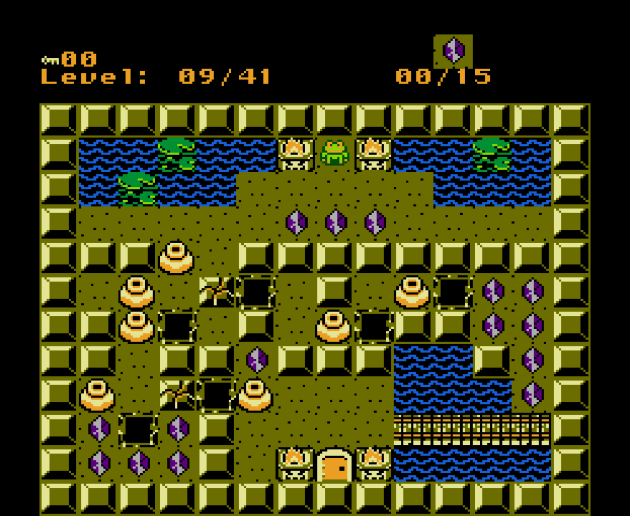
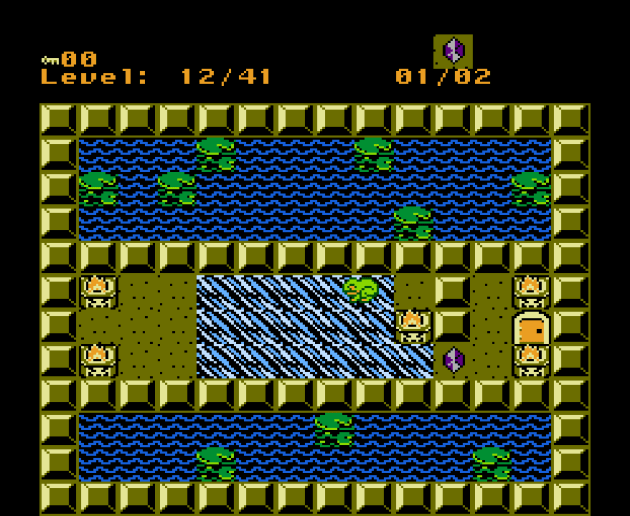
This is one of the final levels of the game, and there’s really very little “puzzle” here. This is like a world one level in a normal puzzle game, only it’s appearing in the home stretch of this game. It really feels like the puzzle logic just sputters out during the end game.

Now, developer Martin Reimer is a hell of a guy, but Cursed Crown needs a lot of work. When it plays well, and by that I mean it has puzzles that you actually have to study the screen and plot out your moves, it’s a damn good game. Unfortunately, there’s maybe 3 or 4 levels in a 41 stage game that are like that, where I had to actually restart the stage because I made the wrong moves. Most of the other stages feel either like tutorial levels or opening world stages. You play as a prince turned into a frog that has to collect gems and enter a door. You move one full character space at a time and the main puzzle element typically involves gaps. The gaps can be filled with both pots and blocks. Some of the spaces become gaps after you step on them once. These are all boilerplate Lolo-like tropes for a reason: they work. So do levels with ice where, once you step on the ice, you can’t stop yourself from sliding in a straight line until you hit something. Again, old hat but a classic for a reason. Sometimes there’s locked doors (but not THE door) that you have to get a key. More than once, I finished a stage with spare keys. A lot of the levels have multiple outs, which works for a game like Baba is You, but here, it’s just too loose of puzzle design.

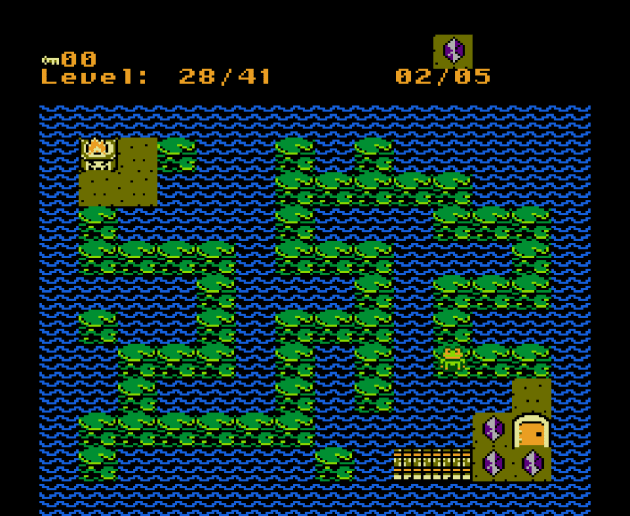
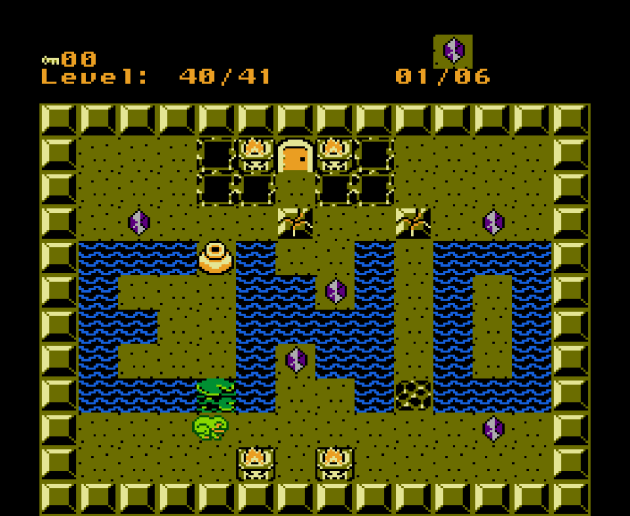
Again, this would be fine for an early stage. This is level 28 of 41, and there’s NO PUZZLE! It’s just an unobstructed path to the finish line. A puzzle game can’t do that type of thing.

The biggest letdown is that Cursed Crown doesn’t save its hardest puzzles for the end. In fact, the homestretch was so easy that it kind of feels like the game was rushed along to the conclusion. I went backwards to see which was the last level where I had to stop and think about what I was going to do. It was level 29 of 41, and even that stage wasn’t that hard. Cursed Crown is like playing a decent proof of concept that has multiple placeholders for rooms that are still being workshopped. The good news is the game is free to download, and the mechanics are solid enough that the potential is here for something really good. It’s just not there yet. What’s out now is too easy, and easy puzzle games are just boring. I’m sure it can’t be a cinch to create elaborate puzzles with one specific solution. But, as an indie game that has no fixed release date, Martin has all the time in the world to come up with them. He’s clearly capable, since a handful of levels in Cursed Crown are genuinely solid. He might want to rethink some of the mechanics. Like how both jars AND blocks can permanently fill a gap in the floor. What if one was a permanent fill while the other was only a temporary one? Or what if the lily pads moved when you stepped on them? Again, this feels like a good proof of concept, but it never evolves past that.

There’s too many tutorial levels as well. I would condense them into a single room that queues you through each gimmick.

The other possible way to look at Cursed Crown, and I don’t mean this as an insult at all: this is actually pretty good as a younger child’s first puzzle game. I had Sasha, my soon to be 9 year old niece, give Cursed Crown a shot. In the event I die, I’ve told my family that Sasha gets Indie Gamer Chick and The Pinball Chick. Don’t roll your eyes. Sasha is already a multi-time Pinball FX world record holder on a variety of tables, including some of the more competitive Williams tables. With Aunt Cathy’s help, she’s even written a few parts of our Pinball FX reviews. She’s also been my playing partner for brawlers lately. So she’s no slouch at games, but she’s also never played a game like this before. So, I passed her the controller, then just sat back and watched. She liked Cursed Crown. She liked the Prince Charming angle. She liked the simple mechanics that didn’t overwhelm and were easy to understand. For her, Cursed Crown worked as a good confidence builder to ease her into a new-for-her genre. That’s not nothing, at least in my book. I can’t give it YES! because I spent most of my playtime waiting for the game to beef-up and it never really happened. The best thing I can say about Cursed Crown is that I enjoyed watching my niece work out the simple puzzles and was happy that it ultimately stoked her interest in one of my favorite genres. That counts for something, but it’s not something I can really take into consideration when making a decision based on my experience. I hope he keeps working on it. We need more Lolo-likes in the world.
Verdict: NO!

Space Raft (Nintendo Switch Review)

Space Raft
Platform: Nintendo Switch, Nintendo Entertainment System
Released August 15, 2024
Designed by Jordan Davis
Published by Nami Tentou
Point of Sale: Nintendo Switch, NES

$9.99 wore a Space Life Preserver in the making of this review.

I feel like Alice in Wonderland here, and I don’t mean the Digital Eclipse Game Boy Color game that was published by Nintendo. As in “I’m in a strange place where nothing makes sense and everything is over my head.”

In the interest of full disclosure, I’m friends with Safe Raft designer Jordan Davis and programmer Dale Coop. That doesn’t really help either of us in Space Raft’s case. A game that promises, quote, “recognizable people and places from the Milwaukee independent music scene, including DMR alumni!” I know of Milwaukee, but I honestly have no clue how big its music scene is, and so I have no idea how much inside baseball is being played here. I’m sure there’s a lot of gags that are destined to sail over my head and probably the heads of 99% of the world’s population. But, this isn’t a music game. It probably should be. I know I just said that about the Blues Brothers and in retrospect I should have said it when I reviewed the coin-op based on the band Journey. But, for what it’s worth, this is the best “should have been a music game but isn’t” title I’ve done at IGC. Space Raft is part auto-scrolling shooter (in the form of scenes with the band’s SUV) and part maze chase played without fixed movement. And apparently all the chip tunes are by the band. They’re decent enough.

I could have done without the van segments.

I should point out that if you buy the Nintendo Switch version, you’re getting two very different versions of the game in one. There’s a special arcade cabinet that was created specifically for a legendary arcade, the very famous X-Ray Arcade. I got a giggle because they’re located in a place called Cudahy, Wisconsin. There’s only one other Cudahy in the United States and it’s right here in California as part of the Greater Los Angeles area. The two cities are named after different brothers, too. Small world! Anyway, you get that game too in this package. The games play out quite a bit different, as well. In the NES version, now called “Space Raft Deluxe”, you must collect every chicken sandwich in each stage, and then the game switches genres entirely with a more open-world type of search for missing car keys and roulette tables. The arcade game is only single-screen-at-a-time collecting sessions where you can skip straight to the exit without collecting everything. The catch there is your health is based on the chicken sandwiches you collect and not normal hit points. The NES version has fixed hit points and scrolling through screens. Both games have levels that start with driving segments too, but they’re functionally side-scrolling shmups with the occasional ramp to go off. The bosses of these parts are fine, but overall these go a little too long for my taste and are a bit samey. They’re always scrolling right, too. It’d been neat if each of the driving segments had a different direction you were going. Something to break up the repetitiveness.

This slideshow requires JavaScript.

The collecting parts are the highlight of the arcade game, sorta. Sigh, this is where it gets frustrating to review a game like this. I think that a lot of the segments are supposed to be wink-wink nods to famous Wisconsin area hangouts and local celebrities, so it’s okay if the gameplay isn’t the greatest. Well, if you’re from Milwaukee, which I’m not, and there’s no references to Giannis Antetokounmpo or the Bronze Fonz, which means this game excludes everything I know about that city. Oh, and Red Letter Media, but they don’t show up either. What is here is a fairly basic arcade scoop-em-up where you have to collect all the items. There’s usually one antagonist on the screen who spits fireballs at you as you do this, along with what I think are birds. You can switch between any of the four band members on the fly, and here’s where things do get unique: each of the four members has unique movement speed and a unique weapon. But, I only found two useful. The red one can throw bowling balls the full length of the screen, while the blue one only throws a close-range punch, but his attacks are instakills and he has the most accurate play control. Everyone else moves too loosely for my taste, including the bowling ball guy. The other two guys drop bombs and spit fire that I found ineffective, at least at first.

The arcade game. You can tell because it says credits up in the top corner.

The movement can be so touchy that there were multiple times where I walked into the stage exit when I didn’t intend to. The arcade game is short and fine for what it is. It’s not amazing. It’s okay. It’s rough, though. None of the movement is “fixed” and it’s inevitable you’ll get hung-up when attempting to turn corners or walk through gaps that are a single character length. Even the computer AI seems to have problems with it for the enemies. None of the baddies had anything resembling patterns that I could make out. This feels a lot like a prototype that has placeholder algorithms for most NPC movement. I couldn’t decide if my #1 “want” for this game was more elegant enemy attack patterns or better movement parameters, which is probably not the best sign, since those two things are really important to games like this. I’ll settle on “I wish movement was better.” Actually, I kind of wish this moved more like something like, say, The Adventures of Lolo where you move a half-space at a time. But, for all of its faults, I had fun with this. If we’re splitting the two games included apart, I’d give the coin-op a very mild YES! because it’s not boring and I feel there’s just enough intense chase moments to make this worth a play.

This slideshow requires JavaScript.

Initially, I liked the coin-op more. I even quit the NES game a little too early to skip over to it, and I’m happy I did. If you end up picking up Space Raft, play the arcade game first, then play the main Space Raft Deluxe game (technically they’re both NES games, but that’s neither here nor there). When I returned to the Deluxe, something I didn’t expect happened: I liked it a lot more now. All the problems of the coin-op are here. The movement sucks, and the enemies can be kind of nonsensical in their behavior. It’s also still “inside baseball” but at least in Space Raft Deluxe, Bernie Sanders and the Green Bay Packers show up, so I’m not completely staring at the screen blankly thinking “I have no idea what’s happening.” But, it’s also clearly the better game. I think the only area where the arcade game is superior is in the driving parts, which are my least favorite sections anyway. Deluxe lives up to the name. The level design is better. The bosses are better. It also does a lot more to change-up the formula. Some rooms might not have you collecting anything at all and instead just clearing a path to the next screen. Hell, the genre itself changes in the third world for two levels and feels more like Legend of Zelda dungeons. Best of all, this more expanded Space Raft made me nostalgic for the type of smaller, more heartfelt personal game that is weird and means more to the developer than it ever could to the player.

See, stuff like this is strange for me. I feel like I’m almost reading a person’s diary or something. This game has a lot of call backs to the good ole days. They’re just not MY good ole days. I’ve always had this belief that if there is such a thing as Heaven, then it’s probably reliving the best, most happy days of your entire life on an endless loop. Space Raft is like someone took that and made a game based loosely on it. By the way, the next graphic is of the Mistreaters standing in front of their burning van. Who are the Mistreaters? (shrug) No clue. In my headcanon, they’re to Space Raft what the Misfits are to Jem and the Holograms.

Space Raft isn’t a fantastic game by any stretch. The movement is frustrating and the enemies feel like they just sort of wander aimlessly. Plus, all the inside jokes were overwhelming for me. Have you ever been to a party where there’s a group of people listening to someone tell a story, and they’re clearly hanging on the person’s every word, but you missed most of it. Then, when everyone laughs at the resolution, you feel awkward but laugh anyway? Yea, that’s where I’m at with Space Raft. I feel like these jokes and references might kill with the right crowd, while I’m just nodding along and feigning a smile. But hell, I used to play games like this ALL THE TIME in my first few years of Indie Gamer Chick. This is exactly the type of personal experience I want to see translated more to games. It’s a quirky game created for the amusement of a small group of people that the developer had the guts to put out for the masses, even if they won’t understand most of the bits. I just wish I felt more invited into this world. Maybe this is the best you can do with 8-bits. A lot of the gags in the game feel like they’d make for a better sitcom than a video game. Something for these guys to think about.

This slideshow requires JavaScript.

As a trip down memory lane from the developer’s point of view, I’m not sure it hit the right notes to leave me charmed. All I have is the gameplay stuff, and it’s fine. I can’t say it makes for a convincing NES game because it has swearing and battles against sentient dog sh*t. I always prefer when developers follow the restrictions studios had in the 80s and 90s and see how close they can come to crossing the line without actually crossing it. But the level design is decent enough and there’s an effort to change up the set pieces and create a sense of adventure. The emulation package is decent, too. No rewind, but it’s not exactly the world’s hardest game. Save states are here, along with concept art and the original NES instruction book and box art. Nice.

This is the part I lost the most lives on in the game, by far. All the van parts are auto-scrolling, and it’s too easy to get hung up on the barrels and unable to move unclip yourself before the scrolling kills you.

If I have one last gripe, it’s that they didn’t quite stick the landing on ending the game, as the worst driving sequence in Space Raft is actually the grand finale. They should have recognized the Zelda-like sequences were their bread & butter and finished on one of those. There’s a LOT of room for improvement, but as a 2019/2020 first game from the guys involved, guys who are getting a LOT better at making games, I’ve played a lot worse. Most importantly, what’s here is a little more fun than it is frustrating, and fun is all I’ve ever cared about. But, realistically, this should be a game that’s made as a limited-quantity physical release that’s sold in Wisconsin gift shops. I don’t even mean that as a negative, either. I think it’s wonderful that an indie game can celebrate local culture. Seriously, if *I* were to make a game, I’d probably be something like this, only it’d be about Emperor Norton and you’d only be able to find it in mom & pop shops in the Bay Area. Put that game on the eShop and people would be like “who the f*ck is Emperor Norton and what the f*ck is Original Joe’s?” It’s inside baseball.
Verdict: YES!

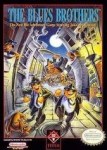
The Blues Brothers (NES Review)

The Blues Brothers
Platform: Nintendo Entertainment System
Released September, 1992
Developed by Titus
NEVER BEEN RE-RELEASED

I will never know joy again.

I go through extended periods of melancholy. If my rate of game reviews slows down, that’s probably a sign that I’m currently having an extended case of the blues. I try to avoid reviewing games when that’s happening because it’s just plain not fair to the games. The bitch of it is, it’s never clear when it’s over. It’s the most quiet recovery phase imaginable, and it’s so frustrating. You can imagine how tough it is to play a bad game when this is happening because it’s never clear if it’s ME or the game. Thankfully, Blues Brothers on the NES is so bad that I don’t have to guess. I used my emulator to select a random game and it gave me Blues Brothers, making me believe the universe really is a simulator and the person playing the Cathy game is trolling me in the same way I did when I fenced in people while playing the Sims. It took about a minute of playtime with Blues Brothers before I said “even my emulator hates me.” Blues Brothers is absolutely abysmal. A series of cheap shots, GOTCHAs, unavoidable damage moments, last pixel jumps, and terrible level design.

This is one of those games that looks fine in screenshots. But playing it is the pits.

The problem is Blues Brothers wants to have sprawling, labyrinthine level design, but it doesn’t quite understand how to go about doing that. There’s so many sloppily-executed jumping puzzles that make no sense, with no semblance of elegance to their design. There’s far too many moments where it’s not even clear what direction you’re supposed to be going. In place of cleverness, Blues Brothers keeps going to the same handful of unimaginative tricks. There’s too many blind jumps, which is probably my least favorite type of bad design. Blues Brothers relies so heavily on blind jumps that eventually I don’t think you could consider the jumps blind anymore. I was able to anticipate when they were coming. Not so much with the other trope: last pixel jumps. It’s not unusual for both types of crap jumping segments to be combined: last pixel blind jumps. Oh, and don’t forget that they often end those necessary blind jumps with enemies placed at the end that you can’t see coming and that you can’t really avoid. Often, it’s possible those blind jumps, when missed, could result in you falling back to the beginning of the level and having to start all over. Thank god for save states and rewind. I’d never had the patience to finish this otherwise.

I think there were maybe two parts in the entire game where riding animals worked the way I think it was supposed to. Mind you, there’s a lot more of these creatures you can piggyback onto, but they didn’t do anything and often just dropped dead.

And it’s kind of glitchy, too. There’s a few animals you can “ride” but they don’t really do anything when it happens and just as often just immediately die and fall off screen. Sometimes the enemies seem like they get caught on a pixel and wiggle back and forth in place. None of the enemies feel specifically themed to the IP, though. The levels I think try to be as there’s a jailbreak scene, but they look so drab and plain. It’s not exactly an ugly game, but it often feels like this could have been anything. Oh, and moving platforms aren’t synced right, but this does contribute to the one semi-clever bit in the entire game. There’s a moment in the final level where there’s multiple moving platforms that all intersect with each-other, and you have to figure out which is the right one. Okay, that was cool, but the moment passes quickly and then it’s back to the same blind jumps and last pixel jumps. You have to use B-run/B-jumping, but you move too fast and the controls are too loose for a game that demands this much accuracy. Having the game end with moving platforms surrounded by spikes before the non-ending ending was the final slap in the face. This is one of the worst games I’ve ever reviewed.

This is how the final level of the game starts. Your minimum jumping height is more than enough to hit those spikes. I spent several minutes rewinding and replaying this, jumping from every angle trying to avoid the spikes, and I came to the conclusion this is just an automatic loss of a health point. It just sucks. This game is horrible.

I don’t have much more to say about Blues Brothers as a game. They weren’t even trying to be fun. They were being sadistic just for sadism’s sake. Five terrible levels of lifeless, boring blind/last pixel jumps, with pretty much nothing else. You can’t defeat enemies. There’s no trinkets to find. Just find the unmarked exit to the level and that’s it. It’s really lazy, actually. There’s no bosses, either. Levels and the game itself just end anticlimactically. I have nothing positive to say here. It doesn’t even really work as a Blues Brothers game. It feels like a completely generic template that an out of touch producer got the license for. “Guys, you won’t believe this, but we finally outbid Konami, Capcom, Nintendo, Sega, everyone, for a hot ticket license that kids will love!” “What is it? Disney? Nickelodeon? Disnelodeon?” “Blues Brothers!” “As in.. Blues Brothers? The Saturday Night Live sketch starring a guy who died before most NES owners were even born?” “Did I say kids will love it? Sorry, my dentures got caught in my throat. I mean their parents will recognize it as a thing they enjoyed when they were stoned on Saturday nights in college and buy it for their kids, because kids always love the outdated pop culture their parents enjoyed in their youth.” See also 20th Century Fox’s Atari 2600 output. That mentality lived well into the NES era.

This slideshow requires JavaScript.

My question is why would you get this license only to do a lazy platform game? If you’re going to make a game based on a comedy music act, shouldn’t that game be, you know, musical and funny? Why would you just make sprites based on the characters? Besides music notes restoring your health, there’s no music theme to this, nor are there any sight or sound gags. None at all. Maybe the bad design was meant to be ironically funny. Nah, that’s far too clever for this. I’m not going to say “this license deserved better” because I don’t know it all too well. I only recently saw the 1980 film for the first time, and I’ve never been able to make myself watch Saturday Night Live from before I was born. I feel like most of the sketches are “you had to be there” in nature. My experience was limited entirely to the sequel, which I saw once, when I was 8 years old. I was bored with Blues Brothers then. I was bored with it now. But, if you’re going to make a Blues Brothers game, I would think the first two steps were “be musical” and “be funny.” This is just generic template 385-B, with sprites made to look like John Belushi, who I imagine is spinning in his grave, though that could be residual from the speedball that killed him. So much for being out of my melancholy phase, but with a game this bad, how the hell can I tell?
Verdict: NO!

Panic Restaurant (NES Review)

Panic Restaurant
Platform: Nintendo Entertainment System
Released April 24, 1992 (JP) October, 1992 (US)
Designed by Kenji Eno
Developed by EIM Group
Published by Taito
NEVER (?) BEEN RE-RELEASED

It’s a looker, but those excellent (and large) sprites come at a steep cost.

A few months ago, I posted a fairly scathing review of Sunman, aka the Superman game by Sunsoft that lost the Superman license, then ultimately never released. I’ve wanted to review this game ever since because it’s probably the best 8-bit title developed by Kenji Eno. The man who would later go on to develop the landmark survival horror D games had tragically died in 2013 at only the age of 42. I didn’t want the only game of his covered in my little corner of the internet to be something I was so highly negative on. I want to celebrate the legacy of a man who devoted his life towards creating entertainment for others and who left gaming better than he found it. Maybe someday I’ll do a review of D, but today, I’m looking at his first unambiguously good game. Panic Restaurant isn’t important to the history of games. It’s just a short, solid hour-at-best hop ‘n smacker where you play as a chef who has to stop an evil Waluigi-looking chef. Which is strange because pop culture has taught me that all chefs are inherently evil.

You automatically lose weapons between each stage. Had this not been the case, I’m not entirely sure I’d have taken a hit in many areas. The spoon is the most common pick-up and is effectively a ranged longsword that I thought was the best weapon in the game.

Okay, so the premise is slightly generic, made even more so by the fact that, while the last boss is an evil chef, almost all the other bosses and basic enemies are food items. Because it’s a restaurant, you see. A gigantic one that has its own forest and ice caverns, I guess. It’s not the most inspired idea, but at least the action is good. Instead of jumping on enemies, you whack them with a weapon. You start with a skillet that has limited range, but alternatives are everywhere. The catch is you can only have one at a time, with no sub-weapons. In addition to the sword-like spoon, you can get unlimited plates that you can throw at enemies like freebees and a fork that works like a fairly hard to control pogo stick. The first time I went to use it, I took damage and reverted back to the frying immediately because I didn’t jump as high as I thought I would. It’s easily the worst weapon in the game. The combat in general is never as impactful as you would hope, and really is just barely decent enough to satisfy.

Getting a pot makes you invisible for a short amount of time, but you don’t move as fast as you’d want. There’s no run button, either.

While Panic Restaurant’s sprite work is charming, the limitations of the NES probably prevented better death animations or OOMPH to the various weapons. That sprite work also comes with a massive downside: massive amounts of slowdown. Panic Restaurant suffers from a ton of frame rate collapse, and unlike titles like, say, Mega Man 2 or 3, it never works in service to the action. It just causes an already somewhat slow game to come dangerous close to plodding. That was sort of the theme for my play sessions. Every bad element is just barely tolerable enough to not hurt the overall experience, while every good element is just barely good enough to carry the game over the finish line. It’s kind of remarkable how consistent that was. Five out of six levels were okay, but nothing special. The boss fights too, and the combat, as previously stated. This game is DECENT in gigantic capital letters, in a way few games really are.

The fifth level, set on slippery ice because that’s required for all platformers, was easily the worst part of the entire game.

Meanwhile, with the exception of the slowdown, most bad things only happen once. One cheap shot from an enemy placed just above a ladder you MUST climb, without being given enough room to avoid it, then it never happens again. One last pixel jump. One bad level. One bad boss fight. Sadly, that bad boss fight happened to be the last boss, where the game decided the only way to feel climatic was to give you a unique weapon (eggs) and have both you and not-Waluigi in the sky riding flying pans. It wasn’t very good, and then the game just ended. If not for the unskippable end-of-stage slot machines, segments that take FOREVER (and I barely ever won on them unless I was already maxed out on health) I think I could finish this in under thirty minutes.

Yet another game that has more McDonald’s menu items than all the McDonald’s games put together. This boss was the closest I came to dying, as I ultimately was down to my final heart.

I didn’t find any of the “hidden” mini-games fun.

It’s also one of the easier games I’ve reviewed in 2024. I never died this entire playthrough, even with a few cheap hits. This feels like a game with a much younger audience in mind, at least until the ice level, which has some brutally unforgiving timing-based sequences. Thankfully, the ship is righted for the final level, unlike Taito’s sequel to their first Flintstones game, where an excellent children’s game becomes insane in the final challenge. Otherwise, this kind of feels like it’s in the same boat as Surprise at Dino Peak, where I suspect that if Panic Restaurant had come out a year or two earlier than it did, it would be remembered as one of the better NES games. Even if I don’t necessarily think it is that good, it has broad appeal with lots of charm. Yea, so it’s not the most complicated game, but Panic Restaurant is solid thanks largely to level design that is just varied enough that it never gets boring and just challenging enough that you can’t play completely on cruise control. Besides the pogo-like fork, the collision is pretty good, enemy designs are mostly good, and it certainly doesn’t overstay its welcome. It’s a reminder that Kenji Eno was the real deal. Had he been alive today, you can’t help but wonder if he’d see a movie like The Menu or TV shows like The Bear or Hell’s Kitchen, then remember that weird NES platformer he once made about a chef fighting sentient food and say “hmmmm.. what if I turned that into a horror game?”
Verdict: YES!

“I’ve got to find a better agent. I wonder who Wario used?”

Streets of Rage 1 & 2 – Sometimes It’s Just Hard to Review Video Games

I intended for this to be a Definitive Review on the Streets of Rage series, but I pulled the plug after playing six games when I intended to review nine total (with Comix Zone and a Streets of Rage mod thrown in). I’m just here to have fun and find neat things about games to talk about. But, I also accept that not every game is worth reviewing because I might not have anything particularly interesting to say about it. This can apply to good games and bad games. Perhaps it was an ominous sign that the original Streets of Rage wasn’t included in any global version of Sega Genesis mini or its sequel mini-console, but that’s not a sign I got. After I played it on my computer, I dusted-off my mini-console and grabbed my nephew to play co-op with me. And then I was stunned and confused when it wasn’t on the Genesis Mini. Wait, there’s no way they left Streets of Rage off the lineup.. right? Yep, they did. The first one at least. Streets of Rage 2 is in the first Mini while Streets of Rage 3 is the Genesis Mini 2. The first game, which launched what is one of the most recognizable classic Sega franchises, didn’t make the cut. Now granted, Sonic the Hedgehog 3 isn’t in either mini, and Michael Jackson’s Moonwalker didn’t make it in for licensing reasons. But, really? No Streets of Rage 1? And then I played it, and I was just very, very bored. Including only Streets of Rage 2 in the first mini was probably a wise choice. It is the good one.

I’m still nothing short of flabbergasted that Streets of Rage isn’t included in either version of the Sega Genesis mini. I literally plugged mine in without checking the lineup first, CERTAIN it had to be in it. It’s Streets of Frick’n Rage! Even if it aged badly, so what? One of the most jaw-dropping snubs in the relatively recent mini-console fad.

I don’t have a lot to say about the first Streets of Rage. There’s just not a lot to it, you know? There’s three characters, each with a limited move set, traversing mostly bare-bones levels while mostly fighting the same handful of enemies in unmemorable settings. During levels, I counted a total of three extracurricular elements in the entire game: a brief series of gaps that you can throw or knock enemies into, a half-elevator that you can maybe throw your enemies off of but it’s hard to do without them simply hitting the rail, and a stage with hydraulic presses. All the stages are straight lines, too, unless an elevator is involved, and that’s functionally just a static room, right? I’d say the best part is that you can grab enemies from the front, flip over them, and suplex them, but all the characters have that move. This might have been better when it first came out, but today, in 2024, Streets of Rage feels like little more than a proof of concept for Streets of Rage 2. Solid violence, but done in the most boring and basic of ways. Really, that’s my review in its entirety. It’s just a nothing game. And one that I wasn’t done with yet, because I had two mediocre 8-bit ports of an already mediocre game to go, not to mention two sequels and the two 8-bit ports of the first sequel.

This slideshow requires JavaScript.

Of the six games I played, ONE was pretty dang good: Streets of Rage 2 for the Sega Genesis. Universally held-up as an all-timer, and it deserves it. Four characters instead of three, with a much larger variety of moves, and the ridiculous bomb is replaced by two health-draining special moves (one done while standing still and the other done by moving). By the way, Streets of Rage’s bomb is the most flow-killing bomb I’ve seen in a game. When you activate it, you summon a cop who drives a police car a distance behind you, who then steps out of the car and fires a rocket launcher from a distance to blow up the screen. Funny the first time because it’s just so corny, but less funny with each subsequent usage because it just stops an already sloggy game dead in its tracks. The smartest thing Sega did with the sequel was kick it to the curb, and with all the additional characters and moves (plus the fact that I could play it co-op on the TV with my nephew), I had fun with Streets of Rage 2.

I typically like using large guys in games like this, but they also tend to break my immersion when they’re able to use weapons like metal pipes or even goddamned swords. Max is twice as big as most enemies and built like the Incredible Hulk completed 95% of his transformation but the part where he turns green failed to load properly. By all rights, when he strikes an enemy with a gigantic metal pipe, it should reduce that enemy down to a puddle of sticky wet molecules. And the sword? It should cleave the poor SOB he hits in half.

But, the second Streets of Rage still suffers from being really generic. Don’t take it personally, Sega fans. I feel the same way about Violent Storm and Final Fight. All these games are kind of samey with enemies and set pieces that feel interchangeable. Streets of Rage is more famous for its soundtrack than its gameplay, and yea, the soundtrack is good. But, I don’t find the characters particularly memorable. I think if you gave a controller to someone who couldn’t see the title screens and had them play the Streets of Rage games, the Final Fight games, and Violent Storm, they could very well believe they’re all from the same series. My brain is already mixing them up, and I literally just played through six variations of two Streets of Rage games. I don’t think I could name every boss fight. Hell, the one character in the whole Streets of Rage series that stood out the most was a boss that literally looks exactly like the famous professional wrestler the Ultimate Warrior, face paint, tights, and all. I almost said “that’s really random and unexpected” but then I remembered that Final Fight had an Andre the Giant lookalike and Violent Storm had characters with face paint and spiked shoulder pads that looked exactly like the Road Warriors (aka The Legion of Doom). It feels almost like a running gag, except for the fact that none of these games are produced by the same company, and it ultimately just further serves to make all these games kind of blend together. The cities look the same. The bosses behave similarly. The destructible objects, weapons, and health refills are similar, if not the same.

Streets of Rage 2 even redoes the first game’s last boss fight, and it feels almost exactly the same: generic business guy with a machine gun. The sprites are bigger and enemies keep attacking during the battle this time, but otherwise, it feels like they just remade the climax. While I’m on the subject, didn’t Double Dragon have a guy with a machine gun at the end of the game?

Now, I like brawlers. When you absolutely NEED a cathartic game, nothing tops a side-scrolling beat-em-up, and they’re normally the easiest games to review, too. Is the violence good? Is there a decent variety of moves and/or weapons? Are the set pieces fun? Does the AI cheap shot you too much? The problem with Streets of Rage 2 is that it feels too close to other games, without any truly memorable characters or set pieces to make-up for it. That goes for both the first games in the series. Much like with the bosses, I can’t recall half the levels and I just played SIX of these games. I found settings to be really dull and forgettable. The only one that stood out was one from Streets of Rage 2 that had the strangest parallax scrolling I’ve seen, to the point that it made my sister and at least one reader of mine get a tiny bit of motion sickness. For what it’s worth, I’m not penalizing these games for being similar to Final Fight or Violent Storm. It’s the nature of the genre, and hey, I’m giving a very easy YES! to Streets of Rage 2 on the Genesis. I don’t think a game needs to be memorable to be recommendable. But, it does need stand-out moments to make for a compelling retro game review.

In the Master System version of the first game, Mr. X looks like Rudy from Funhouse turned into a real boy.

I tried to make this review work with funny anecdotes, like how I died more times from timing out in the Master System version of Streets of Rage than I did all other deaths I suffered from the Game Gear and Genesis versions combined. But after a few days of trying to write a normal review, I threw in the towel. Partially because myself and my entire family are really sick right now (as bad as I feel, I’m heartbroken for the kids, since this ruined their last two weeks of summer vacation) and I just want to sleep until I feel better, but mostly because I attempted to write multiple reviews and it became like a broken record. The four 8-bit Streets of Rage games all suffer from the same problem most bad Master System/Game Gear games have: trying to copy the 16-bit Genesis gameplay on 8-bit platforms. That mindset will always result in a lesser game, and I can’t stretch that critique into four different reviews. Back in my XBLIG days, for every game I reviewed, there were five more than I bought, played through to the end, and never wrote-up a review. I’m even worse with retro games. It’s why I have half-finished reviews for games like the Asterix coin-op, Virtual Boy’s Galactic Pinball, and Flintstones on the Sega Genesis. Sometimes a game being good or bad doesn’t matter at all because the words simply do not come to me. I shrug and move on.

The Game Gear version of Streets of Rage 1 is actually not a bad port, all things considered. But the Genesis original is such a mediocre game that it doesn’t even matter how good this port does at copying its gameplay. Even a perfect copy would still be a NO! And it’s not a perfect copy. The OOMPH is significantly dialed-back, it’s too easy to grab, and the collision on the hydraulic presses are awful.

I’d promised Streets of Rage for the Genesis’ 35th birthday, when I really should have just shrugged and moved on. Maybe someday Streets of Rage 3 will provide me with plenty to talk about (I might eventually do every Genesis Mini game), but after six games, only one of which I had fun with, I’m too burned out on Streets of Rage to play another. Even Streets of Rage 2 isn’t so interesting that I could do a typical review. Don’t mistake that for me saying it’s bad or overrated, because Streets of Rage 2 is actually really good, with my only major complaint being “the flying guy isn’t fun to fight. He’s just very annoying because he’s hard to line-up with.” At least I still had fun with it, because it’s one of the most polished and enjoyable 90s brawlers. Well, at least until the final boss fight with Mr. X on account of being a repeat of the first game. Hey, wasn’t Mr. X also the name of the final boss in Kung-Fu Master? GODDAMMIT, see what I mean? They’re all the same*.
YES! to Streets or Rage 2 for the Sega Genesis
NO! to Streets of Rage on Genesis
NO! to Streets of Rage on the Sega Master System
NO! to Streets of Rage on the Game Gear
NO! to Streets of Rage 2 on the Game Gear
NO! to Streets of Rage 2 on the Sega Master System
*They’re not.

“Is he dead this time? Get some gasoline just to be sure.”

The Ninja (Sega Master System Review)

The Ninja
Platform: Sega Master System
Released November 8, 1986
Developed by Sega
NEVER BEEN RE-RELEASED

This slideshow requires JavaScript.

The Ninja is one of the most generic titles a game could possibly have. It didn’t have to be that way. Based on the coin-op Sega Ninja, which was known in Japan as Ninja Princess, this port swaps a female protagonist for a male one, presumably because in the 80s, game consoles were primarily sold in toy stores and toy stores had distinct sections for boys and girls products. Even though video games should have logically been as gender-neutral as board games, manufacturers had no choice but to choose whether they wanted whatever it was you were selling to be mostly seen by boys or girls. Even when games got their own aisles, the marketing was always based around appealing to boys. In my own experience, I know that when I went to a place like Toys ‘R Us, the video games were always on one far end of the store, directly across from the board games, with action figures and “boys’ toys” on the next aisle, then there would usually be multiple aisles of buffer before you got to “girls’ toys” like Barbies or dolls. It is what it is, but in the case of The Ninja, retaining the female character sprite might have been the type of thing to stand out in an otherwise crowded field of ninja-based games. Mind you, this is before the TMNT craze.

It’s often said the Master System has better graphics than the NES. That might be true on a technical basis, but I find most of the early SMS games look really generic compared to big NES games. Something about the style just doesn’t appeal to me.

The Ninja is one of those games in the mold of Commando or Ikari Warriors, and in fact, the coin-op came out before either of those games. Just replace bullets with unlimited throwing knives and the lone power-up, unlimited shurikens and you’ll get the idea. It’s a very basic game for the most part. Just waves of enemies that act as cannon fodder. You have a relatively big character sprite for a relatively cramped playfield, making dodging enemy projectiles somewhat tricky. Thankfully, unlike Commando or Ikari Warrior, you have a very effective dodge move. By pressing buttons 1 & 2 at the same time, you vanish in a puff of smoke for a second or two. The offensive game is as savvy as the defensive one. Non twin-stick shooters struggle with aiming because you have to walk in the direction you’re facing, but The Ninja gives you a second option: button 2 always shoots upwards. That was smart, especially since most of the stages are strictly vertical scrolling. Since enemies don’t respawn, there’s no time limit, and you can scroll backwards, the logical strategy is to retreat downward while firing upward until you have a clear path to move on. This even works on bosses, none of whom are spongy. So, all is well and good, right? I got to the final level, beat the final boss, and had a decent if unspectacular time.

Oh.

Yea, The Ninja is one of those games that gates you from the true finale unless you collect all the hidden macguffins. In the case of The Ninja, it’s five green scrolls hidden in semi-abstract locations among the first nine levels of the game. In my first playthrough, I only found one, which is the first. It’s all but automatic, at least assuming you kill every enemy, and what’s the point of playing this style of game if you don’t want to kill all the enemies? The others are a little more tricky, but after I looked up how to find the second, I did manage to find the other three without the use of a guide. Once I got into the mindset of the logic of where the scrolls would be hidden, it wasn’t THAT hard to logic it out. Only the final scroll was a little bit more tricky and I wasn’t even entirely sure how I activated it until I looked it up in the guide and realized I didn’t really do anything except move into the right spot, which was the case with a couple other scrolls. The fifth scroll uniquely ends the stage immediately, without having to defeat the boss. The five scrolls provide you with the more complex instructions for how to locate and activate the passage to the true final stage of the game, instructions that would have otherwise been so specific that nobody could possibly do it by accident. All credit to Sega for this one. Usually, I hate it when games hide stuff arbitrarily (see my review of Vs. The Goonies) but it works here because it’s never THAT complicated and it actually was satisfying to find them.

The final level is TOUGH, but in a good way.

The Ninja isn’t spectacular or anything, but the combat is decent enough. I wish there was a bigger variety of weapons or power-ups. The only upgrades are one-at-a-time blue scrolls that speed you up and the red scroll, which turns your throwing knives into shurikens, which cut through all enemies instead of stopping at just the one you hit. All enemies AND YOU are one-hit kills, except for bosses, so a well-thrown shuriken is damn satisfying. There’s only two types of bosses (though their attack might change), but the strategy is the same: scratch-out a distance, then turn and shoot. While the game’s lack of fun stage themes is quite disappointing, with graphics and landscapes that are as bland as tofu, The Ninja is actually a decent overall game.

This is a pretty neat idea. You’re not exactly crossing the river. I think you just have to kill X amount of enemies to force the boss to spawn, then kill him. Still, it made for a nice change-up from the typical scroll upward level design.

It even utilizes three auto-scrolling set-pieces that work well. One has you dodging boulders, the next horses, and finally there’s one that’s basically Frogger with ninjas. Even with the changes of pace, and even though I was forced to replay and find the hidden scrolls, The Ninja is a short game. If you know the locations of the scrolls, it should take you a half-hour to finish, if that. But as someone who has never cared much for Commando or Ikari Warriors, yea, this is pretty dang okay. It’s okay for a game to be just “okay.” If not for the okay games, being great would be meaningless, right? Besides, after three straight NO!s for Sega Master System August, a game finally getting a YES! put a smile on my face. My only question is “if they had kept the Ninja Princess name, would this game be remembered more than it is now, which is barely at all?” I don’t know the answer to that. I know they needed to come up with something better than “THE NINJA.” It’s so uninspired. A generic name for a generic game, but hey, sometimes the generic items are better than the name brand.
Verdict: YES!

Bill, you will be missed. RIP my friend.

“Until she found out she was supposed to be the star of the game.”