Campaign ’84 (Colecovision Review)

Campaign ’84
Platform: Colecovision
Released in 1983. See, campaigns starting too early isn’t new!
Developed by Sunrise Software Inc.
NEVER BEEN RE-RELEASED

I’m Catherine Vice, and I approve this message.

My fellow Americans, I’m humbled and honored to accept your nomination for President of the United States. If elected your leader I will ban.. shoes with laces what the f*ck? And also make Oysters the national food are you f*cking kidding me? Are you sure this is what polls said the people want? Wait.. is that why I’m also taking away the shoelaces? To prevent a epidemic of suicides when I mandate people eat snot on a rock? You DID poll on this stuff, right? What else did you poll on?

Oh wow. What do you mean all the good issues were taken? THAT’S NOT HOW POLITICS WORKS, NUMB NUTS! How much am I paying you? Contingent on if I win, right? Son of a bitch. Well, that list is.. batsh*t and worthless. I’m almost certain that Pet Rocks don’t hold jobs. Just because people use them as doorstops doesn’t mean they get paid! NO, NOT IF THEY’RE PAPERWEIGHTS EITHER! I KNOW THE CONVENTION CAN HEAR ME! Uh, yea, no shoe laces, Oysters for all, and uh.. What polled highest with working men? Um, ban water guns! I guess that’s something you all care deeply about for.. reasons, but worry not, fellow citizens! I’m making that my #1 priority! As your president, I’ll personally assure you that you never have to worry about some stranger getting your wife wet while you’re at work!

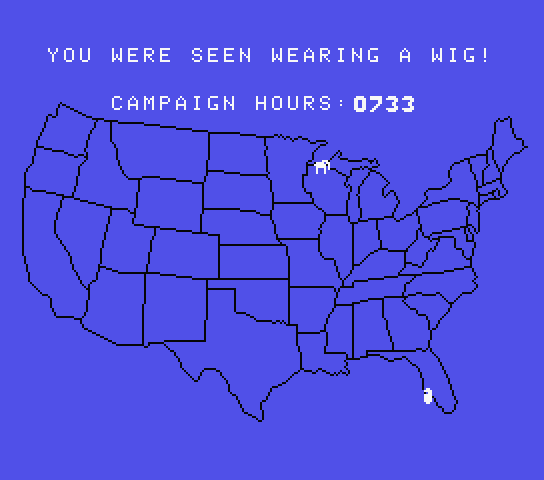
Thank god they only saw the wig and not the dead hooker I was standing over.

I chose to be the elephant because I think people are more likely to vote for someone who steps on them while riding an elephant and not a donkey. There’s dignity to dying via elephant trampling, but a donkey? That’d just be rude! This will matter, trust me. I’m campaigning on oyster rights, for God’s sake. I need every advantage I can get! So, let me get this straight, I just walk around the literal borders of the states, trying to collect white items while avoiding red ones? Are you SURE this is how you run for President? Ain’t I supposed to be shaking babies and kissing hands and not walking around.. ooh, good catch, KISSING BABIES and SHAKING HANDS. Actually, don’t watch the 6 o’clock news. You’ll find out why tomorrow. And you’re POSITIVE that this walking along the edges thing works? Taft did it? Well, hey, can’t argue with the results, right? It’s Taft! Wait, the first time or the second time? Both times? Hell, I’ll take coin flip odds. Okay, I got this. Kiss babies, shake hands. Someone hand me a marker so I can write that on my hand. Make it a permanent one. Actually, hey Lenny, do you still have that tattoo gun?

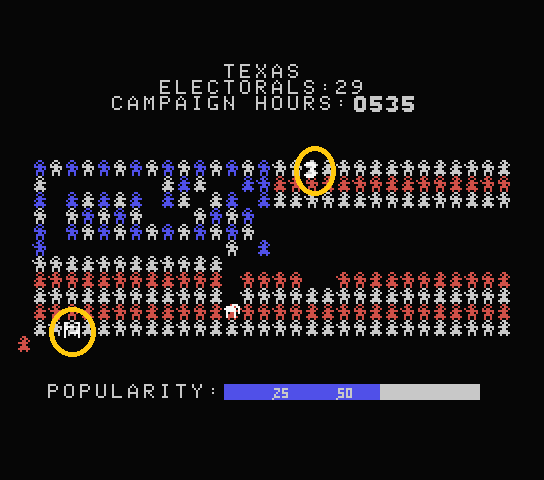
Hey, I know you’re my campaign manager and I hired you presumably because I trust you and not because I was high at the time, but you’re certain that starting my campaign in Nebraska was a good idea? That’s not how the saying goes. It’s how MAINE goes, so goes the nation, AND EVEN THAT’S NOT TRUE! So, you’re sure that, to win the presidency, I have to just run over citizens with my elephant? They like this? Just double checking, but this is PRESIDENT OF THE UNITED STATES we’re talking about, and not the President of Sadomasochists of America, right? Because I’m term-limited out of that. Pssh, eight term limit my aching ass. So, step on the people and I win, right? Oh, ONLY HALF? Duh, of course. 50.0001% of the vote gets me 100% of the state’s electoral votes. Let freedom ring, baby! And yes, that counts for Nebraska and Maine, even though in real life each district gets their own electoral votes + 1 for the state’s popular vote. That’s fine, though. I can step on half the people to become President. Hell, I’ll step on ALL the people. It’s basically why I wanted to run for President anyway! But, I do have a question.. what are these numbers here?

So, if I understand correctly, those are the issues that you so diligently polled on from the start of this review campaign. The ones that just float without being highlighted are things I’m FOR and the numbers that are inside out are what I’m AGAINST. At the start of the game, I mean campaign, all eight “issues” default as “AGAINST” and I could have changed any, all, or none to “FOR” and they mean NOTHING because it just changes whether I get popularity or lose popularity when I collect numbers as they randomly appear at campaign events? And the ONLY campaign events involve stepping on voters with the animal of my choice? Why can’t it be the “IN NAME ONLY” animals? I’d much rather play as a RINO or a DINO. They’d be much more fun to step on people with!

Well, my campaign is going.. swimmingly. Which doesn’t mean I’m drowning, despite what the spin on Reddit says. FAKE NEWS! Besides, I literally inherited Fort Knox and sold it for scrap, which somehow added 30 campaign hours and almost certain federal indictment. Gas up the campaign plane and find me a country without extradition, just in case. Preferably one with a better form of government than this. It’s just clumsily moving along state borders while mashing the fire button and hoping I find the right spot. That’s literally how you campaign in Campaign ’84. You have to walk around the edge until you find that state’s invisible “entry point” but you also have to press the FIRE button, which sadly doesn’t fire my campaign manager. Most entry points were at the top of the state, but not all of them were. There’s also no Alaska and Hawaii, and it’s hard to squeeze into the rinky-dinky states.

This really is the ONLY campaigning you do. And, once you get fifty percent of a state, you want to deliberately maroon yourself onto a single voter. Once someone is run over, you can’t move to that same spot again, at least until the next campaign out of respect for the breathless supporters who sacrificed themselves to my campaign. It’s sort of like reverse Snake. It’s actually harder than it sounds too, because you can move diagonally, and you can’t leave a state until you have no moves left to make. I screwed myself over multiple times by leaving diagonal moves, and every second counts. But, if you collect the right issues, they give you an automatic popularity boost. Just two should put you over 50% for that state, which is enough, and that goes a LOT faster than scooping voters one at a time. Also, Stars & Stripes Forever plays during this whole thing, and it’s intolerable. Thank god the campaign season is almost over. This is boring. Well, here was my.. genius campaign manager’s brilliant electoral strategy. Remember, I need half the electoral votes +1 to become President of the United States. 270. If it’s 269, horseshoes are thrown until a winner emerges.

And that netted me a total of………….

Oh, thank God. You see, dear readers, I actually didn’t want to be President. I just wanted a steady gig as a talking head on cable news. Easy money! Thank god I came up exactly four electoral votes short. I’ve had my concession speech ready for a while. Don’t tell anyone, but I actually wrote that first, before I even announced my candidacy. Real tear jerker. Magnanimous call for unity and, you know, thanking my voters and sh*t. Best of all, I never have to play Campaign ’84 again, one of the absolute most pointless games I’ve ever played in my life. It works neither as an educational game or a joke game, because the jokes begin and end with the campaign issues at the start. Nothing happens. One mini-game! Thankfully, the campaign season is over, and best of all, I LOST! I’ll just call the poor son of a bitch who “beat me” and.. hey wait. If Alaska and Hawaii aren’t in this, then wouldn’t 266 be a little more than the.. the.. majority of electoral votes?

Oh no. OH GOD!

Holy f*ck I’m President Elect of the United States.

Oh god.. that means I have to run again in four years.

I shouldn’t have banned shoelaces.😭
Verdict: NO!

Castlevania: Dracula X (SNES Review)

Castlevania: Dracula X
aka Akumajo Dracula XX (Japan)
aka Castlevania: Dracula’s Kiss (Europe)

Platform: Super Nintendo Entertainment System
Released July 21, 1995
Directed by Kouki Yamashita
Developed by Konami
Included in Castlevania Advance Collection

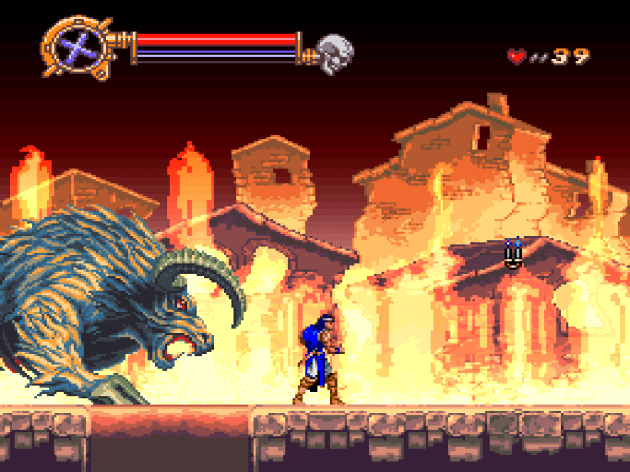
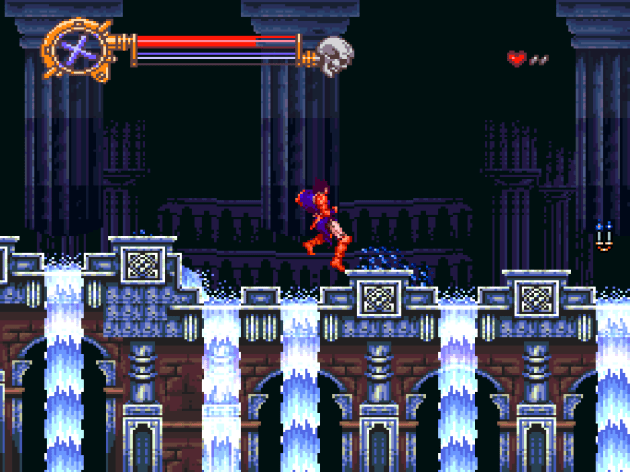
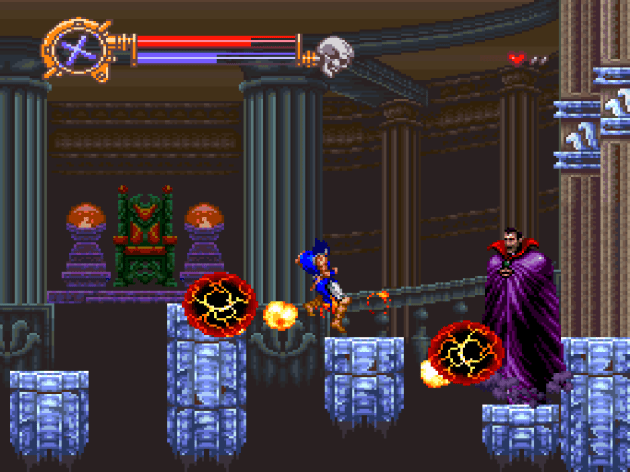
This is the biggest tease of a set-piece, because Dracula X doesn’t have many more. Or any, really. Also, this thing ever shows up again. It’s not a boss or anything. It’s a random slow-speed chase that just ends without any pizazz.

After finishing Dracula X, I found myself staring at my screen, asking myself “did I even have fun with what I just experienced?” TWICE. That by itself is an ominous sign that this isn’t going to be one of the better Castlevanias. I played it for the first time in 2021 and I liked it, but for the life of me I couldn’t remember a thing about it except how awful the final battle with Dracula was and what happened in the above picture. Upon replay, that chase is really the only original set-piece in the entire game. The rest feels like a stripped-down version of Castlevania that runs through all the tropes from the previous four Nintendo games. Of course, this is credited as a “remake” of the PC Engine Super CD-ROM² game Akumajō Dracula X: Chi no Rondo. It’s not. I’m not even sure what the point of this is at all. Probably just being a quick, passionless cash-in before the Nintendo 64 hits, while SNES/Super Famicom owners are still hungry for software. It makes for an interesting review, if nothing else. It poses the question “if the game is made competently, is Castlevania’s core gameplay, all by itself, an automatic YES!?”

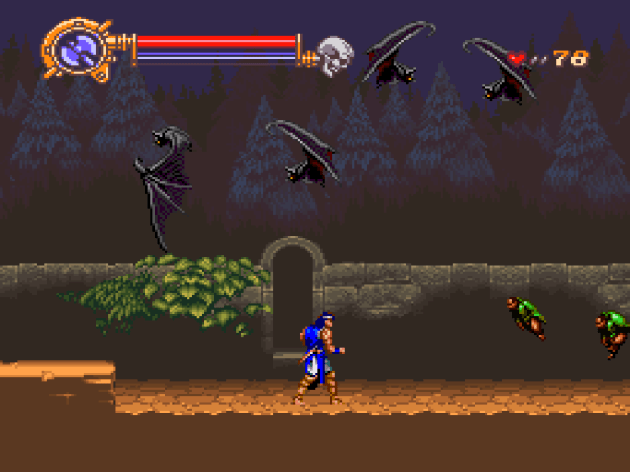
It sure looks like it’s going to be a fun time making your way to the Count.

It’s very easy to see why someone would be disappointed in Dracula X. All the innovations from Super Castlevania IV are gone. How gone? Gone, gone. You can’t even throw a sub-weapon with one of the shoulder buttons. You know, that convenience that opened-up the first SNES that was intuitive and comfortable? Well, screw you! That would be too easy, so back good old fashioned holding UP and pressing the attack button if you want to throw a boomerang. That really says it all about Dracula X. It’s a back-to-basics Castlevania game. Except, Dracula’s Curse was way more ambitious than this is. Dracula X’s has three major problems, and the first is that it’s too basic in every meaningful way. The level design is largely unoriginal. The opening stage, with the town burning behind you, feels like a cruel joke because that’s pretty much the end of Drac X and dazzling set-pieces. Everything else is a rehash of previous Castlevania staples run through a filter of blandness.

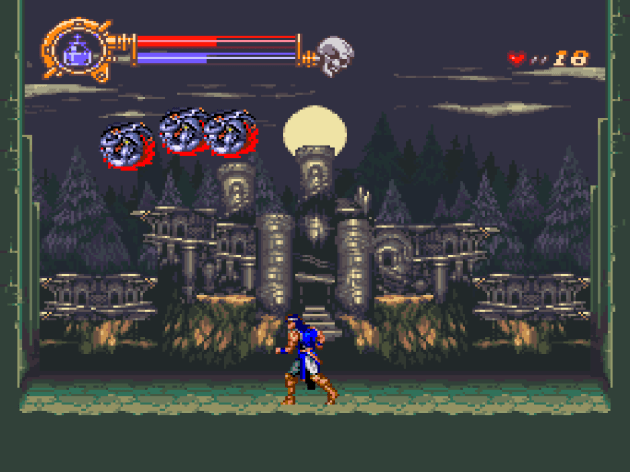
This screen kind of encompasses the Dracula X experience. Boring versions of themes and settings that have already been done better, only this time the game spams enemies in the most unimaginative way

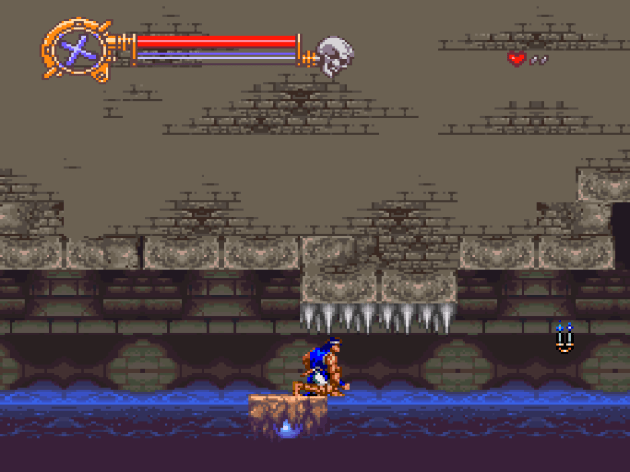
It’s not like the level design is ever bad, but it just doesn’t do anything. I know the specific part where I asked myself “what the f*ck are they even doing here?” There’s a brief moment where the water starts to rise up slowly and you have to race against it. It’s been done in Castlevania before, but because Dracula X’s version uses two of the handful of last-pixel jumps in the game, it just feels less exciting and more of a glorified gotcha trap. But, even if it were idealized, it wouldn’t matter. It lasts maybe a minute, if that, and the safe-zone is so nondescript that I didn’t even realize I’d reached it. And that’s what broke me. The whole point of that type of design is you’re supposed to have an idea when the coast is clear and breathe out a sigh of relief. Without that, there’s no payoff to the tension you just created. Hell, in Castlevania III, the safety zone is exiting the screen, and it worked perfectly. Here, when I realized I was already safe and had been for a while, it wasn’t triumphant at all. It totally deflated me.

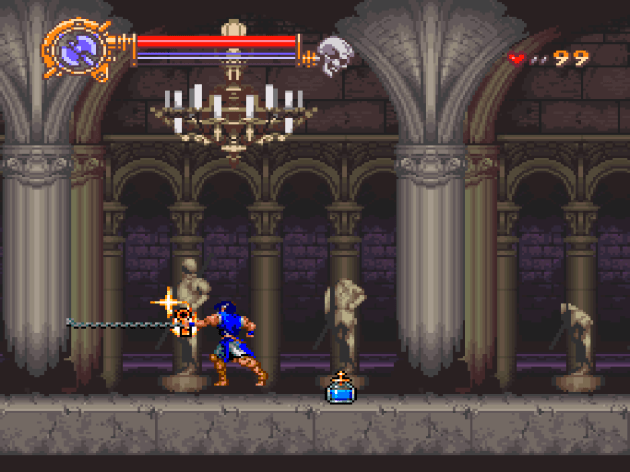
Can you see what got me? Yea, they hid an enemy between the foreground and the plane I’m on. So unimaginative. It’s just a booby trap, not a challenge. If I create a version of The Pit from Mortal Kombat in my house and then throw a rug over it and someone who expects to be able to, you know, walk on a rug falls into it, it makes no sense to scream “GIT GUD!” at them in their final moments of agony before the fade to nothingness eternal. They couldn’t have possibly known it was coming.

Dracula X feels like Castlevania made by someone who doesn’t entirely understand Castlevania OR action gaming beats in general, and that’s almost hard to believe. It’s not like Kouki Yamashita was some schmuck they found. He was one of the programmers of the NES Contra. That’s a pretty big game to have worked on, as far as pedigree goes, but it also tells me he should recognize what makes a good game. Combat alone can’t do it when you’re talking about a sequel, especially if that combat is lifted directly from the previous games. If the combat isn’t evolved, then you have to top previous settings and set-pieces, and Dracula X NEVER comes close. The only other option to topping previous set pieces is “be different” and this feels like a retread of locales and even gameplay segments from previous games, with NOTHING original after the first level.

Oh hey, look, the flying thing that drops the jumping thing.

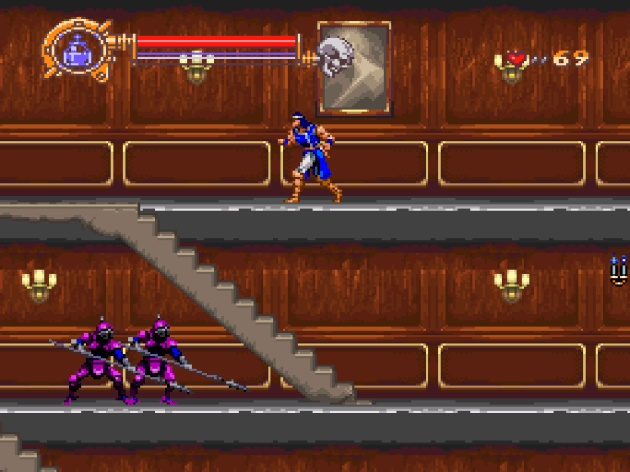
It’s like the development meetings involved cracking open a Nintendo Power with Castlevania and just taking notes of what needed to go into the new game, without any context of how those previous pieces worked to be more than the sum of their parts. The level design is so bland and safe that it feels like it could be randomly generated by AI for how samey it is. “I guess we’ll split this screen down the middle and you walk to one end, then climb up the stairs and walk back the other way. You know, that thing that was as advanced as Castlevania 1 got? We’ll just redo that over and over, only it’s 16 bits now.” And that’s not an exaggeration. That’s pretty much as complex as the majority of Castlevania: Dracula X gets, and then the challenge is based around “how do you attack the enemies that are above or below you?” Like these pink knights with the spears are probably the most problematic non-bat enemy in the game. They can poke at you from above or below, and they have a means to defend against sub-weapons. A not-insignificant chunk of the level design throughout Dracula X is centered around JUST them.

Dude, Zordon was right. Too much pink energy is dangerous.

The sub-weapons activation isn’t the only back-to-basics aspect. The eight-way whipping is gone, even though this game is much more optimized for eight-way combat. The reason I didn’t think it worked in Castlevania IV was the enemies didn’t really attack from all directions. Eight ways of attacking requires eight ways of danger, because otherwise it allows you to preemptively destroy enemies before they pose a threat. Castlevania IV’s enemy attack patterns and placement, and even the boss fight arenas, only makes sense if you use the traditional “straight in front of you” Castlevania combat. Weirdly, Dracula X actually fits IV’s combat better. Enemies attack from below. Enemies circle around you. Enemies throw projectiles in multiple different angles. My bonkers conspiracy theory for Super Castlevania IV applies to Dracula X, only it’s the opposite: going off the way the game is designed, I could swear that it was meant to have eight-way attacking, only they changed their minds at the last second.

Fixed jumping is back, and I lost multiple lives because the game is counting on you over-jumping just as much as under-jumping. Hell, I was THIS close to dying after beating the last boss because of that phenomena. Dracula X is Castlevania: Dirty Pool Edition.

Forget Rondo of Blood. Dracula X is closer to a remake of the first Castlevania, and I’m not kidding. The combat in Dracula X is as good as any other game in the series. That’s why I think Castlevania: Dracula X proves that the franchise’s combat, historically awesome as it may be, isn’t enough to get you over the finish line by itself. It only works in the first game because of the tempo and amazing set dressing. Dracula X’s sets are boring, and it just never feels fresh. Even when it repeats established set pieces, they feel somehow lesser, even with technically superior graphics. Like, there’s a set-piece that feels almost entirely copied from the original game where you have to jump on a moving platform that carries you over a long stretch of water. It still works in the first game, but it doesn’t here because this is supposed to be a sequel. It doesn’t help that, if you miss the raft, you might have to wait quite a bit for it to return.

Look, the classics are classics for a reason. They work. And this IS one of the more exciting segments in the game. But, it’s kind of cheating, isn’t it? You know it’s exciting because YOU’VE ALREADY DONE IT BEFORE! There’s no twist that makes the Dracula X version stand out from previous versions of this segment. It’s just THE Castlevania raft across the water bit boiled down to its most basic core, then glossed-up with 16-bit graphics.

I could have lived with this mentality of game design if they had just said “screw it” and did for Castlevania what Super Mario All-Stars did for the Mario franchise and just remade the first three games in 16 bits. It probably would have been better received than Dracula X was. But, this is supposed to be a new game, and it just never feels like it. There’s some bits I like. There’s like a single frame of animation where you pull the whip behind you before cracking it, and it can hit things behind you, especially projectiles. Love it! Nice! But it also speaks volumes to how little original substance there is to Dracula X that this stood out.

This slideshow requires JavaScript.

This leads to the second problem with Dracula X: the challenge is mostly based around gotchas that are trying to one-shot you. It’s not so much the infamous Castlevania knock-back, either. It’s an interception-based style that’s counting on hitting you out of the air and into a pit. Dracula X relies heavily on bats and a few other enemies that don’t spawn until you’re committed to a jump. Your whip really isn’t great in close quarters. Even the candles are problematic from close range, as I found multiple situations on ledges where I couldn’t find the right angle to whip the candle that, by all logic, I could have just reached up and grabbed with my free hand. But, that minor annoyance becomes a major hangup when enemy placement utilizes that on the edges of pits. Dracula X is so devoted to this style of challenge that the final battle with Dracula is based entirely on this concept of going for the mid-jump one-shot knockout. You can survive getting hit if you’re on your feet. The knock-back doesn’t send you that far back (but you also blink a lot less than previous Castlevania games). But, depending on what pillar Dracula is on, you probably have to jump to hit him, since only his head is vulnerable, and any jump puts you at risk of getting knocked back into a pit.

One of the most boring Dracula fights in the entire franchise. It’s not just the concept itself, but the fact that the arena is three or four times larger than the screen, making this a Dracula fight WITH DOWN TIME! Are you kidding me? And it gets even worse, because you only have time to maybe hit him twice per pass, and it barely does any damage when you do. Because the entire arena is constructed out of these pillars above a pit, it forces you to play conservatively. Again, this isn’t meant to be a punch-for-punch fight. He’s rope-a-doping you while looking for the one punch knockout. I really don’t think this is THAT hard a boss. I took damage multiple times and still won the fight. I mean, there’s a health refill in the room with you, not even hidden. It’s in a candle, and it takes all the stakes out of the fight. What were they thinking with this? It just drags.

The one unambiguous improvement is that most of the bosses are tougher than any previous Nintendo Castlevania release, which not only makes them feel like events, but it increases the satisfaction of victory. As much as I love Castlevania, Dracula’s Curse, and Super IV, the non-Dracula bosses in those games feel more like bonuses for making it to the end of the stage. Like, you got to the end, so you get the honor of totally pwning Frankenstein now. (Excuse me, “The Creature”) The fact that Dracula X’s bosses feel like climatic battles is a plus. Even though you have a triple shot built in, bosses are designed around the sub-weapons.

This slideshow requires JavaScript.

Well, mostly. I beat the final form of Dracula in about five seconds by spamming the Boomerang item crash. It’s basically a bomb that works differently, depending on the item. While they cost a LOT more hearts (the holy water is the only sub-weapon besides the stopwatch that costs more than one heart, at three, and its crash costs 20) the boomerang and holy water crashes are so overpowered that you don’t have to even aim them. Whenever the battle between me and a boss was becoming a little too close for comfort, no problem. I just spammed the bomb. Hearts are plentiful and the only time I came close to running out was when I used the holy water, so I avoided it. I died a lot playing Dracula X, but only once against a boss. It was the Grim Reaper. Speaking of which, here’s Dracula X major problem #3: the game’s too short, and its concept of branching paths is ridiculously stupid.

That’s the key. It appears only once in the entire game, at the end of level three. If you want to fight the Grim Reaper and get the “good ending” you have to not die between the time you pick it up and the time you actually need to use it. Oh, and you need to use it twice. You also can’t swap it for a sub weapon. It IS the sub-weapon, and it looks ridiculous when you use it as such. It has no range and you literally just sort of punch things with it. It even has an immersion-breaking crash attack where you hold the key up to an enemy in a menacing way. It looks like this:

It’ll automatically swap which hand is the hand holding the key, aiming it for you.

So, that’s silly as all hell. Oh, and this also does the most damage in all of Dracula X, BY FAR, at no cost to your hearts. It’s four-and-a-half times more powerful than a whip crack. F*cking outstanding, gang. It’s like a satire of a Castlevania game at this point. Now, to get the good ending, you have to use the key on normal Castlevania doors, which only appear twice in the entire game. Both are in level four, and the first is done to unlock Maria. Oh you don’t get to play as her like you do in Rondo of Blood. She’s just there. Then, you have to unlock a second door which (checks notes) skips the 4th boss that’s literally in the next room and takes you to a different version of stage 5. Are you kidding me? Bosses are why I love playing Castlevania, and you want me to skip one?

This slideshow requires JavaScript.

After this, the key vanishes from your inventory. I thought I’d done what I needed to get the Grim Reaper fight, because if you don’t do this part, you instead fight Carmilla. Except, Carmilla in this game looks like the Grim Reaper. I mean, look at it!

This slideshow requires JavaScript.

Except, I’ve played Dracula X before and I remembered the Grim Reaper fight being different. Well, that’s because I followed a walk-through last time, and I missed one other step. And this is where Dracula X lost me. After getting Maria and going through the door, you also have to rescue Annet, and the way that you do it is completely arbitrary in every way, and it’s all without any clue that this is a thing you need to do. When you rescue Maria, she doesn’t provide a hint that you’re still looking for something hidden. “Annet is trapped in another place.” That’s it. That’s all you get. The location where you activate this final element to get the good ending is arbitrary. The method of getting it is arbitrary. You have to whip a water spout in the final room before the water dragon (Update: wrong Cathy! There’s one section left before the water dragon. In fact, it’s where the ghosts are hidden by the foreground from the picture earlier in this review, you dolt), after the room where the water rises. There’s nothing like this before you get to this point except free lives in walls. But, besides a platform that doesn’t need to be there, the game doesn’t provide you with a clue. I suppose TECHNICALLY you can see that there’s platforms flooded underneath you, but you were just in a room that flooded. It felt like set dressing.

This slideshow requires JavaScript.

Come to think of it, wouldn’t she have drowned? That room was just underwater like a few seconds earlier. Whether she should be waterlogged or not, I would be totally down for this type of game design if the whole game was built around secrets like this. But it’s not. It’s a disjointed series of tasks that feel tacked-on as a last second thought. And ultimately, the game isn’t better for the branching paths. It sure isn’t elegantly handled, like how the branching paths in Dracula’s Curse are secretly and precisely scaled to three different difficulties, depending on the path you take. I honestly think the “good ending” bosses were easier. Right before I finished this review, I went back and took the bad ending path, where you have to fight the minotaur and a werewolf instead of nothing and a sea dragon, and I came a lot closer to dying against the werewolf in the “bad ending” level 5 than than I did against the sea dragon in the “good/best ending” level 5.

The strangest part of the “bad ending” path is the werewolf fight feels very similar to the Grim Reaper fight you wouldn’t get taking this path. Both take a lot of hits and alternate between big slashing attacks and a spinning, diving attack that makes them look like Sonic The Hedgehog.

This whole branching paths fiasco is a microcosm of Dracula X. It’s the arbitrary Castlevania. It brings nothing to the table except more of the same, only this time, it legitimately is tough. But, not tough in a fighting type of way. Its difficulty comes down to trial and error. I loved Castlevania 1 and 3 because it felt like I could react to the challenge instead of being caught off guard by it and having to memorize where the unforeseen death element is going to spawn when I’m mid-air. When Dracula X is about reactive combat, it’s fine, I guess. I mean, it’s nothing new and the same gameplay had already been done better and, dare I say, looked better in 8 bits. But when Dracula X shows you its teeth, you’re usually already dead. I’ve never liked games that are like that, and you know what? I don’t like Dracula X. If you want back-to-basics Castlevania, stick with the NES. Dracula X is competent, redundant, and boring.
Verdict: NO!

THE INDIE GAMER CHICK CASTLEVANIA REVIEW SERIES
 Castlevania (NES) Dracula’s Curse (NES) Adventure (GB) Belmont’s Revenge (GB)
Super Castlevania IV (SNES) Dracula X (SNES) Rondo of Blood (SuperCD²)
Chronicles (PSX) Circle of the Moon (GBA)  Kid Dracula (NES) Kid Dracula (GB)
ROM Hacks (NES) Konami Wai Wai World (NES) Wai Wai World 2: SOS!! Parsley Jō (NES)

Castlevania II: Belmont’s Revenge (Game Boy Review)

CV2GBCastlevania II: Belmont’s Revenge
Platform: Game Boy/Game Boy Color
Released July 12, 1991. Missed my 2nd birthday by a day.
Designed by Toru Hagihara & Yukari Hayano
Developed by Konami
Included in Castlevania Anniversary Collection
Included in Konami GB Collection Vol 3 (JP) or 4 (EU)

“Are you sure about that? The sickly yellow background has me quite motivated!”

It’s not like Konami had a massive hill to climb when it comes to improving Castlevania Adventure. “Don’t be so bad you’re in the discussion for worst video game ever made.” No biggie. And Castlevania II isn’t. If anything, it might be the best Game Boy title I’ve reviewed yet. Does it feel entirely like a Castlevania game? I’m not so sure. At least you encounter a skeleton this time. I mean, as a basic enemy. There’s also a double skeleton dragon boss that feels more like a Gradius boss repurposed as a platforming boss. Otherwise, that’s really it. One skeleton. No, bats and ravens don’t count. Neither do the mermen or mudmen. “There’s Jellyfish!” 😶 Seriously? Why are those even in Castlevania at all? “They’re evil jellyfish things!” Sigh.

By the way, maybe the best looking Game Boy platformer. Stick with the black & white version, which fits, right? It was a black & white movie that made Dracula a major pop culture icon, after all. It works so well for Castlevania. Dare I say, the lack of color actually benefits the theme. I wouldn’t want this EVERY game, but it sure does a better job of setting the mood than the choice of enemies does. Speaking of choices, whoever picked the color schemes for Konami GB Classics in Europe really did a lousy job. It’s not having color, but the choice of colors, that really hurts Castlevania II more than it helps it, in my opinion.

Come on! I want to fight the undead! That’s the whole point of Castlevania, right? Spooky settings! Without that, it’s just any other action game, right? Well, I suppose ANY monsters count, but for some reason, it’s the ghouls, skeletons, and the Grim f’n Reaper that make it feel like a Castlevania, at least for me. Sadly, in terms of setting and atmosphere, this could mostly pass for any other generic action game, albeit one that happens to have a whip, candles, and a pair of sub weapons from the famous franchise Castlevania. It still has a bit of an off-brand Castlevania vibe, like the Master of Darkness people were given the rights to try making the real thing. Actually, that’s not entirely fair. Master of Darkness, lame and overrated as it is, feels closer to Castlevania than this does. But, this is the better game, and that’s all I care about.

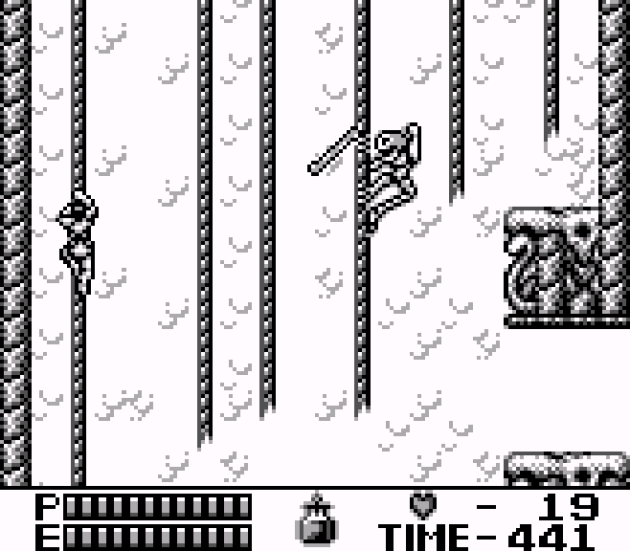
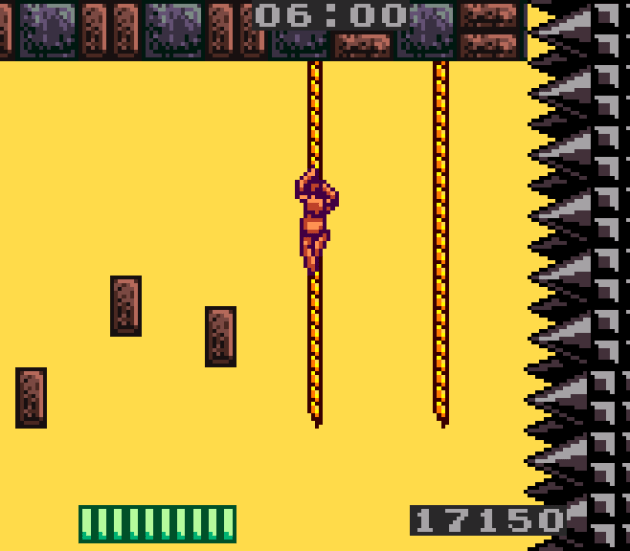
This is it. The one skeleton enemy, and it’s a wily thing that jumps from rope to rope. Yea, yea, it’s a petty thing to bitch about.

The tone really isn’t helped by the lack of grit in the first four levels. The unfathomable decision was made to make the first four levels non-linear, Mega Man style. So, this Castlevania doesn’t scale at all until the game is over halfway finished. A vastly underrated aspect of Castlevania 1 and Castlevania III is the stellar job they both do of building the challenge. Scaling, when done properly, builds the excitement. Well, that’s gone here, as the first four levels lack anything resembling a sense of progression. Mega Man gets around that by adding abilities. What Castlevania II should have done was remove item drops and have you gain a new sub weapon with every boss defeated. The knife and stopwatch aren’t in this. It would have been so easy to both add them and add sections just for them. Without something like that, being able to take the four levels in any order turns them into nothing more than a checklist. And since I’m being nit-picky, one understated side-effect of this is there’s no opening level. Castlevania games often tend to have amazing first levels. That’s gone too, and for no good reason.

Apparently the ritual that revives Dracula involves four non-Vania castles which are, I’m not joking, Crystal Castle, Rock Castle, Cloud Castle, and Plant Castle. So uh, where are these in other Castlevania games? How come nobody ever tried this ritual before. Wait.. hold on.. is that what Atari was doing with Crystal Castles? Is the bear trying to bring back Dracula? They need to make this canon. And I want to kill the bear with a Belmont. I’m dead serious, and possibly mad.

Unlike Castlevania Adventure, you have sub weapons this time. Two, in fact, and like the two non-awful NES games, they’re insanely overpowered. With them, the first four bosses are total pushovers. If you play the US version, the 5th boss is too, provided you have the axe. If you play the Japanese or Game Boy Color version included in Konami GB Classics Vol 4 (in Japan the order is different and Castlevania II is in Konami GB Classics Vol 3), the 5th boss is the first instance of Castlevania II showing its teeth, but then the 6th boss is a cinch, provided you have a boomerang. Why not just bring the axe to the fight in Japan. Because the sub-weapons are different depending on which region you’re playing. Of all the stupidly weird, unfathomable design choices, this is.. one of them. The holy water is in all versions, but only Japan and Europe got the boomerang. The United States got an axe, which can hit the 5th boss when he’s inside a wall. The boomerang is big and covers the full screen, so you don’t have to be very accurate. Until the 5th boss, it really was a wash which version got the better deal. After that? Nah. I’d rather have the axe. Except, wait, the boomerang is better for Dracula. GODDAMMIT, see, this should have been a decision players get to make IN the game, not when choosing which version to play.

This was my only death in my second playthrough. The fifth boss is an auto-scrolling segment with a dragon that jumps around to different entrances. You have a very brief window to hit it, but its body is so long that it’s hard to avoid taking damage from being auto-scrolled into it. Except, in the United States, the axe can damage the vulnerable head even when it’s not in the gap. It significantly nerfs the boss. That’s not an option in Japan or in the Game Boy Color version.

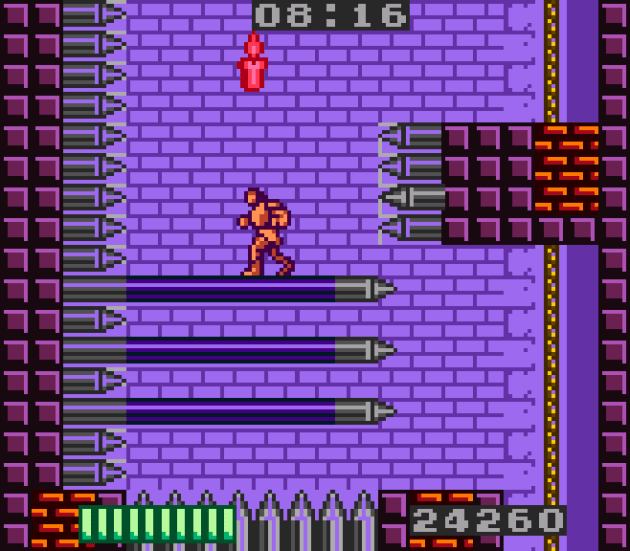
There’s really only two “tough” segments, and maybe three, in the entire game. The dragon above (and only in the JP/EU builds), the 6th boss (and only in the NA build), and the final fight with Dracula are the only parts that ever made me sweat. The rest of the game is built mostly around rope-climbing set pieces. That sounds absurd, but trust me, it’s better than it sounds. While this Castlevania still feels slow and heavy, it’s not to the point that it’s unenjoyable. It’s fine now. There’s little in the way of last-pixel jumps, and there’s no ridiculous extended escape sequence. All the new ideas work. There’s an extended sequence with ropes attached to pulleys (don’t worry, they’re evil pulleys) that’s based around precision movement and timing and it ended up being one of my favorite Castlevania set pieces EVER. It’s really good. In fact, all the rope stuff is really well done, pulley or no pulley.

Dumping the notorious Castlevania staircases was probably the wisest choice in the game. The ropes just make for a more fun game, even if it logically closes off some more complicated design options. The only thing missing is a boss that you fight while on the ropes. I think they probably should have tried it. They did a good enough job with the level design, which legitimately is about 50% rope-based, that I have faith they could have come up with a clever and intense boss battle on the ropes.

Even the spiders are awesome, which is a sentence I never imagined I would say. The spiders apparently spin rope instead of silk, because whatever they’re pooping out can support your weight. The twist is, if you kill the spiders, whatever length of rope they made is all you have, and sometimes, you really don’t want to kill them. It’s very clever. While the combat never really impressed me, all the platforming stuff is top-notch. If the first Castlevania game was really a combat-focused game that occasionally had platforming bits, this is the platforming Castlevania occasionally interrupted by combat. I found Castlevania II’s offensive game to be mostly underwhelming. Not fully, as there’s some intense moments, but it was still off. The fireball from Adventure returns here, I guess because they couldn’t do the length of the whip upgrades. They even returned a few creatures from Adventure, like the fireball spitting stumps (don’t worry, they’re evil stumps) and the Night Stalkers. Bringing them back was probably smart, since those two creatures are the only ones that ever pose a legitimate threat. Most of the action is timing-based, but like with Kid Dracula, it just works.

Killing the spiders leaves the ropes, but the jumping is still tough to judge, especially off the ropes. Speed jumping off the ropes is a big part of the level design in multiple sections.

While the bosses are still mostly push-overs, Castlevania II does a much better job of making them feel like “moments” than Castlevania Adventure did. However, there’s a few missed opportunities. Not one but TWO bosses are actually two different creatures that are fought at the same time. In both instances the dual bosses share one life bar, so killing one wins the whole battle. Weird thing to complain about, maybe, but it just feels like they’re not quite as immersive as you’d hope. Also, the final battle with Dracula is pretty ridiculous. He surrounds himself with huge spinning orbs that fly off in all directions, but in a circular way that makes them hard to dodge. It’s the only point in the game where I felt the collision wasn’t spot-on. But, in my second playthrough, I beat him on the first try. I lost to him so many times on the black & white version I had to reload my save state, and I had like eight lives going into it.

This slideshow requires JavaScript.

It’s funny that Konami was on such a cold streak this year at IGC. Parodius on the MSX got a NO! Monster in my Pocket got a NO! The DOS version of Simpsons Arcade got a NO! along with the US ROM for Simpsons Arcade Game. Rollergames got a NO! twice in one review. The Lone Ranger got a NO! Even NES sacred cow Tiny Toon Adventures got a NO! In fact, before the Contra/Castlevania marathon I’m on right now started, I’d only given one Konami game a YES! in 2024. It was for the Japanese version of The Simpsons Arcade Game. This marathon reminded me that Konami was once an elite developer. I’m not a huge original-generation Game Boy fan. It’s just not for me. But Konami has absolutely proved their bonafides this week with THREE elite games, and honestly I think Castlevania II is the best of the three. Better than Operation C, easily, and I think better than Kid Dracula. It might not completely feel like a Castlevania game, but as a one-off spin-off based around ropes, it’s a LOT of fun. The ropes and the focus on timing and accuracy means you could just as easily replace the “scary” stuff with Indiana Jones and it’d work as an Indy game. Not just that, but probably the best Indiana Jones game ever. You can even keep Dracula. Hell, if Indy can fight aliens, why not The Count too?
Verdict: YES!

THE INDIE GAMER CHICK CASTLEVANIA REVIEW SERIES
 Castlevania (NES) Dracula’s Curse (NES) Adventure (GB) Belmont’s Revenge (GB)
Super Castlevania IV (SNES) Dracula X (SNES) Rondo of Blood (SuperCD²)
Chronicles (PSX) Circle of the Moon (GBA)  Kid Dracula (NES) Kid Dracula (GB)
ROM Hacks (NES)
Konami Wai Wai World (NES) Wai Wai World 2: SOS!! Parsley Jō (NES)

Kid Dracula (Game Boy Review)

Kid Dracula CoverKid Dracula
aka Akumajō Supesharu: Boku Dorakyura-kun
Platform: Game Boy
Released January 3, 1993
Designed by Yukari Hayano
Developed by Konami
NEVER BEEN RE-RELEASED*

*Okay, TECHNICALLY Kid Dracula did sort of get re-released once. In 2000, Kid Dracula was added to Japan’s Nintendo Power flash cartridge service. So it really should be classified as NO MODERN RELEASE.

Is it a remake, a reboot, or a sequel? “Yes.”

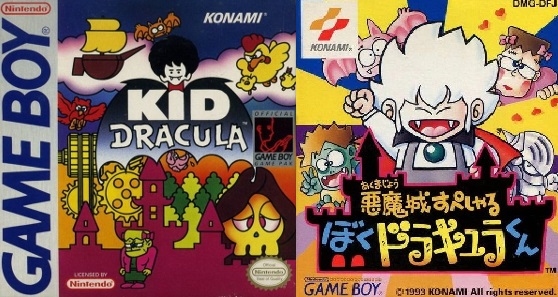
I just reviewed the Famicom-exclusive Kid Dracula. I almost skipped reviewing the Game Boy version after my experience playing the original for the review didn’t live up to my memories of playing it in 2019, with Castlevania Anniversary Collection. I’m happy I didn’t skip it, because it sure was an interesting game. This is the only Kid Dracula that the whole world got. But, even with the global release, this was it. The end of Kid Dracula as a franchise. Why is that? Well, I’m guessing most people never bothered trying this, and it’s not hard to figure out why. Kid Dracula suffers from what I like to call “Avenging Spirit Syndrome.” A quality Game Boy release that they put about two seconds worth of effort for the box art on, so nobody bought it. Have a look.

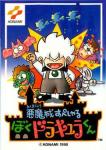
Are you f*cking kidding me? Go through all the effort of developing and manufacturing a game only to have the box art look like how it does on the left. Compare that to the visually striking Japanese cover art that looks like a game that actual effort was put into. We’re a shallow species, and when people see a cover that’s phoned-in, they assume the game is too. That’s not unreasonable, by the way, so do not half ass your cover art. Shameful. Absolutely shameful.

Box art has nothing to do with gameplay, of course, but it really pisses me off because I’m almost certain that cover art drove a stake in the heart of Kid Dracula as a franchise. The Game Boy version, which is part remake, part sequel, slays the NES original while also making some bonkers mistakes. Honestly, the box art tracks, because there were some infuriating decisions made when developing Kid Dracula. Like, hey, who wants post-stage mini-games with so much text that it takes forever just to get to them? Seriously, these are supposed to be the fun little side-game stuff, but the game won’t sh*t the f*ck up and just keeps going and going and going and GOD DAMMIT WHY IS THIS GAME SO F*CKING INFURIATING IN SO MANY NON-ESSENTIAL WAYS?!

If a mini-game requires this much text to explain, maybe you shouldn’t f*cking include it in a Game Boy game! This particular mini-game is basically the Game & Watch disaster “Judge.” AKA the Game & Watch I ranked 51st out of 52 possible games. After painfully explaining the rules to rock-paper-scissors a half-sentence at a time (because that’s all they could fit in the teeny tiny text box), the rules KEPT GOING. You see, it’s not enough just to have the correct throw. No, if you get the right throw, you also have to press a button to club your opponent over the head. If you throw the wrong thing, you can also block. If you hit your opponent when you lost or had a tie, you get a foul. Sometimes, the opponent blocks you, causing this trash fire to drag on even more. You have to get five hits to your opponent’s two, including fouls. This is supposed to be the fun side distraction?

I’ve never seen a platform game from this era with as much downtime as Kid Dracula on the Game Boy has. The levels aren’t that much longer than the time it takes for you to (1) see the cutscene after beating the boss (2) see the new power you earned. Steps 1 & 2 are the only ones you can skip if you want extra lives (3) go through the “welcome to the bonus round” text. At this point, you can opt out of steps 4 through 11, BUT, if you need lives (4) see the text that painfully explains to you every single time what four games could potentially happen based on which crystal ball will have which bonus game (5) the animation that shuffles the crystal balls, which takes a while but goes slow enough that you can clock it (6) you have to choose one of the four crystal balls (7) the idiot telling you what mini-game was selected (8) the introduction and rules to the mini-game (9) actually playing the mini-game, some of which are timed, and some of which can hypothetically go on forever (10) the post-game wrap-up telling you what you won or didn’t win (11) then being sent BACK to the post-stage menu where it takes two screens to say the words “what would you like (next screen) this time?” and if you have enough coins to play again, you have to repeat steps 4 through 11 (12) seeing a completely pointless and non-interactive map screen. THEN you get to actually play Kid Dracula again. Un-f*cking-real! Below is a slideshow of all the screens it takes to get through steps 3 through 7, and that’s not even close to the whole process of getting back to the game!

This slideshow requires JavaScript.

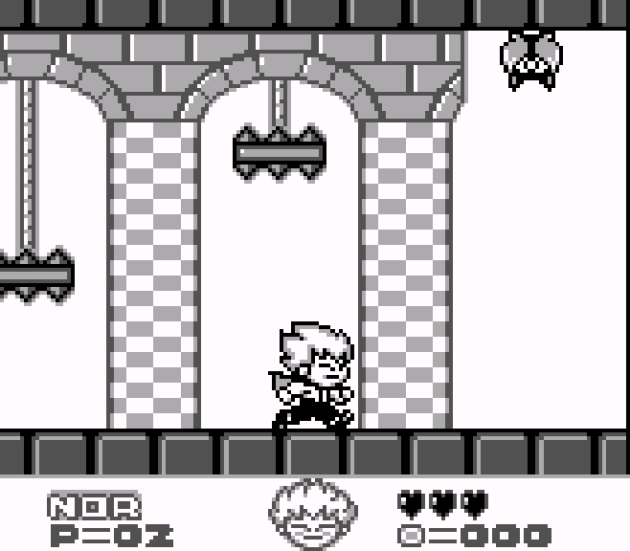
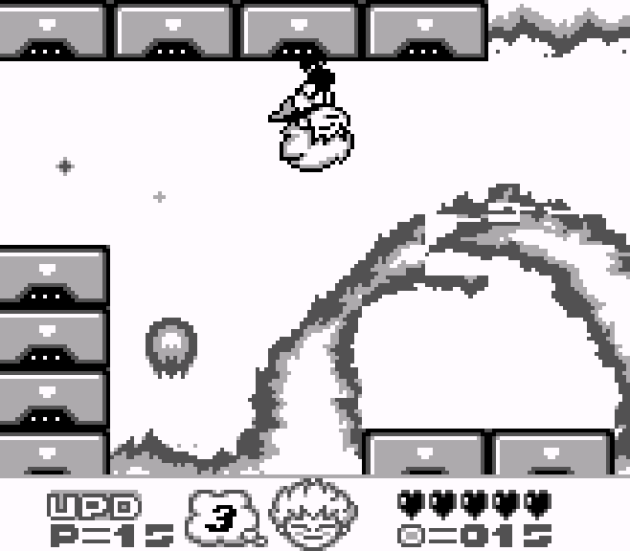
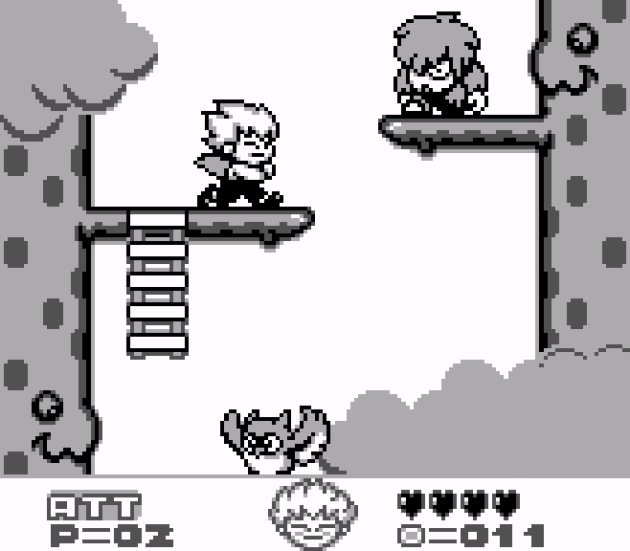
The worst part about all of that is Kid Dracula is a mostly really good game. Right from the start, you can use the “change into a bat” ability, and you get the walk-on-the-ceiling power-up early too. Instead of large stages, Kid Dracula is mostly broken-up into bite-size chunks, complete with an animation when you reach the end of one. Many levels and set pieces from the original game also return. The extended “bullet train” roller coaster sequence is back. The ship is back. The vertical jumping sequence up a narrow tube is back. The speed, jumping and movement physics from the Famicom game are mostly intact. Many bosses return too. This is probably 55% – 60% remake. However, there’s enough surprises for people who already played the first game to not get bored replaying the same stages and bosses in the black & white version. Hell, the first boss had a gag that made me literally laugh out loud. Don’t worry, I won’t spoil it.

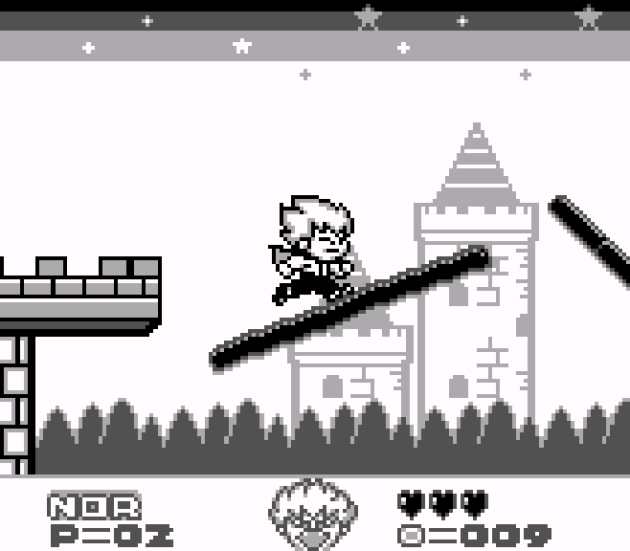
And that’s not to say the levels are a complete retread. The first stage, once again a homage to Castlevania, has this brief section with tilting platforms. Kid Dracula does just enough to remain fresh, at least when it wants to be a platform game instead of the world’s most agonizingly slow mini-game collection.

The same combat that I found to be underwhelming in the Famicom original is back and more-or-less unchanged. Enemies can sometimes be too spongy and your attacks are never as good as you wish they were. The ice attack (and in fact, the entire ice stage) is gone, and in its place is a powerful short-range attack where you make three bats fly in a circle around you that sacrifices range too much. Later in the game, it surprised me by awarding me to two new powers instead of just one when I finished a stage. In addition to the bomb, I got an umbrella that can be used to shield you from some bullets and environmental hazards. It can also instakill some smaller enemies just by walking into them, but it doesn’t destroy them. It just sort of rudely causes them to fall off the screen. This version of Kid Dracula leans much more heavily into tight squeezes, spiky floors/ceilings, and timing-based platforming than the Famicom game. But, that’s for sure a plus in a game where the combat is still pretty ho-hum. I don’t think I’d describe the original Kid Dracula as “exciting” but the Game Boy version certainly is.

Oh hey, this looks familiar.

The bomb attack from the Famicom returns, only this time, it’s also used to break through walls, and this leads to the worst part of the platforming aspect of the game. I bet anyone who has already played this knows what part I’m about to talk about. Near the end of Kid Dracula, there’s moving walls where you have to charge-up a bomb (which is done by holding the B button) and use it to ping one single block of this moving wall at a time. The catch is, when the holes you’ve made scroll off the screen, they’re gone forever. Because you have to hold the button to charge, and because the bombs only destroy a single block with no splash damage and you’re two blocks tall, you have a VERY small window from which to get through the walls before your progress is lost and you have to start over. It took me quite a while to make my way through this small section. One wall is hard enough to get through, but then you have to get through two, and then three. It took me so long that my hands were hurting from this one area alone, and then a boss fight happens that involves a similar play mechanic. This idea should have been killed on the drawing board OR the bomb should have done two blocks of damage. By the way, the initial bullet that blows up is really tiny and you’re going to need to jump too, so timing and aiming this is pretty tricky.

This slideshow requires JavaScript.

Kid Dracula on the Game Boy is deeply flawed in many ways. I have no clue what they were thinking with some aspects of it. It’s often so obviously ill-suited for a handheld device. There’s no saving, either. Passwords only. Now granted, if not for the downtime, this could probably be finished in about thirty minutes to forty-five minutes for a first time player. So what? It’s Game Boy! None of that matters to me in 2024. If this gets a re-release, I’m far more likely to play it on my TV than I am as a handheld. For all its flaws, Kid Dracula is clearly one of the best original Game Boy releases. The boss fights that nearly sank the Famicom game ended up being the element that had me convinced this is the better Kid Dracula game. Don’t get me wrong. The combat is still middling, but the OOMPH that I felt was missing from the TV version is here, along with added gags that land much more frequently. The best bosses from the NES game are here. The bad ones are either improved or removed.

The new stages are easily better than the ones they replaced. The ice stage was awful on the NES. The challenge was based entirely around sliding to your death. The forest works better.

Kid Dracula for the Game Boy deserved to be a hit, warts and all. It does an even better job of telling jokes and being a satire than the NES game did. The personality is dialed-up, but it never comes across as trying too hard. The quiz boss from the Famicom is gone, which tells me they figured out that it didn’t work as they intended. I assume they were aiming for Mel Brooks “going off the rails” type of subversion, but it didn’t land because it wasn’t funny. What would have made more sense was to swap to an entirely different gameplay style. ANYTHING but a quiz. A tennis game would have been funny. Or hell, Kid Dracula slaps on a pair of ice skates and a game of Blades of Steel breaks out. That’s a joke. A quiz isn’t, because it’s not a Konami thing. Thankfully, there’s nothing remotely like that on the Game Boy. There’s so many twists that I didn’t expect, especially with how the boss fights play out, that I just shook my head in disbelief. They really did a great job of subversion of expectations. On a Game Boy game! Whoa!

This was a boss in the first game. It’s a set-piece in the second. So nice.

Sure, they had more time and a few years to reflect on the original, but still, it’s the Game Boy. I didn’t expect them to trounce the NES version to the degree this does. Kid Dracula is one of the most underrated games on the entire platform, even if the post-level mini-game crap is annoying. Nice job on the cover art, gang. Bravo. You screwed us all out of a franchise. This is one of those ideas that Konami should get an indie dev to revitalize. Parodius too. Gaming has caught up to the idea of tongue-in-cheek games. Every Mario RPG is basically Nintendo roasting itself. Konami was light-years ahead of their time, and now, they’re so far behind the times that it’s actually just kind of sad. So, I’ll leave you with thought: it only takes one game to change that. Dracula arises once a century, and hey, there hasn’t been a new Kid Dracula release in the 21st century. I’m just sayin’.
Verdict: YES!

THE INDIE GAMER CHICK CASTLEVANIA REVIEW SERIES
 Castlevania (NES) Dracula’s Curse (NES) Adventure (GB) Belmont’s Revenge (GB)
Super Castlevania IV (SNES) Dracula X (SNES) Rondo of Blood (SuperCD²)
Chronicles (PSX) Circle of the Moon (GBA)  Kid Dracula (NES) Kid Dracula (GB)
ROM Hacks (NES)
Konami Wai Wai World (NES) Wai Wai World 2: SOS!! Parsley Jō (NES)

Kid Dracula, aka Akumajō Special: Boku Dracula-kun (Famicom/NES Review)

Kid Dracula
aka Akumajō Special: Boku Dracula-kun
Platform: Famicom (Nintendo Entertainment System)
Released October 19, 1990
Directed by Shiro Murata
Famicom Exclusive
Included in Castlevania Anniversary Collection

If you’re unable to play this, just put on Castlevania and hum the theme song to Sesame Street.

After playing the completely charmless, unlikable Castlevania Adventure, I needed a game that is all charm and impossible to not like. Kid Dracula is to Castlevania what Parodius is to the Gradius franchise: a satire of their own games. Despite being included in Castlevania Anniversary Collection, gameplay bears little resemblance to Castlevania. Actually, Kid Dracula plays more like Mega Man: a platforming shooter where you gain extra abilities as you go along. Unlike Mega Man, ‘Lil Drac is totally linear, and there’s no ammo for your new abilities. You need only to charge-up the B button. The first level is a direct parody of Castlevania, with set pieces and art assets that will be very familiar to fans of the franchise. Even the music is a friendly remix of the first level’s theme from Castlevania III. After that, Kid Dracula does its own thing. This could have easily been a Count Duckula game for as little as it has to do with Castlevania.

Every stage in Kid Dracula has a gimmick section at some point. Here, you’re riding a bullet train? Either that’s a tiny train or Kid Dracula is HUGE.

If you want to know what to expect, the closest comparison to Kid Dracula is Splatterhouse: Wanpaku Graffiti. You can read my full review in Namco Museum Archives: Volume 1 – The Definitive Review. It’s funny how much the two games have in common.

  • Both games are hyper-cute satires of horror-themed games made by the same publisher as the original game that’s being mocked.
  • Both were Famicom exclusives released in back-to-back years (1989 & 1990).
  • Both debuted globally in retro collections released in back-to-back years (2019 & 2020).
  • Kid Dracula was shot in a Ford, while Splatterhouse was shot inside.. wait, wrong comparison list.
  • Both are not as good as you want them to be, but you can’t help but enjoy them.
  • Both games were probably just good enough to launch sub-franchises, but it never happened.

At least Kid Dracula got a sequel, but only on the Game Boy. This is probably the next IGC Review.

Now, obviously the point about how neither game is quite as fun as you want it to be is the most subjective. But, of the two games, I think Kid Dracula is clearly the winner, and it’s not really that close. Kid Dracula has superior level design and enough gimmicks to keep the game fresh for the whole experience. The first time I played it was with the release of Castlevania Anniversary Collection, and I was totally stunned by its quality. In a positive way. I remembered it as a nearly-flawless and highly idealized NES platformer. In replaying it, boy was I wrong. Not only did flaws stand out quite a bit during my replay, but I realized the gameplay is good, but not great.

I really like Kid Dracula, but the word “unforgettable” doesn’t apply to it. By the way, Kid Dracula is a surprisingly tough game. It looks like a kiddie game. It is NOT a kiddie game. There’s some stretches during it, like the subway stage pictured above, where Kid Dracula shows its teeth. The final level is even harder. By golly, this really is a Castlevania game!

A lot of that comes down to Kid Dracula’s attacks. The combat just isn’t as fun as it probably should be. You can shoot straight ahead of you and up, but not diagonally. Each time you beat a level, you gain some new power, most of which are attacks. Almost any basic enemy killed by a charged-up attack will drop coins that are spent on a randomly-selected bonus game after a level. Enemies can be a bit spongy, and attacks like “SEEK” which is a cross between Contra‘s spread gun and Operation C’s homing gun, rarely does enough damage to kill an enemy. I didn’t get a lot of coins my first play through because I used SEEK and often had to finish off enemies with additional non-charged bullets, which never pay off with coins. While Kid Dracula’s combat never gets dull, it also feels like the offensive game never heats up. Enemy placement is predictable and there’s often not enough to give the game stakes. There’s no “OOMPH” to it as I say, which is strange because Konami usually does OOMPH very well.

I recommend springing for Castlevania Anniversary Collection, which has an emulator optimized just right for this. Minimal slowdown or screen-tearing. On MY emulators, the spirit was willing but the flesh was weak, and I had constant slowdown. I would love for a Super Mario All-Stars or Mario Advance-like mandate on remaking a lot of the more famous NES games. Retain pixel art, but beef it up to 16-bits and no slowdown. Kirby’s Adventure, an NES game I can’t enjoy at all because of the non-stop technical issues, went on to become Nightmare in Dream Land, one of the best Game Boy Advance titles. It’s a damn shame we never got GBA-enhanced versions of Kid Dracula, Contra, or Castlevania III: Dracula’s Curse. They would have been awesome.

Kid Dracula’s biggest strength, besides its personality, is a pitch-perfect pace. The level design is fantastic, with “events” spread out fairly evenly. It’s like they included every platforming trope just enough to check it off a list. There’s a desert stage. There’s a slippy ice stage that sucks ass and is the worst part of the game, easily. There’s a giant climb up a tube into space that’s really good. There’s an underwater stage that uses the concept of moon jumps to build the challenge around, and it just works. Eventually, you gain two platforming special powers that the game immediately utilizes in the level design. Really, it’s three, since the ice power allows you to freeze enemies which can then be used as platforms. I never once used it for that reason. In fact, I only used the ice power at all because the start of the final level has a boss that’s immune to all other bullets except the charged-up ice gun.

“Hey, weren’t you in Mendel Palace?”

The other two powers are the ability to turn into a bat for a few seconds and the ability to walk on the ceiling. Jeez, in 2024 I’ve played a lot of ceiling-walking games. There’s the Jetsons and.. uh.. the other Jetsons. There’s M.C. Kids. And uh.. okay, it’s THREE games and not “a lot.” But it’s four now. But, walking on the ceiling is always fun, and Kid Dracula does it pretty well. You even fight a boss doing it, and it’s one of the better bosses. My biggest knock on it is there’s apparently no way to cancel it once you activate it. I think the only way is to let the timer run out, which you can see in the status bar.

If anything, I think they under-utilize the ceiling stuff.

The bat is more problematic. It has a curling stone-like movement to it, and grazing any wall overrides it and turns you back. That wasn’t exactly game breaking, but rather it just slowed down the process of changing back and forth because you can’t be too close to a wall when you activate it. I was constantly having my attempts to switch to bat mode canceled. On the other hand, there’s a few tight squeezes where you need the bat, and I never died during any of them. Not even on my first playthrough of this review. This could have gone SO badly, as Konami proved themselves with the dam stage in Teenage Mutant Ninja Turtles. I suspect they learned a lesson making that game.

Thankfully, there’s enough clearance to not make it ticky-tacky. This is Goldilocks-levels of tightness. Narrow enough to make you sweat it. Wide enough that you don’t need to be perfect. Collision detection is mostly good too. There’s a few eye-rolling damage moments, but they’re few and far between. Yea, they learned their lesson from that damn dam stage.

So the level design and style swaps are really good, but Kid Dracula rarely sticks the landing when it comes to the boss fights. While they never stink (well, one might), most lack a certain something to put them over the top. And the one that may or may not stink is not even a real boss. You encounter the Statue of Liberty, who hosts a game show where the first to buzz in with three correct answers wins. This is one of those things that crosses the line from “genuinely quirky” to “trying too hard” like someone getting drunk and wearing a lampshade on their head.

I’m fairly sure the questions happen in the same order every playthrough too. Yea, this doesn’t work for me. If you don’t read Japanese, you’ll need a translation ROM hack or just play Castlevania Anniversary Collection, which has an English ROM.

Thankfully, that’s the only instance of something like that. The rest of the bosses are, you know, bosses. The first one is actually censored in Castlevania Anniversary Collection, and you can read why at Cutting Room Floor. The rest are actually fairly cliched as far as gaming bosses go. It never gets as wacky as the bosses in Parodius. Again, they’re not boring, and a couple manage to stand out. But they’re not spectacular, either, and even after replaying the game a few times, I’m not entirely sure why. Maybe there wasn’t enough pizazz to them. Or maybe they were onto something with the Statue of Liberty and should have leaned harder into weirdness. I couldn’t figure it out in two full playthroughs and half of a third on Castlevania Anniversary Collection. But that’s Kid Dracula’s story in general. It’s really good. It’s not great, or at least as great as you want it to be. Good thing it’s charming, because without this, I think it’d be just another above-average NES game.

This slideshow requires JavaScript.

At the same time, it’s a game that deserved to touch-off a new branch of Castlevania as a series. Why couldn’t Kid Dracula become a franchise all by itself? They tried! There’s a Game Boy game that I’ve not yet played (I’m rectifying that right now), but then they just gave up on the Kid. He didn’t even get a Super Famicom game, even though this concept is BEGGING to be made into sixteen bits. It won’t happen now. If there was no outcry for it after Anniversary Collection, it will never happen. And, after replaying it for the first time in five years, I’m at peace with that. Because, enjoyable as it might be, it’s also stiff and awkward handling. I never got a real feel for the jumps. I never really loved the attacks. I was also genuinely surprised by how little of the game I remembered five years later. All I really remembered was liking the game a lot, but nothing stuck with me. Not even the trivia bit. But, after playing it again, that makes sense. It is largely forgettable. That tells me that Kid Dracula is all charm but little substance. It makes for a good afternoon with your NES, but it’s not sustainable as a franchise. I get it now, and even if I want more, I’m also fine with what we got.
Verdict: YES!

THE INDIE GAMER CHICK CASTLEVANIA REVIEW SERIES
 Castlevania (NES) Dracula’s Curse (NES) Adventure (GB) Belmont’s Revenge (GB)
Super Castlevania IV (SNES) Dracula X (SNES) Rondo of Blood (SuperCD²)
Chronicles (PSX) Circle of the Moon (GBA)  Kid Dracula (NES) Kid Dracula (GB)
ROM Hacks (NES)
Konami Wai Wai World (NES) Wai Wai World 2: SOS!! Parsley Jō (NES)

According to my parents, I was scared of Count Duckula’s opening and would make sure the channel wasn’t going to show the “scary duck.”

Operation C and The Castlevania Adventure (Game Boy Reviews)

Operation C
aka Contra in Japan
aka Probotector in Europe
Platform: Game Boy/Game Boy Color
First Released January 8, 1991
Designed by Toru Hagihara & Yukari Hayano

Developed by Konami
Included in Konami GB Collection Vol 1
Included in Contra Anniversary Collection

The Castlevania Adventure
Platform: Game Boy/Game Boy Color
First Released October 27, 1989

Designed by Masato Maegawa & Yoshiaki Yamada
Developed by Konami
Included in Konami GB Collection Vol 1
Included in Castlevania Anniversary Collection

In terms of graphics, this is one of the first great looking Game Boy games.

“Operation C? That’s a funny way of spelling Contra Force, Cathy.” Yea, here’s the thing: I haven’t posted a new review in a few days, but I’m also not ready to finish writing-up Contra Force. It’s one of those games that requires multiple play-throughs and lots of note taking. It’s bad, but not in a simple way. It’s both “complicated bad” and “bad, but in a way that could have just as easily been really good” and reviewing games that fit both those bills is easily the hardest part of what I do. Since I want to keep the content drip coming, I need a game that’s “uncomplicated good.” Thankfully, the Contra franchise is full of those, so the marathon continues uninterrupted. Except, it’s Halloween week, so I need to transition smoothly to Halloween-appropriate games. Well, again, that’s easy. Because these games complement each-other for all the wrong reasons. Operation C really proves how good the Contra formula is. Even with the game chopped-down to five levels, only three of which are side-scrollers, by golly, it’s still Contra. If amputated, colorless, laser-less Contra is still a good game, it’s a safe bet that we should be talking about this as one of the greatest classic gaming franchises of all-time.

How about it? A boss in the top-down levels that’s better than 90% of the top-down stuff from Super C? Yea, this slaps.

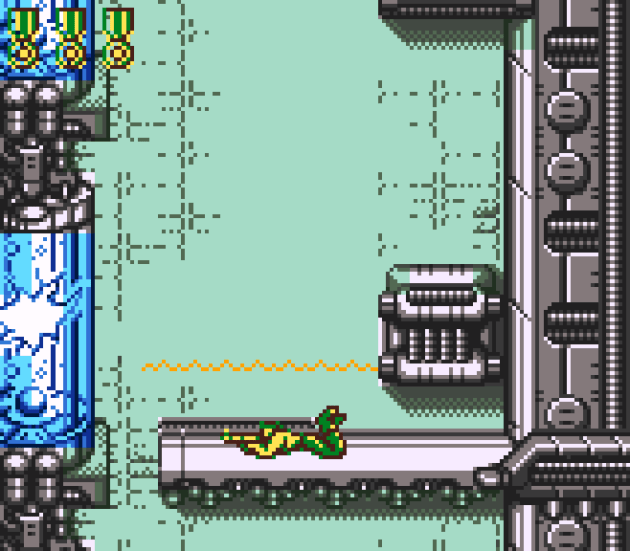
There’s not a ton to say about Operation C, but getting the obvious out of the way first: it’s probably the easiest Contra. I only died once in my warm-up game, making it all the way to the elevator section of the final level when, what is and isn’t a safe distance between you electric gates that come out of platforms isn’t clear. I think the problem is the beams squiggle but their collision boxes are one straight line. In my second playthrough, I aced the game without dying. I didn’t bother to do the “can I beat it without autofire” test because my hands are killing me. Too much pinball. Oh, and at this point, I should note that the second play-through was on the Game Boy Color-enhanced European exclusive release Konami GB Collection Volume 1, which has some ugly ass use of color.

Think that’s bad? You might want to put on sunglasses for this next one.

What’s especially weird is that the collection still uses the Probotector name, but unlike the original European version of Operation C, it just stuck with the Contra characters instead of re-spriting them as robots.

Yea, that’s pretty bad. Still not as bad as Castlevania’s logo looking like it’s ready to suit-up for the Los Angeles Lakers, but I’m getting ahead of myself. Operation C isn’t just missing levels. The machine gun is gone. The laser is gone. Even the rapid fire and invincibility are gone. There’s only three guns, one of which is new and one of which is changed. The spread gun starts with three bullets but, if you collect a second spread item, it becomes five. I’m pretty sure it’s the only one of the three that upgrades like that. The flamethrower is like the flamethrower from Super C, only it can’t be charged-up. A brand new gun, the homing gun, manages to nerf Operation C even more than spread. You fire heat-seeking bullets that seem to always pick the optimal enemy. Overpowered? Sure. The most overpowered gun in the franchise so far. But, at least it’s fun to use.

Can’t stress enough: the top-down levels have made the jump from “elephant in the room” to “legitimate highlight.”

Really, the best thing I can say about Operation C is that, like the two NES games, the designers were wise enough to optimize for FUN instead of blow-harded challenge. The game might be too easy, but I just played through it twice and I wasn’t even a tiny bit bored. Hell, the top-down levels are stronger than Super C’s. Most of the bosses are pretty fun to fight. The final two bosses, a generic tall alien that flies and a tube with some kind of alien that doesn’t even fight back or have any offensive move close the game, and I wasn’t a big fan. Too generic. The jumping is also harder to clock than the NES games, but Operation C is still probably one of the better NES-to-Game Boy efforts. It feels like a smaller, black & white version of the console games everyone loved. You can’t say the same about the first Castlevania release on the Game Boy.

Oof. When players are more scared of having to start over than they are of the settings, you’re doing Castlevania wrong.

Since it’s Halloween time, it’s time for me to move off the Contra marathon for the rest of the week and hit up Castlevania for the second straight year, and there’s enough classic Castlevanias for me to make this an annual tradition for a few years at least. Nice. Not so nice is starting 2024’s Halloween run off with THIS. Now granted, The Castlevania Adventure released over a year before Operation C. Konami had a lot more time to familiarize themselves with the Game Boy to assure their Game Boy Contra felt like a Contra game. In the United States, Castlevania Adventure was released only ten days before the first Christmas of my lifetime. By the time this thing had to go to manufacturing, Konami probably had an inkling that the previously snickered-at Game Boy was going to be a massive hit and the most desired gift for their target audience of 1989’s holiday season. Well, what kid wouldn’t want a handheld Castlevania? Even if what the series was hadn’t exactly been established. This beat Dracula’s Curse to the market in Japan by a couple months, so technically, the series up to this point was the NES game, the wonky and weird RPG-like Simon’s Quest, the exploration-based Vampire Killer for the MSX, and the unimaginable trash fire that is the arcade Castlevania spin-off/remake known as Haunted Castle.

What WOULD be the best idea in the game, hidden rooms like the one I’m going into here, is significantly muted by the total lack of non-whip weapons. They’re rooms with life refills and maybe a 1up. Whoopie.

So, saying that Castlevania Adventure does a poor job of being a Castlevania game isn’t entirely fair. What WAS Castlevania in 1989? Arguably, the only unifying aspects are the whip, a gothic horror tone, and Dracula. Hey, those are in this game! Good job. And yet, there’s something sinister about Castlevania Adventure, because it sure looks like it’s going to be fun in screenshots. Hell, I’d go so far as to say it looks great! Arguably the best looking Game Boy release of its first year. But, that becomes cruel, because playing Castlevania Adventure is the pits. Christopher Belmont must be one arthritic mother f*cker because he moves like his limbs are full of sand. Castlevania Adventure’s movement speed is roughly on par with any other game’s speed on levels where you get stuck waist-high in water or quicksand. That’s when the game is moving full speed. Castlevania Adventure frequently suffers from bouts of slowdown. This often happens while you’re in the middle of jumping. That’s sort of a big deal when the designers decided to make the #1 method of difficulty last pixel jumps and single-block-wide platforms.

This would have been the most clever bit in the game. There’s giant eyeballs that, when whipped, explode like seen here. Okay, neat, except they lead to more last pixel jumps. It’s not a last-pixel jump to jump over them, so I opted to do that. As if to troll me, it started sending two out. You’re not exactly nimble with the jumps, so I had no choice but to whip them. And it made the above gaps in the platform. Oh, and this was a dead end too. Yea, there’s a level with dead ends. I hate this game.

I have no doubt that Castlevania Adventure is the worst game in the series. I’ve played Haunted Castle, and miserable as that game is, at least it’s not as sluggish or boring as this. Even the exciting parts are ruined by going too long. After about one-third of the third level, the game becomes an auto-scrolling race against a rising spiked floor. This goes on FOREVER, and even after reaching the top, the race isn’t over. Then you have to race against the right wall moving in at you. It actually was very exciting.. for about a minute. But then it just kept going until it was exhausting, and then kept going even further until all the joy of surviving had been sapped from it, and it was STILL GOING. It also didn’t help that in the Konami GB Collection version I played, the same ugly banana yellow background from Operation C had returned.

Seriously, why? Who thought this was a good idea?

I think it was probably a good decision to review Operation C and the Castlevania Adventure as a pair, because I walked away with the impression that Castlevania had to die so that Operation C could live. Everything that you could possibly complain about with one is fixed in the other. I don’t expect the Game Boy to have peppy, fast-paced games, and Operation C isn’t. But, compared to a lot of 1989 – 1992 games, it stands out among action games for coming the closest to an NES-like pace. Castlevania Adventure only has four levels, but it feels much longer, and not in a good way. There’s almost no strategy or individualism to the game because there’s no sub-weapons. It’s just a matter of getting from point A to point B, and the only aid you get along the way is a fully upgraded whip can shoot a fireball that literally bounces harmlessly off the first boss. The bosses in Operation C are big and enjoyable to fight, even if they’re easy. The bosses in Castlevania Adventure, easily the highlight of the game, are average-at-best, and some are smaller than you are.

This slideshow requires JavaScript.

Sometimes I play black & white Game Boy icons and think to myself “I’m so lucky I grew up with the Game Boy Color.” By that point, most studios knew how to build fun games tailored to its strengths. But, that was happening long before I got my first Game Boy. Even the Jetsons Game Boy title was really well done. I wonder how much of my own impression of Game Boy was soured by having bad luck with the black & white games I got to play before I started running through retro games on this blog? One of the first was Castlevania Adventure, and I hated it. I hated its sloth-like pace. I hated its jumping. I hated the level design. It might not be the worst game ever made, but it’s one of the most unlikable. Even if you pretend it’s not a Castlevania game, it doesn’t work as an action game. It’s too slow and clunky to be white-knuckle. It’s just a really awful game.

The final level, which was easily the best, was also the only one that didn’t feel like time itself started ticking slower. It rises to the level of “okay.” The problem is you have to play three of the most boring levels in video game history to experience it.

In the case of Operation C, I don’t think a kid would have much regrets with it. It looks like Contra. It plays like Contra. It has all the tropes of Contra. With Castlevania, I think I would question whether this series is for me or not. It seems like it would make any car trip or down time feel longer. It comes across like a bad knock-off of Castlevania. It doesn’t even have skeletons to fight. The enemies are dull. The lack of sub-weapons assures there’s nothing to break-up the tedium. The bosses are too easy, at least until Dracula shows up and hovers above instakill spikes. But the platforming is so heavy feeling. It’s like you have sandbags tied to you, and the whole game is based around how crappy that is to play. Amazingly, another trick they use is having platforms fall quickly underneath you, which is dirty pool given that the controls are unresponsive. Castlevania Adventure IS fine tuned, but not in a way you want from a game. They built terrible movement and jumping physics, then tailored the game around that instead of fixing the damn movement. And yea, sinister is the right word, because you wouldn’t know this from a screenshot. It looks like Castlevania. But it ain’t. It’s an official off-brand Castlevania, and one of the worst games I’ve ever played.
Operation C Verdict: YES!
The Castlevania Adventure Verdict: NO!

THE INDIE GAMER CHICK CASTLEVANIA REVIEW SERIES
 Castlevania (NES) Dracula’s Curse (NES) Adventure (GB) Belmont’s Revenge (GB)
Super Castlevania IV (SNES) Dracula X (SNES) Rondo of Blood (SuperCD²)
Chronicles (PSX) Circle of the Moon (GBA)  Kid Dracula (NES) Kid Dracula (GB)
ROM Hacks (NES)
Konami Wai Wai World (NES) Wai Wai World 2: SOS!! Parsley Jō (NES)

Super C (NES Review)

Super CSuper C
aka Probotector II: Return of the Evil Forces
Platform: Nintendo Entertainment System
Released February 2, 1990
Developed by Konami
Included in Contra Anniversary Collection
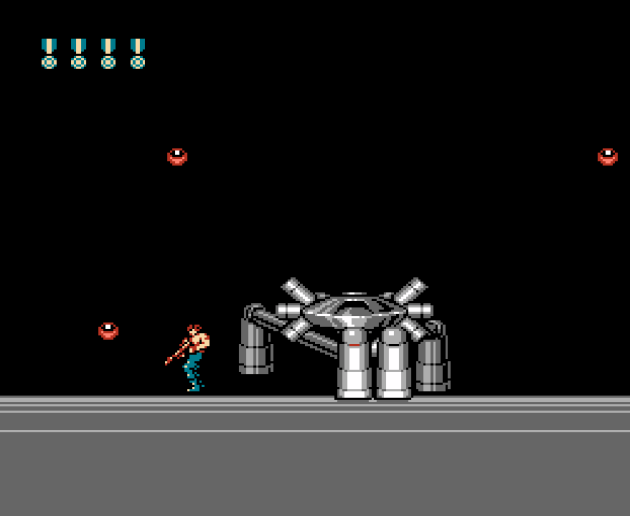
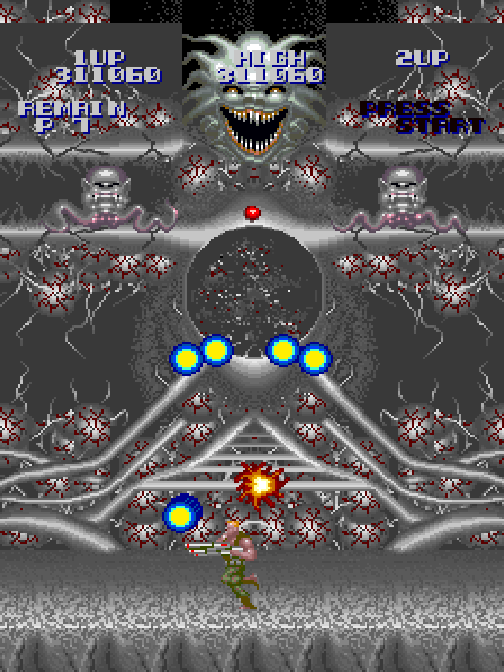
Like most of Super C for the NES, this isn’t from the coin-op. And thank God for it.

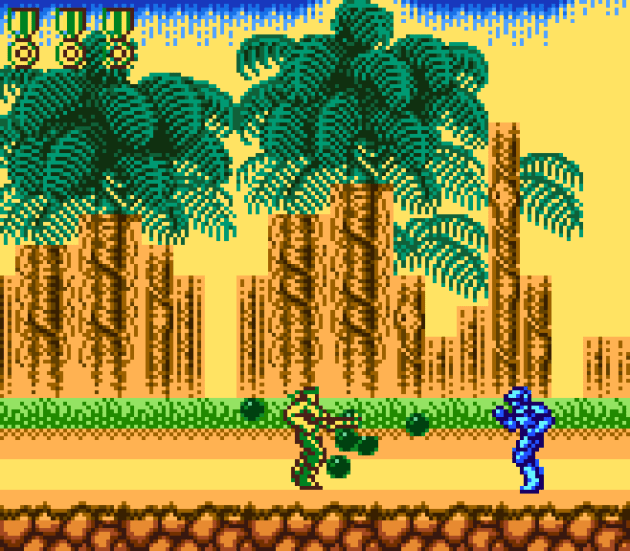
And you thought Contra on the NES was a major leap over the arcade game. That’s NOTHING compared to the gigantic leap Super C made. A leap so high that the letters O-N-T-R-A didn’t make it! At least in the United States, and can you blame them? They had to jump over an ocean to get here. An ocean! Not “Ocean” though as in the game publisher that’s like “why does everyone hate LJN? Did you like any game made by us?” But, I digress. The bad news with Super C is that the top-down stuff from the arcade is here too. The good news is the top-down stuff plays better on the NES. It’s not amazing, and it still makes Contra as a franchise feel like an also-ran. Even mixing it with the side-scrolling genre doesn’t make it stand out in what is an exceptionally crowded field. It really doesn’t help that, for a brief window, Super C has ghastly visibility issues. I tried using a CRT filter, which works on some NES games with noisy backgrounds. It didn’t help with Super C at all. Hey, I love the effort to make an otherwise average game design stand out as a viable set piece. But, I prize being able to see what’s going on more than I do the facade of a new area. But, as much as I miss the third person bases, the two top-down levels don’t suck. Besides visibility issues, they ain’t too bad at all. They work better with the bigger playfield of the NES.

Can you see that I’m about to die?

The other good news is that Super C is so fun that, if not for those top-down levels, I think we’d be talking about whether or not it’s better than the original. It’s insane that they took a mediocre coin-op and turned it into THIS, because Super C is fantastic! They added several levels and set-pieces, and almost all of the additional content is of the side-scrolling variety. In other words, they added more of the stuff that would make people want a sequel to Contra in the first place! Everything wrong with the coin-op’s concept is fixed here, and everything that didn’t work there works here. Things I didn’t expect. For example, everything wrong with the jungle stage in arcades had nothing at all to do with the logical flaw of dumping the third-person areas. It was just a lazily designed stage that relies on foreground objects blocking your view for challenge, then dumps straight into what is the 7th boss in the NES game.

The section with earthquakes manages to be both fair and thrilling without any “gotchas.” This is such an impressive sequel.

In Super C, the jungle level is fine. While it still lacks platforms for the actual jungle part of the jungle level, the pacing of when and where enemies are utilized is smarter. No foreground to block your view, either. Then, they added a memorable mini-boss and a better finale. Instead of a jarring hard cut to the alien base, you run through the earthquake section pictured above. With it comes the first truly tricky platforming section in home Contra history. It’s almost like Konami had the same observations I had: why even have a platform game without edge-of-your-seat jumps? The historically awesome, effective jumping physics are copied exactly from the original NES game, so why not be equal parts platforming AND bullet dodging? The first NES Contra did that, and last I checked, it was pretty sweet. The coin-op doesn’t have a viable jump at all. You can’t even clear a gun with your jump. If a gun you don’t want lands in front of you, you have to wait for it to vanish. If it is possible to jump over it, I never accomplished it.

Super C leans hard into the platforming side of the game multiple times, something I really don’t think the original ever did. In this segment, the ceiling raises and lowers. It’s genuinely thrilling, and there’s multiple jumps that saw me holding my breath. What a wonderful game!

In retrospect, that might be the one thing missing from the original NES Contra. There, the platforming isn’t amazing. There’s hardly any thrilling jumps. I can’t and won’t hold it against that game, because platforming isn’t the point. It’s a means to an end for Contra’s defensive game. Even when it feels like a traditional platformer in stages like the Hanger or Energy Zone, it’s actually more timing-based than accuracy-based. That’s certainly not the case with the sequel, which elegantly steers into a platforming focus on multiple occasions. In the arcade, levels felt like straight 2D lines with only the illusion of platforming. On the NES, Super C is a run & gun with a heavy emphasis on platforming, and it’s remarkable how transformative that is. On the NES, the jungle might still be the weakest side-scrolling stage between the two real Contra games (Contra Force is coming up NEXT at IGC, even if it’s not next sequentially), and it still rises to the level of better-than-decent. It proves within the first third of the game that NES Super C is no half-assed effort. There’s new mini-bosses. There’s new full-sized bosses. They kept all the weapons from before except the flamethrower. Oh, there’s still a flamethrower, but it’s different this time. I don’t feel like a complete tool using it, because now, it looks like this:
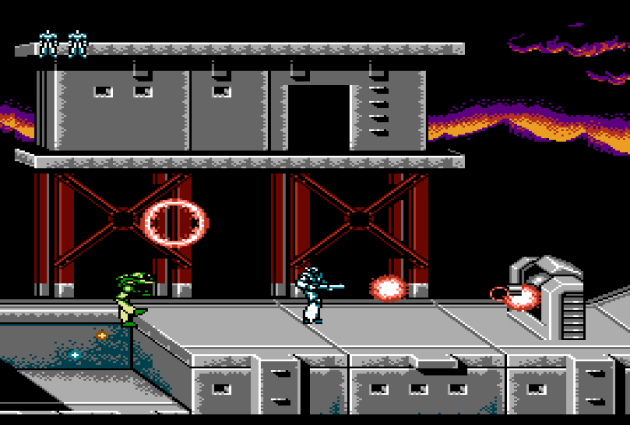
It doesn’t look great in screenshots, but it’s awesome. Instead of bullets doing ridiculous corkscrews, the flamethrower now shoots the biggest bullets in Contra, which explode with splash damage upon impact. This was in the coin-op too, but it was made to look like a grenade launcher. I like shooting fireballs better!

Super C uses the same engine as the first game, and much like the first game, it’s not a lives code that trivializes the difficulty. Autofire and the spread gun will do it. Hell, even the flamethrower is now overpowered with autofire. So, I decided to use the same test I created for Contra: beat the game, without autofire, the lives code, or emulation-based shenanigans. First, I cheesed the game a few times with autofire (including a co-op game). The third game, I had a no-death, no-cheating run. I’ve played Super C significantly less than Contra, so that gives you an idea of just how much autofire and the spreader annihilates the challenge of the NES Contra games. It’s not like I’m a professional gamer over here, but with autofire, both Contra and Super C are some of the breeziest side-scrolling run & guns I’ve played. Hell, I think I would have run the table the first time around, but I messed-up several jumps along the way. Jumps I, if not clocked, learned to pace-myself and wait for during co-op. The real challenge came when I disabled autofire entirely and fired up the Japanese ROM. I made it to the second boss before I died, and I genuinely believe if I had never swapped the spread gun for the laser (which, in two previous solo sessions, I’d barely seen and hadn’t used), I would have gone a lot further without dying.
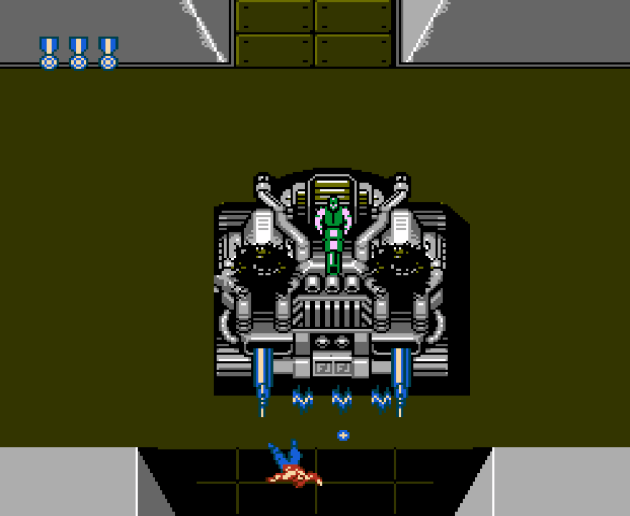
Death #1. Oh, and this time the electrodes and laser kill you.

Like with Contra, playing Super C straight-up, on its terms, mostly made me focus on the item drops. This time, I learned how unevenly-distributed the guns are. It became pretty clean early into the game that Super C sometimes becomes more stingy with the weapons. It really started after the second level. At the start of the third stage, the first two items it gave me were rapid fire and a screen-clearing bomb. It was quite a distance from the start of the level that I got my first REAL gun, the machine gun. During a one-off set-piece where a cannon fires a series of bombs, I ate death #2 right before I collected the laser. Thankfully it was waiting for me when I came back to life. Death #3 came against the six-legged robot, at which point I learned that I could have stood on top of it, because I landed on it when I respawned. Except, you can’t shoot down at it. The target is underneath it. Death #4. Same f’n mini-boss. I was THIS close to a game over here, but it blew up at the last second. I got a free life too.

This slideshow requires JavaScript.

I didn’t get my beloved spread gun back until I reached the earthquake section, but I ate death #5 on the base boss, followed by death #6. Game. Over.

This slideshow requires JavaScript.

Rather than start over, I was curious if I could make it to the end with just the continues it gives me. Nobody expects gaming super heroics from me. Again, I’m certain that I’m capable of brute-forcing most games through repetition to the point that I could ace most games. There’s some that I feel are out of my reach. Like, there’s no way in hell I could do a no-death run through something like Battletoads. But, I think most people, if they chained themselves to one game and one game only, could drill a full ace into muscle memory. That’s not the barometer. Perfection isn’t. The question is “could an average gamer, with a normal non-autofire controller and no access to the 10 lives cheat beat Super C in 1990?” Yep. It’s not that hard. Like Contra or Castlevania, Super C’s difficulty is vastly overstated. And hey, I made it through the entire third level without dying. Not only that but I literally let out a cheer three times in this level alone: for the cannon, the six-legged robot, and the base. I made it to where the vertical section of level four starts before I STUPIDLY threw away a life by starting to climb before the bombs fell. Idiot. And then soon after, I gave up another death. Another change from Contra is there’s a lot more stuff to dodge, and the turrets take more hits to kill.

This slideshow requires JavaScript.

The stinginess with the items was still in full force as I reached the elevator. When it finally spit out guns, it was only the machine gun and the rapid fire. Little redundant there, but hey, that’s literally how the first Contra starts. I died again and fell to my last life without any guns and without even seeing the 4th boss. Thankfully I shot the right canister to get the spread gun. I just needed to hold on for dear life, but I assumed that, even if I get an extra life, I wasn’t going to make it much further. I was wrong, and Super C totally confirmed to me that the spread gun is the most overpowered gun in the game. I did manage to beat the 4th boss, but no extra life yet. I was only 1,000 points short, and got it right after I started the next stage. In fact, I ran through level 5 without a single death. Spread gun kept. Scored another extra life from the boss. I made it through stage 6 without dying too, and was near the end of stage 7, and then it happened.

This slideshow requires JavaScript.

I had defeated the egg thing, but it spits the aliens out in unpredictable trajectories, and it caught me. I had one floor left of these things, and the next one ate up every single life I had except one. I did end up getting another extra life, giving me two to fight the 7th boss without any special gun. I did manage to ping it to death, but I lost a life in the process too.

This slideshow requires JavaScript.

Final level, no lives, no guns, but still on my 2nd continue and..

Yep, that’ll do.

I did it! One continue, no codes, and no cheating of any kind. And honestly, if I went again, I think I could probably make it without a game over at all. Swapping the spread for the laser in level two stupid, especially since this Contra is quite miserly with the guns at times. The next spread gun wasn’t spawned until right before the third boss. Hell, I’m pretty sure the first laser isn’t spawned until the second level. And yet, sometimes the game spits out weapon chances right after you just had one. The pacing is all over the place. Is that why Super C isn’t remembered as fondly as Contra? It can’t be because it’s a sequel. This is video games. Sequels being better is the norm.

My final death, and I was sh*tting myself because it happened early in the fight. But, I discovered that you can lean-up against the front leg of the final boss and aim diagonally for a direct line to the alien crab sponge monster’s weak point. It’s not a cinch after that. The millipede it spits out is invincible so you have to get a feel for its timing. Decent final boss. Sure beats ending the game on a top-down section, like the coin-op did.

Or, what if it’s something dumber? I’m absolutely open to the possibility that the lack of the Konami code is the reason. It’s not an accident that it’s gaming’s most famous cheat code. It’s harmonious. Rolls right off the tongue. But, it’s long enough that it has a secret handshake vibe to it. If you know the code, you’re in the club. The “I take video games at least seriously enough to know how to get 30 lives in Contra without looking it up” club. But, I’ve already talked about that excuse. Think EVEN DUMBER.
Too dumb. Little less.

What if Super C didn’t do as well because it was called “Super C” instead of “Super Contra?” I sure hope that’s not the reason, but you can’t rule it out. I’d like to take it for granted that kids of the 80s/90s knew a sequel when they saw it. Maybe they did. But maybe their parents didn’t. Mom & Dad might know that Junior loves a game called “Contra” but, when browsing games, it might not be self-evident that Super C is Contra. I’m guessing Contra had a lot of casual buys from parents for their kids. Great cover art. Trendy. Looks like the movies Junior likes. Super C has okay cover art, but nowhere near as eye-catching or memorable as the first game. The letter C is the same. That’s it. It’s not exactly McDonald’s-like memorable, especially back then.

Even if you assume the cover is close enough to the original (not even close), that doesn’t mean people not in the know will instantly connect the two. As dumb an excuse as that is, it had to factor in a little bit. It’s called “Super C.” Same engine. Same guns. Same alien invasion. Same platform. But, not the same name. And they did it because the word “contra” was topically hot for non-gaming reasons at the time. Guys, we can’t call it “Contra” because one or two newspapers compared our game to the Iran-Contra Affair! Branding? To hell with branding! Think of the frowny faces! They’ll wag their fingers SO HARD at us!

This boss (no longer the final boss like it was in the arcade game) would later sign a two-game contract with Nintendo, and appear in the game StarTropics as the character “Zoda.” It even got top-billing in the sequel! Then, like so many other 90s bosses, it faded into obscurity. Today, you can meet it at Comic-Con, and for $10 extra get its autograph.

As far as games that slipped through the cracks of history, Super C might be the most inexplicable. It really does feel like a grander version of Contra. On the NES, the bosses are bigger, the challenge is harder, the flamethrower is better, the laser is.. well, actually it’s worse. But the spread gun is god-tier now, and the level design assures that Super C is literally non-stop fun. This is what you want in a sequel. I might not be a huge fan of the top-down levels, but compared to some NES top-down shooters, they’re clearly in an elite class for the platform. I can’t say it’s better than Contra because the pacing and platforms aren’t absolutely flawless this go around. But, it’s not that far behind the original. So, what do *I* think happened? Three words and one number: Super Mario Bros. 3. I think that Contra transcends tastes and genres TODAY, in 2024. I’m guessing it didn’t at the time. But, do you know what franchise absolutely did? Mario. And, in 1990, Super Mario Bros. 3 was the first new release EVENT of the modern gaming era (IE after Atari). A game that was such a moment in the industry’s history that, for the US release, an entire movie was part of the hype. When did Mario 3 come out in the United States? February of 1990. When did Super C come out here? April of 1990. Ouch.
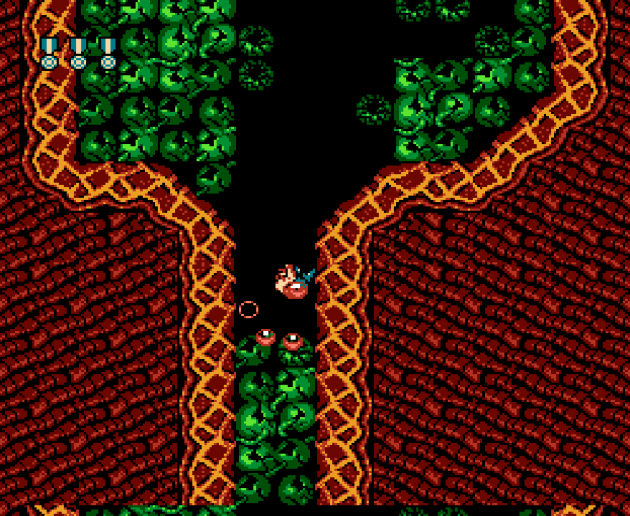
The new set-pieces all work really well too. This feels a LOT more like an alien invasion than the first game.

It’s never just one thing, of course. I’ve come up with four valid reasons that, on their own, would be heartbreaking in their pettiness as reasons why the NES Super C has little-to-no historic clout. Top-down replacing 3rd person? Dumb. No Konami code? Not sure why they did that. Changing the name? Needlessly risky. Launching against what had been the biggest video game in history up to that point? Oof. Yet, none of them account for the complete lack of prestige Super C has to it. Add them all up though, and it’s a perfect storm of bad timing and bad decisions. In reality, Super C isn’t just a good sequel, but it’s a GREAT video game, all on its own. If this had been the first game in the series, I honestly think there’s a chance the conversation around Contra would be mostly unchanged, and the only difference is we’d be talking about Super C and not Contra as a legitimate contender for the Greatest of All-Time. There’s no insurmountable stakes. The action is non-stop, intense, but SO enjoyable. It’s epic, and beautiful, and one of the best co-op releases to grace 8-bits. What more could you ask for? Contra might be the dark horse of the GOAT conversation, but Super C is the clear favorite in the conversation “what is the most underrated NES game?” Hot damn, this franchise is awesome AND interesting, and I love it.
Verdict: YES!
With this YES!, I feel comfortable saying Contra Anniversary Collection is worth $19.99. Hell, it’s worth it for the two NES games alone. That means the 16-bit games are a spectacular end-zone dance.

PART OF THE CONTRA REVIEW SERIES!
IGC Review of Contra the Arcade Game
IGC Review of Contra on the NES
IGC Review of Contra on MSX
IGC Review of Super Contra (Arcade)

Super Contra (Arcade Review)

Super Contra
Platform: Arcade
Released January 28, 1988
Directed by Hideyuki Tsujimoto
Developed by Konami
Included in Contra Anniversary Collection
Sold Separately via Arcade Archives

Well, it looks the part. But, it doesn’t do a good job of playing the part. At least on a full-time basis.

I get it now. I get why Super Contra didn’t reach the legendary status the original did, and I get it before I even reach the NES game. It’s not the Konami code. It really is the top-down sections. In what has to be one of the most historically bad decisions in game design history, Contra’s sequel, released just under a  year after the original, dropped the third person base segments and replaced them with generic top-down sections. What a stupid move. War-themed action games were smoking hot in gaming at the time, but there were a LOT of top-down shooting games that feel exactly the same as Super Contra’s top-down levels, surrendering the original game’s uniqueness.

Real subtle, guys.

I assume that’s why they used third person areas instead of top-down in the first place. How do you stand out in a crowded field in 1987? Mix genres. Side scrollers are popular, and top-down shooters are. Why not do both? Great idea, but top-down is too commonplace, from Front Line to Commando to Ikari Warriors. Hell, Ikari Warriors’ sequel, Victory Road, came out in 1986. You don’t want people to think you’re playing follow the leader with SNK or Capcom, do you? So instead, you mix a side-scroller with unique third-person levels that shift the focus from run & gun platforming to intense bullet-dodging in a tight space, but in a way that retains the acrobatic movement and jumping from the side-scrolling levels. Neat. Novel. Original. Tantalizing. And ALL YOURS. Now you’re the one doing the innovating! Anyone that follows is eating your dust, not the other way around. So, why move away from that? I honestly don’t know. Maybe they got bad focus testing or early reviews specifically on the third-person stages. I hope that’s not it. If you’re a game critic or participated in a focus group and sh*t on the base levels in Contra, thanks so much for ruining the sequel. You’re a bad person, and you’re going to gaming hell, where you will be forced to play Super Contra. I kid, because it’s Konami’s fault. What a truly stupid decision.

Okay, this IS kind of funny. See the two probes with the electricity running between them? They don’t kill you, or damage you, or anything. They do nothing. You stand right over them. Not even the energy hurts you. Cutting Room Floor, aka my favorite gaming site in the whole wide world, generously describes this as an “oversight.” Yes. Yes, “oversight.” I don’t think they just forgot to program that as a lethal element. It feels like an adjustment made by play testers, because I genuinely think if they hadn’t done this, Super Contra’s reputation would have gone from “meh” to outright scathing on account of extreme difficulty. There’s just not enough room to fight it without those being nerfed. Once again, the coin-op feels like it fails to make the best use of the vertical screen.

And it’s not like the top-down sections of Super Contra stand out in any way. They’re short, unmemorable, and generic. When Super Contra drifts aimlessly away from its bread & butter, hell, it could be ANY top-down game. The level design is so basic that, all by itself, it turns Contra as a franchise from coattail wearer to coattail rider. Like the previous game has to catch up to sh*t like Ikari Warriors. I’m not slamming Ikari Warriors. I’m saying Konami had a good thing going and threw the brakes on for no good reason. Those top-down levels feel like you’re running through hollow boxes and only occasionally have to change directions, but otherwise, they make for boring set-pieces. It doesn’t matter if you’re fighting aliens. They don’t feel alien. It’s especially jarring because the side-scrolling levels do a good job of that even when things like a normal helicopter shows up that you have to blow up. At only five levels, the game is pitifully small, but only three of those levels offer the type of action that feels like the sequel you want Super Contra to be. The word “super” was overused in gaming, probably thanks in large part to Super Mario Bros. In the case of Super Contra, it does such a bad job of feeling like an evolution of the Contra concept that calling it “super” feels like a lie. It also doesn’t help that this is also the owner of the first bad level in Contra. Or, more accurately, the first bad side-scrolling level. This level:

You can’t see it, but that guy is shooting me.

Hey, let’s make visibility a major challenge factor! Trees in the foreground that block your view. What a desperate move for a game that feels like, after a solid first level, it just lost faith in the formula. The first level is rock-solid. The fourth level is rock-solid. Levels 2, 3, and 5 stink. Super Contra is just fundamentally not fun 60% of the time. It’s not even the case of the NES version out-classing it (though that’s absolutely the case yet again). On its own, the set-pieces are much less memorable. The bosses are. The level design feels uninspired and arbitrary. I literally can’t believe Electronic Gaming Monthly named this the 9th greatest arcade game of all time. Apparently they did in 1997. So.. what you’re telling me is they only played 9 arcade games, right? Was the first Contra one of them? Because I’d rather play that. Nothing blocks me from seeing bullets in that game, and there’s no dull, far-too-basic top-down sections in that one. Was it a typo? Did they mean Contra? Because this is a cookie cutter action game that briefly becomes a Contra sequel. But it doesn’t last. EDIT: Come to think of it, it doesn’t have as much jumping as the first game did. Even the side-scrolling stages usually only offer one path and no options or flexibility.

Okay, FINE, the last boss is pretty damn cool looking. But, the giant heart was unforgettable. I’m not sure I’ll remember this next week. I’ve beaten this before.. sober.. and for the life of me I couldn’t remember what the hell the last boss was. Also, the game ends on the lame-ass top down sections. So deflating.

Easily the most fascinating aspect of the arcade version of Super Contra is that, completely unprompted, it feels like a game that’s grasping at straws. As if it’s some kind of knock-off game instead of the sequel to a bonafide milestone in gaming. I’ve never seen anything like this, but actually, it totally makes perfect sense. They didn’t wait long enough to make a sequel, and since this came out a month before the NES/Famicom Contra released, they had no way of knowing what Contra was about to become. Hell, they didn’t even know that after it came out. Contra on the NES did good, but it wasn’t even one of the seventy-five NES/Famicom games verified to have sold a million units. That’s something even I didn’t realize when I wrote the previous reviews: at the time, Contra was something of a cult hit, not a hit-hit. I assumed it was a massive hit, but Konami alone had at least six NES/Famicom games outsell it. At least, and likely even a couple more. Contra was a sleeper that, in the decades since, woke up as a giant. But that took time. And that’s why Super Contra turned out so bland. Konami didn’t have enough time to observe the type of reaction and feedback Contra, as a coin-op or a home game, would have. You need that to make a GREAT sequel. All sequels are fan service, after all.

It’s a f’n vertical screen, and they still screwed up everything. Look at this! THE SCORE COVERS THE BOSS! Did you guys even care? This isn’t a nit-picky thing. It’s immersion you’re messing up. In an action game, if you don’t have immersion, you don’t have sh*t!

It’s taken three decades and a lot of historical reevaluations for NES Contra to reach the phase it’s at, where it’s mostly agreed upon that it’s one of the greatest video games of all-time. As recently as Contra Anniversary Collection five years ago, which is when I REALLY got into the original games, I didn’t realize what it accomplished. I just thought it was a really fun game. Safe bet Konami had no idea what they had either. It happens in gaming more than you would think. Namco didn’t realize what made Pac-Man work. Super Pac-Man and Pac & Pal proved that. Super Contra proves Konami didn’t have a clue either. Unlike the original, this can’t even fall back on “it’s only bad in comparison to the superior NES game.” I don’t think it’s actually a well-made game in general. This feels even more cramped than the first coin-op Contra. And, just like the first coin-op, that squeeze doesn’t come with a sense of tension. The jumping is not as good as before. You can’t even jump over a gun you don’t want, and there’s no jumping in the top-down sections. That button is used for the one screen-clearing bomb they give you per stage. Bosses and “event” enemies are spongy now, too, a genuine first for the franchise since the MSX game technically came after this. The only legit positive is the machine gun now fires rockets as bullets. Hey, that’s cool, but this is just not as fun as its own game or as a sequel. Super Contra is mostly boring, and that’s where it’s stuck, forever. At least we’ll always have the NES version.
Verdict: NO!

SoCalledSuperPART OF THE CONTRA REVIEW SERIES!
IGC Review of Contra (Arcade)
IGC Review of Contra (NES)
IGC Review of Contra (MSX)
IGC Review of Super C (NES)

Contra (MSX Review)

MSXContra
Platform: MSX
Released May 26, 1989
Developed by Konami
NO MODERN RE-RELEASE*

*For the purposes of this review, “modern” means “after Wii U”

The “lost” Contra, or in the case of American audiences, the “there’s another 80’s Contra?” Contra.

I really want to get on to Super C, but there was one last stop to make along the way. Instead of playing the DOS version of Contra, which apparently most everyone agrees is garbage, I decided to skip over to this Japanese exclusive. MSX appealed to me more, anyway. After all, the MSX was the closest we’ll ever come to Konami having their own platform. They were THE gaming face of the MSX, and in the not so distant future, I might be exploring their contributions further.

Some Konami MSX games I look forward to more than others. There’s an MSX version of Konami’s NES Teenage Mutant Ninja Turtles and it’s.. not going to be my favorite game ever. To say the least.

Contra on the MSX is a very different game from the Nintendo and arcade games. It might use those as a road map for what the game absolutely needs to pass for Contra, but it’s essentially an entirely new game that wears the Contra name. There’s no scrolling. There’s health, so a bullet doesn’t kill you, at least immediately. There’s no spread gun, aka my favorite gun. That one hurts, but at least the gun that replaced it is actually pretty helpful during boss battles: the “rear gun” which shoots behind you as well. Since one of the game’s go-to moves for challenge is having the grunts spawn on both sides of the screen during boss battles, it cuts down the busy work of shooting a guy on one side, then turning around and shooting again before you can go back to shooting the boss. This becomes very important thanks to the two worst additions to the Contra formula: sponge and small collision boxes.

It was actually kind of insane how many shots the final targets in the bases take to kill. Without hyperbole, these always took me over a minute of pinging them. They have a small collision box too.

I’m grateful for the MSX version of Contra because it validated my suspicion that speed and generosity play a big role in the success of Contra. On the NES, and even in arcades, Contra cuts a blistering pace. The MSX game isn’t “slow” for the most part. Instead, it’s too stop-and-go. When you’re making your way to a boss, it is a close approximation to Contra, only played one screen at a time. But then the bosses happen. They usually have small collision boxes. The best example of this is the jumping alien. In the NES game, you could shoot anywhere on its body and it registered damage. On the MSX, you HAVE to shoot it in the head, and it has a pretty tiny head. Everything is this way. The big ass tanks from the snow level? They’re here, but you have to shoot them in the gun. There’s an annoying little wrinkle that comes with all this: if you have muscle memory of Contra’s jumping from the NES or Arcade, it won’t help you with timing at all here. You jump a little higher and a little floatier on the MSX. I really struggled to aim, whether I was side-scrolling or shooting at the wall in third person mode. Speaking of which, you have to aim up in some levels in third person mode, but for most targets, that goes over them. But, your standard trajectory often doesn’t work either, so you have to jump and shoot as middle ground between angles. So annoying.

This slideshow requires JavaScript.

For these reasons, Contra on MSX has a reputation of being especially hard, and yea, it’s true. By the way, there’s NO continues. Yikes. After a couple hours, I opted to use a popular ROM hack that gives you virtually infinite health and I still managed to lose a couple lives. It’s really telling how tough the collision is (not bad, but tough) because with the addition of these challenging aspects also comes the addition of straight-up cheese. Contra MSX’s screen-based scrolling allows you to run past entire sections of the game. The lead-up to the battle with the giant alien heart? It’s here, with the alien turrets that spit  “spores” out that heat seeks you. Only, on the MSX, it’s a cinch! You can just run past them with no consequence. They get a fresh spawn every new screen and need time to fire their first bullets, which in turn need a few seconds before they pose a danger to you. If you don’t care about your score, you have more than enough time to just run across the screen. Nothing chases you to the next screen. Not enemies. Not bullets. They cease to exist. This is almost certainly why they beefed-up the bosses. They had to, because this is a Contra that rewards cowardice. Thanks to that health bar that they chose to go with in addition to a life system, getting shot once doesn’t cost you a gun. But not getting shot at all costs you nothing. Why engage if you don’t have to? You know the bosses are going to be tough, so just leg it past enemies when you can and save your strength for the battle ahead.

“Hey.. HEY.. you can’t do that! That’s cheating!” “Duh! I’m using the ‘cheat enabled’ ROM! How did you think I was going to play? With honor? Hah!”

So, that’s Contra on the MSX. You know the drill. Swap between side scrolling and third person gameplay. Kill a few aliens. Shoot an alien heart to death, then watch the credits..

Hey, wait a second..

Why’s the game still going?

This slideshow requires JavaScript.

Okay, okay, yea, I can dig it. When you kill the heart in Contra on MSX, there’s still a lot of game left. As in “you’re only about halfway done.” After the heart battle, Contra introduces more gameplay elements that are new to the series. Like vertical levels where you travel down instead of up. Okay, that’s different. Sure, the cheese issue from before applies even more here. It’s very easy to just drop down to the next screen without engaging anything. But, the highlight is easily a pair of third person bases that are, in fact, mazes. You don’t know which way leads to the final chamber and picking the wrong way takes you back. It’s not that hard to find your way around, but I was impressed nonetheless. The only truly new set piece is a lava stage, and then the final boss is called the “vital alien organ.” As opposed to what? Shooting the Appendix of Contra? The Spleen of Contra? Oh, oh, the Tonsils of Contra! No, that one wouldn’t work. What if they’re infected? You’d be doing the alien a favor. Yea, taking out vital organs probably makes more sense.

The Vital Alien Organ. I will not make the most obvious joke here. You’re welcome.

Keeping it real, Contra on MSX is one of the least popular games among fans of the franchise for a reason. There are certain benchmarks that make for a good Contra game, and this is missing a few. There’s no co-op. Single player only. The gunplay isn’t amazing. It’s pretty basic, especially compared to the more famous NES and Arcade games, and that’s assuming the guns worked at all. The flamethrower from the coin-op/NES is here. You know, the gun that shoots bullets that travel in circles. Circles bigger than the collision boxes are in this version of Contra. You see where this is going.

Yea, the flamethrower bullets circled around the tiny collision box on the UFO. Every single bullet missed when I stood right underneath it. The flamethrower is WORTHLESS against bosses. I think it might be the worst video game gun invented before Goldeneye’s Klobb.

And I didn’t find the laser very satisfactory either. Not worthless. Don’t get me wrong, but just not as fun to use. It’s too subdued. Weirdly, the basic machine gun or the rear gun are the most satisfying and useful weapons. Oh, and this time around, the capsules that fly onto the screen don’t drop guns. They instead drop items that boost your movement speed and firing speed. They’re also much harder to hit. Again, tiny collision boxes. I have no idea why Konami’s team (it’s hard to find credits for a lot of MSX games) made the choices they did, but few of them are in service to the game’s enjoyment. Ultimately, Contra for MSX never feels like Contra. Even with replicated set-pieces and bosses, it doesn’t even come close. I make “dollar store knock-off” jokes all the time, but in the case of Contra, that really is the closest I can come to saying how it feels. If there were such a thing as a dollar store gaming knock-off, Contra on MSX would be the dollar store Contra.

Another change, and this is a very big one: you can’t destroy primary targets until you’ve taken out all secondary guns. Take the first boss, for example. Want to blow up the main target? Gotta take out the top two guns first. Even though it makes the damage noise, the main target won’t blow up no matter how long you pump bullets into it. I actually like this change. It adds stakes, and in fact, would be a positive addition to the NES version. Like the “Final Gate” boss before the alien lair, where you can just run up and hit the target before it even gets one shot off at you? That would be out the window. You’d have to take out the two cannons first. Contra MSX is full of those kinds of ideas that COULD work, but they don’t help this specific game for other reasons.

On the other hand, I genuinely enjoyed the extra levels and effort that went into coming up with replacements for the hardware’s shortcomings. No spread gun? That sucks, but the gun that replaced, while nowhere near as fun, got a LOT of use from this chick. That should count for something, right? And then there’s ideas that are totally out of left field, like how picking up new guns work. Once you pick up a gun, you have THAT gun, and every time you get to another spot where you can pick-up a gun, even if it’s an old one you already have, you can choose to equip any gun you’ve previously found via a menu. I don’t think I’d like that for NES Contra, but it certainly works here. I used it too, to swap between the laser and the rear gun a few times. There’s a lot of novelty here to make MSX Contra interesting beyond the raw gameplay. But, gameplay is king. The best thing I can say about MSX Contra is that it took the skeleton of Contra and boiled a perfectly fine gaming broth both out of it that might make for a lousy game of Contra, but it’s perfectly decent as a bland action game. Contra on MSX might not deserve to wear the Contra name, but it does, and it should be included in any collection of classic Contra games. This deserved a spot on Contra Anniversary Collection, even if it doesn’t feel like the Contra we all love.
Verdict: YES!

The names of levels are hilarious. The boss of the first base is called “Homicide Censor No. 1.” That’s hardcore. Meanwhile, the first stage is called “Asphalt Jungle.” WTF? Do you even know what an asphalt jungle is, Konami? Your game takes place in a LITERAL jungle, not an asphalt one.

Contra (3)PART OF THE CONTRA REVIEW SERIES!
IGC Review of Contra (Arcade)
IGC Review of Contra (NES)
IGC Review of Super Contra (Arcade)
IGC Review of Super C (NES)

Contra (Arcade Review)

Contra
aka Gryzor 
Platform: Arcade
Released February 20, 1987
Directed by Koji Hiroshita 
Published by Konami
Included in Contra Anniversary Collection
Sold Separately via Arcade Archives

This slideshow requires JavaScript.

When I reviewed Contra for the NES yesterday, I didn’t mention the arcade game at all. That’s because I think the conversation belongs here, in the arcade review. I don’t know if the fact that the NES game is superior to the coin-op is impressive or shameful. Maybe a little from column A and a little from column B. By any metric, the NES has the better game of Contra. Yes, that includes the graphics. I think Contra in arcades is pretty ugly. The graphics look washed-out, but not in a cool, stylized type of way. It’s just so drab looking, especially compared to the NES. But, who cares about looks? Gameplay matters, and I’ll still take Contra on the NES. Despite being a coin-op, Contra Arcade feels like a smaller game. Which is technically true because the NES game has more levels, but what I specifically mean is probably more related to the use of a vertical monitor. The game doesn’t benefit from a taller playfield, even on the waterfall stage where you climb upward. All the vertical screen does is subtract from the playfield without adding any benefits like a sense of claustrophobia or heightened urgency. It’s just cramped, period. The whole game is. By all rights, the arcade game should feel more grand and epic, but here’s the third boss in the NES game that came out a year after the coin-op:

Giant alien monster with two tentacle arms that shoot fireballs.

And here’s the original arcade version:

Two normal turrets, a five-gun turret, and a target.

One is unforgettable, and the other is so pedestrian that it could be any game. The NES version is a gigantic alien. In arcades, it really is just a base, and not even as grand a base as the first boss. It doesn’t even have to be an alien base. It could be a G.I. Joe‘s Cobra-like terrorist organization you’re fighting that has a bad H. R. Giger fetish. It’s just so generic and forgettable. The funny thing is, most of the bosses are almost identical in appearance and gameplay to the NES game, except they feel less important, and others genuinely are. By that I mean they’re bosses on the NES, but not in the arcade. The jumping alien isn’t. The giant UFO that drops smaller UFOs isn’t. Hell, you fight two of each of those in the arcade version. And the base boss before the final level from the NES game? It’s not even in the coin-op. In fact, after you beat the second base, the rest of the game kind of plays out as one large, continuous level. It’s strange, and it doesn’t work. I’ve always felt that bosses are a game’s metronome. They set the tempo, and build a player’s anticipation. Levels are always a little more exciting when you know you’re inching closer to a boss. Contra gives up on that design mentality early on, and it’s not better for it.

This slideshow requires JavaScript.

I had a developer friend once half-jokingly tell me something to the effect of, “thank god we started with transistor–transistor logic. If they had access to today’s computing power in 1972, we might still be waiting for the first great video game in the 2020s. They would have had so many options that they wouldn’t have known what to do with themselves!” In essence, great games wouldn’t have happened because the steps that created great games happened due to limitations and not despite them. He was kidding, but I’m not. He was right! Look no further than the arcade Contra. It’s the first game. Not based on anything (well, any video game). Much more powerful hardware than home consoles had at the time. And, when home releases did happen, such as the NES game, it’s pretty dang close. All the set pieces from the arcade game are on the NES, and in fact whole sections of some levels are. The NES game is a faithful adaptation, all things considered. But even with all the potential advantages in terms of hardware and resources the coin-op had, the NES just totally outclasses it. Remember how the vertical screen didn’t improve the waterfall? The one vertical-scrolling stage? Well, it did even less for the bases. They’re much smaller in scope and scale on the arcade version, with the only exception being the illusion of moving left and right at the end of them.

This slideshow requires JavaScript.

Some people really don’t like Arcade Contra, but it’s fine. It’s not amazing. It’s alright. If it seems like a bad game, it’s only by virtue of how amazing the NES game was. The arcade port has less personality and none of the charm. It has fewer levels. But, it’s still an okay game. Harder for sure, and there’s limited continues (the NES has this too, but the arcade has no 30 lives code). Except the laser is especially valuable now, and probably crosses the line into overpowered territory. It cuts through enemies like butter, but admittedly in a fun way. But, otherwise, it’s just a lesser game. I once said the SNES version of Teenage Mutant Ninja Turtles IV: Turtles in Time was perhaps the first coin-op action game outclassed by the home version, but I was clearly wrong. Contra on the NES completely blasts its arcade counterpart. And yet, what has the arcade version done so wrong? It controls fine. The action is good. Bosses are fun. Co-op is decent. The finale is memorable. It is Contra, only if Contra was okay instead of phenomenal. I’ve played hundreds of bad versions of great games. This isn’t bad. It’s just not as good.

Golly, this review sounded like a eulogy.

Don’t get me wrong. Even if the NES game didn’t happen, Contra would not be an elite arcade game. It would be a B-lister Konami coin-op, and there’s a lot more of those than I realized when I started my retro adventures. Yet, none of those are vilified to the degree Contra is. I kind of feel sorry for it. History will continue to look back more and more kindly on NES Contra. Its reputation is not done growing. Ironically, that’s why the arcade game’s fate is sealed. There will be no historic reevaluation. Contra Arcade is what it is: an okay game, and nothing more. Except, it does get credit for being a proof of concept for a superior game. The blueprints to one of the greatest video games EVER made. That has to count for something.
Verdict: YES!

PART OF THE CONTRA REVIEW SERIES!
IGC Review of Contra (NES)
IGC Review of Contra (MSX)
IGC Review of Super Contra (Arcade)
IGC Review of Super C (NES)