Desert Demolition Starring Road Runner and Wile E. Coyote (Sega Genesis Review)

Desert Demolition Starring Road Runner and Wile E. Coyote
Platform: Sega Genesis
Released February, 1995
Developed by Blue Sky Software
Published by Sega
NEVER BEEN RE-RELEASED

PURPLE STREAK SPEEDS BY! MEEP MEEP THE ROAD RUNNER! WON’T BE IN THE WILE E’S PIE! MEEP MEEP THE ROAD RUNNER! MEEP MEEP! HE’S NOT ON THE MENU! MEEP MEEP! HE’S NOT COYOTE FOOD! MEEP MEEP! HE’S THE FASTEST BIRD ALIVE! HE’S THE FASTEST BIRD ALIVE!

When I say Desert Demolition is baby’s first Sonic The Hedgehog game, I swear to God I don’t mean it as an insult. I’ve thought about this a lot over the years, and I’m almost certain I was once a little kid myself. In fact, I’m pretty positive everyone was at some point. Even George Washington needed to be burped and likely spit up on someone’s shoulder. There’s something you don’t think about, but that seems to be how life works. With that in mind, little kids need games too. Even though there was an SNES in my house long before I got my own game consoles, my father didn’t own the right games for a toddler. That’s why I admire the hell out of today’s game. Desert Demolition is a fantastic game for all ages, but I think it’s especially well-suited for kids ages 5 to 7, or thereabouts. I have no means to test this theory. All the rugrats in my life grew up, the selfish bastards. The youngest is my niece, Sasha. She’s 9 but she’s already a highly-gifted gamer and pinball player. But, she was the closest option to test this theory of mine. She really liked Desert Demolition a lot.. and said it was clearly for kids younger than her. But, like me, she’s just guessing that. Given the fact that we died a combined total of seven times between us spread across four different play sessions, yea, safe bet. And playing this twice each was necessary because this has two totally different play-styles in one. You can choose to play through Desert Demolition as the Road Runner or Wile E. Coyote. It makes a big difference, too.

Instead of rings, you collect stamps. They don’t fly out of you like the rings in Sonic, but otherwise, you should absolutely think of this as a Sonic game.

Regardless of the character you choose, Desert Demolition’s levels are more or less identical. It’s how you navigate them that changes dramatically. The Road Runner, for all intents and purposes, is just a scrawny Sonic The Hedgehog. You run as fast as you can, not worrying about exploration at all and simply trying to reach the goal. There’s the occasional hazard along the road, but mostly it’s just you and the coyote. Avoid him because he’s an instakill, and otherwise, just run like the dickens. It’s VERY Sonic like, including springs, trampolines, water spouts, and even loops. Does it feel like the cartoon? Not really. Not even close. It feels like Sonic if Sonic was facing off against one lone chaser type of enemy. But, it works really well for the twenty-five or so minutes the game lasts. Yep, it takes less than a half-hour to finish Desert Demolition, even on your first play session, not knowing where to go. It’s a pretty short game. But, it’s pretty much non-stop fun from start to finish. It controls responsively. Looks great. Excellent character models. This is a good job. Then we remembered that we had to play as the Coyote.
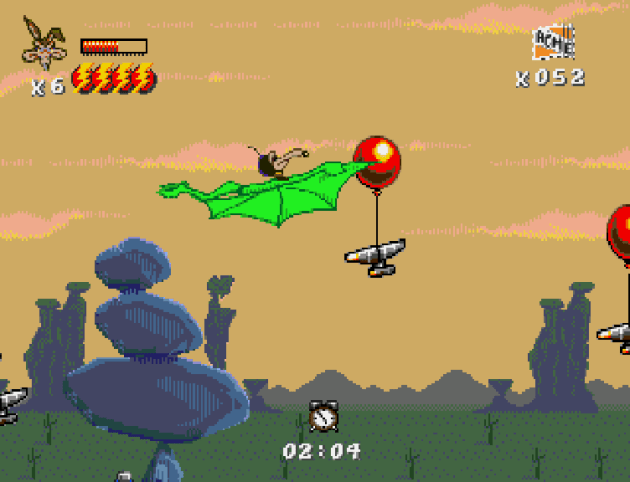
This takes a while to get the hang of.

Wile E. Coyote’s half of the game isn’t anywhere near as fun as the Road Runner’s. Even though you move much slower, I caught the Road Runner on the first level in literally under thirty seconds. You know, that thing the Coyote has been trying to do for three-quarters of a century now? Yea, I did it right off the bat. It’s not even how you win the game, and he respawns after a few seconds. You just have to get to the end. Touching the Road Runner just rewards you with extra stamps and time.

It completely deflated the experience. While the Road Runner’s segment NEVER feels like the cartoon series, the Coyote’s outright betrays it. The timer is basically the main challenge of the game. You have energy and take damage from everything, including jumping and hitting your head on low ceilings, but I never died from taking too much damage and Sasha only did once, during the final boss. But, we timed out several times on the Coyote stages. He doesn’t move anywhere near as fast as the Road Runner and he controls much stiffer. It speaks volumes to the can-do spirit of this game that it actually is still a little bit fun to play as the Coyote, who has a variety of ACME gimmicks at his disposal. A couple were quite clever, like this:

The tightrope helmet pulley, where you actually do have to balance back and forth while you slide down the rope. I’ve seen this type of thing in games before, but because you’re upside down, it’s never been done quite as immersive. And this is why being able to catch the Road Runner so easily especially hurts, because this type of thing totally fits the cartoon franchise. If not for the fact that they already completely ruined the connection, this would be the thing that puts it over-the-top as one of the best uses of a slapstick license ever, helped along by some of the funniest animation sprites in any 16-bit game. Seriously, the Coyote’s sprites are FANTASTIC! Genuinely laugh-out-loud hilarious. Even funnier is that I’ve never been impressed with Blue Sky Software. I think Vectorman is lame. I think the Genesis Little Mermaid game is incredibly boring. I can’t believe there’s Blue Sky fans, because I just don’t think they’re very good at making games. Remember, these guys were owned by Titus. F*cking Titus! They were a joke when *I* was a kid. They’re the Superman 64 people! Blues Brothers 2000! This is a bad lineage, but this game? Desert Demolition? It’s fan-f*cking-tastic! How come nobody talks about this one? It’s wonderful!
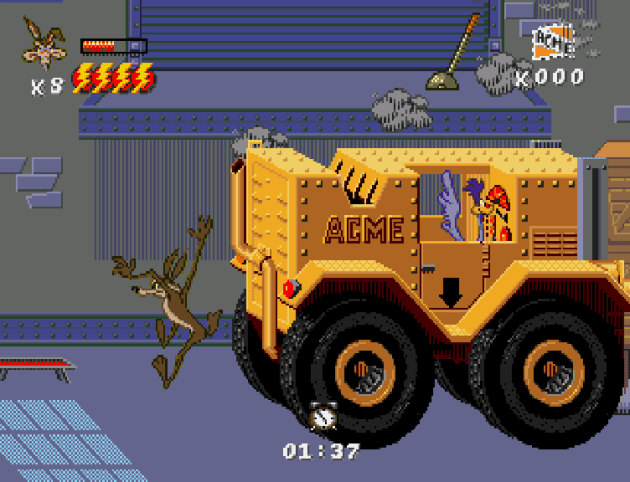
The final boss is the same in both versions. You have to just run back and forth activating levers that drop exploding barrels on this Acme truck that the opposite character is driving. This is an okay ending for the Road Runner’s quest, but the Coyote’s? It’s so lame. Why would the Road Runner need to drive what is, let’s face it, a monster truck? It makes no sense! I’m sure it would have been a massive pain in the ass to come up with two different boss fights, but they really should have.

I kind of get why Desert Demolition slipped through the cracks of time. Probably for the same reasons the Ronald McDonald game by Treasure on the Genesis did. It’s too short, too easy, and based on a children’s property even though the Genesis was marketed to an older demographic. Okay, fine. But, like the Ronald McDonald game, it’s proof that the Genesis really was a console for all ages. Especially with the Road Runner. In some ways, I like this even more than Sonic. There’s fewer GOTCHAs and the level layouts seem to be based around anticipating where players will jump blindly, because I think we landed nearly every “go for it” blind jump we took. We took enough of those that, statistically speaking, some ought to have failed, but if any failed spectacularly, I don’t remember it. So, either we got insanely lucky, or they did some serious studying of play testers. I’m going to assume neither myself nor Sasha were THAT lucky. That tells me that Blue Sky precisely accounted for where players would take those jumps and adjusted the level layout accordingly. That’s next-level thinking on a developer’s part. The extra effort that you don’t expect from a licensed game. Short as it is, I dare say Desert Demolition is one of the best games on the Sega Genesis. Give me twenty minutes of near-perfection over hours of great gameplay every day. Even coming close to perfect is so much rarer than great gaming.
Verdict: YES!
Back to the Future (NES Review)

Back to the Future
Platform: Nintendo Entertainment System
Released September, 1989
Designed (?) by Mark Morris
Developed by Beam Software
Published by LJN
NEVER BEEN RE-RELEASED

Angela is going into filmmaking and is the movie buff to end all movie buffs. She loves Back to the Future. She loves “movie magic” and special effects in general. But, besides, pinball, she’s not so much into gaming at all. However, I have a blast showing her these old video games and their, ahem, “interpretations” of films. My longtime followers will remember me reporting on her tantrum when she found out that E.T. for the Atari 2600 didn’t contain flying bicycles. Showing her this game, just the first level, she was baffled. “Is it…… Grease? They made a Grease game? Oh wait. HEY DAD, what’s that show with the Fonz? Happy Days? Is it Happy Days?” It wasn’t until I got to the map screen that said “Hill Valley” that her face turned red. “That’s Back to the Future? Are you kidding me? Wait, that’s the photograph of Marty and his siblings at the bottom? Why does he look like a greaser? Where’s the life jacket?” However, she was impressed that it had the Enchantment Under the Sea dance and Johnny B. Goode and getting to use the DeLorean.

Well, I did the Super Famicom quasi-sequel, so I figure I might as well do the game that I THINK is single-handedly the reason Super Back to the Future Part II gets the occasional praise. I think SBTTF2 is a horrible game, but compared to THIS? Yea, I can see people thinking they just played a masterpiece. Part of me wonders if the main gameplay was even meant to be a Back to the Future game or if they had a generic gameplay template that they just plugged in vague BTTF references. For most of the game, Back to the Future is an auto-scrolling avoider/shmup. You have to simply stay on the road, avoiding enemies and obstacles while picking up clocks. If you pick up a bowling ball.. yes, a bowling ball.. you get unlimited firepower to take out enemies. What any of this has to do with Back to the Future is beyond me.

They remembered to include the memorable scene with the bees, though. Who could ever forget that scene? The scene where Marty dies from bee stings and Lorraine starts screaming and crying at his funeral about how he’s not wearing his glasses. Oh wait, I’m thinking of My Girl. Okay, well I officially designate this the NES version of My Girl. Oh Jesus, f*cking end me.

Okay, so the degree of difficulty in turning a fantasy comedy that has minor action bits like Back to the Future into an on-trend NES game was high. There was one scene in the whole movie, and only one, that lent itself perfectly to video games. No, not the Delorean lightning scene.  He literally just drives a straight road, and nobody wants to play as Doc. No, I’m talking about the scene where Biff tries to run down Marty with his car. I love car chases. They are my absolute favorite movie trope, bar none. But, that scene is not in the NES game, because of course it’s not. How is it that these licensed games constantly forget to put the one part of the property that feels like it’s in the movie/TV show FOR the video games into the video games? Krull did it. Rollergames did it twice. E.T. did it. BUT, in the case of Back to the Future, it kind of feels like the street scenes were meant to be the car chase, and they just forgot to include the car part. The problem with road sections is they’re so damn boring, but the game keeps going back to them. They don’t play badly or anything, but it’s a boring design that doesn’t feel like it connects to the property. It feels like an immediate rug-pull.

And this is where the game falls apart for good.

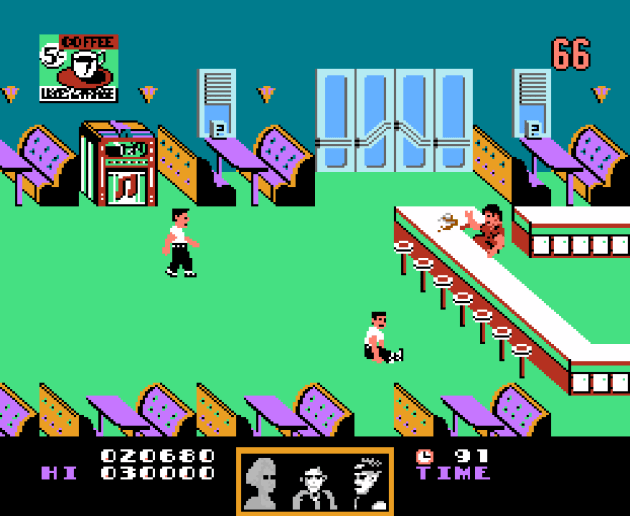
There’s four other gameplay styles, though. In the first, you have to throw mugs at bullies as they enter a cafe. This scene goes on FOREVER. Like, seriously, if this had actually been in the movie, Marty would still have been throwing mugs at bullies while George watched with binoculars from a safe distance as a drunken Biff approached Lorraine to um.. well, yea. Marty then would have blinked out of existence, meaning he never went back in time to push George out of the way of a car and we’d have a major paradox. What I’m saying is this level is so bad it could end the universe. The same engine is then recycled for the next break from the road levels, only this time you have to shield yourself from your mother’s affection as she fires a continuous stream of hearts. If just one heart gets past you.. uh, what? Take me down this road. What’s the consequence? Look at it this way, Marty: it’ll make for an interesting bar story some day.

The stated object of this level is “break Lorraine’s heart.” I mean, seems a little late. I just always assumed the mom got freaky with him after he got hit by the car. She’s insatiable, and besides it was the 1950s. Ideas like consent were still purely hypothetical. Could have made for an interesting sequel. “Marty, you have a long lost older brother named Mortimer. You see, your mom.. uh.. had her way with this guy named Calvin Klein while he was unconscious and she ended up pregnant.” “Whoa, this is heavy!” “Yes, and so was your mom when she was 17. For about nine months, at least. Weirdly, he wasn’t named after his father. Actually, you were, Marty. Also, I just realized you’re a dead ringer for him, too. Hey, wait a second.. oh, oh that whore! LORRAINE!! IS THERE SOMETHING YOU WANT TO TELL ME?” I’m probably going to get in trouble for this review.

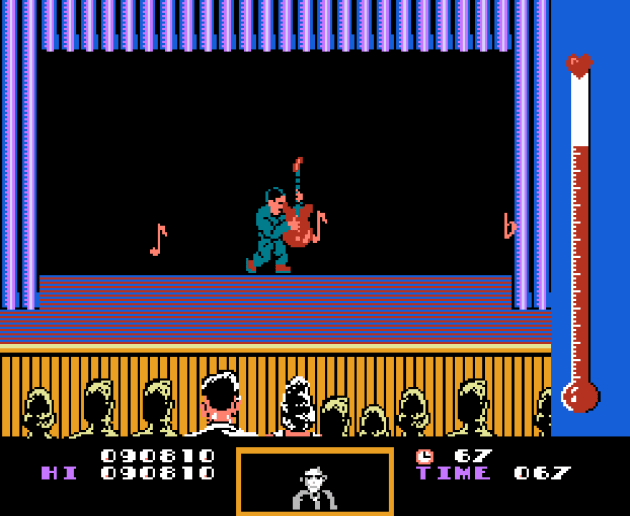
The worst of the levels is the Johnny B. Goode scene, where you hold a guitar up and down to catch music notes. The difficulty spike of this section is pretty bonkers. During my play session with Back to the Future, I only died once on any of the road scenes. They’re fairly easy to clock and, once you have the bowling ball, it’s not really THAT hard to avoid touching enemies. But, I wouldn’t have passed the guitar segment (or the cafe scene, for that matter) without cheating. The notes just come flying in too quickly, and the amount of memorization required was too much for me to handle. Thank God for save states. By the way, I had a giggle when I realized using save states alone made this more of a Back to the Future experience than any of the gameplay did.

It’s basically an LCD game at this point. Like, seriously it’s not that hard to imagine that if Tiger Electronics did Back to the Future, it would look something like this six-channel spinning plate mini-game.

Finally, you have to avoid lightning strikes (and the ground they’ve touched) and get the DeLorean up to 88 mph. There’s no sense of speed and the road is too narrow for all the lightning strikes that happen, but at least they worked the DeLorean into the game. That’s what’s astonishing about NES Back to the Future. The core gameplay could be any property BUT Back to the Future. It doesn’t look like Marty McFly and it doesn’t look like 1955. It is what it is. BUT, they did include major scenes from the film. They all suck, but they’re there. I go back to how high the degree of difficulty was to make a logical video game out of Back to the Future. Not every great movie lends itself to video games. Or, as Angela put it best: there’s a reason why there isn’t a Citizen Kane video game.

It’s an ugly game, too. Even by the standards of 1989. Remember, this came out nearly a full year AFTER Super Mario Bros. 3 was released in Japan. I don’t expect a four-man crew to be able to pull off that kind of look. But, this is one of the lower-tier games in raw appearance. Part of the reason the game plays boring is it looks boring.

Back to the Future is yet another throwback to the Atari era, only on the NES. But, that by itself doesn’t mean the game is fated to be bad. Another LJN game based on a famous Universal Studios film, Jaws, was actually not a bad little game at all. If you actually sit and watch Jaws, it doesn’t lend itself well to video games either. So, it can be done if you focus on one gameplay style and optimize it. The skateboarding angle was probably the right way to go, and they just needed better level design and better set-dressing to make it feel more like the movie. When you play that Jaws game, you really do walk away feeling like it couldn’t have been anything BUT Jaws. Even with scenes lifted directly from the movie, Back to the Future relies too heavily on the road stages that come across like Template #048D-59, with minimum alterations. A plug-and-play engine that was never fun to begin with, only with the name “BACK TO THE FUTURE” slapped on it. Do I think this is among the worst NES games? Probably not, but I also understand how it earned that reputation. There’s a ROM hack that changes the graphics around to make it look more like the movie.

Well, slightly more like the movie.

Nope, doesn’t help. Which is strange, because the road levels control relatively well and never come across as unfair. They offer the right type of challenge. The mini-games that buffer them are all awful, but the core gameplay isn’t broken or anything. Few games on the NES play as well as Back to the Future and still have a scathing reputation that’s so well-earned. Because, plain and simple, Back to the Future on the NES is BORING! It’s certainly not what I or anyone else would want from Back to the Future anyway. Really, during this era, a point and click game similar to Shadowgate would have made a LOT more sense. Or, not making a game based on it at all. It’s not exactly the Terminator or Escape From New York. Do you know why there’s no good Back to the Future games? Because a Back to the Future video game is a dumb idea, period.
Verdict: NO!

Just tell her that she’s going to be in Howard the Duck.

Super Back to the Future Part II (Super Famicom Review)

Super Back to the Future Part II
Platform: Super Famicom
Released July 23, 1993
Developed by Daft
Published by Toshiba EMI
Never Released Outside of Japan
NEVER BEEN RE-RELEASED
Link to English Translation Patch

19 levels of suffering to see Biff get covered in poo. Worth it. Not.

What is the only good Back to the Future game? That’s a trick question. There is no good Back to the Future game. Not the Telltale game, which is just lazily written fan fiction given a budget, and not this Japanese-exclusive platformer that gained fame through an Angry Video Game Nerd episode that declared it “a good Back to the Future game.” It’s really not good. It’s not even okay. This is a terrible game that only kind of feels passable in comparison to the Back to the Future games that came before it. It also isn’t trying to be ambitious. It’s a simple Point-A to Point-B platformer. No puzzles to solve. No time travel follies to undo. Just “get to the end of the level” gameplay, with the only twist being this is essentially a skateboarding game. Well, in theory, but the designers didn’t make a game tailored to skateboarding. Instead, they made a game that controls like if Sonic The Hedgehog handled like a shopping cart.

Sonic really is the closest cousin to this, since they were clearly aiming for a sense of speed and jumping that requires momentum. That’s why the frequent slowdown is especially face-palming. This would have been better suited for the Sega Genesis.

Super Back to the Future II is one of the worst controlling platform games I’ve reviewed. Building on the Sonic comparison, imagine if Sonic was heavier. Sonic The Plump Hedgehog. Now, imagine playing through Sonic 1 or 2 if the character built up speed slower and lost momentum faster. That’s what this game is like. Whoa, this is heavy, Doc. And that doesn’t even scratch the surface of the problem. Sonic worked because the levels were tailored around the sense of speed and momentum, but Super Back to the Future II’s levels aren’t. Actually, they often feel like generic, arbitrary platform stages. It’s so bad that, at one point late in the game when there was a series of platforms with architecture built around the hoverboard, I nearly fell out of my chair. “Hey look! They remembered what game they were making!” The fact that it stood out that much was one of the most damning things I’ve ever experienced in any game.

“Oh my God, skateboard ramps! In a skateboarding game!”

For the most part, the levels are designed around precision jumping, but then you get into the contradictory controls. Jumping is heavy, but basic movement is loose. So when you need to just turn around a little bit to jump, you move too far. If you’re on a small platform, you might fall off it. BUT, if you don’t, you might not have enough momentum to make the next jump anyway. SBTTF2 does this constantly. Most of the game’s challenge is based around platform placement that isn’t optimized for the physics. Any remaining challenge is based around trollish enemy placement and poor collision detection. The combat is standard hop ‘n bop gameplay. There’s no attack button, so all attacks must be done by leaping onto enemies. But, collision isn’t 1-to-1 with the sprites, and because the enemies and Marty are exaggerated to the degree they are, sometimes you take damage from a jump that should work. There’s also an overemphasis on spikes and disappearing platforms that go against the whole idea of running and jumping as fast as you can through the levels. The sprite work is great, but if it results in bad combat, it’s hard to consider it a net-positive.

The best thing I can say about SBTTF2 is it has one of the longest “blinks” in gaming history. You seriously get around five seconds of invincibility after taking damage, which often allowed me to circumvent large sections of levels. This also allowed me to accept damage against bosses in exchange for getting two or three free shots in. They weren’t fun to battle straight-up, so I was at least grateful the option to cheese ’em was so easy.

While the game tries to have set pieces that match the movie, they’re just not fun levels and there’s nothing that changes up the gameplay. There’s no event stages. You never drop the hoverboard. It’s boring. You can tell that most of the energy went into making this look great in screenshots, because the bosses look fantastic. Excellent character models, truly. But the bosses play no better than the main game. First off, a few of the fights started with the bosses going instantly into their damage animation, even blinking. I’ve never seen that before. It happens because there’s usually methods to cause environmental damage to the bosses. Sometimes there’s switches in the arena, and pressing them causes something to happen that can hit the boss. Okay, that’s different and kind of neat. Except, you can also damage the bosses by jumping on them. I wonder if this was a band-aid. The relatively large bosses are fought in cramped arenas, and their collision detection is especially unforgiving. I wonder if being able to damage them via jumps was added because their elaborate plans to use environmental factors to win battles (as befits Marty McFly) didn’t work without players dying from damage. Then again, you seem to instantly come back to life during boss battles, but ONLY during boss battles. Die during a level and you return to the start.

This slideshow requires JavaScript.

Super Back to the Future II is one of those cynical “made to look great on the back of a box” games that irks me. It feels like karmic justice that it never came out globally, but then it gained a reputation as being an underrated classic that American fans got shorted on. Even that rep didn’t last long after that AVGN episode aired, and there’s a reason for that. People found it, played it, and realized this is AWFUL. It’s Marty The Heavyweight Hedgehog, on the wrong platform, with terrible boss fights. I totally get the appeal in Japanese-exclusive games, especially when they’re based on American properties. I didn’t even grow up in the 8-bit/16-bit era and I get excited for them. Of course I do! I’m here to have fun and find hidden gems. This is the stuff I’m seeking out.

Behold: the one semi-clever bit in the entire game that works. Your jumping move is always spinning (again, Marty The Heavyweight Hedgehog) and works as soon as you press the button. In this section, soda cans rain down on you, and by doing the jump attack, you have to basically guide yourself up this tall shaft by hitting the cans on the way up. Great idea, but then they recycle it at other times in a way that doesn’t work because they chose to include spikes and/or enemies that fire projectiles along the pathway, which your spin attack does nothing against. Any game that turns its best idea into a negative is a truly putrid game, indeed. You hate to see it happen, but SBTTF2 does it multiple times.

This one hurts. I’ve never seen a licensed game that more people wanted to be better than it is than Super Back to the Future Part II. What a strange thing, right? A one-off, generic platform game based on the second film of a trilogy. But, it’s yet another reminder why so many of these weird Japanese licensed games exist. When you first find out about a title like Super Back to the Future Part II, it combines all the excitement of a lost treasure and a forbidden fruit. But, the genuinely good ones usually manage to find a cult following on their own and rise above the level of “historic curio.” That’s not the case with Super Back to the Future II. It has some fans, but every game has some fans. E.T. has fans. Like the Tokyo Disneyland Mickey Mouse game I did last month, this thing fell into obscurity for a reason. Or to put it another way, when Biff crashed his car, he was coated in copies of this game.
Verdict: NO!

(insert BOING noise)

The Adventures of Tom Sawyer (NES Review)

The Adventures of Tom Sawyer
Platform: Nintendo Entertainment System
Released February 6, 1989 (JP) August, 1989 (US)
Developed by Winkysoft
Published by SETA
NEVER BEEN RE-RELEASED

So much for “let he who is without sin cast the first stone” because this is a sin against gaming.

There are, in fact, two Tom Sawyer NES games, but I’m not reviewing the Japanese-exclusive RPG by Square, and not even because it has some seriously questionable content. It’s Tom Sawyer. “Seriously Questionable Content” is basically the novel’s 21st century title (and also makes for a great metal band name). I just don’t want to play a Japanese RPG. In fact, I only picked this platform game because I wanted a game I could knock out in under an hour that was bad in an uncomplicated way. And hey, for once I got what I wanted with that. The Adventures of Tom Sawyer is certainly not a good game. It has loose controls, unfair enemy placement, and some boring level design.

It’s so generic that it almost feels satirical.

To be honest, I’m not even sure what the point was in making a Tom Sawyer game in 1989. I know kids in my lifetime (which, granted, started in 1989) didn’t give two wet squirts about Tom Sawyer (and Huckleberry Finn was always cooler anyway), but did the generation before me care, either? I know there was a Disney movie with the kid from Home Improvement, but that was years later. I guess this exists because, for whatever reason, Tom Sawyer is popular in Japan. Who knew? But, this is as generic as a game gets. Well, with the exception of the river rafting sequence that makes up the entire second stage. It’s basically a shmup with jumping, and while the stage overstays its welcome by quite a margin, it’s also easily the highlight of the game. Well, except for how it handles jumping. When you jump, you can move around mid-air, except the raft doesn’t stay under you. I lost most of my lives on this part until I figured out to just not move mid-air at all. Otherwise, this feels like it could have been the whole game and it would have been much better off.

When you jump on the river rafting level, for god’s sake, don’t move after pressing the button until you land.

The rest of the Adventures of Tom Sawyer features boilerplate platforming gameplay from the era. You scroll. You jump. The hitch is that the game is more combat focused. You have an unlimited supply of rocks that you lob at enemies. Well, unless you pick up a slingshot, which I found to be mostly useless. Upon pick-up, your projectiles will travel straight across the screen for a limited time. Except, the enemies seem more tailored for the normal attack, so lining up to hit them is significantly harder with the item, and a couple bosses I’m pretty sure can’t be hit at all with it. Go figure. The combat is all the game has going for it. Besides that second level and a segment in the cloud section of the game where you ride the world’s worst controlling cloud, the level design couldn’t be more phoned-in. Not that I think it would be better if it changed-up the formula more. Your sprite barely “binds” to ladders when you start to climb them and falling off the sides is too easy. There’s some very mild climbing sections, but otherwise you just scroll and engage enemies, some of which spawn literally right on your sprite. Like this part:

I fully admit, I used rewind in this section.

I died the very instant a fish appeared on the screen multiple times while climbing up this waterfall. Now that’s the last level of the game, so maybe they felt the pressure to increase the difficulty in order to feel more climatic. But the actual result is this GOTCHA! crap forces players to heel-toe their way up the waterfall to “tempt” the enemies into spawning away from you. It totally ruins what should be Adventures of Tom Sawyer’s grand finale. This is level design 101 type of stuff and it shouldn’t be that hard to grasp why that type of design mentality is a terrible idea. Then again, by the third level of the game, I was already so bored with the combat that I was ignoring enemies and legging it for the finish. Maybe their play testers were too. Maybe that’s why the home stretch before the last boss does that. Wouldn’t surprise me, especially since most of the development energy seems to have been put into the boss fights, all of which feature gigantic sprites.

This slideshow requires JavaScript.

They look great, but in terms of gameplay, they’re not that they’re much better. Both the first and last bosses only managed to fire off one single attack before I won. The fourth boss was a total slog that continuously summons demons you have to jump up for your rock to reach, and only when it’s lower to the ground too. The more interesting boss was a multi-tiered battle with a blimp that felt more like a shmup boss if, instead of a spaceship, you were piloting a shopping cart with a broken wheel. Please note that I didn’t say “good” but interesting. Then the game ends with Injun Joe riding the Loch Ness Monster, because at this point, f*ck it, why not? I just played through Tom Sawyer twice and my brain is already hard at work deleting my memory of it. There’s really nothing to it, and while it’s not putrid by any means, it also really doesn’t feel like it’s trying to stand out in any way. Paint by numbers levels (and a single last-pixel jump before the final boss), easy bosses, overrated graphics (it’s not ugly, but it’s not THAT amazing looking), loose controls, and even forgettable chiptunes. What was the point of this? Is there such a thing as anti-ambition? If there is, I think the Adventures of Tom Sawyer has it.
Verdict: NO!

“Oh my God! It wasn’t a dream! I performed a hate crime!”

LCD Games XI: The Quest for the Crystal of Liquid Displayfulness

Haven’t done one of these since Christmas of 2023. We’re overdue, and since Super Mario Wonder is taking me forever and I’ve also been binge-playing our AtGames Legends Pinball with Sasha the Kid and the rest of my family, I’ve not been posting enough updates to IGC. When in doubt, LCD games to the rescue. So, for the first time since 2023, here’s some LCD games of the 1980s and beyond. From here on, LCD features will include six games per feature. All of these are done by Itizso. If you have any mint condition LCDs laying around that haven’t ever been translated like this, you should hook him up and preserve them FOR EVERYONE. Trust me, the nostalgia for these is off the charts. My LCD features are among the most read here. Even after taking a year off LCDs, I’m still “that girl who reviews LCD games.” I had someone tell me “you should do another spin-off. The LCD Chick!” Yea right. I need LCDs for THIS site. They’re the best pinch hitters I got! Make sure to check out my retro review index for a full list.

Go play some LCDs. Retrofab has tons, and even more coming!

But, when you look at all the LCDs that have ever been made, even with as many as I’ve done, I’ve not come remotely close to scratching the surface of this genre of games. I’ve taken atoms off the surface at best. There’s tons of LCDs I’d love to do. There’s an Attack From Mars LCD! Are you kidding me? It’s pretty rare too, so rare most databases for LCDs don’t list it. The Handheld Museum doesn’t. This one doesn’t either. That should be f’n alarming. As much as it makes Nintendo furious, I think it’s nothing short of miraculous that ROMs for every classic game console, complete libraries, are readily available. I see zero evidence it affects sales of classic games or even the second hand market. But, with LCDs, 99.9999% of them will never be in compilations. Digital Eclipse will never do a Gold Master Series release on them. When they’re gone, they are GONE, and only a handful have been preserved by translating them into digital form like the ones reviewed in these features. If you happen to own LCDs that you cherish? They’re rotting. There is nothing you can do about it. The plastic will last essentially forever, but the game stored inside it will last about as long as your average human being, give or take. The majority of video games are preserved forever. The majority of LCDs are in danger of being lost for all time. If that doesn’t make you sick, I don’t know why you even clicked this feature. So, donate your LCDs to wizards like Itizso, which is basically giving them to the entire world.

Anyway, on with the feature. And yea, two of these I’ve already posted in my daily updates that I abandoned. Whoever guessed those would last a month wins a smack in the face for being right.

SPLATTERHOUSE!!
Varie/Namco (1988)
Gameplay Type: Cross-the-Road/Combative

This slideshow requires JavaScript.

I just reviewed the arcade classic Splatterhouse and its not so good Sega Genesis sequel as part of Kung-Fu Master: The Definitive Review (it makes sense, trust me). So, why not start my first LCD feature in fourteen months with the handheld version many (including myself) didn’t even realized existed? Well, it’s not famous for a reason. I don’t know if Itizso’s port plays right or not, but without exaggeration, this was easily the fastest game over I ever suffered on an LCD in my life. If it was even two seconds, I’d be surprised, and the next several games didn’t play out much better. Even after ten or so games, I spent more time listening to the intolerable opening chiptune than I did actually playing Splatterhouse. To help you visualize this, here’s what that was like in game review form. The object is to catch DEAD. The Object is DEAD. The DEAD GAME OVER. Want to try again? The object is to catch laddDEAD. ThDEAD are you f*cking kidding me on that one? The object is to catch the ladders in order to DEAD GAME OVER. Excuse me, I’m going to go have a cry now.

Seriously, that’s what it’s like when you first start. There’s no grace period for enemies, and the knives that come in from the bottom left of the screen basically spawn on the same space you occupy, meaning some double kills are inevitable. The object is, in fact, to jump up and catch ladders so that you can zig-zag three stories and fight a boss to rescue your girl. The combat and safe zones are NOT intuitive, and it takes a lot of practice to figure out the timing. It doesn’t feel even a little like Splatterhouse and actually would make for a better Donkey Kong game, but after an infuriating start, I admit, there’s SOMETHING here. It took me a long time to get the timing down for the enemies, and I’m still not comfortable describing how to beat the boss. Basically.. stand back and don’t attack when he does, I guess. I can’t say I had a good time because it’s a busy game with tiny enemies, quick deaths, and one of the most ridiculous jump animations I’ve seen, but it wouldn’t take much fine-tuning to make this worthwhile.
Verdict: NO!

BURGERTIME!!
Bandai (1982)
Gameplay Type: Cross-the-Road

On the most basic level, this plays like Burgertime. Preschool Burgertime that completely misses the point of the genre, but Burgertime nonetheless. You shimmy up and down ladders and knock exactly two patties and four buns to the bottom of the screen, and then you do it over and over again. There’s one enemy patrolling every floor that you can pepper when they’re next to you. After one level, a little bar warps around and might temporarily block a ladder. At first, I wondered how this could feel like a maze chase since there’s no maze. The answer is “they didn’t even try to replicate that.” Instead, you basically play Red Light-Green Light with the enemies and wait for them to waddle away from the burger parts. Well, unless you kill them, and you might as well do that. Unlike the coin-op, you get all your peppers back between stages. If you can’t even wait that long, you get refills from ice cream and coffee mugs that appear on the first and second floors. So unless you screw up the timing of when to use the pepper, this is just too easy. I don’t even know why they bothered releasing this if this was the best approximation they could do of Burgertime. Um.. seriously? Two channels? TWO? Wouldn’t it have made more sense to turn the screen on its side so the playfield could be bigger?
Verdict: NO!

WESTERN BAR!!
Casio (1984)
Gameplay Type: Shooting Gallery/Quick Draw

How many games have you play as an alcoholic sheriff who gets ashtrays thrown at them? At least one! And actually, Western Bar is one of the better shooting galleries I’ve played in this format. You can tell the designers took a long, hard look at the Game & Watch franchise, because this is very Nintendo-like, and I mean that in the best way. Levels are divided into two parts. In the first, you have to shoot targets that pass from the right of the screen to the left while dodging objects thrown by two patrons. From the second cycle onward, sticks of dynamite are thrown from the left of the screen that you do NOT want to shoot (when are you ever going to learn to read the instructions, Cathy?). From the third cycle onward, the bartender will catch the sticks and toss them onto the playfield, and you have to walk next to them to dump your whiskey out on the fuse. I spent far too much time on Google trying to find out if that would actually work or just blow you up faster. I never got a clear answer. Either way, the second part is a quick draw match against an outlaw. You hide behind a table. He hides behind the left of the counter, and when he pops out to shoot, all you have to do is press the fire button. But, he’s capable of faking his move, so make sure not to draw until he’s actually in his shooting cel. Western Bar is a busy game (you’ll want this on full screen) but it’s genuinely a lot of fun and one of the best LCDs I’ve played that isn’t from Nintendo.
Verdict: YES!

WESTERN SHERIFF!!
Casio (1987)
Gameplay Type: Shooting Gallery

It even looks boring.

I had high hopes for this pseudo-sequel to the previous game, but Western Sheriff has none of the intense gameplay or charm of Western Bar. You gallop automatically on a horse and when bandits pop out, you shoot them. As you ride, if you hit a barrel, your horse loses 3 out of its 10 energy points, but they can be refilled with carrots. There’s tons of carrots. Far more than enemies, actually. From the second cycle onward, enemies throw dynamite from houses that have to be avoided. So, a fairly generic, mundane LCD experience, but there is one novel twist. Despite only having left and right directions, your gun can aim in multiple different channels. So, for example, if you move left, your gun will remain pointed the same way, but then moving left a second time will adjust your gun, then moving left again will move to the next space. So, that’s interesting, I suppose. But Western Sheriff is a total slog to play. If you want a good multichannel gunslinger, Konami’s Lone Ranger is so much better. and it’s on Retrofab.
Verdict: NO!

BEAUTY SHOP!!
Bandai Electronics (1981)
Gameplay Type: Spinning Plate

This slideshow requires JavaScript.

Well, this is a different theme, at least. In Beauty Shop, you have to cut and shampoo hair. While there’s only three spinning plate channels, there’s seven movement “stations” in the game. Two of them are essential towards maintaining the spinning of the plates, while two of them can score optional bonus points: a tea tray on the left of the screen and a cash register on the right. These both blink in and out of existence rapidly, though you can actually get a rhythm for when they will appear. The sheer amount of movement for a three channel game is staggering, and this is further compounded by the fact that the customers won’t always get up as soon as you perform the action. They could require multiple button presses to satisfy. The game wisely created indicators to let you know which of the three is the one about to cost you a miss. The customers raise their hands, then get “steamed” if they wait too long. Beauty Shop is a shockingly intense game, but a flawed one. I feel that I only lost after 3,000 points because I kept making plays for the cash register and tea tray. Had I ignored them completely, I really think it’d be easy to just maintain the plates indefinitely. The two bonus channels don’t really score enough to justify their risk. I hate it when LCDs do that. Beauty Shop does a better job than most at the genre, but the risk/reward balance is completely wrong.
Verdict: NO!

CUPHEAD!!
“Homebrew” by Itizso
Gameplay Type: Spinning Plate

This slideshow requires JavaScript.

Cuphead is an original creation by recreation master Itizso. While it’s a typical six-channel spinning plate game disguised as a gallery shooter, there’s a big twist to this one: you’re not scoring points. Instead, you’re just trying to survive for as long as you can, with scoring measured in minutes and seconds. Unfortunately, there’s no auto-fire here. You actually do have to mash the shooting button. This isn’t a game I could put extended playtime into without annihilating my hands. I suppose the question is “does it feel like Cuphead?” And the answer is “not even a little bit.” The pea shooter’s noise, that now apparently iconic clicking sound, is here for the LCD, but otherwise, nah. I think most fans of the franchise would be disappointed that the LCD is themed more after one of the platforming segments instead of an encounter with one of the humongous, transforming bosses. But, while I don’t think this necessarily works as a Cuphead game, the addition of leaderboards makes this a one-off spinning plate experience that I enjoyed, in small doses.
Verdict: YES!

Where’s Waldo? (NES Review)

Where’s Waldo?
Platform: Nintendo Entertainment System

Released July, 1991 or September, 1991
Developed by Bethesda Softworks
Published by THQ
NEVER BEEN RE-RELEASED

Riiiiiiiiiight.

During Christmas at my house, we have a rule that everyone must get everyone else two specific gifts in addition to all the cool stuff we actually want. One must be something homemade (or as close to homemade as you can get) that’s “from the heart” and the other is everyone has to give everyone else a joke gift that’s usually a little kid’s toy. Angela, my adopted sister and the future Spielberg of her generation, is the absolute best at picking out the joke gifts, because the stuff she gets us is actually stuff we always end up playing around with. I got a Slinky this last Christmas, which my little deaf wiener dog Kunoichi absolutely despises and growls at even if it’s sitting still on my desk. I’ve walked into my bedroom more than once to see her up on my bed and snarling at it because she can see the Slinky being used as a paperweight. We assume she thinks it’s a skeleton of her breed. So that’s fun and kind of insane. But it was the year before that where Angela gave me one of the best “joke” gifts ever: a complete box set of all seven main-series Where’s Waldo books called “The Ultimate Waldo Watcher Collection.”

Genuinely a ton of fun and I recommend it to everyone of all ages.

Everyone laughed when I opened it. They weren’t laughing soon, though. No, we were all gathered around, calling out when we found each thing. “Found the scroll!” “Found the wizard!” “Found the camera!” And the best thing is, if you owned the original version of the books, they moved the locations of Waldo around AND added the Wizard, Odlaw, Woof, Wanda, and tons of other stuff to find. It’s for sure a top-10 all time Christmas present. I got it for Christmas of 2023 and didn’t finish the whole thing until around Thanksgiving of 2024. We didn’t mark the pages either, so after it was finished I gave it to my nieces and nephew and they enjoyed it. So, I’m a big Waldo fan, and in my authority as a fan, ARE YOU F*CKING KIDDING ME?

What the f*ck is that sh*t? Now a Waldo video game where Waldo’s location changes from game to game isn’t the worst idea, but if this is the best the tech can do, you need to apologize and get your money for the license back. This is embarrassing. Can YOU spot Waldo in the above picture?

HE’S NOT EVEN WEARING RED!! Apparently that’s a twist they added to NORMAL/HARD for difficulty.

Jeez louise. Now fine, it’s the NES so it’s not like the elaborate pictures of the books could be recreated here. Hell, it can’t even recreate the two early books where the pages weren’t completely spammed with characters like the later books tended to do. But those books weren’t just about finding one guy dressed in stripes. Even if you ignore the other four characters, Waldo books have other things to look for and tons of skits and sight gags to admire. When you finished the book, there was even a checklist of more things to find involving those gags. They had genuinely funny bits and memorable character design. Waldo isn’t about Waldo. He’s a means to an end. The chucklef*cks who made this game didn’t understand that at all.

Uh, no.

And it is only Waldo you have to find. No books. No cameras. Now granted, I don’t even think Whitebeard, Odlaw, or even Woof had been invented yet when this came out. But, there were always more things to find than just Waldo, but for the five total “find Waldo” screens it’s really just him, and they’re awful. Waldo often doesn’t look like Waldo, and there’s no humor or personality or gags to be seen. Just these “find Waldo” screens alone would have made this one of the worst NES games I’ve ever played, but then you get to the grasping-for-straws mini-games and that’s the point when it becomes clear they had no passion or drive to make a quality game at all and simply did not care. In the cave, you have to just move around at random until you see Waldo moving, then click him.

In the Subway, you have to change the direction of these different octagonal pathways and find both Waldo and his glasses. While you do this, at least on NORMAL and HARD difficulties, a wizard jumps around to the empty spaces. BUT, instead of being limited to jumping on only a space next to him, the wizard can teleport from anywhere across the playfield directly on top of you. Sharing a space with the wizard quickly drains the time you have remaining, and because his only rule is that he doesn’t go on the playfield edges, there really is no way to plan to avoid him. Are you serious? Hell, you can’t even time it, because the intervals of when the wizard jumps aren’t fixed. More than once I waited for him to move before moving spaces only to have him immediately teleport to that space. So there’s no excitement to the chase because it’s not actually a chase. It would be like if the ghost monsters could randomly teleport on top of Pac-Man. I’ve never seen the likes of that level of thoughtlessness. How stupid can game design get?

And then there’s the grand finale. Is it one of the “find Waldo” segments that’s really the only reason anyone would want a game like this in the first place? OF COURSE NOT! It’s a slot machine! Yes, really! With all the time you have remaining, you have to time the three reels so that each one comes up Waldo.

Total time to beat the game: probably around five minutes.

I’m actually really angry about Where’s Waldo because kids in the know weren’t this game’s target audience: their clueless parents were. Where’s Waldo was released in 1991, at the height of the books’ popularity. It’s not hard to imagine a well-meaning parent who knows their kid loves the Waldo books buying this for them, and it’s so unlikable and lazy. There’s only five “find Waldo” screens total, along with the above mentioned “mini-games.” Five whole levels that give players the type of Waldo they’d actually want. Shameful. It’s not like this was the best they could do at those, either. The cursor only has one speed, and that’s full steam ahead. Just aiming the cursor at Waldo when you find him is an act of frustration. But the fact that they ended the game on a slot machine instead of a puzzle or anything remotely related to Waldo was the final straw for me. This really is the worst NES game, and a legit contender for worst video game ever made. For all the crap E.T. for the Atari 2600 gets, at least that feels like the developer had the best of intentions. Not this. Where’s Waldo is right up there with Defenders of Dynatron City and Action 52 in the heartless cash-grab hall of shame.
Verdict: NO!

Christ, this is a franchise.

Castlevania: Circle of the Moon (Review)
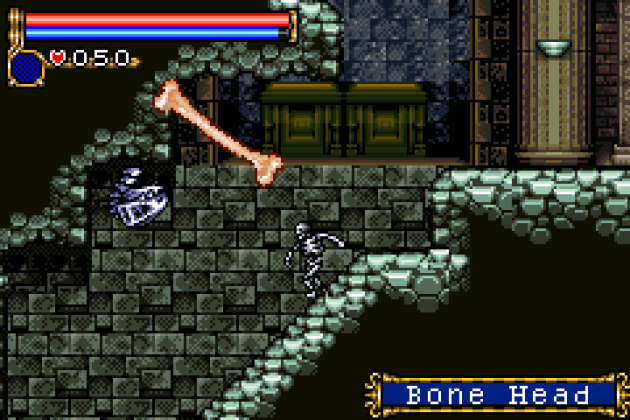
Castlevania: Circle of the Moon
Platform: Game Boy Advance
Released March 21, 2001 (JP) June 11, 2001 (US)
Designed by Koji Horie
Developed by Konami
Included in Castlevania Advance Collection

Bats are basically just sacks of blood, apparently.

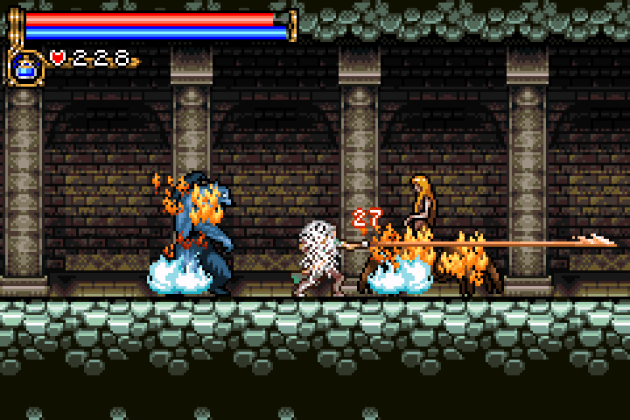
I got Circle of the Moon on the day the Game Boy Advance launched in North America. Oh, I didn’t play it then. Did you ever watch the White Walker battle in the final season of Game of Thrones? Probably not, even if the TV was tuned into it, because you couldn’t see a damned thing. Castlevania: Circle of the Moon was kind of like that when it launched. Even after my father installed one of those aftermarket, warranty-voiding light kits to my GBA, visibility wasn’t very good and I still didn’t play it. Actually, because the Game Boy Advance screen was so impossible to see, I didn’t play a lot of GBA at all until the SP and the Game Boy Player (for my younger readers, this was a device that let you play Game Boy Advance titles on the TV via a GameCube) came out in 2003, both of which came with the novelty of being able to see the games you bought. Well, the Game Boy Player did. The original SP was front lit, because Nintendo never admits to mistakes until they’ve exhausted all other possibilities. But, for me at least, the killer app of the Game Boy Player was Circle of the Moon. In fact, I binged the three Castlevania GBA games back-to-back-to-back. And it was a couple of the happiest weeks of what would be a very crappy year for me. So, I cherish the Castlevania GBA trilogy. But, did they age well?
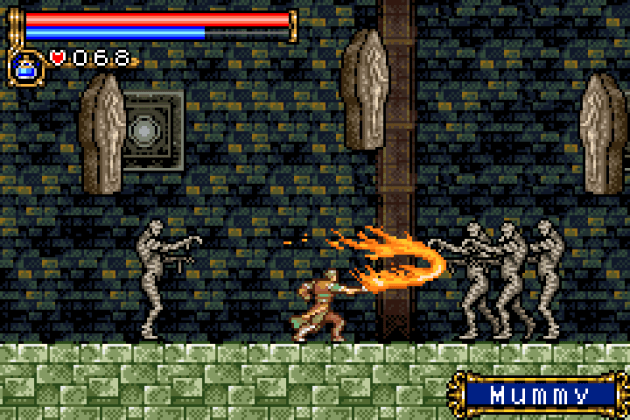
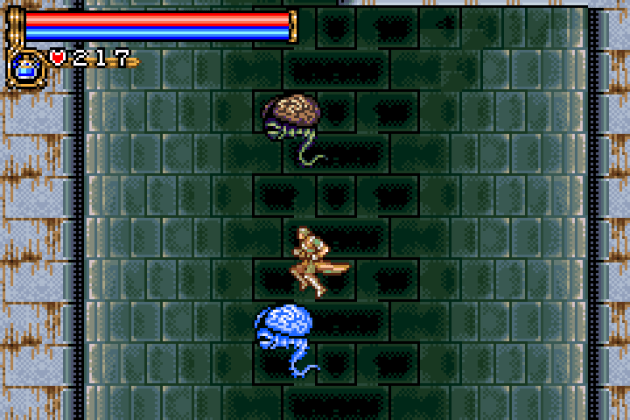
Find the right enemies and grinding can go so quick that it’s kind of shocking. Does it still count as “grinding” if you can get a couple levels in under five minutes?

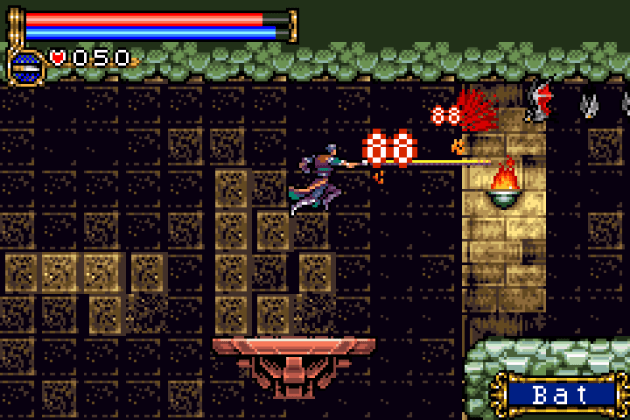
As the second “Metroidvania” game in the series and the first since the legendary Symphony of the Night, Circle of the Moon had a LOT to live up to. Circle of the Moon doesn’t attempt to be quite as RPG-like as that game. Actually, it’s more like a noncommittal hybrid of a traditional Castlevania game and a Symphony of the Night-style adventure. While the actual map is massive and sprawling, your only primary weapon is the Vampire Killer whip. Apparently this is not THE whip of the Belmont clan and instead is called the “Hunter Whip” but who gives a f*ck? It’s the Vampire Killer, period, and there’s no permanent upgrades for it and no alternatives. Luckily, the whip is one of the most satisfying of any Castlevania whips, with plenty of OOMPH and a lot of magical spells to buff it and the standard assortment of Castlevania subweapons to complement it. The action is top-notch. Controls really well, too. This is one of those games that plays so well that it completely lives and dies on the merits of the design.

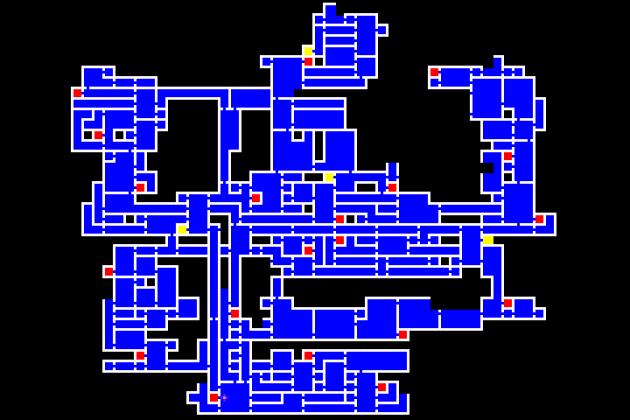
This was my map when I finished the game. Dracula is directly to the right of the first yellow block from the left. With his room filled in, this is a roughly 90% complete map, and I have no idea how many HP/MP/Heart boosts I missed along the way. I didn’t use a guide for them, and actually, I only used a guide for which enemies drop which weapons.

Instead of finding weapons, there’s only armor and accessories which are dropped by enemies. In fact, each individual enemy drops only two potential things, one common, the other rare. I’m not the biggest fan of this design because I hate having this type of thing come down to tracking down lottery tickets. Like, the second best armor in the game is dropped by an enemy that exists only in one specific room. Also, the base drop rate for this armor is 0.5%, and since there’s only one of these enemies in the entire game, if you don’t get it, you have to leave the room and come back and fight it again. Something about that is really inelegant to me, and for this game, I decided not to play along. Instead, I used save states to make some of the drops go quickly. Sometimes it made a big difference, but other times? I’m not at all encouraging you to watch this whole video, but even cheesing the game with save states, it could take quite a while for the item I was seeking to drop.

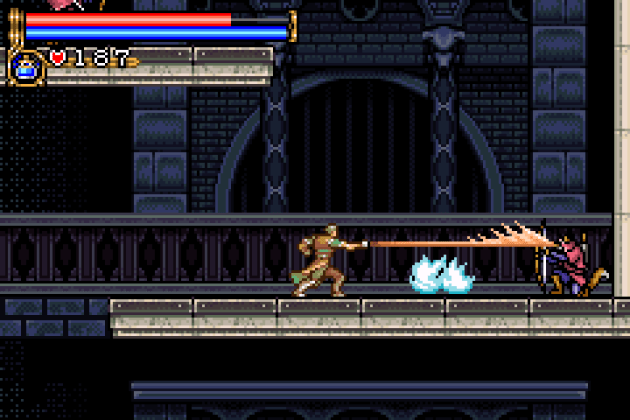
By the way, the dice seem to be rolled the moment the fatal shot is THROWN, not LANDED, so if you have a boomerang about to kill an enemy on the return trip, reloading the state won’t change whether or not the enemy drops something or not. Speaking of the Boomerangs, they’re pretty rare in this. I’d recommend holding onto them when you first get one because they’re seriously overpowered for all bosses.

Additionally, some enemies drop cards that allow you to cast spells. Unlike armor, card drops happen only once, but if you want to do THAT, logically the first kill against the target enemy should result in a drop. It doesn’t. Lame. There’s two tiers of cards that have to be combined. These mostly enhance your whip. For the most part, I only used two combos, one of which gave me a fire sword and one of which made my whip twice as long. I might switch to one that increased the damage I inflicted by 25% for bosses, but otherwise, I mostly stuck to those once I had them. The problem is the same as the accessories: they’re random drops from enemies. Every treasure that can be found (besides post-boss upgrades) are either upgrades to hit points, magic points, or max hearts you can carry. I didn’t start cheesing the game with emulation trickery until over halfway through the game. If the drop system had been remotely rewarding, I would never have done it. Random drops might be great for the surprise factor, but I can assure you, it gets old. I really think it would have been more satisfying to hide the big armor and accessories as treasures in the castle.

Mercury Card + Golem card ended up being, no joke, my favorite Castlevania whip ever. It reaches nearly half the screen and, although it comes at a cost of speed, it sure made backtracking a lot less painful.

So, this is awkward to say, but I found the RPG elements of Circle of the Moon to be some of the worst in a good game I’ve ever played. Too many enemies that are pushovers pay off too many experience points. Like this room here:

That “frozen shade” paid off so much that I was able to grind up about ten levels in under half-an-hour. It’s not up to players to use the honor system to protect the integrity of the game from lazy design. Designers are supposed to discourage that through challenge, right? Clearly that enemy was not something I was supposed to be fighting then and there. It had easy-to-dodge attacks and, with the fire sword spell and the star bracelets it dropped for me, I was wasting it in four or five hits, before it even fired at me. And since magic refills slowly (another bad choice, in my opinion) I didn’t have to hold back while fighting it. I have no idea how they determined some of these XP totals, but it makes Circle of the Moon one of the most exploitable RPG systems in the entire history of gaming.

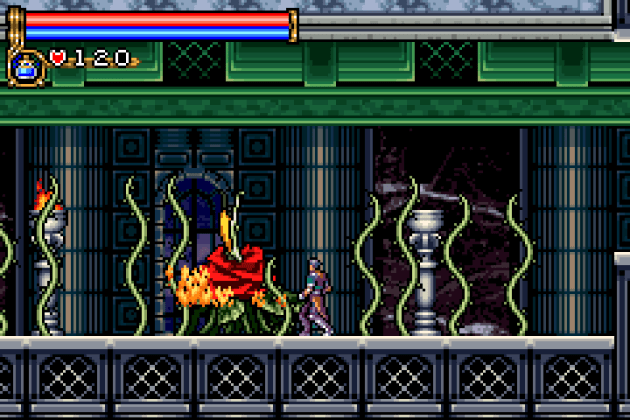
One neat thing that it does do is replace weak enemies with strong ones as you make progress, though it waits a little too long to do this, and it doesn’t implement it nearly enough. If you want to put such a heavy emphasis on backtracking, you need more of this. These enemies are at the start of the game, but they don’t show up until you’re nearly finished.

There’s just absolutely no sense of balance, and no balance means no risk/reward to calculate. This is where you have to give turn-based RPGs props. In those, if you encounter an enemy that pays off so huge that you can hypothetically grind out hours worth of leveling-up in under half-an-hour, a punch-for-punch battle would see you go tits-up, lights-out in probably the first attack the enemy got on you. Action games can be that way too, but if you don’t PERFECTLY distribute the enemies or accessories, at some point the opportunity to cheese the game will present itself. Circle of the Moon does that a few times. It’s really badly done in that regard.

Don’t get me wrong: finding the hidden stuff is f’n awesome. I cracked a smile every single time a wall broke.

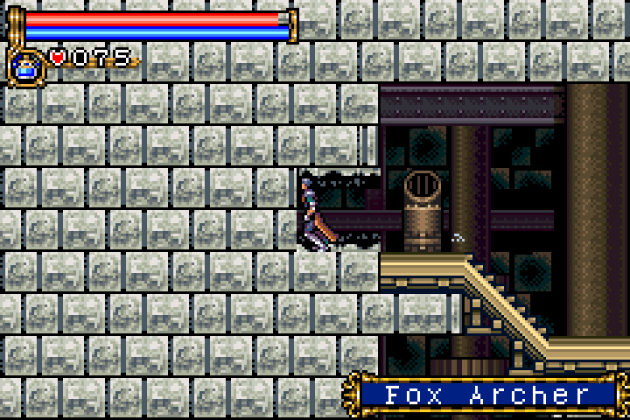
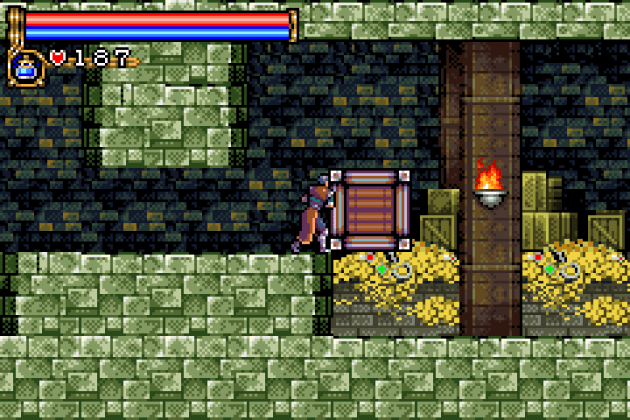
Now here’s the good news: the level design is mostly pretty good. There’s a ton of annoying backtracking and not nearly enough fast-travel tunnels. According to the game’s clock, it took me six-and-a-half hours to finish the Circle of the Moon, and I’d guess at least a third of that was spent making my way back to areas just to get one previously inaccessibly stat upgrade or find an enemy who dropped a card I missed. If the combat wasn’t so damn satisfying and the level design some of the best in this genre, I wouldn’t have been up for it. Yet, there’s a lot of really weird design choices that made me shake my head. Stuff that shattered my immersion that I was a badass vampire hunter exploring a castle. Like, this for example:

Are you kidding me?

One of the very last items you get from defeating a boss is the ability to shove boxes. Okay, that’s a time-honored staple of the genre. EXCEPT, one of the very first upgrades you get in Circle of the Moon is the ability to shatter stone blocks with a dash move. So, let me get this straight: Nathan Graves (hero of the game) masters the ability to shatter stone with his shoulder before he learns how to push a wooden crate out of the way? I had a spell that turned my whip into a goddamned flaming sword that, by all rights, should have set the box on fire, but I had to wait until the game was almost over to schlep a box? And by the way, they put a lot of those boxes throughout the “levels” of the game, so after getting this upgrade, if you want to boost your stats you have to spend about an hour just making your way to them so you can push them out of the way and pick up the boosts.

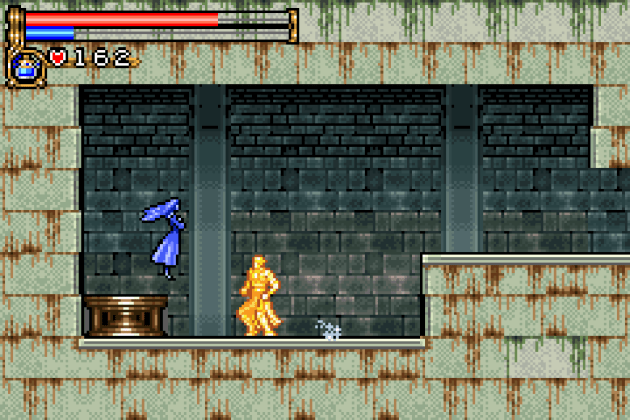
When the game is over, you get a series of passwords that allow you to replay the game in a different way, though the hero sprite is still Nathan. Thankfully, you don’t have to beat the game to get these, but honestly, they’re all really boring and feel like the type of challenges that pro gamers come up with to keep themselves amused. The Wizard (pictured here using a spell that turned me into a skeleton) is activated by putting FIREBALL as your name, which is also the name of Angela’s dog. Funny. The wizard is weak in everything except magic, and you start the game with every card so you basically have to magic your way through it. GRADIUS is the fighter, who can’t cast spells but his strength is insane. CROSSBOW is the “shooter” who has weak stats and has to use sub-weapons (including a new version of the dagger) that come at half the cost of hearts to use. This is one of the worst ways to ever play a Castlevania game. Finally, THIEF has weak stats but enemies drop stuff at a significantly higher rate. Sorry, no upside-down castle this time.

In terms of a pure action game, Circle of the Moon is clearly one of the most elite launch games in the history of the medium. It’s actually astonishing to think about: this was a day one Game Boy Advance game. I mean, pity about the vision thing, because the wide variety of enemies, settings, and huge boss fights make this legitimately a pretty good Castlevania adventure. While the RPG aspect is a complete airball in my opinion, the epic scale of the boss fights almost makes up for it by itself. This includes one of the best Grim Reaper fights of the 21st century, a memorable encounter with a gigantic minotaur that’s practically trapped in a pillory, and an even more gigantic two-headed dragon. Sadly, after several top-notch boss fights, the game ends with back-to-back AWFUL fights: the battle against Nathan’s rival, the insufferable Hugh Baldwin (who was originally going to be a playable character) and one of the most sloggish Dracula battles ever. Seriously, the final form of Dracula includes this dashing attack where he’s invulnerable and it’s just the worst. Castlevania: Circle of the Moon sticks the landing about as well as that pole vaulter who landed ass-first on the pole.

This slideshow requires JavaScript.

Okay, so Circle of the Moon wasn’t as good as I remembered it. Not even close. I can’t stress enough: this WAS the killer app for the Game Boy Player twenty-two years ago. It was the reason I wanted to own one in the first place, and I suspect I wasn’t alone in that. In 2003, at the age of thirteen/fourteen, it felt like it lived-up to my high expectations. But, it certainly didn’t hold-up perfectly two decades later. As great as the map is, it’s not an optimized map. More fast travel points would have been transformative of this game. Hell, just get rid of those and turn the save stations into fast travel points. Why not?

I’m a complete idiot, because it turned out I had the ability to do this much sooner and I just somehow skipped past that card.

Plus, the lack of balance really shows a roughness that I never noticed the first time. Like, the first time I played the game, I beat levels out-of-order because the way you clean the toxic water out of that level is so far away and disconnected from that area that I actually missed it back in 2003. I beat the toxic water level without ever cleaning the water. I just thought it was a really hard stage. That’s on the designers. Actually, knowing where to go next is not intuitive. The first time you play this, expect a LOT of aimless wandering. Thank god for the combat. Circle of the Moon is lucky that Castlevania’s core combat is so bulletproof that you can tack on a terrible RPG system and some haphazard Metroidvania progression and still have a good game. But I’ve been wrong for the last twenty years, because I thought Castlevania: Circle of the Moon was great. It’s pretty good, but nowhere near great.
Verdict: YES!

THE INDIE GAMER CHICK CASTLEVANIA REVIEW SERIES
 Castlevania (NES) Dracula’s Curse (NES) Adventure (GB) Belmont’s Revenge (GB)
Super Castlevania IV (SNES) Dracula X (SNES) Rondo of Blood (SuperCD²)
Chronicles (PSX) Circle of the Moon (GBA)  Kid Dracula (NES) Kid Dracula (GB)
ROM Hacks (NES)
Konami Wai Wai World (NES) Wai Wai World 2: SOS!! Parsley Jō (NES)

I’m now convinced Dracula has a plant fetish.

Mickey no Tokyo Disneyland Daibouken (Super Famicom Review)

Mickey no Tokyo Disneyland Daibouken
Platform: Super Famicom
Released December 16, 1994
Directed by Hirori Miyashita
Developed by Graphic Research
Published by Tomy
Never Released Outside of Japan
NEVER BEEN RE-RELEASED

This was pretty much the last time I was excited about the game’s primary mechanic. About, oh, a minute or two into the game.

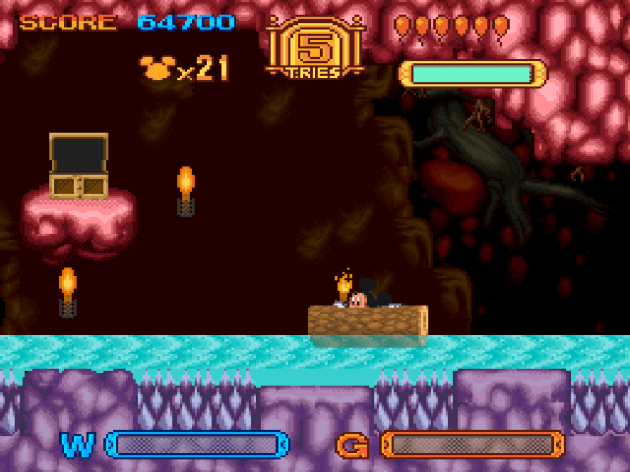
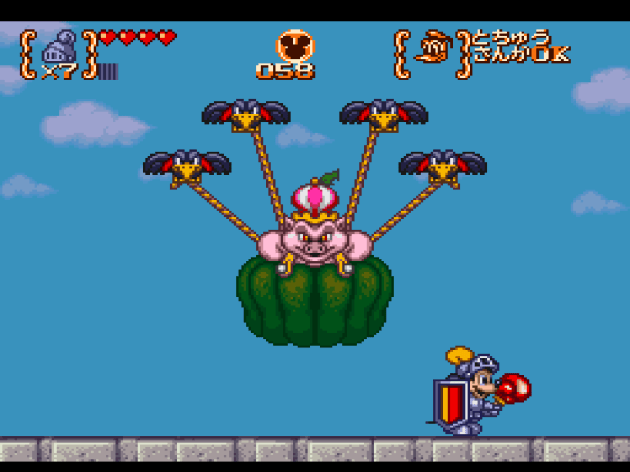
I think my biggest gaming pet peeve is games where the entire challenge is based around difficult controls. Well, that’s this game, which is translated to “Mickey’s Tokyo Disneyland Great Adventure.” Because market research told them “Potentially Fun Adventure Ruined by Awful Gameplay and Clunky Controls” wouldn’t sell as well. I’m so disappointed because this is basically what I wanted from Adventures in the Magic Kingdom: a full-scale platformer built around famous Disney Park attractions. There’s six rides in total: Pirates of the Caribbean, Big Thunder Mountain Railroad, Splash Mountain (which now ONLY exists in Tokyo Disneyland, as it was re-themed as Tiana’s Bayou Adventure elsewhere), The Haunted Mansion, Space Mountain, and Cinderella Castle. If that last one is confusing because that’s not EXACTLY a ride, well, it sort of was at Tokyo Disneyland. From 1986 to 2006, the Tokyo version of the castle had the “Cinderella Castle Mystery Tour” which was one of the first Disney ANYTHING that celebrated Disney Villains, the centerpiece of which was The Horned King from The Black Cauldron. In the United States, Black Cauldron bombed badly, but it must have been a big, big hit in Japan because he keeps showing up in these games. He was the last boss in Land of Illusion, in Mickey Mouse III aka Kid Klown, and in Mickey Mouse for Game Boy aka Bugs Bunny Crazy Castle. And, the Horned King is in fact, the final boss of this game as well.

Technically it’s Pete dressed as the Horned King since cosplaying Pete is the boss for every world. But, he even has the Black Cauldron and can raise an army of skeletons, or generic dog bad guys dressed as skeletons.

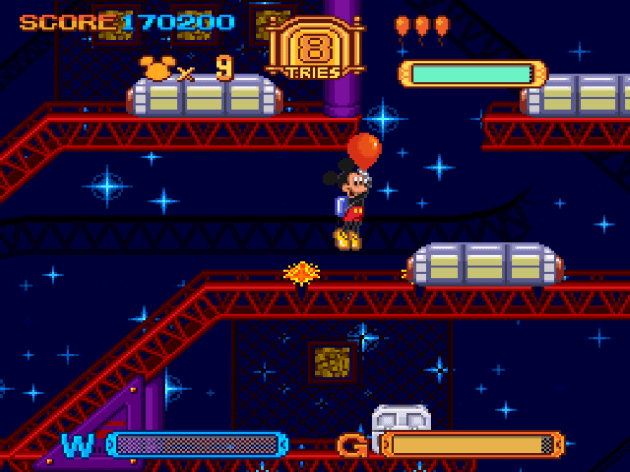
The thought of a Japanese exclusive Mickey Mouse/Disney Parks game had me excited, until I realized this wouldn’t exactly be the sequel to Adventure in the Magical Kingdom I hoped for. Instead, it’s basically a spiritual sequel to Mickey Mouse III, the third Crazy Castle game that had Mickey dropped from the US release and was renamed Kid Klown in Night Mayor World. Like that game, Tokyo Mickey is all about balloons. You have two different types: one that you fill with water (don’t ask where the water comes from) and another you fill with gas (REALLY don’t ask). The water balloons are used for combat as basic projectiles, but they can also be placed on the ground to act as trampolines or to weigh-down switches. When they’re placed on the ground, they don’t last very long, which leads to one of the most frustrating aspects of the game. At one point in the Haunted Mansion stage, one of the challenges involves two switches and a locked door. Without exaggeration, it took me ten minutes to successfully place a water balloon on each switch and get through the door. This was so frustrating that I almost quit. “Well, thank God that’s over and I never have to do it again!” I thought, but, the next world did the same exact two switch gimmick. That’s the Tokyo Mickey experience in a nutshell. It’s so exhausting.

The balloons disappear REALLY fast, but it takes time to actually inflate the next one.

The controls are somehow both stiff and sensitive. They literally measured out the exact distance from the two switches so that you would JUST BARELY get through the door if you were absolutely perfect with your movement. It was counting on playing screwing up the timing because of the sluggishness of transitioning from ducking to moving. This is one of those games where you have to tap forward to initiate running, but if you’re ducking, it doesn’t register. And that’s really the heart of Tokyo Mickey’s problem: they created cumbersome, clumsy play control and movement physics that they then tailored the game around. Now, they didn’t half-ass the level design. There’s some solid set-pieces and the level layout rises to the level of “clever” more than once. But, it’s all based around how tough the controls are, and for whatever reason, I’m unable to become immersed whenever I spend a large part of a game fighting the controls. I can’t stress enough, it’s my #1 gaming pet peeve.

This boss you have to kill by placing the water balloons on the ground so that he brains himself on the spikes above. I wasn’t sure if the ride was Splash Mountain or Mr. Toad’s Wild Ride at this point. Either way, this is also based around how difficult it is to transition from placing a balloon on the ground to moving, since you have to time it so the frog lands on the balloon BUT leave yourself enough time and space to dodge out of the way. With these controls, it’s more frustrating than fun.

That brings me to the second balloon, the “gas balloon” which can be used to slowly float you upward OR can launch you like a projectile. My #2 gaming pet peeve, and this one is more genre specific: leap of faith platforming. I hate blind jumps. They always take me out of a platform game. Unless there’s some methodology that allows a player to logic-out where the landing zone will be, they always feel like they turn the experience into nothing more than a fancy version of a shell game. By the very nature of how the gas balloon launches you, Tokyo Mickey has a large risk of blind jumps. BUT, here’s where I admire the effort, because they mostly did a good job of creating either the sense of intuitive logic as to where you want to land, or they just built a ceiling to catch and deposit you where you’re supposed to land. As annoyed as I was with the unresponsive movement, they actually did custom build the game around it. It doesn’t exactly complicate my final verdict, though. Actually, it makes me annoyed, because clearly the development team had talent and there’s nothing cynical about the design.

In fact, most of the blind jumps are self-inflicted. If you want to throw yourself around the level with reckless abandon CATHY, it’s not their fault.

With that said, the second half of the game has an overemphasis on the balloon launching gimmick, including one segment where you have to continuously fling yourself up a tall vertical shaft and then refill another balloon while you’re falling, fling yourself again, and so forth, making incremental progress. A single screen of this would have been challenging enough, but this concept goes for well over a minute. There’s TONS of precision timing moments too. A common example is having to start filling a balloon, then walking off a platform so that the balloon will fill-up at the right moment. If you time it right, the balloon will catch you, and then you can launch yourself forward through a narrow gap in the wall. It’s not the worst idea, and they actually did put effort into creating a sense of gravity and momentum. But, Tokyo Disney has far too many “fall off a platform and have the balloon catch you at the last second” bits, and that’s a problem because even after a couple hours of trial and error, I still never got to the point where the gas balloons felt intuitive in any fashion, timing or trajectory. That’s what happens when you bet the farm on seemingly deliberately awkward controls.

This isn’t even the part I was talking about, but the basic idea is the same.

Maybe it wouldn’t be so bad if it didn’t repeat the same gags over and over. Tokyo Mickey has good ideas in terms of level design and challenge, but it runs those ideas into the ground. Every level design flaw comes back to the play control. Having to repeat the same basic types of jump designs wouldn’t feel like such a padded-out slog if it was actually fun to make those jumps. If the game had smooth play control, it might have an almost parkour-like vibe to it similar to something like Super Meat Boy. But, because the basic movement is so slow and unresponsive and the controls are so clunky, there’s just no excitement to what should be absolutely thrilling level design.

They really seemed to deliberately aim for “counter-intuitiveness.” Take this segment during Splash Mountain. See those torches? They’re lethal to the touch, and when you duck, Mickey’s sprite still sticks out and touches the torches. Logically, it’s a hit, right? Nope. The ducking overrides it, even though you’re no-doubt-about-it touching the thing that kills you from standing up. Just paint the torches higher in the background, guys! Tokyo Mickey feels like a game that is trying to throw players’ instincts off balance, by any underhanded means necessary.

Plus, the combat between the jumps is so boring. The water balloons make for an unsatisfactory projectile, and there’s no supplementary weapons to break up the monotony. This becomes especially problematic during boss battles. Pete is the final boss in every stage, and sometimes he’s invincible to your attacks and sometimes he isn’t, but there’s no “shield” animation for when the attack won’t work. The balloon just doesn’t do anything. When you score a hit, he does a brief look of annoyance but then carries on like nothing happened. It’s so badly done.

The “mini-boss” before the finale is the dragon from Sleeping Beauty. I think. I mean, that dragon was pitch-black and this one is copper-brown, and that looks more like green slime than green fire. But, this boss has the same problem as any Pete battle: there’s no OOMPH. Also, the dragon has to lower its head all the way to the ground for about one second worth of vulnerability, but because it has a random attack cycle, you could end up waiting quite a while just to get a single hit in, let alone win the fight.

When I said this is a spiritual sequel to Mickey Mouse III for the Famicom, I wasn’t kidding. Much like that game, there’s SOMETHING here that’s compelling enough that I wanted to see Tokyo Mickey through to the end. It even does the occasional wink to the rides themselves to remind you that you’re playing a theme-park based game. I particularly enjoyed the design of the Space Mountain segment that involved switching to different cars on different tracks. A lot of games have done that trope, but they designed this one like a maze. I’ve never seen that before, so there was SOME genuine inspiration at work here.

I mean, it doesn’t feel remotely like Space Mountain, which is a roller coaster set in the dark, but at least it’s trying.

I think if this had controlled as well as, say, the Capcom version of Aladdin, this might have gone down as one of the best Mickey Mouse games ever made. Okay, so the combat is pathetic, but this is a PLATFORM game, and the exploration and jumping, for all the flaws with Tokyo Mickey, can still manage to generate excitement. Flinging yourself across a gap and sticking the landing on a platform is going to be satisfying every time. But too much of the challenge is based around “we made terrible controls and movement physics, deal with it!” Like a race against a ghost in the Haunted Mansion where you have to zig-zag up a shaft while hitting switches to reveal staircases. This could have been intense and exciting, but when you’re shorting jumps or getting stuck on stairs thanks to how sluggish the act of turning around and moving again is, it just becomes annoying. It makes it feel like it’s not YOUR fault you’re losing. I don’t think the designers seem to grasp that video games need to play well enough that a player knows it’s their fault they failed.

I had to reload this f’n thing so many times before I BARELY won.

We’ll never know what Mickey no Tokyo Disneyland Daibouken could have been if it played better. I’d played it before and didn’t finish it, so I kind of knew going into it that it wouldn’t be my favorite Mickey game. Japanese exclusives don’t really get a ton of clicks at Indie Gamer Chick, but I still love playing them because of that whole “forbidden fruit” quality they have. Tokyo Mickey never lost that aspect, even though it’s not a good game. It’s bonkers that it even exists given that Mickey Mania released fifty-one days before this. Granted, Mania’s Japanese release didn’t happen until three months after Tokyo Mickey, but still, this little unsung Mickey adventure in a theme park was set to go head-to-head with a heavily publicized Mickey Mouse game that was developed as a technical showpiece. Christ, can you imagine the pressure developers Graphic Research had?
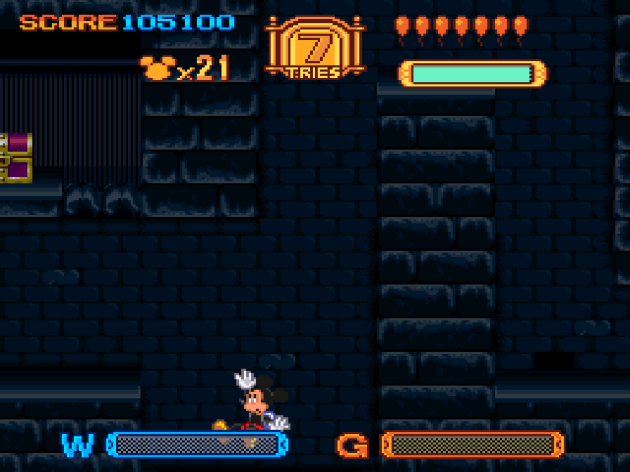
There’s a few times where I could swear they wanted to be Castle of Illusion so bad they could taste it. Part of me wonders why they didn’t just make a basic platform game that strives to be a Nintendo version of the Illusion games? People really like those games. Castle of Illusion for the Genesis and Sega Master System and Land of Illusion on Game Gear/SMS especially.

So, in a sense, I admire that they seemed to set out to make something that felt completely different from the Magical Quest games and what Mickey Mania would be. But, Mickey Mouse is a children’s property, and I don’t think little kids will enjoy a game with controls this rough. If grown-ups don’t, why would children? I played this on normal difficulty, but curiosity got the better of me and I went back and tried to adjust the difficulty to easy to see what this did to accommodate younger players. You know, the audience most likely to want a Mickey Mouse game? Well, the only thing it seemed to change was how many hit points you start each life with: eight hits instead of five. Seriously? I checked hard mode, and yep, it gives you three. If it adjusts the enemies, it wouldn’t matter, because the challenge is entirely based on controls and movement physics, and that sucks. Most of the development team behind this didn’t last in the game industry, and it’s not hard to see why. There’s nothing cynical about Tokyo Mickey, but for all their effort, I can’t imagine a game missing the point of Mickey Mouse more.
Verdict: NO!

Mickey to Donald: Magical Adventure 3 aka Magical Quest 3 (Super Famicom/SNES Review)

Mickey to Donald: Magical Adventure 3
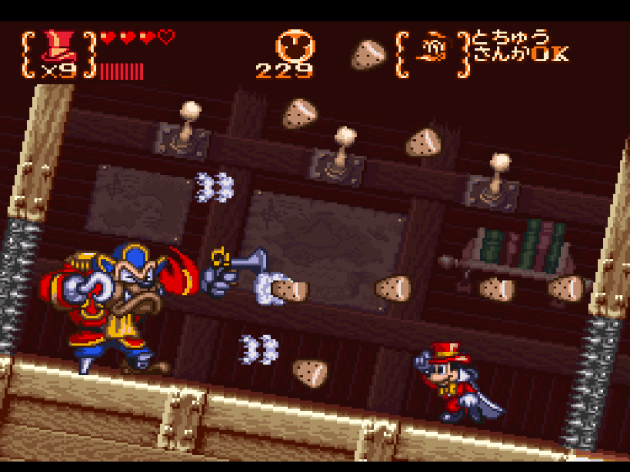
aka Magical Quest 3
Platform: Super Famicom
Released December 8, 1995
Developed by Capcom
Originally Never Released Outside of Japan – Ported to GBA in 2005
No Modern Release

How many trilogies have the first game end up being the best one? I can’t think of many.

I hated the Great Circus Mystery, which had nothing inspired about it. That’s not exactly the case with this third and final Magical Quest game. Hell, I even think they could have released this in America and saw roughly the same success as MQ2. I get why they didn’t. While Mickey Mania didn’t exactly block the release since Traveler’s Tales and Sony didn’t own exclusive Mickey Mouse rights for any window, Magical Quest 3 looks kind of fuddy-duddy when put side by side with Mickey Mania. Regardless of whether or not Magical Quest 3 is the better game, Capcom had experience with one of their sprite-based games getting smashed by a game promoted by cutting edge cel-graphics: the Aladdin fiasco with the Capcom SNES game and the Virgin Sega Genesis game. They didn’t want a repeat, and Mickey Mania was even better looking than Aladdin, on the Nintendo platform as well, and critically acclaimed, so they said “nah.” Yea, that’s almost certainly why this didn’t come out in America. Sad, huh? Especially since Magical Quest 3 is no-doubt-about-it better than the SNES version of Mickey Mania. Whether or not it’s better than the base Mickey Mania that I gave a YES! to on Sega CD wasn’t as clear, at least immediately.

Unlike Magical Quest 2, where you can choose to play as Mickey or Minnie but it doesn’t make any gameplay difference, Mickey and Donald are unique characters with unique costumes and abilities. Well, “unique” is a bit a stretch, and I’m almost certain the climbing costume has the same abilities despite having a different look. Both characters each have a knight-like combat costume. In water, Mickey sinks in his suit of armor while Donald, who looks like a complete tool in his barrel, can float. See, Mickey? You should have dressed like a tool. Of course, in the underwater stage, you can’t use Donald’s suit at all since it takes you to the top of the screen.

One HUGELY annoying aspect of the game is just the act of turning around, because you don’t just turn and face the other way. You also move a character segment forward. That makes avoiding boss attacks a huge pain in the ass.

In the knight costume, Mickey follows in the footsteps of Green Arrow and uses a lance with a boxing glove on the tip, while Donald uses a hammer. BOTH are hugely satisfying and probably the best costumes in the entire franchise. No notes. The problem instead is the magician costumes and the randomly-generated refills for them. Mickey is CLEARLY a comic fanrat since he throws playing cards like Gambit. Donald wears a fez and uses a lamp with a genie to cast spells. Mickey’s costume allows for rapid fire, while Donald’s projectile has a pronounced delay for the animation. When I fought this mini-boss as Donald:

I had to hold down the fire button to successfully score hits. The boss is immune to all attacks BUT the magical costume, since it’s shooting fast moving cannonballs at you that you have to deflect. TECHNICALLY you can use two costumes with Mickey, but with Donald, you can only use the magic costume, and it makes for a slow, agonizing fight. Early on, I thought they corrected the problem with spongy bosses, but they didn’t. There was a boss fight with a giant flower that died so quickly that I couldn’t believe it, But, by the halfway point of the game, boss fights once again dragged on so long that it sucked all the excitement and joy out of the battles. Even the mini-bosses are total slogs to fight. On the plus side, collision is better than the SNES Great Circus Mystery, but if the gameplay isn’t fun, that’s not much of a consolation prize.

The final battle against Pete did ALMOST put a smirk on my face since he changes costumes like the player. Cute idea, but the animation is so limited and sloppy that it’s like amateur hour. He just sort of waddles back and forth, and when he attacks, it doesn’t do a convincing job of creating the illusion that it’s one sprite doing all the work.

I’m genuinely fine with extended boss battles. I just drooled all over the fact that I spent nearly an hour battling a boss in Super Mario RPG, and I could totally be on-board for a platform boss being along those lines, but only if the fight is kept exciting. That requires changes of tactics, but most Magical Quest bosses have one form of attack and maybe some kind of rushing move, so two total gameplay elements that are then repeated randomly over and over and over. They also usually have some kind of interval when they’re vulnerable, so the fights feel like you’re just waiting around for something to happen. These are BAD boss fights, and they didn’t have to be. Cut the damage required in half and they would have been fine, and maybe even fun.

The first boss is actually a massive tease because he’s the type of boss I want. He has two distinct forms that feel different and take the correct amount of shots to pass. I have no idea why all the bosses aren’t like this.

Like Great Circus Mystery, I assume a lot of the decisions made were done to accommodate co-op play. This time, I *did* play a limited amount of co-op, but it’s just a slower experience that mostly comes down to one player creating a platform for another player. It’s the same problem World of Illusion had: the original game was fine, and you don’t need to build a co-op game out of that. You need to build UP, and co-op inherently prevents that. Part of me has always wondered if that’s why the New Super Mario Bros. games never “did it” for me. How many things have to be sacrificed so the co-op design can work, which has a NICHE audience as opposed to the all-encompassing one of the original game? With that said, the levels are significantly improved over the second game, but they’re still not as good as the first. There’s also some problematic elements related to the climbing gear. It’s done like a lumberjack, with a rope around the thing you’re climbing that you use to sort of scoot upwards and fling yourself. But things like these:

I really struggled greatly to “bind” myself to, even with practice. It’s certainly not intuitive or smooth-flowing. There were multiple moments in the game where I was stressing that a soft-lock was in play and ultimately only barely got past because an enemy appeared that I could use to bounce off of. There’s an overall lack of elegance, and lots of situational issues where if you run out of ammo for the magic, you probably will get stuck. The refills are random, even if they’re inside blocks. A couple times, I had to rewind the game and break blocks a couple times to assure I got refills so I could use the magic to create a platform to scale over a structure and continue the level. Well, the obvious answer is that these segments were made, you guessed it, for the co-op. If they feel that strongly about co-op, stand by your conviction and have no single player. Because all the uninspired design made for a co-op experience that between 5% and 20% of all players will probably use really seems to be the root cause for all the conservative level design.

Well, the climbing stuff isn’t great in general, single or otherwise. It’s slow and clunky, and so when they do the rising fire trope in the final level based around it, it doesn’t land at all. You can’t do that gimmick if it’s based around unreliable controls.

Or how about this one part where there’s switches and you have to use the climbing rope to drag a barrel over to them. Except, you don’t actually DRAG the barrel. Even though they’re placed quite a distance from the object, you have to throw the rope out and catch it, then drag it one single space, then repeat until it’s on the switch. Look how far away it is! How stupid! It’s actually breathtaking how consistently the Magical Quest games consistently manage to add busy work and subtract fun from so many aspects of gameplay, from bosses to platforming segments to even the act of putting a barrel on a switch. Did they sit around with a stopwatch and try to find places they could add seconds to the gameplay, so that nobody could accuse them of making a game that can be finished in an hour?

I actually thought this was going to get a YES! by virtue of being closer to the first game than the second, but when it was all said and done, I actually had to ask myself “did I really have fun with that?” At the start of the game, I did. The first couple levels were pretty good, but the fun stopped soon after. I played Magical Quest 3 twice, once with Mickey and once with Donald. The two characters weren’t so different that it felt necessary. When the credits rolled on the Donald game, I said “well, that was a colossal waste of my time.” And that’s when I knew my verdict. Unlike Great Circus Mystery, Magical Quest 3 isn’t entirely a wash. There’s a couple really good levels, but the majority of the game is a slow, clunky bore. I was bored playing it, and I was bored writing about it. There’s a reason why this franchise died the death it did. The first game was the best, and it felt like it left so much on the table. The ideal Magical Quest game would be one that takes the first couple levels from Magical Quest 3 and somehow cuts them and pastes them into the middle of the first game. Magical Quest 3 isn’t a dumpster fire, but it’s not good, either.
Verdict: NO!

At least this one has an air meter.

The Great Circus Mystery Starring Mickey & Minnie (SNES and Genesis Reviews)

I’m going to do the SNES game, then the Genesis one. Can you tell I wrote the full SNES review before I touched the Genesis version?

The Great Circus Mystery Starring Mickey & Minnie
aka Disney’s Magical Quest 2 Starring Mickey & Minnie
Platform: Super Nintendo Entertainment System
Released October, 1994
Developed Capcom
Re-Released for the Game Boy Advance July 18, 2003
No Modern Release

Well, it looks good. I guess.

If I didn’t know better, I’d guess that the second game in the Magical Quest trilogy was made up entirely of ideas, levels, and costumes rejected from the first game for being too boring. Mind you, for all the whining I did with my review of the first Magical Quest, I also said in no uncertain terms I thought it was “one of the better SNES mascot platformers.” So, what happened to this piece of crap? How’s this for a bonkers conspiracy theory: I think they dropped the “Magical Quest” name from the US version of the game and changed it to the Great Circus Mystery (despite having only ONE LEVEL related to the circus) because Capcom’s US branch recognized what an absolute failure the sequel is. Folks, this is a TERRIBLE game.

What a strange name. “The Great Circus Mystery” when none of the enemies outside of the first area, none of the costumes, NOTHING is circus themed. It’s not even a well done circus themed level, either. It’s entirely superficial.

The core pick-up-and-throw gameplay returns for the sequel with basically no changes, so the new content is entirely based around the three new costumes. The first one is a vacuum cleaner, which is basically the fireman’s suit from the first game in reverse. It’s easily the most satisfying costume in the game as well, but even it’s boring. Instead of sucking up enemies which can then be shot, it eats the enemies and poops out coins, and it does it in a way where the coins go FLYING behind you so you have to scramble to get them. How stupid. A couple bosses are fought using the vacuum gun, and while I think all the bosses are, simply put, boring, the least boring ones usually involve the vacuum. There’s also some very limited (and entirely optional) platforming bits that require you to use the vacuum to pull a block closer. As in, I did it exactly twice, back-to-back. That tracks with the unimaginative level design in general. The only costume that gets extended use for platforming is the explorer costume, which is basically Mickey with a hook. It’s used for swinging off pegs, scaling walls, and occasionally sliding down vines. That doesn’t sound TOO bad, right?

Behold, the best part of the entire game. This is like a better version of Super Castlevania IV‘s rotating room. It lasts under a minute. So, the sum total of the entire game’s entertainment value is maybe 45 seconds of someone else’s idea made marginally better. Being a Mode 7 segment, this room is not in the Sega Genesis build.

Even the explorer costume is as boring as possible. First off, there’s NO offense with this thing besides enemies who can be jumped on. You can’t even pick up a downed enemy and throw them with this costume, nor can you pick up any blocks at all while wearing it. Because there’s a huge delay when you’re swapping costumes, this costume alone causes a much slower pace than the previous Magical Quest game. The level design that takes advantage of it isn’t much better. In the first stage based around the explorer costume, there’s an extended section where you have to climb up trees. As if to really stress how much contempt the designers of this game had for players, the things you’re waiting on are actual snails that move as fast as you would expect, which is so goddamed slow that I wanted to throw my controller through the screen.

Platforming done at a literal snail’s pace.

The third costume is one of the worst power-ups I’ve ever countered. It’s “Cowboy Mickey” which sees Mickey bouncing up and down on a hobby horse. All movement with this is bounce-based, and it’s SO inelegant. If you want to jump higher, which is the theoretical advantage of this costume, you have to time it based on when the up-and-down hopping is currently down. Since the hopping is so quick, it’s really not easy to actually jump or do anything with this costume. It also shoots, but not straight in front of you. The corks you shoot are a little bit high and then arc slowly. It’s literally custom designed to be hard to shoot anything with, and when games do that, that’s not really a challenge. That’s just being trollish. It also has a dash move, but that seems like a hold-over from the Genesis game, as there’s no place where it was useful in the SNES game. The poor controls with the cowboy suit make it one of the most unresponsive, unintuitive gimmicks in any platforming game. The whole idea should have been killed on the drawing board. It should NEVER have made it to the finished game.

Imagine if you could only jump randomly 1 out of every 3 times you pressed the button. That’s sort of what using the cowboy costume is like.

I wasn’t doing a comedy bit in the first paragraph. I genuinely think Great Circus Mystery is composed entirely of concepts rejected for the original game. There is just no way that everything sucks as much as it does. The first game was too well made. Hell, even the bosses fail. They’re a total slog, all taking too many hits to kill without changing up their attack patterns. “Why be four hits to kill when it can be six? Why six when it can be eight or more?” Well, because if you’re not throwing more twists into the fight, you’re really just making the bosses an endurance test, right? And it’s really not helped by the fact that the collision detection this time around is really bad. There were multiple points in the swimming stage where I used rewind just to search for the thing that damaged me. The closest enemies were so far above my sprite that I couldn’t believe that it was the cause, but it must have been unless you just randomly take damage while swimming. Look at this. The answer seems to be “the jellyfish” but you’ll note that it’s not even a little close to me.

UPDATE: Actually, you have to breathe air underwater via bubbles. They just forgot to have an air meter, which I assume was an oversight since the sequel has such a meter. Every time I took damage, it was close to an enemy, and since the collision is bad outside the water, I just assumed the damage was caused by the enemies since there was no indication on-screen that this was one of those “need to breathe” games.

Non-swimming collision is never THAT bad, but it’s never consistent. Some enemies are 1-to-1, but others aren’t. Most of the boss attacks sure aren’t. With the SNES version of Magical Quest 2, you can’t ever really use the sprites to suss out the safe distance. By this point in the SNES’ lifecycle, anything but 1-to-1 sprite collision is lazy and unacceptable. Every single boss had at least one moment where I had to jump over something and my sprite clearly, unambiguously missed the danger sprite with a full character length between us and I still took damage. NOTHING in gaming breaks immersion quite like bad collision detection, and it was the final straw that ruined Magical Quest 2 for me. Look how much clearance I had over the thing the boss is throwing at me here:

The whole game is like that, but the bosses are where it’s the most damning. Bosses are like double-or-nothing for mediocre platformers. Really good boss fights can absolutely turn a meh game into a decent one, but bad ones can confirm it as an all-time stinker. The Great Circus Mystery’s bosses do the latter. You know, there’s a third Magical Quest game that remained a Super Famicom exclusive until the Game Boy Advance re-releases in the mid 2000s. I’m starting to figure out why that never came out in America. The Great Circus Mystery killed the franchise, dead. I have no idea what the contemporary critical reception was to this, but I genuinely feel this is one of the worst sequels I’ve ever played and I can’t imagine what a let-down this must have been for kids of that era. It’s REALLY bad. The levels are dull and lacking in memorable set-pieces. The combat is dull. That cowboy costume is genuinely embarrassing, and hell, I even think the graphics are pretty lackluster. And now I know what the great mystery REALLY is: why this wasn’t cancelled before release.
Verdict: NO!
No, I didn’t play this co-op. Absolutely nothing I said above would be fixed by having a second player suffer with me.

The Great Circus Mystery
aka Mickey to Minnie: Magical Adventure 2

Platform: Sega Genesis
Released June 2, 1994
Developed by Capcom
NEVER BEEN RE-RELEASED

For Sega Genesis fans, the collision detection in the Genny version of Great Circus Mystery is VASTLY improved. It doesn’t make it a YES! game. The costumes, level design, and spongy bosses are all still so terribly boring. But, my final big complaint was fixed in this version. If you only play one version of Magical Quest 2, fire up the Genny version. It’s MUCH improved and rises to the level of a standard boring platformer.

I wasn’t originally going to do this review, but right before publishing, curiosity got the better of me, and then I saw that the Sega Genesis game released before the Super NES game did. Hmm, I thought. I think I figured out what happened with the SNES game. Funny enough, I think it’s the same thing that happened to another Mickey Mouse game, Mickey Mania. I think the developers built a Sega Genesis game that they then had to port to the SNES. The collision detection for Mickey Mania was historically awful on the SNES. It was almost a non-issue on the Sega CD build that I played. In the case of Mickey Mania, it led to a split-decision, with the Sega CD build coasting to a YES! and the Super NES getting the NO! hammer dropped on it. Well, Great Circus Mystery is now the second Nintendo versus Sega game starring Mickey Mouse where the Sega version is better based on collision detection. Remember this?

Here’s the same boss on the Genesis, doing the same attack. Look where I am.

I’m LITERALLY TOUCHING THE SPRITE and I’m not taking damage. While it makes a monumental difference in terms of playability, it was also never Great Circus Mystery’s biggest problem. The levels are largely the same, with the only noticeable difference being the lack of the rotating room. No Mode 7 on the Genny, so they couldn’t do it. That’s where the cowboy dash move comes in. Like with the vacuum’s ability to draw blocks closer to you, they created a couple situations where it’s necessary to use it to justify its existence.

Right here. You have to hold the fire button down, which means shooting a bullet in order to perform this

The Great Circus Mystery on the Sega Genesis at least rises to the level of competently boring. I totally stand by my theory that this game is made entirely out of ideas for the original game that were shot down. The best costume in Magical Quest 2 is worse than the worst costume in Magical Quest 1. The weakest level in that original game is also better than this one’s strongest level. There is NOTHING memorable here. It’s so paint-by-numbers basic and predictable. I assume it was done that way to accommodate co-op gameplay that nobody asked for. Technically, the level design is microscopically worse on the Genesis. At least the SNES game had a forty-five second segment that outclassed one of Super Castlevania IV’s most memorable sequences. The Genesis version doesn’t even have that going for it. Meanwhile, a couple of the bosses on the Genesis game, even with better collision detection, last longer. Like this boss fight on the back of a dinosaur:

On the SNES, I could occasionally hit it twice a pass, which is nice because the bosses are so unbearably spongy that it sucks all the excitement out of the fight. On the Genesis, you’re limited to one shot per pass, which makes the fight drag on so much longer than any sense of fun lasts, then it keeps going until you actually regret turning the game on at all. None of the bosses are memorable in the least bit. The first game had a giant Pete Spider. In the sequel, the final boss is a giant, generic looking Pete Dragon. Not Pete’s Dragon. That would be lame as f*ck too, but not as lame as it turned out. I’m just in a state of shock over here because the original game was such a quality title that absolutely did not get the most out of the costumes it had. They could have done more levels with THOSE and ended up with a better game than this. While I give the nod to the Genesis version, it still really does nothing right. Ease back on the sponginess of the bosses and the levels are still bland. Make better use of the costumes and they would still be uninspired. Magical Quest 2 feels like a sequel they didn’t want to make. Nothing more than an arbitrary +1 for the release schedule. Magical Quest deserved a better sequel.
Verdict: NO!

(SNES Version) This DOES NOT pull off the “use background sprites to create the illusion of the boss being bigger than it actually is” trick. That’s actually laughably pathetic. What a farce of a game.