The Karate Kid (NES Review)

The Karate Kid
Platform: Nintendo Entertainment System
Released November, 1987
Developed by Atlus
Published by LJN
NEVER BEEN RE-RELEASED

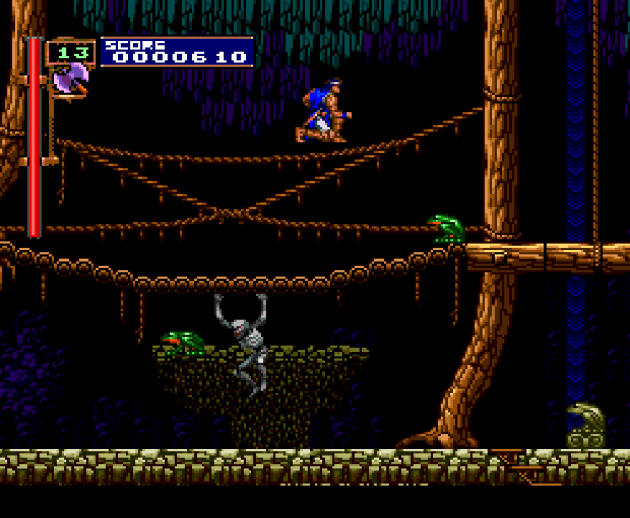
That does not look like Sensei Lawrence. Also, all the screenshots are going to look like a piece of paper that someone spilled water on thanks to the pattern in the status bar. I bet that looked nicer on old tube TVs.

This might come as an incredible shock to my readers, but as I’m typing this sentence, before rendering my verdict on The Karate Kid, vilified NES publisher LJN has a winning record at Indie Gamer Chick. The current scorecard stands at 2 YES!, 1 NO! Don’t mistake that for some kind of accomplishment, since those YES! games barely made it over the finish line while the NO! game couldn’t find the finish line if the finish line crawled up its ass. We’re not exactly talking masterpieces I played over here. The first was Jaws, back in October of 2023. A game that’s historically maligned but genuinely not horrible. It just doesn’t do enough. Then, as my Christmas 2024 feature, I looked at nearly every light gun game on a Nintendo platform, including LJN’s Gotcha! The Sport. A bland but serviceable NES Zapper game. Finally, earlier this year, I took a look at Back to the Future. Is BTTF as bad as people say? Nah. It’s just very boring, which granted, is the worst thing a game can be, but it’s not the legendary trash fire I expected. Well, I had a feeling what to expect with Karate Kid. I was wrong, too, because this is no half-assed effort.

Update: Cathy, you silly dumbass. I’ve done FOUR games by LJN. I forgot about Wolverine, which got a NO! It’s okay. Everyone else forgot about Wolverine too.
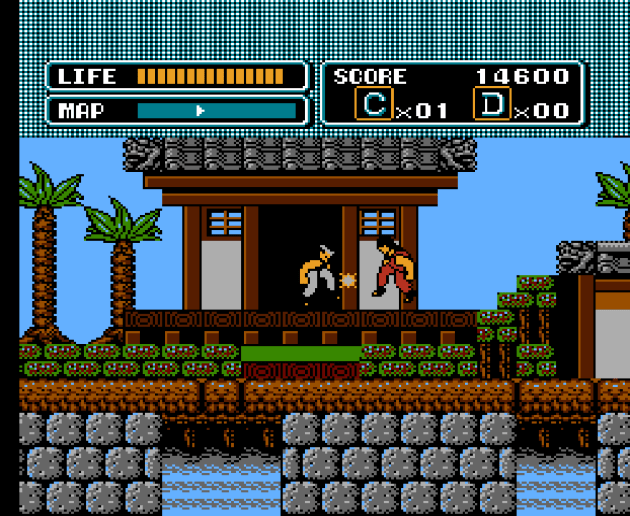
If you dare to play Karate Kid, be ready to see a lot of sprites that look like this.

For starters, unlike Jaws or Back to the Future, Karate Kid makes an earnest effort to follow the story of the first two movies. Mostly the second movie, as only the opening level has anything to do with the first flick. You start with the finale of the Karate Kid: the All Valley Tournament. You have to win four matches against sprites that look nothing like the characters from the films. Weirdly, that’s the only major disconnect from the films. After that, the game is a more platforming-focused take on Kung-Fu Master. In fact, I should have included Karate Kid in my Kung-Fu Master: The Definitive Review feature, since the gameplay is clearly inspired by that legendary game. The combat really is almost identical to the famous Irem game, at least in theory. One button for punch, one for kick, press UP to jump, with the full range of moves from Kung-Fu Master. If you’re going to copy, copy from the best, right?

There’s also three different bonus games taken directly from the films. One where you smash blocks of ice, one where you catch flies in chopsticks, and the hammer seen here. I never got good at this one. The timing is weird.

Karate Kid doesn’t just copy Kung-Fu Master, though. It tries its damnedest to one-up that game by including two special moves: the drum technique from the second film and the legendary crane kick. They’re even animated in a way where the actual attack part comes with a slight delay, but they’re pretty convincing for a 1987 NES game. The problem with them is they’re done by simply standing still and pressing the kick button for the crane kick and punch for the drum technique. It makes it way too easy to activate them accidentally. The drum punch especially seems a lot more sensitive and poorly coded than the crane kick. I was constantly accidentally using the drum even when my movement should have cancelled the activation. Since you very much want to save these special moves for boss encounters or even when two enemies are attacking you out of sync, it’s annoying how easy it is to burn through them. This is compounded by Karate Kid being yet another NES game where the SELECT button goes unused. Why not map it so SELECT + A/B activates the special moves?

Speaking of bosses, this is supposed to be Chozen, the jerk ass from Karate Kid 2 who becomes one of the coolest allies in Cobra Kai. But, it looks nothing like him! Instead, this sprite is a DEAD RINGER for John Kreese! I mean, seriously, I did a double take and everything.

Before I continue, holy crap, the Kreese thing gets weirder. The basic enemies look EXACTLY like 8-bit versions of Young Kreese from Cobra Kai.
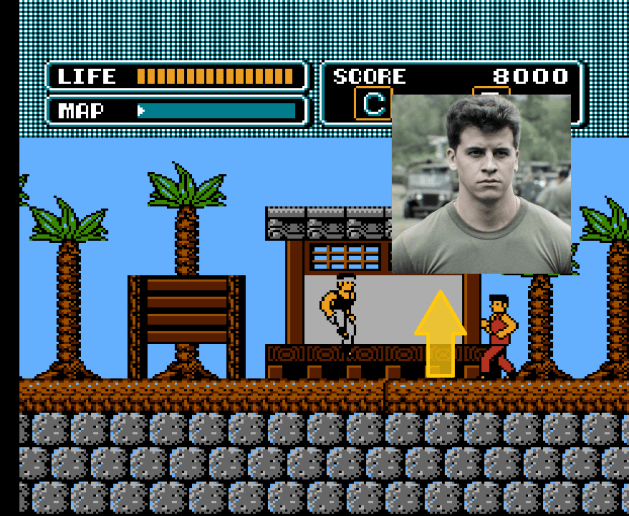
WTF?! Actor Barrett Carnahan (Young Kreese) could use that sprite as his driver’s license photo! Mind you, “Young Kreese” didn’t debut until Season 3, episode 2 of Cobra Kai, and this game is five years older than Carnahan, so this is kind of spooky. Oh, and Young Kreese is also the best character in the series and I’ll fight you on that. I do think Young Kreese and old Kreese are two separate characters from alternative dimensions since I literally cannot believe that Young Kreese grows up to be Old Kreese. Every single time I thought they were going to finally bridge the gap between the characters of Young Kreese and Old Kreese, nope, they did something else that made me think “there is no way that guy eventually became THAT guy.”

Anyway, I thought Karate Kid was decent enough at the start. Certainly rough in terms of movement and jumping, but nothing offensive, and it had acceptable level design and decent enough graphics. This lasted until about five seconds into the second stage, when the gameplay came to a screeching halt thanks to some of the strangest damage physics I’ve experienced in any 2D platformer. When you get hit in Karate Kid, there’s a pronounced knock-back, but unlike Castlevania or Mega Man, that knock-back has no blinking with it. Naturally, Karate Kid’s default challenge is sending two enemies at you who attack just out of sync. Of course it would be that way, and thus you can get caught very easily in a juggle. Hell, the level design even seems to be tailored specifically to cause this. Look at this shot:
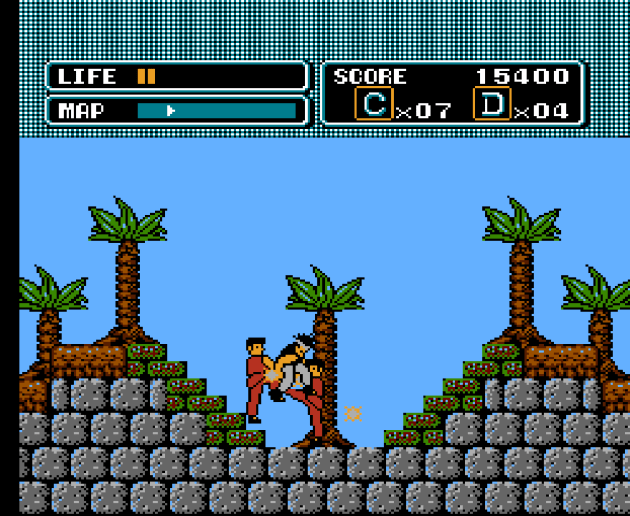
I had a full life bar going into this part. You really don’t want to give up the high ground because of stuff like this. So, the combat is, to say the least, frustrating. As if to cosmically square this, enemies really don’t seem to know how to navigate the terrain. When they reach a low point on the playfield like in the above screen, even though they seem mechanically capable of climbing out of it, they become too confused to do so. In later stages, enemies are so lobotomized that more of them will kill themselves via the pits than be killed by you. A few years ago I reviewed the Atari-developed Indiana Jones and the Temple of Doom coin-op that had me gobsmacked by how suicidal enemies were. This game gives it a run for its money. Karate Kid’s dimwitted basic enemies are just as bad, often walking off platforms to their doom. Some even jumped willingly into the water to die by drowning. That’s hardcore. You know what? I get it. They knew they wouldn’t even get a cameo in Season Six of Cobra Kai, but come on, fellas. Maybe there’s hope for a Chozen spin-off!

But, the surviving enemies aren’t so much fun to fight as they are pests. By the end of Karate Kid, I was so bored with being used as a tetherball that I opted to leg it and run away from enemies. That’s a viable strategy if you can get in front of them, since the game can only spawn two at a time. Then the third level hit, which takes place during the typhoon sequence of the second movie. Now, again, very admirable that they tried to recreate the set-pieces of the film. You even rescue the little girl from the typhoon while fighting Kreese Chozen. Okay, so in the film Chozen isn’t part of that sequence, but it’s the thought that counts. Despite its scathing reputation, Karate Kid does a lot right. The sprites have more frames of animation than most NES games of this time frame do, which gives the combat a pretty good sense of OOMPH! Nice graphics. The game follows the movie as close as you can do in an 8-bit platformer. Karate Kid isn’t phoned-in at all.

The baddies are like “OH COME ON, EVEN THE LITTLE GIRL GETS CLOSURE IN COBRA KAI AND WE DON’T?” By the way, this stage was a slight epilepsy risk thanks to the lightning flashes, so I’ll remind everyone that I’m partnered with AbleToPlay so please support them and sign up to contribute to their database to help people like me.

It sounds so cool, but that whole typhoon level is an unimaginable clusterf*ck of sadness because the entire time the wind is pushing you backward AND crap is flying at you randomly. It’s hard to get too mad because I understand why it’s like that. Altus figured out that the game would be monotonous, so they had to do something to differentiate the stages. The same can be said about the structure of the final boss. Again, they based it on the scene from the sequel, where you fight Chozen to the death on a platform. Except, they want players to honor the spirit of the movie and allow Chozen to square-up with you because of honor or some such bullsh*t. If that’s how they wanted it, why even program him to tee himself up for players by leaping onto the platform from high above you? Because if you punch him out of the air, it’ll knock him into the water, but that’s NOT supposed to happen so they just restart the fight over and over until you allow him to land. Then, not only do you have to fight him, but you have to make sure Kumiko isn’t knocked into the water, and her hit box and movement behavior is far too sensitive.

Calling Karate Kid a disaster is just straight-up wrong. It’s not even a run-of-the-mill bad licensed game. This actually had a fighting chance to not only be a quality game, but maybe even a beloved one. It doesn’t lack for effort. Karate Kid lacks for polish. Based on what I’ve heard about motion picture licensing from the 80s, Atlus probably had a very strict deadline to bring Karate Kid from the drawing board to the manufacturing. The people granting the licenses, simply put, didn’t know there was a difference between good video games and bad ones. To them, video games were no different than action figures, and if kids think a toy is boring, that’s on the kid, not them. This screwed a LOT of talented studios, which in turn screwed a lot of game consumers.

Two of the three characters in this picture are about to drown while the third will do the heroic thing: point and laugh at them.

It speaks volumes to how talented Atlus was, even in 1987, that Karate Kid rises to the level it does. Because my hunch tells me that, when it came to gameplay concepts, they had to use whatever was the first viable (IE programmable) idea that was pitched. There was no time to weed out bad ideas. Hence the wind in level three, or the way Kumiko works in the final battle, or even the very short length of the game. Despite this, Karate Kid follows the plot better than any other movie-based NES game up to this point. Actually, it probably held that title for years afterwards. Most developers wouldn’t have bothered. That’s the thing about LJN/Atlus’s Karate Kid on the NES. I never once got a sense of cynicism or laziness out of it, like I did with Back to the Future. Karate Kid is so clearly made with the best of intentions that it breaks my heart that it’s no good.

“Uh, Mr. Miyagi, I’m being attacked by a man using his two foot long serrated penis! Any sage advice?” “Daniel San, I helped you bring down Cobra Kai. I taught you ancient martial arts passed down from father to son. But I didn’t sign up for this. You’re on your own. Miyagi getting the f*ck out of here!”

Karate Kid is a fan service game, as a movie-based game should be. Atlus just didn’t have the resources, experience, or time to clean up the janky combat. That’s all this game needs: POLISH. Okay, and maybe an extra level or two, but what’s here would need minimal fine-tuning to become an above average movie game. Atlus would eventually go on to accomplish some amazing things in gaming, and it’s not hard to see their potential in Karate Kid. I can’t give it a YES! because it’s bad and even when I know a game got a raw deal due to a licensing agreement, I show no mercy in my verdict. But, in my heart, I feel pain for Atlus and the team behind Karate Kid. I didn’t hate this game. Like Back to the Future, its reputation is largely exaggerated, but unlike Back to the Future, Karate Kid doesn’t deserve it. Back to the Future is a joke because of how little it feels like the movie. Karate Kid the NES game feels like an actual Karate Kid product. If only the gameplay was a little more refined, I think it could have gone down as an all-timer on the NES. I really do.
Verdict: NO!

This slideshow requires JavaScript.

And yea, I played pacnsacdave’s Cobra Kai ROM hack. It doesn’t fix the collision or blinking issues, so there’s really not a lot to say. What Karate Kid is BEGGING for is a quality of life ROM hack. I think there’s an above average Kung-Fu Master knock-off in here somewhere that some talented ROM hacker can unlock. I’m there for it when it happens.

Bonk’s Adventure: Arcade Version (Arcade Review)

Bonk’s Adventure: Arcade Version
aka Kyuukyoku!! PC Genjin (Japan)
aka B.C. Kid: Arcade Version (Europe)
Platform: Arcade

Released in 1994
Developed by Kaneko
NEVER BEEN RE-RELEASED

Certainly a gorgeous game with impressive sprite work and memorable enemies.

Calling the arcade version of Bonk “the forgotten Bonk” kind of seems weird when the whole franchise is essentially forgotten at this point. Many of my older readers have talked about the original Bonk’s Adventure for the TurboGrafx-16 as a game that looked so enticing that they wanted to trade their NES in for a TG16. For a while, it looked like Bonk would be a mascot on the level of Mario and Sonic. It never happened. The last fully original Bonk game released in 1995, and the last console release happened exclusively in Japan with a PlayStation 2/GameCube remake of the original Bonk’s Adventure. Back in 2023, I had planned to do every Bonk game. I only finished two games, the original and its NES remake, before I needed a break. I have quite a few games left, including this extremely weird arcade take that’s built around co-op play, though the game is fine in single player.

This might be my new favorite screenshot ever. In the co-op game, Bonk’s girlfriend tags along and you and her can bonk each other till your heart’s content, though as seen in this pic, she might not like it. The dinosaur above Bonk is like “hooo, this will be fun to watch!”

If you’re expecting a close approximation of the console versions of Bonk, forget about it. You can’t even “glide” by rapidly doing and undoing the diving headbutt like in the original games. There’s also no exploration at all during the twenty-one levels, which are bite-sized. Seriously, in my first play through, I usually took about 40 to 45 seconds per stage. Speed is incentivized, as the game keeps track of the fastest times for each level. You don’t have to worry about gathering items, with the exception of the smiley faces. You’ll notice the smiley faces are stacked on Bonk’s head in most of the pictures. In the coin-op, they act as a sort of helmet that both protects you from some attacks and gives you extended reach on your headbutts. But, if you take damage, they go flying like the rings in Sonic. It sounds nice, but I never fully got a grasp on why some enemies were knocking the smileys off my head and others were damaged by them.

Sometimes the ball is a basketball. Sometimes it’s a soccer ball. Sometimes it’s a football. My non-American readers are ripping their hair out and/or screaming at their monitors after those last two.

You’re also expected to grab a sportsball and carry it to the finish line of each stage. You even score points for every second you carry it. The end of stages features a moving finish line straight out of Super Mario World, only the twist is the tape is a hoop that you dunk the ball through. It sounds more important than it is. Arcade Bonk is a straight-up platforming action game that’s based around simple enemy attacks and hazards like spikes or falling blades. Despite all the elements that have been added over the console Bonk titles, this is a much simpler game than those. Play the short stages, all of which are left-to-right scrolling. There’s no vertical stages and no set pieces. The only themed stage of note is a single stage with swimming. That old chestnut, and it sucks as much here as it normally does. Seriously, for all the whining I do about slippy-sliding ice stages (and those are here too) I’d rather be frustrated by them than bored with a swimming stage.

Funny enough, Bonk games tend to have better swimming stages than most platformers and the coin-op Bonk is no exception. But I’d still rather have a normal level. I’ve never understood the popularity of swimming stages in games. “It’s kind of like the game you’ve been playing this whole time, only slower. Much, much slower.”

The tiny stages are weird, but how they play out is even weirder. You can play the twenty-one levels in any order. After every three levels, you then fight one the seven bosses in any order. Normally this would be a sign of a game that doesn’t scale properly since, in theory, being able to choose any level and especially any boss means the levels need to be balanced. That’s not the case here. Bonk’s levels are numbered, and I’d say the sequential order scales as you would expect it to almost perfectly, with the final stages offering a pretty hefty challenge. I have no clue why they made this non-linear. Presumably it’s because this was kind of designed to be a ticket redemption game and, in theory, you can get more tickets on the harder levels since there’s more scoring opportunities. If you do play this, I strongly suggest you activate the SERVICE MODE in the dip switch settings and beef up the difficulty (you can also change the Japanese text to English). The default setting is set to 0 out of 3 in difficulty, but it should be set on 1 or 2, at least.

Some damn good boss fights too, including one against Evil Baby Bonk. Kind of redundant since all babies are evil until they work it out of their system.

Keeping it real, the coin-op version of Bonk is probably going to be one of the weaker games in the franchise. Despite all the effort to give this layers of complexity, it’s one of the most basic platformers to come out during this time frame. Thankfully, the action of the Bonk franchise is really, really good. The arcade game is proof of how good. It was a smart move to take away the ability to hover, as it would have allowed players to circumvent most of the challenge. By removing that, you’re left with a short and basic platformer that’s been polished to a mirror shine. Personality matters A LOT, and they really went all-out with making the sprites feel alive. Despite what the Wikis say, there’s even power-ups that turn you into a robotic skeleton or what appears to be a Native American warrior.

The combat is chaotic and visually loud, but always satisfying, and the levels are well constructed. Including all the downtime between stages, it’ll only take you a little over a half hour to beat Bonk even if you die several times. If you play co-op, since you can attack and bounce off each other, it might take longer. I didn’t get to play it co-op as much as I would have liked, but fans of New Super Mario’s co-op should get a kick out of it. So, will we ever see Bonk Arcade get an official release? I wouldn’t bet on it, but then again, I have no idea what the rights situation is with this one. I assume a Bonk collection is coming soon, but either way, I wouldn’t be shocked if this is missing from it. Hell, as far as I can tell, nobody even knows the fate of Kaneko or its library. I do hope that coin-op Bonk can be plucked from obscurity some day, because as short and strange as it is, it’s actually a lot of fun. Maybe not quite the Bonk you’d hope for, but still Bonk and still fun nonetheless.
Verdict: YES!

Gremlins 2: The New Batch (Game Boy Review)

Gremlins 2: The New Batch
Platform: Game Boy
Released December 20, 1990
Developed by Sunsoft
NEVER BEEN RE-RELEASED

I mean, it doesn’t look too bad, right? But actually Gremlins 2 is so bad that this became the first time since last May that I’m posting a review for a game I didn’t finish. Let’s coin a new phrase and say that Gremlins 2 on Gameboy is “Dynatron City levels of bad.”

It’s been almost two years since I gave a NO! to the semi-popular NES version of Gremlins 2. I know it has fans, but its awkward jumping and poor level design didn’t work for me. But, I’d rather be forced to play Gremlins 2 on the NES all day, every day for the rest of my life than be forced to spend another minute with the Game Boy version, also by Sunsoft. I don’t rage quit a lot of games these days. If a game becomes especially infuriating, I just use save states or even rewind to give me unlimited chances. For me to rage quit, I have to reach the point where I’m absolutely certain that the developers did not give the tiniest of squirts whether or not the game was fun, just as long as they were being trollish with game design just for the sake of it. With that said, Gremlins 2 is one of the worst Game Boy titles I’ve ever played, and it’s mostly owed to some of the most unintuitive use of springs I’ve encountered. The game is largely built around jumping off these, but the timing is pretty fickle. I never got the hang of it, and then came this part:

This is how the fourth and final level of the game begins, and without hyperbole, I spent twenty minutes rewinding and replaying trying to get past this. I never came even a little close. The springs don’t just send you flying up. You have to time when to press the button. That’s fine. Other games do that. Except the timing for Gremlins 2’s springs is so anal that it’s probably the shortest possible amount you can program on a Game Boy. Otherwise, you just fall off the spring. The challenge in the above screenshot is, within a literal fraction of a second, you have to activate the spring without falling off into the spike, move right, shimmy left, and land on the platform. You have to key this in perfectly to the microsecond, or you won’t make it. I fired up a full Longplay of it on Youtube and noticed even someone who apparently knew what they were doing could barely get past it. I tried and tried and tried, but then I glanced over at that video I cued up and noticed that, if I got past this literal start to the final stage, there were a lot more jumps like this ahead of me followed by a 100% blind jumping maze. F*ck you, Gremlins 2, I quit.

Gremlins 2 did exactly one thing that was kind of okay: these boxing glove blocks:

Which, logically, you have to design a convoluted situation with a basic enemy in order for them to work, but at least they’re satisfying to activate. I’m almost convinced they added these just to show their bosses that they had a vague notion of what “fun” resembles. They actually add nothing because there’s no way to improvise using them. The game just feeds you an enemy to kill whenever they pop up, and at most, you might have to scroll the screen a little to make it spawn, then retreat backwards and activate the glove. I think I just talked myself out of the boxing glove blocks being the one positive thing in the game. I really don’t think Gremlins 2 does anything right. I mean, I guess it looks fine, but when the game plays this poorly, what good is that?

For the bonus stages, you have ten seconds to hit that boxing bag 100 times to get a free life. With actual autofire on, I reached 100 literally as the timer ran out. Correct me if I’m wrong, but there was no way to do autofire on an original Game Boy, right? Jeez, Gremlins 2 is a game that never misses an opportunity to be cruel just for the sake of cruelty.

You know what? I don’t actually think the people behind this game were actually trying to make an enjoyable experience. Gremlins 2 is so bad and so disconnected from the films that it feels malicious. As if the game developers were Care Bear-like loveless villains plotting to make the children of the world suffer because they didn’t get enough hugs as kids themselves. Either that or the development team resented getting this assignment and resolved to make a terrible game out of spite. It’s not like everything else about Gremlins 2 was sublime. This is ALL bad. Your primary weapon is a pencil that you have to find at the start of every stage. It doesn’t carry over between levels. Logically a pencil would only be useful to stab enemies, but no, you bonk them on the head with it. You couldn’t swat a fly with a pencil, let alone kill a Gremlin with one, especially when its length barely extends beyond your own sprite. So, naturally most enemies take multiple shots to kill.

It goes like a single pixel further to the side than the last pixel of Gizmo’s ear. By the way, the bat gremlin drops three smaller bats that heat seek you, matching your movement perfectly. Sometimes, they will stop right above your head, but other times, it’s an outright unavoidable life slap.

Gremlins 2 is one of those games where you just have to accept damage again and again and hope that there’s a health drop or two in front of you. During a moving block sequence in the third stage, I tried over and over again to figure out how to ride the dang thing without being pushed off the platform by a spiky block and falling to my death, especially since it moves faster than I can jump and move. Apparently you need the tool box, but when *I* used the tool box, I lost it as soon as I took my first damage. Eventually I just decided to accept the loss of health and use the spikes as platforms. So, I didn’t finish Gremlins 2, which is fine because I’m pretty sure the developers didn’t either. This is the absolute worst Game Boy platformer I’ve reviewed so far. Granted, I haven’t done a lot, but I expected better from the studio that did the fairly decent Batman: The Video Game on Game Boy. I don’t even know why the people who made Gremlins 2 even wanted to be game designers if this is the type of garbage they wanted to produce. Hey jerkasses, you were making a game based on the film Gremlins, not Troll.
Verdict: NO!

Someone get Gizmo a stool softener.

Castlevania: Rondo of Blood aka Akumajou Dracula X: Chi no Rondo (Review)

Castlevania: Rondo of Blood
aka Akumajou Dracula X: Chi no Rondo
Platform: PC Engine Super CD-ROM²
Released October 29, 1993
Directed by Toru Hagihara
Developed by Konami
Included in Castlevania Requiem (PS4 Exclusive – $19.99)

I could just skip the review and note that I spent all night getting a 100% completion. I did a complete run with both Richter and Maria, then had to go back and figure out what I was missing, which took a while, but I never got bored the entire time.

It’s been nearly six months since I reviewed Castlevania: Dracula X for the Super Nintendo, which is sometimes called the SNES remake of Rondo of Blood. Friends, I assure you that it’s just not true. In terms of level design, Dracula X is much, much closer to a remake of the original Castlevania than it is to Rondo, no matter what Wikis tell you. Hell, I’d go so far as to say Dracula X is even closer to a remake of the original game than Castlevania Chronicles, a game that’s all but advertised as a remake of Castlevania 1. The “reimagining of Rondo of Blood” is largely based on Dracula X reusing many of the same sprites from that game. Here’s a few comparison shots, and remember that Rondo is always on the left and Dracula X on the right. Here’s the giant bat:

Here’s the headless guy:

In case you didn’t know, the TurboGrafx-16, despite the name, is an 8-bit console running a slightly modified version of the same CPU the NES and even Atari 2600 have. That’s oversimplifying it, of course, as the TG-16 has a few extra things that make it much more advanced than any other 8-bit console and allows a game like Bonk’s Adventure to be more colorful and have bigger sprites than its NES counterpart. Furthermore, the Super CD-ROM² add-on gives the PC Engine/TG16 additional resources to pull from. Specifically, it quadruples the frame buffer from 64kb to 256kb. BUT, this is still an 8-bit console, so I’m not sure if this is more of an impressive win for the 8-bit Rondo of Blood or an embarrassing loss for the genuinely 16-bit Dracula X, which really doesn’t look THAT much better, if it looks better at all. Here’s the werewolf, and honestly, I think the 8-bit platform wins in a landslide in terms of atmosphere. Certainly spookier than the faded/washed-out look of the SNES game.

The SNES has more detailed backgrounds, but the character and enemy sprites themselves are usually identical. Not universally so, as Dracula has an entirely different model, but common enough it’s a little startling. It’s not just looks, either. The attack patterns of bosses and basic enemies are often similar, if not identical. That’s not a bad thing, since the bosses (except Dracula himself) were the one aspect of Dracula X I was able to praise without qualifying it. Bosses in Rondo feel climatic, helped by having a “last hurrah” final attack after being defeated. But, some of them, especially the werewolf and Dracula himself, were big improvements over the SNES game. I’ve often said that certain games, good and bad, should be shown in game design courses. I’m not kidding when I say Rondo of Blood and Dracula X should be an entire course in game design on their own. These two games together prove beyond any doubt that the difference between a historically amazing game and a game so pedestrian that it’s boring can be more subtle than you might realize.

Seriously, this one off set-piece style enemy is a cinch to get past, but it certainly wakes you up.

In fact, all the best aspects of Dracula X are here and, if they’re not identical, they’re BETTER on Rondo. In addition to the bosses and enemies, the item crash debuted here and it’s fun. The key and locked doors are in both games but mechanically, Rondo does it better. So I can get why people would call Dracula X a “reworking” or “reimagining” or even a “remake” of Rondo, even if the 16-bit game is actually a huge downgrade. But, the most important thing is that Rondo is darker and scarier than Dracula X. Some might disagree with me, but I think that Castlevania, for all its silliness, should always be played sincerely and try for spooky, not corny. Here’s one final “same boss, different game” comparison shot. You tell me, which one feels more scary looking?

It’s much more accurate to call Dracula X an “asset flip” and a lazy one at that. Having now closely examined Rondo of Blood, I think I’d be inclined to be even more harsh on Dracula X than I already was. Dracula X now feels like little more than one of those mean-spirited Super Mario ROM hacks that ramp-up the difficulty with no vision beyond being a bastard for the sake of it. It feels obvious now that the team behind Dracula X played Rondo, copied the best parts, but fundamentally didn’t understand why those bits were the good stuff. That’s the classic ROM hack problem in general. The bad ones are ones by developers who aren’t deeply interested in the why of game design.

The opening stage, a tribute to Simon’s Quest, is the best thing to come out of that game. This is a memberberry done right.

If it seems like this review is more of a continuation of my Dracula X review, well, blame Rondo of Blood. It’s hard for me to do my job when a game doesn’t give me many flaws to work with. I really wish I had played Rondo first, because I think I would’ve had a better time laughing at how they completely screwed the pooch on making a worthy “Castlevania X” Nintendo release. It wouldn’t have made the game better, but it sure would have made the experience better. I was so bored playing Dracula X: a slow, uninspired game that’s obsessed with cheap shots, and certainly not worthy of reusing the sprites from Rondo of Blood, a game that lives up to its towering reputation. Hell, the only major knock I have on Rondo is the art direction of the cutscenes. Richter looks fine, but I just can’t take the threat of Dracula seriously when he looks like the world’s most douchey douchebag. Seriously, Count Chocula is more scary than this dweeb.

Look, I’m not trying to be shallow and/or superficial because that’s the type of thing that gets a person cancelled these days, but I have my limits. I can suspend my disbelief and buy that the Grim Reaper works for Dracula when logically it should be the other way around. Whatever, it’s Castlevania so sure, death incarnate lets Dracula call the shots. But what I cannot believe is that the Belmont family wouldn’t take one look at THAT guy and say “you’re adorable, Alucard, but I’m here to kill your pops. Wait, YOU’RE Dracula? No. No, you’re not scary! You look like the villain in a deodorant commercial!” I could believe a guy who looks like that is someone who would deliberately give you the wrong answers on a finals test so that he wins valedictorian. I could believe that’s a guy who would plant a bra in his best friend’s car in an attempt to break up his relationship and steal his girlfriend. I could believe that’s a guy who would start a whisper campaign about you not being a team player at work so he gets the big promotion instead of you. That is the face of someone who is clearly evil, but in a smug, underhanded, douchey kind of way and not in a “I will call on the forces of darkness to raise the dead and take over the world” type of way. Evil, but not EVIL-evil, you know?

Rondo of Blood just works better because it’s not designed around enemies trying to score one-shot kills, which Dracula X was heavily invested in. The level design is instead optimized for a faster-paced Castlevania romp. That’s surprising, because, like Dracula X, Rondo is still a back-to-basics Castlevania game for the most part. To put it in perspective, when you play as Richter, all the basic sub-weapons except the stopwatch and bible only cost one heart. This is a game that was made to be fun and not because the designer has some vendetta against humanity. Like the best Castlevanias, it’s fun to play just for sightseeing, with plenty of memorable settings and basic enemies, none of who are too spongy or too cruelly placed to make progress ever feel slow.

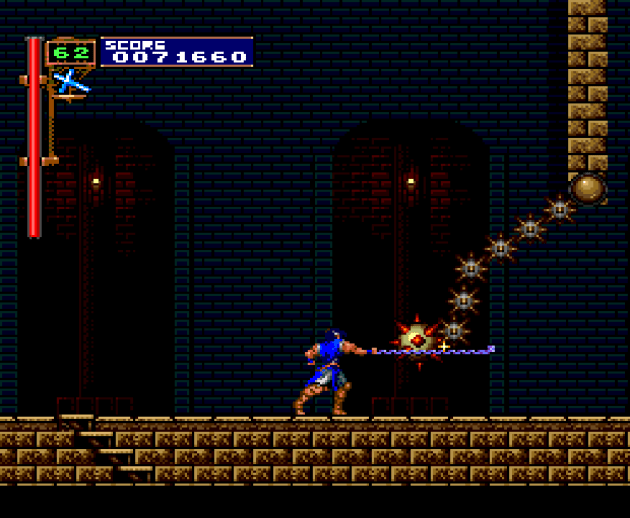
Ever wanted to whip one of the spiky ball chains? Now, you can, and it doesn’t just reverse direction. I was caught off guard when it behaved kind of realistically and was hard to get past. It’s that extra effort towards immersiveness in the level design and enemy design that makes me so frustrated with the cringey cutscenes.

Hell, I think this might even be one of the best games to introduce someone new to the Castlevania franchise. It’s not that hard a game, actually. The enemies are consistently fine-tuned to such a degree that it’s genuinely surprising when you encounter the rare spongy one. Even then, they’re usually staged in a way where they have an almost mini-boss feel. It’s actually remarkable how often Rondo takes what would normally be a flaw in a lesser game and turns it into a positive. If you’ve been intimidated by other classic-style Castlevania games solely because of their reputation for difficulty, give this one a try. In addition to some of the most balanced combat in the entire franchise, Rondo offers plenty of life refills and 1ups. If you die, while you lose your sub-weapon and your hearts are reset to 10, you’re not totally screwed, either. That’s because there’s no whip upgrades, yet every single enemy feels like it’s balanced properly to be slain by the default whip.

The only aspect that I feel isn’t well balanced is the bible sub-weapon. It has so much range and power that it’s essentially a low-cost item crash. If the cutscenes aren’t the worst problem with Rondo, the bible is because it’s too overpowered. Three hearts is just not a steep enough cost for an item this effective, and it even has a low cost (ten hearts) item crash.

While I can’t say with complete confidence that the bosses are also perfectly optimized for the whip, you will always have a chance to get at least one sub-weapon before entering a boss chamber. While you can still cheese the bosses if you have enough hearts to execute an item crash (and some cost quite a bit. One is a whopping FIFTY hearts!), it never feels like you’re cheesing it. What makes it even better is that Rondo’s defensive game is equally satisfying thanks to a variety of dodging moves. Enemies telegraph their attacks in a way where there’s always enough time to activate the backflip move. It takes practice to get the timing down, but it’s so satisfying when you successfully utilize it. I wouldn’t say this is a kinder, gentler Castlevania, but it offers the right amount of grit with almost none of dick moves Dracula X or any other Castlevania game ever has pulled. This might be the most balanced game in the franchise.

In my first playthrough, I lost three total lives from damage, two which were at the hands of the boss rush sequence that makes up the entirety of level six. It’s actually inspired, because the first four bosses are directly lifted from the original Castlevania. They don’t play the same, as Medusa has a body instead of being a gigantic head, there’s only one mummy instead of two, and The Creature doesn’t have Igor with him. I survived all of them, but I lost the final battle against the guy who resurrected Count Draculahaha. A guy named Shaft. I’m resisting the temptation to break out into song.

And this go around, the branching path system works a lot better than the half-assed effort made in Dracula X. Actually, the most damning observation of that game I have now that I’ve played through Rondo a few times is how half-assed the branching paths in the SNES “version” are. They seem to only be in Dracula X because Rondo leaned very heavily into the idea and they needed some token representation to say “see, this is totally an upgraded Rondo! It’s got an X in the title and a couple hidden paths and everything!” But whereas Dracula X’s paths feel arbitrary and out-of-nowhere, Rondo’s mostly have an elegant logic to them. Every start-to-finish game of Rondo (you open up a level-select option in the main menu after beating the first stage) will consist of playing eight levels, but each of the first five levels has secret pathways. The secret pathways aren’t that hard to find and usually contain an alternative boss which then leads to alternative levels, which, once again, have hidden paths, and so forth, and so forth. For example, in the first level, you go here:

And you get a different boss fight than if you just keep following the normal pathway and you’ll get a different second level. So, it’s not like Castlevania III where you choose a different path between levels. Now, to be clear: I prefer the way Castlevania III did it, and I’d really prefer the option of playing all the levels in a single run. If there had been a ROM hack that allowed this like the one I experienced when I reviewed Dracula’s Curse, I would have taken that option after finishing the real game. Of course, it wouldn’t work in this game without somehow rearranging the level layouts. The themes and enemies for roughly half of each of the first five levels and their alternative route counterparts change depending on which path you take. But, when the level design is THIS outstanding, I feel something is lost when you’re forced to replay it instead of them naturally unfolding. But, if a game is going to be designed with the branching paths in the levels themselves, this is probably as perfect as the concept gets.

Sometimes there’s more than two paths to take. There’s a LOT of secrets in this game, including a few one-off hidden rooms. I’m fine with that. Unlike Dracula X, Rondo feels like it’s fully based on exploration and secrets instead of just shoving a couple token ones into the game because the popular game it borrowed assets from had them.

The most noticeable secrets are that four maidens are hidden in the game, the first of which is Maria Renard, who is a playable character. The method of saving the maidens is much easier than in Dracula X, where one key had to be held for multiple doors. In Rondo, there’s three total keys, each of which is used once, in the level you found it in, and not too far from where you found it. With that said, I guess that would be the biggest strike against Rondo: you never know if a pit is actually a pit or the secret path. It happens more than once, too. There’s no way to spin that as a positive if the emulator you’re playing on doesn’t have quick save/quick load or rewinding because you have to just plug your nose and jump blindly while searching. So there, Rondo isn’t perfect. Unless you have a good emulator.

Apparently, not every “hidden path” actually goes somewhere. If there’s a point to this room, I never figured it out. I got a 100% completion so I guess the game just wanted to show where all these flea men riding cannonballs were coming from.

The replay value comes from a very enjoyable alternative character. Maria is unlocked in the second level, though you have to go back to the main menu to switch to her. She’s radically different from Richter, throwing doves at enemies instead of a whip. Richter gets a defensive backflip move, while Maria gets a double jump. She also can do a sliding move, but I never found any situation where it was more effective than jumping. Even a situation that seems tailored specifically for it didn’t work. The mummy in the boss rush stage throws blocks at you and, even though it appears high enough off the ground to slide under, the slide doesn’t work for it. Whatever. Her double jump works fine enough as a defensive move. Maria’s sub-weapons are all animal-based as well, including throwing a goddamned dragon at enemies, which is the most powerful sub-weapon in the game. But even throwing a cat at an enemy is both effective and hilarious, as the cat relentlessly attacks. It’s what my cat would do, even if it wasn’t fighting the forces of evil.

The item crash with the cat is some Power of Grayskull sh*t. Well, HONOR of Grayskull in its case. By the way, Maria apparently has a Street Fighter-like special move, but I was never able to execute it.

I know that a lot of the appeal in my reviews is talking about the flaws in a game, but the truth is Rondo is close to being without flaw. The unskippable cutscenes are easily the most annoying part, regardless of whether or not you know Japanese. In case it wasn’t clear from my tirade above, I really don’t like the art style. I don’t get the direction of it at all, really. It doesn’t match-up with the in-game graphics and really only breaks my immersion. But, fast forwarding through a handful of agonizing cutscenes to play a Castlevania that doesn’t really make any critical gameplay mistakes is a very small price to pay. I guess I was disappointed that the level that’s hidden until after you beat Dracula once doesn’t have a boss fight. Seems kind of lame for a Castlevania game, but even Dracula’s Curse does that too. Sigh. Rondo of Blood really is close to being criticism proof, especially with emulation trickery used to speed-up exploration. I can’t say enough good things about it. This was such a treat to finally sit down with.

OH HEY, there’s part of a bad level! Actually, the river rafting sequence doesn’t even qualify as bad. It’s just very bland, especially when compared to the rest of the game. It needed to be trimmed by at least half.

A lot of the time, famous Japanese exclusives that never got released globally during their original life cycle are really overrated. I’ve played several of them at IGC, from Super Back to the Future Part 2 to Magical Quest 3 to Wai Wai World. Rondo is the rare Japanese holy grail that actually deserves that status and it’s an absolute travesty that it took so long to go worldwide. It got a Wii Virtual console release fifteen years ago and a PSP release a little further back than that. It was also included on the already long out-of-print TurboGrafx-16 Mini, which kind of got hosed by a limited production run and incredibly poor timing as it was delayed due to the pandemic, which is a shame because it was arguably the killer app for it.

“Hey, haven’t you ever heard of guest rights? WHAT DO YOU MEAN THAT ONLY APPLIES TO THE HOST? No, it doesn’t! Wait. Yea, you’re right. I suppose it is right in the name. It ain’t called Host Rights, after all. I guess you’ve got me there. Well, next time I resurrect, I’m going to YOUR home to kill you. See how you like it when the shoe’s on the other foot, jerk! Oh, you won’t open your door for me? Hmmmph, rude! I always open my drawbridge for you! Where would you be if I didn’t do that? Kissing your family goodbye right before I enslave humanity, that’s where!”

Hell, Rondo would be the killer app for any collection. Konami could just as well slap a $4.99 price tag on it for Xbox and Switch owners and make a killing. So, why in the hell is the only available release a PlayStation exclusive? Now granted, Castlevania Requiem: Symphony of the Night & Rondo of Blood is a contender for best retro two-pack on the market today, but come on, Konami. The cutscenes aren’t THAT embarrassing. Okay, fine, they are, but that doesn’t explain why the hell you gave us Dracula X in Castlevania Advance Collection instead of this masterpiece. I thought THAT was evil, but then you put Haunted Castle in Dominus Collection instead of Rondo, and now I know true evil.
Verdict: YES!

THE INDIE GAMER CHICK CASTLEVANIA REVIEW SERIES
 Castlevania (NES) Dracula’s Curse (NES) Adventure (GB) Belmont’s Revenge (GB)
Super Castlevania IV (SNES) Dracula X (SNES) Rondo of Blood (SuperCD²)
Chronicles (PSX) Circle of the Moon (GBA)  Kid Dracula (NES) Kid Dracula (GB)
ROM Hacks (NES)
Konami Wai Wai World (NES) Wai Wai World 2: SOS!! Parsley Jō (NES)

“Yes, it vas I who put the sugar in your boyfriend’s gas tank, causing him to be late for school and getting him detention. Now you’re free to go to zee prom with me! Muhahaha! Truly I am the lord of evil! WAHAHAHAHA! Vas zat over the top? So vat do you say? Pick you up at 7:00? Does 7:00 mean 7:00 or are you one of those chicks where you say 7:00 but you’re still doing your hair and we leave at 8:00? I’m only asking because my hair gel starts to flake after a few hours.”

Astro Invader and Kamikaze (Arcade Reviews)

Astro Invader
aka Kamikaze
Platform: Arcade
Released in 1979/1980
Developed by Konami
Distributed by Stern (US)
NO MODERN RELEASE

I’d never heard of this game, but it’s featured in the music video for the song “You Got Lucky” by legendary singer Tom Petty in his first group, Tom Petty and the Heartbreakers. You can have a listen just as long as you SIGN HERE _____________X and INITIAL HERE___X to opt out of any health services for your ears. For everyone else, mute your computer before clicking this link right here. Hello, fellow citizens of Mute City. And it’s just you reading at this point, because everyone who had the volume on is on the floor with blood gushing from their ears after they used the nearest screwdriver to puncture their own eardrums. I tried to warn them but, hey, I already got their page view so f*ck ’em!

One of the first games developed by Konami and the first video game ever published by the legendary Stern, Astro Invader (US) aka Kamikaze (Japan) is also probably one of the first video games with transformative regional differences. I can’t stress enough how the US and Japanese games look the same and have the same concept but play completely differently. The base concept appears like it’s yet another Space Invaders-like shooting gallery, but the twist in the formula makes for a delightfully intense one-off unlike any of its fellow wannabes. You don’t actually get shot back at, as the enemies are just trying to um.. well, you know. I’ll ignore the implications of the title and assume this isn’t alien pilots trying to unalive themselves for the good of the cause. When these totally unmanned spacecraft crash, they explode, but you don’t die as long as you’re not in the blast radius. That brings us to major difference #1. In Kamikaze, the aliens create a great big blast radius that’s nearly as big as half the screen. In Astro Invader, the blast is less than half that. Big difference #2 is that the playfield is different. Kamikaze is on the left, Astro on the right.

Each of the slots fills one bomber at a time, in a left-to-right then right-to-left pattern until the row goes four-deep. At this point, the bombers begin to be released when a bomber enters a row. It’s certainly an interesting idea, as the enemies start off as sitting ducks that, if your aim is true, you can hold off for quite a while before the action starts getting faster than your movement. As you can see, Astro Invader has two fewer slots and red rectangles blocking the slot against the walls. This change has huge gameplay ramifications. In Kamikaze, the left and right most channels do not have a queue, so every “pass” sees bombers enter the playfield and become danger elements immediately. This doesn’t happen in Astro Invader, but it’s not necessarily easier even with the smaller blast radius for missed bombers. With two less slots, the remaining rows fill up much faster. UFOs also enter the playfield, but they’re not a bonus point thing. It’s a secondary danger element in Kamikaze and the primary danger element of Astro Invader, because if a UFO touches the ground anywhere, you lose a life. Now, this is the biggest change in my opinion: in Astro Invader, the UFOs can emerge from the center and from two red rectangles, but in Kamikaze, they only come down the center. So, in this screenshot:

I’m dead. There’s no chance I can get that UFO. It’s one of the most genuinely clever twists on the Space Invaders-like shooting gallery formula I’ve played because it’s not just about raw accuracy. Oh, that matters. Only one bullet can be live at a time. In Kamikaze especially, missing a shot when you’re under a live bomber is all but assured to be fatal. These are both games about screen management. It’s also a game that requires different strategies for each version. You can go all-in on defending one side much more easily in Kamikaze because it’s only the middle channel you have to defend from the UFOs. It feels like a much more pure shooter. Astro Invader’s three channels gives it an LCD-like spinning plate vibe that makes it one of the most intense games to ride Space Invaders’ coattails.

My biggest knock is easily the amount of down time that happens between rounds. Each wave is represented by a countdown on the mothership of how many bombers are left to enter the playfield. When it empties, there’s no pomp & circumstance. The mothership just slowly leaves the screen, then slowly returns, and it’s flow-killing. If this could be cut by 80%, I’d have almost no major complaints. These are fantastic games once you get the hang of them.

I didn’t like Kamikaze at all for the first fifteen – twenty minutes. Thought it was too repetitive and too low on the thrills. It only started to grow on me once I was able to compare and contrast with Astro Invader, which I got into much more quickly. Once I got a feel for the format and especially for the timing of how much time and distance I needed to be safe from bombers I couldn’t or wouldn’t shoot, I couldn’t put this down. You can think of Kamikaze as this concept’s “easy mode” but really, both games are solid and very addictive, with excellent scoring rules. I figured this review would take me an hour or two at most. Instead, I kept jumping between these two games for a whole day. It’s been a while since I discovered an older gallery shooter that did that to me. A couple years, actually. Kamikaze and Astro Invader are shameless bandwagoners, but they’re shameless bandwagoners that now join King & Balloon and Carnival among my favorite gallery shooters. It’s also one of the most underrated statement games from this era. At this point, Konami was still producing and distributing actual bootleg clones of popular games like Space Invaders and Head-On. Astro Invader was their way of saying “you know what? We’re better than being glorified pirates.” Yep. A LOT better, it turns out.
Verdict: YES! and YES!

And I wouldn’t have played these if not for Dave pushing for them. He finds me all the good stuff.

Wai Wai World 2: SOS!! Parsley Jō (Famicom Review)
Wai Wai World 2: SOS!! Parsley Jō
Platform: Famicom
Released January 5, 1991
Developed by Konami
Never Released Outside of Japan
NO MODERN RELEASE

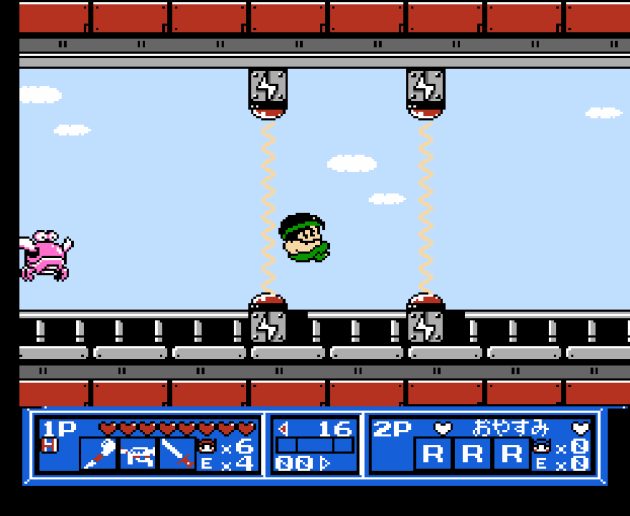
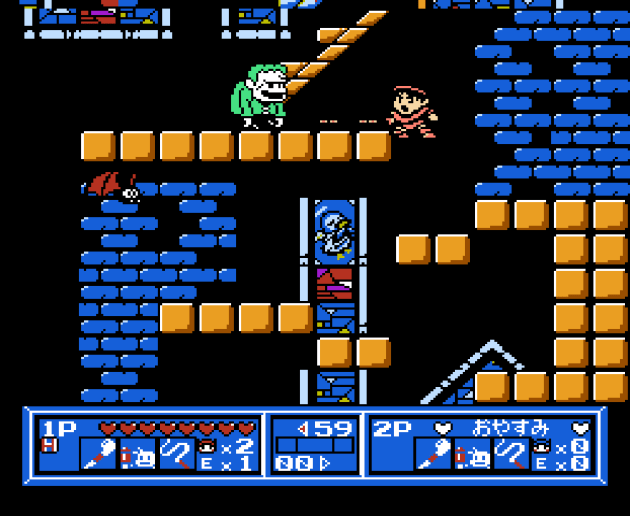
It looks like it’s going to be so much fun. Sigh.

Hoo, boy this is awkward. A lot of my friends have very different taste in games than me. While I was suffering through the first Wai Wai World, people I like and trust assured me that the sequel would be a lot of fun and to not worry about it. So, I didn’t. I really did have faith this was going to blow my socks off. Well, my socks are still firmly attached to my feet and I’m so darn butt hurt about it I could spit nails. So, it falls to me to knock YOUR socks off. Let’s see if this statement does it. Ahem. I really hated the first Wai Wai World, but I’d rather play it than this sequel because this is one of the most boring competent games I’ve ever played in my entire life. Wai Wai 2 is mechanically fine and it’s dull.

Instead of the possibility of playing as every character in a single run, you’re limited to only three of five Konami all-stars, which are.. you know what? F*ck it. There’s no point in even saying what characters are included or what games they’re from because they don’t feel anything like the original characters.

This is NOTHING like the first Wai Wai World. That’s all I really knew about Wai Wai 2 going into it. I never looked at a screenshot, and if I played this when I ran through hundreds of NES ROMs a few years back, I don’t remember it. So, when I saw the look of the game, my first visceral reaction was “eww.” It’s not what I was hoping for. Wai Wai 2 reminded me of Kid Dracula, which I liked just fine. It’s an okay game, but that art direction worked for it, and I’m over it. For this franchise, I wanted something that resembled the sprites from the Konami library, not hyper-cute versions of them like Kid Dracula did. It’s what the first Wai Wai World did and what I thought I was signing up for. But, I kept my mind open, at least until the gameplay slammed it shut with one of the most intolerable opening stages ever.

Look! It’s the guy from Contra! I mean, it doesn’t look like him or play like him even a little bit. You can’t even shoot the gun diagonally. None of the iconic power-ups that made Contra an all-time classic are along for the ride, which would be the only reason anyone in their right mind would want to play as the guy from Contra in a non-Contra game. Allegedly the spread gun is here somewhere, but I didn’t see it, and it wouldn’t have helped in THIS game. Even with just the basic gun, he’s so overpowered that he takes what little stakes there are out of the game completely. Calling this the Contra guy is jiggling a key chain at its worst.

Unlike the first game, this is a completely linear ten level genre mash-up that opens with one of the slowest auto-scrolling platform stages I’ve played. An introductory stage that has no excitement at all. I’ve never used the fast forward function on my emulator as early as I did here, and then I kept going back to it because there’s so much dead air where nothing is happening because the screen isn’t so much scrolling forward as it is eroding forward. I’m not a big fan of auto-scrolling platforming in general. I can tolerate it, but not when it’s this slow and nothing happens. The enemies are easily dispatched and the game continues to inch forward. When the stage was still going on minutes later, even though I frequently fast-forwarding, mind you, I really started to become afraid the whole game would be like this. When the second stage allowed me to actually do the scrolling, it was such a relief. “Well, at least the auto-scrolling is finished.” And then, later in the game, this happened:

By the way, that robot is the main character, with all the Konami all-stars being like power-ups you switch to.

That is a screenshot from the slowest and most boring auto-scrolling stage in the entire history of video games. LOOK HOW SLOW IT SCROLLS! Who the hell play tested this? Did they think it was exciting? Did they think this was fun? Now, the stages where you actually do the scrolling aren’t the worst levels in game history, but they are very boring. The designers seem to have overcorrected the difficulty problem of the first Wai Wai World, because this sequel is completely toothless. I never died once during the platforming segments, even though I was braining myself on the spikes in the slow-moving swimming stage above. Besides one boss fight, I don’t think I ever had more than one or two hearts worth of damage. I can’t imagine playing this co-op, because it sure seems like one of the two players is going to have nothing to do for all but one level. There’s not enough meat in these levels for one player, let alone two.

I feel like this is the embodiment of the Leonardo DiCaprio pointing at the TV meme. I too recognize that scene with three coffins from Castlevania III. Jiggle jiggle.

Instead of switching on the fly between the different characters and using them to get past character-specific obstacles, this is just a pure, mindless action platformer where the all-stars are glorified power-ups. You collect an item that turns on a meter that swaps between the three icons of your Konami all-stars loadout. When you press UP and A on the one you want, you switch to that character for the next sixty seconds. Oh, and you’re now invincible. For sixty seconds. Not even fast counting Punch-Out!!-like seconds, either. Granted, if you take damage, it takes a few seconds off the countdown. That doesn’t matter though. This is a seriously cinchy game. I’m not even kidding when I say this is like a baby’s game.

Most (if not all) platforming bosses can easily be beaten by mindlessly slashing at them. I’ve found that a reliable barometer for how mindful a game’s developers are of the type of game they’re making can be found in how much effort a boss takes to dispatch. If you can literally walk up to one the first time  you ever play it and, without making any effort to dodge its attacks, defeat it by simply mashing a button with no regard for how much damage you’re taking by doing that, that’s usually reflective of the game being a product of developers who simply didn’t give a sh*t. Don’t mistake what I just said for easy. It’s not the same. An example of an easy boss is the first Bowser in Super Mario Bros. You still have to actually have timing, especially the first time you ever fight it. Some proactive step has to be taken instead of just not caring what happens to you because you’re going to outlast it regardless.

But even if you do take damage while wearing one of the all-stars, there’s so many power-ups that start that meter. Even if you’re already wearing an all-star, you can start the meter going by grabbing an item, wait for the count down to get low, and activate it for the same character again. By the end of Wai Wai 2, the game is giving you the items for that meter seemingly every screen, allowing you, in essence, unlimited invincibility. On top of that, there’s “health boxes” which reset the timer to 60 seconds. Someone got paid for this idea, and someone else got paid to say “good idea!” to that person, and someone else got paid even more to agree with the second person and green light the first person’s idea.

In addition to the platforming segments, there are also a bunch of one-off distractions from the mediocre platforming along the way. Like, the lead-up to the Castlevania stage is basically Frogger. It lasts under a minute, but it’s better than anything in the platforming stages. And for you shmup fans, don’t worry, I’m getting to that. It’s the only good part of the game.

Of course, having so many of these all-star switchers are probably there to accommodate co-op because, as always, co-op ruins everything. Even taking co-op into consideration, the game abandons the idea of the items being special by the end of the game. I couldn’t keep up with all the meter-starters in the last few levels and didn’t bother trying, but they seem to have forgotten about the 60 second timers. I don’t think I took a single hit of damage for the back half the game, at least in the platforming stages. It’s like Wai Wai 2 gets stuck in God Mode, and God Modes get old fast. You just can’t design a game like this and expect it to be enjoyable, you know?

This would have been neat if Kid Dracula didn’t also do a similar Castlevania, only with much more fun play mechanics. Or if I want to play something like Castlevania, I could just, you know, play Castlevania. I thought the point of Wai Wai was to play Castlevania with the Contra guy, and it’s actually THE Contra guy, with the sprites from Contra and the controls from Contra. That’s the game we all want, right? That’s quirky and weird, especially if you play it completely straight.

I feel like they just had the wrong overall concept for the platforming bits, which make up over half the game. It’s such basic, generic level design with no-frills combat. The closest any Konami game comes to this isn’t actually Kid Dracula. It’s the NES Tiny Toons, another overrated Konami game that’s all style and no substance. What was even the point of doing a sequel to Wai Wai World that doesn’t feel even a little like the first? I didn’t like it, but it does have fans and, at the very least, I’m very intrigued by the concept. I feel like this couldn’t possibly appeal to whatever fans the first game made, but at the same time, this feels so disconnected from the other Konami characters being honored that I’m not even sure why they bothered with this game at all. The platforming stuff is all pure digital boredom and I have nothing positive to say about it, but at least there’s a couple very, very good shmup stages.

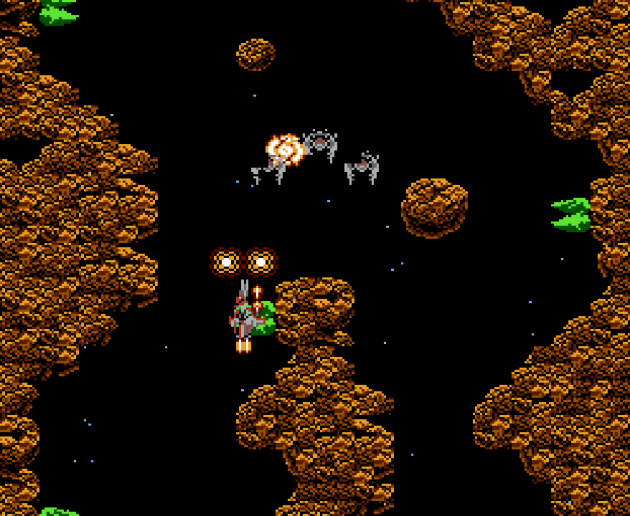
A comically gigantic version of the iconic Big Core MK I from Gradius is the highlight of the entire game. It’s very cool and actually very challenging. When I wasn’t capturing screenshots, I lost several lives fighting it. You’d swear these segments are a different game entirely. They basically are. Crying shame that they’re stuck in Wai Wai World 2.

Unlike the first Wai Wai game, the shooting stages actually feel like the real games that inspired them. Specifically TwinBee, which is the third stage and Gradius/Salamander, which is the eighth stage. Both of those are “branching paths” but what that means is if you play the game a second time (or reload a save state to return to the level select screen, which is what I did), you can play a different course. This only happens with the shmup stages. I don’t know why they didn’t cut or merge some of the platforming stages and then have every other stage be a shmup, since they’re really fun. I’m not so much into TwinBee, but it’s alright and so are its levels in this. But I’m a huge fan of the whole Gradius format, and both the stages and the encounter with the giant Big Core are every bit as good as the franchise deserves. It’s basically a slightly less silly version of Parodius.

I literally sat up in my chair when the game transitioned to third-person in the TwinBee section, but it was a massive letdown. This is only a bonus stage that feels like After Burner, and all you do is get bells, and here, you can only juggle the bells into one color instead of many. There’s also no enemies. I was really hoping for a boss fight. I’m about to play somewhere around a dozen TwinBee games for a Konami Shmup Definitive Review, and I wouldn’t mind seeing more of this, as long as it does more.

There’s one other branching-path segment that allows you to choose between doing something that kind of resembles a sliding puzzle, only without the normal sliding puzzle rules, or a car driving level. The puzzle was bizarre only because, while you solve it, you occasionally have to switch the position of a character that has a train heading for her. It’s not hard and just adds busy work to the puzzle experience, but it was different. The car level was somewhat close in both look and feel to the Autopia level from Adventures in the Magic Kingdom, which is shockingly one of the most popular reviews I’ve ever written. It controls looser, has projectiles, manual jumps, a boss fight, and it’s much more challenging, but it still feels similar. In fact, when I reached that stage, I wondered if Magic Kingdom was the game that inspired Wai Wai 2. Magic Kingdom had large, hyper-cute characters and basic platforming. The difference between the two games is that one is the platforming is just better done in Magic Kingdom. No boring auto-scrolling helps.

It’s not hard to figure out why Wai Wai World didn’t take as a franchise. It feels like the first game created an amazing set of blueprints to build off of. You never know! Who imagined after playing the first Grand Theft Auto that it would go on to become one of the biggest things in gaming? For all we know, Wai Wai had that breakout potential, and Konami squandered it by seemingly choosing a team that didn’t get the joke of the first game. The idea of a dead-serious cross-over like Wai Wai World is kind of funny by itself. The first game would have been charming if not for the plethora of technical problems. This sequel isn’t charming. It feels like it’s trying too hard to be irreverent and quirky. Going over the top with the wacky sprites and completely changing how the roster of all-stars is implemented so that they no longer feel remotely connected to the games they came from feels like it betrays the entire concept of the first game. And the designers didn’t even stand by their convictions, because they stuck so closely to the TwinBee/Gradius formula for those stages that they feel like they were stolen from other games instead of belonging to this one. I think a ROM hack could save the first Wai Wai World, but this? I don’t think it came from a place of inspiration. It feels cynical, and I can’t forgive it for that.
Verdict: NO!

THE INDIE GAMER CHICK CASTLEVANIA REVIEW SERIES
 Castlevania (NES) Dracula’s Curse (NES) Adventure (GB) Belmont’s Revenge (GB)
Super Castlevania IV (SNES) Dracula X (SNES) Rondo of Blood (SuperCD²)
Chronicles (PSX) Circle of the Moon (GBA)  Kid Dracula (NES) Kid Dracula (GB)
ROM Hacks (NES)
Konami Wai Wai World (NES) Wai Wai World 2: SOS!! Parsley Jō (NES)

I honestly forgot this was in the game. After the auto-scrolling in level one, you do this shmup section where you can shoot both ways. It’s as forgettable as the platforming segments.

Konami Wai Wai World (Famicom Review)

Konami Wai Wai World
Platform: Famicom
Released January 14, 1988
Designed by Konami
Never Released Outside of Japan

NO MODERN RELEASE*

*Really should be NEVER BEEN RE-RELEASED but technically a mobile port was released in 2006.

Wai Wai World has two MAJOR problems that I couldn’t get over. This is the first:

No, I don’t mean Simon Belmont fighting a dragon from the Goonies. Hypothetically, that’s cool. What’s not so cool is how much you have to hug the screen to get it to scroll. I can’t say for certain it’s solely responsible for Wai Wai World getting a NO! (spoiler alert) because this is a generally problematic and boring game. But it’s impossible to know, because the combat would be transformed by normal scrolling. What do I mean by that? Well, the game that Wai Wai is most often compared to is Castlevania. The Wikipedia page says gameplay is, quote, “very similar to Castlevania.” VERY similar. Folks, it’s just not true. I hate it when Wikis say crap like this. Those completely generalized “the game is a top-down maze, so it’s essentially like Pac-Man or Bomberman” type of comparisons like with the PC Engine version of Batman. Do not go into this thinking you’re playing a Japanese exclusive Castlevania that lets you also play as Goemon and Mikey from The Goonies.

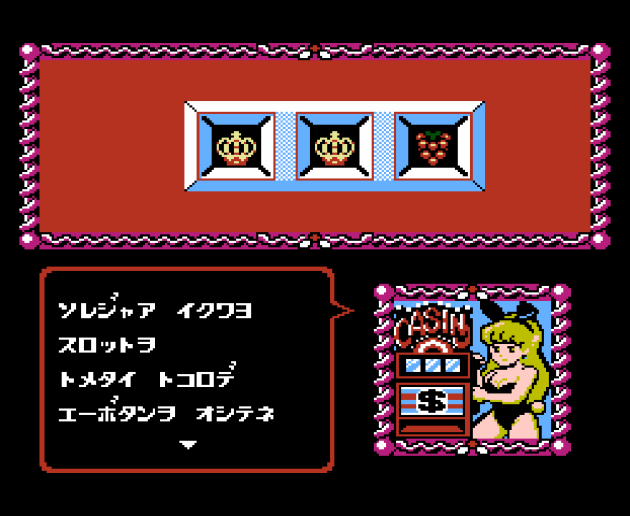
Few non-RPGs have as many ROM hack translations out there as Wai Wai World has, but you really don’t need a ROM hack or know Japanese to play it. The walkthrough at StrategyWiki should be more than enough. You might need the slot machine to bring back dead characters, but I never lost a single person. Well, I did but it was BS so I rewound it. What?

Wai Wai World has the stairs from Castlevania that are essentially identical to the ones from the first Castlevania and that’s where the similarities end. The combat doesn’t feel like Castlevania. The action doesn’t feel like Castlevania. Hell, Wai Wai World doesn’t even feel like Castlevania when you’re in the Castlevania level playing as Simon Belmont and fighting skeletons and Dracula. I’m not kidding. It feels like a bad bootleg of Castlevania, and it’s from the same company! That is one of the most f*cking astonishing failures of game design I’ve seen in my life and worthy of mockery, but I’m going to play along anyway and use Castlevania as an example. So, when you’re scrolling the screen in Castlevania, where are you on screen?

IN THE CENTER OF THE SCREEN! And where are you in Wai Wai World?

You’re closer to the side than you are to the center.

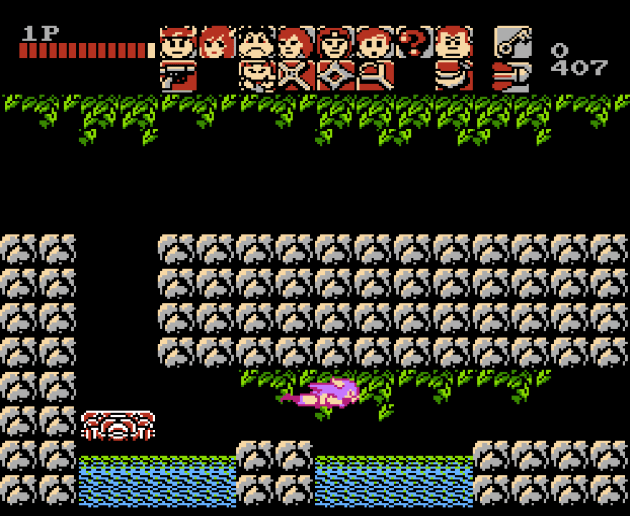
Because of the scrolling, combat is lacking in the elements I think the average player seeks from action games, like excitement, catharsis, or a worthy test of your skills. Most of the time in Wai Wai World, enemies are sprung on you, and if they have the capability of firing a projectile, usually they fire and as soon as they appear. For a lot of them, their attack conveniently is measured perfectly to match the exact length of distance between you and the edge of the screen where you scroll. How lucky for them. So, as you scroll them into existence, they fire and you take a hit that you can not react fast enough to avoid. It’s nothing but a GOTCHA and a life slap.

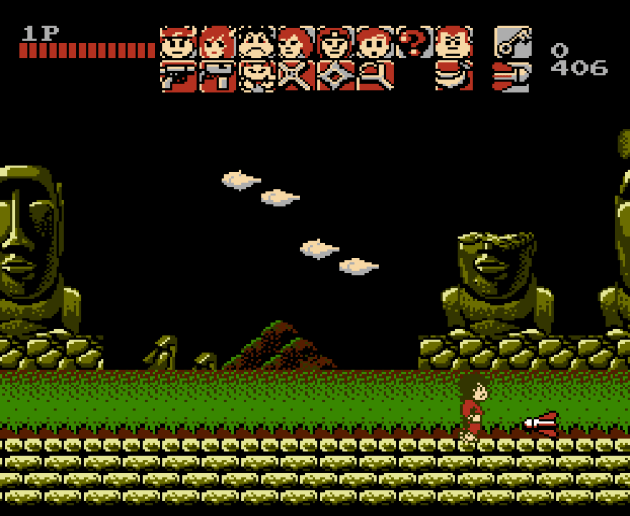
The design is universally crap. That heart had actually been on the ground and in a treasure chest. By the way, as far as I could tell, the only thing in treasure chests are life refills. But, for whatever reason, only Goemon can open the chests, and when he does, the heart flies up in the air before landing. Throughout the Moai statue level, there’s multiple hearts placed within reaching distance that immediately fly up in the air to an unreachable platform. Even hearts that come from chests disappear relatively quickly, and as far as I could tell, you don’t have enough time to touch the chest with Goemon, scroll through the characters to reach Konami Man or Konami Lady, jump up in the air while holding down the button so you can enter your flying mode, then fly up and grab the heart, which only refills the character who is selected anyway. It’s so trollish. Maybe it’s a co-op thing. I dunno, but this game has a mean-spirited attitude in general so I assume these were meant as jokes.

While life refills are plentiful via random drops, that’s not the point of an action game. There’s no sense of tension because the enemy has already spawned and damaged you before you even know there is an enemy, and so all the action is kind of retroactive, as if combat comes with a life tax. It takes the joy out of making progress, because you’re in a state of hyper-vigilance whenever you’re moving forward, especially as the enemies become more dangerous. If you become low on health, you essentially have to heel-toe forward until you rebuild your health because no amount of skill can protect you from enemies who spawn into existence already in their attack animation right in front of you. At one point, I did find my entire roster critically low on health and resources in the Hell stage, and it sure as heck wasn’t fun. I assume the scrolling was done this way to accommodate co-op, which Wai Wai World offers. It isn’t more fun with two players, especially for the person who goes first and does the scrolling. It just goes to show that arbitrary co-op ruins everything. And I’m not even entirely sure it’s the WORST problem.

Here’s the second major problem with Wai Wai World:

In that picture King Kong (yes, King Kong. This game is weird) is successfully landing a punch. LOOK HOW FAR AWAY I’M STANDING FROM THE THING I’M PUNCHING! And this isn’t one of those games where that works only one way. You can’t use sprites to suss out a safe distance between enemies and the bullets they spray because the collision is universally horrendous. That, combined with the fact that most attacks have no middle frames of animation, make Konami Wai Wai World a game completely lacking in cathartic combat. There’s no OOMPH to the attacks, no sense of violence at all, and thus no immersion. You feel like you’re playing a sloppy-ass game that wants to be quirky without any of the actual charm or effort that made Konami an elite NES developer in the first place.

Even the space shooting level that happens before the final level isn’t good. This feels like a bad knock-off of a Konami space shmup. Even the boss at the end feels like it’s a deleted scene from Life Force that was cut for extreme lameness.

It’s just not a fun game to play, or to explore. Rather than being Castlevania, which I can’t stress enough this is nothing like besides the staircases, this is much more like The Goonies. Not the excellent NES sequel Goonies II, but the first one that never got an American NES release. The combat especially feels just like it: flimsy and lacking in weight. If you’ve not played Goonies 1, instead think of this as a poor man’s Zelda II. Specifically Zelda II’s dungeons, which the levels in Wai Wai World are very similar to in structure and feel. Only, there’s no hub-world and instead you use the starting screen on each stage and hidden warp zones to return to the game’s Mega Man-like level select screen.

I probably shouldn’t have used this picture because hot damn, that looks fun. I just played Wai Wai World two and a half times and know it’s a terrible game, and my brain is still telling me “look at that! Golly, that looks good!”

The basic gameplay idea is you start with the superheroes Konami Man and Konami Lady, and you have to go around looking for keys in stages that allow you to unlock the star of a Konami game that’s trapped within the stage. There’s six in total: Simon Belmont from Castlevania, Mikey from The Goonies, Goemon aka Mystical Ninja, the hero of the Famicom exclusive Getsu Fūma Den (which I’ll try to review in 2025), one of the Moai from Gradius (one of 76 games reviewed in Konami Shoot ‘Em Ups: The Definitive Review) and King Kong from another Famicom exclusive called King Kong 2: Ikari no Megaton Punch (again, I’ll try to get to it in 2025). After you save them, you do a single shmup level with Vic Viper from Gradius or the TwinBee. It’s one of the most random lineups ever, but it’s not like Konami in 1988 had a deep roster to pull from.

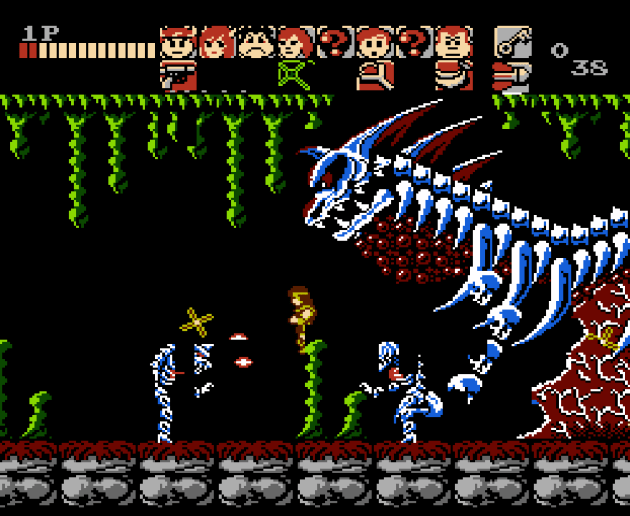
Dracula isn’t even a boss in the Castlevania stage, but he’s a major nuisance who absolutely spams the screen with bullets. Do you see the armor next to him? You cannot get it until Konami Man and Lady have the ability to fly. If you play the game by the universally suggested order, Castlevania is the 2nd and 7th of ten steps. Unlike a lot of Wai Wai World’s problems, this is one that I get what they were aiming for, but having the stuff just laying around doesn’t lend it that air of importance. They really needed to implement the items in a way that felt more eventful. There are some big bosses that drop keys and one even directly unlocks a new character, but it’s not enough.

It still sounds like such a neat idea, but after a while most of the characters feel too samey. Goemon stands out because he attacks almost diagonally. Simon stands out because the whip has reach. King Kong stands out because his collision box seems King Kong-sized. But, besides Simon’s whip, none of the basic attacks feel radically different, and thus none of the characters feel radically different. You’ll want to rely heavily on sub-weapons for combat. The sub-weapons use one point of ammo, except Simon’s boomerang which uses five points (that was the smartest design choice they made because three can be thrown at a time and it’s very overpowered) and Fuuma’s ninja stars, which cost three points. Each character has a sub-weapon hidden somewhere in their level, but you probably won’t be able to get a few in a single run through their stage and will have to return later. Wai Wai World has far too much backtracking, some of which is optional, and some of which isn’t. 

I had to use my standard safety configuration of sitting far from the screen and drowning out the room with lights while fighting bosses because of epilepsy concerns. I figure I should use this space to remind people that I’m partnered with AbleToPlay to help spread awareness of photosensitivity, which is going to be an issue for older games. Wai Wai World wasn’t always bad with it, but damaging bosses leads to my specific trigger of bright, white flashing. Go support AbleToPlay and sign up to help curate information on risky games, or games that are suitable for people with limited motor functions, or colorblind players, or deaf players. It’s a great idea and I’m so down with it.

For example, the easiest level in the game is Feudal Japan, where Goemon is. Find the key, slay a dragon, get Goemon, who has the highest basic attack of any character. Trust me, that comes in very handy for the rest of the game. However, in order to get Goemon’s lucky cat sub weapon, you need to have the Konami Mantle. That’s a cape that lets Konami Man and Lady Fly, which also makes them lay down and stretch out their arms heroically, which allows them to squeeze through tight spaces. The Mantle is located in Hell, which in order to get into the majority of the stage, you need King Kong, since only King Kong can jump high enough to get past one specific jump that blocks off the majority of the stage. King Kong is located in the big city. In order to enter the majority of the Big City’s stage, you need Mikey from the Goonies because only he can fit through the tiny hole that blocks off the majority of the stage.

This is where it gets kind of silly. Mikey is the only one who can fit through this hole, which appears early in the Big City stage. It’s a tried and true Metroidvania trope of “find the thing that lets you get through the small gap.” It can be done well. I have no objection to the morphing ball in Metroid. I can believe that makes total sense. But, for Wai Wai World’s suspension of disbelief to work, you have to make believe that none of the other characters can crawl. Crawling, otherwise known as that thing that babies do. And that sh*t in the picture isn’t exactly morphing ball-sized. It’s a teenager-sized gap. You mean to tell me that Simon Belmont, slayer of vampires, the man who walked into Castlevania and didn’t immediately run back out when he saw walking skeletons and the literal personification of death, can’t duck his head just a little bit to save the f*cking world? Really?

So, you have to go to the Goon Docks stage and get Mikey in order to get King Kong in order to get the cape in order to go back through a level you already beat once just to pick up a couple things you missed before. Some games can pull off this kind of design mentality, but Wai Wai World can’t, because the gameplay’s lack of excitement renders the backtracking and replays a complete slog. If the combat along the way had been good, I might have been talking about this design being genius, but instead, Wai Wai World is just so boring that it’s insufferable. It’s so frustrating because I really do get the sense that somewhere in this disaster, there’s a great video game.

The game ends on a Metroid-like “everything is blowing up” escape. You’ll want to use Konami Man or Lady and just fly through it, because if you mess up only once, you won’t have enough time to finish.

Switching characters is too clunky, as it’s done spontaneously by holding up while pressing the A button. That was silly, because it forces you to jump as you change, which causes a lot of problems in the heat of battle. You can’t pause and switch characters, which would have helped. Changing from your main weapon to the sub-weapon is done by holding down and pressing A. If only there was one specific button on the Famicom/NES controller you could use to help SELECT which character you wanted. A select button, if you will. Well, this is once again a foible of the co-op. The Famicom’s controllers are hardwired into it, and the second player controller is lacking START and SELECT buttons, and thus the crappy swapping system Wai Wai World has. Say it with me: CO-OP RUINS EVERYTHING. Why couldn’t they also have SELECT switch characters for those of us playing single player? Because guess what? They did do that, sort of! You can use select in the shmup stage to switch between the Gradius ship and the TwinBee ship.

Oh, now you’re using a logical control scheme, for one level, at the end of the game? Oh you bastards. You absolute no good rotten bastards. Are we entirely sure this whole game isn’t some kind of practical joke?

Wai Wai’s final nail is that it doesn’t even feel like a Konami NES game. It feels like one of those modern indie games that tries so hard to feel like a popular 80s style generic action game and comes so close that it triggers the uncanny valley. The best example, and this is going to sound like such a nitpicky thing, but just the act of turning around and attacking is totally different here than it is in Castlevania. When I try to turn around and attack a monster that’s right on my ass in Castlevania, I can usually do it. In Wai Wai, I usually didn’t do the “turn around” part and swung my weapon in front of me. The timing of movement and attacking is all wrong, and in a game that’s based entirely around having enemies spawn right on top of you, that’s a mortal wound. You know, I thought I was heading towards a “competent but boring” NO! verdict, but this is actually a very incompetent game. It’s so technically wrong on so many different levels that whatever the hell Konami was aiming for in terms of style and substance doesn’t even matter. You can’t play with good intentions, only the end results.

This part here, where you get Konami Lady’s sub-weapon, is one of the most broken elements I’ve seen in a game. That looks like a normal elevator in the game, but it’s actually a quick-dropping booby trap. So quick that it’s basically an instakill. You have to wait until you get the Mantle to fly down to it. Well, except the gap is so narrow and the collision so spotty that I died anyway several times from the game deciding I had landed and springing the trap when I clearly was not standing on anything. I mostly didn’t cheat playing this, but I did rewind those incidents, because that was straight-up bullsh*t.

It’s really hard to judge creative design like level layout or the potential of enemy attack patterns when the game’s flaws are entirely mechanical in nature. Of all the retro games I’ve reviewed over the last year or two, no game is begging for a quality of life ROM hack as much as Wai Wai World is. I’d LOVE to see a talented, passionate ROM hacker give this game a tune up that fixes the scrolling, collision, and movement physics. Fix two of those those aspects, any two really, and I think Wai Wai World would at least rise to the level of “solid.” Fix all three and, for all I know, this might be a historically fantastic 8-bit game. Wai Wai World is such a mess that I honestly can’t figure out what its ceiling could have been. But, what I do know is myself and everyone else who hears about this game wants it to be better than it actually is. Even as you’re playing it and coming to the slow realization that what you’re playing is actually quite crappy, you still want this premise and these characters to come together and blow you away. I don’t want a re-release of this. I want a remaster, and I want to see what happens.
Verdict: NO!

THE INDIE GAMER CHICK CASTLEVANIA REVIEW SERIES
 Castlevania (NES) Dracula’s Curse (NES) Adventure (GB) Belmont’s Revenge (GB)
Super Castlevania IV (SNES) Dracula X (SNES) Rondo of Blood (SuperCD²)
Chronicles (PSX) Circle of the Moon (GBA)  Kid Dracula (NES) Kid Dracula (GB)
ROM Hacks (NES)
Konami Wai Wai World (NES) Wai Wai World 2: SOS!! Parsley Jō (NES)

E.T. the Extra-Terrestrial (NES Review)

E.T. the Extra-Terrestrial
Platform: Nintendo Entertainment System
Developed by Khan Games
NES Graphics by Pacnsacdave

Oh, this isn’t part of the phone. That’s finished. E.T. got his girlfriend pregnant and is none too happy about it.

I bet you think this is an April Fools joke, huh? Well, it ain’t! Download the ROM here.

Okay, so E.T. for the NES is kind of an April Fools joke in the sense that I’m reviewing it with my tongue firmly resting against my cheek. But, make no mistake, this is a real game. In fact, this is a ROM hack of a remake of a game. Someone built an NES version of E.T. that had more Atari-like graphics, then another guy turned those into NES-like graphics. Just like how talented people think it’s a perfectly good use of their time to remake Plan 9 From Outer Space, a few talented game designers said “hey, let’s put our time and effort into remaking one of the most notoriously bad games ever made, beat-for-beat.” Now, I’ve already reviewed the E.T. Atari 2600 game because it’s required by law for anyone who covers retro games, and per tradition, I noted that it’s not the worst game ever made. It’s really not. It’s just boring. So, how’s this remake?

As far as I can tell, there’s no “junior” version of the game that doesn’t include the enemies. That’s fine. At least the pits are easily visible and a lot less easy to fall into.

It’s literally the same game with bland NES graphics. The uninspired gameplay of the original is here in all its insufferable glory. Walk around as the adorable little alien, picking up delicious Reese’s Pieces™ The Official Candy of E.T.™ while avoiding the FBI agent and the scientist. Fall into pits, deliberately or accidentally, to find the three components of the galactic phone. Walk around hoping to stumble upon the context sensitive spot that allows you to phone home, then run to the spot where your ship lands. Did they fix anything? Well, the pits are more visible, though I had multiple instances where I switched screens only to fall immediately into a pit. The only other major quality of life improvement seems to be a high score table that was pretty dang glitchy.

I really though the game might crash here.

On one hand, it’s funny that anyone would do this, and do a good job of it. I mean, it does retain the exact feel of the Atari game that is, in fairness, one of the most famous video games ever made.

On the other hand……… really?

Like I said in the Atari review, the problem with E.T. is that it’s not bad in a compelling way. It’s just plain boring. This premise had no potential to ever be fun and should have been killed on the drawing board. Collectathons can work, but not via pits. Not with two guys who grab you and carry you away from your search. Not without combat. Not without some variety to the areas you search. Not without needing to slowly hover out of the areas you’re searching while holding a button down. Fix any one aspect of E.T. (and the pits are often fixed in ROM hacks) and it doesn’t help because there’s another five things that sink all the potential for fun. You cannot fix E.T. because E.T. is a boring idea that had no merit at all behind it. It was never a game that came from a place of genuine inspiration. It exists because Warner Bros. overpaid and over-promised Steven Spielberg and gave their most talented developer (at least most talented who hadn’t already bolted for a third party) carte blanche to make whatever he thought he could finish in the under six weeks he had. The only thing that makes me giggle is that Spielberg thought the idea was lame and asked why it couldn’t be more like Pac-Man. Heh, I guess he didn’t play the Atari 2600 Pac-Man.

It looks like he’s hugging the damn FBI guy.

So, E.T. for the NES is bad because E.T. for the Atari is bad. Maybe the guys behind E.T. for the NES (at least the version I played, because apparently there’s others) understood that this game is beyond redemption, which is why there’s no real attempts at quality of life improvements outside of the pits. But, if you want to pay tribute to a bad game, the best way to do that is to attempt to fix it. The novelty of playing E.T. with NES graphics lasts, oh, about two or three screens, and then you’re stuck with one of the most boring games in history, only with improved graphics. Why not add scrolling or change some of the pits to caves? Try something that hasn’t been done. Get weird with it. Look what NES Rocks did with Super Pitfall! He turned a game that makes many “worst of NES” lists into a game that is beloved by the indie and retro communities (I swear I’ll get around to reviewing it in 2025). I don’t know if that’s even possible with E.T., but you’re not going to find out just by remaking it.

Why does it always take me multiple games of this crap to find the call zone? I’m still convinced in some games it must randomly place that in the center of a pit.

If you got a kick out of the existence of an NES-port of a game often labeled the worst game of all-time, I’m happy for you. I don’t get it at all, because to me, this is the wrong way to honor a legendary bad game. I think the only way to do that is to make that game better. I get that there’s some people out there who unironically love E.T., maybe because it was part of their childhood and they didn’t know its reputation or maybe they just like the slower, low-pressure collecting aspect. But, they’re in the minority and they don’t need a tribute like this. They just need the original cart, which works FOR THEM. They’re happy with it, and that’s tribute enough. A proper E.T. tribute needs a complete tear-down and rebuild that grasps what Howard Scott Warshaw was aiming for. That guy who is the one person in the whole pitiful E.T. for Atari fiasco who had the best of intentions. Honoring his intentions and not the end result is the only real way to honor E.T. for the Atari 2600.
Verdict: NO!

Looney Tunes (Game Boy & Game Boy Color Review)

Looney Tunes
Platform: Game Boy, Game Boy Color
Released October 2, 1992 (GB) September, 1999 (GBC)
Directed by Akito Takeuchi
Developed by Sunsoft
NO MODERN RELEASE

Early in my play session with Looney Tunes on the Game Boy/Game Boy Color, I thought this was going to turn out to be an underrated game. One of those “jack of all trades, master of nothing” affairs, but a decent one. The idea is neat: each of the seven levels sees players taking the role of a different heroic member of the Looney Tunes cast. In level one, you play as Daffy and make your way through a series of bite-sized platforming screens. There’s even a novel attack gimmick: you throw a frisbee that works like a mix between a boomerang and the Dagger of Throwing from Wizards & Warriors. The controls were a little loosey-goosey and the collision wasn’t amazing, but I loved the projectile and the level design seemed well above average. I thought “okay, this could be special.” Nope. The problem is, after the first stage, you don’t return to that style of platforming until the last stage. And, when it returns, the decent level design doesn’t return with it.

The graphics are fantastic, whether you use the Game Boy or Game Boy Color versions.

The second stage has you playing as Tweety. This is an avoider-style platformer where you’re simply trying to avoid Sylvester. Having just played one of the best avoiders I’ve experienced, ironically a Road Runner game for the Genesis, this really doesn’t cut it thanks to the lack of variety. You just repeat the same tiny handful of obstacles for several agonizing minutes (it feels longer), while the strategy to avoid the cat remains the same: just zig-zag. You don’t die if he catches you, instead only losing a single heart (and there’s plenty of refills). There’s also a variety of open sewers that the cat will blindly run into, and it’s not very hard to trick him into doing so: just stay low. This was completely brainless and one of the worst second stages I’ve ever played.

This isn’t even the “big boss” of the stage. The little star tailing the witch is.

The third stage is the typical and seemingly required-for-certification Game Boy shmup stage, just like Mario Land or the Game Boy Batman. This WOULD have been okay, but the collision is at its worst here. That’s a big problem because the stage’s last boss shoots a heat-seeking fork that’s sometimes seemingly impossible to avoid. It can be shot down, but it takes a lot of shots to do so, and if it’s shot close to the edge of the screen, you just won’t have time. I died twice fighting this boss alone, and all six hit points felt completely unavoidable. I’m not the biggest fan of Mario Land’s shmup stuff, but Looney Tunes made me appreciate what that game accomplished. In the case of this game, I think the sprites are too big for what they wanted to do. Compared to some of the other ideas in Looney Tunes, this wasn’t a disaster, but it certainly wasn’t good.

“Level” four is a waste of time.

Level four is basically a no-fail bonus stage where you have a minute to get as much meat as you can with the Tasmanian Devil. It’s not very good, as it’s too easy to get stuck at the top of the screen. The whole idea behind this bonus stage made more sense in the original black & white Game Boy game. In the Color version, each level has a bonus stage attached to the end, making a mid-game solo bonus stage redundant and a massive waste of time.

The worst attack in video game history? Maybe.

Speedy’s stage I would call a back-to-basics platformer. Like in levels one and seven, you can jump on enemies, or you can use a projectile. But, the Fastest Stereotype in All of Mexico doesn’t get the kick ass frisbee. Instead, a single press of the fire button causes him to dance in place and shoot stars in multiple directions, one star at a time. It’s HORRIBLE! What were they thinking with this attack? His gimmick is literally that he’s fast, and they give him a super duper slow projectile that leaves him more open to attack. This is also where the level design goes off the rails, as nothing is really done to make this feel tied in any way to Speedy Gonzales. I’m going to guess they decided that, since the Road Runner was up next, having two stages based around speed made little sense. So, here’s a thought: DON’T DO THEM BACK TO BACK, YOU IDIOTS!

“We’re out of ideas. Have a couple rocks to jump over and then get the coyote in there.”

The Road Runner’s level is an auto-scroller where you have to dodge a handful of boulders and then the developers ran out of patience and just sent the coyote in almost immediately. He’s a boss that has to be jumped on, and weirdly, the same collision problems that plagued the shooting section are part of this stage, too. I died here in ways that felt completely unavoidable. The coyote certainly isn’t fun to fight, either. When I realized there was nothing to stop me from just going to the edge of the screen and jumping on him like a fleshy trampoline, the fight ended just seconds later. I get the impression that, at some point, everyone in the development side of things lost their will. Or they ran out of cart space.

“Get me out of this game.”

The final stage with Bugs Bunny plays identically to Daffy’s stage, frisbee and all. The problem is that this level leans very heavily into two things: a cramped screen and mini-boss battles. The cramped screen problem is tied to the bad collision. Looney Tunes is counting on you taking damage from not being able to scratch out a safe attack distance from the enemies. After some mild platforming bits, you rematch with every mini-boss (except the shmup one) that appeared up to this point, plus a new one. Then, you have to avoid a boulder in an extended sprinting sequence that had one idea that ran out of both tension and fun long before the level ended, then there’s a final battle with Elmer. This ended when I caught him in a collision cycle and basically could let go of the controller and still win the game.

The final battle is against Elmer Fudd, which I guess makes SOME sense since he’s the only villain to provably beat Bugs, which happened in What’s Opera, Doc?

I’m certain that Looney Tunes was better in 1992 or even 1999 than it is today, in 2025. But, this is NOT a good game. Only the first level was fun, and to its credit, it really is pretty well made. The rest of the six levels range from bland to outright bad. They should have stuck with the Daffy play style and fine-tuned it to perfection, because they were on to something. Without exaggeration, they had the foundation for what could have been one of THE great Game Boy platformers, and it’s a dagger to the heart that nothing that follows comes even a little close to the enjoyment of that first stage. Looney Tunes is like watching one of those Ben Simmons-style pro athletes that has all the talent in the world but without the cutthroat focus you need to break through to elite status. You can’t make a level as good as the first level in Looney Tunes without talent. What they needed was someone on their staff to realize that’s where the money was and not this genre mash-up crap that so many Game Boy titles fell into the trap of. You blew it, Sunsoft. You blew it.
Verdict: NO!

Road Runner (Arcade, Atari 2600, and NES Reviews)

Road Runner
Platform: Arcade – Atari System 1
Released July, 1986
Directed by Mike Hally
Originally Designed by Ed Logg, Apparently

Developed by Atari Games
NEVER BEEN RE-RELEASED

This could have been an incredible maze chase if you just change.. well.. basically everything.

Atari Games’ Road Runner is the answer to the most useless trivia question in the entire history of video games: what game has Indie Gamer Chick attempted to review the most times? I started and stopped reviewing Road Runner three previous times before this fourth and final attempt that, if you’re reading this, must have taken. There’s very good reasons why I want to review Road Runner. It ticks every box for the type of retro reviews I seek out. (1) It’s a licensed game (2) that has no modern re-release and likely will not for the foreseeable future. (3) It has a very interesting behind the scenes story. (4) It’s a maze chase, which is a genre I’ve devoted a significant amount of my free time towards achieving a greater understanding of. (5) Finally, it’s topical in a modern conversation thanks to the recent fiasco regarding the almost fully completed motion picture Coyote vs. Acme that might never see the light of day. Road Runner might be one of the most fascinating bad arcade games I’ve played.

In the coin-op, I really struggled to get cars to hit Wile E. Coyote. I think his collision box is a lot smaller than in the two home ports I played. I guess that makes sense, since this is trying to suck quarters from players.

Road Runner was commissioned to be Atari’s answer to Dragon’s Lair and capitalize on the LaserDisc craze/fad of the early-to-mid 1980s. In fact, their intent had been to one-up Dragon’s Lair by making a hybrid game that didn’t create the illusion of interactivity, but rather gave players direct control over sprites, something LaserDisc games typically didn’t do. Only the backgrounds and death animations would utilize full motion video taken straight from Road Runner cartoons. The rest would be a normal video game. By the way, this HAPPENED, as FMV Road Runner was 100% completely finished and route tested, which means they placed cabinets in specially selected arcades to monitor the reaction to it. Usually route testing means ten-to-twenty units are produced, which was the case with the only verified “killed in route testing” video game I’ve reviewed: Nintendo’s Sky Skipper. Atari’s Akka Arrh seems to have also made it to route testing but the extent of it I haven’t been able to figure out. I have no idea how many copies of FMV Road Runner existed, but at least one unit survives to this day and is a mainstay on the California gaming convention circuit. What makes Road Runner unique is that it was killed in route testing, but was still eventually released to arcades in the time window of its development, albeit without the LaserDisc gimmick.

If they ever do figure out a way to re-release this to modern audiences, they might as well go all the way with it and release it as the FMV hybrid it was intended to be. It’s the only thing the game has going for it, frankly.

So what happened? It’s hard to know for sure, but I think I have a good guess. First, the obvious: LaserDisc video games had “fad” written all over them. A bubble certain to burst. Road Runner was NOT the type of game to bet heavily on if you expect it’s riding a fad. Road Runner, despite being a normal video game, would have still cost a LOT more than a standard upright coin-op for operators. Dragon’s Lair cost $4,000 in 1984 bucks, $1,000 to $1,500 more than the competition. Second, the technology was notoriously unreliable. I’ve heard so many stories of disappointed 80s gamers seeing LD games like Space Ace wearing OUT OF ORDER signs. They had heat problems. They had disc reading problems. LaserDisc cabinets are basically an arcade game made out of a bigger, bulkier, heavier, hotter DVD player with additional circuits attached. That’s a recipe for hardware failure if I ever saw one. But, above all that, I suspect Atari recognized that Road Runner just wasn’t a very good game to begin with. That’s why Road Runner was reworked to remove the FMV elements in favor of sprite backgrounds. The game that came out in 1986 really is the exact same game as the LaserDisc version would have been, and it was probably a very wise decision because Road Runner isn’t very fun no matter how much you dress it up.

UPDATE: Thanks to Dave Sanders, who found that the original designer of Road Runner was Asteroids/Centipede/Gauntlet/Dr. Muto (hey, I liked Dr. Muto) designer Ed Logg. It looks like “unreliable tech” is the declared reason why FMV Road Runner was canned.

The third stage is where the level design drops all pretense of fairness and just counts on players getting hung-up on the road or placing bird seed in dead-ends so you have little-to-no room to run around the coyote. Just sh*tty design that isn’t meant to be fun. It’s meant to get players off the machine by any underhanded means necessary.

You have to run around collecting bird seed while avoiding Wile E. Coyote and his various ACME gadgets. You can miss up to four bird seed piles before you die. The movement is SUPER loose and very difficult (see after the verdict for an update on this, as we found out after the fact Road Runner uses useless analog controls). This is combined with narrow, twisty-turny roads that you must stay on. There’s no off-roading in Road Runner. The coyote chases you directly for the most part, and like most games where the chaser makes a beeline for you (not all, but most), it makes for a boring chase element. For the most part, you can only scratch-out distance by running a circle around him in one of the wider parts of the road. Sometimes the coyote uses gimmicks like spring shoes or riding a rocket, but for the most part, he just runs at you directly. A maze chase with a boring chaser is a fatal flaw to begin with, before you even factor in the awful movement physics. Sasha compared the NES version (coming up) to being like bootlegs of Pac-Man where the walls are removed, and that’s a spot-on comparison. Getting stuck trying to corner is the leading cause of death in this game, which doesn’t pretend to play fair. Like, look how low visibility this cannonball is:

Because of the fast movement speed and scrolling, it’s much harder to see in motion than in this screenshot. These are basically a GOTCHA that relies on memorizing levels.

I just found Road Runner to be a huge drag of a game. The collision boxes with the bird seed are quite unforgiving, unlike the landmines or other obstacles. Plus, Wile E. seems to have a smaller collision box than you, because I wasn’t very successful at luring him into traps, which is kind of a secondary object of the game. You score points based on how many times you cause the coyote to fail, both when an incident happens and as bonus points at the end of stages. It’s exactly what you want from a Road Runner game, but because the controls are so loose and unwieldy, it’s no fun to hit Wile E. Coyote. Plus, the coyote will injure himself just as often without you having to do anything, which hypothetically should work and fit the Looney Tunes theme. In practice, it takes the zing out of a maze chase. Imagine if the ghost monsters in Pac-Man practiced self-cannibalism. It’s MY job to eat you. What are you doing? And that’s why it doesn’t work here.

The main challenge isn’t the coyote, but getting hung-up on the edges of the road, and that’s just the worst idea for a video game challenge.

I didn’t get very deep into Road Runner. I made it to the seventh level when I realized concepts were starting to recycle, and I’d seen enough that I just had to give up and play something else. Road Runner is a maddening combination of frustration and boredom the likes of which I’ve rarely seen in a maze chase game. I honestly don’t think there’s any problem with a game I hate more than basing levels around precision movement, then giving you imprecise controls. It’s dirty pool, and if I want that experience in an arcade game, I’ll play a ticket redemption game. At least there I know I’m being cheated. But, let’s assume the controls were perfect. Would I be having fun then? I can’t say for certain, but I still don’t think so. I think the Coyote is a dull chaser. I think they were aiming for the Coyote to be more like Bluto from Nintendo’s Popeye: a singular, terminator-like pursuer. But, every turn-the-tables element is indirect at best, and incidental at worst. Road Runner’s base gameplay could be made perfect and it still wouldn’t be fun. This is a low point for the genre.
Verdict: NO!

UPDATE – Analog Controls

Used analog and died immediately because I wasn’t going fast enough. Like, the coyote immediately won. You HAVE to floor it.

Dave and Btribble clued me in to the fact that Road Runner used an ahead-of-its-time form of analog based around the Hall Effect that’s all the rage these days. But if you’re using MAME or other emulators, any analog controller works (you might want to adjust the settings though). Now, I swear to God I had no clue as the Wikipedia page doesn’t mention it and Sasha, who uses the analog stick instead of a D-Pad (which I prefer because then my hand tremors don’t really factor in), didn’t report anything. It wasn’t an oversight on her part, either. It simply does not make a difference. I just tried it and, because of the speed of the Coyote, you only get fractions of a second at most where it matters. Any precision gains are negated by how closely the coyote chases you. During straightaways you literally have to floor it anyway or he’ll get you almost immediately. During zig zag courses where he uses the rocket or spring shoes, again, there’s still no point in slowing down because you’ll immediately have to jerk the stick when the coyote makes his gains anyway. That’s INSANE! It would be like putting a pedal on a driving game then giving players only enough time to win if they have the pedal to the metal the entire race. Analog really doesn’t help Road Runner even a little bit and actually makes it kind of worse, as I think I got hung up on the edges even more when I tried to feather the stick. So in addition to the NO! I’m punting the Road Runner square its virtual ass for wasting innovation.
Follow-Up Verdict: BAM, right in the ass.

Road Runner
Platform: Atari 2600
Released in 1989
Designed by Bob Polaro
Developed by Atari Corporation
NEVER BEEN RE-RELEASED

This slideshow requires JavaScript.

Well, on the plus side, you don’t really get hung-up on the edges of the road in the Atari 2600 port of Road Runner. That’s because the twisty-turny level design isn’t really here. It’s mostly running in a straight line. The coyote doesn’t run quite as fast as he does in the coin-op, but he still gets the occasional burst of speed to catch you. When he gets that burst, the same strategy is used from the arcade version: run around him in a circle to scratch out distance. Which is pretty much the most boring way to escape a chaser, but it works. The Atari version is MUCH easier to lure the coyote into the landmines, which actually makes this game slightly better than the coin-op. It feels truer to the cartoon. But, the gameplay is just dull as dirt. I suppose on some level, this is an impressive technical achievement, but if the gameplay is boring, who cares? Road Runner on the Atari 2600 is a stripped-down but competent port of a terrible coin-op.
Verdict: NO!
I had planned to do more ports of Road Runner but I can’t take it, so I’m only doing one more.

Road Runner
Platform: Nintendo Entertainment System
Released November, 1989
Developed by Beam Software
Published by Tengen
NEVER BEEN RE-RELEASED

This slideshow requires JavaScript.

If there’s such a thing as “the best version of the arcade game Road Runner” then the NES port from Beam Software and published by Tengen is it. It controls the best. By far. Because the movement is nowhere near as loose, you don’t get hung-up on the fringes of the road as often. Oh, it still happens. In fact, it happens quite a bit, but that’s because the core design is just not very good. Sasha made a really good point. “Remember those Pac-Man bootlegs where they removed the walls? Road Runner is like that, only it scrolls!” (Read Pac Man Museum: The Games They Couldn’t or Wouldn’t Include for examples of such games.) She’s right, too, especially when it comes to the collecting aspect. The bird seed requires you to run on top of the pile. If any part of your sprite counted, the game would be much faster paced.

There’s not a lot of practical room to avoid the Coyote in sections like this, especially when he uses his rocket skates. Imagine if your only option to avoid the ghost monsters was to wiggle the joystick. That’s not in the spirit of a maze chase.

The smaller collision box on the seeds, in theory at least, seems like a solid game plan. If you miss one and want to keep your score perfect, you have to run backward and risk getting caught by the coyote. Sound logic, right? But, it all hinges on the coyote being an exciting antagonist, and he’s just not. It would have been far more exciting to make the bird seed easier to pick up via bigger collision boxes and lean more heavily into having the world’s fastest-paced maze chase. This should have been to that genre what Sonic The Hedgehog was to the platformer. I mean, why not? So, how sensitive are we talking, here? The shot on the left is to show you how small the pile of bird seed is, and the shot on the right is me standing literally on top of it, in a way where my sprite is blocking the seed but you can clearly see I’m not collecting it.

Screw that. If you want to give players loose controls and wide roads to navigate, being that strict with the seed is asking too much. This is every bit as bad as one of those brawlers where the main challenge comes from lining up on the exact right plane of existence as the enemies. I hate those, and I hate this. Instead of being that anal about it, presumably all for the sake of making players double back and put themselves in harm’s way, they could have made the seeds easier to collect and simply added more environmental hazards so that the coyote remains an ever-present threat, but not the MAIN threat. There’s a potentially great game buried in this crap, but the way they have Road Runner now, it makes me wish they had just shamelessly copied Pac-Man and set the game in an actual walled-off maze. To hell with suing ACME. The movie should have been Coyote vs. Atari Games.
Verdict: NO!