Metroid: Zero Mission (Game Boy Advance Review)

Metroid: Zero Mission
Platform: Game Boy Advance
Released February 9, 2004
Directed by Yoshio Sakamoto
Developed by Nintendo
Available with Switch Online Expansion Pack Subscription
Listing at Metroid Wiki
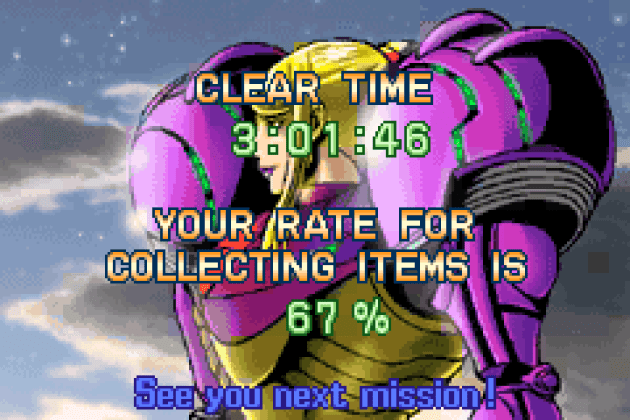
ARE YOU SH*TING ME? How the heck did I miss 33% of the items? I knew I should have used a guide. Oh, and ignore my completion time, because I did rewind and use save states a lot to undo backtracking. At one point, I spent close to an hour trying to figure out how to get one super missile pick-up (this one) when I knew I had the stuff to get it, but I also wanted the best ending. I really thought I’d be further along in my Nintendo marathon, but trying to 100% every game is getting to be a pain, especially since I missed an energy tank in the first Metroid anyway (I didn’t get the one in Kraid’s chamber). For Zero Mission, I really did think I got most everything. I’m genuinely stunned I missed so much. I thought, at worst, I’d have like 90%.

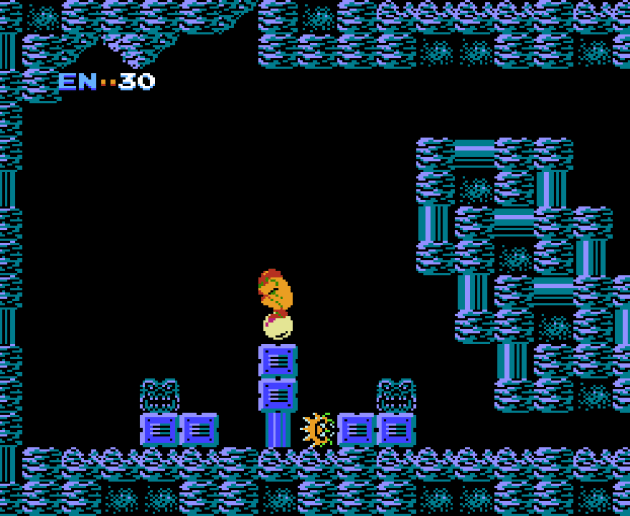
It’s really not accurate to call Metroid: Zero Mission a remake of the original game that I just reviewed. There are winks to the original game, but calling this a “remake” is like saying the 2025 Superman movie is a direct remake of the old 1950s Kirk Alyn serial Atom Man vs. Superman. I mean, they’re both about Superman fighting Lex Luthor, who uses an artificially-created Kryptonite to neutralize Superman while unleashing a doomsday device on Metropolis. They’re practically identical! Except, no, they’re not really that similar at all. Zero Mission is barely even inspired by the original, and instead shares a small handful of similar rooms and a couple gags from the first game. Like, remember this GOTCHA?
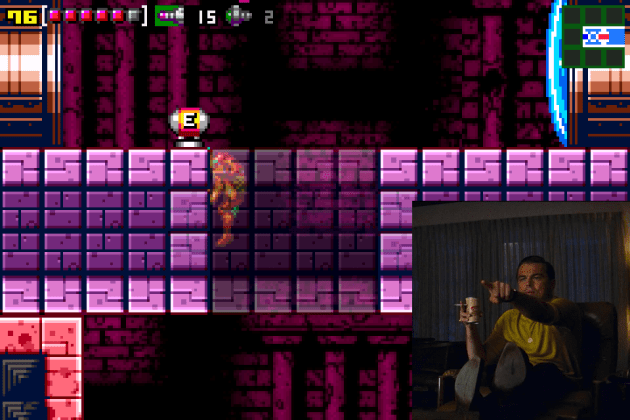
I could have also done the Captain America “I understood that reference!” meme here.

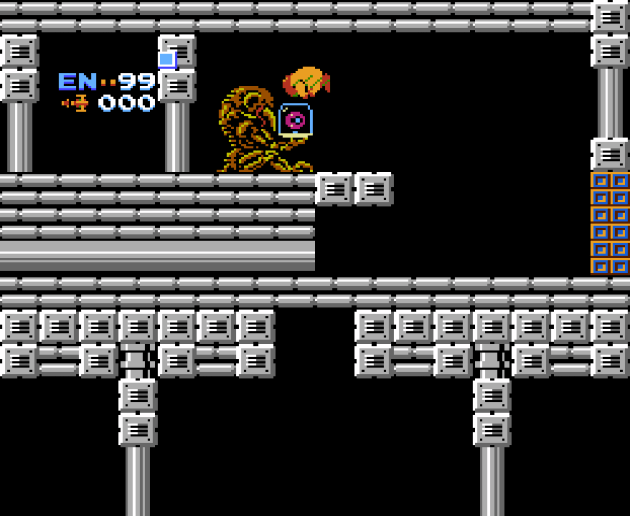
But otherwise, this is basically more of a direct prequel to Super Metroid, like Nintendo said, “what if in 2004 we released what the 1986 game would have been like if we had made it in 1994 instead?” It’s Nintendo’s version of wish fulfillment. Which isn’t to say you should expect a game with as grand a scale as Super Metroid, either. I was actually surprised by how small the world of Metroid: Zero Mission is, even if you count all the Zero Suit stuff. I remembered the game being much bigger, but there really are only two “benchmark” boss fights before you tackle Mother Brain. Nintendo’s own version of Bulk & Skull, the dynamic duo of Kraid and Ridley. There’s other boss fights but not a single one of them shakes the “mini-boss” vibe, and hell, I beat Ridley in about twenty seconds. I even called my nephew and his friends over to watch the fight since they’re big Smash Bros. fans. “Hey kids, want to see me beat Ridley?” and the fight was over before the kids even finished talking about how cool a design it is.
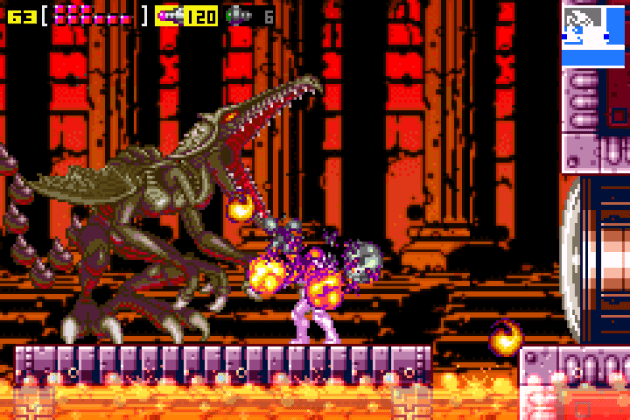
Maybe I’m just good at fighting Ridley. I died against both Kraid and Mother Brain, but later on, I beat Robo Ridley only getting hit twice.

I guess I just expected to like Metroid: Zero Mission a lot more than I did. I was certain I’d be saying it’s one of the all-time great Game Boy Advance titles, but I’m not going there. Much like with Super Mario Bros. 3, eh, it’s fine. It just brings very little new to the table. The disappointing thing is, when it does manage to bring fresh ideas, they usually are fantastic. It’s such a small thing, but at one point you’re attacked by these annoying-as-hell space parasites. You can’t shoot them, and once they’re on you, you have to bomb them off. I kind of figured they only existed to be a tutorial for the bombs. Later in the game though, you have to deliberately infect yourself with the parasites, then lead them to these otherwise indestructible heart-shaped barriers. Apparently the parasites like them more than the taste of Samus’ armor.
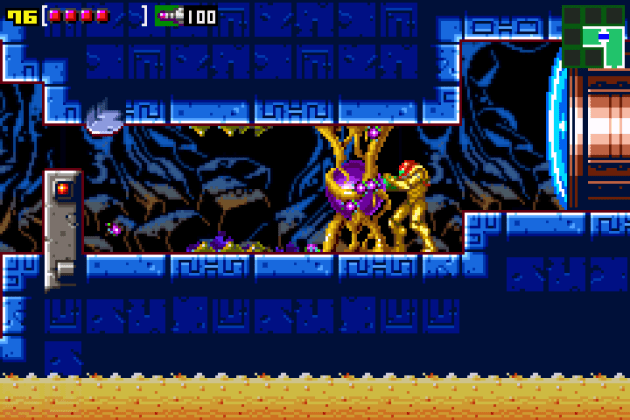
Chow down, gang! Whoever eats the most will become the new Khaleesi of the Great Grass Sea! (My sister read that and said “that’s not why she eats the heart. It’s to prove she’s carrying the Stallion who Mounts the World you idiot.” I feel so loved.)

It’s such wonderful world building that helps make Zebes feel like a genuinely organic, thriving ecosystem, but those moments are few and far between. Zero Mission just never successfully loses the vibe of being a lesser-version of Super Metroid. It sure doesn’t play as well. The movement and aiming is clunkier and the sense of exploration is muffled. The level design is fine, but it’s not amazing. If they were aiming for a sense of claustrophobia, great. I was kind of surprised that’s something that people craved from Metroid, but again, I got into the series through Metroid Prime. While it has plenty of moments of feeling closed-in, the thing *I* most directly associate with Metroid is the believable alien world. At the time I played Metroid Prime, I’d played a lot of first person shooters that controlled better and had better action, but it was the atmosphere and the settings (and the enemy design to a lesser degree) that immersed me like few games ever had. For a 2D game, Zero Mission does okay at that, but there’s not enough of a push towards giving it that lived-in feel.

This is the only cutscene that works, and it’s for one of my favorite game bosses. A giant one-eyed brain with spikes and tubes coming out of it that’s submerged in a giant glass jar is objectively terrifying. On the other hand, the one right before the Zero Suit section of the game was so damn silly that I chortled. It looked almost identical to the opening of the Mighty Mouse in the Great Space Chase, which a young Cathy Vice most certainly didn’t watch so much she wore out the VHS tape. I showed this joke to my parents and they both looked off into the distance like they were having flashbacks. You know, come to think of it, I “wore out” an awful lot of video tapes that my parents hated having to watch over and over again. I just gave them the stink eye, but they claim innocence. “We would never have broken your treasured video tapes, Cathy. We might have lied about our ability to find replacements, though.” Well, that’s fair.

Everything that happens until after the Mother Brain fight has the feel of going through the motions. There’s not really any new items or abilities. There’s lots of gizmos in the levels themselves that you can use to get around, but otherwise, this is just a boilerplate, paint-by-numbers Metroid adventure, and it’s good, really. It’s pretty much impossible to not enjoy Metroid once they perfected the formula. But I found myself waiting for something to happen that really made me sit up in my chair, and it just never happened. You beat Mother Brain, run away, and it feels like a decent but unspectacular game is over. Everything that happens afterward feels almost like a completely different game. I’m guessing they were aiming for an epilogue vibe. They failed badly at that.
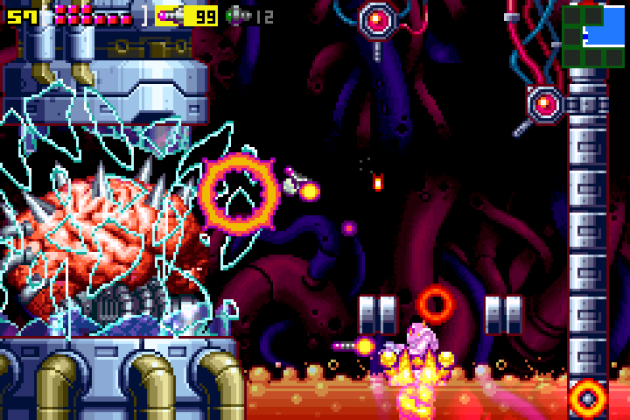
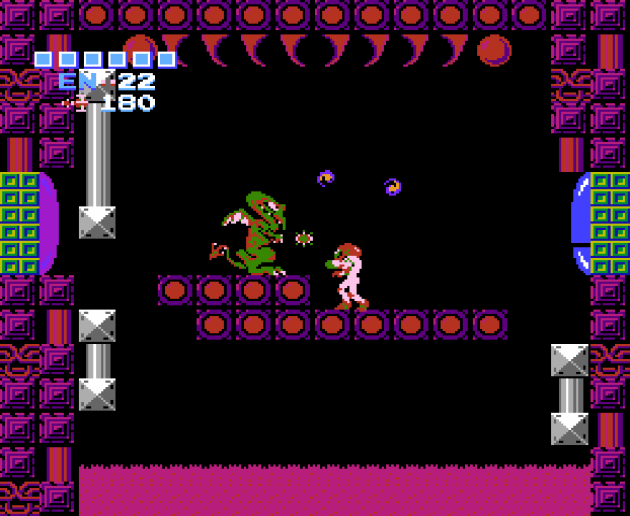
The home stretch leading up to the battle with Mother Brain is probably the part of the game that feels most closely pulled from the original. In fact, it’s actually a safe bet to say that the only twist really is that you’re not playing the original game. It’s a little easier to dodge the bullets shot by the indestructible guns and you presumably have super missiles to make breaking through the barriers go faster. Then you get to the Mother Brain fight, and I felt it’s a massive letdown. It’s staged very poorly, with two single-block platforms and a pit of lava underneath you, with two guns continuously shooting at you AND those orange circles. This was a chance to fix one of the worst last boss fights Nintendo ever did, and they just made it SLIGHTLY more tolerable. The only new aspect is now Mother Brain’s eye must be shot, and it’s just not enough. How come Kraid and Ridley get whole new fighting styles but Mother Brain is only slightly updated? “Because she’s the last boss!” BUT SHE’S NOT! It’s a boring Robo Ridley fight that’s basically the same type of fight as Mother Brain with a small target that’s covered in glass that has to be shattered, then you have to wait for the glowing dot (an eye, if you will) to be vulnerable to shoot it with missiles. Only THAT fight doesn’t have lava and over four other things shooting at you from all angles while you balance on two small blocks. I would have preferred something truly fresh over a retread of the same old sh*t. Have the glass itself fight back, T-1000 style or something.

Yes, the Zero Suit stuff is fantastic. So fantastic that I kind of wish they had the guts to do that as the entire game. It pulls off genuinely scary stealth mechanics in 2D just about as good as a platforming-shooter can do. Okay, so it’s nowhere near as hair-raising as the evil Samus in Metroid Fusion was (the first time I realized a 2D game could be scary), but running from the Space Pirates was always exciting. Even if some of the moments chosen as the spot you run to that makes them give up and turn around made no sense at all.
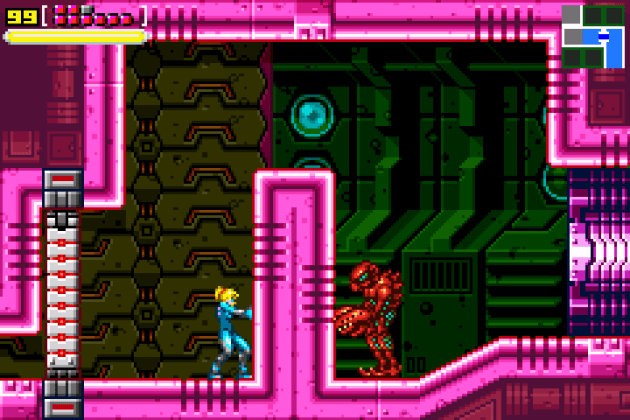
“Duh, let’s see, I was right on her tail when she ran into this room, but she’s not here. All that’s here is this wall that both her and I can easily jump over. I’ll just assume she was so scared of me that all her atoms depolarized and she vanished. Good job, me! The literal brain that’s my boss would be so proud of me if she hadn’t just been killed by some blond chick wearing a superhero suit. Hey wait a second! I wonder if that blond chick wearing a different kind of superhero suit that I was just chasing knows her? Well, too late to ask, I suppose, on account of her atoms depolarizing. Hopefully when they make a game about this some day, all the little space pirates who play it won’t have their immersion completely shattered when they see how my victory over the blond girl who I’m pretty sure isn’t the same blond girl who killed Mother Brain plays out.”

Okay, so Zero Mission requires a LOT of suspension of disbelief at the ends of the chases, but most of the sneaking and running is very well done. I just wish it lasted a lot longer. Once you get the suit back, not only does the game go back to being paint-by-numbers Metroid, but the final stretch leading to the ending leans too heavily on a poorly-designed Space Jump. Metroid: Zero Mission’s jumping I think is the weakest link of the game. Even when you have the high jump, it never stops feeling too heavy to the point of being slightly uncomfortable. Oh, it’s not a deal breaker or anything. You’ll adapt to its limits and timing because they did a first-rate job of designing the levels in a way that puts a focus on the limits of your jumps. Eventually it’ll be intuitive, and that must be harder to do than it seems from a development standpoint because a lot of games where the jumping isn’t comfy never manage to recover like Zero Mission does, especially as quickly as it does. But it’s always the elephant in the room, and that elephant goes on a murderous rampage once you get the Space Jump.
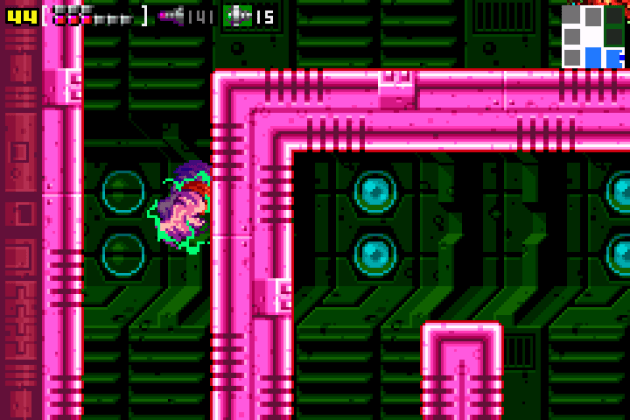
This is one of those mechanics where you have to pause and shake feeling back into your hand.

Unlimited jumping WITH heavy jumping physics is a really, really bad idea, and so course it’s the primary gameplay mechanic of Metroid: Zero Mission’s climax. It’s actually exhausting to use, and in some (thankfully limited) instances, it crosses the line into outright bad game design when enemies shoot you out of the air. Since the heavy jumping leaves no elegance to the timing of when you have to press the button to jump higher, it turns what should be a fun superpower (it’s basically flying when you think about it) into a mindless button master. A chore that you have to do a lot at the end of the game. After the stellar Zero Suit stuff, it pretty much sours the finale of an otherwise perfectly decent Metroid game.
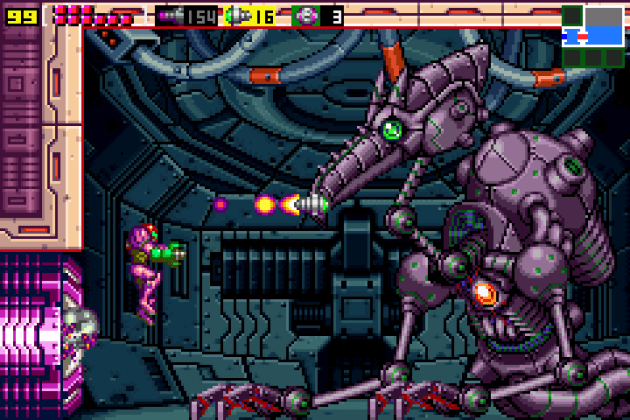
“Nice shootin’, Tex!”

So Metroid: Zero Mission blew-up what should have been a historically amazing ending to a game that already suffers from feeling more like DLC for Super Metroid with little in the way of worlds that are “new” to explore. BUT, the important stuff is all here. Zebes does feel like a living alien world at times. Instead of feeling like a series of samey platforms in a video game, it feels like you’re an intergalactic bounty hunter exploring caves and structures on a hostile planet. That’s what I want, so giving Zero Mission a YES! was easy. And yet, that Zero Suit stuff was such a tease because it worked. As silly and convoluted as it is, hell, stealth stuff in video games, even games more serious than this, are usually silly and convoluted. If I can’t deal with that sh*t, I wouldn’t like the genre at all.
I wonder if the underwhelming reaction to Metroid Fusion was the reason why Nintendo hasn’t done a full Zero Suit game in the style of Zero Mission’s finale, including using a stun gun instead of a deadly weapon. You know, Fusion had a weird suit instead of the normal one, therefore it’s not what people what. No, that’s not true though. I think people sh*t on Fusion because it’s basically a linear game, and the enemy/item format was lame as f*ck. You can learn lessons in critical failure (and Fusion didn’t fail critically. Nobody hates it or anything like that. It’s just not Metroid as we want Metroid to be) but you should never lose your willingness to experiment. I just find it hard to believe that the company that made an RPG series where the Mario cast are instead paper dolls or a Kirby game where he’s made out of yarn don’t have the balls to do a full 2D Zero Suit Samus game.

All I care about is having fun, and the Zero Suit gameplay is the highlight of Metroid: Zero Mission for the twenty to thirty minutes it lasts, if that. It’s one of the best sequences in the entire franchise regardless of whether I’m talking about two dimensions or three. Of course, the timing of when it happens is jarring and awkward. It makes it feel tacked-on, and it kind of is. The whole Chozo origin story is, too, and while the level themes when the Chozo drop awkwardly in and out of the narrative are cool (apparently the way to my heart is having hieroglyphs or petroglyphs in games) it feels shoehorned. I can’t help but wonder if they originally intended to start the game with the Zero Suit, since that would have made so much more sense, and they simply lost their nerve. I would have also been fine with a game where Samus has to abandon the suit multiple times throughout, perhaps to retrieve other times. They can come up with reasons why to do that. They’re smart. Either way, the Zero Suit deserves its own game. I think Zero Suit Samus could be a huge franchise for Nintendo. Not that they’re hurting for those, but there’s so many Mario spin-offs. Would one Samus spin-off kill them?
Verdict: YES!
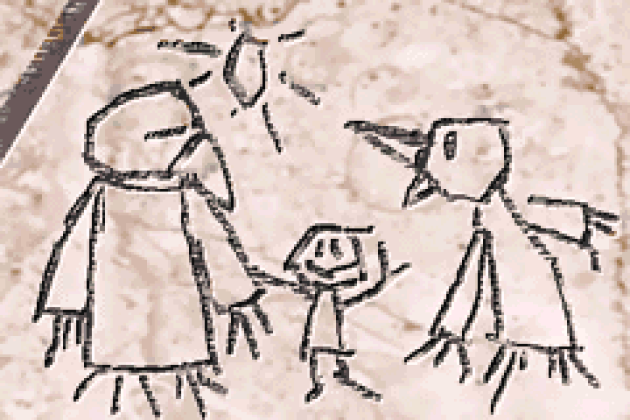
“Well…… she can’t draw worth a sh*t, so I guess our experiment to create the greatest artist in the galaxy was a complete failure. I haven’t been this disappointed since that giant, spiky, one-eyed brain we created went evil. Who could have seen that coming? Well, I suppose we should toss Samus in the incinerator and start over. She does pack a mean punch though. Meh, just slap some armor on her and tell everyone to pretend like we were trying to create the galaxy’s greatest bounty hunter. Also, maybe we should stop toying with mother nature.”
Metroid (NES Review)

Metroid
Platform: Nintendo Entertainment System/Famicom Disk System
First Released August 6, 1986
Directed by Satoru Okada
Developed by Nintendo
Available with Switch Online Subscription (Standard)
Listing at Metroid Wiki

Metroid is one of the original “looks like it’s going to be fun but it ain’t” games.

Well, I reviewed Kid Icarus so I suppose I should also review the game that Nintendo thought was the better bet. They were probably right, too, though I can’t stress enough how miserable I was playing Metroid. I’m not ignorant enough to call it the worst Nintendo-developed game ever, but it certainly ranks among my least favorite games by them. Until this review, I’d never actually finished the original Metroid. Like most people my age, my first experience with the franchise was Metroid Prime, which I LOVED as a kid. It was a major milestone in my gaming life, but the larger franchise really wasn’t. I didn’t even play Fusion or Zero Mission on the GBA until many, many years later and my first experience with Super Metroid was on Virtual Console around the same time I played the GBA games. It wasn’t out of malice or anything. The funny thing is, my older readers probably couldn’t have imagined Metroid as a first person shooter, whereas myself and I imagine many people from my era couldn’t imagine it as anything else!

All credit where it’s due that they really did invent a lot of nifty ideas for how exploration could be handled in a 2D space. Metroid is a bonafide pioneer, and I’m saying that to remind the hardcore Metroid fans who do NOT like people talking smack on the original game that nothing I can say can take away from Metroid’s legacy.

I actually did own the original Metroid for my GBA. I hated it so much that I almost didn’t put Fusion and Zero Mission in my Game Boy Player. It wasn’t just the clunky, laggy mechanics either. By the way, if you’re curious why there’s lag, this is an excellent explanation video from Displaced Gamers, one of the absolute best gaming content creators on YouTube, who I discovered thanks to his video on the infamous dam stage from Teenage Mutant Ninja Turtles, broken down into layman’s terms for dummies like me. But the movement, lag, etc? That didn’t turn me off Metroid, and hell, I think the jumping is pretty dang good, all things considered.

Since this is a largely negative review, I wanted to start off right away by saying the Morphing Ball is an inspired idea. One of the all-time great gaming concepts. It would have been really easy to just say “meh, make her crawl, whatever.” But no, she turns into a ball that even bounces when you fall. When I was a kid, I wondered “does that mean you can play basketball with Samus?” Ooh, I smell an idea for the next Camelot-developed Nintendo sports game! And while I’m on the subject, bring back Metroid Prime Pinball you bastards!

I could handle a challenge, but what I couldn’t handle was taking damage when the controls weren’t in my hands. I couldn’t handle not being able to aim in any direction but straight ahead or straight up. I couldn’t handle having no built-in map, which seems like a massive oversight even for the time period. Hell, even the original Zelda had a map. Many maps, actually, one that gives you an idea of your position in the overworld and one for each dungeon. I really couldn’t handle the repetitive level design. So, I put Metroid away, but thank goodness I plugged my nose and popped in Metroid Fusion, because THAT was the game where I became a fan of the larger franchise, and eventually I would be blown away by Super Metroid and Metroid: Zero Mission, both of which are a LOT better than Fusion was.

This and the Ice Beam are just about as far as I’d made it in any previous attempt before I was too bored and/or frustrated to continue. But a review requires a full playthrough. And morphine, but despite my pleas, my family said it would count a relapse.

After close to twenty years and probably around three or four attempts to play Metroid, I finally told myself I HAD to finish it because it was the next, logical IGC review. Then I quit after thirty minutes and booted up Zero Mission. But then I rebooted Metroid and decided, screw (attack) it, I’ll cheat. So, yeah, I’m not following the rules of my Mario Marathon, IE no rewinding, no save states, no walkthrough. I used all three for Metroid because my ultimate goal is “find the fun, by any means necessary.” Now to clarify, I rewound only to shave time off exploration. In other words, if I went the wrong direction, I rewound it instead of turning around and fighting my way back. I used save states only at the end of the game with the Metroids, and I did use a full walkthrough of the game from WikiStrategy. BUT, I wasn’t glued to it, and not just because the map was small and couldn’t be zoomed-in without making it blurry. I swear! Armed with these tools, which leaves the raw combat and gameplay, did I find the fun that I never found in Metroid before? Well, no. Because, you know, it’s not a very fun game. Hell, the last hour was spent trying to inch my way towards Mother Brain with no means of fighting back. DOES THAT SOUND FUN?!

Actually, I used a combination of save states and rewind to deal with the Metroids because I couldn’t fight the f*cking things and running away was my only option. It turns out that the first Ice Gun I picked up I got out of order. Weirdly, that part happened before I went full tilt into cheating. Later, I got the second Ice Gun THEN the Wave Gun. Well, doing it that way took away my Ice Gun(s). I didn’t know you couldn’t kill the Metroids if you didn’t have the Ice Gun! The Ice Gun I didn’t intend to trade for the Wave Gun! I figured I’d have a wavy Ice Gun! What I’m trying to tell you is that I HAD NO MEANS TO KILL THE TITLE MONSTERS OF THE GAME! WHY WOULD THEY EVEN MAKE THIS A THING THAT COULD HAPPEN? YOU SONS OF BITCHES AT NINTENDO! I HATE YOU! I HATE ALL OF YOU! I HATE YOUR STINKIN’ GUTS! I HOPE YOUR OATMEAL GETS REPLACED WITH MANURE! MANURE!!!

Metroid is even higher than Little Nemo: The Dream Master on my list of NES games that I seriously do not understand how anyone can be a fan of them or justify some of the level design or mechanical choices made by its developers. There’s some VERY bad game design in Metroid. The pain of the above screenshot is still pretty fresh, literally because I think I injured my throat from all the screaming. I think I had a half-dozen rage quits before reminding myself “you’re right at the end.” I also had to remind myself that I was originally tickled pink when I realized the Ice Gun was gone. When you pick up the Ice Gun, it MURDERS the combat. You can’t turn it on or off, so from the moment you have it, it actually increases the sponge of enemies, which are seemingly not damaged from the act of being frozen, but rather only from being unfrozen. Unless you want to freeze them, jump on them, and plant a bomb on them. If I were a space marine and had to do that, I think I’d probably die because enemies would ambush me while I stared longingly at my gigantic arm cannon saying “what happened? You used to be so cool.”

Or how about this sh*t? In Super Mario Bros.: The Lost Levels, VERY late in the game players encounter fake Bowsers in the middle of the levels, and it’s pretty awesome when it happens. I wonder if Metroid’s designers were sneaking a peek at that game’s development and saying “hey, we should do that!” Because this is a fake Kraid that uses the exact same sprite, only I encountered it well before the real one. And now I’m sparing a thought for someone who saw the Kraid statue in Brinstar, thought this WAS Kraid, beat it, then left this area and returned to the original hub world only to later realize the one they killed wasn’t the real one. IT HAD TO HAVE HAPPENED AT LEAST ONCE! There is some poor bastard out there who remembers the time they walked all the way to Mount Doom, then returned to the Shire only to realize they disposed of the mood ring they got at a flea market instead of the One Ring.

There’s been plenty of people who mention the sloppiness of getting life slapped when you enter a door by an enemy who is placed right on the other side, or the wave gun going through blocks, or the inconsistent item drops. But ignoring all those things, I think Metroid is just not that exciting of a game. There’s no elegance to the combat or the level design. Even for its era, it feels very un-Nintendo like in terms of intuitive combat or navigation. While the enemies explode with a nice crunch, there’s just not enough of them that are actually fun to kill. The lack of flexibility for the combat hurts a great deal. There’s also so many jumping corridors or areas of the game where the platforming layout feels samey. They even recycle the logic of the hidden areas. There’s a few duplicate rooms, the first of which usually has a fake-out hidden door that leads to a dead-end while the second has something in it at the same spot. And now that I really think about it, I’m guessing this is the case because it saved on memory space.

One aspect of the game I didn’t really struggle with was the bosses. Well, two out of the three of them. With autofire and the Wave Gun, I beat Ridley in a few seconds. Curiosity got the better of me and I tried the fight without it and it didn’t end so well for me. My props to anyone who actually got through this back in the day.

I already said the roster of enemies isn’t quite big enough, but you can still take steps to get the most mileage out of a limited roster by spacing them out or mixing them up the right way. Look at all the mileage Super Mario Bros. got out of its smaller roster of baddies. Or maybe I’m wrong. Hell, maybe Metroid’s enemies just have boring attack patterns and there was no actual usage to get out of them besides what we already got. None of them are implemented in a particularly clever way, or at least the ones that aren’t meant to be used as frozen platforms. Or perhaps it’s a combination of poor level layouts with inelegant enemies. The best way I can describe it is the original Metroid’s level design and enemy placement feels like the type of design you would commonly see if a game called Metroid Maker existed today. Tons of single block platforms to navigate and the same clusters of enemies spammed on them until they lose all their excitement, just like so many Mario Maker levels.

For all my bitching, the one mechanical part I don’t mind is the jumping. If Metroid’s platforming physics felt the same way Kid Icarus did, with floaty jumps and heavy momentum upon landing, Metroid would probably not be around today. This original Metroid game relies very heavily on single-block-wide platforms. They’re all over, and the big “escape the planet” finale is ONLY single-block platforms. Hell, these platforming layouts would have been tough even with Super Mario 1’s jumping physics, and that game was considered a major milestone in the history of video jumping. So, why isn’t Metroid? Because I think the jumping is reliable and solid, as long as you’re not buried in the lava. For all its problems, Metroid is a genuine step forward for Nintendo’s education on how to do perfect jumping in platform games.

An even better example of poor pacing is the locations of the items. Nintendo is good at hiding stuff in the Metroid games, but not in this one. Some of the missile upgrade locations reminded me of when I’d pester my exhausted and likely annoyed parents to re-hide easter eggs for the fifth time on Easter Sunday and they’d just lay them down around the couch, whining the whole time about how they thought I’d grow out of this by 36 years old. At one point, you can get five missile pick-ups in a span of a minute or two. I’m guessing they figured players would be overjoyed to find a treasure trove of missile upgrades. They didn’t know yet that hiding five upgrades so close together doesn’t leave any cool down time for players. By not spacing them out, they give players one exciting moment for the price of five. That’s a really lousy deal, especially when there’s plenty of dead spaces that could have been given new life by relocating four of those upgrades.

OH how I hated the whole finale. These indestructible guns combined with bubbles that just spawn from the void. I had to restart this last stretch of the game probably a dozen times just to have enough life to make it through, and it’s not like I was full of life after having no means of fighting back against the Metroids. Then Mother Brain nearly gave me a seizure at the end and I had to take a nap. Man, I hated Metroid. I really, really hated it. But, I got Metroid Prime out of it so, you know, thanks Metroid 1.

The good news is that Nintendo did get something priceless out of Metroid: experience. They also learned that gamers were very interested in the concept of fully interconnected, exploration-based space adventure. The concept was solid. This version might not have been very fun and was sure to age worse than most NES games, but as proof of concept for an entire genre, they could have done a lot worse than Metroid. It does a lot right. Shooting bubble doors to open them. The missiles. The Long Beam being an upgrade instead of the default range of your gun, which should be frustrating but instead feels like an earned moment. The Morphing Ball. Freezing enemies to use as platforms. The Screw Attack. Mother Brain. The whole vibe to this world. The Metroids themselves. And of course, Samus Aran. These are way cooler ideas than an Eggplant Wizard or building up to a climax where a character who already has had wings this entire f*cking time finally gets to fly. Metroid on the NES is one of the greatest foundations in gaming history. But I could have lived without actually playing through Metroid. Every house needs a solid foundation to build up from, but you can’t live in the foundation.
Verdict: NO!

FYI, I played the Famicom Disk version, which has less lag, apparently. I tried to give myself the best possible way of having fun. I didn’t. Sorry, Metroid fans. For what it’s worth I plan on drooling all over Super Metroid soon.

Super Mario World 2: Yoshi’s Island (SNES Review)

Super Mario World 2: Yoshi’s Island
Platform: Super Nintendo Entertainment System
First Released August 5, 1995
Directed by Takashi Tezuka
and Hideki Konno
and Shigefumi Hino
AND Toshihiko Nakago
Jeez, anyone else? No? Okay then.
Developed by Nintendo
Available with Switch Online Subscription (Standard)
Listing on Mario Wiki

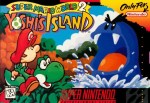
The phrase “oh baby” has more than one meaning with Yoshi’s Island, though for the purposes of this review, you can safely assume my “oh baby!” is in reference to how overjoyed I am to have changed my mind about reviewing this because OH BABY! What a masterpiece! By the way, like Super Mario 3, my first experience with Yoshi’s Island was on the Game Boy Advance, which has significant changes. Consider this review MOSTLY for the SNES version since I didn’t want to 100% it twice for this review. This is NOT a game you breeze through.

There’s an urban legend that Big Shiggy Style and Takashi Tezuka were ordered to make Yoshi’s Island look like the recently released “hi-tech” Donkey Kong Country, and in a fit of rebellion, they instead told their team to lean extra-extra hard into the crayon look, which got approved by Nintendo. According to the legend, Miyamoto also said Donkey Kong Country was a mediocre game in an interview he did side-by-side with Rare Ltd. founders Chris & Tim Stamper and was generally butt hurt by Donkey Kong Country’s success because it meant that all gamers cared about was pretty graphics. I’d read it myself in a book, but people I trust on the subject say it never happened. Well, the interview didn’t happen at least. As far as the graphics go, to me it sounds like someone higher-up at Nintendo merely floated the question “could you make this look more like Donkey Kong Country?” in the same way you might ask a cop if there’s any way out of a speeding ticket. In other words, they knew it was a long shot but felt they had to ask because it’d make the game more commercial or trendy. Nothing wrong with asking, but Yoshi’s Island was so far into development that it was too late to turn around.

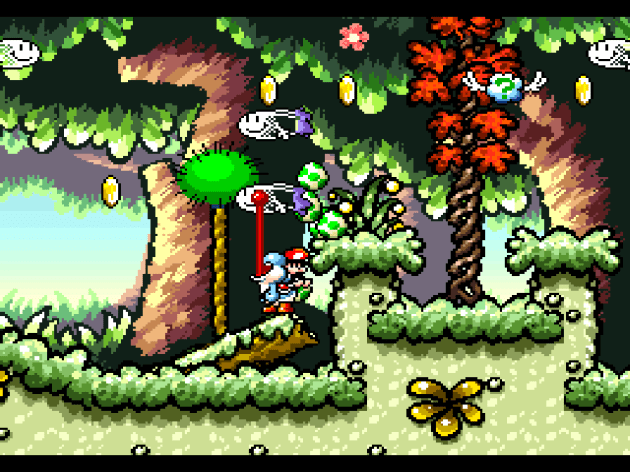
Probably the best animation frames for any 16-bit platformer. Yoshi’s Island isn’t entirely just fun because of personality and charm, but it sure helps.

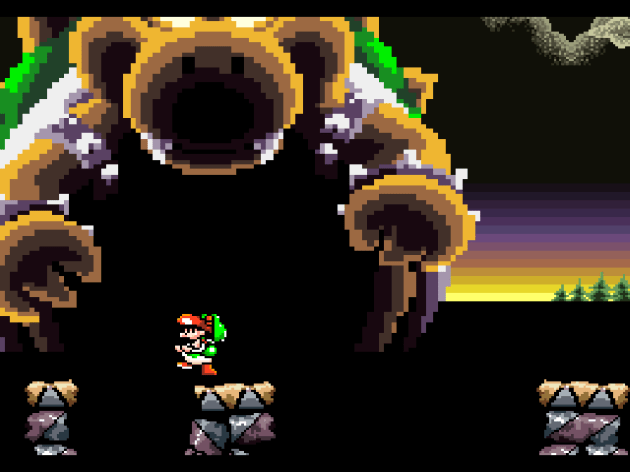
What it wasn’t too late for was to exaggerate the hand-drawn look. Talk about lucky timing. I don’t know how well the Donkey Kong Country games have aged from a gameplay perspective. I guess I should find out, hint hint. In the looks department, there’s no denying those games have a waxy appearance that doesn’t necessarily feel timeless. Yoshi’s Island is still a damn pretty game to look at even thirty years later. And it DID have a few technical achievements to marvel at. This is especially true of the bosses thanks to the Super FX 2 chip. Instead of doing the traditional “it’s really the background done in a way to make it feel like a sprite” trick, the tech had reached the point where you could do very large enemy sprites, or in the case of Mario World 2, make it appear normal-sized enemies were being transformed into gigantic ones. The twelve big-bosses of Super Mario World 2: Yoshi’s Island are some of the best in ANY game that wears the Mario label. The best boss fights shouldn’t just be challenging, but so fun that they feel like rewards for reaching progress benchmarks, and Yoshi’s Island NAILS IT!

I’m f*cked. Want to know the really embarrassing part? This is a rematch of a fight I already won because I didn’t get a red coin at some point.

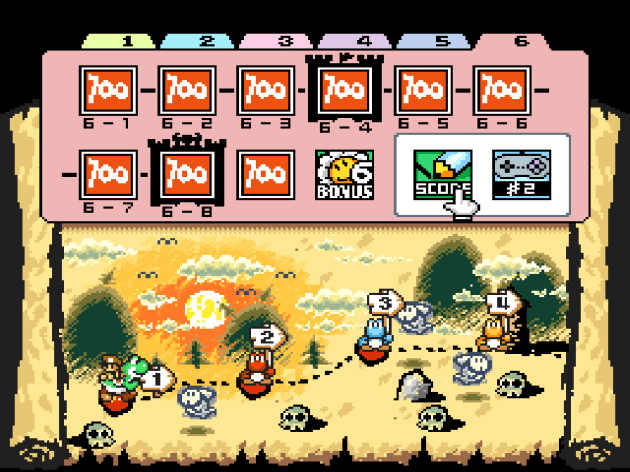
But the bosses are hardly the only highlight. Yoshi’s Island features forty-eight stages spread over six worlds, plus each world has an additional level if you finish all eight of its levels with a 100% completion. To do this, you have to get five flowers and twenty red coins in each stage and then cross the finish line (or beat the boss) with all thirty stars still intact. By the way, this is a lot tougher than most modern games because all three extra goals have to be done at once, since the 100% completion is done as an end-of-level score and not as a checklist to finish whenever. If you take even a single tick of damage fighting a boss, you’ll either have to charge-up an egg so that it drops stars or start the fight over.

While exploring the levels and making progress is much slower than most Mario games, the tempo of action happenings is downright frantic and requires quick reflexes.

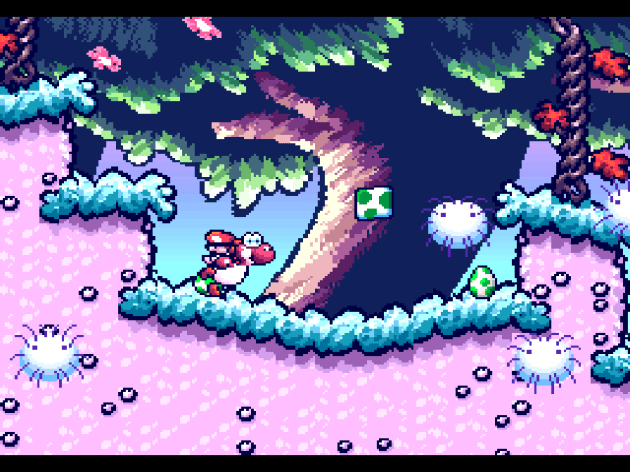
Finding the flowers/coins isn’t just a formality, either. They require a full exploration of the level, and some are VERY cleverly hidden. Even early in the game, I had to replay some levels to find stuff I missed. They’re not all just laying around like modern Mario games tend to do, and the hunt for them actually enhanced the game in a way that 100%ing other games in this Mario marathon I’ve been on has been. It’s certainly easier to find the red coins on the original console version of Yoshi’s Island. I was startled when I found out that, when you play the SNES version, you can actually see which coins are the red coins. They have a subtle but noticeable tint to them that wasn’t present on the Game Boy Advance port, where you have to use a magnifying glass item to make them pop out. That item is still in the SNES game, but it’s mostly useful for not having to look too hard, and for revealing hidden question mark clouds. In the two screenshots below, there’s two red coins. In the heat of battle, it can be tough to spot.

Acing every level also unlocks unlimited cracks at the end of level bonus rounds, which allows you to stockpile items. I don’t know why they did it THAT way when it makes way more sense to unlock the bonus rounds when you 100% the extra stages since those tend to be really hard. It’s also worth noting that the SNES and GBA games have different extra stages. You’ll forgive me for going off memory on the GBA versions because I figured I’d play Yoshi’s Island for a day and instead I needed three days and in the ballpark of a one hundred lives to get 100% without cheating. Some of the flowers and red coins are pains in the ass to get, but for what it’s worth, both versions have really fun bonus stages. It’s certainly worth the effort.

Before starting this review, I could have sworn that I 100%ed this on the GBA, but now I’m pretty sure I didn’t. Either way, I just 100%ed without cheating. You know, I never 100%ed Super Mario Sunshine either. Oh, and I use control scheme #2, which is where you hold the fire button to begin the aiming cursor and release to fire. I think it’s better for jumping shots.

There’s two major things that stand out to me about Yoshi’s Island. The first is that this game sort of proves the point I made when I reviewed Super Mario Bros. Wonder: you don’t need a busy-work map for a platformer if it comes at the cost of difficulty scaling. Yoshi’s Island has a relatively bland level select screen with linear progression and no branching paths. The extra stages are just that: extras. You can also replay beaten stages as many times as you want if you miss any coins or flowers, but otherwise, it’s a straight line from level 1 – 1 to level 6 – 8. Remarkably, Yoshi’s Island does a REALLY good job of scaling, to the point that I think that it’s worthy of study by would-be platform game designers. Weirdly, the only stand-out scaling problems were with the extra stages. Extra 1 and Extra 2 were far and away harder than the extra stages that followed, especially the second. Meanwhile, I beat the sixth and final extra stage with a 100 score on my first try.

The second thing is that Nintendo clearly went all-in on the idea that each stage has to have its own unique vibe and personality, with plenty of set pieces that are either limited or even one-off. Even late into the game, new enemies are introduced and sometimes get entire levels built around them. You might be racing a gigantic chain chomp, inflating a gigantic balloon that you then ride, or pushing a boulder through a large portion of the map, and even if you’ve seen those mechanics before, they almost always figured out a way to make them fresh again for the next encounter.

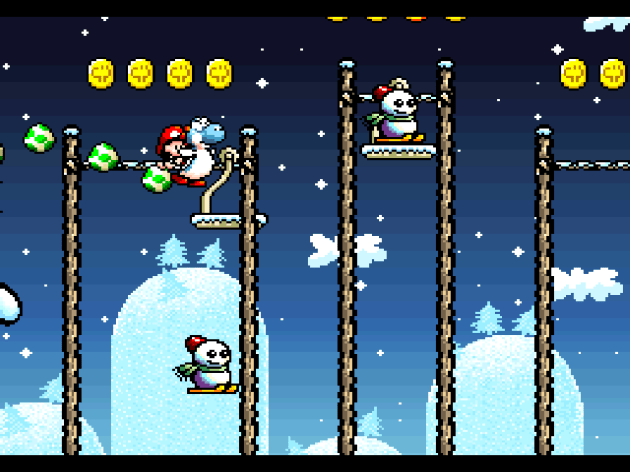
I normally hate snow/ice levels, but they’re really well done in Yoshi’s Island. There’s a memorable skiing segment, and even the ski-lifts themselves feature some of the best moving platform design I’ve seen in 16-bits.

The game also tested the limits of its own mechanics many times by using enemy attack formations or their raw physics to introduce new gameplay concepts. Here’s an example late in the game: there’s a flower walled-off in a way where you can’t reach it, and a bandit inside the chamber with it. In order to get the flower, you have to lure the bandit over to the flippers to open them, then time it so you shoot an egg (or watermelon seed) when they open. It’s such a small thing, but there’s PLENTY of examples of how they used the enemies fourth-dimensionally for a lack of a better term.

Now, unlike Mario 3, these are not bite-sized levels. Yoshi’s Island’s stages are pretty damn big, at least relative to other games in the series up to the point this came out. The “bag of potato chips” rule is out because, if a level doesn’t work for you, you’re not seconds away from a new experience. You’re a few minutes, or more since the game actually is pretty difficult. Yoshi’s Island certainly has a slower pace than Mario 3, World, or Wonder, and in fact, I’d say they probably could have cut the level count from eight per world to six. Not that there’s two stinkers per world, because I’d dare to say there’s no “bad” levels in Yoshi’s Island. It’s because the level “types” tend to be stretched thin. In particular, the castle levels, at times, come dangerously close to feeling interchangeable. Okay, so that’s not a big deal, right? The airships were the same way in Mario 3 but there’s still unique and memorable moments in them. Sure, but when a developer is close to perfection, I kind of wish they’d go for it. Perfection is so rare, and Yoshi was within sniffing distance of it.

Yes, yes, we all laughed when Yoshi got stoned. But for all we know, that poor red Yoshi then had to spend 28 days in rehab and several months in a sober living home. #FuzziesAreGatewayDrugs

Not that Yoshi’s Island would be perfect without the vague sense of padding. The physics with Mario’s bubble can be a little unpredictable at times. At one point I shorted a jump over the big blue mouth monster, but even though I was well above the water, SOMEHOW Mario ended up under the platform I was on and in the water, like he flew the opposite direction I was hit from. Then the water monster blocked me from all directions and I didn’t have an egg. Then on top of all that, I screwed up the last-second rescue when I took damage again. I tried to rewind to get a clip of it (I laid that life down afterward so it doesn’t count as cheating) and I wasn’t able to recreate it when I tried from every angle. While experimenting after I finished the game, I realized that I might have shot Mario with an egg at the very moment I lost him while trying to shoot the monster. The egg would knock the bubble low immediately and would combine with the normal knocked-off physics to send him well out of reach. There were several “WTF” instances with the physics. The only reason I didn’t lose more lives is because I used the star items at the last second if I was on death’s door.

But the level padding and the bubble physics are VERY minor complaints. Yoshi’s Island really is a fantastic video game. The use of the eggs as projectiles is so well done, and it’s especially satisfying to treat the level layouts like a billiard table and hit off-the-wall shots. The level design is consistently clever throughout. Yoshi’s Island also has a very large, very memorable roster of basic enemies, most of which are squeezed for every drop of gameplay they could get, including gimmicks with the movement physics that you just know they didn’t intend at first. This feels like a game where the people making it were saying to each-other “hey, look what I found out you can do!” a lot. Like Mario Wonder, nearly every square inch of Yoshi’s Island feels like a labor of love. There’s NOTHING cynical about Yoshi’s Island. Which is funny because half of the four directors split for Mario 64 in the middle of development. From everything I’ve read about this game, it sure seems like Nintendo didn’t have high hopes for Yoshi’s Island. And it’s one of the best games Nintendo ever made, go figure.

“Baby Mario, I failed you.” “Well Cathy, maybe you’ll be reincarnated as SOMEONE WHO CAN SHOOT STRAIGHT!”

If Yoshi’s Island counts as a “Super Mario” game (it really shouldn’t) then it’s in the discussion for the 2D G.O.A.T. of the franchise. Win or lose, there’s a legitimate case to be made that it’s better than Mario Wonder. I’d even concede the action is better, and I like a LOT of action with my platforming, but it’s also no slouch in the “games as a unique experience” category. Finally, I’d say Yoshi’s Island probably offers players more flexibility to create their own strategies with the combat, and there’s plenty of situations where using your banked items is mighty tempting. It helps that the egg-aiming, which could have turned out complicated and unwieldy in the wrong developer’s hands, is actually intuitive and easy to get the hang of.

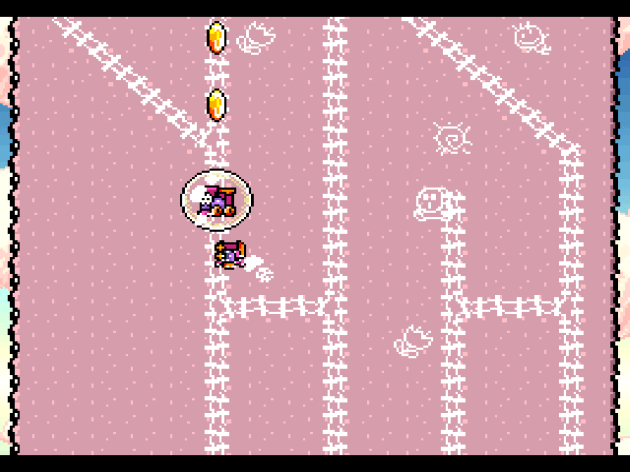
Besides the helicopter, I didn’t love any of the Yoshi vehicles. The train was my least favorite because there’s just no excitement to it, which hurt because Yoshi’s Island is a game that usually stays pretty exciting at all other times. I hated the sub too, especially the insane recovery time when you take damage with it, but at least there’s combat and a sense of urgency. The trains don’t even successfully pull that off even with a time limit.

I’m still leaning towards Mario Wonder, which controls better, cuts a better pace, and has far more big-scale stand-out moments. Yoshi’s Island makes the most with its base engine, but Mario Wonder practically lives off the beaten path and doesn’t have to obey its engine. Again, win or lose, we have to debate it even though it’s not really a Mario game. Yoshi’s Island is a game so good it forces the debate, and it forces itself into the Mario discussion whether it makes sense or not. You know, I think that should count for something! How many games can you honestly say force themselves into the GOAT debate for a franchise they don’t even really belong to? It’s maybe a one-off achievement. If you find that whole “is it or is it not a Mario game” debate silly, first off, (blows raspberry) and second, FINE. How about “Yoshi’s Island is in the debate for best overall SNES game” and it has a VERY strong case.

“Okay, NEW PLAN! Everyone gather around. You too, chain chomps! Okay, my plan is a bit out there, but hear me out: what if, in all future encounters with Yoshi, we just make the courses and mechanics he has to travel to save the day so uninspired and boring that nobody will bother to finish the games? CAN’T LOSE TO YOSHI IF THE PLAYERS GET BORED AND QUIT!”

There’s also a sadness to Yoshi’s Island, because it’s not a real Mario game. It’s only in the debate because of the “Super Mario World 2” part, but really this is the launching point of a franchise that, frankly, has not blown my socks off. My first Yoshi game was Yoshi’s Story, which was the first game I got after Ocarina of Time. Okay, that’s a tough act to follow, but Yoshi’s Story was a game that I did not like at all as a 9 to 10 year old child. It felt like a baby’s game, and was one of the first games that made me realize not every first party Nintendo game would be one I would enjoy. It’s like the gaming version of finding out Santa isn’t real. Later, the Nintendo DS and 3DS games were VERY bland, and the two console games, Wooly World and Crafted World were just sort of okay. Thirty years later and Yoshi’s Island is the one franchise-launcher in the Nintendo catalog that still stands tall as the best game in a franchise that’s had a lot of games. Maybe retro fans will celebrate that fact, but I won’t. I think celebrating a great game for being a great game is awesome. It’s what I love most about doing this blog. But I also hate the idea that a thirty year old game might never be topped. That’s not an achievement. That’s a tragedy.
Verdict: YES!

Kid Icarus: Of Myths and Monsters (Game Boy Review)
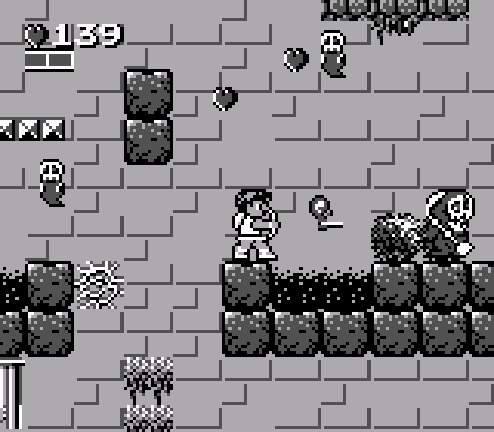
Kid Icarus: Of Myths and Monsters
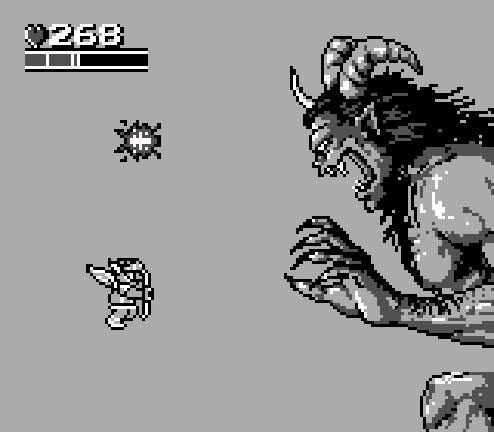
Platform: Game Boy
First Released November, 1991
Designed by Masafumi Sakashita
Developed by Nintendo and Tose Co., Ltd
UPDATE: Now
Available with Switch Online Subscription (Standard)

Déjà vu.

Alright, let’s make this one go quickly. I’m not really THAT interested in the sequel to Kid Icarus. I’m only doing this because of a niggling little voice in my head asking how the f*ck Kid Icarus as a gaming franchise was in the same boat as Metroid to the point that they were basically identical twins for the first, oh, eight years of their existence. I know that’s stating the obvious, but when you lay out the comparisons, it’s actually jaw-dropping.

  • Both are Famicom Disk games that debuted in 1986.
  • They were developed by the same team. I mean, eventually.
  • Both released in the United States in the Summer of 1987.
  • Nintendo opted to convert the save systems of the Famicom Disk System versions to a new password back-up system even though they had perfected the battery-backup format for Legend of Zelda (arguably their triplet since it was an FDS game released in 1986 which also debuted in the US in the Summer of 1987, but it had a different development team).
  • Both games are among the 40 top-selling games of the NES/Famicom. Metroid ranks #18 at 2.73 million copies while Kid Icarus finished #34 at 1.76 million units sold.
  • And both went on to get underwhelming Game Boy sequels made by literally the same lead designer, Masafumi Sakashita that fixed some problems but ended up much more bland than the original, as if they were afraid to experiment too much.

Kiss the memorable enemy sprites of the first game good bye. Myths’ enemy sprites suck. These things look like malicious portable electric fans.

It’s like the Kennedy/Lincoln comparison of Nintendo, only, you know, real. But Metroid went on to be one of the biggest franchises in Nintendo’s lineup while Kid Icarus apparently wandered off into the woods, never to be seen again. Oh, they say it had a game on 3DS but if it had basically no gameplay connection to Kid Icarus, is it really a sequel to Kid Icarus or a completely new game that just uses the name that was suddenly relevant again because Pit was in Super Smash Bros. You know, the famous fighting game franchise directed by the guy who did the Kid Icarus revival? I don’t really care if the 3DS game is good or not (I couldn’t play it without risking a live reenactment of the stoner film Idle Hands) because the actual Kid Icarus is just gone, like StarTropics, Wave Race, or Gyromite or modern stuff like Chibi Robo or Nintendogs. If I had to guess why, I’d say maybe Nintendo just realized Kid Icarus was never that good.

I thought the bosses of Kid Icarus were lame, but I’ll take them over these bosses that are so spongy and repetitive that all five boss battles become boring.

Kid Icarus on Game Boy is a much closer remake of the original than Return of Samus was for Metroid. If there was anything to salvage from Kid Icarus, this was the chance. And there are some improvements. There’s no falling deaths in this game, it controls MUCH better, and there’s also a much greater emphasis on exploration. The hammers that were only good for freeing NPCs to help you fight bosses now can uncover hidden doors. That’s a great idea. Zelda is basically based around how awesome hidden doors are. Well, except the stuff you uncover in Zelda helps you, and some of it is even essential to finishing the game. That’s not true of Kid Icarus GB, where I’m not sure I found a single hidden room that was actually worth seeking out.

The only hidden items of substance are keys that allow you to go back to already-visited rooms. This is another idea that should have been killed on the drawing board. Nearly every major risk/reward factor of the original game didn’t carry-over to the sequel. This isn’t specifically why the game died a miserable death, but the autopsy certainly lists it as contributing factor.

Most, if not all, of the hidden rooms I found offered a hot-spring to refill your life. That would have been swell, but they also added life drops, including hiding them in the fixtures you smash to reveal the doors to the hot springs. So in order to uncover a thing that refills your life, you have to collect things that refill your life. It made me realize how well done the original game’s damage/healing system was and how destructive just adding the ability to find health refills sitting around is. Hell, at one point the game teased that there was a hidden door at the entrance to the level I was on, so I jumped down to the beginning of the stage and found out that the hidden door was, you guessed it, a life refill. Well, that was totally worth starting the level over again.

I was confused at first by the level design, because the wrap-around playfield from the original game returns for the vertical stages, except now the playfield is wider than the screen is, so instead of walking through one edge of the screen and popping out the other side, you now scroll the screen like a cylinder. I never quite adapted to it, either. It was still disorienting right up until I walked through the final door of the final vertical stage.

Kid Icarus: Of Myths and Monsters is one of the strangest cases of a failed sequel I’ve ever seen. It retains the three power-ups (with the same life-based requirements) and the exact level formula of the first game. Three vertical levels and a dungeon, then three side-scrolling stages and a dungeon, then three more vertical stages and a dungeon. The only change to the formula is that the shmup finale is replaced with an actual platforming level that features free-roaming flight. That part certainly works better and the stage is probably the highlight of the game because it’s the only part that doesn’t feel like it’s made by a game designer who keeps checking their watch. Even if, when you stop and think about it, it’s functionally identical to a swimming level in a Mario game. Pump a button to stay buoyant while you navigate tight squeezes. Okay, so you’re shooting arrows instead of fireballs, but it’s the same basic concept.
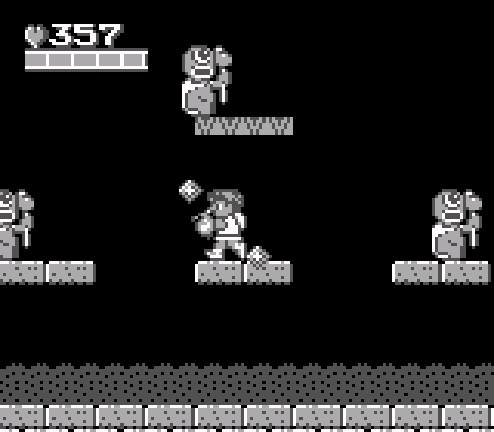
Whatever. At least the level design is okay here.

But while the finale might be tolerable, at least before you take on the slow, clunky final boss fight, nothing that happens before that final stage is worth anything. NONE of the vertical levels offer the same thrills as the highlights of the NES game’s climbing sequences. It’s not just because the stakes are removed, either. They’re just not that well designed. I thought Kid Icarus had some damn elegant enemy placement, especially considering the nightmarish development cycle. The Game Boy title’s enemies often feel arbitrary. Like “well, we have to put SOMETHING here” without having any logic of how that something relates to the landscape. They also somehow made the moving platforming even slower and more miserable to utilize.

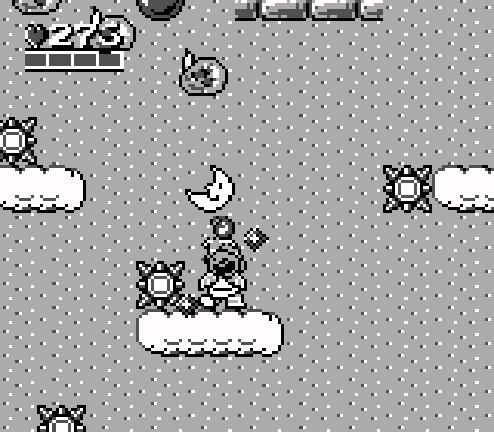
The Grim Reapers are significantly less threatening this time around.

And then there’s the side-scrolling levels, which are a complete disaster because they’re completely spammed with doors to explore. Even if you pretend there are no hidden doors, by the mid-point of the game, Kid Icarus is so completely bloated with shops, enemy chambers, test chambers, arrow upgrades, and assorted other doors that the game has no flow to it at all. When the rooms continuously offer the same stuff, that gets boring. “Just don’t go into the rooms!” But nobody is going to do that. It’s up to the designers to assure that the pace and spacing of their game isn’t interrupted by useless gameplay stoppages. You can’t put that sh*t on players. Even if they had given an actual reason to go inside every single room, I don’t want level design where the main stage has a door every few seconds. The gameplay I’m actually here for isn’t going to be inside them.

This boss looks fantastic, but it’s AWFUL. It pokes its head out for a second or two, then retracts and does the same attack pattern with no variation until one of you dies.

For all of its many, MANY problems, I was never bored with Kid Icarus on the NES, at least until the final stage. Frustrated? Sure. Annoyed? Of course. But never bored. I was SO BORED playing Kid Icarus: Of Myths and Monsters. Even the dungeons were complete letdowns. The only reason I really played the Game Boy game was to experience three more dungeons, but these ones were smaller in scope and much easier to navigate, with no real sense that they’re trying to trick you into getting lost. In the NES game, you might have to climb down a ladder, then fall to the side in order to continue towards the boss. That idea is removed completely. They never even really feel maze-like. They feel slapped-together, because they probably are. Kid Icarus often had the vibe of a game that nobody had confidence in, but this sequel is so much worse because it just doesn’t feel like it comes from a place of inspiration. It feels like Nintendo poking Kid Icarus with a stick to see if it’s really dead, and it is.

It really doesn’t help that, by the time I reached the end, I was killing the Eggplant Wizards in one shot. There’s too many arrow upgrades. What’s really remarkable is those upgrades don’t make the bosses any less spongy. I’m shuddering thinking about “what if I hadn’t gotten those?” I’d probably still be fighting the second and third bosses. Oh, and you’ll note the items work in the dungeons this time.

Now, in fairness, this wasn’t Kid Icarus’ shot at redemption any more than Return of Samus was for Metroid. The redemption would have been an SNES game made by a team that was bound and determined to turn Kid Icarus into a flagship franchise. That’s what Super Metroid was, and that series has been a pretty damn big deal ever since. I said it was unfair, but if I had been a decision maker at Nintendo and had to do a Sophie’s Choice between these two, I’d have chosen Metroid as well. The truth is, Kid Icarus’ vertical gameplay was already topped by Super Mario Bros. 2, and the shooting mechanics with a colorful cast of enemies was topped by Metroid itself, and even the potential for a game based around flying was taken over by Kirby. What really is left for Kid Icarus? The dungeons? That’s what Zelda is for. The humor that the original designer didn’t even want in the first place? Hell, that could be any Nintendo game.

The boss chambers are bigger than the screen. Don’t you just LOVE fighting super-spongy bosses who make the fight last even longer by weaving in and out of the visible playfield. No? Yeah, me neither.

It kind of hit me while making this review that Kid Icarus is just a hodgepodge of gameplay concepts that Nintendo already was building other games heavily around. Everything bad about Kid Icarus WAS improved. It just wasn’t done in a Kid Icarus game. So, my new theory is that Kid Icarus went to video game heaven because it just didn’t offer anything that you couldn’t already get elsewhere from Nintendo. Why put the resources into rescuing a franchise whose core gameplay is already found in more viable titles? The only reason to even try would be if the game’s main reputation is anything but being “the janky one.” But even fans of Kid Icarus will concede that, among famous Nintendo-developed games, it’s “the janky one.” That’s why it died, and that’s why the 3DS game was completely different. Because it kind of had to be, because Kid Icarus as a concept was already dead and forgotten before I was even born. It’s the video game equivalent of an organ donor. Of Myths and Monsters isn’t a sequel. It’s a eulogy for a potential series that died, but in doing so, it might have saved others just by providing a road map of what not to do.
Verdict: NO!

Kid Icarus (NES Review)

Kid Icarus
aka Hikari Shinwa: Palutena no Kagami
Platform: Nintendo Entertainment System
First Released December 19, 1986
Designed by Toru Osawa

Directed by Satoru Okada
Developed by Nintendo
Available with Switch Online Subscription (Standard)

This grim reaper is just so not cool. Sure, this is much better than being Dracula’s flunky, but nowhere near as righteous as teaming up with a pair of time traveling teenagers who are in the afterlife because they were murdered by evil robotic clones of themselves sent from the future by a gym teacher angry that the future is boring.

I’ve been a little too lovey-dovey with Nintendo this month, so how about a game that doesn’t get a YES!? Actually, Kid Icarus is a heartbreaker. The game is no good on its own, but it could have been an excellent first step. There’s something here that’s highly compelling that just doesn’t overcome some terrible design choices and really sloppy play control. I don’t really like the original Metroid either, but it’s in the same boat as Kid Icarus in that both games laid a foundation for something much, much better. But Metroid did get more chances to build upon the first game, and already fun games like Super Mario Bros. and Legend of Zelda got to grow out the base formula with the sequels that improved upon the core game design and especially the play control mechanics. Within just a few sequels, Nintendo had literally perfect jumping physics for Mario, combat mechanics for Zelda, and level design for Metroid. And then there’s Kid Icarus. The franchise that didn’t catch the bouquet so it gave up and became a nun. It’s not fair, really. It had just as much potential as any of their other tentpole IPs.

If you play Kid Icarus, have a second controller ready. In the American/Europe builds, pressing A+B on the second controller haggles with the shopkeepers, who may lower their prices or dramatically increase them. In the FDS version, you have to just blow into the microphone to trigger it. I’m pretty sure no FDS games actually require you to actually speak words to make the mic work. It’s like how I beat the mic games in WarioWare Touched by scratching the microphone. Also, you don’t want to ever max-out your money because you will not get enough credit for collecting money, thus failing to impress the Gods, thus not allowing you to get all four arrow strength upgrades, thus gating you out of the best ending.

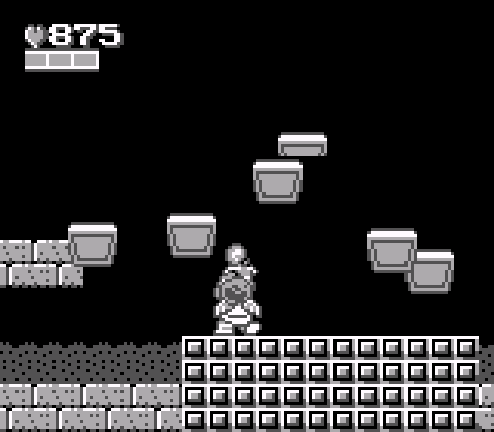
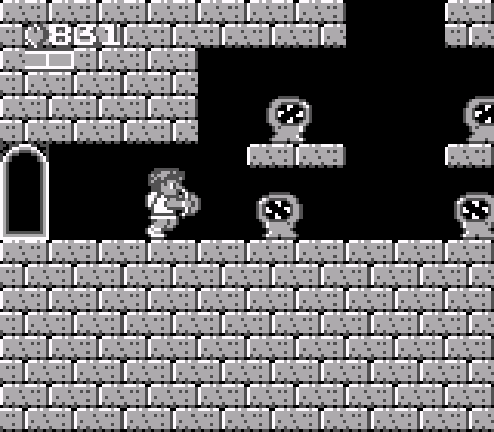
Kid Icarus is among the jankiest Nintendo-developed games ever made. It’s sloppy in so many aspects that it’s tough to know where to begin. Play control is the obvious one. I should have saved “skid to my doom my darling” for this game because my most common method of dying was slipping off platforms. But, that could have been a non-factor if the levels were designed for these physics, and they clearly aren’t. Kid Icarus is riddled with things like slip-slide ice platforms, ultra-slow moving platforms, and single-block platforms. Each presents a problem on its own just based on how rough the platforming physics are, before you even take into account that you often have to perform combative maneuvers while navigating all this crap.

Son of a bitch! See, those evil mouths fly around in erratic patterns that make them hard to shoot, and then you have this spongy snowman thing that shoots projectiles at you. It seems like you can duck those projectiles, but if you duck on certain platforms, you almost instantly fall through them. That’s what I found out here, and I burned through a valuable feather.

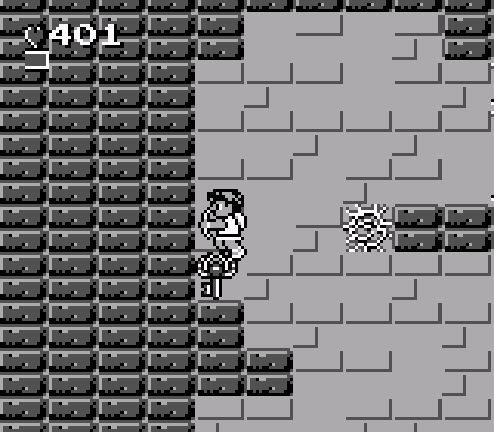
And then there’s the ultra-jarring tonal shifts. Despite only having thirteen levels, Kid Icarus features a whopping four different styles of level design. The most famous of these is the vertical levels, which represent six of the thirteen stages, and they’re fairly notorious because, as you climb, you also create a bottomless pit, logic be damned. If a platform that had been right at the bottom of the screen is barely scrolled off it, you die if you fall where it had just been. The punishment for falling should be having to make all the jumps again and the risk of losing more health from enemies or hazards. Kid Icarus has too stiff a punishment for failure to stick the landing, and that’s especially true with the rough controls and sloppy coding. Like, look at this:

I’m not ON the platform in this picture. I’m IN the platform. I didn’t do anything special to get there except somehow short the jump without shorting it. It does matter too. Many times, while firing my bow without moving the direction pad at all, I fell off platforms. It’s so inelegant in basically every way movement in a 2D game can be. When there’s nothing under you to catch you, that’s a big problem. especially since the game leans extra-heavily into nail-biting platforming segments. MAYBE if you had the accuracy of Super Mario 1’s controls, this could have worked. But Kid Icarus instead is too floaty and has too unpredictable of momentum. So when the level design is like this:

Kid Icarus is kind of fantastic, at least in terms of the big picture. Navigating the stages, which includes a wrap-around playfield, is exhilarating. The levels look great too, so the game really shines brightly as a thoughtful, original action-adventure with solid combat and a memorable cast of baddies that are satisfying to shoot. BUT, when the level design is like this:

Kid Icarus becomes an unbearable slog and the platforming is NEVER exciting because it controls so poorly and the physics are so inconsistent that it never feels like YOU’RE failing. It feels like the game is screwing you, and it often is. And mind you, this is just one of FOUR play-styles in this game. There’s three more. Three of the thirteen levels are traditional side-scrollers. I guess I must be weird, but I think these levels are much, much stronger than the vertical levels.

The test chambers sadly don’t have you shooting portals. Rather you have to just stay alive until the game says “okay, you’re good” and gives you one of three really fun upgrades. One puts a shield around you, one adds a flame to your arrow that spins around it, and the other gives you additional range. They’re awesome, but the catches are ridiculous. The flame requires you to have two full bars of health, the added range three bars, and the shield four bars. The other catch really sucks: you can’t use these items in the dungeons.

Oh, they’re often still not good. Well, let me clarify: they’re haphazardly designed. For example, level 2 – 2 starts out with not one, not two, NOT three, but four goddamn doors before you encounter a single enemy. You’re supposed to use two of the doors to build up XP in order to get the arrow upgrade. This is where I learned that saving money makes no sense because the Gods get pissy if you’re stingy. But there’s nothing else like this section in the entire game. It’s total amateur hour game design.

Like this here. Kid Icarus utilizes low ceilings to cut off Pit’s ability to jump over enemies, and that COULD have been used to greater effect if they hadn’t put the most basic enemy as the “risk” side of the “risk/reward” scenario. Or if they had given you a way to logic-out which path is the best path to take.

The problem with the side-scrolling levels is they contain none of the exhilarating boldness of the vertical levels. For all the problems that those stages have, it feels like they come from a place of inspiration and there was careful consideration for enemy placement and how it relates to the jumps. I really don’t get that vibe from the side-scrolling stages at all. They certainly make fewer mistakes, nonsensical room placement aside. That’s why I think they’re stronger overall, but they also feel like they’re going through the motions. Hell, large stretches of the stages (like the aforementioned nonsense doors) feel like placeholders that got left in the final design. Don’t rule out that’s what really happened. If you don’t already know, you’ll soon find out why.

Yeah, yeah, I used a guide. The treasure rooms (pictured here) have a sequence to them where you can win every time. What I didn’t know is that the Gods frown upon breaking pots in the treasure rooms. So I didn’t get the final arrow upgrade and thus I didn’t get the best ending.

And then there’s the grand finale of Kid Icarus, where all the janky but memorable platforming action is dumped in favor of one of the worst shmups I’ve ever experienced, and I’ve been playing a whole lot of shmups in 2025. Hoo boy, what a dumpster fire Kid Icarus is at the end. In it, you have to shoot bland targets like falling tiles and an enemy that splits into three over and over and over until you reach a certain benchmark for “doing things.” After the game is satisfied you’re not on cruise control, it’ll let you fight Medusa, which has a safe zone so big that you could build a nursery in it. The level getting there is what drives a stake through Kid Icarus’ heart because suddenly the act of moving is hard. The controls are heavy and unresponsive for the finale, and even if that wasn’t the case, the last level would be a disaster anyway because this style of game is not at all compatible with all the gameplay that came before it. It’s one of the worst final levels and final bosses in any Nintendo game.

How did Kid Icarus turn out so janky when games like Mario, Zelda, and even Metroid, at the very least, control well? Actually, Metroid is kind of to blame, but really it was just bad corporate decisions. Metroid was considered a very high prospect game, so Nintendo devoted all their resources to it while one guy, the debuting Toru Osawa (who went on to direct games like Mario Clash and Legend of Zelda: Ocarina of Time) had to spec out Kid Icarus all by his lonesome. He had to design the world, the enemies, and most of the levels. He only got a full working team to help him once Metroid was mostly done, and then the team he got were exhausted from doing the already dead-serious space adventure so they usurped his concept of a dead-serious mythological adventure by inserting “humorous” things like the credit card and the Eggplant Wizard.

Kid Icarus was the first game released in North America with the revolutionary MMC1 chip that allowed the NES to do bigger, more detailed games. In screenshots, it looks amazing. But you actually have to play it.

But the thing is, while the staff liberally plied Kid Icarus with humor and stuff like the haggling with the shopkeepers, what nobody bothered to do was refine the actual gameplay. Then the release date was set for the end of 1986, well ahead of when the game could reasonably be completed, so everyone just hung around Nintendo HQ in the freezing cold (apparently the building wasn’t heated) to finish the game. They BARELY finished in time, and in fact, Kid Icarus was only sent to manufacturing three days before it was set to release. Consequently, it wasn’t subject to the same type of play testing and polishing that other games from this era got. Kid Icarus is Nintendo’s E.T.: The Extra-Terrestrial, and it speaks volumes to how talented they really were even back then that the final product is as good as it is. But what we got is a fraction of its potential. Nobody did the responsible thing and delayed it.

Yet another example of jank are these things. Touching them even once costs you the power items you won in the test chambers, which you either have to win back in another test chamber or buy back on the black market. MAYBE this could have worked if you could fight back and reclaim the item before they vanish off the screen. That would add proper risk/reward balance. Well, you can’t because they’re indestructible. What an overall terrible game. Well, except one aspect………

“Cathy, you left out one gameplay type.” I know, but I saved it for last for a reason. Because the one thing Kid Icarus unambiguously does well, it does it so well that I almost want to cry that it’s not the whole game. It’s the dungeons, which are kind of like side-view versions of Zelda’s dungeons. I mean much more than Adventures of Link’s dungeons. They’re designed like legitimate mazes, where you might think you’re plotting the right course only to find out the room you’re making your way to has no means to continue on the path you’re trying to take. Well, at least two out of three of them are like that. Because I enjoyed these levels so much, I put away the guide and it took me quite a while to beat levels 1 – 4 and 2 – 4. Then in the third dungeon (3 – 4), I found the boss so quickly that it took me a moment to process it. I literally couldn’t believe it was placed where it was, which was next to a shop.

The hammers you collect in the levels via the harps or treasure rooms can be used to smash these statues in the dungeons, which free the Centurions that were turned to stone by Medusa. You want to do this because they’ll help you fight the (relatively spongy) bosses. Too bad they have absolutely no survival instinct.

But the dungeon levels worked for me. Oh, did they ever. And that’s why it’s such a punch to the gut that there’s only three of them. I can’t help but wonder if Kid Icarus would have been better off being based entirely around this specific style. Instead of nine total vertical and side-scrolling stages and the lame-ass shmup finale, I would have preferred a game that had eight to ten dungeons. Had they gone that route, I honestly think Kid Icarus might be remembered as highly as Metroid or Zelda. I think the combat-focused maze explorer done in this style and with these themes, separate from Nintendo’s other flagship IPs, makes Kid Icarus stand tall in a crowded field. The problem is, in order to play these three amazing dungeons, you have to play nine mediocre-at-best levels that are really nothing like the dungeons.

There’s no happy ending here, because Kid Icarus is one of the few early Nintendo franchises that they never put a good faith effort into building upon that initial foundation. There’s a Game Boy sequel that I might take a look at soon (Update: the review is up) that apparently has most of the same problems, and then there’s the 3DS game which basically is nothing like the original game, changing the genre and gameplay. These days, Pit is more famous for his role in Smash Bros. than he is as the star of his own franchise. This despite the fact that Kid Icarus was big enough decades ago that it contributed a main character to the unwatchable animated series/Nintendo infomercial Captain N: The Game Master, and then was still memorable enough in the present era that it was one of the games featured in 2024’s Nintendo World Championships: NES Edition. Granted, Kid Icarus had the challenge that took me the most attempts to get an “S” rating and that outcome was largely the result of the sloppiness of the whole thing. But, nearly forty years later and Nintendo actually said “yeah, we better put Kid Icarus in this thing.” But the one thing they’ve never done is redeemed that original base concept.

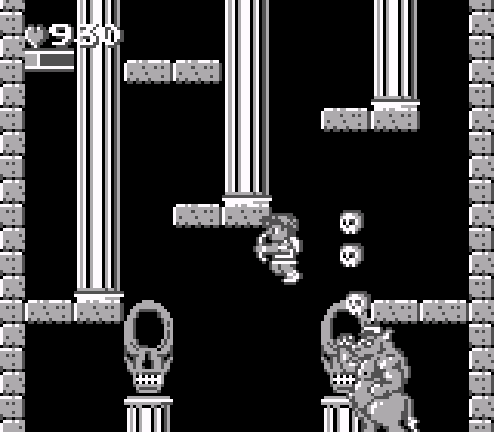
Okay, so the boss graphics aren’t strong. That’s supposed to be Cerberus in the corner, but instead it looks like two dinosaurs humping. After having unforgettable sprites for the Eggplant Wizard, grim reaper, and even the basic enemies, having this thing look like someone sneezed while filling it in is such a let down.

What Nintendo should do is take all the space age technology they’ve since invented and do a true sequel to Kid Icarus. Not a third person shooter either, but a REAL sequel that builds much more heavily around the best part of the game: those dungeons. If you want, go ahead and make a few vertical levels as well. I’m fine with that because they would certainly have to apply everything that’s been learned in the fields of level design and play control. They could keep the humor or dump it like Osawa wanted. That doesn’t matter because gameplay is king. Kid Icarus is a bad video game, but not ALL bad. It just never got the redemption that Nintendo’s own game design evolution would have given it. Those amazing dungeons still feel fresh in 2025 because, really, there aren’t a lot of Nintendo-made games where their exploration feels like Kid Icarus’s three dungeons. It might not be a game worth playing in the 2020s, but the idea of Kid Icarus is an idea worth saving.
Verdict: NO!

Can’t be unseen. 🖕😶🖕You’re welcome.

WarioWare, Inc.: Mega Microgame$! (Game Boy Advance Review)

WarioWare, Inc.: Mega Microgames!
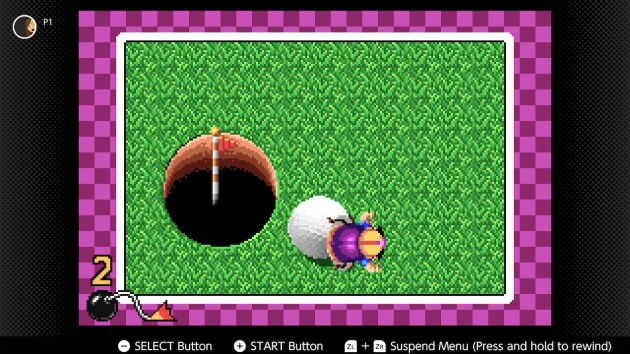
Platform: Game Boy Advance
First Released March 21, 2003
Directed by Hirofumi Matsuoka
Developed by Nintendo
Available with a Switch Online Expansion Pack Subscription
Listing at Mario Wiki

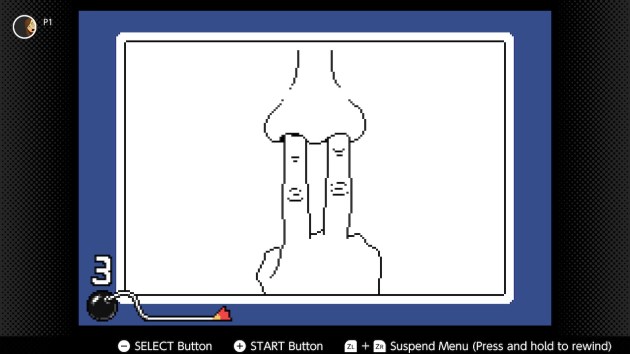
Behold: the one and only time I won the third stage of the nose picking game. My skills have eroded badly.

When I started Indie Gamer Chick, if you had asked me what my all-time favorite video game was, this would have been my answer. WarioWare Inc.: Mega Microgame$! for the Game Boy Advance. Not the best video game I’d ever played. That still hasn’t changed. In 2011, I would have answered with Portal, Tetris, or Shadow of the Colossus. In 2025, I’d narrow it down and say Shadow of the Colossus is the greatest achievement in game design of all-time. But that’s the BEST video game, and I think it’s okay to name one game the best and another your personal favorite. I’m talking about the game that, for whatever reason, I personally had the best time with.

I had to reach a score of 80 on Crygor’s stage (my highest of any of the levels BY FAR this entire play session) to get this, the last mini-game I needed for a full set. It just would not spit it out.

WarioWare wouldn’t even have that title today. If I was stuck on a desert island and given the option to only have WarioWare or Super Mario Odyssey, well, I’d probably say “f*ck that” and swim for it. Assuming that wasn’t an option, I’d take Mario Odyssey. Which, by the way, I take a lot of comfort from. Today is my 36th birthday (at least it was when I was typing this review, but I didn’t hit publish until after midnight the next day), and I think it would be tragic if I’d already had the best time I will ever have playing a video game when I was 14. The fact that it took fifteen years for that to be taken over by a different game is fine, because that means it could change again. Gaming probably hasn’t “peaked” for me at 36. That puts a smile on my face.

Goddamn this game is full of nightmare fuel. That’s not even the scariest potato in the game.

Now granted, people have ALWAYS been baffled by how I could love WarioWare as much as I do. And by that I mean the first game and not the franchise. For the most part, I don’t even like the WarioWare franchise. That’s the thing that really bugs everyone. I only really loved the first one. A few years ago, I enjoyed WarioWare: Get it Together just fine, but even though I spent over a week playing it when it came out, I can’t name a single micro game from it. Not one. My brain just completely bleached its existence from my head, and I didn’t even bother buying the latest game in the series. WarioWare was fun the first time, but it’s only the first one that really avoids that “trying too hard to be quirky” vibe. The others all feel like they’re trying to top this game in terms of weirdness. But, I didn’t play this because it’s weird. Oh, that got my attention, but it was the score-driven gameplay that hooked me.

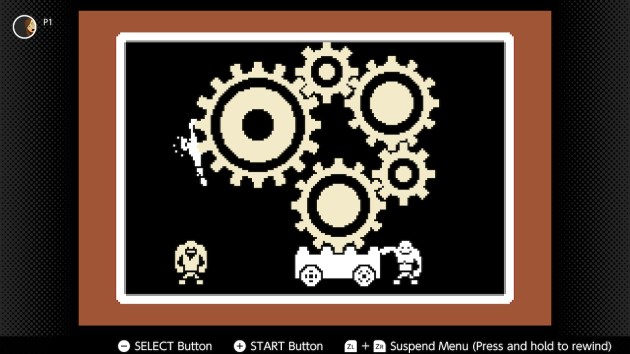
As a kid, I hated this game. I fancied myself smart, but I could never properly calculate this one. Today I……… uh, well, I mean….. yeah.

The strange thing is, besides pinball, I’d never really been into high score games, but that’s all WarioWare really is. Try to complete an increasingly difficult series of bite-sized mini-games that are shot at you at an increasingly higher speed until you run out of misses. It’s such an uncomplicated game that you only use the D-Pad and one button, the A button. Everything else goes unused, and they mined this simple control scheme for 150 micro-games, though some are just the same game reskinned. There’s also tons of games that are just about mashing the A button or stopping a meter in time.

This is one of those games that, for whatever reason, was one of my weaknesses.

But, while it’s impossible to claim that all the games feel distinct, that’s not the point. It’s the random nature of “you never know what games will come in what order” and the fact that the action speeds up. Later versions of WarioWare did a much better job of tying each level’s games to a central theme, but MOST of this first game isn’t like that. Sometimes it is, like all the games in Orbulon’s stage are “intelligence-based” so they’re like IQ test type of things and have a longer time limit. The games of Jimmy the hipster are sports-themed. But, most of the mini-games could be in any character’s collection. In fact, many actually do repeat even outside the levels that feature games from every collection. But, what makes it work over future installments of WarioWare is that there’s no sense of gimmickness to it. This is gaming stripped to its purist minimalist form. In a sense, this is the closest Nintendo ever came to their old Zapper games where personality needed to carry otherwise VERY simple gameplay.

Here’s the game’s most evil potato. It’s still only the second most evil potato I’ve encountered in my life. It’s evil, but not as evil as the one that told me I should set my parents’ bed on fire.

And that’s why it succeeds. WarioWare is oozing in personality. There’s no one graphical style and seemingly anything goes, from a girl who has to suck her snot back up her nose to navigating a mosquito past bug spray to bite a baby. Actually, if not for all the Nintendo stuff, I don’t think anyone would ever guess this was a Nintendo game. Some of the graphics are hand-drawn. Some are pixelated. Some are stick figures and others are actual digital photos. It’s so completely weird and original. Like, one game looks like this:And the next might look like this:

And you have to process the change in graphics and gameplay style and react right away. But it works. The simple instructions and simple objectives make this the greatest quick-draw game ever made. Even in the days before online scores, I found myself trying to play long enough to just make it one game further than my best run on any level. It’s addictive. And it does hold up to the test of time. I don’t think any of the ones that followed would have. I didn’t even really like WarioWare Gold. I also didn’t play too many of the side-quest mini-games and I never even tried the multiplayer games in WarioWare before yesterday. I did this play session and exactly one of them was fun. It’s this one:

I was the top player. I fell off the cliff seconds later, but we don’t need to talk about that, Sasha. Oh, and show of hands: who thought the thing on the bottom half of the screen was SpongeBob SquarePants the first time they played this? (raises hand)

Chicken Race actually does use L and R so that two players can compete on a single Game Boy Advance (or Nintendo Switch in this case). Both players hold and release their respective shoulder buttons and try to get as close to the cliff as possible without falling off. I wanted to play a couple rounds and Sasha and I ended up playing it for half an hour. As a kid, I also played a ton of the paper airplane game, where you have to guide an airplane as far as you can without crashing. WarioWare offers tons of distractions, but none of them can hold a candle to the core gameplay. It’s easily Nintendo’s best arcade game since they got out of the arcade business. They should do more games like this, really. I don’t mean more WarioWare, but more simple, scoring-driven arcade style games. They’re really good at it.

My best this session was 125. As a kid, I got into the 300s a few times.

Playing WarioWare today, it’s not hard to imagine how this could have ever been my #1 favorite game ever. I played it for close to a week and the only reason I’m stopping is to write this review. Then I have to move on to other games. I never did end up breaking for 100 points on any of the levels like I did as a teenager. I’m old now and my reaction time sucks. But I accept the new reality of my increasingly decrepit state and so when I had 44 in one round and 46 the next, I felt pretty damn good about myself. WarioWare is STILL fun to challenge yourself with. Eventually the personality that eases you into the game gives way to one of the most white-knuckle tests of your muscle memory that you can get on Switch Online.

My arch nemesis with WarioWare in this play session was any game that required button mashing, of which there are far too many. This is one of them. This should count as my Metroid 1 review, by the way. No? Fine.

Playing WarioWare today reminds me of how STUPID I was as a kid. Not for choosing this as my #1 game. No, it was a good choice. WarioWare isn’t perfect. Too many button mashers. Not every game lends itself to speeding up. Some of the games don’t scale well enough to have three difficulty levels. But as a first-of-its-kind experiment, it’s fantastic. One of Nintendo’s best games ever, really. And I was stupid for not realizing that challenging my own high scores is something I would enjoy in other games. I had a snobbish streak even through my 20s. I didn’t understand the point of chasing offline high scores at all, except for this game. These days, I can sit down with Pac-Man or really any 80s arcade game and just chasing the score alone makes my play session fly by, which makes my review process easier even for bad games. WarioWare hasn’t changed, but I have. Do I like WarioWare as much as I did in my youth? I don’t know, but I know I admire it more now than I ever did before.
Verdict: YES!

Super Mario Advance 4: Super Mario Bros. 3 (Game Boy Advance Review)
Super Mario Advance 4: Super Mario Bros. 3
Platform: Game Boy Advance
First Released July 11, 2003 (my 14th birthday!)
Directed by Hiroyuki Kimura
Developed by Nintendo
Available with a Switch Online Expansion Pack Subscription
Listing at Mario Wiki

After not having that tough a time playing Lost Levels, I got swallowed by a goddamn fish three times.

Super Mario Bros. 3 is one of the most celebrated video games ever, and one of the most studied. If you have twenty minutes to spare, well, please keep reading because I work really hard on these things. BUT if you have forty minutes, after me, go read everything Cutting Room Floor has on Mario 3 because it’s fascinating. The amount of drawing-board content that made it into the final game’s code rivals the volume of deleted content you’d see in something like a modern Grand Theft Auto game. It’s also the final console-based Super Mario game to first release before I was born. More importantly for the sake of this feature, Mario 3 is a game that I tend not to like anywhere near as much as my older readers, and I swear to God, it’s not just for the sake of being contrarian. Who would actually say something that’s good isn’t just to be a prick? Well, that’s not my argument with Mario 3 anyway. I like it a lot! I just don’t love it.

In the making of this review, I 100%ed Mario Advance 4. No levels were skipped. No P-Wings were used. I didn’t use rewind to cheat and I never laid down a single save state. I also got every Advance Coin and e-Coin out of the 38 E-Reader levels. Then I replayed probably 25% of the core levels to figure out why I was just not digging them as much as my older readers. The answer involves one-of-a-kind circumstances that can never be replicated along with a dash of science! And if you’re looking at the above picture and saying “hold on, what?” and you’re a Switch online expansion pack subscriber, stop reading now, pick up your Switch, open up Mario Advance 4 and go play the E-Reader levels. It’s cool. I already got your click. It might screw up my “average read time” though so just leave the window open. Thanks.

I can’t appreciate the level of anticipation that gamers of the 1980s went through in the lead-up to Mario 3’s release. I mean, of course there were games I looked forward to as a child, but Mario 3 was arguably the last major game to come out before anything resembling a console war was happening. It’s a situation that will likely never be replicated. The Genesis didn’t really blow up until 1991, so Nintendo stood alone and Mario 3 was the single biggest title that kids wanted. For anyone my age, go back to your childhood and think of the game you wanted the most, and now imagine it was the ONLY game in town, with McDonald’s Happy Meal toys and a cartoon series and motion picture tied into the advertising campaign. Yeah, this will never happen again.

I swear there will be a game review here. Eventually. But this stuff is important to the review I’m going with, trust me.

Super Mario Bros. 3 came out in North America a whopping 477 days AFTER the Famicom release. Publicly, Nintendo blames a ROM shortage, but I think there’s more to it. Oh, I’m sure there was some ROM manufacturing hiccup, but I think they took advantage of it because they didn’t want Mario 3 to cannibalize Game Boy sales. It was their first non-NES device that was released around the time Mario 3 was originally penciled-in and they sort of needed it to do really good to prove they weren’t a flash in the pan. Maybe selling millions of copies of Mario 3 AND millions of Game Boys in 1989 would have been a flex, but who knows? Maybe it could have gone the other way. Gaming had already crashed once, and asking for Mario 3 undermined the Game Boy’s pitch. This is still firmly the “most children’s bedrooms didn’t have a TV” era, and Nintendo’s pitch to parents was “buy your child a Game Boy and get the living room TV back!” But if children in 1989 were asked “it’s either a Game Boy or Mario 3, so take your pick” I think they pick Mario 3, don’t you? Hell, the most famous Mario 3 ad doesn’t show a single f*cking second of gameplay. That’s how hyped the game was, and if Nintendo forced a competition between their own products, I think Mario 3 would have left Game Boy in a smoking crater. Why even create the possibility for that scenario if you don’t need to?

Well, clearly they didn’t need to. Assuming I’m right, sitting from my comfortable distance decades later, I kind believe they were vindicated for the choice to delay. Game Boy was a big hit and Super Mario Land is one of the biggest sellers ever. So was Super Mario Bros. 3 for that matter. The extra time allowed Nintendo to go hard on the Mario 3 advertising with a media blitz that included a Happy Meal promotion at McDonald’s and a cartoon series that was so popular that reruns were still on TV when I was a child. I thought it was completely unwatchable when I was 6 years old and I think it’s still unwatchable now that I’m about to turn 36 years old. Okay, TECHNICALLY the Adventures of Super Mario Bros. 3 aired after the game released, something I wish I had checked on before I watched the entire f*cking series, all twenty-six 10-minute-long shorts, for this feature. Here’s my review: Oh God, the Koopa Kids (who are all the wrong names for some reason, WTF is that about?) are a parody of Ninja Turtles. HAH, because they’re turtles! Someone got paid to make that connection. Oh God, Milli Vanilli is on the show. That sounds like I’m making a joke but I’m not. That’s really them. Oh God, Luigi’s a dog now. Is that a thing they planned for the game?

Nope, this doesn’t work for me. I need someone to take a drill to my head and get it out. I’m not kidding. It feels like The Adventures of Super Mario Bros. 3 is digging at my skull from the inside. Get it out. GET IT OUT! GET IT OUT! GET IT OUT! GET IT OUUUUUUUUUUUUUUUT!

Most famously of all, Mario 3 was the climax of a feature length Nintendo/Universal Studios advertisement called The Wizard, which was released in theaters two months before Mario 3’s US debut. No need to drill this one out of my head. My film buff sister and her pretentious friends (sorry, sis) watched it during a “bad movie marathon” last year and honestly they didn’t think it was bad enough to be included, because it’s not so much “bad” as it is “completely shameless, cynical, and/or soulless.” Even though I was there ruining the experience for them by pointing out that not a single one of the video game scenes in that movie makes a lick of sense. Somehow Jimmy got 50,000 points on Double Dragon in approximately thirty seconds. I tried this myself, syncing Double Dragon for the NES with the scene in the movie. In my best run, my score from the opening cinematic (seen in the movie) until the time Fred Savage says “50,000?!” was 2,050 points.

I guess that’s why Jimmy is the Wizard and I’m not.

That’s even giving me a full extra second or two since Fred Savage needed a moment to process that his brother is obviously a legitimate wizard. As in a practitioner of sorcery and/or witchcraft who clearly possesses the Time Gem, and possibly all the other Infinity Gems which he used not wipe out half of all life in the universe but instead change the scoresheet for Double Dragon so that every landed shot scores about 4,000 points, give or take. Diabolic. Hey, it’s either that or there was a cigarette burn on the screen right where the score is displayed that looked like the number 50,000. What? It could happen! The Wizard is the definitive “kids’ product made by people cashing in on a kids’ trend who aren’t interested in figuring out why the popular thing is popular.” And it’s really bad about it, too. Even Roger Ebert said he knew that the shots of Teenage Mutant Ninja Turtles that were purported to be of the third stage were only the first stage while Gene Siskel recognized that nobody who made this loved the games featured. It’s THAT obvious, even to a non-gamer. But ask gamers at the time if they remember that part, and they don’t. They remember this:

Even though that scene makes no sense either. Why would they be scoring points as soon as the host said “GO!” How would Jimmy even know the warp whistle is there? Why would warping boost his points? Shouldn’t he be scoring no points while he f*cks around with the warp whistle, and how did he even know how to activate it in the first place? Why would losing a life cost you points? If Jimmy lost so many points, how did he still win when Lucas is the only one on stage who never died? This thing has more plot holes in the big finale than all of Season 8 of Game of Thrones. I take back what I said about the Wizard, because it’s so much worse than simply being disinterested in what kids are into. It’s a movie made by people who think kids are stupid. Not that it matters. It more than doubled its modest $6 million budget at the box office, and that’s before you consider that normal Hollywood metrics don’t apply since the movie was not meant as a normal movie but as a feature length advertisement heavily subsidized by outside forces. Hell, even the finale I’m pretty sure was partially subsidized by the state of California for a sh*thole roadside attraction, the Cabazon Dinosaurs. I went there as a kid before it was turned into a creationist museum (I just found out it’s back to being a run of the mill tourist trap), and remember it had an intense musty smell.

Pictured above: how this review is going. But I do have a point: I want you to consider everything I talked about above. Prerelease circumstances that have never, and will never, be replicated. I think that’s part of the reason why Super Mario Bros. 3 is a huge deal to my older readers and not so much to my generation. I’ve met plenty of people who have it on their short list of “greatest video games of all-time.” I’m so sorry to my 40-something to 50-something readers, but I’ve never really understood it, because I don’t think Super Mario Bros. 3 should even be in the GOAT conversation. It’s fine. The flying racoon idea (with tail-whip attack) was inspired. Some of the levels are truly breath-taking. The enemy design especially never gets the credit it deserves. I think the roster of basic enemies is even better than Mario 2’s. Super Mario Bros. 3 is a solidly good game. Maybe even a great game. Maybe, as in I wouldn’t passionately argue against someone who wants to call it “great.” BUT, I do have a case to make against its greatness.

One of my biggest problems is that I think the Koopalings are boring bosses. They’re not that different from the Boom Booms in the fortresses (which I also think suck, they’re too easy to cheese). In fact, only this one pictured here feels different from the other six. Before fans get mad at me, I didn’t think they were particularly strong in Super Mario World either. Want to know the best appearance by the Koopa Kids? It’s EASILY Yoshi’s Safari (as seen in my Definitive Review of Nintendo light gun games), where each of them feels unique. Ironically, the game where you point a f*cking bazooka at them is the only one where they don’t feel like cannon fodder.

Mario 3’s base game only has a couple stages I’d consider to be particularly strong. Don’t read that as “she’s saying the levels suck” because I’m not. My attitude towards the base game in general is “it’s fine” and when it comes to the level design I’m going to stick with “it’s fine.” Except, you know, when it’s not. It just often feels like there’s no good incentives to explore the levels. Take level 2 – 1 for example. They built these two massive hollow structures that you literally walk over the top of. You can go inside them and collect an extra life and some coins. Except extra lives are plentiful and coins just aren’t enough of a reward. This is just bad risk/reward design and a poor use of real estate, and if this were ANY game but Super Mario Bros. 3, I think people would universally say this is nonsensical design.

As punishment for nonsensical design on the part of designers, I made Mario, their bread and butter, wear the Tanooki suit in the scorching-hot desert environment. You made me do this, Nintendo.

But that kind of head-scratching design is all over Super Mario Bros. 3. Even in levels that are fun to explore. You’ll notice that I didn’t say the structures themselves are stupid or anything because I’m not sh*ting on them. Their shapes are perfectly logical platforming game layouts. Good enemy placement on the inside. Not so much the roofs, which are, you know, the parts you have to actually walk across to get to the end of the stage, which is right there past the second structure. Hell, the second one didn’t even have a single enemy on its roof. But I think the little jumping flames inside the structures are quality enemies and a credible threat to Mario. There’s just not a good reason to go inside of them. This could have easily been fixed by creating some kind of circumstance that necessitates going through structures. A key. A switch. Anything besides a nominal reward with no risk/reward balance consideration.

The one thing about Mario 3 that I just plain do not like are the maps. I think the whole map system is TERRIBLE. Bypassing levels. Confusing pipes. The airships flying off to other parts of the map and creating busy work, especially if you went for a 100% like I did. Shouldn’t scoring a 100% in the world before you enter the castle just automatically anchor the airship so you don’t have to play fetch every single time you die on the stage?

But the thing that bothers me most about Mario 3, and this will annoy my older readers quite a bit I imagine: I think it’s too conservative. Like, the Tanooki suit can make invisible things visible, including platforms and doors. You can do a LOT with that idea, but they really didn’t. There’s only a small handful of uses for it, most of them quite subtle, and none of which made me sit up in my chair. The Hammer Bros. suit can kill enemies other suits can’t, but they never once built a stage specifically tailored to that strength. I hate to keep using the same argument, but if ANY OTHER GAME had an item like the Hammer Bros. suit and never once worked up the courage to make a level where it’s a necessity instead of a luxury item, I think the average gamer would question why they bothered. And you know they’re capable of better since they certainly did a good job building reasons to use Racoon Mario or even Frog Mario.

No complaints about the Frog Suit. It’s the one element of Super Mario Bros. 3 where the risk/reward factors are given proper balance. Okay, so the maps could have used much more clear indicators of what stages have practical usages for it.

Now, in fairness, Mario 3 does offer plenty of highlights. World 1, as in every single stage in Grass Land, is one of the most downright scientifically perfect opening sequences ever in any platform game. The absolute perfect education for everything to come. Along with Mario 1’s World 1, these stages could be the whole curriculum of game design school for how to introduce mechanics into your game. After World 1, the level design keeps up a consistent drip of uniqueness, including several one-off moments. You don’t expect that from a 1988 game. The most famous is, of course, the shoe. Hey, who doesn’t love the shoe? I mean, it would probably be lame as hell if it was just a regular roster item, but it ain’t! It just shows up in a seemingly random World 5 stage (specifically 5 – 3), gives you a short playground that takes under two minutes to beat even if you f*ck around, and then it’s taken away from you and never shows up again until it had its mystique utterly shat upon by about fifty-thousand uncreative people in Mario Maker.

It’s just so random, you know? “Hey, for this level, ride a shoe!” In fairness, if the shoe had been an option in World 7, you might as well gather the kids around and tell them that World 7 is going to a farm upstate where it’ll get to run around free and happy with all the other worlds.

That’s the thing though. For all my bitching, the bite-sized level format also kind of makes the game bullet-proof. Even when Mario 3 is outright bad, and on rare occasions it is, it’s still okay because, barring a loss of life, you’re two minutes or less away from something that’s different. Well, besides those damn airships, all of which felt interchangeable except the first one (again, perfectly balanced like everything else in World 1) and the last one (the series of speedy ones in World 8). I’m really not a fan of auto-scrolling in platforming games and I didn’t enjoy the airship concept at all. Otherwise, nobody can accuse the levels in Super Mario 3 of feeling samey. There’s clearly an effort being made to give stages individual personalities, unique game design goals, and their own one of a kind “vibe” for lack of a better term.

While World 1 might be “perfect” my favorite world, except for that busy-work-inducing map, is World 7. Something about it just worked for me.

That’s the ground Mario 3 really broke, and it’s VERY modern in that regard. A rapid-fire series of unique platforming challenges that hit one after another, with tonal whiplash that would leave you in a neck brace if it were any genre but a 2D platformer. That individualism overrides the actual gameplay content. While I might be very frustrated by how de-emphasized exploration is, I’m also picking nits with full knowledge that’s NOT the point. Mario 3 isn’t a five course meal. It’s a bag of potato chips. That’s not an insult, by the way. Who doesn’t pig out on potato chips? You can’t just stop at one! That’s the point! It’s why I don’t really think there were any truly stand-out “holy crap that level was amazing” moments in Mario 3. Instead, it just maintained a consistent tempo of quality stages, and I kept reaching into the bag to have another, and another, and another. If you want gourmet food, you want to play Super Mario World, where Nintendo applied the lessons they learned making Mario 3 to make much more logically-sound levels that have exploration highly incentivized.

Or you can play the E-Reader levels.

Yep, that’s the cape from Mario World. Yep, this is still Mario 3.

If you’re a Nintendo Switch Online expansion pack subscriber, you can play the E-Reader stages in Super Mario Advance 4, and trust me, they’re absolutely f*cking phenomenal. Well, 33 out of 38 of them, since the first five are just remakes of Mario 1’s World 1 and Level 2 – 2 because of-f*cking-course they would do that. If you want those to be fun, you have to make your own fun. I just flew around with the Mario World cape dive-bombing enemies out of spite. F*ck them.

Goomba: “Yep, this is going to hurt.”

Now don’t expect all of the E-Reader levels to offer some kind of hardcore white knuckle challenge. All of them have some kind of gimmick and several of them are just plain silly. But, they all remember to have fun. Okay, so maybe it IS a cinch to use the sticky blocks to run around a track. You just hold the B-button and forward on the D-Pad and watch the game beat itself with minimum effort, but that’s not the WHOLE stage. It’s there because that’s fun, and that should be all that matters. Even the weakest of the E-Reader stages are so damn charming in how out of f*cks they are about presenting any resistance when they could just have some toy for you to play with that they shoot the moon and becomes genius. Like at one point, a Boomerang Bros. shows up and he has a blue boomerang that, once you kill him, you get to pick up and throw at the next enemy. It happens once and never again and I LOVED IT!

I hope I didn’t just imply that some of the stages aren’t pretty tough, because THEY ARE. Most are middle of the road in terms of difficulty, but when the E-Reader levels show their teeth, they REALLY show their teeth.

Plus, nobody can accuse THESE levels of not wringing every drop of gameplay out of their real estate. The best way I can describe these stages is that they do for Super Mario Bros. 3 what the Special Zone stages in Super Mario World did for that game. This is the culmination of everything that has been learned by those who worked on these games saying “okay, let’s really show ’em what this engine can do.” As a result, the rough sloppiness of Mario 3’s level design is completely gone in these stages, replaced with fine-tuned level themes that very specifically require the players to explore. In fact, my absolute favorite levels of the core game, the ones that are mazes, are the main style of game in the E-Reader stages.

Oh it’s not just the items from Mario World that show up.

And even the gimmicky levels, like ones with timers so short that you only have 20 seconds, give players an actual reason to explore: the Advance Coins and the rarer e-Coins. I have no f*cking clue why these weren’t added to the core Mario Advance 4 game. Assuming they placed the coins in the right locations, and I have no reason to believe they wouldn’t have, it would have been transformative. I was constantly saying “what the f*ck was the point of having that entire section there?” That would have been off the table, but they didn’t do that and that’s pretty heartbreaking. When I did Mario Advance last week, I didn’t go for 100% of the post-game Yoshi Eggs. But, had they done the same kind of post-game bonus with Mario 3, I would still be playing Super Mario Advance 4 instead of writing this. I would have gone for 100% in the eighty-eight core levels just like I did with the thirty-eight E-Reader levels.

Oh, these stages are so good. They actually created space for 72 such stages. I wonder if, somewhere in the bowels of Nintendo’s archives, there’s even more of these waiting to be released.

That’s why, while I’m so happy I finally played Super Mario Bros. 3 for an IGC review, I also walk away feeling that it’s maybe the most overrated “all-time great” in terms of its actual content. It’s fine, but almost all my happiest moments came from playing the E-Reader levels. They felt more like the type of stages I would see in a Mario game from MY lifetime. I still think the core game isn’t as good as Mario 2 or Mario World. Not even close, and some of the ROM hacks I’ve played of Mario 3 annihilate it completely. So, why do older people tend to put this on such a pedestal? Is it really “you had to be there?” Well, yeah, but it’s much more complicated.

Okay, there’s SOME sloppiness. The Big Boo from Mario World returns a couple times in the E-Reader levels, but because you don’t have the ability to kick things upward in Mario 3’s engine like you can in Mario World, the fight is kind of janky.

I can’t imagine how big the leap from Super Mario Bros. 1 to Super Mario Bros. 3 must have felt for my older readers. Literally, I cannot, because there’s no comparison to anything in my gaming lifetime, especially since I just missed the jump from 2D to 3D. My gaming lifetime started in 1996, with the PS1, and really took off in 1998, when I got my Nintendo 64. If my parents had let me play Grand Theft Auto, then the jump from GTA 2 to GTA 3 would have been the Mario 1 to Mario 3 killer, but I was 10 and then 12 years old when those games came out and I wasn’t allowed to play them. My parents were afraid if I played the wrong kind of games, I’d become a cynical, foul-mouthed deviant. The results speak for themselves. Anyway, from a game design evolution point of view, I experienced a series of incremental steps forward. That’s kind of crazy when you think about how close I was to the dawn of games. I was only a decade late. Maybe a decade-and-a-half, but either way, I pretty much missed the age of big progress in game design entirely. And if you don’t think I’m so jealous of my older readers that they got to experience one gigantic leap forward after another that I want to swap their shoes with mouse traps, you’re wrong. You f*ckers were spoiled!

My favorite levels were almost always the fortresses. Anything that REQUIRED exploration and experimentation in Mario 3 was usually elite level design that holds up to the test of time.

But I also think those leaps might have made games seem better than they were. I’m not condescending my older readers, either. There’s actual science on this, and with games that make those gigantic leaps forward like Super Mario Bros. 3, it’s deeper than the simple nostalgia science of “Mario 3 is your favorite game because you played it as a child and didn’t have the burdens of adulthood weighing you down.” Oh no, it’s actually even more potent than that. Since the leap between Mario 1 and Mario 3 was so huge, it’s safe to say that Mario 3 was practically a whole new experience unlike anything you had experienced before. Agreed? Good. Well, get this: new experiences cause your brain to literally trip a sort of circuit breaker and go into a “recording” mode. And, of course, it does this with the brain’s favorite chemical: dopamine, which makes you even happier, which lights up even more neurons and gets them ready to record, which releases more dopamine, and so forth, and so forth. There’s actually a reason your brain is doing all this, too. Your brain is putting itself in a state for memories to form easier and last longer because it’s now operating under the assumption this new activity that you’re enjoying is one you will do again, so whatever you’re doing now, you’ll need to clearly remember what you did and how you did it so you can do it even better next time. Neat, huh? But consequently, anything similar that follows will lose that sense of “newness” so it won’t trigger the same reaction in your brain, and so you can NEVER replicate it. If you played Mario 3 when it was new in 1990, maybe that’s actually why nothing has felt quite as fun as it since. Your brain was literally configuring itself for almost all video games based on your experience playing Mario 3, and to assure that, it made you drunk on happiness. People my age aren’t looking down on you. We’re in the same boat with different games. For me, it was Banjo-Kazooie, Ocarina of Time, and Goldeneye.

The hammer suit in Super Mario Bros. 3 has to be one of the most overpowered items ever in a Mario game. It’s ridiculously effective, taking out too many otherwise impervious enemies like the ghosts and thwomps and dry bones. They can even kill Bowser directly. I imagine this is why it’s not until the last third of the game that you can get it “naturally.” I got my first hammer suit at the end of world six in this play session. Fun fact: if you don’t count Mario Maker games, the hammer suit is the only item in the Mario 3 to never be reissued in future Mario games. It’s the Black Lotus of Mario items.

Well, unfortunately for Super Mario Bros. 3, I had played games like Mario 3 before I played it. I even played Mario World before I played Mario 3. That’s why it felt like a step backwards. I can’t stress enough that I’m not hating on Mario 3. The base game, all by itself, is fine. I’d even give it the title of “Mario game with the best first world and best final world.” World 8 not only feels fantastic, but genuinely climatic. That’s harder to do than you would think. It’s a milestone in terms of scope and roster of characters. It shouldn’t just be studied by would-be game makers for introductory stages, but also for basic enemy design. It might be the most up-tempo 8-bit action game EVER. Needless to say, it would get a YES! even without the bonus E-Reader content. It’s kind of impossible to not like it. Also, nothing I can say is going to take away from Mario 3’s place in history. It’s in Cooperstown. Its star is on the Walk of Fame. Even among legends, it’s a big deal.

Seriously, even the flying beetles get an unforgettable bonus stage. By the way, the E-Reader content is now 22 years old. I really think Nintendo is sitting on a winning lottery ticket with bonus content for older games. The engines themselves are so flexible that Nintendo could make 33 of some of the best Mario stages ever decades after the fact. So, why quit at all? Seriously, if Nintendo announced tomorrow that they were putting out an expansion pack for Legend of Zelda: A Link to the Past that added eight full-sized dungeons at a cost of $29.99, how many copies does the DLC pack sell? 500,000? A million? Two million? More? They could also use development of new content for old games as a way to train a new generation of designers on how to make “Nintendo-style” games, because that’s an art form I NEVER want to see lost, but it could happen. Big Shiggy Style, Tezuka, and the rest are aging-out. They’re not going to live forever, and neither are the people they already trained. But these older games are a proven stepping stone in learning how to make not just great video games, but timeless masterpieces. Such DLC will not eat into the profit of new games. Nobody is going to buy Link to the Past DLC in lieu of Breath of the Wild 3. They’ll buy both. It’s what Nintendo fans do, and they know that. New content for old games would ensure a brighter future for all of us. I want my nieces and nephew to have the quality of Nintendo games I have now when they’re senior citizens. Well, the best school for game design is the Nintendo catalog itself. By the way, a lot of people still think I’m a Nintendo hater. Do I really sound like one? Seriously?

Super Mario Bros. 3 is also a game where you can clearly feel the designer learning curve, and hell, I’d say it’s more obvious than even the original Super Mario Bros and probably the single roughest mainline “Super Mario” game ever made. They didn’t know exactly what they were doing yet, but they were getting better. You can even feel the progress as the game goes along with strong worlds like 5 and 7, and 8 really feeling like they’re putting it together and starting to get weird and experimental. And yet, you can also feel where they used the brakes just a little too much. So, I really hope my older readers aren’t offended when I say you probably liked Mario 3 more than “modern crap” because you were still developing as a person. But, here’s why that’s okay: because everything I dislike about Super Mario Bros. 3 is a result of the people who made it still developing as game designers. It’s Nintendo’s adolescence at its peak, where you can see that they’re going to go on to do some spectacular things, after they get done sprouting peach fuzz and popping zits.
Verdict: YES!

Super Mario Advance (Game Boy Advance Review)

Super Mario Advance
Platform: Game Boy Advance
First Released March 21, 2001
Directed by Toshiaki Suzuki
Developed by Nintendo
Available with a Switch Online Expansion Pack Subscription
Listing on Mario Wiki

Oh, sweet Clawgrip. How did they ever do Doki Doki Panic without you?

I’ve already said everything I need to say about what masterpieces Super Mario Bros. 2 and Doki Doki Panic are. All that’s left is the game that introduced me to that world, which I first played in the wee hours of the morning following the GBA’s launch. I probably clicked-on my GBA at around one o’clock in the morning on June 11, 2001. At about 1:01 A.M. I was probably red in the face angry over how sh*tty the GBA screen was. It didn’t matter how many launch games I got, because I could only see two of them: this and ChuChu Rocket. It’s funny that I look back on 2001 with such fondness, because two of the three major launches SUCKED! My hands were too small to properly wield the Duke, and I couldn’t see the GBA’s screen. At least the Xbox issue was fixed by my father snagging an imported S-controller for me relatively quickly. Nothing could save the GBA though.

I wasn’t even into puzzle games during this era, but I liked the versus mode of ChuChu Rocket, which was the first console game I ever played with online play. Except it had seriously horrible, ruinous lag. That was fine. On Dreamcast, I played the hell out of this against CPU opponents, which is why I wanted a copy for my new portable game device. Would have been nice if I could have seen the screen. ChuChu Rocket, like Super Mario Advance, is pretty bright, but still not bright enough to overcome the GBA’s horrible original screen.

I was pissed because the game I had actually been hyped for, and the one that was the first game in my brand new Game Boy Advance, was Castlevania: Circle of the Moon. I can’t believe there’s apologists for the GBA screen, because I thought it was un-f*cking-playable. Circle of the Moon was clearly not fine-tuned for THAT screen. I’m actually certain the only explanation was the development team didn’t know the screen wouldn’t be backlit. Meanwhile, ChuChu Rocket was obsolete because I already had a version of it that I could, you know, actually see! I wanted ChuChu Rocket for car trips, but even in sunlight, I thought the screen sucked. So the only reason why the GBA’s launch wasn’t a complete letdown for me was Super Mario Advance. Even though I really enjoyed it, I had no idea what Super Mario Bros. 2 had actually accomplished. To my credit, I was still 11, about to turn 12.

If you want to be mean about it, you can steal Birdo’s bow. They should have had it get pissed and fire eggs like a machine gun if you do this.

In that original 2001 session, I remember thinking that Mario Advance was maybe the easiest video game I’d ever played up to that point. I’m pretty sure even back then I didn’t die more than a couple times, with world 5 – 1 and 7 – 2 being the only levels that got me more than once. I only remember one specific death: when the door came flying at me right before the Wart battle, I was so startled that the damn thing killed me. Otherwise, besides the odd jump to my death, I quickly got through Mario Advance, and while I enjoyed IT well enough, I enjoyed the squinting required to play it so much that my GBA went into a drawer, pretty much never to see the light of day again. I never got another new game for that model. I was excited for another installment of Pokemon, but when those came out, so did the GBA SP, and the Game Boy Player followed soon after. So really, the only game I ever played with my original GBA was this one, and while I really liked it a lot, it wasn’t exactly like it blew my mind. I think the reason it didn’t was entirely that f*cking screen.

The funny part of that story is that I had no idea that Nintendo had actually made this version of Super Mario Bros. 2 unfathomably easier than the already pretty damn easy NES original. How?

  • They added a third hidden mushroom in every stage, so now your max health is five.
  • Health refills are just sitting around pretty much everywhere.
  • Including inside boss chambers.
  • And you get health refills for every thrown object (be it an item or enemy) that results in a kill combo of two or more. The POW blocks are the exception to this.
  • Just the act of throwing the new giant Shy-Guy, even if you throw it at nothing, gives you a heart every throw, meaning every single appearance by them is basically a full life refill.
  • There’s significantly more enemies, which sounds like it should make the game harder, but instead, they’re there specifically to be combo victims. That means even more opportunities for health refills.
  • They’ve significantly increased the amount of weapons you can pluck from the ground.
  • And they added more weapons tailored towards mass destruction of the enemies.
  • They also added many more extra lives in the stages.
  • They made it so you can bet all your coins on a single spin of the slot machines, paying off tons of lives if you win.
  • A kill combo five gives you an extra life.
  • Plus you get an additional extra life for every enemy after five.

There’s just no way I can spin these decisions in a way that makes logical sense. This goes beyond simply nerfing Super Mario 2. This is like full-on baby proofing of a game to a level never before done, unless you count emulator stuff like save states and rewinding. If you manage to Game Over playing Super Mario Advance, you should seriously consider another hobby because this gaming thing just isn’t going to work out for you.

The Birdos especially get it bad, as there’s usually additional weapons in their chambers AND life refills.

Everything I disliked about Super Mario Advance as a soon-to-be 12 year old is still 100% accurate. I’ll tell you this: if you have a REALLY young child, you might want to consider this as the game to break them into platform games, or even gaming in general. I mean, it’s colorful, has a wide variety of levels and enemies, tons of stuff to do, memorable characters, satisfying bosses, controls like a dream, and it’s basically the most easy video game this side of playing Pong against someone with a broken paddle. If you’re a challenge seeker, there’s nothing here for you. Okay, so the whole “games an experience instead of a challenge” is my driving force, and was my driving force even back when I was 12. But there’s SOME limit to that. Games need to push-back. Mario Advance is the game that not only doesn’t push back, but it practically switches sides and pushes with you against itself.

It wouldn’t be until years after it launched that Mario Advance grew on me. I’d just finished Mario Galaxy and realized I’d never REALLY played Super Mario Advance 4: Super Mario Bros. 3. After that, apparently I still had to work Mario out of my system because I played Mario Advance 1 again. Back then I DID NOT replay games once I finished them. That just wasn’t something I ever did. But my Mario Advance experience had been tainted by Darko Nintendočić, so I popped it in my Game Boy Player. It was almost like it was divinely inspired, because I remember thinking “how did I never notice this game is f*cking brilliant?” I hadn’t aced the game the first go around and didn’t expect to this time, either. But I did. Every Advance Coin. Every Yoshi Egg. Okay, the Advance Coins weren’t THAT hard to find and neither are the Yoshi eggs. Why it matters is nabbing a 100% completion means playing EVERY level.

In a sense, the Yoshi egg hunt could be considered the game’s “hard mode” since the eggs replace two of the mushrooms. This would be swell, except they’re almost always hidden close by where the mushrooms they replaced were originally found. Plus you have to unlock the egg hunt by beating the game. Thankfully, you don’t need to nab every Advance Coin to do this, something I forgot. I wish I had just warped really quick to the end, but I didn’t. I beat the game with Mario, and realized quickly I didn’t want to get every egg again. I think I’ve overdosed on Mario 1 & 2 and need to move on.

In my first replay of Mario Advance, I enjoyed experiencing all twenty levels so much that I was crushed when I found out getting a 100% completion didn’t unlock more content. I was blown away by how all twenty of them feel completely unique from each-other, and how playing them with each character also changes the, for lack of a better term, personality of each level. I came to realize that they really went all-out on the layouts and enemy design and fine tuning the controls for the characters. Mind you, it wouldn’t be until decades later, when I played Doki Doki Panic, that I realized how truly fine-tuned it actually is. I think that actually speaks volumes about how good Super Mario Bros. 2 is that so many people who love it are completely unaware that the version they’re playing isn’t even the game at its most idealized.

I swear to God, the first time I played the NES version of Super Mario Bros. 2, I had no clue there was no Robo-Birdo. When I got to the end of World 3 and another Mouser was waiting for me, my heart sank. I really thought the game was going to alternate between Mouser and Tryclyde until the Wart battle. This is such a fantastic boss battle that I think it sucks they didn’t replace the second Mouser with a second new boss. Maybe for the next remake, Nintendo? I’m kidding. Please don’t remake this again. Make a brand new game with this type of gameplay.

I first played Super Mario Advance as a soon-to-be 12 year old. Now I’m a soon-to-be 36 year old, and like so many things in life, my opinion on Mario Advance has changed dramatically over the years. Of the four versions of Mario 2 (not counting BS Super Mario USA, a modified version of the Super Mario 2 found in Super Mario All-Stars that made for the Satellaview, which isn’t even the full game), Mario Advance I’d put third, with only the version found in Super Mario All-Stars behind it. It’s still an amazing experience. Veterans of Mario 2 or even Doki Doki Panic can enjoy playing “spot the difference.” with the subtle changes made to level layouts or enjoy one of the easiest collect-a-thons ever made. I did one single full playthrough for this review and I got 99 out of 100 coins.

Son of a bitch. Forgot one f*cking coin in World 3 – 1 and somehow never noticed. Yes, I went back and got it. You can collect the coins in the Yoshi Challenge. Unfortunately, by the time I unlocked that, I was too burned out on Super Mario 2 to go get all the eggs.

But, I do question why they took such extreme measures towards lowering the difficulty. It’s almost unprecedented in the history of gaming. The irony is Doki Doki Panic became one of the biggest games in the entire history of the medium because the original Super Mario Bros. 2 was too hard, yet they subtracted from its difficulty in Super Mario Bros. 2 USA. But that version still does little things that prevent you from going on complete cruise control, like having you be committed to a single character every stage. Pick someone not as suitable for a level? Tough sh*t, and in retrospect, I’m fine with that. But then they removed even that from the Super Mario All-Stars version, which allows you to swap every life. (shrug) That’s why, as much as I love Super Mario Bros. 2 and even Mario Advance, I really hope they don’t remake it again, because what’s left to nerf at this point? Have it literally rain hearts? Have enemies surrender on sight? When you pull Birdo’s bow off, the brain spurts out of a hole? Get to Wart’s chamber only to find him dead with an empty can of V8 laying next to him?
Verdict: YES!
It’s my little blog’s anniversary! Thank you everyone for fourteen incredible years! I love you all! For keeps!

All Night Nippon: Super Mario Bros. and Yume Kōjō: Doki Doki Panic (Famicom Disk System Reviews)

All Night Nippon: Super Mario Bros.
Platform: Famicom Disk System
Released December 20, 1986
Developed by Nintendo
Published by Fuji Television
Never Released Outside of Japan

NEVER BEEN RE-RELEASED
Listing at Mario Wiki

Yume Kōjō: Doki Doki Panic
Platform: Famicom Disk System
Released July 10, 1987
Directed by Kensuke Tanabe
Developed by Nintendo
Published by Fuji Television
Never Released Outside of Japan
NEVER BEEN RE-RELEASED
Listing at Mario Wiki

The 1up trick: masochists edition.

Between 1986 and 1987, Fuji Television and the Nippon Broadcasting System partnered with Nintendo for two games, one of which is fairly inconsequential, and the other is, well, consequential. Before there was Doki Doki Panic, there was All Night Nippon: Super Mario Bros. It’s based on a popular radio program called All Night Nippon that dates back to 1967 and still runs to this day. It’s a cultural institution in Japan on the level of, say, Saturday Night Live here in the United States. Hell, BIGGER than SNL, actually. So big that people lined up for days to snag one of the limited 1,000 copies that would be sold of this on December 20, 1986. Two-thousand copies were won by people who sent postcards to the station, while a pair of gaming magazines each gave away twenty copies, bringing the grand total to 3,040 total copies and making it a cherished collector’s item today that fetches $1,000 or more a copy on the open market. For a ROM hack. Hmph.

The Toads are replaced with the hosts, who were arguably among the biggest celebrities in Japan at the time.

Okay, so it’s not just a Super Mario Bros. 1 with the Goombas, Piranha Plants, and Toads replaced by the hosts of All Night Nippon. Three stages from the coin-op Vs. Super Mario Bros. and three stages from Super Mario Bros.: The Lost Levels were substituted for six other levels in the standard Super Mario 1 roster of thirty-two stages. Hell, level 8 – 4 is level 8 – 4 from Lost Levels. Additionally, the graphics are mostly taken from the original Japanese Super Mario Bros. 2, with some small alterations to add a bit of a radio theme to a few bushes. There’s really only one reason to seek out this build of Super Mario and that’s the ability to play as Luigi, with all his quirks from Super Mario Bros. 2, in a game that’s mostly made out of Super Mario 1 stages. It makes for a genuinely fun novelty. For about twenty minutes, but hell, how much more Super Mario 1 can you possibly want?
All Night Nippon: Super Mario Bros. Verdict: YES!

You can hit that question mark from a standing flat jump off the ground. Alright, go have fun cheesing (most) of the original game with Luigi’s jump. Not that it matters. The odds of this thing ever getting a re-release are probably lower than even something like Michael Jackson’s Moonwalker.

Okay, okay. Nobody came here to read about an obscure version of Super Mario 1 so let’s get to Doki Doki Panic. When the original version of Super Mario Bros. 2 was sent to America, a guy named Howard Phillips (aka the guy from Nintendo Power magazine’s Howard & Nester), who was basically the best gamer on Nintendo of America’s staff, is credited with convincing NOA that it was too similar to the original game and too hard for American audiences and they should just ask for something else.

By this point, Nintendo of America knew Super Mario 3 was coming, but they didn’t want to waste at least a year waiting for it. Nintendo was arguably the hottest property in America and they knew they would need a lot more Mario to keep the NES’ momentum going. Instead of making a new game from the ground-up, they decided to take a game that was developed as part of a promotional event held by Fuji Television that was kind of like a World’s Fair or a carnival, replace the theme of masks with Mario-themed stuff, and swap out the Arabian-themed main characters created for the event with Mario, Luigi, Toad, and the Princess. If you want to know more, the Video Game Historian has you covered. I want to talk about the gameplay.

Despite looking like the character that evolved into Mario, Papa is actually the character that became Toad. By the way, due to the flashiness of exploding bombs and the speed at which the water is animated, I had to take full precautions playing Doki Doki Panic. I don’t advise this game for people who are photosensitive.

Doki Doki Panic might look exactly like Super Mario Bros. 2, but in terms of gameplay, this might actually still be the best build of it. Lately, I’ve been on a “games as a challenge” versus “games as an experience” kick. Lucky me that Doki Doki Panic and Super Mario Bros. 2, two versions of one game, exemplifies the difference between those two mindsets. I’ll be reviewing Super Mario Advance next (it’s up, click here), which is almost certainly the better EXPERIENCE. They added a lot of content, including a new boss and new stuff to find, plus it looks fantastic. But it’s also not exactly the most challenging game. In fact, you might look at the ability of Luigi and Princess Peach and shake your head, because they’re so clearly overpowered that they nullify entire segments of the game. Well, actually THEY don’t, but what you can do with them in Super Mario Bros. 2 does. Doki Doki Panic was NEVER meant to have B-running and jumping. The addition of that alone fundamentally changes the entire game experience for literally all four characters.

Besides B-running, the biggest missing element from Super Mario 2 is Clawgrip the Crab. Instead, you fight a third Mouser at the end of World 5. Since the Clawgrip fight is fantastic and the Mouser fight is the same one you’ve already done twice, only spongier, this was the right call. Nintendo would later change Super Mario Advance’s boss order, adding a new Robo-Birdo fight to the end of world three, but instead of doing a new boss for the end of world six, not only did they dump the second Tryclyde fight but they replaced him with Mouser. Sigh.

Now, I already love Super Mario Bros. 2. It’s my favorite 2D Mario game (well, unless you count ROM hacks) and it’s clearly a milestone in level design. Seriously, the twenty stages found in this game, each offering unique platforming challenges, are some of the most well designed Nintendo ever did in 8-bits. But, I also acknowledge it’s a very problematic game thanks to the ability to circumvent so much of that elegant level design by just B-running to higher platforms. Well, you can’t do that sh*t in Doki Doki Panic, and it’s transformative. Now, you have to make use of the FULL level layouts. Almost every single platform matters for at least one character. A door is well above your head? Better start stacking blocks or hitching a ride on an enemy. Want to make it across that waterfall? You’ll need every log or fish to do it, especially if you’re using Imajin (Mario) or Papa (Toad).

Peach’s floating trick obviously covers a lot less ground, and if you have it activated, any enemy who touches you will damage you. You have to let go of the jump button to be able to stand on enemies. Smart.

Yes, Lina (Princess Peach) and Mama (Luigi) can still use their abilities to bypass SOME relatively small sections (and the Luigi proxy’s jump somehow feels floatier but that might be just an illusion because of the sprite’s animation), but you’ll still need to actually use most of the terrain most of the time. Playing Doki Doki Panic is revealing of what a truly generational masterpiece Super Mario Bros. 2 is. You really do have to play this version of the game to appreciate how fine-tuned the levels are. Platforms that made no sense in Super Mario 2 are essential to finishing Doki Doki Panic, and thus the challenge is significantly increased. Mario 2’s difficulty scaling feels pretty wonky. Doki Doki scales much more naturally. By the way, if it sounds like the game’s pace is significantly slower, while it might be technically true, it never really feels like it. Weird, right? But it’s true because you’re having to pay closer attention. Slower movement doesn’t matter because Doki Doki has a faster happenings-tempo.

Like these things here? I didn’t get a picture of it, but there’s a moment during this sequence where you have a small space to build up a duck-jump that you have to do WHILE moving and WHILE dodging an enemy. It has no stakes at all in Mario 2 if you hold the B button down. Here, only the Luigi character can skip the ducking part.

Okay, so you can’t completely recreate the experience with a US copy just by avoiding running. There’s other small changes. Like, you know how satisfying it is to throw an enemy and have their dead body take out the next four or five enemies? That doesn’t work in Doki Doki Panic. While items like the vegetables can still take out multiple baddies, thrown enemies only kill the first enemy they make contact with. That doesn’t make that big a difference. There’s no sections built around the combo technique, probably because it was never meant to be a thing. You also don’t shrink when you’re down to your final hit and some of the enemy attack patterns are slightly modified. But, yeah, you’ll get 95% of the Doki Doki experience just by stopping yourself from using B-running. Give it a try!

Right up until the final two levels, you still feel the difference and might find your finger reaching for that B-button only to say “oh right!” I just beat Doki Doki Panic four times today and I was still doing it right up until the bitter end.

Also, similar to how you have to beat Lost Levels eight times to see everything, you have to beat Doki Doki Panic once with all four characters to unlock the “true ending.” While I would never have enjoyed putting that much work into the version of Super Mario Bros. 2 Japan got, I had no problem doing that with their quirky little FDS game that eventually became the whole world’s Super Mario Bros. 2. I have to assume someone at Nintendo, around the time Doki Doki Panic finished development, said “why the f*ck did we waste this on Fuji Television?” And it would have been a good question, because up to that point, I don’t think Nintendo had ever made a better game. I might enjoy the experience of playing Super Mario Advance more, but Doki Doki Panic is still the best all-encompassing package this specific game ever got. The version that offers both an experience and a challenge.

For all the credit Super Mario 1 gets, Doki Doki Panic feels like it takes the platforming genre in an even bolder direction. You can remove the timer and make a possibly slower exploration-based adventure that still retains all the tricky jumping and satisfying combat fans want out of the genre. Doki Doki Panic represented a leap in design logic that left gaming better for everyone. Will it ever get a re-release? I’d hope that Nintendo and Fuji Television could work something out. It’s been almost forty years and it’s the most important re-spriting in gaming history. Sure, we celebrate Super Mario Bros. 2 today, but that doesn’t mean we celebrate Doki Doki Panic at the same time. Instead, it’s been relegated to the status of being an answer to a trivia question. A historic footnote and nothing more, and I think that’s tragic. Really, you can play any version of this game and have a lot of fun, but you can only play one version that still does that while putting up a fight, and that’s Doki Doki Panic.
Yume Kōjō: Doki Doki Panic Verdict: YES!

Don’t worry, Wart. The rest of them won’t show up again, either.

Super Mario Bros. 2 aka Super Mario Bros.: The Lost Levels (Famicom Disk System & SNES Review)

Super Mario Bros. 2
aka The Lost Levels
Platform: Famicom Disk System, SNES
FDS Original First Released June 3, 1986
Super Mario All-Stars Released July 14, 1993
Directed by Shigeru Miyamoto & Takashi Tezuka
Developed by Nintendo
Both Available with Switch Online Subscription (Standard)
Listings on Mario Wiki: Famicom Disk SystemSuper Mario All-Stars

Does the “bounce off the turtle shell for easy 1ups” trick seen above count as cheating? If the answer is “no” then I just beat the infamous Super Mario Bros.: The Lost Levels twice in one day without cheating. Sort of. I also didn’t warp, but one time in each version, I would have warped if I hadn’t rewound the game. Since a full tour of all the levels requires you not to warp, and since I had no intention to replay these once I was done, I used rewind to take me back to the start of the branching path. But that’s it. If I died or lost my power-up, I didn’t undo it. Now, at the start of this process, I didn’t intend to play the original FDS version as anything more than a sampling. In the original Famicom Disk Version, if you want to see four out of the five bonus worlds, you have to beat the game an absolutely ridiculous EIGHT TIMES. On Super Mario All-Stars, they’re lumped-in with the ninth world that you get for not warping. Besides, I was certain I would be miserable playing Lost Levels. I wasn’t, and thus:

Oh I didn’t beat the game eight times. I’m not that insane. Also, my FDS session came after I’d already beat the game with Mario on Super Mario All-Stars. One thing became really clear when I played the game with Luigi: the overwhelming majority of Lost Levels’ challenge is based around Mario, and only Mario. The only real difference in movement physics between Super Mario 1 and Super Mario 2 is that this game introduced the concept of Mario springing off enemies. It’s not as dramatic as it would eventually become, but Mario 2 is clearly the prototype for that gameplay concept. If that’s not the tough stuff, the sheer amount of long jumps and single-block platforms is.

Oh I died here. Damn turtle needed to be a little higher.

But all those jumping challenges were designed with Mario in mind. Platforms or long jumps that you need a running jump for with Mario can typically be handled by Luigi with a lot less effort. Luigi jumps a lot higher and a lot further, so unless there’s a low ceiling, he nerfs most of the tough jumps from the Mario side of the adventure. Luigi’s biggest drawback is how far he slides before coming to a stop when you use the B-run. Most of my deaths with Mario were from shorting jumps. Most of my deaths with Luigi were from some form of sliding, mostly off the edge of platforms. But, I had a much easier time adjusting to Luigi’s quirks than Mario’s shortcomings.

♫ Fly through the stage, Cathy! Zoom, zoom, zoom! Forgot for a second it’s not the thing to do! Lost another life sliding! Boo hoo hoo! This ain’t the red plumber! It’s a different hue! Luigi’s traction doesn’t stop like glue and I skid to my doom my darling!

One other thing became clear while playing this: I was wrong about Super Mario Bros. 2 or Lost Levels or Super Mario for Super Players or whatever else you want to call it. I always dismissed it as a glorified ROM hack, no different than any of the hundreds of fan-made ones of the original Super Mario Bros. I wasn’t entirely wrong, but I wasn’t entirely right, either. Yes, it’s just a mod of the original game with some changes to background graphics and a new whammy: the poison mushroom. I think the poison mushroom is a flop that only works the first time IF you don’t already know it’s coming. Once you adjust to it, it’s not that hard to just not pick it up even if you spring one from a question mark block. More problematic are the red piranha plants. Normally, the plants become shy if you stand next to the pipe, but the red ones require you to be ON the pipe to trigger their bashfulness.

They also added wind, but I didn’t think it was that big a deal. I didn’t lose more lives than average because of it. It’s not unpredictable. It’s just another fixture. Part of the level design. Hell, if anything, I welcomed it when it showed up because it broke up the monotony of playing more of the same with Super Mario Bros. I wish it had more gimmicks like that. It was certainly better than the green springs. They launch you so high into the sky that you can’t even see where you are. Well, except you can use the scrolling to aim. There’s two stages built entirely around them that both feel nearly identical. Launch off the spring, clear a massive gap, land on the next spring, or maybe it’s a small platform. They weren’t very hard, and I honestly didn’t remember losing a single life on either version. Actually I did lose one but it’s because I got greedy and tried to make it further than I realistically could.

This is the one I died on.

For all the hoopla of how hard Lost Levels was supposed to be, thanks to the 1-up trick (which is literally possible right at the start of level 1 – 1), I never came that close to a game over. The stages are hard but not insurmountable. I only timed-out once on one of the castle mazes. I only dropped ten lives or more in a single stage twice, and never when playing as Luigi. Hell, I was acing levels even late in the game. It’s tough and there’s a lot of trial and error, but once you get a feel for the design logic, it’s not that bad. Like, if a jump seems TOO impossible, chances are there’s invisible blocks around to provide some kind of assist or boost. That’s the part I was wrong about. It might be a glorified ROM hack, but there is a predictable method to the madness. Once I approached Lost Levels as a challenge of my gaming skills instead of as a gaming experience, it’s kind of an exciting game.

Really, just the act of taking your time should reduce the difficulty by 50%. I think a lot of the moaning is probably based on how quickly players are able to run through Super Mario 1. It’s one of the most speed-run games in history. But for Lost Levels, I noticed the more I paced myself, the fewer attempts I needed to beat a stage.

Where the game still feels kind of janky is in the difficulty scaling. One thing that the original Super Mario Bros. got right was the progression of the challenge. Well, that’s out the door here. Lost Levels has a difficulty curve that resembles a heart monitor. One of the levels I dropped more than ten lives on was 4 – 3, which it turns out is actually a cut & paste from the coin-op version of the original game, Vs. Super Mario Bros. Okay, that’s kind of funny, especially since I’m pretty sure that was the stage I died the most on. But then I breezed through worlds five and six and even got my first fire flower in a few worlds, which I still had to use against world six’s Bowser. Now, some of that can be chalked up to adapting to the types of challenges in the game. But certainly not all of it can be.

By the way, I was STUNNED by how easy World 9 was, though it seems that was meant as a kind of reward and a winking nod to the minus world from the original game by the development team. The color scheme for world 9 is especially weird on the Famicom Disk. It’s worth mentioning that the FDS version has an additional twist for world 9: you only get one life. Don’t worry though, because it’s not THAT tough as long as you remember to jump on the ceiling during the home stretch of 9 – 4.

But, to the shock of my friends, I had fun on Saturday playing this. Lost Levels became one of those games that I thought I’d knock out in a morning and instead I played it for the better part of a day and never really got bored. Okay, the whole “beat the game eight times to get the final four hidden worlds” thing is ridiculous, but future re-releases dumped that. I think Nintendo made a big mistake not bringing this out in America in the 80s. They really underestimated gamers. There’s people who beat games blindfolded, and they vetoed making millions off this because there’s a poison mushroom near the start of the first stage? Really? Oh, I’m totally fine with our version of Super Mario Bros. 2 getting the “#2” label, but if Nintendo was worried about alienating the fan base by releasing such a hard game, don’t call this Mario 2. Call it “More Super Mario Bros.” or something like that.

Lost Levels is actually very modern in many ways. I know I’ve said a lot of games feel like DLC packs, but in the case of Super Mario Bros.: The Lost Levels, it REALLY feels like a prototype for modern DLC. It wouldn’t be hard to make this even more modern. Replace the lives system with a death counter and maybe a clock for speed runners and Lost Levels could pass for a 2025 design. So, yeah, I was wrong about Lost Levels, kind of. I really don’t think it’s for EVERYONE. If you’re not specifically seeking a challenge for your platforming skills, don’t bother. Nothing new it offers over Super Mario Bros. is worth the suffering you’ll experience, and that’s before I even consider that most of the elegance of the original game is lost. But if you want an often clever platforming challenge that maintains the purity of Super Mario 1, then I’d say Lost Levels is worth dying for again and again and again and again and again and again and again and again………….
Verdict: YES!