When I came up with Tales from the Dev Side, I figured it would be a good way to solidify myself in the development community while also providing some entertaining insight to my readers. What I didn’t expect was thousands of page views and a reception so warm that it could double as an Easy Bake Oven. And it all started with Ian Stocker’s magnificent “Magic Seal Pelts” piece. It became easily the most popular, most linked to, most talked about article ever at Indie Gamer Chick. It also opened up the flood gates of developers changing their prices. We might never know if it was directly responsible for the recent change in price change policy for Xbox Live Indie Games, but I wouldn’t bet against it. Well, it’s been over a month and Ian is back to let us know how his pricing experiment played out.
I probably shouldn’t call this a monthly update, since I didn’t do one in December. It wasn’t out of laziness or forgetfulness either. The truth is, nothing made the leaderboard in December. We all knew that it would come to the point where a month or more would pass between new games being added, and so it shouldn’t have come as a surprise to anyone.
Having said that, there is not one but two new additions to the leaderboard this month. Well, I guess that’s technically not true because one of them is a former leaderboard occupant that fell off the list and is now back on it. So what are they?
The new #8 game is Pixel Blocked! It occupied the #9 spot from August 1 to September 1, way back when Indie Gamer Chick first opened. In the six months that passed since I first reviewed it, multiple games have joined and fallen off the list. It says a lot that a game that hit so early in the life of the leaderboard could find its way back on the list after a five month lull.
This drops Blocks That Matter down to the #9 spot. Meanwhile, Orbitron: Revolution has become the new #10 game. The glitzy shooter was cut from the same cloth as Defender, but features the same timed-frenzy feel of Pac-Man Championship Edition. The developers recently had a promotion where they tried to entice people to buy the game with all proceeds going to charity, and still only sold under $50 worth of it. Hopefully a price drop will come and cause a sales spike. If not, there’s always a PC port that will run in glorious 1080p.
Drool.
In the “close but no cigar” category, I really, really considered Avatar Grand Prix 2 for a spot on the list. This awesome clone of Mario Kart nailed most of the fundamentals and also included online play and leaderboards. Ultimately, it came down to the track design. Most of them were just too dang short. Also up for consideration was Lexiv, the Sim City-Scrabble hybrid that was a bit too glitchy, but ultimately rejected because the game starts you off with the letter “V” no matter what. Petty on my part for sure, but as any word game fan will tell you, completely justified.
Since I skipped December, I figure I should bring up the game from that month that came the closest to making the list: Alien Jelly. I really enjoyed its wacky “cube puzzle as told by Tim Burton” feel, but I’ve played dozens of games like this over the current console generation, and there’s nothing particularly special or memorable about its gameplay. But it’s a good game and it’s worth your dough.
And of course, it’s time to say goodbye to the two games that got bumped from the leaderboard: Flight Adventure 2 and Johnny Platform Saves Christmas. And by “goodbye” I mean “if you haven’t already bought them, they are still worth your money.” So go get them. Now.
And thus ends January. Hopefully February will be an awesome month at Indie Gamer Chick. The site will reach 100,000 hits sometime early in the month (currently sitting on 96,572 at publication time), an event that will be commemorated with the most requested review I get. Can’t promise the review will be, ahem, crafted well, so please don’t storm my, cough, fortress if it sucks.
Very subtle.
Oh don’t worry Kairi. If you hate it, you only alienate a million fans.
The first sequel to a Tales from the Dev Side will be posted tomorrow. Ian Stocker’s first editorial, “Magical Seal Pelts” was one of the most read and retweeted articles ever at Indie Gamer Chick. Ian is back to update everyone on how his pricing experiment worked. Last time, he announced the price drop of his popular SoulCaster series. This time, well, you’ll see.
And I’ll be reviewing the Simpsons Arcade Game, coming February 6 to Playstation Network. Why? Well, I’ve never actually played it. But I know enough to know that the game fucking sucks. If it really is the old Teenage Mutant Ninja Turtles game with a Simpsons reskinning, yea, it sucks, and you should know better to be excited for it. Then again, I should know better than to think you would know better. Anyway, I haven’t taken the piss out of a sacred cow since December, and like Bart Simpson himself says, don’t have a sacred cow, man.
I’m currently writing an FAQ for this site, and one of my answers ran so long I figured I would just break it off into its own editorial. The most common question I get is, well, actually it’s “Are you really a girl?” The answer is yes. At least it was the last time I checked. Hang on, I need to consult a diagram.
I guess that’s what it looks like. Yep, still a girl.
Now then, the second most common question I get is “why aren’t there any review scores here?” I get this one daily and it comes in a wide range of variations. “How come there’s no score?” “These aren’t really reviews. Reviews have scores.” “I can’t tell how good a game is because you didn’t give it a score!” I even get the occasional developer asking me to make an exception and assign their game a score. I usually respond with “fine, it’s a 2 out of 10” regardless of the game’s quality because that number is every bit as meaningless to me as an 8 would be.
When I play a video game, my brain does a lot of things. It thinks about how the graphics look, how the game controls, whether the overall execution is good, and most importantly, whether or not I’m having fun. The one thing it doesn’t do is spit out some arbitrary number that is the sum of all those thoughts. Simply put, I think review scores are total bullshit. I don’t think any game can be broken down into a simple number. Many sites try to do this and the results are usually baffling to me. A reviewer can spend pages upon pages ripping a game a new asshole and then close the review by giving a game a 4 out of 5, or a 9 out of 10, or seven thumbs up, or 11 gold stars.
I think people tend to skip through reviews on professional sites and go straight to the final score. I know this is probably true because I’ve been guilty of it from time to time. But the result is writers all become interchangeable and devoid of any real personality. The only way my site can grow in readership is if my writing is good enough to leave an impression on the readers. If they’re skipping what I write and going straight to a meaningless number, I can’t do that. When you read one of my reviews, you actually get to learn about the game and maybe decide for yourself whether you want to play it. If you care about my opinion on a game, it’s usually not too hard to decipher how I felt about it. A number would actually help nobody, because it doesn’t explain how I felt about a game, or why I felt the way I did.
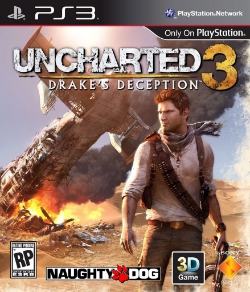
And really, aren’t scores just flame baiting? Affirmation that your favorite game is exactly as good as you think it is? The way gamers act about scores, you would think they were handed down unto the people on stone tablets from Mount Sinai. It’s just a fucking number, people. When Uncharted 3 was reviewed by IGN, it immediately resulted in two warring factions of dweebs taking turns shouting “I told you so!” or “What a bunch of bullshit!” at each other for days. Mind you, the fucking game hadn’t even come out yet. Not one person involved in this desecration of the human species had played it themselves. Yet within seconds of the review going live, before anyone could have possibly had the time to actually read the damn thing, the fighting was on. The Sony fanboys were rubbing it in the faces of Microsoft fanboys, who were decrying it as IGN’s official jump-the-shark moment. Not one person involved actually knew anything about the game or how the writer came to that conclusion, and they probably never will.
World peace? Hell, we’re ready to shed blood over pre-release game reviews.
Sure, fanboyism played a part in that, but that situation wouldn’t have happened if IGN had the balls to shit-can the whole fucking rating system and just let people figure out for themselves whether the writer actually liked the game or not. So where are the benefits? Consumers become less likely to know if there are aspects of the game that cater to their tastes or not. Developers are less likely to learn what could be improved about their game. I suppose it might in some way benefit me. I could get listed on Metacritic or get the arbitrary number posted on a developer’s website. You know, assuming it’s a good number.
By the way, this isn’t exclusive to the world of video games. Just read any reviews of TV shows on IGN. Even if an episode is a stinker that the writer clearly didn’t like at all, it usually still gets some kind of highish-sounding number. Here’s an example. Read the review carefully. It sure as hell to me sounds like Ramsey Isler thought the episode completely sucked. Yet he gave it a 5.5 out of a possible 10. I actually read through it trying to figure out where those 5.5 points came from. Going off his writing, I couldn’t find them anywhere. Maybe one or two points tops, but 5.5 points came out of someone who wrote that? What the fuck?
Doesn’t that make him kind of lose his credibility a bit? To spend all that time writing about something only to then throw out a seemingly random number is kind of silly. But he did it, and so do lots of critics. Well I don’t really want to do that. At best, a score would leave most people with a vague understanding of how I felt about a game. I could give something a 10 out of 10, but maybe the reasons I got that number are things you wouldn’t like about the game. Or maybe a game I give a 1 out of 10 to had aspects I hated that you normally love. If you look at a number, you don’t get that information. So in a nutshell, that’s why I don’t have scores.
The Cusp is a monthly highlighting of three Xbox Live Indie Games that came up just short of the leaderboard here at Indie Gamer Chick.
Welcome to the first installment of The Cusp! For the last few months, Brian and I have kicked around the idea that there should be some “runner-up” list to complement the Leaderboard. We implemented the first idea, that former Leaderboard games should receive recognition, and while this idea has worked, maybe it’s not enough.
So we came up with The Cusp. Three games that will be featured over a 30 day period on the sidebar here, and a post explaining why they made it. Or almost made it, depending on how you look at things. In addition, The Cusp gives the developers of the selected games a chance to talk about their game and their plans for the future.
In the future, The Cusp will likely include monthly themes, like three games of the same genre or maybe even same developer. The one thing every game featured on the Cusp will have in common is they are all good games that are worth your money. If you missed them before, don’t miss out on them again.
For this opening month, we went with a variety pack. Three games with absolutely nothing in common except the fact that they went overlooked, both at this site and on the marketplace as a whole. I would also like to point out that the inclusion of a game by Bionic Thumbs has nothing to do with paying them back for trashing their recent game Plugemons: Part 1. The Cusp has been in the works for a while and Starzzle was always one of the games that I had planned to include.
Well over a year before I started Indie Gamer Chick, I stumbled into the Xbox Live Indie Games channel for the first time. I had read about this retro-themed RPG parody called Breath of Death VII. It seemed right up my alley, so I snatched it up. It was my first XBLIG purchase. As I went to boot it up, the very first thing I noticed was there was no space for GamerScore points. In other words, no achievements. Lame.
I consider myself to be, more or less, the average video game consumer. If that was my initial reaction, I’m sure that most Xbox owners felt the same way when they booted up their first Xbox Live Indie Game purchase. Now, I’ve never been hugely into the concept of achievements, but I will admit that they’ve conditioned me to feel a sense of satisfaction every time I hear “Beep Boop” sound when I unlock one. I much prefer the Playstation trophy system over the arbitrary points one used by Microsoft. I just find something to be very wrong about a system where you get only 30 points for something as damn near impossible as beating Mega Man 10 without taking a single point of damage, while you get the full 1000 points possible in Avatar: Burning Earth by doing little more than booting up the game.
But a quick and unofficial poll on Twitter confirms that most gamers prefer the Xbox achievement system. That’s probably because most of the people who read me are Xbox users. The irony is I’m guessing the system based around numbers instead of actions is the very reason why Xbox Live Indie Games get excluded from the achievement party.
If the Xbox was more like the Playstation, where games hand out four levels of trophy based on the difficulty of the action performed, it would be extremely easy to come up with something for indie players. A fifth class of trophy for indie games that in no way can be used to abuse the entire achievement system. Xbox doesn’t discriminate, so the five points you have to work your ass off to get for the Crowning Glory achievement in Perfect Dark mean absolutely nothing more than the five points you get just for turning on The Simpsons Game. From a personal perspective, I have to say that in the six-plus years I’ve been playing on the console, I’ve seen some mighty-high gamer scores and never once have I been inclined to look and see how someone got them. I think that’s true of most players. Conversely, I have looked at people on my friends list on Playstation 3 to see if they’ve unlocked particularly difficult trophies on games I also play. I don’t recall doing that even with friends on Xbox.
But some people take those gamer scores very seriously. Too seriously. Get-a-life seriously. And they’re not going to want Indie Games besmirching their precious arbitrary numbers. The thing is, we all know what will happen if XBLIGs get their own achievements. Within the first month of it going live, no less than two dozen “instant points” games will hit the market. It’s inevitable. The majority of “solutions” I’ve seen for this issue range from impractical to laughably absurd. Some examples include having some kind of fail-safe system in place to assure that such games can’t be made. Others have suggested, possibly while stoned, that there needs to be a governing body in place that sanctions indie achievements.
All these “fixes” come at a high cost to Microsoft. Adding achievements is going to require additional infrastructure and overhead to the entire channel. The bottom line is the bottom line. Adding this feature, no matter how it ultimately turns out, will cost money. Someone will have to code it. Someone will have to debug it. Rolling it out will necessitate a system update that requires close monitoring. And people who are on the clock will have to take time out of their schedules just to discuss implementing it. It’s not as if they only have to flip the “now you have it, now you don’t” switch that some of you seem to think is there. Changing the way things are is rarely free.
Having said all that, I want to make an appeal in the name of capitalism: Xbox Live Indie Games should have achievements. Why? Because it makes them more competitive. Money is the only thing that should matter in the decision-making process at Microsoft. If a system can be created at a minimal cost with minimal intrusiveness on the current system, it should be given the green light.
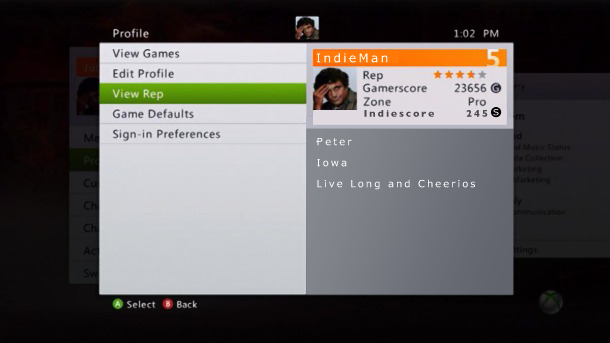
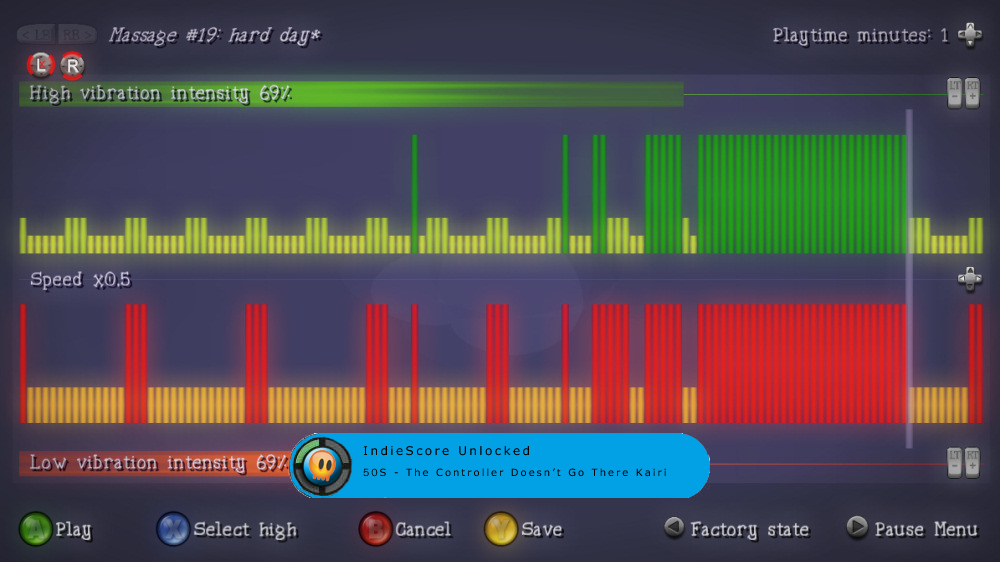
I believe the most cost-effective way this can be done is by segregating the standard GamerScore with a new category called IndieScore. This score will NOT be displayed on the snapshot of a Gamertag. IndieScore would only be visible by viewing a the full card of a Gamertag.
Kind of like this.
There will be no standards, regulation, or extra moderation for how developers implement IndieScore. Sorry guys, but it’s really all or nothing. In a system as open and inclusive as Xbox Live Indie Games, adding this feature means people can and will continue to be dicks and put in as little effort as they can if they can get away with it. So while you might meticulously spend years crafting your dream game and fine tuning it to perfection, developers can and will be releasing EASY INDIESCORE XII: JUST PRESS START FOR 200 POINTS countless times in the interlude. Obviously, there will be a cap, but people will abuse the system, and developers will have to accept that it’s better than nothing. Again, if that seems flawed, remember, you are the guys who love the arbitrary number system. The scoreless Playstation trophies would be so obviously better for XBLIGs, yet not one person out of dozens on Twitter voted for it. Fools!
Maybe this isn’t the perfect solution, but it has the advantage of being the easiest to create and the cheapest to implement. It would be one extra line in the Gamertag’s card. Mind you, that one extra line will come at a cost of months of programming and overhead to create, not the mention the added infrastructure that the new system will be based around. It’s the cheapest reasonable solution, but that doesn’t mean it’s free.
So here is something I ask of developers: what are you willing to pay? Since this system will costs tens of thousands of dollars to put into place, money Microsoft is under no obligation to spend on your behalf, what are achievements worth to you? Would you pay more for your XNA membership? Would you take a smaller royalty on your sales? And don’t try using the argument that Microsoft would stand to make more money, because that’s speculation. Solid speculation based on good old-fashioned common sense, but speculation none the less. Microsoft executives are not going to cut a single check to alter the indie system that they’re perfectly satisfied with (even if you aren’t) based on a hunch.
Microsoft is willing to change the way things are to allow Xbox Live Indie Games to be more competitive with mobile gaming, or with Live Arcade games. Adjustments to pricing policy have already proven that. There is little doubt that adding achievements would make XBLIGs more attractive to consumers. Yes, the system will get abused, but so what? I just played Hypership Out of Control for iPhone and it took me all of five minutes to unlock about ten achievements on that for Game Center. That kind of thing happens all the time in iGaming. I do know that many people are less likely to buy iOS games that don’t feature Game Center support. This shit does make a difference to gamers. If you think of the Xbox 360 as a car lot, disc based games are the souped-up sports cars like Ferraris or Lamborghinis (even if the occasional Alfa Romeo finds a way in), Live Arcade games are the affordable yet dependable Toyotas, and XBLIGs are the used Pintos with shaky engines and bad handling that most people fail to see the hidden depths in. Maybe if they had shiny hubcaps in the form of achievements, people might be more willing to take them for a test drive.
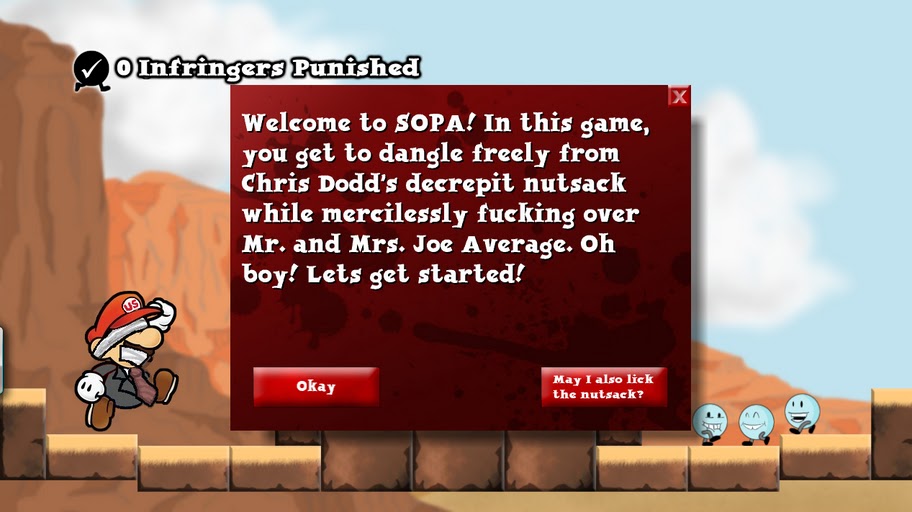
SOPA is a tactical strategy game in which you are tasked with protecting the intellectual properties of the entertainment industry. Playing as an agent of the industry under the jurisdiction of SOPA (which no doubt stands for Supremely Oppressive Pricks & Assholes), you get to wield unprecedented power at your own discretion to help fight for the big guys and bring justice to the unwashed masses.
I normally try to keep my cards close to my chest when I write these reviews, but I can’t hold off any longer: I FUCKING LOVED THIS GAME! Think of all the dick moves you’ve ever pulled playing Grand Theft Auto and multiply them by a jillion. That’s how much fun you can have as an agent of SOPA. For example, I was perusing YouTube when I came across a video uploaded by a fourteen year old. It was a highlight reel of his best kills in Gears of War 3, set to the tune of “Let the Bodies Hit the Floor.” Now, if this was a game like Saints Row, you cap the little bastard in the back of the head and T-Bag his corpse. BOR-RING! In SOPA, you sue the little kid into the stone age, file charges against his parents, have their internet access cut off, and collect damages from YouTube because it was all their fault to begin with. With this level of loosely defined parameters, you have the freedom to pretty much destroy lives in ways you never could have imagined.
Bad controls have always been my biggest sticking point in a game. Thankfully, SOPA gives you more control over non-player characters than any game ever has. I remember playing Mercenaries 2 and watching the dimwitted NPCs fall to their deaths by walking off a four-foot high ledge. You don’t have to worry about that here. Rounding up people to interrogate them over illegally hosting a 60 second long MP3 copy of the Golden Girls’ theme has never been so intuitive or easy to accomplish. And the tools you’re given are amazing too. Wiretaps, bully lawyers (that is lawyers who are bullies, not lawyers for bullies, although I’m sure there is some cross-pollination), lobbyists, and all the power of the federal government are at your disposal. I used to feel pretty damn empowered when I held the Spartan Laser in Halo, but that is absolutely nothing compared to how I felt with all of the power I wield in SOPA.
And if you thought the emotion technology used in L.A. Noire was impressive, you haven’t seen anything yet. This one time I was busting a Captain Kirk fan site for using clips of Star Trek set to the tune of Bonnie Tyler’s “I Need A Hero.” Not only was I able to tie the dude up in court for years, but I was able to go after every single person who had linked to his site in the process. The dude had like 500 followers on Facebook! It was like a genocide, only blood was replaced by tears, and that’s so much more evil and thus fun, wouldn’t you agree? The look of terror on their faces and the tremble in their voices as they slowly realized that all the freedoms they had taken for granted were being extinguished is one of the most defining moments in a game I’ve ever had.
Not to mention all the employees of Facebook and all the internet service provider employees who I was able to put out of work because all these restrictions made their companies unprofitable. It brought me a sense of satisfaction that all the nuns tied to the train tracks in Red Dead Redemption could never hope to equal. Really, how can you go back to running over a Granny with a Buick in GTA when you can litigate a family into bankruptcy over having the theme from Days of Their Lives play in the background of a video of little Junior’s first steps? Hey, you shouldn’t have uploaded it. Not very smooth criminal of you. By the way, using Smooth Criminal lands you five years in Gitmo so watch your step.
On-screen metaphors for what happens when you sue the shit out of a family making less than $40k a year.
Ultimately, your goal is to the destroy the entire internet. Probably the biggest problem with SOPA is how easy that is. If you’re the patient type, you can wait a few years, slowly conditioning the population to accept less and less accessibility to the internet they’ve grown so accustomed and dependent on. And while I can see the merits of watching the people of 2022 fondly reminiscing about the time before SOPA where you could actually upload of a video of you singing the latest Lady Gaga song on your Facebook without having to lawyer-up, I simply don’t have the patience for that. So I went all scorched Earth on the damn thing and just had Google shut down. Hey, served them right for linking to a site that linked to a site that had a copy of the Adventures of Pluto Nash uploaded illegally to it. This move destroyed the entire Silicon Valley economy, crippling America’s ability to stay ahead of the curve in the technology race and pretty much making us about as useless to the rest of the world as Segway access ramps. I watched with satisfaction as the credits rolled on the game and nearly needed some, ahem, private time, as the final cut scene where Nigeria claimed a higher GNP average than the United States played out.
So overall, I heartily recommend SOPA to everyone reading this. It does the wanton-destruction genre better than any sandbox game I’ve ever played, and it does it by a pretty big margin. It’s the little things that make the big difference. Sure, spraying shit on buildings in Saints Row is fun, but it can’t top watching the Feds break down the door of a sixteen year old girl who should have known better than to have downloaded that episode of Vampire Diaries. Or busting that family for uploading a video of them singing Happy Birthday to their St. Bernard while you could clearly see the TV playing the latest episode of Family Guy in the corner of the screen. For those of us who have always wanted the chance to know what it’s like to be truly merciless and cruel, this is the chance you’ve been waiting for. And it’s all in the safety of a video game, where it can’t possibly ever happen in the real world.
Oh wait. Fuck.
SOPA was developed by the United States Congress
240 Years of Freedom were flushed in the name of stopping six-year-olds from linking to unauthorized videos of Justin Bieber in the making of this review.
SOPA is not reality yet. But unless something is done, it will be soon. Do you really want the people who thought nine seasons of Roseanne were a good thing but fourteen episodes of Firefly was too much to decide what is right or wrong for the internet? Visit StopAmericanCensorship to learn what you can do.
Right before I posted my review of Plugemons: Part 1 last night, I sent out a preemptive apology to two guys in the XNA community who I have the utmost respect for. One is Jesse Chounard, the guy who developed Bluebones Curse and whose dog I had shot. The other is George Clingerman, an XNA MVP who is probably the most respected individual in the entire Xbox Live Indie Game community. Both these guys played a major role in educating me in the inner-workings of the community and gaining acceptance among Xbox Live Indie Game developers.
Both guys also really don’t like it when I go completely Lizzie Borden on games. I figured since the Plugemon review was my first really brutal one in a while, I should give them a preemptive heads up on it. I guess the result was George having this epiphany about what role I play in the development process. The end result was this episode of Tales from the Dev Side. I almost didn’t post it, because I felt maybe an article that was about me posted on my own site would come across as obnoxious.
Scott Tykoski’s Elfsquad7 was perhaps not the most commercially successful title released on Xbox Live Indie Games in 2011. However, I found the game to be charming, if a bit simplistic, and I’m kind of surprised the timely release did not have better sales over the holidays.
Despite dipping his toes in XBLIG, Scott is an honest-to-goodness professional game designer with a decade of game design under his belt. His Stardock games is famous for such PC titles as Sins of the Solar Empire, Galactic Civilizations, and the Political Machine. Okay, well the Political Machine isn’t exactly their calling card, but I liked it, damn it!
Scott eagerly jumped at the opportunity to do an editorial for my site. And then I took three weeks while I struggled to correctly format it. But it’s finally time to publish it. Developers have talked about pricing here. They’ve talked about standing out here. Yet, what could be more important to a game in our visually-minded society that what style of graphics you give it? In that spirit, Scott talks about graphics.
Like with previous Tales from the Dev sides, Scott has provided prizes for you, the readers. He’s really outdone himself, providing two IndieRoyale Xmas Bundle codes, which include the PC version of Scott’s Elfsquad7 game. Since tracking down who has retweeted articles is a bitch, the prizes will be handled differently this time. To win, reply to this article stating what graphic style you think is the most advantageous for potential Xbox Live Indie Game developers and why. One winner will be chosen by me, the other by Scott. Whoever makes the best case for their point will win. We’ll decide who wins on Friday, January 20, 2012. Be sure to include either a valid e-mail address or a link to your Twitter account when you reply.
This started out as my Second Chance with the Chick review of Inferno! But then I went off on a bit of a tangent and decided to split it up into two articles. Here, I would like to address something that has always been a pet peeve of mine since I started this site: the generic name.
I had a little experiment I wanted to perform. One of the few things Mr. Dave Voyles of Armless Octopus and myself agree with is that Xbox Live Indie Game developers should come up with a name that sticks out in a Google search. Inferno! has perhaps the most generic name of any game I’ve reviewed thus far at my site, and it reminded me that I’ve been meaning to do this experiment for quite a while. So here’s how it will work. I’ll search for the game once based just on its name. Then, once with Xbox added to the search. Finally, once with Xbox Indie in the search. I want to see how buried the first result that brings you to anything related to the actual game is. Let’s begin!
Inferno!
Just the name: Not within the first 100 results.
With “Xbox” in the search: 16 results down. Most results point to Dante’s Inferno by EA. First actual hit points to marketplace page.
With “Xbox Indie” in the search: 3rd video down is a gameplay video. Third actual link points to my review. Most results point to Radiant Games’ Inferno.
Obviously Inferno! was not a very wise choice of a game name. It’s not an effective tool at landing eyeballs via a Google search. It’s also not really catchy. What it sounds like is a name that the developer put zero thought into. It’s not reflective of the game’s quality of course, but it gives off the impression that it could be. I mean, if they spent that little time thinking of the name, they probably didn’t spend that much time making a good game. Inferno! is actually a perfectly fine game, but with a name like Inferno! who will remember it tomorrow?
Now let’s look at the Top 3 Google Searched games on my site.
Trailer Park King
Just the name: 1st result is a direct hit to my own review of the game.
With “Xbox” in the search: Same as above. The very first result takes you to the Indie Gamer Chick review
With “Xbox Indie” in the search: The exact same.
Temple of Dogolrak
Just the name: 1st result is a direct hit to my own review of the game.
With “Xbox” in the search: 1st result takes you to the marketplace page of the game.
With “Xbox Indie” in the search: #2 link is a direct link to my review of the game. The 1st link is the link to the main page of my site.
Wizorb
Just the name: 1st result is a direct hit to their official website.
With “Xbox” in the search: 1st result is a direct hit to the game’s marketplace page.
With “Xbox Indie” in the search: 1st result is to a Destructoid article on the game.
The name of your game is your first and possibly only chance at successfully marketing your game. A good name will pull up some kind of article related to the game when entered into Google. The more generic a name is, the more likely it is to be buried. Surprisingly, many of the Google searches that lead to my site do not contain terms like “Xbox” or “Indie” anywhere in them. Now let’s look at two games that use common words as creative puns.
Escape Goat
Just the name: third result down, which links you to the official website for the game.
With “Xbox” in the search: 1st result is a direct hit to the game’s marketplace page.
With “Xbox Indie” in the search: Same as above.
Dead Pixels
Just the name: eighth in the list, links to the marketplace page.
With “Xbox” in the search: direct hit to the game’s marketplace page.
With “Xbox Indie” in the search: direct hit to the game’s review at GamingTruth.com
As we all know, Dead Pixels way outsold Escape Goat, so maybe my concept isn’t entirely reflective on a game’s sales potential. Of course, literal dead pixels are more common than literal escaped goats. At least I hope so.
Now let’s look at games that all sound kind of the same, but are not.
Blocky
Just the name: 14th result down (I’m fucking shocked at that too), links to the game’s marketplace page.
With “Xbox” in the search: Direct hit on the game’s trailer. First non-video link points to the game’s marketplace page.
With “Xbox Indie” in the search: Same as above, except the first non-video link points to my review of the game.
Blockt
Just the name: sixth result down, which links to the game’s marketplace page.
With “Xbox” in the search: direct hit to the game’s marketplace page.
With “Xbox Indie” in the search: Direct hit to my review of the game.
Blocks That Matter
Just the name: direct hit to the game’s official website.
With “Xbox” in the search: direct hit to the game’s marketplace page.
With “Xbox Indie” in the search: same as above.
The more complex a name gets, the more likely it is to score one of those “direct hits” that do seem to make a huge difference in the amount of people who have awareness of your product. Of course, when a game’s name is too simple, it can be a disaster, like I already demonstrated with Inferno! If that’s not proof enough for you, check out these games.
OTO
Just the name: 36th on the list, first link is to the marketplace page.
With “Xbox” in the search: direct hit to the game’s marketplace page
With “Xbox” in the search: direct hit to the game’s marketplace page.
With “Xbox Indie” in the search: direct hit to the game’s official website.
Here’s something that I’ve noticed since starting my site: most of my search results do not include the words “Xbox” or “Indie” in the search results. People mostly search just for the game’s name. The games that have the less complex names simply do not get as many search results. To hammer this home, if someone is looking for a review of the game, they in general just put the name of the game and “review” in it. If someone does that, here is what happens with all the games that have been listed above.
Inferno! Review: no matches within the first 100 links. Same with if you add “Xbox” to the search, where instead you get 100 reviews of Dante’s Inferno.
Trailer Park King Review: 1st result takes you to my review.
OTO Review: 16th link down takes you to the same 1up or Poison review listed above.
Plague Review: 64th link down takes you to an N4G linked review.
It’s said you only get one chance to make a good first impression. Your game’s name could be that one chance. If a game like Plague was called Captain Shooty’s Shooting Shooter, it probably would have sold better. It certainly would have been more likely to catch your eye. If Inferno! had been called the Adventures of the Lava Sucking Robocoaster, you might have laughed at the absurdity of the name, but you wouldn’t have forgotten it any time soon. So when the time comes to pick a name out, don’t just put down the first thing that comes to mind. That’s how Sarah Palin named her kids, and you’re better than that.
The minimum price of 240MSP now applies to games 150MB in size or higher. Games at under 150MB can (AND PROBABLY SHOULD!!) be priced at 80MSP.
Developers can now publish twenty games a year.
As people know from my previous article about pricing, I have no patience or tolerance for developers that over price their games. It’s not reflection of quality. It’s how the market works. Microsoft made this move so developers could be more competitive. And for the record, this is not a race to the bottom. Your games are only worth what consumers are willing to pay for them. If you price higher without being forced to on some misguided principle, you’re just being silly.
Any developers who wish to use my site as a forum to announce you’ve dropped the prices of your games, you got it. Tweet me the title of your game and I’ll note it in a daily update every day for the rest of the month. The guys at Zeboyd Games have already done so with Cthulhu Saves the World, which is now priced at 80MSP.
I’m also interested to hear what you developers plan to do with all the added space you now have at your disposal. You can e-mail me or let me know in the comments section of this post, and I’ll include it in those daily updates. I applaud Microsoft for this decision in helping developers compete better with wireless gaming apps and against their own Xbox Live Arcade platform. Well done chaps. Now stop being assholes and get games a better place in the dashboard.
UPDATE: Indie Gamer Chick leaderboard member Antipole is now also 80MSP, down from its original price of 400MSP. Outstanding move. You absolutely have got to get this game right now.





 Indie Gamer Chick
You must be logged in to post a comment.