Pinball M: The Definitive Review & Table Review Guide – UPDATED to include Camp Bloodbrook

Our Pinball FX and Pinball M reviews took a lot of playtime and revisions. If you enjoy what you read, or even if you hate it, please consider making a donation to your local food bank. For my American readers, you can find your closest one by using the search tool at Feeding America. A cash donation to your local food bank buys exponentially more food than donating canned goods. I also support Direct Relief, and in the aftermath of Hurricanes Helene and Milton, they could use some help. They have a page up just to explain their hurricane response. They’re worth it. Thank you, and enjoy the review. Or hate it.

PLEASE NOTE THAT NINTENDO SWITCH’S VERSION OF PINBALL M ISN’T SPECIFICALLY INCLUDED IN THIS FEATURE YET. WE WILL UPDATE BEFORE 2024 IS UP WITH ANY IMPORTANT NOTES ABOUT PINBALL M ON NINTENDO SWITCH. THIS FEATURE WILL BE UPDATED AS MORE MEMBERS OF MY TEAM SUBMIT THEIR RATINGS. THANK YOU FOR YOUR PATIENCE AND ENJOY THIS FULL REVIEW GUIDE TO PINBALL M!

LAST UPDATED – November 5, 2024
Camp Bloodbrook’s review is up!
Jordi’s rating for The Thing and Camp Bloodbrook are in.

A NEW GOLDEN AGE

For all the bitching and whining I’m about to do, we’re sort of in a new golden age of pinball. Pinball tables are probably second only to pool tables in terms of the most desirable high-end furniture-like gaming devices for family rec rooms or man caves. The problem is real pinball tables cost a LOT of money. Thousands and thousands of dollars for a noisy, heavy gaming device that plays one game, and one game only, forever. And that’s before you get to the hidden costs of owning a pinball table. They require maintenance. Waxing. Replacement of the rubber rings. And if something breaks down and you don’t know how to fix it yourself, it could cost quite a lot. They wear out too, and if something happens and the playfield is damaged, you either have to live with the damage or replace it entirely. That’s what our very own Dash had to do with his Swords of Fury table. He picked it up for $3,500, then needed to put an additional $1,500 to restore it. Pinball is a very expensive hobby.

Average cost of repairs for an old table, give or take.

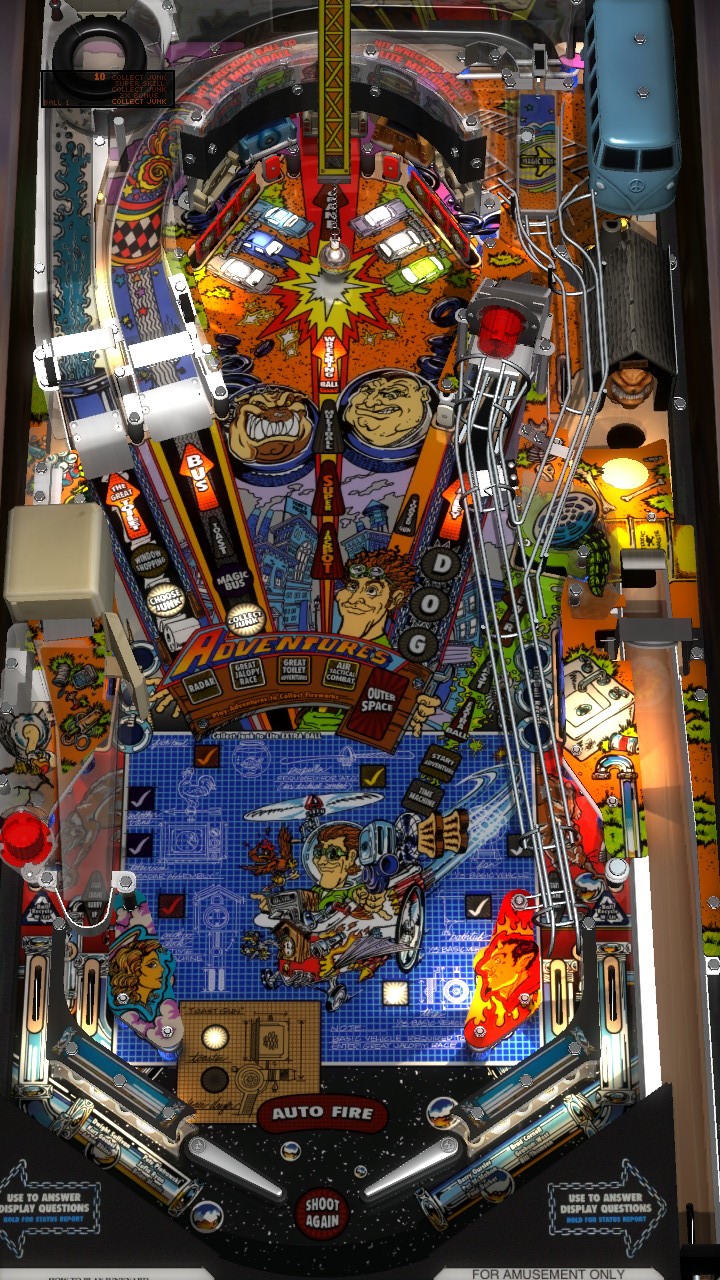
With digital pinball, anyone can afford the fun of pinball without the cost or hassle. You can spend $7,000 to $12,000 to score a mint condition real life Addams Family table, or you can buy the digital version in Pinball FX for $9.99 that has the same playfield, same targets, same call-outs, and same ROM, and the physics are 85% to 90% there, and hopefully climbing (no Christopher Lloyd though, much like Pinball Arcade). To put this in perspective, a rubber ring replacement kit for a real life Addams Family will cost you over three times the cost of Addams Family on Pinball FX by itself. So, how much is that final 10% to 15% difference in realism worth to you? And I’ll sweeten the deal for you. In Pinball FX3, you could only play with true-to-life table dimensions on PC or Nintendo Switch. With Pinball FX and Pinball M, no matter what platform you’re on, vertical screen options are available and so easy to set up. So your $9.99 game of Addams Family goes from looking like this:

To looking like this:

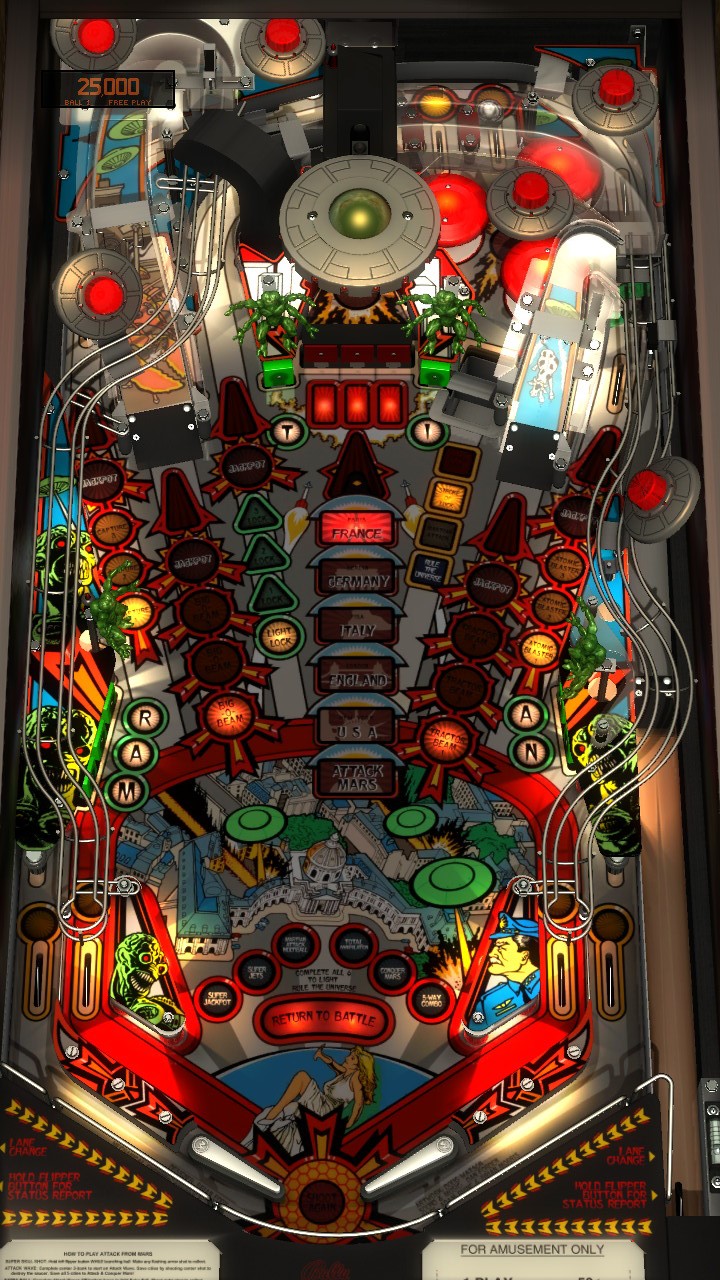
Those screenshots both come from the same copy of Pinball FX on an Xbox Series X. Wow! As of this writing, there’s over 135 tables in Pinball FX and Pinball M, and while we rate five of Pinball FX’s tables OUT OF ORDER (none for Pinball M), every table can be played vertically. You can absolutely feel the difference, especially in shooting accuracy and timing. You don’t need an expensive digital table to do this, either. Just turn any TV or Computer monitor on its side and use any game controller. It works with Steam, Epic, PlayStation, Xbox, and Nintendo Switch and every table can feel like you’re viewing a real pinball table. And, if you want the full DIY digital table with arcade flipper buttons, Pinball FX and Pinball M are excellent starting points. There’s a LOT of problems with Pinball FX and Pinball M, but the addition of universal vertical access overrides all of them and makes Zen’s output our favorite digital pinball experience. I’ll talk more about the problems with Zen’s adaptations of real life tables in the Pinball FX review, but all you need to know is by turning your monitor on its side, this:

Becomes this:

And you don’t have to spend a penny more to do it. Very cool.

WHY PINBALL M?

Zen Studios wanted blood, guts, and swearing in pinball. I mean, those things are already part of pinball when I play.. one way or another. But, adding those things to Pinball FX not only bumps that to an M rating, which I’m guessing almost certainly violates contracts they have with Disney regarding the Marvel/Star Wars licenses, but it would outright prevent release in some countries due to censorship laws. You’ll note that many of Pinball FX3/Pinball FX’s Williams pins have had superficial alterations to the artwork to remove anything risque. If I have to choose between them making changes so minuscule that neither Dad nor Angela could spot changes without being told what they were or not having the Star Wars/Marvel pins, I’ll take the Star Wars/Marvel pins and the “censored” artwork every time. But, making new pins that would potentially breach existing contracts they have AND cut off their ability to sell family-safe tables in some markets wasn’t an option until now. Zen’s solution is an entirely different pinball platform. The advertising and table selection suggests that this is really a horror-themed pinball program. As of this writing, 6 of the 8 available tables are themed around horror, with only Duke Nukem’s Big Shot Pinball and System Shock representing traditional M-rated games (and System Shock is pretty much horror too).

Is this necessary? Probably not, and weirdly enough, it’s Zen that proved that. A sanitized version of Pinball M’s best table, System Shock, is also on Pinball FX and plays identically. Wrath of the Elder Gods is also on both platforms, but.. well, one works and one doesn’t. We’ll get to that. But really, it’s just tables with cussing, boozing, and red paint smeared all around. In the case of a table like The Thing, it isn’t even all that gory and wouldn’t have taken that much modifying to earn a T rating or even E rating on Pinball FX. Just change the B-O-O-Z-E name to T-H-I-N-G, remove the red, beep the cussing, and it’s the same table. Even the Duke Nukem table isn’t that risque. We’re comfortable letting my 9 year old niece Sasha, heir apparent to this very blog, play everything on Pinball M so far. There’s nothing that isn’t too intense for a child to play while supervised by a grown-up. It’s pinball, for god’s sake. So, what other differences make Pinball M worth the download?

This slideshow requires JavaScript.

SPRUCE-UP YOUR COLLECTION

As you play and make progress, you earn in-game currency that can be used to buy custom upgrades to tables that have no effect on gameplay. You can change some of the sound effects, the look of the ball, the appearance of the motion trail that follows the ball, the room lighting, and the look of the cabinet housing the table (which only matters in the menu). I was slowly making progress on these until I posted a seventeen-trillion point game of Texas Chainsaw Massacre, which gave me enough currency to buy everything (and level up my profile to the max level of 120) with 1,015 currency points to spare for Camp Bloodbrook later this month. If you’re into customizing pins, you’ll dig this a lot more than me. The only knock I have is that there’s no option to randomize the balls or sound effects. That would be nice.

There’s also power-ups for the arcade and campaign modes that, in a return to how they worked in Pinball FX3, require leveling-up. That means grinding. My family and I agree that we prefer Pinball FX’s way of doing it, where power-ups have a fixed value that doesn’t slowly upgrade as you accomplish menial tasks in the tables. It means we can compete on a fully level playfield right out of the hypothetical box without having to spend what could take over an hour to build up the boosts we want to use. This is one of those things that feels like it’s done to boost “engagement” without thinking of the ramifications that 99.999% of all owners will never bother and some might feel the work required isn’t worth the time or effort and give up on Pinball M altogether. The customization stuff is a good idea, but leveling-up boosts is forcing players to do busy work in order to be competitive on some leaderboards.

Five new challenges, three of which are fine, one of which is silly, and one of which is dumb.

NEW CHALLENGES/FEATURES

In addition to the usual rigmarole of 200 flip challenges or five minute challenges, Pinball M adds a whopping five new challenges to compete on. In Dread, you have one minute to score a benchmark of points. Reaching the benchmark adds a minute to the time and sets a new benchmark. This goes on until you run out of time. This is one of the good ones. So is Rescue, which is a race to see how fast you can reach a lone benchmark. Times, not scores, are posted to the leaderboard. The same goes for Survival, but that’s the worst of the five challenges, easily. In it, you have so much time to start building up your score before you start “bleeding points.” IE your score begins trickling away at an increasingly faster rate. Eventually, you’re bleeding points by the millions and games end in seconds. It’s just not fun. Madness has more going for it. It’s a unique multiball challenge that utilizes whatever the table’s max is, but it’s NOT a quick pass to the wizard mode. Instead, the more lights you shoot, the faster the values of jackpots increase. This is insane, chaotic, and everyone’s favorite new challenge. Yes, even me. And then there’s Shiver, which is “pinball in the dark. Practically blind!” Here’s what it looks like:

This slideshow requires JavaScript.

Pretty lame, Millhouse. Now, your mileage may vary depending on how bright your settings are, but since the table’s lights still work, come on, you’re not going to miss much. But hey, three-for-five ain’t bad. The challenges are also part of the new campaign mode. The campaign missions are mostly easy (some can be finished in literally under one second), and they’re not that hard to complete. In fact, we’ve only missed getting one completed on the high level. It’s a Survival challenge for Texas Chainsaw Massacre that requires you to stay alive for four minutes. By time you reach 3:30 – 3:50, you’re bleeding MILLIONS of points every second. I shot the lights out one game and still came four seconds short. Dad and Sasha both put up similar numbers when THEY shot the lights out. Under 20 people in the world have cleared this, according to the leaderboard. We will. We just have to wait for Angela. Anyway, it’s all about the tables.

TABLE REVIEWS

Our system is simple.
MASTERPIECE – Our best score. 5 out of 5.
GREAT – Better than GOOD, not quite a MASTERPIECE.
GOOD – Even though this is the lowest passing grade, it’s still a passing grade.
BAD – A table that particular rater thought wasn’t deserving of an overall positive rating.
THE PITS – The reviewer felt the table has little to no redeeming qualities.
I then average the scores, and if the average is 3.6 to 4.5, the table is awarded a Certificate of Excellence. My team has agreed a Certificate of Excellence winner is worth the price of a $14.99 set by itself. If it’s a stand alone table that costs $14.99, get it, because it’s a very, VERY fun table. A table that scores higher than 4.5 enters the Pantheon of Digital Pinball. These are the cream of the crop. The elite. Very few tables make it in. As of this writing, Zen has only made four non-Williams tables that entered the Pantheon. They are Star Wars: Battle of Mimban, Star Wars: Clone Wars, Epic Quest, and Fear Itself, with Mimban being our near-unanimous choice for Zen’s best table ever. Their versions of Attack from Mars, Medieval Madness, Getaway: High Speed II and the Pinball FX3 build of Monster Bash are also Pantheon Inductees. But, one more Zen creation might enter the Pantheon today, hint hint. A table that receives all positive scores but isn’t good enough to be certified excellent is still awarded a Clean Scorecard, which is pretty hard to get. A Clean Scorecard means we think it’s a safe bet the average player will enjoy the table more than dislike it. And finally, a table that scores an average of under 1.5 is declared a Certified Turd, but as of this writing, no Pinball M table is even that close to it.

Camp Bloodbrook
Coming October 24, 2024
Designed by Daniel “Dolby” Vigh
Stand Alone Release ($4.99)

They should have armed the killer with a nail file because this sucker can file off serial numbers like no other.

I assume that Zen Studios started preliminary work on a Friday the 13th table only to find out they weren’t getting the license. Instead of repurposing it, Police Force style, they just made a generic masked slasher table set at a lake. I’m all for it, and my only question is why didn’t you do that with Jaws? Without the music, hell, it could be ANY shark attack table, right? Anyway, Bloodbrook is Dolby Vigh’s best table yet and one of Pinball M’s best tables. While we currently consider the Pinball FX build to be so busted that we classify it OUT OF ORDER, the Pinball M version works great. The difference is in the mode start locker.

Signature Shot – Mode Start Locker: In Pinball FX, in “realistic physics” mode, this locker will drop the ball straight down the middle, right between the flippers, with alarming consistency. That doesn’t happen in Pinball M. In fact, this is a good shot in Pinball M.

Ignore the name. This IS the Friday the 13th table everyone has expected since Pinball M was announced, and it does a much better job with theme integration than anything in the Death Save Bundle. In fact, as far as horror goes, only Texas Chainsaw Massacre is better at matching a pinball layout to movie theme. The use of two dead end lanes on a single table, one for starting modes and one themed as a lake (it’s so small it looks more like a kiddie pool) adds to a sense of claustrophobia, but in a good way. This layout slaps, as the kids say. A multitude of good to great shots, but the fun stops there. Camp Bloodbrook speaks volumes about how far you can get simply by having a mistake-free layout. Pretty dang far. As if it’s channeling the spirit of 90s Gottlieb, it’s the ROM and the scoring system that nearly takes a machete to Camp Bloodbrook.

Signature Shot – The Lake: I get that the lake shot has to be round for the canoe spinner to work, but how many lakes are perfectly round? Immersion BROKEN. I kid. Actually, it IS satisfying to spin the canoe, though like so many aspects of Camp Bloodbrook, it’s underutilized. It’s just a glorified ball lock that doubles as a lane shot for the various modes. If you’re going to have water on a table, you need a satisfying splash down, or what’s the point? Zen has done it well before, or at least I think so. I personally find Pacific Rim’s splash down satisfying, something my family vehemently disagrees about. We’re all in agreement that Camp Bloodbrook’s water is missing something. Having Not-Jason snatch the ball would be nice for a third ball lock, but I don’t think it works for the first and second. It would be neat if each of the three ball locks did something different. Also, the release for Lake Multiball is lame too, but the actual shot itself is nice. One of the few Zen Studios shots where a backhand is consistently effective.

Bloodbrook’s modes are pretty average and underwhelming overall. This table reminded me a LOT of Chucky’s Killer Pinball. It’s so close that, if it were a cookie, it feels like it was made out of the same batter. It even has the mode where the antagonist walks onto the table and you have to shoot lanes without accidentally shooting him, only it’s a poorer version of it. Unlike Chucky, “the killer” of Camp Bloodbrook takes quite a while to lumber into place before the shot becomes lit. It’s annoying. This happens in the wizard mode too, where the instructions specifically tell you the object is to shoot him, but he’s not, for lack of a better term “lit”, until he waddles to his designated spot. There’s four main modes, one of which is shooting the bad guy, followed by a final mode where you once again shoot the bad guy, followed by a wizard multiball. The modes are NOT balanced, so they probably should have been forced to be played in sequential order. In fact, the fourth mode, Escape Plan, pays off so much and has so many lit shots (where even the false lights are worth a million points) that all four Vices play it first.

Signature Targets – STORM! Targets: Angela said the placement of the live multiplier targets and the ease of use makes these shots “like rewarding bricks.” It’s absolutely true that you can light these mostly via missing the actual lanes themselves. BUT, I like that for a reason. Sometimes I’ll find myself at the end of a mode and I’ll notice that I’m only one or two of the S-T-O-R-M-! targets away from activating the 3x scoring multiplier. It becomes mighty tempting to try and activate the multiplier before completing the mode for a windfall of points. Dolby’s Thing table has a similar set-up, but the table doesn’t blow wind that messes with the ball in Camp Bloodbrook. Also, it’s much easier to activate this multiplier because the lights don’t turn off if you shoot them a second time. We were split on if this was a good choice, or if it’s TOO powerful. Oscar really thinks x3 was too much and a progressive that starts at 1.1 to 1.5 and grows with each new STORM! activated would have been preferable. I agree that x3 throws the balance off too much, especially since the modes themselves aren’t even close to balanced, and would have been fine with it being x2 scoring. But, x3 it is, and I enjoyed the targets more than I disliked them.

The live multiplier is pretty much it for high scoring. There’s no progressive scoring for completing the modes, and doing well in the modes doesn’t enhance scoring in the wizard. In Angela’s Xbox world record-setting game (2,311,291,577), she completed multiple full mode cycles, and was scoring the same throughout, and part of the reason why she started playing recklessly (she had earned four extra balls on her third ball), was she just got bored. The shame is, this is probably the least difficult of any of Dolby’s pins too, but without dynamic scoring mechanics, it gets old. Even x3 scoring gets boring if the modes pay off the same whether you’re on your first cycle or seventh. The only progressive-scoring mode seems to be Lake Multiball. And that mode only consists of two shots: the lake and the ramp directly left of the lake. They probably kept the overall scoring low and non-progressive because the STORM! x3 buff isn’t very hard to trigger. By the way, for all my complaints, we all REALLY liked Camp Bloodbrook. While I didn’t love the rule sheet, there’s no grinding and it doesn’t fundamentally feel like it takes forever to do anything. All the side-modes go super fast. The pace works, if not the scoring itself. I might not consider Bloodbrook to be Dolby’s best, but by scoring average, it easily is.
Cathy: GREAT (4 out of 5)
Angela: GREAT
Oscar: GREAT
Sasha: GREAT
Jordi: MASTERPIECE (5 out of 5)

Scoring Average: 4.2CERTIFIED EXCELLENT

Chucky’s Killer Pinball
Released November 30, 2023
Designed by Zoltan Vari
Set: Death Save Bundle ($19.99)
Links: Pinball FX Wiki

Kickback – Jordi: As Chucky says: “If they don’t let us play, they all go away.” This table doesn’t let me play. The skill shot makes no sense since it’s undervalued and overly risky, but it’s only the first of many killer issues on this table, and I don’t mean that in the “killer, dude! Radical!” way. The central Voodoo targets are designed to return the ball straight down the middle, and the right orbit is absolutely lethal if the ball doesn’t make it all the way up there. So many balls go just over the right flipper and down the drain, and with how unreliable nudging is with the new engines (shared by both Pinball FX and Pinball M) defense is nearly impossible. I really wanted to like this table. When a mode works well, it is not a grind unlike in most of Zen’s new tables, the theming is spot on, and there are so many references here that just work. Sadly, Chucky is let down by a table that refuses to let me play even a single session without stealing a ball or two. “Are we having fun now?” No.

Despite the blood, swearing, and innuendos, Chucky’s Killer Pinball feels like it could have been an ideal trainer table. Chucky is a smooth shooter with multiple satisfying shots, the greatest of which SHOULD have been a humped ramp themed like a roller coaster that’s always a thrill to complete. The problem is it doesn’t always complete, and there’s no rhyme or reason why sometimes it doesn’t make it over the second hump or not. Since it’s the finale of the Tiffany mode, and completing the full circuit is the first jackpot in multiball, it’s kind of important that you can’t count on a shot working every time. The weird thing is, we weren’t 100% sure whether or not the point was to create a ramp circuit that could only be completed off a batted shot or not. If it was deliberate, it’s a very bad idea. If the intent was that the ball should finish the circuit every time, it’s just a run of a mill fail. What a shame. That should have been a historically awesome shot. To make up for it, the sequence shot used to lock balls is one of Zen’s finest ideas. You have to shoot the left side’s locker, which triggers a razor blade flipper that then bats the ball up into the lock. SO satisfying to hit, except it goes back to that circuit that doesn’t always complete. PLEASE fix that, Zen. It needs it!

Signature Mode – Marble Prank: I don’t know what to make of this multiball mode. The concept is unique: after so many bangs of the bumpers, a jar full of marbles rises onto the playfield near the Voodoo targets. When you break the jar, it releases five glass marbles onto the playfield that behave like faster mini-balls. If you can hit the marbles hard enough with the pinball, it breaks them for a million points each plus a million for each marble broken so far. The other extermination method is to use the razor flipper to fling them at the multiball lock, which is 10M + 10M instead. It sounds great, but the problem is the jar hangs directly over the drain, and it’s not rare for several of the marbles to immediately drain. While the pinball has ball save the entire time the mode is going, the marbles don’t. A neat mode but not worth the effort, really.

Originally, the Vices all had Chucky’s Killer Pinball rated at GREAT, but the more we played it, the less we liked it. While the roller coaster not working every time is what sealed Chucky’s fate, all it really did was make all the little annoyances stand out that much more. Like the VOO-DOO targets resetting if you accidentally start another mode. I already hated them anyway. Vari-targets are my least favorite type of pinball shot, and this has not one, not two, but THREE that act as the mode start and hang right over the drain. Yes, there’s a ball save that protects you, but only if you push one in all the way. There’s repetitive callouts galore (we adore Brad Dourif and Jennifer Tilly, but even they become annoying after saying the same stuff over and over) or blood splatter blocks your view during the Marble Prank. Most of all, Chucky’s Killer Pinball features scoring so imbalanced that it assured Oscar cement his rating to GOOD even if they fix the coaster. Jordi was right about the skillshot leaving a lot to be desired. Going off his body of work, I suspect Zoltan Vari isn’t a big fan of skillshots in general. Chucky’s is a difficult to clock, super high-risk skillshot, and when we actually got it, we were stunned by how little value it is for the challenge and risk it involves. It certainly tracks with the rest of the table’s poor factoring-in of risk and reward. Dad ain’t wrong about that.

Signature Mode – Olly Olly Oxen Free: Of the three main modes, this is the worst, easily. In it, Chucky jumps onto the playfield and you have to avoid hitting him. A single hit ends the mode. This is potentially problematic because the game doesn’t just give you the ball to start. It kind of sideswipes it towards players, so that it reaches the flippers as chaotically as possible. Because, say it with me, “Zen Studios’ designers are hostile towards ball control.” Well, sometimes the ball might hit the slingshots and violently fling around the table until the ball pops up and hits Chucky, ending the mode before you even get your first shot. Yea, getting hit by the slingshots counts as “shooting him.” To the game’s credit, this is extremely rare, but it’s a completely unnecessary thing to happen in the first place. Just give players the ball! I’d say half the time the ball ends up in the drain before your first shot, though it doesn’t instantly kill-off the ball save. I have a feeling they realized how badly some aspects of Chucky handle and used ball save as a band aid instead of a feature. System Shock is like that too.

Other than the mode in the caption above, Chucky’s modes are pretty well done. No grinding. They make use of the full table. If there’s a downside, it’s that each of the three main modes is a “tour the table” type of mode, only done slightly differently. “Chucky Says” is just “hit the lit shot” and nothing more. It’s not timed differently. It doesn’t play differently. It’s too simple. I would have preferred the modes play out sequentially like Getaway: High Speed II, but I’m not going to complain too much about a table that does what we want: have fun, non-grindy modes. And the wizard mode is a ton of fun. Spoiler: you hack Chucky up bit by bit, and it’s awesome. Chucky’s table is really well done in many aspects, so we REALLY want to give this table higher scores. But, until the coaster’s fix is in, we really can’t. If it was intentional, GOOD is Chucky’s ceiling (unless you’re Angela. She LOVES that it’s hard to complete the circuit. She insists it makes it more exciting). Also, yea, I’m pretty peeved that this is one of the few tables I put a MAJOR marathon into with a world record pace only to have the game glitch out and start taking away points from me instead of adding them. I wouldn’t have reconsidered my score, but my GOOD would be a very enthusiastic one. Even though this wasn’t our highest-rated pin, we want to make it clear: the lack of grinding and quick modes are a very positive thing. More of THAT please, Zen! The best thing I can say about Chucky’s Killer Pinball is it feels like the prototype that gave us System Shock. Worth it!
Cathy: GOOD
Angela: GREAT
Oscar: GOOD
Jordi: BAD
Dash: GOOD
Sasha: GOOD
Elias: BAD* (Nintendo Switch)

Overall Scoring Average: 3.0 – GOOD
*Nintendo Switch Scores not factored into average. This will be updated at a later time.

Dead by Daylight
Released November 30, 2023
Designed by Gergely “Gary” Vadocz
Set: Death Save Bundle ($19.99)

Is it ironic that this is a pinball table licensed on one of the most license-heavy video games ever made?

Dull by Daylight, according to Angela and Oscar, is the worst Pinball M table so far. Hell, it’s the only table among the original five launch tables that doesn’t have its own Pinball FX Wiki page as of this writing. It’s second-to-last for me. A slog of a pin in desperate need of some spit shine. On literally our first shot ever taken on this table, Angela valleyed the skillshot, and no amount of nudging could free it. Even after patchwork, in the final sweep of tables before we published this feature, we valleyed balls on the tall ramp, and the only difference seemed to be a gentle nudge dislodges the ball now. While it might not break the table, it speaks volumes to how unpolished this one is. Plus it has some of the most frustrating rails and outlanes around. Even when the ball seems like it doesn’t have the energy to carry on, it still manages to crawl across the rails and slither down the outlane. This on a pin where nudging feels especially ineffective. But, none of that matters, because Dead by Daylight has a much, much bigger problem: it’s just a boring table. One of those instances where the shot selection is less than the sum of its parts.

CORRECTION: In the original review, I said the patched table valleyed the skillshot. That was wrong. Originally, we were valleying (coined by Oscar from a term borrowed from roller coaster lingo meaning “gets stuck midway through the circuit” that we’re trying to add to the pinball lexicon) on the skill shot, but that doesn’t happen anymore. Instead, the valleys happen at the top of the tall ramp. Sorry for the mix-up.

Signature Feature – Survivor/Killer Loadouts: Dead by Daylight is one of those tables where you choose a buff before the game starts, just like the video game it’s based on. Survivor mode has four, while Killer has three. Oscar is a big fan of the concept of loadout buffs, provided they’re balanced enough that there’s not one logical choice. The loadouts you can choose for every Pinball M’s arcade mode (IE enhanced multiball, bumpers, ball save, etc.) have this problem. According to Dad’s theory, if you had a 100 different buffs and 98 were weak and only two were beneficial but equally balanced, it’d still be worth it because it means players have a legitimate choice with pros and cons that can be tailored to the player. On the flip side, if you have seven choices, six of which are equally balanced with each-other while one stands out as the no-brainer choice for all players of all skill sets, it wrecks the whole concept. With that in mind, myself, Oscar, and Sasha decided to play a bunch of games with every load out, and all three of us consistently had our best standard games (Classic/Arcade) using KILLER – EASY SACRIFICE as our buff. I should note the one exception to this was I put up the #6 all-time arcade score with SURVIVOR- EASY SKILL CHECKS. This feels like a one-off fluke as my other games were all on the lower side with it. The other exception is the special challenges, where putting up points fast matters, in which case we all scored higher using SURVIVOR – FAST GENERATORS.

Dead by Daylight’s biggest problem is there’s just no good shots on the table and no sense of flow. Maybe that makes sense since the shots mostly represent distance closed in a cat and mouse chase regardless of which side you pick. This is what we call a “pick ‘n flick” because, despite the heavy use of hurry-ups, this is a game where you’ll want to trap the ball and aim carefully, because accuracy and not volume of shots will win the day. But, a pick ‘n flick table absolutely needs thrilling shots to succeed, and that’s not here. The closest it comes is smacking crates to increase your distance if you’re playing as a survivor, while the killer has a giant bear trap that you want to shoot before you start shooting orbits, since it leads to a faster capture. But even the bear trap is a massive let down. It’d be more fun to build a two ball multiball around it where it captures the first ball and then you have to smack it several times to open it back up. Oddly enough, the limited shot selection would make for a better multiball table if not for the aforementioned outlanes and rails. Oh and you have to shoot very bland drop targets that appear in the center of the table to score a capture.

Signature Mode- Survivors: It seems fairly unanimous in my house that playing as the Survivors instead of the Killer turns Dead by Daylight into a more well-rounded pinball game. There’s five generators that require a full table tour. They are (1) the spinner (2) flashing lanes (3) the marked sinkhole (4) the flashing lanes, again (5) the bumpers. What becomes annoying is the video mode “Skill Check” pauses a live ball. The video mode itself is quick. You just have to stop a meter in time, with a zone close to the edge scoring more points. But, the mode can interrupt play, and it’s even happened to us when the ball is on a flipper. When this happens, it can screw with your timing when the mode ends and play resumes. We’re honestly not sure if this was a deliberate choice or something that needs to be patched out, but assuming it’s a bug, it wouldn’t change any of our ratings.

The center loop that acts as the skillshot, the multiplier increase, and sometimes the key shot for modes is just too clunky to be satisfying. We split on whether the tall ramp in the center was too rejection-heavy or not. Actually, the argument was more about whether the rejections were based in reality or if it was just Unreal Engine living up to its name and throwing back shots that had the angle and velocity to complete the ramp. Unlike some faulty ramps in Pinball M or Pinball FX (the teardrop from Texas Chainsaw for example), I didn’t feel it was clear one way or another. I’m open to the possibility that the design is inherently flawed. Either way, this became one of Angela’s least favorite pins and she can’t believe we don’t consider Dead by Daylight to be Han Solo/Safe Cracker levels of bad.

Signature Shot – Bear Trap: Talk about a letdown. When we saw the bear trap for the first time, we were imagining the possibilities of how this could be used as a sick M-rated ball lock. Nope. You just clank it a few times until it opens, then you shoot lanes before it closes. That’s it. It’s not a ball catch. It’s not a decorated cellar. It’s a bland digital target, and nothing more.

The lack of targets and poor flow from shot to shot means that Dead by Daylight was fated to grow old quickly. Our suspicion is the limited shot selection was done to make the differences between Killer and Survivor more pronounced, and to Gary’s credit, the two modes do feel different enough, but Killer offers a lot less flexibility since it makes logical sense to arm the bear trap before shooting any other target. Individual strategy for that side of the equation begins and ends with what loadout you want. We spent the better part of two days playing this and trying to find the fun. Sasha liked it, as she felt the chase aspect worked well regardless of what side you choose, plus she liked the shot selection more than we did. The rest of us were just really bored. Dead by Daylight probably does an admirable job of feeling like the video game, but as a pinball table, it was dead on arrival.
Cathy: BAD
Angela: THE PITS
Oscar: BAD
Jordi: BAD
Sasha: GOOD

Elias: GOOD* (Nintendo Switch)
Scoring Average: 2.0 – BAD
*Nintendo Switch Scores not factored into average. This will be updated at a later time.

Duke Nukem’s Big Shot Pinball
First Released November 30, 2023
Designed by Grego “Rockger” Ezsias
Set: Death Save Bundle ($19.99)
Links: Pinball FX Wiki
Full Review at The Pinball Chick

Angela has dubbed this “Duke of Whirl” because of the merry-go-round. She’s a fan of rotating targets in general and thinks it’s one of the most underused concepts by Zen Studios. I pointed out that it wouldn’t be a big deal if it showed up regularly as a featured target. She said “why would the best type of target stop being fun?” We dueled to settle who was right. She won 4 to 0. She always wins.

Duke was a sort of breaking point for me, where I’d had all I could stand and I could stands no more. Zen has a tendency to go overboard with shot requirements, and they finally crossed the line of reason with Duke Nukem’s Big Shot Pinball. It’s as if someone at Zen is saying “why have a mode require five shots when it could instead require ten? Or hell, why not twenty?” And the answer is “because you also want to have hyperactive slingshots that are aimed right at the outlane and it’s not reasonable to expect someone to keep the ball alive during this.” I think Duke Nukem is a terrible table. Serial killer slingshots with hair triggers aimed right at the outlanes combined with modes that need their shot requirement clipped by 80% at least. A typical game consists of the ball hitting the slingshot and going into the outlane about six times, or possibly ricocheting off one of the many cardboard targets, skipping across the rails and going down the outlane. It’s all defense, all the time and it’s SO exhausting and boring. Every mode is that way.

Signature Mode – Kick Ass and Chew Bubblegum: In this video mode, you have to alternate between four channels and press the launch button three times when a target pops up. Do this twenty times. It’s not exactly a first person shooter, and the novelty of it looking like Duke Nukem 3D wears off pretty quickly. There’s no tension at all. Even when we’ve played it poorly, we’ve never fallen under 60% health. I imagine if someone had a stroke while they were playing this, or if they were attacked by swarms of murder hornets in the middle of a game, they might lose it. Maybe. Some of Zen’s video modes aren’t so bad. This thing is such an unfathomable slog to get through, and it has nothing at all to do with pinball. You know, that thing we’re here to play. I wouldn’t mind this if it lasted only a few seconds and involved shooting one enemy and maybe avoiding its fire, but it’s nothing like that. It’s just a shooting gallery with a generous amount of wiggle room.

By reputation, Duke Nukem is one of the hardest tables Zen has ever made. I have no problem with a hard table if it’s fun, but Duke Nukem also requires a massive grind to accomplish anything. Want to get an extra ball? Hit the NEST targets 100 times, which can only be shot off a toe shot right next to the drain and in which case the ball is likely to go off a slingshot and die, or get into the secret room ten times. How do you get into the secret room? Well, first you need a pipe bomb. How do you get a pipe bomb? You have to complete one of the three side modes. Oh, side modes? That sounds quick. What do you do? Well, for “I’m The Cure” you have to score 6 sinkholes in the merry go around, which has six slots, half of which don’t feed the sinkhole. You then enter an “alien nest” where you have to get 60 spins of the spinner. Then you get the pipe bomb? No, 60 spins spawns four more targets which raise up and down. THEN do you get the pipe bomb? Well, maybe. It’s a random award. Could be the pipe bomb. Could be something else. Doesn’t that sound like boring ass busy work? Uh, yea? And if you want that extra ball from the secret room, you only have to get lucky with the random award for all that work ten times over. You won’t be able to. See, the designer thought it would be hilarious if he aimed the slingshots at the outlanes and gave them a hair trigger. And also have the ball return sometimes come in from the side at a sharp, sideswiping angle that could go down the outlane or onto the slingshots which can also send the ball into the outlane. Having fun for your $19.99 for the Death Save Bundle yet?

Signature Shots – Cardboard Targets: The soldiers in front of the boss targets take multiple shots to kill, then the boss takes a ton of shots to kill. Hypothetical future bosses past the first one are even spongier AND and they have more minions in front of them AND those minions require more shots. Let’s pretend that Duke Nukem doesn’t have extremely lethal slingshots and kickbacks that require five shots each to light. Let’s pretend that you have a ball save lit the entire fight and instead the only factor during the boss fights is your health. That’s a thing that exists on this table, by the way, but don’t worry because you’ll die long before your health runs out anyway. But, pretend that health was the only factor and not the drain or outlanes. Wouldn’t shooting these static cardboard targets get boring anyway? It’s not like it’s two or three hits on each. The bosses can take as many as 18 shots to kill, and that’s after you get through the spongy minions in front of them. No shot on a boss counts until the minions are clear. Didn’t anyone stop and say “wait.. is this fun?” Because it’s not! It’s such a mindless chore that it’s practically a holistic lobotomy.

I’m sure that someone has gotten in the ear of Zen’s design team lineup and told them “making tables harder is good! Making it take as many shots as possible to get anything going is good! It increases engagement!” It actually doesn’t. At all. It just makes your table boring, so that people who aren’t in the pinball bubble like me, my family, and my friends won’t want to spend their time with it. So, how’s Duke Nukem’s ruthless difficulty working out for it? Well, a few minutes ago, I had a game of Duke Nukem’s Big Shot Pinball where I beat the first boss. So basically I finished a single mode. I completed zero side modes and made only one skill shot. That game, where I barely accomplished anything, is the 17th highest score on the Duke Nukem arcade mode leaderboard right now. Not for the week. It’s #1 for the week. It’s #17 all-time. One boss alone got me a top 20 all-time score. That’s engagement? Because to me, that sounds like Duke Nukem is a barren wasteland of non-engagement. BAD was too generous for a table that I’ve honestly never had even a tiny bit of fun on. I can’t rate a table based on the fun I could have had if its designer hadn’t made it such a slog to make anything happen. I can only rate the table as it exists, and I think Duke Nukem is currently the worst Pinball M table. I stand alone in my group on that opinion, but hey, I’m used to it. Just wait until you see the Knight Rider review.
Cathy: THE PITS
Angela: GOOD
Oscar: GREAT
Jordi: GOOD
Dash: GREAT
Sasha: GOOD
Elias: GOOD* (Nintendo Switch)
Scoring Average: 3.0GOOD
*Nintendo Switch Scores not factored into average. This will be updated at a later time.

System Shock
First Released February 15, 2024
Designed by Zoltan Vari
Stand Alone Release ($5.49)
Links: Pinball FX Wiki

If the mark of a truly magnificent licensed pinball table is one that makes non-fans of the featured property interested in finding out more about it, System Shock must be one of the very best digital pins ever. My father, now in his mid 70s, purchased the recent remake based on his experience playing Zen’s tribute to it. Fans will appreciate that they nailed the creepy menace of SHODAN and the sense of isolation, but you absolutely don’t need to be a fan of 1994 PC classic to enjoy the thrilling shots of what is easily Zoltan Vari’s greatest triumph (sorry Fear Itself). While the build we played had that expected launch-window Zen clunkiness, we still couldn’t put down our copies of Pinball FX and Pinball M, playing nearly a full week of duels. Eight months after its release, in October of 2024, we again couldn’t put it down. Few tables from Pinball FX or Pinball M are easily classified as a modern pinball triumph. System Shock is. In fact, there’s only one thing that takes it out of the conversation for best Zen Studios pin ever. So, let’s do a caption and get that out of the way.

Signature Brain Fart – Laser Mode & SHODAN Battle: In the annals of “what were they thinking?” this one is the most peculiar, because it’s so silly that I literally laughed. First off, let’s talk about Laser Mode. It’s one of four checkmarks players must knock out before the final battle with SHODAN. Getting to Laser involves completing the harrowing three-shot journey up the spiral tower (maybe add a fourth shot if you haven’t hit the Serv-Bot yet), at which point you play a brick breaker style video mode. That’s fine. It’s a fun mode. Well, it’s also the wizard mode and the final battle with video game icon SHODAN. The only difference is instead of killing two enemies, you have to hit SHODAN twenty times with the puck before you drop the puck twenty times. Yep, really. That’s the wizard mode. Presumably Zoltan Vari won a bet.

Oof. On a table where every angle, orbit, and ramp is fun to shoot, not having a tour-the-table wizard is almost beyond belief. Zen has a history of bad mini-tables, but given how amazing the layout and the shot selection is for System Shock, it’s a safe bet that ZV was on a roll and he could have pulled off a sick boss fight mini-table for this one. And yea, SHODAN’s value is potentially so high if you hit all nine targets (“collecting items”) on the roto target that it negates the rest of the table. BUT, since the Wizard is easy to get, we’re cool with it. Oddly enough, this might be the most generous Zen table ever. Not only are extra balls plentiful, but so are ball saves. The tower is the obvious center piece, but get this: there’s a target behind the entrance to the tower that activates a magnet that assists in teeing-up the ball for the bat flipper that shoots the tower AND gives you a split-second ball save if you drain within the next second and a half. That feature was hotly debated in the Vice Household regarding whether or not it nerfed the table too much. Oscar was THIS CLOSE to dropping his vote to GREAT. The fact that every Vice ultimately rated System Shock a MASTERPIECE should make it clear it wasn’t a deal breaker even for the challenge-frothing Oscar or Angela.

Signature Shots – The Tower: Actually, every Vice had their own “I almost dropped this from MASTERPIECE” feature. This was mine. Specifically, the second level of the tower. This both doubles as the super jackpot in multiball while also functioning as a crank which rotates the base of the tower. The base features stand-up targets that function as the tools you collect to increase the value of multiball and the final battle with SHODAN. There’s 9 total targets and 3 cellars that are the ball lock. The reason I almost dropped the score from MASTERPIECE is the crank has a tendency to go nuts. In theory, it should only do one quarter rotation when you hit it. But, it frequently goes more than one crank, or sometimes it’ll crank forward and then backwards. When you create experimental targets, things go wrong. It wasn’t a deal breaker by any means, and the more I thought about it, the more I questioned whether I was even frustrated by it. So, while it didn’t factor into my rating, I wouldn’t shed a tear if they fixed it so it was always a quarter-turn of the base. Also, and this is very nit-picky but I wish there was better representation of the nine tools you collect. Better use of lights that tells you which targets you haven’t hit, because you do have to hit all nine specific stand-ups on the roto-target, whereas any of the three sinkholes count towards a ball lock.

System Shock is that rare table where nearly every shot is thrilling. This is further enhanced by the fact that the four “modes” you must complete to open the SHODAN fight require minimum grinding. The one that requires the most work is probably “COMBO” where you have to shoot the front-right ramp several times, which places three unique balls as targets just above the flipper zone. Two are fakes that explode on contact while one is a real “rubber ball” with its own unique physics that must be sunk in the sinkhole above the right flipper. This lights the two front ramps, at which point a single crisscross combo gives you the COMBO light. It’s a lot of work and probably the toughest light to get, but it’s also a light you can get through natural progression instead of grinding. Oddly, after you’ve finished the wizard, you can skip all the steps I listed above except the single crisscross combo to relight it. The second wizard takes a LOT less time to reach. There’s a small but very annoying (not to mention potentially game ruining) glitch attached to it if you’re playing one of the modes that allows you to use the Ball Save buff. If you screw up hitting the real ball before time runs out and you have a maxed-out Ball Save buff, it could take five or more minutes before you get another shot. Another annoyance is sometimes, when shooting the final shot that earns you the “REACTOR” light, the ball begins slowing down as it starts to “complete the shot” only for it to fall back down. In theory, you should be home free once it reaches the point where it slows down since it seems to be something that the game does and not the physics of your hit.

Signature Mode – Cyborg Attack: I have a gut feeling that it didn’t used to be four checkmarks before fighting SHODAN. My hunch tells me it started as five, and this was the fifth. In it, you have to just shoot the same front-left ramp you’ve shot multiple times to activate it. This also happens to be the hardest mode in System Shock. Nothing else is even close. Oscar calls this a Fastest Gun in the West type of mode because you don’t really have time to set-up shots. You have to ready and aim yourself in a split second, because when the cyborg locks onto your ball, it fires a laser at the ball which sends it flying. Try trapping and even if you begin the shot by letting go of the flipper, the Cyborg will hit the ball, which is a big outlane risk at that point, and it also halts all other modes while the attack is going. Cyborg Attack only awards a nominal amount of points. but the real reward for it is it lights valuable magna saves. This is a prime example of well thought out risk/reward. It was wise to have this be separate from the main modes thanks to the difficulty spike, as was attaching a genuinely desirable award to it. You can even earn the right to stack additional magna saves if you complete mode. Fantastic. More of this type of thoughtfulness with side modes, please.

The worst thing most of us accuse System Shock of is being a flawed MASTERPIECE. That still makes it a MASTERPIECE and, statistically speaking, the best table in Pinball M so far. The only other table in Pinball M that has even a MASTERPIECE vote from anyone on my team is Texas Chainsaw Massacre (two of them, in fact). Only System Shock stands tall as a table entering the Pantheon of Digital Pinball. Oscar said that System Shock reminded him of the pace Getaway: High Speed II has, only if the modes were non-linear. He’s not wrong. Not that System Shock shoots as well as Getaway, but what does? I want to stress once more that you certainly don’t have to be a fan of the original game to enjoy this pin. My father had never played System Shock and Angela and Sasha had never even heard of it. If you feel old now, you’re having the right reaction. But, this is exactly the type of licensed table Zen should be doing. Non-punishing. Easy to understand objectives. No grinding. A table even an average player should be able to finish. But also a table with strategic flexibility and options that measure risk and reward. Sure, you can postpone getting multiball until you collect all nine tools, but if you drain, game over. System Shock offers that constantly. It’s Zoltan Vari’s best table and, indeed, the best Pinball M has offered yet. So naturally it’s also on Pinball FX as well. Go figure.
Cathy: MASTERPIECE
Angela: MASTERPIECE
Oscar: MASTERPIECE
Jordi: MASTERPIECE
Dash: GOOD*
Sasha: MASTERPIECE
Elias: MASTERPIECE** (Nintendo Switch)
Scoring Average: 4.71 🏛️PANTHEON INDUCTEE🏛️
*This feature will be updated as soon as Dash gets time to explain his GOOD rating. He’s been swamped with work stuff.
**Nintendo Switch Scores not factored into average. This will be updated at a later time.

Texas Chainsaw Massacre
First Released June 6, 2024
Designed by Zoltan “Hezol” Hegyi
Stand Alone Release ($5.49)
Read the full review at The Pinball Chick

John Larroquette’s opening narration from the original movie is here. They got that, so how come they couldn’t get him to do the callouts, too? Just call his cell and ask “hey, can you say MULTIBALL into the phone and maybe MULTIPLIERS INCREASED? What’s this for? We’re doing a pinball table based on Night Court and you’re the only cast member still alive. No, we’re not counting Karen Austin. Hello? Helllllo?”

Texas Chainsaw is currently the #2 ranked Pinball M table, and it’s certainly worth the $5.49 asking price because it’s not possible to get bored with it. The longest single game of pinball I’ve ever played in my entire life was on Texas Chainsaw Massacre’s arcade mode. I gamed the boost level-up system by maxing-out BALL SAVE, then I reached the wizard mode. With the fully-charged ball save boost, I only needed to convert one shot every ninety seconds or so to keep the ball save lit. After a ten hour long wizard mode (including all the breaks I took to ice my hands, and I’m not even kidding), I was the world champion, and then I laid down the next four balls instead of risking Pinball M crashing. There’s not a lot of tables I would play for ten hours straight. It’d be boring, even if I was on a world record pace. That alone speaks volumes to how amazing Chainsaw’s shot selection is. We were rough on newcomer Hezol’s first table, A Samurai Vengeance, but you could see this guy was going to be legit too. Chainsaw proves it.

Persistent Problem – Physics: When ramps in Pinball M or Pinball FX go bad, it’s usually very bad. For example, the teardrop ramp, which is a pretty big shot on this table. It opens a mode and it’s the skillshot. But, the ramp doesn’t work sometimes. I don’t know if it’s too steep or too tight a curve, but we’ve broken it more than once, and thankfully we got a clip of it. Not only did the ball get stuck when it should have had the speed to clear the ramp, but the ball began wiggling. How does a ball wiggle on an incline? It never stopped, either. The clip doesn’t show it but the ball was stuck wiggling at roughly the same speed for quite a while. The wiggle prevented the ball from resetting, and it was jammed so badly that nudging wouldn’t knock it loose. I almost tilted trying to. In fairness, this happened during a silly challenge in the game’s campaign mode. Had this happened during the (former) world record game, I’m not even sure I would have remembered it.

Besides the teardrop ramp, every shot is well-placed and properly satisfying. The highlight is the subtle but sweet chainsaw ramp. It’s one of the shorter ramps in Pinball FX or Pinball M, but it’s also brilliantly angled and works as both a traditional shot and as a toy. The severed head moves along a diagonal track but never feels like it’s angled in a trollish way. The “set ’em up, knock ’em down” modes where you bank points that you then earn via a “massacre” jackpot is an inspired concept, and the only downside is that they don’t pay off enough. Oscar wasn’t a fan of the score imbalance, as he feels the modes were a little more than checklists to get you to the high scoring multiball and wizard modes. When I countered “so does every table, including System Shock” he said fired back with “the shots aren’t as good as System Shock.” They’re really not, but it’s a safe bet that some people will find the shots too conservative and bland. Thankfully there’s minimal grinding and Chainsaw has one of the easier-to-reach wizards Zen has done. That was very wise, given the lack of value for standard modes. Had the scoring been more balanced, this would be a contender for the Pantheon. I think that Hezol is going to work out just fine.
Cathy: GREAT
Angela: GREAT
Oscar: GOOD
Jordi: GREAT
Sasha: MASTERPIECE
Elias: MASTERPIECE* (Nintendo Switch)

Scoring Average: 4.16 CERTIFIED EXCELLENT
*Nintendo Switch Scores not factored into average. This will be updated at a later time.

The Thing
First Released November 30, 2023
Designed by Daniel “Dolby” Vigh 
Set: Death Save Bundle ($19.99)
Links: Pinball FX Wiki

The weirdest thing is that Zen’s Godzilla table looks colder than this table that’s literally surrounded by ice. Oh and please note that, right now, only the ratings for the main version of Thing are from the four Vices. This review will be updated in late October, 2024 when the review for Camp Bloodbrook is added.

The consensus seems to be that either Thing or Dead by Daylight was the worst table of Pinball M’s launch. Personally, I’d rather play either of those over Duke Nukem, but to each their own. I don’t think Thing is that bad. It’s a very frustrating table, and one I’m not enthused enough with to argue too passionately in favor of, but bad? Nah. My pops and I are in total agreement: Thing has something going for it, though it’s hard to pinpoint exactly what that is. One thing about THE Thing that we all agreed on was the layout didn’t do the movie justice. A traditional Japanese fan layout probably wasn’t the right way to go for a pin based on this specific flick. The 1982 John Carpenter film is one of the most imaginative horror movies of all time. How does it do it? Claustrophobia. What is the Thing pinball table? A vast, wide open playfield where every made shot can be followed-up by almost any other orbit. In pinball terms, that’s the literal opposite of claustrophobia. Hell, the Dead by Daylight table would have been a more accurate representation of The Thing’s tone than this. I get a lot of guff from my friends, family, and readers for not putting more stock into theme integration. I think it’s rarely notable unless a table does exceptionally good or exceptionally bad. Thing is exceptionally bad, at least in terms of replicating the emotions of the film, and I say that while noting that I think it’s an okay pinball table.

Persistent Problem – Bad Mini-Tables: Zen Studios has a mini-table problem, and the only good thing I can say about Thing’s mini is that at least it’s not another bland-ass circular table. I get that Dolby was probably aiming to replicate the tight, claustrophobic vibe of the movie with this mini’s shots, but it’s too tight, too limited, and over too fast. If Zen is going to keep insisting on having mini-tables, they should allow players to practice them off the menu instead of having to play a practice game and grind your way to them. Actually, I wish they overhauled their practice mode altogether. Basketball players looking to improve their free throw shooting don’t have to play entire games for the opportunity. They just go up to the line and shoot during practice. Let us do that for all your modes and shots. Do that and you’ll see scores increase across the board.

The real problem with Thing is basically the same problem all tables by Daniel “Dolby” Vigh have, to the point that I could probably cut and paste this review from any other review of his tables: punishing difficulty to the point that it becomes exhausting instead of exciting. Slingshots with hair triggers that only need a single pop to send the ball flying into outlanes faster than you can nudge to defend against it, not that the nudge is all that effective. A ramp’s wall hover directly over the drain in a way designed to funnel balls from the bumper zone straight down the drain, and since it’s right over the middle, often a nudge can’t save you anyway. Sharp toe shots being too essential to the gameplay. Rails where the ball constantly gets cruel bounces instead of kind ones. Modes that take far too many shots to complete given the extreme difficulty. I’m talking about The Thing, but that could apply to Snoopy, Kong, World War Z, Terraforming Mars, and Princess Pride. All middling tables at best, but in six tables he’s not yet gotten his first Certificate of Excellence, and World War Z we consider one of the worst tables in Pinball FX, and I think Princess Bride is just a boring slog. The shame about all this is I think Dolby has the chops to craft great shots. I think Terraforming Mars is far and away his best pin, but I’m not finishing modes on that either. Going off the leaderboards, not many people are. If players are quitting before accomplishing anything in your pin, that shouldn’t be a badge of honor. They’re not giving up because of the difficulty. It’s because it’s boring.

Persistent Problem – Blocked Shots: The physics engine of Pinball FX and Pinball M is far from perfect. The bounce you get off objects never feels quite natural. Often the ball just goes limp, as if the target was heavily padded. Consequently, it’s unpredictable what even an aimed shot will do. This becomes a problem when any Zen designer creates a table that’s ultra-punishing of missed shots, then has modes where targets block the orbits. When you really think about it, it’s a rejection that counts as make, isn’t it? But, logically wouldn’t the ball be likely to react the same way as the average miss or rejection? Uh, yea! If a table has angles and shot placement designed to increase the likelihood of a near-miss draining or outlaning, it feels like digital targets are artificial difficulty taken to an extreme degree.

The thing with Dolby’s pins is that high scores feel lucky instead of skillful. Like after dozens of games, I finally had one where the bounces fell my way. Maybe if the physics were completely overhauled, this wouldn’t be so bad. But Thing even has a mode where wind pushes the ball left and right. A table like Zen’s own Jaws can get away with that, but not a table like Thing that’s specifically meant to be as punishing as humanly possible. I don’t think Dolby is completely misguided in this stuff. For all the sh*t I’ve given him over this mentality, he’s only made one table that’s unambiguously a trash fire: World War Z (and likely Princess Bride too, but we’re waiting for patches before writing-up the final review). My team has awarded CLEAN SCORECARDS to Kong, Snoopy, and Terraforming Mars, meaning those pins didn’t get a single negative rating. I even gave TM a rating of GREAT, and so did Angela. He’s not a hack. But he has to decide if he wants to be the guy that makes tables so difficult the ceiling of enjoyment is low or if he wants to be elite. Nobody accuses Steve Ritchie of making soft tables, but they didn’t feel like they only exist to ice players right out of the starting gate.

Persistent Problem – Out of Reach Wizards: It’s not hard to figure out how many players have reached the wizard mode in any given pin. You just reach the wizard in the Practice Mode, look at your score, and see how many players are in the ballpark of that score on the leaderboard. The above screenshot is Thing’s Wizard, and you can see I have about 136M, so if you give me 30M to account for extra stuff I did, we’ll say 100M is the “range.” For The Thing exactly 20 players EVER have scored over 100,000,000 points in Classic Mode, and not all of them presumably reached the Wizard unless they both somehow shot VERY efficiently while also losing their balls immediately after completing modes. If I had to guess, I’d say it’s 12 to 15 wizards and 5 more who were close. Out of everyone who has bought the original bundle of table. That shouldn’t be a positive thing for designers. Oh, and you can’t use the achievements as a barometer because they were broken for a long time and didn’t work, but for what it’s worth, 0.02% of all players on Xbox have the achievement for the wizard mode in Thing. We don’t have it. Comparatively, that’s exactly the same percentage for Pinball FX’s Xena: Warrior Princess, Battlestar Galactica, and Knight Rider, all of which we have earned. This should be alarming. Again, I assume their designers had it pounded into their skulls “extreme difficulty and mind-numbing grinding is good for engagement” when all evidence says that’s just not the case and you’re boring players away, and when they’re bored away, they probably ain’t coming back for non-Williams pins no matter what license you guys score. I want Pinball FX and Pinball M to stick around, but stuff like this worries me.

The main modes last so long they become boring, and if you fail them, they don’t stay lit. On a table with so many drain angles, that’s a recipe for a middling pinball experience. The side modes aren’t much better. Like there’s a mode where a fire spreads from lane to lane and hitting shots puts the fire out. Only it might relight less than a second later. I can’t imagine why people are frustrated with Zen Studios pins lately. People like challenges, myself included, but after a while it just becomes demoralizing and a downer to play. I was sure I’d be giving this a score of BAD, but once I moved off the standard CLASSIC mode and onto ARCADE, the table had a lot less lethal angles and the outlanes weren’t so murderous. Was it actually fun? It was okay, and I’ll take okay. Now if Zen Studios is happy with okay, that’s troubling. Also, while stringing together the orbits was satisfying, that’s always satisfying regardless of the pin. Modes are what makes each table unique, and Thing’s modes are just alright. Dolby, you have got it in you to go down in history as one of the best pinball designers of the 21st century. You don’t suck, but some of your tables do, and they didn’t have to. It speaks volumes that a table as unlikable as Thing still won me over because it shoots pretty good. I think you have a gift, Daniel. And if you squander it, it’s on you, because everyone is waiting for you to make a table that cares more about being fun than it does being hard.
Cathy: GOOD
Angela: BAD
Oscar: GOOD
Sasha: BAD
Jordi: GOOD

Elias: BAD* (Nintendo Switch)
Primary Scoring Average: 2.6OKAY AT BEST
*Nintendo Switch Scores not factored into average. This will be updated at a later time.

Wrath of the Elder Gods: Director’s Cut
First Released November 30, 2023
Designed by Gary Vadócz
Links: Pinball FX Wiki

Free to Play with Pinball M Installation

Kickback – Angela: Elder Gods just edges out Chucky to earn my vote for the second best Pinball FX table so far. And it’s free! What’s unique about this pin is that Wrath of the Elder Gods feels much more like a modern Stern-era arcade release in terms of the pace of the modes. Nothing lasts too long, and the table is equal parts offense and defense. Although the left outlane is a touch on the gnarly side, Elder Gods has an effective nudge and kickbacks that aren’t a chore to light, so playing defense isn’t fighting windmills. I really don’t get everyone’s problem with the multiball. So what if it’s a snap-shooter? It’s a shooter’s table! How else would you wizard it? Wrath of the Elder Gods proves Zen can still make fun-for-everyone pinball tables when they don’t go overboard with grinding or shot requirements. It might not be the best table in Pinball M right now, but I think it better represents their potential than System Shock.

The paid version of Wrath of the Elder Gods on Pinball FX has physics and orbits so busted that it’s one of only five tables on Pinball FX we’ve declared to be OUT OF ORDER. Thankfully, the free-to-play, M-rated version of Wrath of the Elder Gods mostly works. And it’s, you know, fine. I think they were aiming for “eerie” and did a good enough job with it. Oddly, you’d expect a Lovecraft-themed table to be a little slower and more deliberate, but the opposite is true. This could have just as easily been themed around the Road Runner because the ball runs so fast. It’s what we call a “Kinetic” pin because the speed and the angles are designed specifically to make snap shots instead of trapping and shooting. In recent years, Zen Studios’ design mandate seems to be that ball control is the absolute worst thing a designer can allow. It’s frustrating as all hell, but in the case of Wrath of the Elder Gods, at least the table makes sense to be anti-ball control.

Signature Shot – Strange Structure: Doesn’t this look like a fun front-and-center target along the lines of something you would expect from Brian Eddy? This COULD have been an all-time great toy target, but it’s too conservative in its design. There’s little to no feedback when you hit it. A moan. A weird chant in an alien language. Something. ANYTHING. Occasionally, it opens up, but even hitting it doesn’t do anything. The eye creepily follows the ball, and that’s fine, but it’s not enough. This table needed its own version of Raul Julia’s callouts from Addams Family. It should have been wickedly over the top. For what it’s worth, the u-turn surrounding the Strange Structure is fine. I like u-turns in pinball. Always fun to shoot.

The biggest problem with Wrath of the Elder Gods is that it wants to both be a multiball-heavy table while also making multiball as difficult to enjoy as humanly possible. In the wizard mode, balls fly onto the playfield at the speed of light, and there’s just so many balls that you can’t possibly hope to juggle them since the auto plunge is tailored specifically to interfere with shooting. The balls are likely to bounce back in the direction they came too, making shots on the left side of the table especially difficult. Five balls total, on a table that runs fast and has fairly dangerous outlanes. Oh, and what lane is one of two lit during the first part of this insane five-ball multiball? The one that the balls are auto-plunged onto, on the left side, which of course prevents the shot from being made if you’re not in complete control of all five balls at once. God, I really hope the giggles Gary had in Zen’s offices when he came up with that outright trollish crap was worth it. I’m sure the excuse was this would come across as chaotic madness in line with the Lovecraft theme. Instead, it’s the total opposite, because when you can’t get a shot off in pinball, the table becomes really boring. Wrath of the Elder God’s wizard mode is basically like a five year old child trying to shoot a basketball, only to have Shaquille O’Neal slap down every attempt and then taunt the child to “git gud.” Well, at least while the ball save is lit. Oddly enough, the best strategy is just flick away while ball save is going, but then settle it down to a two-ball multiball after the protection fades. I should note that Angela LOVES this style of multiball. She’s adopted, in case you couldn’t tell.

Thanks everyone for reading the Pinball M feature here at Indie Gamer Chick or The Pinball Chick. Whichever you’re using!

Wrath of the Elder Gods has the theme, layout and modes to be an all-timer. It’s the mechanics that ruin all the fun. The slingshots are SO violent. The kickbacks are SO violent. The auto-plunge is SO violent. Anytime the table itself takes over the ball movement, the fun stops and the recovery process begins. The end result is a table that’s both fun and a trash fire. Despite what Angela insists, there’s too much defense on Wrath thanks to the fast speed, violent slingshots, and bouncy rails. Balls are so drawn to that area around the left flipper’s lane rails that you’d swear there’s a vortex there from another dimension. I guess I can’t rule out that’s actually the case with this table, but the table isn’t better for it. I’d also like to note that any goodwill this table built up by being the freebie of Pinball M is burned away as long as the paid version on Pinball FX is unplayable. It literally just drops the ball right between the flippers. This does NOT happen on Pinball M’s free to play version. This is weird, Zen! You know, it’s been almost 600 days since Sky Pirates came out and it still hasn’t been patched. Do you really think fans are still angry over Pinball Pass or not getting legacy tables they already paid for once for free on the new platform? Maybe the anger is more about the feeling that you’re giving us a giant middle finger with the lack of urgency to fix stuff people already paid for, or the overall direction your original pins have taken. You recently re-released Super League Football, and it got everyone excited. Maybe it’s because that table comes from an era where your designers weren’t obsessed with trolling players and just wanted to make fun shooting tables. You need to call a meeting of your designers and remind them that you’re making pinball, not Dark Souls.
Cathy: GOOD
Angela: GREAT
Oscar: GOOD
Sasha: GOOD
Elias: BAD* (Nintendo Switch)
Primary Scoring Average: 3.25 🧹CLEAN SCORECARD🧹
*Nintendo Switch Scores not factored into average. This will be updated at a later time.

REVIEW COPIES WERE SUPPLIED FOR SOME MEMBERS OF THE PINBALL CHICK TEAM WHILE SOME TABLES WERE PAID FOR OUT OF POCKET BY THEM OR BY A MEMBER OF THE VICE FAMILY. PINBALL M TABLES PLAYED BY MY FAMILY WERE PAID FOR BY OSCAR, WHO IS VERY CROSS WITH ME FOR MEMORIZING HIS CREDIT CARD NUMBER. FOR BOTH PINBALL FX AND PINBALL M, WE LIKELY PURCHASED BETWEEN 2 TO 3 VERSIONS OF EACH TABLE, IF NOT MORE. WE ALSO PURCHASED A FULL YEAR MEMBERSHIP OF PINBALL PASS. IT TURNS OUT WE SHOULD HAVE SPENT THAT MONEY ON TABLES INSTEAD.

The Pinball Chick: Williams Pinball (Pinball FX 3 Set Reviews & Table Rankings) UPDATED to Include Volume 6!

Welcome to The Pinball Chick Complete Buyer’s for Pinball FX3’s Williams Pinball Collection. We’re going to keep recreations separate from original tables at The Pinball Chick. This guide will be updated as quickly as possible (about a week or so after each set releases) to add every new Williams pinball table. This guide will NOT include the 1up Arcade Attack from Mars stand-alone 3/4 Scale Tables. That will be reviewed separately. Each judge considers the best version (Single Player Zen or Classic Physics) in their rankings.

Please do not copy or reprint this guide. This was the work of nearly a year and hundreds of hours spent across multiple platforms. Passages may be quoted, but otherwise, please link directly to ThePinballChick.com Pinball FX3 Complete Buyer’s Guide to Williams Pinball page, and not the IndieGamerChick.com post you’re reading now.

To all Indie Gamer Chick Readers: please be sure to check my new site, The Pinball Chick! If you like this guide, please check out our 100 table guide to The Pinball Arcade!

Pinball FX 3 Williams Pinball Collection DLC Pack Ratings

Based on the Average Rating of the Tables between myself, Oscar, and Jordi. All reviews are done by me, Cathy, the Pinball Chick.

#1: Williams Pinball Volume 1

3 Tables for $9.99
Certifications: Medieval Madness (Pantheon Certified), The Getaway: High Speed II (Pantheon Certified)
BEST TABLE
Cathy: Medieval Madness (#1 of 21)
Oscar: The Getaway: High Speed II (#1 of 21)
Jordi: The Getaway: High Speed II (#3 of 21)

Welp, this is awkward. Since I previously had Getaway listed as “Good” (not even Great), Volume 1 rested in the second spot, behind the Universal Monsters Pack. I’ve since put a lot of time into Getaway and come to see that I wasn’t just wrong, but not even in the ballpark. My revised rating is Masterpiece, putting it as one of three Pinball FX3 Williams tables in the Pinball Chick Pantheon of Digital Pinball, along with Attack from Mars and Medieval Madness. Speaking of which, it’s here and it’s my #1 ranked table. Weighing the set down is novelty table Junk Yard, which Oscar considers the worst table not named “Champion Pub” in all of Pinball FX3. Neither Jordi nor I hated it that much, or at all. It’s different, but we think it’s neat. Really though, the headline here is “TWO Pantheon tables for $10.” Yep, that’s why this is #1.
SET RECOMMENDED

#2: Williams Pinball Volume 6

3 Tables for $9.99
Certifications: All three tables are Certified Excellent.
BEST TABLE
Cathy: Funhouse (#4 of 21)
Oscar: Space Station (#2 of 21)
Jordi: Funhouse (#5 of 21)

The first alpha-numeric table pack, and the first pack from Zen Studios that has a table never before (officially) converted digitally, William Pinball 6 statistically has the same scoring average (4.11) as Volume 1. Really, both packs are so good that you can’t go wrong buying either of them if you can only get one set. Me personally? Give me two historically amazing tables versus three simply great tables any day. Historically amazing is much harder to come by, let alone getting two in one $10 pack. Volume 6, meanwhile, has no agreed-upon weak links. I nearly dropped Dr. Dude to “Good”, but nearly isn’t doing. This is the only three-table pack where all three tables are certified excellent. Funhouse is worth the price alone, and while I’m not sure you can say that about Space Station or Dr. Dude, the boys might disagree with me. It’s your call whether historically excellent or all-around excellent is your cup of tea. It’s MY site, so #6 has to settle for 2nd place.
SET RECOMMENDED

#3: Universal Monsters Pack

2 Tables for $9.99
Certifications: Monster Bash (Certified Excellent)
BEST TABLE
Cathy: Monster Bash (#2 of 21)
Oscar: Monster Bash (#6 of 21)
Jordi: Monster Bash (#2 of 21)

Not having a third “drag” table almost certainly elevates the Universal Monster Pack, but actually, I feel it’s deserving of a top spot regardless. Would *I* put it #1? No. But it does score a 4.0 among us. Given our wide variety of likes and dislikes, it’s saying something that these two tables scored well across the board. The highlight is Monster Bash, George Gomez’s genuinely heartfelt send-off to an entire era of Bally Pinball. Monster Bash is a table that anyone of any skill level can enjoy, perhaps uniquely so among late arcade-era tables. Creature from the Black Lagoon is a decent, unspectacular, somewhat over-rated bonus.. BUT a great table to practice low-angle shots on. In fact, that’s probably the best thing I can say about the Universal Monster Pack: veterans can enjoy it, but it’s a tremendous introductory pack to pinball as well. Come for Monster Bash, and enjoy your complementary Creature.
SET RECOMMENDED

#3: Williams Pinball Volume 2

3 Tables for $9.99
Certifications: Attack from Mars (Pantheon Certified)
BEST TABLE
Cathy: Attack from Mars (#3 of 21)
Oscar: Attack from Mars (#3 of 21)
Jordi: Attack from Mars (#1 of 21)

Another pack that split our team. Attack from Mars is an incredible table. In fact, it’s the only table I describe as “perfect” even though I don’t have it ranked #1 (but Jordi does). I just can’t find anything wrong to say about it. The other two tables make for a much more interesting debate. Jordi and I disliked The Party Zone, with me rating it the second worst table. Dad actually liked it, saying that, yea, the game can be limited to two simple, forgiving shots. BUT that you’re rewarded for voyaging away from them to attempt higher risk stuff. Dad also thought Party Zone had educational value, teaching new players the need to nudge to get ahead.

Black Rose fared better. An incredibly tightly-packed table that introduced the Brian Eddy signature “centralized target”, it’s also one of the tables that debuted in Pinball Arcade but wasn’t done justice until Pinball FX3. The better physics makes this table such a joy to play. That is, when the outlanes don’t swallow up your multiballs right off the bat. Overall, this is one of those “buy the masterwork, get the other tables as a bonus” type of deals. How much you like that bonus depends on if you like the absurdly overly-simply Party Zone or the potentially fun but often unfair Black Rose. Anyone should feel perfectly fine with just Attack from Mars.
SET RECOMMENDED

#4: Williams Pinball Volume 5

3 Tables for $9.99
Certifications: None
BEST TABLE
Cathy: No Good Gofers (#9 of 21)
Oscar: Cirqus Voltaire (#12 of 21)
Jordi: Tales of the Arabian Nights (#11 of 21)

A solid pack with a variety of tables that lacks a particular “highlight” but has not a sinker in the bunch, either. No Good Gofers isn’t much to look at, but the variety of shots and frantic modes make it a lot of fun, even for the Lawlor haters among us (ahem, Daddy). Cirqus Voltaire makes its digital pinball debut in a non-busted way (the Pinball Arcade version saw the ball skip rails) and can be fun when it’s not a grinding, frustrating slog. Finally, Arabian Nights is just a perfectly decent table that’s main complaint is unbalanced scoring. Volume 5’s main weakness is having two John Popadiuk tables and one Pat Lawlor table, meaning there’s nothing really here for the more conservative pinball fan. Or not. The fact that we all picked a different table for best-in-set really speaks volumes to the sheer variety offered in Volume 5.
SET RECOMMENDED

#5: Williams Pinball Volume 4

3 Tables for $9.99
Certifications: None
BEST TABLE
Cathy: Red & Ted’s Roadshow (#8 of 21)
Oscar: White Water (#5 of 21)
Jordi: Red & Ted’s Roadshow (#8 of 21)

With Volume 4, we welcome you to the more polarizing sets from Zen Studios. Williams Pinball Volume 4 barely squeaked by with a 3.0 or “GOOD” average. This mostly owes to controversial White Water, which both Jordi and I rated BAD while my father, Oscar, went with GREAT. It’s on the top ten list for the Internet Pinball Database (then again, so is Tales of the Arabian Nights and Scared Stiff, neither of which are worthy of top ten all-time status). White Water’s issue is it’s one of the most prohibitively difficult tables ever made. One feature I wish Zen Studios had was the ability to access the “coin door” to mess with the features so my Dad and I could duel under our silly “Galactic Rules” (ten balls + ten potential extra balls + all hurry-ups and modes set to extra easy). Without that, all we have is a table that feels like it’d have a lot of potential if it had less bouncy slingshots, less hungry outlanes, and wasn’t so damn crowded. Roadshow’s sheer girth as the only SuperPin converted to digital by Zen Studios is a marvel, but the complicated rules might turn off many players. Hurricane actually has legitimate value as a table to practice shots on, but it’s also a bit of a slog. Nothing outright offends, and your mileage may vary on White Water. Volume 4 is worth getting but not as a priority.
SET MILDLY RECOMMENDED

#6 Williams Pinball Volume 3

3 Tables for $9.99
Certifications: The Champion Pub (Certified Turd)
BEST TABLE
Cathy: Theatre of Magic (#5 of 21)
Oscar: Safe Cracker (#18 of 21)
Jordi: Theatre of Magic (#9 of 21)

By far the lowest rated set by our three-person panel, Volume 3 is the only set that failed to clear the “good” average and thus fails the recommendation of The Pinball Chick as a site. As an individual, I think Theatre of Magic is terrific and rated it a “Masterpiece.” That sentiment was not shared by my team. Jordi rated it “great” while Dad, not a fan of the works of John Popadiuk, considers it his worst table and awarded it BAD based on its lack of balance. Theatre is still by far the highlight of this set, which also features our unanimous choice for worst table in Pinball FX3 (and Pinball Arcade, for that matter) in Champion Pub. A table with literally no redeeming value, unless you want to stare at the pretty artwork. Safe Cracker is also here, and despite being perhaps the most bizarre Williams/Bally table of the DMD era, it’s actually pretty horrendous and didn’t earn a single positive vote from our team. Volume 3 is all about Theatre of Magic, and if you don’t like it, this is the easiest pass you’re getting in Pinball FX3’s Williams Collection and the only set that didn’t win us over.
SET BARELY NOT RECOMMENDED

The Pinball Chick’s Pinball FX 3 Williams Pinball Collection Table Rating Index

Pinball FX 3: Williams Pinball Season One + Universal Monsters Pack + Volume 5
Total Tables: 21
Masterpieces: 5
Great: 6
Good: 6
Bad: 2
The Pits: 2

Special thanks to Steve Da Silva for his guides, which were very helpful. I’ve linked to them all.

THE PITS

#21: The Champion Pub

Featured in Williams Pinball Volume 3
Type: Pick ‘n Flick
TABLE FACTS
1998 by Midway Manufacturing, 1,396 Units Sold
Based on a concept by Pete Piotrowski
Art by Paul Barker & Linda “Deal” Doane
Music & Sound by Rich Carle
TRIVIA
-Along with Cactus Canyon, one of two tables that had its production cycle halted by Midway as they transitioned to the Pinball 2000 system.

REST OF THE TEAM
Oscar: The Pits (#21 of 21)
Jordi: The Pits (#21 of 21)
THE PINBALL CHICK CERTIFIED TURD
Link to Strategy Guide

The Pinball Chick team disagrees often on a wide range of pinball topics. So, it really is telling that Champion Pub has twice now been our unanimous choice for the worst table in a collection of recreations. Champion Pub was ranked #100 out of 100 tables by all three of us in Pinball Arcade as well.

Sometimes you hear the concept of a game or a pinball table and you say to yourself “gee, that sounds amazing! I can’t wait to try it!” And then you actually play it, and you realize that what sounded amazing to you (and those who made it) could never actually work when done for reals. The Champion Pub is probably the best pinball example of it.

The Champion Pub has one of the most bizarre development cycles in pinball history. It has no lead designer, and the primary concept came from an engineer by the name of Pete Piotrowski. Piotro Pete was awarded several patents still in use in pinball today, but he wasn’t a game designer by any means. So the people of Williams came together to bring this idea of his to life. The result is one of the worst tables I’ve ever played, and one of the most notorious for breaking down. You don’t have to worry about that in the digital version, though there is a prominent dead zone smack dab in the middle of the table where marooning balls is a common hazard. In real life, you’d have to call an attendant to un-stick the ball, or accept a TILT in order to shake the ball loose. In Pinball FX3, the ball magically teleports to the chute to be auto-launched back onto the field. That’s nice, I guess.

At one point I launched a ball so hard off the ramp that shattering the glass would have been in play.

Pub is such a bad table. The layout is garbage. The fighting concept is extremely poor in execution. I landed head-shots that counted as body shots so many times that the boxing gimmick fails completely. This is also extremely unstable in Pinball FX 3. More than once, the game credited me with starting a multiball despite not having done so, giving me XP for doing so and even leveling-up the multiball boost. This happened once *after* I’d already gamed over and was entering my initials. Like the real table, there’s a gap that allows you to land live balls back into the starting chute, and this seems to trigger the multiball glitch. Since you can use a boost that gives you extra points while in multiball, it’s never clear if you’re scoring based on what’s really happening or what the engine THINKS is happening. Sometimes the camera wouldn’t do a close-up of the jump-rope or speed-bag minigames, and other times it would. It was never consistent.

Signature Mode: The Champion Pub’s boxer toy is a very ambitious concept. Too ambitious, as it turns out. Even on real tables, the censors couldn’t detect several direct hits that should count. Champion Pub didn’t get proper route-testing either, as Midway was nearing the end of manufacturing traditional tables. It begs the question: with holographic tables on the horizon, why wasn’t this idea saved Pinball 2000?

I feel horrible about this because Champion Pub has fans out there, and having a digital version of a rare table that’s hard to find in working condition (and would breakdown if you got it anyway) sounds like it should be awesome. In theory, this version should be better than a real table. All the fun of the original without any of the mechanical failure bullcrap. But the digital table is every bit as unstable and broken as a real Champion Pub machine. It’s the worst of the Williams tables, easily.

#20 The Party Zone

Featured in Williams Pinball Volume 2
Type: Pick ‘n Flick
TABLE FACTS
1991 by Midway Manufacturing, 3,862 Units Sold
Designed by Dennis Nordman
Art by Greg Freres & Jerry Pinsler
Music & Sound by Dan “TOASTY!” Forden
ALTERATIONS
-Licensed music has been removed.
TRIVIA
-Characters and references from previous tables Party Animals, Elvira & the Party Monsters, and Dr. Dude and his Excellent Ray are all present.
REST OF THE TEAM
Oscar: Good (#15 of 21)
Jordi: Bad (#18 of 21)
Link to Strategy Guide

The Party Zone can booked at as part of an unofficial series of tables by Dennis Nordman that all have similar layout-concepts. Nordman specialized in the “Valley Style” where key targets are off to the side while the central playfield is empty. Party Zone’s twist on that concept is having a gigantic head plug up the center that may or may not insta-drain your ball. Well, that’s.. different.

Dennis Nordman is NOT my favorite designer, but he’s actually made some truly inspired works. Party Zone isn’t among those. In fact, Party Zone is the weakest Nordman you can get in Pinball FX3. The problem is you’re not truly incentivized to be bold or daring while playing it. Games of Party Zone can really come down to repeating two shots until the cows come home (the cows presumably have gone elsewhere to play a better table). One of those two shots is INCREDIBLY forgiving, to the point that you almost forget that there’s a completely unfair toy smack-dab in the center of the table that has a good chance of insta-killing your ball.

Signature Shot: Captain B. Zarr’s “select-a-song” has a novel, jukebox-ish feel to it. But, the kicker might throw the ball straight down the outlane or drain with no hope of recovery. The shot isn’t worth a lot of points, either. Shamefully, Party Zone’s signature shot is one you’re better off avoiding.

I’m sorry, but I’m of the belief that if you lock the ball on a target designed to score points and the lock throws the ball down a drain or outlane, that’s straight-up robbery. These were designed to cost $0.50 a play, after all. If you’re going to cheat players out of their balls, Nordman might as well of dressed-up like the Hamburglar and beat up school children for their lunch money with crap like that. And what’s actually here isn’t really that good. There are targets in the upper corners that are actually fairly easy to hit, especially the right one which triggers most of the modes of the game. In fact, the “comedian” shot has one of the most forgiving margins for error in DMD pinball. Really, Party Zone’s biggest crime is that it’s a lumberjack table. You can try higher risk shots, but the wood-chopping ones pay off enough that world records could be set just by repeating the same shots over and over and over and over and you get my point.

THE BAD

#19: White Water
Member of the 7K Club

Featured in Williams Pinball Volume 4
Type: Kinetic
TABLE FACTS
1993 by Williams Electronic Games, 7,008 Units Sold
Designed by Dennis Nordman
Art by John Youssi
Music & Sound by Chris Granner
TRIVIA
-The Bigfoot is modeled after designer Dennis Nordman’s appearance.
-The truck seen on the backglass was based on Nordman’s 1952 Dodge.
REST OF THE TEAM
Oscar: Great (#5 of 21)
Jordi: Bad (#17 of 21)
Link to Strategy Guide

This is the one that gets me blown-up like Robert De Niro in the beginning of Casino.

Our resident curmudgeon Oscar disagrees with Jordi and me. He was delighted with White Water’s brutal, no-holds-barred take on the finesse-type table. Suddenly, all that leather and whips I found in Mom’s closet makes sense.

There’s two types of pinball tables: operator’s tables and player’s tables. White Water is an operator’s table. It’s designed to look pretty, lure in players, make money, and then kick players to pay up for more or let the next idiot pony-up. I consider myself a reasonably skilled player and even after putting a few hours into White Water alone, I still frequently had games that lasted under a minute. For all three balls. There’s no ball save unless you literally score no points. The left outlane is one of the most hungry I’ve ever seen. The orbits are narrow and too steep. In the normal Pinball FX 3 mode, most shots done towards an orbit will result in a straight-down-the-middle instakill if it’s anything but a full-strength hit. This is the one Williams table where I actually preferred Classic mode more. The physics aren’t as punishing. Plus, I’ll give credit where it’s due: the scoring is relatively balanced. Assuming you can, you know, actually keep the ball alive for thirty seconds.

Signature Shot: the iconic upper-right flipper shot is one of DMD pinball’s most notoriously difficult-to-master shots. That’s going to be especially true here, because Pinball FX3, like most digital pinball, has not quite mastered the plunger as of yet. My kingdom for a plunger accessory!

And the crap thing is, this SEEMS like it should be a fun idea. White Water rafting! Wavy ramps! Whirlpools! Robin Williams.. oh wait, that’s bigfoot. Bigfoot!! But, like The Party Zone, White Water is designed to look great but game over quickly. Dennis Nordman must have been an all-star with arcade owners for as often as he cranked out brutal but irresistible tables. It was suggested to me that you had to use the tilt on this table more than any other, but I *was* tilting and it didn’t matter for drain-shots. The problem is, Pinball FX3 has relatively weak tilting. Sure, it’s powerful enough to save from the outlanes. But there’s also a limit for how many times you can use that. Plus, many times I’d start a multiball only to have the VKU feed an unplayable house ball straight down the drain. White Water not having ball save is a crime against humanity. After a certain point, you just have to concede that a table isn’t fun, was never supposed to be fun, and move along. White Water should never have been ported to Pinball FX 3. It’s a table designed to cheat players out of quarters, and nothing more. Easily the most over-rated machine of the solid-state era.

#18: Safe Cracker

Featured in Williams Pinball Volume 3
Type: Kinetic
TABLE FACTS
1996 by Midway Manufacturing, 1,148 Units Sold
Designed by Pat Lawlor
Art by John Youssi
Music & Sound by Dan “TOASTY!” Forden
TRIVIA
-Safe Cracker was developed under the assumption it would be based on the board game Monopoly.
-Designer Pat Lawlor later did do a Monopoly-themed table for Stern in 2001.
-The only “small body” table done by Williams/Bally in the solid state era.
-Despite the flyer advertising 10 unique “Magic Tokens”, twenty different ones were made.
REST OF THE TEAM
Oscar: Bad (#18 of 21)
Jordi: The Pits (#20 of 21)
Link to Strategy Guide

“Let’s have a smaller table, but let’s pack as much crap into that smaller table as we would a normal table.”

Safe Cracker has its fans because it’s just so weird, but I really was just bored silly by this table. And that’s heart-breaking for me because Pat Lawlor is my all-time favorite designer. But, not every idea is a home run. Clearly Safe Cracker wasn’t, as operators weren’t inclined to order it. At 1,148 units, it’s his lowest-selling table (at least from his Bally era). In part because the table is significantly shorter than other tables, which makes it look kind of dumb when displayed near other tables. The other reason is because it runs on a timer instead of having three balls. Safe Cracker is a anomaly among pins. As one reader of mine put it, a niche of a niche. Combining pinball with a board game.. a very slow, very basic board game.. the primary draw to players was the idea that you’d win real collectible coins by playing well. Of course, that novelty is lost in a digital translation.

Signature Feature: The board game is extremely limited and based on chance. When I finally got to the center and got my first non-existent token, I didn’t feel accomplished. I felt like luck finally played out for me. I’d played rounds where I’d added tons of time extensions, but because the dice rolls didn’t work out for me, I didn’t make it to the center. The time I did happened during one of my less well-played rounds. By the way, getting the achievement for this table requires you to get all twenty magic tokens. It took me a full day of playing nothing but this terrible table to get that. On the plus side, I ended up #14 on the global leaderboard.

All that remains is a basic, bland, overly crowded table with nubby electro-mechanical era flippers. Safe Cracker feels like one of those higher-end toy pinball tables you spend $200 for at Christmas.. nowhere near arcade quality, but kids are dumb and won’t realize it.. then you watch in horror as your kids play a couple rounds, then never touch again. I’m not even exaggerating. It feels like a toy pinball table. The point of the table is really to move the action to the backglass, where the board game takes place. You roll dice, move spaces, and if you can make it to the center of the board, you win a real life coin. Only you don’t here. An animation of a fake digital coin falls and that’s it.

Signature Mode: “Magic Tokens” earned by reaching the center of the board (and very rarely via special rewards on the main table) can be spent on “Assault the Vault” mode, a timed multiball mode with a relatively complex scoring system. This opens up TONS of problems. Safe Cracker is too small and too packed to accommodate a four-ball multiball mode. Also, Pinball FX3 doesn’t segregate standard scores from Assault the Vault scores on the leaderboard. Thus, the only way to compete at all is via Assault the Vault, which makes the standard play a slog you work through only on the off-chance you MIGHT win a Magic Token. You can’t actually control winning or losing Magic Tokens no matter how well you play since the board game aspect is pure random chance.

I could totally get why this table would be so memorable to arcade-goers from the 90s. Not a lot of games rewarded you with actual, corporeal keepsakes you got to take home with you. The only possible reason to want to play Safe Cracker can’t translate to a digital recreation. So, like, why bother? This table sucks without it.

THE GOOD

#17: Hurricane

Featured in Williams Pinball Volume 4
Type: Pick ‘n Flick
TABLE FACTS
1991 by Williams Electronic Games, 4,400 Units Sold
Designed by Barry Oursler
Art by John Youssi & Python Anghelo
Music & Sound by Paul Heitsch
TRIVIA
-The concept of a ball being transported via a basket contained in a reel (as seen in Hurricane and prequel Cyclone’s Ferris Wheel) dates back to 1935’s Barrel Roll. It works functionally the same here as it did 85 years ago.
REST OF THE TEAM
Oscar: Good (#11 of 21)
Jordi: Bad (#19 of 21)
Link to Strategy Guide

Hurricane is probably one of the better tables to build primary angles into your muscle-memory. Whether or not the clown will scare newcomers away, I’m not sure.

The finale of Oursler’s Roller Coaster Trilogy (following 1985’s Comet and 1988’s Cyclone) and, in my opinion, the weakest of the three. Hurricane is a good table, but in Pinball FX 3, it’s not a great one. Many Pinball FX 3 tables feel like the slope is too steep or the gravity is too strong in the standard mode with the specialized PBFX3 physics. That stood out so much more in Hurricane than any other table. I own a real Hurricane table. It’s not even remotely this hard to get the balls up the ramps or clearing orbits. I’d made flush hits that should have easily had sufficient enough force to climb the front ramp, only to see the ball stop just short of the top and come back at me. But, here’s the weird thing: EVERY ramp had this “YOU ALMOST HAD IT” phenomena going for it. Accessing the Ferris Wheel? YOU ALMOST HAD IT! Accessing the Hurricane roller coaster? YOU ALMOST HAD IT! Accessing the Juggler? YOU ALMOST HAD IT! It got to the point where only trapped tee-shots could ever hope to get the correct force needed. It didn’t feel on the up-and-up. Yea, this isn’t present in Classic mode, but (1) the physics are TOO rubbery-bouncy in any table’s Classic mode for my tastes and (2) you don’t get XP, boosts, or super powers in Classic.

Signature Shots: the Cyclone and Hurricane ramps are both hated by professionals for their ability to chop-wood on, but ideal for newbies wanting to drill commonly-used angles into their muscle memory. The Hurricane shot is actually deceptively difficult and mastering it is almost a rite-of-passage.

And, while we’re on the subject, you can’t post any high scores online playing in multiplayer. And that’s a damn shame because it means my Father (known here as Oscar) and myself are both global-leaderboard contenders, so we can’t duel each-other traditionally. Instead, we have to watch each-other play a full game. There’s really no reason to not have that. Heck, make a Hot Seat leaderboard if you have to.

Hurricane is one of the tables where you can’t really see the back of the table at all unless you use one of the cameras that follows the ball. I wish there was a better top-down view to practice on.

Anyway, it speaks to the potential quality of Hurricane that, even with YOU ALMOST HAD IT syndrome, the table is a lot of fun. Heavy on toys and gimmicks but with a layout optimized for casual fun. Professional pinballers (yes, they exist) hate Hurricane because you can easily “chop wood” (repeat simple shots and grind up points) and draw out matches. Also, Hurricane is easily the table that you’ll want to use the Skillshot boost on the most. You can post a top 500 global score just by having it, the Score boost, and hitting the skill shot all three balls. It worked for me.

#16 Creature from the Black Lagoon
Member of the 7K Club

Featured in Williams Pinball Universal Monsters Pack
Type: Finesse
TABLE FACTS
1992 by Midway Manufacturing, 7,841 Units Sold
Designed by John Trudeau
Art by Kevin O’Connor
Music & Sound by Paul Heitsch
TRIVIA
– The concept for basing the table on Universal’s Creature from the Black Lagoon was chosen after the decision was made to incorporate a hologram.
ALTERATIONS
-Mortal Kombat characters have been removed from the Pinball FX3 version.
-Licensed music has been removed.
REST OF THE TEAM
Oscar: Great (#9 of 21)
Jordi: Good (#12 of 21)
Link to Strategy Guide

Thankfully, I can praise the art direction without feeling like I’m propping up a convicted pedophile. Yeah, Creature from the Black Lagoon is a looker. I absolutely adore the clashing, dulled colors. If there’s such thing as a technicolor table, this is it.

Combine one of the most clever themes with one of the most maddening layouts ever and you get Creature from the Black Lagoon. Designed by John “Horrible Human Being” Trudeau, my main problem is the right lane is blocked by a “transparent” whirlpool that’s isn’t actually transparent. I play the game muted and thus get no cues on when balls are being VKUed to the right flipper, so I’m kinda screwed by this choice. And what am I being screwed by? A feature that’s barely used. In dozens upon dozens of rounds, I only once was able to get into the whirlpool. Granted, doing so paid off huge and single-handedly gave me table mastery status and (at the time) a top 100 global score, but still, it’s a high visual price for a relatively barren feature.

My team struggled to agree on what, exactly, is the signature shot of Creature. Hypothetically, the multiball is it, but it’s universally agreed upon to be among the weakest two-ball multiballs in the sport. Move Your Car is easily the most exciting and white-knuckle, but the table isn’t driven by it. Really, Creature stands out by being so different from other tables of the era. It’s the only “anti-flow” table that actually kind of works.

You get there via a two-ball multiball that has no ball save attached to it. Activating multiball was no problem for me. But, the mode would pretty much end in under three seconds every single time I did so, with the very first ball taking a trip down an outlane no matter how I hit it. Creature has too many brickable shots to keep up with such an unforgiving setup. You CAN restart multiball once but that requires hitting the snack bar within a limited time. Damnit, I don’t want to get mad at this table. It sure seems like it should be tons of fun. But the drain is so huge it could be legally be described as a canal, the outlanes are too hungry, and Creature just plain frustrates too much. Good table, over-rated, next.

#15: Black Rose

Featured in Williams Pinball Volume 2
Type: Finesse
TABLE FACTS
1992 by Midway Manufacturing, 3,746 Units Sold
Designed by John Trudeau & Brian Eddy
Art by Pat McMahon
Music & Sound by Paul Heitsch
TRIVIA
-Prototypes used black pinballs, but this idea was abandoned due to visibility issues.
-Artist Pat McMahon created X-rated backglass art for less prudish European markets, but the art was never used.
REST OF THE TEAM
Oscar: Good (#13 of 21)
Jordi: Great (#6 of 21)
Link to Guide

Change what I said about Creature from the Black Lagoon: THIS is the prettiest table in Pinball FX 3.

Yep, this is a John Trudeau table. Yes, the man is a disgusting creeper. Developed alongside Creature from the Black Lagoon, Black Rose has all the hallmarks of a Trudeau design: maddening mulitballs that are designed to drain out before you get a chance to play them. A wide drain. Starving outlanes. But, Brian Eddy (Attack from Mars, Medieval Madness) co-designed it, and his design signature (a prominent central target) is along for the ride. Like the Darth Vader table in Star Wars Pinball, Black Rose is really notable for being a valley-style table, with an empty center for a playfield that runs the length of the board, with the primary target against the back wall and all other targets off to the sides.

Signature Shot: Black Rose’s broadside shot is the prototype for all Brian Eddy designs to come. It’s a low-percentage survival rate if you miss, but the concept works wonderfully and direct hits reliably feed the right flipper for a trap. Oddly enough, the broadside doesn’t drive the table’s scoring though. It feels disconnected from the rest of the flow.

And that primary shot is absolutely maddening. It’s crowded, but in one of those logical pinball-type of ways. Hitting the target spoon-feeds the right flipper the ball (just hold it for a trap and you’ll be delivered the ball safely every time). But, the wide drain and sharp angles makes nearly every other target super high risk. Actually, I kind of love it, but I don’t think it loves me back. Combine it with one of the most impossible video modes I’ve seen (walking the plank, which requires you to pump the action button, which nobody in my house could successfully pull off) and a cannon that, I swear, misses manage to drain out every time. Plus, there’s absolutely no semblance of risk/reward balance. Easy shots pay off huge. Difficult shots aren’t worth anywhere near as much as they should be. Black Rose has a fun swashbuckling theme, but I can’t help but wonder if this table would had instead been a 1995 – 1998 Brian Eddy design that had the same fine-tuned scoring balance his other works had.

#14: Tales of the Arabian Nights

Featured in Williams Pinball Volume 5
Type: Finesse
TABLE FACTS
1996 by Williams Electronic Games, 3,128 Units Sold
Designed by John Popadiuk
Art by Pat McMahon
Music & Sound by Dave Zabriskie
TRIVIA
-Tales of the Arabian Nights is the first pinball table with a vertical magnetic diverter, which is used for the Genie shot.
REST OF THE TEAM
Oscar: Good (#17 of 21)
Jordi: Good (#11 of 21)
Link to Strategy Guide

Every single primary angle has a high degree of risk. There’s not a lot of tables that can say that.

Much like John Popadiuk’s soccer-themed nightmare World Cup, Tales of the Arabian Nights shirks the idea of calculated risk entirely. Both primary targets of the table are high-risk shots that spoon-feed the drain and necessitate quick tilting reflexes to truly master. Frankly, I never could get the hang of tilting. As a result, I probably said either “are you kidding me?” or simply moaned in agony dozens of times while playing Arabian Nights. It’s just too damn hard a table to truly be great. That you can’t even shoot main targets without risking the ball draining out can cause great rounds to end suddenly and very, very painfully. Arabian Nights is probably the most difficult good table of all the Pinball FX3 William recreations. That difficulty is not tempered with reasonable scoring balance. Don’t get me wrong: it’s fun to get tons of spins of the lamp, which can end up racking up massive points. The problem is you really can just chop wood by shooting at the lamp if you can charge its value up enough. The bumpers, ramps, and other shots don’t pay off enough. Tales has horrible scoring balance issues. Not as bad as Theatre of Magic, but then again, it’s not as fun either.

Signature Shot: while I think most would agree that the lamp is the most satisfying shot of TOTAN, the Genie drives the entire table. Unfortunately, it also often drives the ball straight down the drain with no possible hope of saving it. This is one of the few tables with Pinball Arcade’s version is superior. You can save the ball with a nudge so much easier.

And, frankly, I think it needs a little more time to cook. On a real Arabian Nights table, the magnetic field in front of the genie really shouldn’t lead to an instakill drain-out on players. In the Pinball FX3 version, you have about a 10% chance of a houseball when activating any mode. That number seems to increase when you begin multiball, as over half the time, at least one of the three balls (usually the first one) was unplayable upon being served. That’s especially damning on a table with an already extremely hungry drain and no ball-save for multiball. Arabian Nights also features some tight squeezes among its very cluttered layout. Shots based around using the lower portion of the flippers are among the most difficult shots of the solid-state era. And, again, they don’t really pay off enough to justify it. Arabian Nights is a legendary table, and while it still can be fun (and potentially more fun if the magnetic stuff is stabilized), the prohibitive difficulty muffles the enjoyment. Sometimes legends don’t live up to their reputation. Tales of the Arabian Nights is that type of legend.

#13: Junk Yard

Featured in Williams Pinball Volume 1
Type: Pick ‘n Flick
TABLE FACTS
1996 by Williams Electronic Games, 3,013 Units Sold
Designed by Barry Oursler & Dwight Sullivan
Art by Paul Barker, Pat McMahon, & Linda “Deal” Doane
Music & Sound by Kurt Goebel
TRIVIA
-Junk Yard is the final table of Barry Oursler’s career.
-Contains modes from other Williams/Bally tables Creature from the Black Lagoon, Attack from Mars, Addams Family, and Terminator 2.
-References other tables such as Earthshaker, Dr. Dude, Safe Cracker, Who Dunnit, and The Getaway: High Speed II.
REST OF THE TEAM
Oscar: The Pits (#20 of 21)
Jordi: Good (#14 of 21)
Link to Guide

I can just hear the pinball community now. “YOU MURDERED WHITE WATER BUT PUT JUNK YARD #7? JUNK YARD?!” What can I say? Guilty pleasure.

Junk Yard is based mostly around a single gimmick: a second ball that’s suspended by a chain that you whack to hit other targets. At first, a person might think the wrecking ball is all Junk Yard has going for it. And yeah, this is a pretty limited table. There’s no secondary flippers. It doesn’t have orbits to shoot combos. It doesn’t even have bumpers. From what I can gather, it’s one of the least popular tables among professional players, where matches end up slogging and players resort to chopping wood (shooting low-risk targets to grind up scores). Skill shot, extra ball, and Time Machine mode are all shared by a single, easy-to-hit target. It sort of has to, since the rear of the table needs enough room to make the wrecking ball gimmick work. This table shouldn’t be good.

Signature Shot: The wrecking ball is dumb fun. Yea, I totally get why pros hate Junk Yard, but this was easily the most popular Williams Pinball FX 3 table in my house among the less hardcore pinheads in the Vice family. At least until Funhouse came along.

But, I like it. In a guilty pleasure sort of way. Easy to get multiball, easy to get jackpots and super jackpots. A few video modes. A few roulettes. Even the backglass comes into play with random chance prizes that don’t totally destroy the balance. Is Junk Yard a finesse table? No. But it wasn’t meant to be one. This is a rare pinball table from the era where it feels like they knew the end was near and decided to just make the most wild designs imaginable because they might not get another chance to. As the finale to Barry Oursler’s esteemed career, he could have done worse. Well, unless you’re my father. Oscar absolutely hates this table. “Junk Yard is so bad that you have to believe Champion Pub could only be worse if it was trying to be, deliberately.” Ouch.

THE GREAT

#12: Dr. Dude and His Excellent Ray

Featured in Williams Pinball Volume 6
Type: Sharpshooter
TABLE FACTS
1990 by Midway Manufacturing, 3,983 Units Sold
Designed by Dennis Nordman
Art by Greg Freres
Music by Chris Granner
TRIVIA
-Dr. Dude is the first table to offer a “family setting” in the operator’s mode specifically to tone down the language and themes.
-Dr. Dude is rumored to have started life as a laboratory-themed sequel to Elvira & the Party Monsters, but it was felt it was too soon to release a sequel to table that would then compete against a table still being sold.
REST OF THE TEAM
Oscar: Great (#7 of 21)
Jordi: Great (#7 of 21)
THE PINBALL CHICK CERTIFIED EXCELLENT TABLE

Come on, guys! The Bill & Ted license was right there and would have pushed Dr. Dude over the 10K mark for sure.

God, this one hurts.. in more ways than one. I rated Dr. Dude “Masterpiece” for Pinball Arcade, one of the true surprises in the 100 table collection. In fact, Dr. Dude finished #11 out of 100 there. Here, it’s #12 of 21 as of this writing. Why the drop? Well, because the central channel in this valley-style table is, for lack of a better term, evil. Hmmm.. actually, maybe genocidal is a better term. You absolutely HAVE to shoot at both the R-E-F-L-E-X lights AND the “I” Exam, but any and all of those have a huge chance of the ball going limp and falling straight-down the drain. These shots go beyond merely high-risk. Without a proper defense nudge (which Pinball Arcade has and Pinball FX3 lacks), these shots are downright suicide missions. Ones you, again, MUST DO in order to play Dr. Dude well.

Signature Shot: The infamous parody of Bride of Pin*Bot’s billion-point shot, Dr. Dude’s Gazillion Point Shot is tied to an out-and-back ramp that feeds into a caged spin-disk called the Molecular Mixmaster. It’s a satisfying shot, but like every other shot in the Pinball FX3 version of Dr. Dude, it punishes you. Dr. Dude is second only to White Water as the most difficult recreation Zen Studios has done. It’s so hard that it’s almost mean-spirited.

Dr. Dude is still really fun, because there’s nothing quite like it. It’s a Sharpshooter on the basis that precision is rewarded above all, but the speedy, bouncy balls also make it flow like a Kinetic (you can’t even trap balls fed off VUKs) while allowing enough flexibility in strategy to feel like a Finesse table. It’s so weird, but kind of brilliant. The scoring system is unique and, yeah, you can chop wood. That is, if you want to chop the most dangerous, high-risk wood in pinball. Sure, go for it. What keeps it from masterpiece status for the whole team is the lack of defensive options and the tendency of multiballs to clear each-other out instantly. Dr. Dude and his Excellent Ray is excellent, but it should be historically so, and instead it’s merely exceptionally so.

#11: Cirqus Voltaire

Featured in Williams Pinball Volume 5
Type: Finesse
TABLE FACTS
1997 by Williams Electronic Games, 2,704 Units Sold
Designed by John Popadiuk & Cameron Silver
Art by Linda “Deal” Doane
Music & Sound by Rob Berry & Dave Zabriskie
TRIVIA
-Cirqus Voltaire had the highest production budget of any standard Williams/Bally table, in part because mechanisms used in it were being tested for the Pinball 2000 initiative.
-The only Williams/Bally table to have the Dot Matrix Display inside the cabinet, and only the second table overall (Capcom’s Flipper Football was first in 1996).
-Cirqus Voltaire is the first solid state table with a disappearing pop bumper, though this feature existed as far back as 1958 with Williams’ Gusher.
REST OF THE TEAM
Oscar: Good (#12 of 21)
Jordi: Good (#13 of 21)
Link to Strategy Guide

“Let’s give the most expensive table ever a generic circus theme. And we’ll have the bonus points be themed like judges giving scores like in the Olympics, because we don’t know what a circus is. CAN YOU BELIEVE THE PINBALL DIVISION IS LOSING MILLIONS FOR MIDWAY?”

When you play the work of John Popadiuk, you could totally understand why silverball enthusiasts would give him money to make a limited edition table.. and then be crushed it didn’t live up to their expectations (and what they got wasn’t remotely close to finished) because it turns out it’s hard to build and release tables when you don’t have a big ass company like Midway actually supplying materials and facilities for it and a continuing paycheck depends on you actually finishing your work. I get it. Dude made some amazing tables when he worked for Midway, parent of Williams/Bally. Theatre of Magic, World Cup Soccer, Tales from Arabian Nights. All ambitious, and often wonderful pins. He even got tapped to do one of the holographic tables in the Pinball 2000 line: Star Wars Episode One. A case could be made that it was him, and not Pat Lawlor (or Brian Eddy, though I think he’s out of the running by virtue of only having three tables), who was the greatest pinball craftsman at the end of the arcade era of pinball.

Personally, I prefer the white-knuckle challenge of Lawlor’s work or the sheer elegance of Eddy’s catalog to the kooky mad scientist vibe I get from Popadiuk. But, gun to head, if I had to convince a non-pinhead that there’s more to pinball than meets the eye, I’d probably use Popa’s work first. And with Cirqus Voltaire, you can totally see (1) why he’s so cherished and (2) why Williams cratered around the this time. Adjusted for inflation, Cirqus Voltaire is the most expensive traditional pinball table designed to be routed (earn quarters) ever made. But, like so many post-Addams Family tables, it was prone to breaking down, and OUT OF ORDER signs earn no money. I’ve encountered exactly two Cirqus Voltaire machines in the wilds of the San Francisco Bay Area in my lifetime. Both were unplugged and wearing such signs.

Signature Shot: People remember Cirqus most for its Ringmaster. Well, that and lots and lots of neon. Dad heard that Cirqus Voltaire was a “fill-in-the-blank” concept that could have been tied to the 1996 Olympics, but a deal wasn’t reached.

That’s why you have to love Pinball FX3, and really the entire digital conversion revolution as a whole. While Cirqus Volatire is THE dream table many fans of silverball would love to own for real in their homes, it’s also a massive investment. In near-mint condition, CV will run you over $10,000, and if you lack engineering skills, you’ll be spending even more due to issues with the Ringmaster toy breaking down. Which it will. I imagine many a pinball dream has turned into a nightmare with a Cirqus Voltaire investment. It’s why owning Pinball FX3 makes sense to even the most starry-eyed would be pinball owner. 98.5% of the fun, only that missing 1.5% means you won’t ever spend hours giving a deep cleaning and waxing to a table, nor will you start banging your head on the glass when an inevitable mechanical failure happens.

Signature Feature: technically called the “BOOM! Balloon”, Dad calls this the “whammy bar.” Which shows the old age is getting to him, as this is NOT a bar. Actually, this is an example of perfectly placing a potentially chaotic element. Despite being a tarted-up pop-bumper, you’re unlikely to die using the BOOM! It also is finely turned in terms of scoring, and the extra ball you can use for it feels like something that’s difficult to earn. One of the last truly great features for any Williams/Bally table.

Speaking of which, like many late Williams tables, Cirqus is based around a primary toy target. In this case a green Ringmaster that, I swear to God, looks just like Flabber from Big Bad Beetleborgs. If you use the enhanced visuals, you’ll have the theme song to the song stuck in your head. Unlike Attack from Mars or Medieval Madness, the Ringmaster is off-center with a short orbit behind it. In theory, it should make for a faster-running experience. Instead, the opposite is true: Cirqus Voltaire is actually a slow, deliberate table based around simple angles and lots of multiball modes. And, it’s fun. There’s some weirdness I don’t get. The large ball on the left of the table feels gimmicky and just clutters an otherwise immaculate playfield. Of all Popa’s work, this one feels the least wacky and most simple. Like the rest of his resume, there’s also scoring balance issues that are further compounded by Pinball FX3’s boosts. But, really great table. One of the better recreations in Pinball FX3.

#10: Fish Tales
Member of the 12K Club

Free to Download with the Pinball FX3 Launcher
Type: Finesse
TABLE FACTS
1992 by Williams Electronic Games, 13,640 Units Sold
17th Highest-Selling Solid State Table
Designed by Mark Ritchie
From a concept by Python Anghelo & Pat McMahon
Art by Pat McMahon
Music & Sound by Chris Granner
TRIVIA
-One of four tables (along with Bram Stoker’s Dracula, Popeye Saves the Earth, and Doctor Who) with “Lightning Flippers”, 1/8 inch smaller flippers.
-Fish Tales is the highest selling table converted to digital by Zen Studios so far.
REST OF THE TEAM
Oscar: Good (#7 of 18)
Jordi: Good (#8 of 18)
Link to Guide

Simple elegance. They really couldn’t have chosen a better table to be the freebie.

Designed by Mark Ritchie (kid brother of the legendary Steve Ritchie, designer of Getaway: High Speed II), Fish Tales is free for everyone as the sample Williams recreation table for Pinball FX3. Probably a good choice for it, too. It’s one of the best selling pins ever, at over 13,000 units made. I joked that Fish Tales was required to be installed in every tavern as part of their certification. I can’t imagine children of the early 90s would be interested in a fishing pinball game. Then again, one of my favorite launch-window Dreamcast games was Sega Bass Fishing. And I did basically use Animal Crossing as a fishing game..

Okay, point taken.

What strikes me most about Fish Tales is how simple it is. Clean layout. There’s no supplemental flippers. There’s no skill-shot with the auto launcher. There’s no complex step-by-step objectives. The targets are simple, the ramps and orbits have clear, easy shots. Maybe too easy in the case of the ball lock. It got to the point that I could very easily shoot three consecutive shots into it without breaking a sweat. Not that the rest of the table is easy. In fact, I died as a result of the multiballs that lock triggers. Still, Fish Tales feels like a table that brings the best qualities of the early 80s through the early 90s without any of the confusing, overly elaborate excesses.

Signature Shot: The boat’s horseshoe leads into one of the most intense but simple combo-shooting experiences in PBFX3.

The result is a pretty dang good game. And, like most other Pinball FX3 recreations, this is a solid port job. The biggest flaw in Fish Tales is that Mark Ritchie designed the table to use standard flippers, but the machine shipped with the infamous “lightning flippers” that are very slightly smaller than normal flippers. This was done at the request of UK operators who were pissed that players lasted three minutes at a table instead of under two. Many owners of real Fish Tales tables change over to standard sized flippers, since that was Ritchie’s intent and all the angles were based around them. But, Pinball FX3 offers no such option, and uses the Lightning Flippers despite them being a last second addition to the game to cave in to the demands of bitchy arcade owners. Do the right thing, Zen: give us normal flippers.

#9: No Good Gofers

Featured in Williams Pinball FX3 Volume 5
Type: Finesse
TABLE FACTS
1997 by Williams Electronic Games, 2,711 Units Sold
Designed by Pat Lawlor & Louis Koziarz
Art by John Youssi
Music & Sound by Vince Pontarelli
TRIVIA
-Rumors persist that a prototype that featured a gopher popping out of the center of the playfield existed, but no tangible evidence for it has ever been found. The whitewood (undecorated prototype) lacks this feature, and no function for the gopher exists in the scoring code. However, it is insisted by insiders that fifteen prototypes with a third gopher exist.
-The Hole-in-One is the highest open-ramp shot in pinball.
-Pat Lawlor’s final table for Williams/Bally.
REST OF THE TEAM
Oscar: Good (#16 of 21)
Jordi: Good (#16 of 21)
Link to Strategy Guide

Why not just spring for the Caddyshack license? It couldn’t have cost THAT much by 1997?

Pat Lawlor’s work isn’t exactly known for being newcomer friendly. No Good Gofers, his final table of the arcade era of pinball, is one of his more difficult tables, but also feels like his least inspired work as well. The whole situation is bizarre, because both Gottlieb and Williams made extremely similar tables based on golf that had gophers because they were trying to stoke a Candyshack vibe. No Good Gofers came out four years after Gottlieb’s Tee’d Off and is clearly the better table in every single way. But still, I get a strange “this isn’t really what I want to be doing” vibe from Gofers. Lawlor was coming off Safecracker, which had been designed to be based on the board game Monopoly until Williams dropped the license and he had to switch the theme around at the last second. I always got the feeling Gofers was a rebound table, like he was coming off the disappointment of Safecracker being unpopular with operators and not resembling his original Monopoly vision and his heart wasn’t into it. Plus, there’s been a persistent rumor (completely unverified) that Gofers originally had a large, animatronic gopher toy in the center that was vetoed halfway through development as a cost-cutting measure. If true, that means he dealt with two straight tables that got the screws put to them by Williams.

Signature Shots: the circle is Gopher’s iconic hole-in-one shot, which is technically the tallest open ramp shot in pinball. The star is the “putting green” which you tap in off a bat shot. Mastery of both these is essential to playing No Good Gophers well.

Whether it’s true or not, No Good Gofers is still a really fun table. Maddening, like any Lawlor pin tends to be, but fun nonetheless. It’s probably one of his faster tables, as evidenced by a VKU throwing the ball at the flippers like a baseball pitcher. But, the absurdity that a golf-based table would play very fast actually works. Even better, the difficulty is tempered with a lot of safeguards to assure fairness. Gofers has one of the more generous kickbacks of the late Williams era and frequent ball save activation. It’s a hard table that goes out of its way to be enjoyable, which is, frankly, the hallmark of Lawlor’s body of work. Well, that and modes. Lots and lots of modes. Do you know what the problem is when you make extremely mode-heavy tables? All but a small handful of them tend to make you wish you were playing the more scoring-heavy ones. It throws an otherwise balanced table’s scoring out of whack. This is further compounded by Pinball FX3’s scoring and mulitball boosts. It’s also one of his least pretty tables, in terms of layout and placement. Gofers is a lot of fun, but it also feels slightly phoned in and an underwhelming swan song for Lawlor. He was supposed to have the first of the holographic Pinball 2000 tables, but his Magic Blocks project was cancelled to devote resources to Revenge from Mars and Star Wars: Episode One. The man deserved to go out on a higher note than Gofers.

#8: Red & Ted’s Road Show
Member of the 6K Club

Featured in Williams Pinball Volume 4
Type: Sharpshooter
TABLE FACTS
1994 by Williams Electronic Games, 6,259 Units Sold
Designed by Pat Lawlor, Dwight Sullivan, & Ted Estes
Art by John Youssi
Music & Sound by Chris Granner
TRIVIA
-The final member of the SuperPin line, and the only one not based on a licensed property.
-Red is voiced by Carlene Carter, daughter of June-Carter Cash and stepdaughter of Johnny Cash.
-Rumors persist that Earthshaker originally was going to feature a construction worker’s head where the Earthquake institute was located, but Williams made designer Pat Lawlor choose between the shaker motor or the head, and he chose the motor while moving the talking head concept to his next table, Funhouse. Red & Ted acts as a sequel to Earthshaker and features two heads AND a shaker motor.
-Briefly held the record for most expensive pinball production until being replaced by Stargate (1995 Gottlieb).
REST OF THE TEAM
Oscar: Good (#14 of 21)
Jordi: Great (#8 of 21)
Link to Guide

I’ve always wondered if this was originally supposed to be based on a licensed property and the construction stuff was added when negotiations for something broke down.

1993’s Twilight Zone is wide(bodi)ly considered the greatest pinball table ever. Red & Ted’s Road Show is Pat Lawlor’s follow-up to it, and you’ve got to feel for him in the same way you feel for Francis Ford Coppola every time someone talks about anything he did after the Godfather or Godfather II. Once you’ve made anything that’s, according to fans and many peers, “the best ever“, you can’t possibly live up to that prior work again. Road Show doesn’t remotely try to feel like Twilight Zone. The only similarities are being part of the SuperPin line of gigantic wide body tables (in fact, Road Show is the final of the series) and being a mode-heavy experience. Lawlor has a reputation for making the most complex pins imaginable. This one might be more convoluted and confusing than even Twilight Zone.

Signature Shot: Ted (on the left) drives the table, and also drives you mad with their inane chatter. While the characters are supposed to stir memories of Rudy (from Funhouse), the way the Red & Ted heads are used just isn’t remotely interesting.

More than any other Williams Pinball Season 1 table, Red & Ted’s Road Show requires a time investment just to get a feel for what you’re supposed to be doing and how the massive volume of modes work. There’s over twenty, mostly named after cities. There’s a vast, wide open playfield with two nightmare-fuel ventriloquist heads that serve as the primary targets, but most of the modes are activated by shooting ramps and targets behind them. You know what? Just watch this video courtesy of Bowen Kerins and the Replay Foundation. It’s 33 minutes long. Yea, it really requires that much time to figure this thing out.

Did you watch it? LIAR! You did not! And you really should, because you’ll be expected to do all that. Is it fun? Well, yeah. I mean, obviously. I have it ranked as “great.” But Red & Ted has issues. The scoring balance is wonky, with some of the easier modes worth more points than harder ones (and hell, that’s before you factor in Pinball FX 3’s boosts). My Dad’s been on my case all year for rewarding tables that FUBAR the risk/reward balance, especially since that was the main complaint of my Nintendo’s Pinball review. Yea, that’s a legitimate complaint. What can I say? Nintendo’s Pinball isn’t fun. Red & Ted is. Theatre of Magic is. And there’s something about the SuperPin line that makes hitting high degree-of-difficulty shots feel so much more satisfying. My biggest issue with Red & Ted is there’s simply too many things to keep track of, with too many important elements based on chance. Multiballs have an uncanny knack for clearing each-other out. Maddening table, but oh so fun too. Also, I’m going to go ahead and say it: worst launcher/skill-shot ever.

#7: Space Station

Featured in Williams Pinball Volume 6
Type: Sharpshooter
TABLE FACTS
1987 by Williams Electronic Games, 3,804 Units Sold
Designed by Barry Oursler
Art by Tim Elliott
Music & Sound by Brian Schmidt
TRIVIA
-Space Station is the first digital recreation by Zen Studios that has never had an official digital conversion.
-This sequel to 1984’s Space Shuttle was a huge flop for Williams due to high production costs of the Space Station toy.
-Prototypes featured a drop-target that was removed to shave costs from production. The target would have virtually been a blind-angle anyway.
-At the moment artist Tim Elliott was drawing the space shuttles for the backglass art, he looked up at his TV to see the Space Shuttle Challenger had exploded.
REST OF THE TEAM
Oscar: Masterpiece (#2 of 21)
Jordi: Good (#15 of 21)
THE PINBALL CHICK CERTIFIED EXCELLENT TABLE

Nobody at Williams said it out loud, but let’s be real: arcade operators didn’t order Space Station because of the Challenger. Really, they should have re-themed the table, keeping the Station concept but adding Sci-Fi elements. The shuttles were probably depressing for arcade goers looking for escapism in 1987, even if it was released 23 months after the disaster. For many young people, it was their JFK moment, where the world got too real. Who wants to be reminded of that when you’re in an arcade?

While 1984’s Space Shuttle wasn’t an unprecedented hit by any means, its success bought the pinball industry valuable time and convinced arcade owners the medium wasn’t done yet. Williams especially had suffered a string of catastrophic commercial flops, with some of their tables outright hated by operators. Space Shuttle might have attracted players with a cheap plastic space shuttle toy, but it wooed players back to Silverball with its absolutely stellar gameplay. Without question, Space Shuttle saved pinball.

Signature Feature: while many would argue the Space Station ball-lock is the main feature, I’d argue that the stacked roll-over lanes are the key to successfully utilizing the roll-overs. The bottom U-S-A lights on the bottom multiply the value of the Stop & Score, aka the the hurry-up drop target & ramp that leads to the station. The 1-2-3 lights on top increase the bumper value AND re-activates the locks for multiball. Space Station is the ideal table to practice lane-switching since it features the best roll-overs in all of Pinball FX3. There, I said it. Someone had to.

The sequel would have nearly tanked it again, had Williams not just run off a string of global hits like High Speed, Pin•Bot, Comet, and F-14 Tomcat. Tables that feel like they’re taking gigantic steps towards what the sport would become during the DMD era. Space Station, in many ways, feels like it’s deliberately trying to slow the medium down and catch its breath. Hence, Space Station takes on the feel of an early-80s sharpshooter, with the focus being tight, precision shots and lots of lights and targets. The focus instead is on taking the target-shooting and refining the scoring to be as razor-sharp as humanly possible. Incredibly, a 1987 table thus manages to somehow feel like it’s paying tribute to a bygone era. Weird.

Notice something missing? Well, if you’ve ever cursed annoying inlanes, this is the table for you!

Speaking of weird, Oursler wasn’t totally against outright experimenting. Throwing players of all-stripes off balance is the fact that Space Station has no inlanes. Instead, the slingshots actually buffer the small outlanes. It makes a precision-shooting table dip its flippers to test the Kinetic waters. It never succumbs to outright chaos, but it puts it all on the player to prevent it from happening. So actually, this old-school feeling table takes quite a bit of getting the hang of. In the case of Space Station, it’s a successful experiment, though a lot of players hate it, and I can totally understand why. Multiballs are incredibly hard to keep alive and tend to clear each-other out, especially if you’ve already lost your kick-back. But, brave the lack of stabilizing inlanes and you’ll find one of the most inspired and fine-tuned tables of an entire generation. What generation that is, I’m not quite sure.

THE MASTERPIECES

#6: Theatre of Magic
Member of the 6K Club

Featured in Williams Pinball Volume 3
Type: Finesse
TABLE FACTS
1995 by Midway Manufacturing, 6,600 Units Sold
Designed by John Popadiuk
Art by Linda “Deal” Doane
Music & Sound by Dave Zabriskie
TRIVIA
-Originally the table was going to be based around famous magician David Copperfield and production started before even finding out if he was interested. Copperfield allegedly wanted too much money, but the concept didn’t require a famous name attached to it.
-Theatre of Magic originally had a disappearing drain post, but arcade operators complained that posts led to extended play times and Midway mandated they not be used anymore.
ALTERATIONS
-Mortal Kombat references have been removed.

REST OF THE TEAM
Oscar: Bad (#19 of 21)
Jordi: Great (#9 of 21)
Link to Guide

Not to be confused with Capcom Pinball’s Magic. Speaking of which, Zen Studios has worked with Capcom in the past. God willing, we’ll get a Capcom PBFX3 pack that contains Pinball Magic, Breakshot, Big Bang Bar (less than 10 units made it into the open market), and Airborne. I’d pay $19.99 for that four pack. Are they any good? I don’t know. I’ve never played any of them. Even Breakshot. Here’s hoping!

While John Popadiuk’s story once he left Williams was, ahem, less than inspirational, Theatre of Magic has left its mark on pinball as one of the most popular and influential tables ever. I’m surprised operators allowed this to become such a big hit. A relatively easy (by the standards of the era) table based around shooting combos, Theatre of Magic is built for fun, with any quarters it ate being secondary to that. Theatre utilizes the magic gimmick to its fullest potential. This includes a heavy use of magnetic areas, including magnets that save balls from outlanes. It’s ambitious, and it works.

Signature Shots: Theatre of Magic’s tri-orbital layout drives the flow of the table while the magic box activates modes and contains the jackpot. It’s a high-risk, high reward design that changes as the game goes along. Both the magic box and right staircase reveal key shots. This is a table that begs to be explored. The most finesse-heavy of Pinball FX3’s finesse tables.

Theatre of Magic is a player’s table, and a genuine masterpiece. But, it’s hardly perfect. In fact, my ranking of it at #4, in the masterpiece category, was the source of controversy in the Vice household that led to a full-blown shouting match. I felt the the biggest flaw is the high-risk center orbit that, depending on the angle the ball enters it, can lead to a no-hope (even if you attempt to tilt it) instakill drain-out. My Dad, a pinball purist, felt that an instakill orbit was nothing compared to the utterly broken scoring balance. Simple orbits pay off too much. The multiball is too easy to trigger (even average players should be able to activate it every ball) and jackpots are too easy to come by. The biggest rewards in Theatre come from relatively easy shots. Also, there’s a video pinball mode on the dot matrix display that’s possibly the worst video pinball ever made. Why would you do a video pinball mode that bad on any real pinball table? Come to think of it, once we’re doing a video pinball mode on a video pinball game, we’re sort of through the looking glass. Ugh. But ultimately, it feels like a table designed primarily to be fun, not to make money. I can’t justify ranking Theatre of Magic this high, except to say that it’s insanely entertaining. Isn’t that why we’re all here?

#5: The Getaway: High Speed II
Member of the 12K Club

Featured in Williams Pinball Volume 1
Type: Sharpshooter-Kinetic
TABLE FACTS
1992 by Williams Electronic Games, 13,259 Units Sold
18th Highest Selling Solid State Table
Designed by Steve Ritchie
Art by Doug Watson & Mark Sprenger
Music & Sound by Dan “TOASTY!” Forden
TRIVIA
-High Speed and Getaway were based on the designer Steve Ritchie’s 1979 experience leading California police on a high-speed chase in a Porsche.
REST OF THE TEAM
Oscar: Masterpiece (#1 of 21)
Jordi: Masterpiece (#3 of 21)
THE PINBALL CHICK PANTHEON OF DIGITAL PINBALL MEMBER
Link to Guide

Getaway is yet ANOTHER table that was notorious for breaking down in real life. Getaway had one of the worst fatal-flaws in all of pinballdom. Balls would get stuck under slingshots, which would short-out the MPU. As if that wasn’t bad enough, the owner’s manual had a misprinting that instructed operators to use a 48 volt lamp light instead of a 20 volt. Smart.

I didn’t get Getaway at first. I’d never played High Speed, the industry-altering table this is the sequel to. Frankly, Getaway’s design made little sense to me. It’s a sharpshooter-style table, no doubt about it. You absolutely NEED precision to hit targets and string together combos and make tight squeezes through orbits, or shoot the Ritchie-signature short-orbit loop. Great, it’s a sharpshooter! Duh! But, no sharpshooter ever has had such a live ball. In fact, while the target placement and scoring system are exactly what you’d expect from a sharpshooter, Getaway feels like a kinetic. Even accurate shots go flying, and missed shots could go anywhere! Not only are the balls lively, but they move so fast and test your reaction times. I suppose that’s keeping with the car chase theme, but still, it felt like the two styles clashed too much.

Signature Shot: Getaway’s supercharger is really a fancy temporary ball lock. But it also leads to some of the most thrilling moments in DMD pinball. To get jackpots, you have to put one or more balls in the super charger, which lights the multiball lock, now tied to the jackpot. It’s genius.

Having put dozens more hours into The Getaway since I first wrote this review, I’m not too proud to admit it: I was wrong. The Getaway II is absolutely stellar, and worthy of being the sequel to a table that brought pinball design into a new golden age. But, I also think it’s safe to say that many players, even good hardcore pinheads, might need time to “get” Getaway. It’s a difficult table where many of the targets that are necessary towards driving the score are extremely high risk. Well, assuming you miss, hence the necessity for precision.

The pace of Getaway is the stuff of legends. Shooting the orbits charges up your RPMs and also lights the Burn Rubble reward, which is surprisingly balanced as far as random awards go. I mean, besides the two random chances at extra balls, once of which can be snatched from video mode. Speaking of which, even notoriously anti-VM grouch Oscar gives props to Getaway’s video mode for being simple, easy to understand. I’m not totally sold on this being #1, and frankly, I’m stunned my scoring-balance loving Daddy can forgive the completely ridiculous Redline scoring. Nonetheless, the boys were right and I was wrong: Getaway is one of the best tables in Pinball FX3. There, happy?

#4 Funhouse
Member of the 10K Club

Featured in Williams Pinball Volume 6
Type: Finesse
TABLE FACTS
1990 by Williams Electronic Games, 10,751 Units Sold
27th Highest Selling Solid State Table
Designed by Pat Lawlor & Larry DeMar
Art by John Youssi
Music & Sound by Chris Granner & Jon Hey
TRIVIA
-Rudy is voiced by Mortal Kombat co-creator Ed Boon, who also voices Scorpion, Shang Tsung, and others in those games.
-The clock featured in 1993’s Twilight Zone table was originally designed for Funhouse, but the feature couldn’t be finished in time and was held over for future use.
-Funhouse is actually a remake of a 1956 table “Fun House” designed by Williams founder Harry Williams that featured unique “trap doors” under the gobble holes.
REST OF THE TEAM
Oscar: Great (#8 of 21)
Jordi: Great (#5 of 21)
THE PINBALL CHICK CERTIFIED EXCELLENT TABLE

Golly, Zen Studios keeps getting better and better. By the next generation, I expect the smell of Windex on the glass will be present.

There’s tables that sold more than Funhouse, and there’s tables from it’s era that are more remembered than Funhouse, and yet, no table from it’s era produces the warm feelings of nostalgia and a more innocent time quite like Funhouse. It’s the comfort food of the pinball universe. Which is kind of funny because Rudy, the giant ventriloquist dummy head voiced by Ed “GET OVER HERE” Boon, is one creepy S.O.B. But seriously, there’s no table that Gen Xers collectively celebrate as much. A table where they can list off exactly when and where the Funhouse they dropped their quarters in was. There’s always a sense of warmness in their cadence too. No other table does that to people. It’s warm and fuzzy in that sense.

So, no pressure in converting a table that does all that to digital, Zen Studios!

Signature Shot: Rudy is as iconic as any shot in pinball gets. But, this is one table with a famous shot that withstood the test of time. The bat shot to Rudy’s mouth is among the most challenging and rewarding in the sport. Plus, hearing the mouthy butthole scream “ahhhhh!” when you smack him is so satisfying. Then again, 9-year-old me was terrified of him, so he has it coming. The switch our tables were plugged into turned them all on, and once I stood at another table only to glance over and have Rudy talk at that moment.. let’s just say it was years before I was alone in that room again.

Well, congrats: you guys did it! Funhouse is one of the few early 90s tables that lives up to a towering reputation even in digital form. It has a high degree of difficulty and deliberately stresses players with one of the most maddening multiball drops in the sport. Yet, connecting on shots is breathtaking and pulling off the incredibly-difficult jackpot while keeping the other balls alive is a thrill like few other tables have. There’s something primal about mastering Funhouse, and my family got to experience that together. Myself, my father Oscar, and my 10-year-old sister Angela, traded the world record for Pinball FX3’s Five Minute Challenge Mode in the game several times. Dad beat the previous champion first (his first Pinball FX3 World Record), then I beat him, then Angela beat me (her first ever pinball World Record) before Dad regained his title. Finally, I took it back for a second time and have kept it ever since. Angela, meanwhile, has the highest five minute score recorded on a Switch. All of this in a 24 hour span, mind you, and all of us scoring MUCH higher than all other global competitors while my Twitter followers watched in disbelief. “How can you guys be so good that you’re trading world records AT WILL?” Well, we’ve played a lot of the real table. Still, it was magical while it was happening.

Surprisingly, we’re still the champions nearly a week later. I’m sure these won’t last much longer, but the 24 hours we spent playing hot potato with an actual world championship will stay with me forever. Thank you, Zen Studios.

Of course, that type of experience isn’t one that’ll be common among other players. But, what will be is the sheer elegance of Funhouse’s design and surprisingly fine-tuned scoring. The biggest knock I have is that Funhouse relies a lot on the plunger, but Pinball FX3 hasn’t exactly gotten the mechanics of the plunger properly adjusted to analog controllers. There’s a strong chance that Funhouse could move into the #2 or #3 spot on one of Arcade 1Up’s upcoming digital pinball tables that they’ve partnered with Zen Studios with, assuming they properly map the plunger. Funhouse would have passed Attack from Mars, at least in my view, with a proper plunger. The Steps shot is nearly impossible to clock without it, especially on Nintendo Switch. But that’s literally my only major complaint. Rest assured, gen-Xers: your favorite table is back and it’s still amazing.

#3 Attack from Mars

Featured in Williams Pinball Volume 2
Type: Kinetic
TABLE FACTS
1995 by Midway Manufacturing, 3,450 Units Sold
Designed by Brian Eddy
Art by Doug Watson
Music & Sound by Dan “TOASTY!” Forden
TRIVIA
-Attack from Mars is the first electronic game with an epilepsy warning.
-Despite what you’d think, Attack from Mars was not inspired by the Tim Burton film Mars Attacks!, which exactly a year after the table hit arcades. Nor is it inspired by the 1962 trading cards the film is based upon.
-Attack from Mars and sequel Revenge from Mars were developed into a successful line of slot machines in 2011.
-Artist Doug Watson also provided the voice and script for the Martians.
REST OF THE TEAM
Oscar: Masterpiece (#3 of 21)
Jordi: Masterpiece (#1 of 21)
THE PINBALL CHICK PANTHEON OF DIGITAL PINBALL TABLE
Link to Guide

The real life table was the first pinball machine (and one of the first arcade games in general) that came with an epilepsy warning. My family has an Attack from Mars in our collection that has the strobe lights removed. Besides roughly eight-dozen tables not yet included, my #1 wish-list item for Pinball FX 3 is being able to turn off certain flashing lights. Epileptic people can’t play real tables if they have strobe lights (unless we buy our own), nor can we just go up to the operator and ask if they’re unscrew the lamp lights just for us. They’d be annoyed by it. Video pinball should be their ticket to pinball heaven, but nobody is including options for us. Yet, at least.

Brian Eddy is one of my favorite pinball designers, but the man only really led the design on three tables: Medieval Madness, The Shadow (based on the Alec Baldwin movie, itself based on an old pulp magazine), and this. All three are masterpieces in the annals of silverball. That the medium faded out just as Eddy was hitting his stride is one of the great tragedies of gaming. Attack from Mars is a wonderful table. One of the fastest, high-thrills pinball machines ever made. And one of the best in terms of layout. A clean, simple design with clear targets and simple angles. The challenge comes not from impossible shots but relying on players to feel the pressure of a high score as it draws near. Eddy understood that the best challenges in pinball are ones players put upon themselves.

So, what’s the problem with Attack from Mars? No seriously, I’m asking you. Because I left this part of the review blank for days while I finished off the other tables. I’m here right now trying to figure out a negative thing to say. I can’t. Attack from Mars proves perfection isn’t unobtainable. The scoring balance? Rock solid (even if the “count by hundreds of millions” shtick feels forced). The modes? Easy to grasp, difficult to master, with a perfect tempo. The theme? So much fun. I’ve heard player after player who has been buying these sets tell me that, going in, they thought it’d be Medieval Madness or Theatre of Magic they’d keep returning to, but it turned out that Attack from Mars was that game instead.

Signature Shot: the Saucer is one of the great targets in all of pinball. A brilliant concept executed to perfection. Attack from Mars is a close cousin of Medieval Madness. Replace the alien invasion theme with sword and sorcery and really, the two tables aren’t that different.

I hear you asking “so, why isn’t it #1?” Simple: there are two tables more fun than it. While Attack from Mars is genuinely flawless (one of only four games I feel you can say that about, along with video games Tetris, Portal, and an NES Homebrew game you’ve never heard of called Böbl), and one of the best pinball machines ever made, I feel, even at its fullest potential, Medieval Madness and Monster Bash are just more fun. I can’t stress enough: Attack from Mars is the perfect table. In fact, it should be the first table that everyone learning the in’s and out’s of modern pinball practices on. I just watched my nine year old niece get her first wizard mode. Brings a tear to my eye. But Attack from Mars also proves you can be perfect and still not the best.

#2: Monster Bash

Featured in Williams Pinball Universal Monsters Pack
Type: Finesse-Kinetic
TABLE FACTS
1998 by Williams Electronic Games, 3,361 Units Sold
Designed by George Gomez
Art by Kevin O’Connor
Music & Sound by Vince Pontarelli
TRIVIA
-The final traditional pinball table to carry the Williams brand name, and the final traditional table completed in the Williams/Bally family (Cactus Canyon had development and production halted).
-Released on the 9th birthday of Cathy “Indie Gamer Chick” Vice (aka The Pinball Chick, aka ME!). Hey, it doesn’t get more trivial than that!
REST OF THE TEAM
Oscar: Great (#6 of 21)
Jordi: Masterpiece (#2 of 21)
THE PINBALL CHICK CERTIFIED EXCELLENT TABLE
Link to Guide

It’s worth noting that the art for these tables aren’t 100% arcade authentic. Changes were made in order to assure an E rating, which in some cases Zen Studios was likely under contractual obligation to do.

Initially, I had Monster Bash #1, but the more I thought about it, the more I felt Medieval Madness is the most purely fun, perfectly-balanced real table recreated by Pinball FX3. It’s the table I’ll be going back to the most. And thus, Monster Bash wins Miss Congeniality, by a razor thin margin. It really only comes down to how darn precisely measured the scoring for Medieval Madness is. Monster Bash is slightly more chaotic, based around stacking modes, though unlike Medieval Madness, most of those modes don’t center around wacky multiball. Modes are super easy to trigger, and really, this is one of those zany fun tables Midway (under the Williams label) was cranking out at the end of the 90s. Like Junk Yard, there’s a sense of finality to it. The knowledge that Pinball 2000 is going to be the future, and win or lose, traditional pinball was dead for Midway. Monster Bash feels like George Gomez is personally thanking every fan of the sport for their loyalty with a balls-to-the-wall experience that simultaneously feels like every late-era table, though done in a way that feels one-off and totally original even twenty-years-later. Just.. wow. How the hell did he pull that off?

Signature Feature: Monster Bash is based around tons of stackable modes. In this picture alone, you can see the entrance to the Frankenstein multiball, the Mummy shot, the Bride of Frankenstein’s ball & chain orbit, and the Wolfman’s shots. Just off picture are two more monsters: the Creature from the Black Lagoon (a surprisingly difficult off-angle shot) and Dracula’s casket. Every single mode is huge fun, except maybe Wolfman’s. That almost NEVER happens in pinball, where there’s no stinkers in the bunch.

My top two tables have a lot in common. They’re player’s tables that feel like a love letter to every eccentric pinball trope. And stacking modes. Lots and lots of modes. Monster Bash is toy-heavy and built around triggering Monster Bash mode, where every single toy becomes active. If you’re playing in the standard mode and have unlocked the scoring boost, you’ll want to save it for this (and stack it with the multiball boost). And by God, this mode alone is probably the greatest multiball of all-time. Monster Bash isn’t perfect. Monster Bash mode is so central to gameplay that everything leading up to that feels more like an arbitrary checklist. I don’t get excited for the other modes the same way I do for starting anything in Medieval Madness, though they’re still all fun just as experiences. Also, that Phantom Flip is a pain in the butt. Not only does it often miss, but those misses can easily drain out. Call the Ghostbusters! Having said that, the edge still goes to Medieval Madness. The greatest mode doesn’t make the greatest table. But don’t let that scare you off. Bash is good enough to be worth the $9.99 pricetag of the Universal Monsters Pack alone.

#1: Medieval Madness

Featured in Williams Pinball Volume 1
Type: Finesse
TABLE FACTS
1997 by Williams Electronic Games, 4,016 Units Sold
Designed by Brian Eddy
Art by John Youssi & Greg Freres
Music & Sound by Dan “TOASTY!” Forden
TRIVIA
-Tina Fey of Saturday Night Live fame provides voices for The opera and cockney princesses.
-Brian Eddy didn’t work on another pinball table until twenty-three years later, when Stern tapped him for their 2020 Stranger Things table.
ALTERATIONS
-Some artwork has been toned-down or removed in order to secure an E rating.
REST OF THE TEAM
Oscar: Masterpiece (#4 of 21)
Jordi: Masterpiece (#4 of 21)
THE PINBALL CHICK PANTHEON OF DIGITAL PINBALL TABLE
Link to Guide

The best of the best. At least until Zen ponies up to do Twilight Zone. Well, assuming it’s even possible to do Twilight Zone justice in digital form. Pinball Arcade didn’t even come close, with their version finishing #26 of 100 tables (Great/Great/Great from the Pinball Chick team, for a table that is universally recognized as the best ever). No pressure, Zen!

What can I say about Medieval Madness that hasn’t been said? It’s one of the all-time greats. It’s one of the last great Williams/Bally tables. It’s designed for chaotic, flipper-mashing mayhem. It guest stars Tina Fey (no joke). This is a wonderful table. Like a more refined, idealized version of Attack from Mars that slows the action down (changing the table style from a Kinetic to a Finesse) with a Dungeons & Dragons theme. Which makes sense, since both are Brian Eddy designs. Same basic concept, really. There’s a large, primary target in the center of the field that you chip at. There’s simple orbits on the sides with easy-to-access loops. There’s tons of quick-to-activate modes. Really, it’s Attack from Mars on steroids: bigger, stronger, and slower. But slower in a good way. Really, Medieval Madness couldn’t have handled being as fast or as bouncy as Attack from Mars. It would have ruined the table.

Signature Shot: Medieval Madness’s drawbridge/castle shot is the last truly iconic shot the Williams brand would ever have. But, don’t mistake this for being a rerun of the saucer from Attack from Mars. While the concept is functionally the same, the actual drawbridge is every so slightly angled and it’s crowded by two absolute bastards of rails that completely change the risk/reward dynamic. You need to successfully destroy four castles to get the necessary-for-high-scores Battle for the Kingdom wizard mode. But, every single drawbridge shot will have you clinching your teeth hoping you didn’t wiff the shot just enough that it’ll fall straight down the drain. Medieval Sadness 😦

Medieval Madness’ greatest strength is that there’s no wasted room. Every single successful shot feels like the player is getting something out of it. Multiball modes stack. You can cycle through progress of different modes. The biggest issue by far is that the table’s primary target, the castle gate, is designed in a way where the ball has about a 30% – 50% chance dropping straight down the middle from a variety of angles. Which, frankly, is the exact same issue with Attack from Mars. There’s “smart angles” that you can take shooting it, but the margin for error of those angles is razor thin. Also, the super skill shot (which you do by holding the left flipper) is worth less for skilled players (irony) than a standard skill shot because it doesn’t give you multipliers for making it, and multipliers are a bit harder to come by than the points you get from the super skill. But, like I said, nit-picky, as you can tell from the ranking here. Any would-be pinball designer should study Madness in laboratory conditions just to learn how you properly balance risk-reward. Let it be said: no table of the dot-matrix-display era handles scoring better. Medieval Madness is a legend for a reason, and the best real table on Pinball FX 3.