The Legendary Axe (TurboGrafx-16 Review)
May 16, 2025 4 Comments
 The Legendary Axe
aka Makyō Densetsu
Platform: TurboGrafx-16
Released September 23, 1988 (JP) August 29, 1989 (US)
Designed by Tokuhiro Takemori and Keisuke Abe
Developed by Victor Musical Industries
Published by NEC (US)
NEVER BEEN RE-RELEASED

You’re going to notice a LOT of straight line levels in screenshots of this game that took home actual Game of the Year awards the year I was born.
It was pretty stunning that Legendary Axe wasn’t included in the TurboGrafx-16/PC Engine Minis. It’s probably the most high profile game that was left out of the lineup, and hell, it never even got a Virtual Console release on the Wii either. What makes that strange is that Legendary Axe won a lot of awards and was even named 1989’s Game of the Year by some publications. How did that happen? I’m going to take a stab in the dark and guess it’s because the check cleared? (shrug) I literally cannot believe a group of people who play video games for a living collectively decided that this was better than any other game they played that year unless they were paid to say it. The only other option is that group of people was so impressed by the smallest hint of an audio-visual upgrade over the NES that they have probably since perished from sensory overload when they saw the PlayStation’s loading screen for the first time.
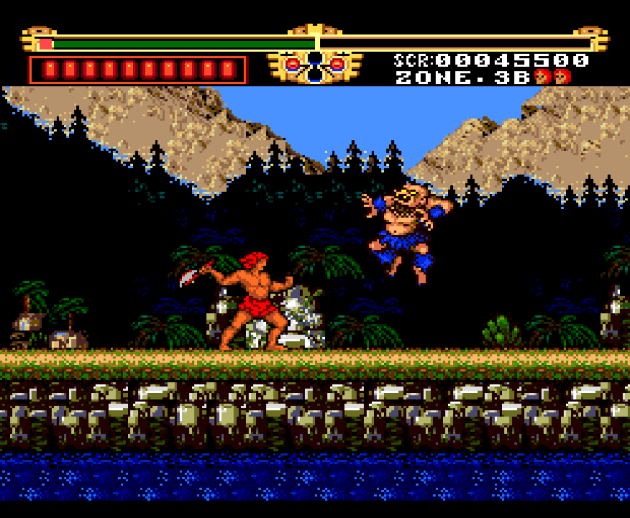
Woo hoo! More straight line level design! You know, I think a jump is going to happen soon. Whoa, slow down, buddy. A jump? You don’t want to overwhelm people. Keep it straight and slow.
But the accolades kept coming years after the fact. Electronic Gaming Monthly named it the 80th best video game ever made in 1997. How did THAT happen? I assume that list was compiled by people who played exactly eighty video games in their lives. Seriously, you guys could only find seventy-nine better video games than this? Really? Or were you so embarrassed that you once named this TurboGrafx-16 game of the year instead of Alien Crush that you just went along with naming it a top 100 game ever as some kind of weird sunk cost fallacy? I found the list and, besides sports games like MLB 98 (hell, even I named NBA 2K1 on the Dreamcast to my original top 10 all-time list in 2012), I cannot stress enough how much Legendary Axe sticks out like a sore thumb among other games on it. This ahead of Bonk’s Adventure? Are you kidding me? Ms. Pac-Man? Oh come on!

As far as I could tell, this is the only thing in the game that feels like a kind of 1989ish level of gaming evolution. It’s a key that opens up a handful of extra health refills and an attack meter increase. It’s like they knew they had to do more than the straight line, but that was too hard so, after programming this, they said “alright, now it’s a ‘real’ game. Back to the straight lines!”
It’s not that Legendary Axe is bad. I mean, it is, but mostly because it’s boring by design and the object of game development is to create a means of escaping boredom, not causing more of it. At best, it’s a run-of-the-mill flat arcade-like combative game. But even those types of games normally had evolved well past gameplay this rudimentary by 1989. This feels like an NES game from two or three years earlier, only with SLIGHTLY updated 8-bit visuals. I just reviewed Cadash in Taito Milestones 3: The Definitive Review. That was another 1989 release that feels like THIS specific genre. That arcade platforming/hack ’em up genre, only that was so much more ambitious than this. Legendary Axe is so BASIC that it’s a nothingburger of a game. This should not have felt like a big deal even in 1989. So what gives?

The final level of the game? Straight lines, but fashioned like a maze. I genuinely can’t believe anyone of any era would give it any award except “most generic” and “most walking in a straight line” and “most time spent waiting around for your weapon to charge-up.” I checked. There aren’t awards for those things except “most generic” only it’s instead called “The Golden Globe for Best Motion Picture – Musical or Comedy” and it’s reserved for movies.
In Legendary Axe, you mostly walk in straight lines and swing your axe at enemies. Occasionally you have to jump over a pit or swing on a vine, but the overwhelming majority of the game is walking in a straight line and fighting spongy enemies with very basic attack patterns. When a game plays out like that, the combat better be phenomenal. Legendary Axe’s is not. Actually, it’s pretty dull in design logic and amateurish in execution. From an execution point of view, collision detection is terrible. Your own box seems to grow by quite a lot when you swing your weapon. Since it’s literally the only form of attack, with no sub-weapons or items helping you, you’ll spend a lot of time getting smacked by enemies who didn’t even come close to having their sprites hit your sprite. Maybe they have REALLY bad breath or something?

This brief section in the third stage is the game’s platforming at its most complicated. Sometimes you have to jump to a higher series of platforms, but that’s fairly rare. There’s no moving platforms and, at most, you have to time a jump after a fireball or enemies has flown up from the pit you’re crossing. There’s just no imagination at all in Legendary Axe outside the final boss. It’s a remarkably uninspired game. Sadly, some decent jumping physics go to waste.
From a logical point of view, Legendary Axe is a game that forces players to spend a lot of time waiting around. The gimmick is your axe has a meter that empties every time you swing it, and a full-powered swing takes a while to charge up. Just mashing the attack button does hardly any damage at all, and so you’re highly incentivized to wait for the axe to charge-up at least half-way. As you go along, enemies become spongier and spongier, but you’ll eventually be able to locate four upgrades to the meter’s size. These give you more powerful attacks, but with them comes a meter that takes a LOT longer to fill up.
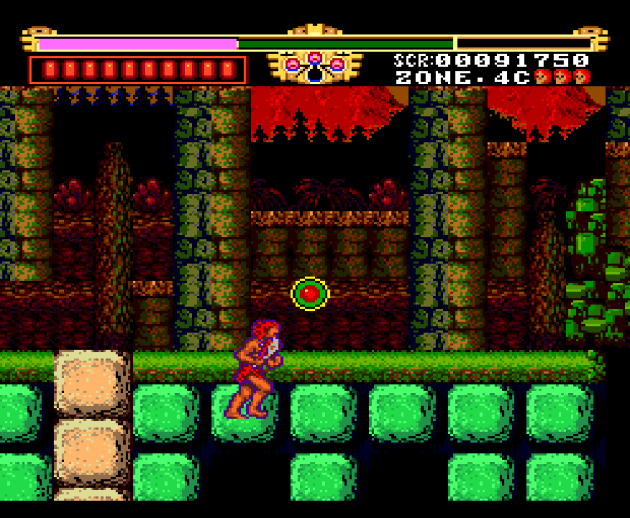
“We need to do something besides straight lines and rudimentary platforming.” “I GOT IT! False floors! Everyone loves those!” At least these ones are easy to spot once you know what to look for, I guess.
By time you have all four upgrades, which you ABSOLUTELY NEED if you don’t want most enemies to shrug off your attacks and immediately counter-attack you until you’re out of life, you have to wait a couple seconds for the meter to charge up. You can’t swing upward, and when you’re ducking, your attack becomes a horizontal slice instead of the normal vertical one. Your axe also only does the full damage on the first thing it touches, so if an enemy shoots projectiles right before you land your hit, you waste your charge shot on it. For many of those types of enemies, I honestly couldn’t figure out a way to avoid taking damage. I’m pretty sure a couple of them are life slaps because they spam their projectiles in uneven patterns. This combines with collision issues and enemies that typically counter-attack. You don’t exactly have a lot of range, so all combat is close-quarters. It gets old really fast.

Like these chicks here who look kind of like Marge Simpson when she lets her hair down. They continuously throw three balls and immediately throw again as soon as you land a hit on them. One time I thought I’d avoided the balls and successfully slayed her only to then have a ball spawn mid-air after she was dead and ping some of my health.
Maybe their hearts were in the right place with the meter, but logically, the combat of Legendary Axe is completely reduced to needing to back up, wait for the meter to fill up all the way (which takes quite a while even after getting items to boost the speed) then make your move and hope the thing doesn’t fire a projectile to essentially block the attack you waited several seconds for. You HAVE to do it this way. If you try playing by any other means, you will die from the counter-attacks slowly pinging you to death. To show you what that’s like, watch this clip. In it, I fight a room full of enemies the only way that makes sense if you want to win. THEN I rewind the room and fight the final guy over again, only this time I don’t wait for my meter to fill up.
Mind you, that’s after picking up the items that increase the speed of the meter filling. 1989’s Game of the Year, everyone. I don’t get it. It’s such a basic, unexciting, repetitive nightmare. None of the drawbacks are done in a way that it could be considered a balanced risk/reward equation. A lot of enemies take so many shots that it’s no longer satisfying when it finally dies. You’re just happy it’s over with. And it keeps getting worse from there. A lot of the time, when a game’s collision is bad, it works both ways and you can cheese enemies the same way they do with you. That’s not the case with Legendary Axe. YOUR box is huge, but not the enemies or bosses. Also enemies and bosses seem to have more invincibility frames than you do. So while you can’t let this boss’ fireballs anywhere near you, your axe better be well onto its sprite, and you better not have just hit the thing. I’m not scoring a hit in either of these two pictures.


So, why the hell did Legendary Axe really win all those awards? Was gaming media of 1989 really that f*cking shallow that slightly better graphics overrode all gameplay merits? Because if that’s the case, I honestly think Altered Beast for the Sega Genesis, a game I didn’t like at all, was better than this. The combat was more impactful. The enemies are more imaginative. The bosses are more memorable. And the graphics, true 16-bit graphics and not just a rewarmed NES with a couple extra features, are far superior to the graphics of Legendary Axe. Altered Beast is a better game in every way a game can be better, and it came out exactly two weeks before Legendary Axe did in North America. Look at each game’s first bosses. Legendary Axe’s accolades couldn’t be just because “wow, look at the pretty graphics!”


I don’t even think this looks that good. It only looks good in comparison to the limits of NES games. How about one final comparison? On the left this time is Legendary Axe. On the right is what is essentially the NES version of Legendary Axe. A game called Astyanax that has a similar “wait for the meter to fill up” axe-based combat in a rudimentary platformer. Look, you even fight green eyeball monsters that float just above your axe’s reach in both games! Peachy.


But, nobody named Astyanax game of the year or one of the 100 best games of all time. I guess it really was about a slight audio/visual upgrade. I’ll never understand it. There’s just nothing to Legendary Axe. It features a limited variety of enemies. The level design and stages all feel samey. There’s no exciting set-pieces. The most complex thing in the game are vines you swing across or the occasional ladder that gets you out of a pit. I find it hard to believe that people awarded THIS piece of garbage Game of the Year in 1989, and I really can’t believe it would make a top 100 games of all time list in 1997. Is it REALLY just because of the last boss? Oh God, it is, isn’t it?

I guess this is technically the best part of the game because it’s actually a little fun to play, I think. Anything is better compared to what came before it.
I mean, it’s a cool looking boss and it plays a lot better than the rest of the game. But it’s not that hard. I beat it on my second attempt and probably would have won on the first if I had full life. The boss I fought right before the finale put up a bigger fight, mostly because against it, only one in three direct shots actually counted as hits. For the final boss, you can even strike it in the foot and get credit for a hit every time. I find that when a game responds to my actions, I usually have more fun than I do when it doesn’t, you know? It’s like they put everything into this one encounter. Even with a sweet final boss, Legendary Axe is basic even by the standards of 1989. I don’t think this is a game that sucks now because it aged badly. I cannot believe anyone could ever shower this clunky, unimaginative Conan wannabe with praise.
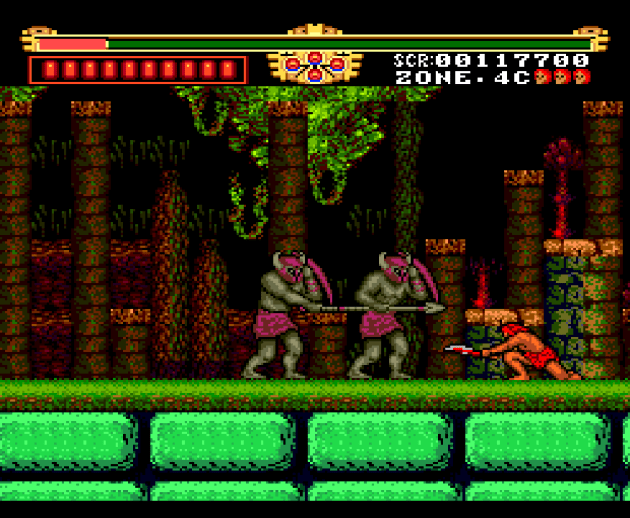
This is a boss fight. Legendary Axe does that thing where a boss of a stage becomes a basic enemy afterward.
Shame on me for assuming that Keith Courage was a lesser game before even playing Legendary Axe. At this point, I’m starting to understand how the TurboGrafx-16 failed in the United States. If Legendary Axe really was the killer app of the platform, that doesn’t bode well for it. Of course, the real killer app was Bonk’s Adventure, and Legendary Axe just further proves to me NEC made a big mistake not throwing every resource in their vast company towards making sure it was ready by the US launch. But, if given a choice between the pack-in game they chose or their big critically acclaimed game Legendary Axe? I’d much rather have Keith Courage. Like, by a big margin. And now I know why the curators of the TG16/PCE Minis didn’t lift a finger to secure this dumpster fire.
Verdict: NO!
By the way, the creator of Bonk worked on this game too. I stand by venom.
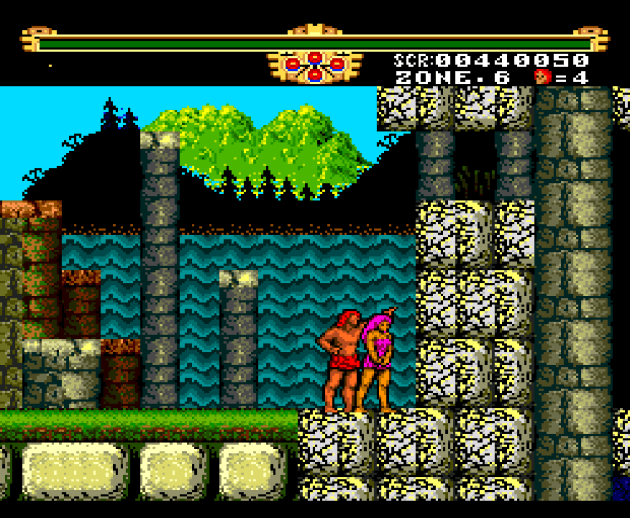
It’s a rock. I can’t wait to tell my friends. They don’t have a rock this big. Actually he looks like he’s chewing her out for getting kidnapped, doesn’t it?

 Indie Gamer Chick
Pingback: Keith Courage in Alpha Zones (TurboGrafx-16 Review) | Indie Gamer Chick
The soundtrack rules on this game though!
I didn’t have a TG-16 during its time, but I would read any video game magazine I could get my hands on, and Electronic Gaming Monthly’s obsession with this game is a distinct memory. I don’t remember the game being “a thing” outside of EGM though, which does indeed beg the question – “what was that all about, anyway?”
I did later get a TG-16 console from a flea market and bought a handful of games, but never did buy Legendary Axe…
EGM named it “TurboGrafx-16 Game of the Year” for 1989. Not exactly a lot of competition. NEC bungled the launch badly. They also named the final boss a tie with the final boss of Ghouls & Ghosts on the Genesis “best boss fight” or something like that. Apparently the magazine that named it “game of the year” was VideoGames & Computer Entertainment, which I had never heard of, which became a magazine called “VideoGames” that folded in 1996 before I was really playing video games. I didn’t really start getting game magazines until right before my parents got me the N64 for my 9th birthday. We had PlayStation magazine. By the end of 1999, I had subscriptions to every single gaming magazine on the planet. Between them and sports magazines, I think I got a magazine close to every day 😛