Mickey no Tokyo Disneyland Daibouken (Super Famicom Review)
February 3, 2025 1 Comment
 Mickey no Tokyo Disneyland Daibouken
Platform: Super Famicom
Released December 16, 1994
Directed by Hirori Miyashita
Developed by Graphic Research
Published by Tomy
Never Released Outside of Japan
NEVER BEEN RE-RELEASED

This was pretty much the last time I was excited about the game’s primary mechanic. About, oh, a minute or two into the game.
I think my biggest gaming pet peeve is games where the entire challenge is based around difficult controls. Well, that’s this game, which is translated to “Mickey’s Tokyo Disneyland Great Adventure.” Because market research told them “Potentially Fun Adventure Ruined by Awful Gameplay and Clunky Controls” wouldn’t sell as well. I’m so disappointed because this is basically what I wanted from Adventures in the Magic Kingdom: a full-scale platformer built around famous Disney Park attractions. There’s six rides in total: Pirates of the Caribbean, Big Thunder Mountain Railroad, Splash Mountain (which now ONLY exists in Tokyo Disneyland, as it was re-themed as Tiana’s Bayou Adventure elsewhere), The Haunted Mansion, Space Mountain, and Cinderella Castle. If that last one is confusing because that’s not EXACTLY a ride, well, it sort of was at Tokyo Disneyland. From 1986 to 2006, the Tokyo version of the castle had the “Cinderella Castle Mystery Tour” which was one of the first Disney ANYTHING that celebrated Disney Villains, the centerpiece of which was The Horned King from The Black Cauldron. In the United States, Black Cauldron bombed badly, but it must have been a big, big hit in Japan because he keeps showing up in these games. He was the last boss in Land of Illusion, in Mickey Mouse III aka Kid Klown, and in Mickey Mouse for Game Boy aka Bugs Bunny Crazy Castle. And, the Horned King is in fact, the final boss of this game as well.

Technically it’s Pete dressed as the Horned King since cosplaying Pete is the boss for every world. But, he even has the Black Cauldron and can raise an army of skeletons, or generic dog bad guys dressed as skeletons.
The thought of a Japanese exclusive Mickey Mouse/Disney Parks game had me excited, until I realized this wouldn’t exactly be the sequel to Adventure in the Magical Kingdom I hoped for. Instead, it’s basically a spiritual sequel to Mickey Mouse III, the third Crazy Castle game that had Mickey dropped from the US release and was renamed Kid Klown in Night Mayor World. Like that game, Tokyo Mickey is all about balloons. You have two different types: one that you fill with water (don’t ask where the water comes from) and another you fill with gas (REALLY don’t ask). The water balloons are used for combat as basic projectiles, but they can also be placed on the ground to act as trampolines or to weigh-down switches. When they’re placed on the ground, they don’t last very long, which leads to one of the most frustrating aspects of the game. At one point in the Haunted Mansion stage, one of the challenges involves two switches and a locked door. Without exaggeration, it took me ten minutes to successfully place a water balloon on each switch and get through the door. This was so frustrating that I almost quit. “Well, thank God that’s over and I never have to do it again!” I thought, but, the next world did the same exact two switch gimmick. That’s the Tokyo Mickey experience in a nutshell. It’s so exhausting.

The balloons disappear REALLY fast, but it takes time to actually inflate the next one.
The controls are somehow both stiff and sensitive. They literally measured out the exact distance from the two switches so that you would JUST BARELY get through the door if you were absolutely perfect with your movement. It was counting on playing screwing up the timing because of the sluggishness of transitioning from ducking to moving. This is one of those games where you have to tap forward to initiate running, but if you’re ducking, it doesn’t register. And that’s really the heart of Tokyo Mickey’s problem: they created cumbersome, clumsy play control and movement physics that they then tailored the game around. Now, they didn’t half-ass the level design. There’s some solid set-pieces and the level layout rises to the level of “clever” more than once. But, it’s all based around how tough the controls are, and for whatever reason, I’m unable to become immersed whenever I spend a large part of a game fighting the controls. I can’t stress enough, it’s my #1 gaming pet peeve.

This boss you have to kill by placing the water balloons on the ground so that he brains himself on the spikes above. I wasn’t sure if the ride was Splash Mountain or Mr. Toad’s Wild Ride at this point. Either way, this is also based around how difficult it is to transition from placing a balloon on the ground to moving, since you have to time it so the frog lands on the balloon BUT leave yourself enough time and space to dodge out of the way. With these controls, it’s more frustrating than fun.
That brings me to the second balloon, the “gas balloon” which can be used to slowly float you upward OR can launch you like a projectile. My #2 gaming pet peeve, and this one is more genre specific: leap of faith platforming. I hate blind jumps. They always take me out of a platform game. Unless there’s some methodology that allows a player to logic-out where the landing zone will be, they always feel like they turn the experience into nothing more than a fancy version of a shell game. By the very nature of how the gas balloon launches you, Tokyo Mickey has a large risk of blind jumps. BUT, here’s where I admire the effort, because they mostly did a good job of creating either the sense of intuitive logic as to where you want to land, or they just built a ceiling to catch and deposit you where you’re supposed to land. As annoyed as I was with the unresponsive movement, they actually did custom build the game around it. It doesn’t exactly complicate my final verdict, though. Actually, it makes me annoyed, because clearly the development team had talent and there’s nothing cynical about the design.

In fact, most of the blind jumps are self-inflicted. If you want to throw yourself around the level with reckless abandon CATHY, it’s not their fault.
With that said, the second half of the game has an overemphasis on the balloon launching gimmick, including one segment where you have to continuously fling yourself up a tall vertical shaft and then refill another balloon while you’re falling, fling yourself again, and so forth, making incremental progress. A single screen of this would have been challenging enough, but this concept goes for well over a minute. There’s TONS of precision timing moments too. A common example is having to start filling a balloon, then walking off a platform so that the balloon will fill-up at the right moment. If you time it right, the balloon will catch you, and then you can launch yourself forward through a narrow gap in the wall. It’s not the worst idea, and they actually did put effort into creating a sense of gravity and momentum. But, Tokyo Disney has far too many “fall off a platform and have the balloon catch you at the last second” bits, and that’s a problem because even after a couple hours of trial and error, I still never got to the point where the gas balloons felt intuitive in any fashion, timing or trajectory. That’s what happens when you bet the farm on seemingly deliberately awkward controls.
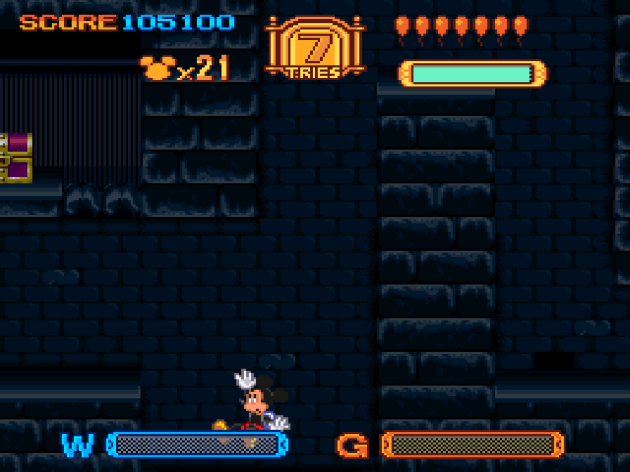
This isn’t even the part I was talking about, but the basic idea is the same.
Maybe it wouldn’t be so bad if it didn’t repeat the same gags over and over. Tokyo Mickey has good ideas in terms of level design and challenge, but it runs those ideas into the ground. Every level design flaw comes back to the play control. Having to repeat the same basic types of jump designs wouldn’t feel like such a padded-out slog if it was actually fun to make those jumps. If the game had smooth play control, it might have an almost parkour-like vibe to it similar to something like Super Meat Boy. But, because the basic movement is so slow and unresponsive and the controls are so clunky, there’s just no excitement to what should be absolutely thrilling level design.
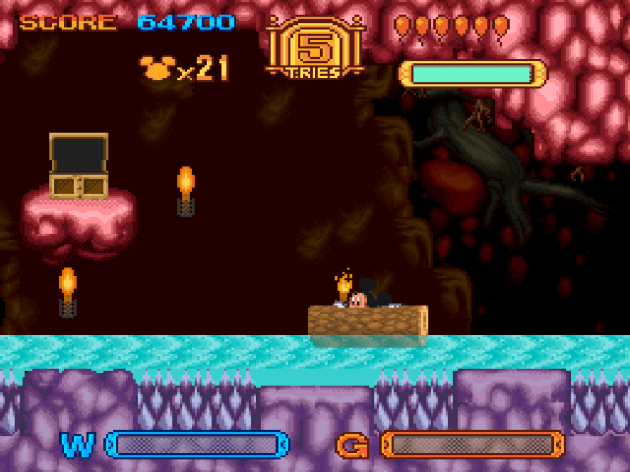
They really seemed to deliberately aim for “counter-intuitiveness.” Take this segment during Splash Mountain. See those torches? They’re lethal to the touch, and when you duck, Mickey’s sprite still sticks out and touches the torches. Logically, it’s a hit, right? Nope. The ducking overrides it, even though you’re no-doubt-about-it touching the thing that kills you from standing up. Just paint the torches higher in the background, guys! Tokyo Mickey feels like a game that is trying to throw players’ instincts off balance, by any underhanded means necessary.
Plus, the combat between the jumps is so boring. The water balloons make for an unsatisfactory projectile, and there’s no supplementary weapons to break up the monotony. This becomes especially problematic during boss battles. Pete is the final boss in every stage, and sometimes he’s invincible to your attacks and sometimes he isn’t, but there’s no “shield” animation for when the attack won’t work. The balloon just doesn’t do anything. When you score a hit, he does a brief look of annoyance but then carries on like nothing happened. It’s so badly done.

The “mini-boss” before the finale is the dragon from Sleeping Beauty. I think. I mean, that dragon was pitch-black and this one is copper-brown, and that looks more like green slime than green fire. But, this boss has the same problem as any Pete battle: there’s no OOMPH. Also, the dragon has to lower its head all the way to the ground for about one second worth of vulnerability, but because it has a random attack cycle, you could end up waiting quite a while just to get a single hit in, let alone win the fight.
When I said this is a spiritual sequel to Mickey Mouse III for the Famicom, I wasn’t kidding. Much like that game, there’s SOMETHING here that’s compelling enough that I wanted to see Tokyo Mickey through to the end. It even does the occasional wink to the rides themselves to remind you that you’re playing a theme-park based game. I particularly enjoyed the design of the Space Mountain segment that involved switching to different cars on different tracks. A lot of games have done that trope, but they designed this one like a maze. I’ve never seen that before, so there was SOME genuine inspiration at work here.
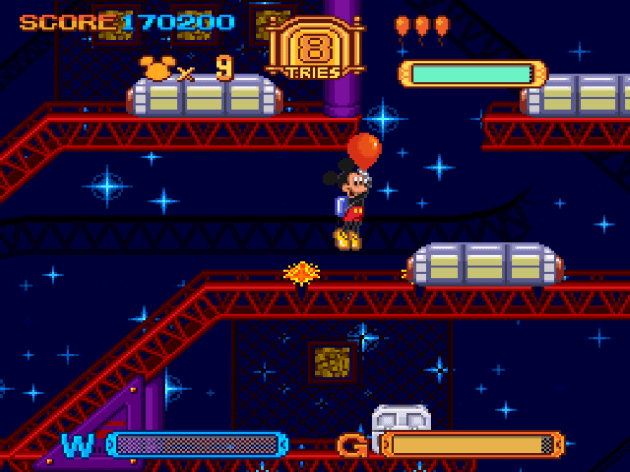
I mean, it doesn’t feel remotely like Space Mountain, which is a roller coaster set in the dark, but at least it’s trying.
I think if this had controlled as well as, say, the Capcom version of Aladdin, this might have gone down as one of the best Mickey Mouse games ever made. Okay, so the combat is pathetic, but this is a PLATFORM game, and the exploration and jumping, for all the flaws with Tokyo Mickey, can still manage to generate excitement. Flinging yourself across a gap and sticking the landing on a platform is going to be satisfying every time. But too much of the challenge is based around “we made terrible controls and movement physics, deal with it!” Like a race against a ghost in the Haunted Mansion where you have to zig-zag up a shaft while hitting switches to reveal staircases. This could have been intense and exciting, but when you’re shorting jumps or getting stuck on stairs thanks to how sluggish the act of turning around and moving again is, it just becomes annoying. It makes it feel like it’s not YOUR fault you’re losing. I don’t think the designers seem to grasp that video games need to play well enough that a player knows it’s their fault they failed.

I had to reload this f’n thing so many times before I BARELY won.
We’ll never know what Mickey no Tokyo Disneyland Daibouken could have been if it played better. I’d played it before and didn’t finish it, so I kind of knew going into it that it wouldn’t be my favorite Mickey game. Japanese exclusives don’t really get a ton of clicks at Indie Gamer Chick, but I still love playing them because of that whole “forbidden fruit” quality they have. Tokyo Mickey never lost that aspect, even though it’s not a good game. It’s bonkers that it even exists given that Mickey Mania released fifty-one days before this. Granted, Mania’s Japanese release didn’t happen until three months after Tokyo Mickey, but still, this little unsung Mickey adventure in a theme park was set to go head-to-head with a heavily publicized Mickey Mouse game that was developed as a technical showpiece. Christ, can you imagine the pressure developers Graphic Research had?

There’s a few times where I could swear they wanted to be Castle of Illusion so bad they could taste it. Part of me wonders why they didn’t just make a basic platform game that strives to be a Nintendo version of the Illusion games? People really like those games. Castle of Illusion for the Genesis and Sega Master System and Land of Illusion on Game Gear/SMS especially.
So, in a sense, I admire that they seemed to set out to make something that felt completely different from the Magical Quest games and what Mickey Mania would be. But, Mickey Mouse is a children’s property, and I don’t think little kids will enjoy a game with controls this rough. If grown-ups don’t, why would children? I played this on normal difficulty, but curiosity got the better of me and I went back and tried to adjust the difficulty to easy to see what this did to accommodate younger players. You know, the audience most likely to want a Mickey Mouse game? Well, the only thing it seemed to change was how many hit points you start each life with: eight hits instead of five. Seriously? I checked hard mode, and yep, it gives you three. If it adjusts the enemies, it wouldn’t matter, because the challenge is entirely based on controls and movement physics, and that sucks. Most of the development team behind this didn’t last in the game industry, and it’s not hard to see why. There’s nothing cynical about Tokyo Mickey, but for all their effort, I can’t imagine a game missing the point of Mickey Mouse more.
Verdict: NO!

 Indie Gamer Chick
Pingback: Super Back to the Future Part II (Super Famicom Review) | Indie Gamer Chick