What I’m Playing #22 – The Famicom Tetris Review
November 18, 2024 2 Comments

It was a 58 year old man whose best days were decades behind him against a 27 year old in the prime of his athletic life. What did people think would happen? I was born in 1989, and so by the time I was watching and remembering boxing, I had to go off my dad’s word that Mike Tyson was a generational talent. I never got to see it until years after the fact. My father is a huge boxing fan who ordered all the fights on pay-per-view, and he was HYPED for Tyson/Holyfield. As a young child, I thought Tyson seemed like much ado about nothing. I was a couple weeks away from turning 8 years old when the infamous “Bite Fight” against Evander Holyfield happened. I liked Holyfield as a kid. Him and Lennox Lewis were my favorites. I got hooked on boxing during the original Tyson/Holyfield fight, which did live up to the hype and was an exciting fight, at least for a 7 year old. The whole time my dad was saying “it’s too bad this didn’t happen in 1990!” But it didn’t, and even by 1997, almost everything about Mike Tyson that made him a boxing phenom was already gone. He was a good, but not great, tactician with a good chin, but he didn’t have the explosiveness that made him famous to begin with. I missed that stage of his career entirely. So, even as a kid, I didn’t “get” Tyson. To me, he was just another cooked boxer, like George Foreman.

I didn’t see the guy who was annihilating guys in the first round. I didn’t see the guy who won his first 37 matches. There’s a reason why the Buster Douglas loss was so shocking. It was unfathomable a guy on his level would lose to a guy on Douglas’ level. It’s not one of those situations where people look back on and say “well, it was inevitable.” It feels like if you replayed reality 100,000 times, we live in the one and only reality where Douglas actually won. If you need proof that it didn’t feel inevitable, just remember that Tyson himself beat a guy who was 21 – 0 to become Undisputed World Heavyweight Champion, and that, by all accounts, had an inevitability about it. Not Tyson, though. He was legit, and so amazing as a boxer that I don’t think the sport ever recovered from him. Tyson was one of those athletes who, when it was over, it was REALLY over. He had matches that ended on stoppages after committing fouls. He was disqualified after the fact against Andrew Golta for failing a drug test. No, not steroids. Weed. Which is only a performance enhancing drug if the winner gets a bowl full of cookie dough. A month before I turned 16, Tyson had his final bout against a guy named Kevin McBride. McBride was seemingly chosen because he was exactly the type of journeyman Tyson had plowed through in the twenty or so fights he had before he became the world heavyweight champion. It’s the type of match an aging boxer takes as a confidence booster, except that’s not what happened. McBride completely tuned Tyson, who didn’t just quit the match in the sixth round, but retired from boxing altogether. In the 19 years that followed, apparently people forgot that, in his final professional match, Tyson was literally beaten into an on-the-spot retirement by a nobody.

Anyone who was excited to see Mike Tyson fight nearly twenty years after he retired apparently forgot that everything after 1997 from Mike Tyson was just kind of sad. I know, because that was the only version of Mike Tyson I ever got to see. Having now found and watched his old fights, I get it now. There has never been a combination of speed and power like Mike Tyson. As a fighter, he was a one-off. Most people don’t know this, but there’s a reason why in Mike’s Tyson’s Punch-Out!!, for the first minute and a half of the Tyson match, one punch knocks you down. Because Tyson legitimately did knock down fighters with one punch in multiple bouts in 1985 and 1986. He even won a few of those matches with one punch! Imagine paying good money to see a match that lasted one round, and everyone walks away happy. That would never happen now, but that was Tyson early in his career. Why would people be happy to see a one round fight? Because everyone left with the impression that they had seen a type of fighter they would never see again, and they were right. Being cooked with no “post-prime” isn’t exclusive to boxing. Some of my favorite basketball players were that way. Steve Nash, Allen Iverson, Boogie Cousins, Dwight Howard, (some might disagree with me on that one) and most recently Derrick Rose, when it was over, it WAS OVER. They might have still been technically playing, but what stuck around was a shell that made you wish they’d turn back the clock for one vintage performance that would never come. Sports are cruel like that. In a way, I’m happy Netflix didn’t cooperate on Friday. If a vintage Tyson performance never happened when I was 8, why would I expect it at 35?
So, what AM I playing? Like you even need to ask. Here’s a preview of the upcoming Tetris Forever review: the full review of the Famicom version of Tetris. This is directly from the feature.
 Tetris
aka “Famicom Tetris”
Platform: Famicom
Released December 22, 1988
Programmed by Bob Rutherford
Developed by Bullet-Proof Software
Never Released Outside of Japan
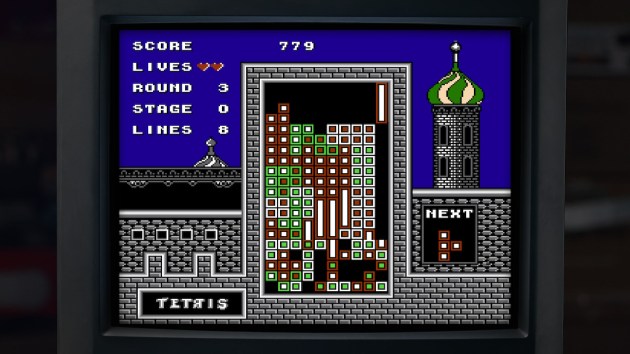
Dynamic scoring! WOOO! And.. lives? What the f*ck?
The first ever console version of Tetris is also one of the weirdest builds of Tetris I’ve ever played. First thing’s first: I love how Digital Eclipse felt compelled to put a warning that the controls are so stupid that players will want to change them. It doesn’t say it like that, but it’s not wrong. In this Tetris, pressing DOWN rotates the blocks, while the buttons do hard drops. I assume they did it this way because people hit DOWN accidentally. I sure have, but I’d prefer doing that sometimes to how the controls are set up. It’s worse because the only remapping is via the emulator itself, and while it is an option, remember that changing what button is the hard drop means that new button, presumably DOWN, is now “enter” for the menus, and now you can only scroll one way when you enter your name. So awkward, but the weirdness of Famicom Tetris is just getting started.
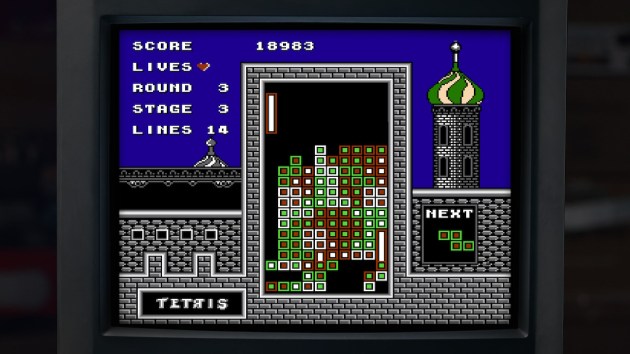
Dad called this “Christmas Tetris” because of the color scheme.
So yes, dynamic scoring is here and players FINALLY have some measure of risk/reward to deal with instead of just stacking for efficiency. But, there’s a catch: this Tetris is played in 25 line intervals. There’s no uninterrupted marathon mode, and also I might have a concussion for banging my head on the desk. It’s honestly incredible how many versions of this game needed to happen before the Tetris we all love emerged. I’m six games into this feature, five of which are Tetris games, and I’ve still not reached a Tetris that feels like my Tetris. And the weirdness keeps coming in the form of lives. You get to fail three times, and when you die, you still get all the points you earned for this 25-line interval, but then you restart with a new 25 line target. You also don’t get to know how well you’re doing until the breaks, as the score isn’t tallied until you die or reach 25 lines. It’s like Game Boy Tetris’ B-Mode as a solo game.
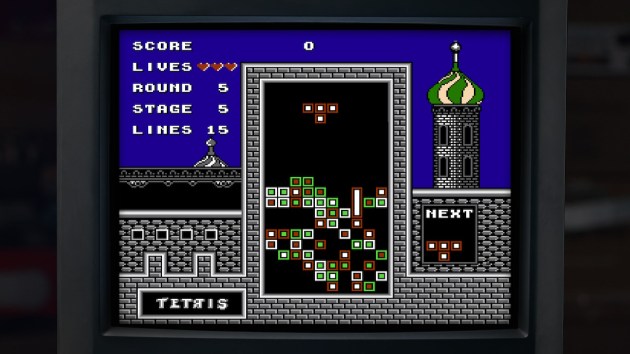
My motto of “find the fun” took a little longer with Famicom Tetris. The 25 line or bust gameplay engine put up a fight. But then I realized, screw it, embrace it by jacking up the handicap to the max. And lo, the fun was found.
Not strange enough for you? If you play with handicap and clear 25 lines, whatever progress you’ve made is retained for the next 25 line batch. But if you die, you start from scratch with a fresh pile of garbage blocks on the playfield. I don’t recommend playing on level 0, as it’s just not fun. Even if you use handicap, start on at least level 5 for speed. This is one of the rare Tetris games where the garbage blocks are the best part of the game. Without a marathon and a much slower sense of progression, challenging tall stacks of garbage is the best thing Famicom Tetris has going for it. What stood out to me the most about Famicom Tetris is how everyone involved still had no idea what they had with Tetris. I appreciate that they realized what they were doing, and what Spectrum Holobyte had done, was certainly not maximizing its potential. This was a big step, and while they had a ways to go, I did manage to “find the fun” by treating this as a hybrid of a logic puzzler and Tetris. BUT, if you just hate the Game Boy Tetris’ B-Mode, feel free to imagine this verdict flipped.
Verdict: YES! – $2 in Value added to Tetris Forever

 Indie Gamer Chick
Hi Cathy! I need advice. I love writing about games, but because I have pretty severe inattentive ADHD, my task initation skills are basically non-existent. How do you do it? How do you get up and write so consistently? I regret every day not writing, and yet the next day comes around and nothing has changed. My blog (invisiblestudio.blogspot) has been dormant forever, but I’d like that to change. Thanks for your time.
Hi there! Actually, I struggle with it too. I don’t have ADHD but I have issues with depression that can suck the will to write out of me on any given day.
My first advice is to write the type of reviews or articles you would like to read yourself.
Second, and this is probably the most important: find ways to keep it interesting for you. I do that by constantly asking questions of myself. We all know instinctively what we do or don’t like. Expressing that is easy. But I find that asking myself a lot of questions until I reach a point where I can’t go any deeper. The stuff might not make it into the review, but it makes for a better review process because all the little idiosyncrasies that make games stand out or fail are usually in the tiny details and not the big picture. I don’t like sluggish play control. Who does? BUT, that can’t be a deal breaker obviously, because I’ve given games with poor control a YES! and I’ve given games with flawless control a NO! Same with set pieces or level design or any other aspect of the game. If I like something, I always ask myself “why is that?” and sometimes it reveals to me what makes or breaks a game. It’s how I figured out the chase aspect matters more than the collecting or turning the tables in maze chases. It wasn’t one game, but a process through many games that I figured it out. I don’t know if I would have if I hadn’t followed path of asking myself why certain things work or don’t work for me. And you know what? It makes the entire process fun FOR ME, because I learn things about my own tastes in games I never realized.
And the final piece of advice is don’t try to be a “professional writer” and just have fun. This is our hobbies, not our careers. I wouldn’t want to do this professionally because sometimes I might go a while without wanting to write. I want to reserve the right to do that.
Have fun, Gryphomane!